4

                                POWER SYSTEM STABILIZERS


Power system stabilizer (PSS) controller design, methods of combining the PSS with the
excitation controller (AVR), investigation of many different input signals and the vast field of
tuning methodologies are all part of the PSS topic. This thesis is an investigation into modifying
the input of a specific type of PSS as applied to a power system, and is not intended to serve as an
exhaustive review of the domain of PSS application and design. The references related to this
topic, [18-29], provide a survey of the state-of-the-art of this topic. This chapter will focus on
providing a review of a few of the technologies and approaches, with the goal of making the case
for using this type of controller to solve the low frequency inter-area oscillation problem. Details
such as the type of PSS structure selected, tuning methods for controllers with and without the
use of SPMs, and input signals considered are given in Chapter 6.
4.1    Control Action and Controller Design

The action of a PSS is to extend the angular stability limits of a power system by providing
supplemental damping to the oscillation of synchronous machine rotors through the generator
excitation. This damping is provided by a electric torque applied to the rotor that is in phase with
the speed variation. Once the oscillations are damped, the thermal limit of the tie-lines in the
system may then be approached. This supplementary control is very beneficial during line outages
and large power transfers [23,24]. However, power system instabilities can arise in certain
circumstances due to negative damping effects of the PSS on the rotor. The reason for this is that
PSSs are tuned around a steady-state operating point; their damping effect is only valid for small
excursions around this operating point. During severe disturbances, a PSS may actually cause the
generator under its control to lose synchronism in an attempt to control its excitation field [24].


            Input     1 + sT1            1 + sT3             sK STW      VPSS
                      1 + sT2            1 + sT4             1 + sTW


                      Figure 4.1: Lead-Lag Power System Stabilizer [23]


                                                   21
A “lead-lag” PSS structure is shown in Figure 4.1. The output signal of any PSS is a voltage
signal, noted here as VPSS(s), and added as an input signal to the AVR/exciter. For the structure
shown in Figure 4.1, this is given by
                     sK S TW (1 + sT1 ) (1 + sT3 )
        VPSS(s) =                                    Input(s )         (4.1)
                    (1 + sTW ) (1 + sT2 ) (1 + sT4 )

This particular controller structure contains a washout block, sTW/(1+sTW), used to reduce the
over-response of the damping during severe events. Since the PSS must produce a component of
electrical torque in phase with the speed deviation, phase lead blocks circuits are used to
compensate for the lag (hence, “lead-lag’) between the PSS output and the control action, the
electrical torque. The number of lead-lag blocks needed depends on the particular system and the
tuning of the PSS. The PSS gain KS is an important factor as the damping provided by the PSS
increases in proportion to an increase in the gain up to a certain critical gain value, after which the
damping begins to decrease. All of the variables of the PSS must be determined for each type of
generator separately because of the dependence on the machine parameters. The power system
dynamics also influence the PSS values. The determination of these values is performed by many
different types of tuning methodologies, as will be shown in Section 4.3.

Other controller designs do exist, such as the “desensitized 4-loop” integrated AVR/PSS
controller used by Electricité de France [26] and a recently investigated proportional-integral-
derivative (PID) PSS design [27]. Differences in these two designs lie in their respective tuning
approaches for the AVR/PSS ensemble; however, the performance of both structures is similar to
those using the lead-lag structure.
4.2    Input Signals

The input signal for the PSSs in the system is also a point of debate. The signals that have been
identified as valuable include deviations in the rotor speed (∆ω = ωmach - ωo), the frequency (∆f),
the electrical power (∆Pe) and the accelerating power (∆Pa). Since the main action of the PSS is
to control the rotor oscillations, the input signal of rotor speed has been the most frequently
advocated in the literature [1,11]. Controllers based on speed deviation would ideally use a
differential-type of regulation and a high gain. Since this is impractical in reality, the previously
mentioned lead-lag structure is commonly used. However, one of the limitations of the speed-
input PSS is that it may excite torsional oscillatory modes [11,23].

A power/speed (∆Pe-ω, or delta-P-omega) PSS design was proposed as a solution to the torsional
interaction problem suffered by the speed-input PSS [25]. The power signal used is the generator
electrical power, which has high torsional attenuation. Due to this, the gain of the PSS may be
increased without the resultant loss of stability, which leads to greater oscillation damping [11].

A frequency-input controller has been investigated as well. However, it has been found that
frequency is highly sensitive to the strength of the transmission system - that is, more sensitive
when the system is weaker - which may offset the controller action on the electrical torque of the


                                                             22
machine [23]. Other limitations include the presence of sudden phase shifts following rapid
transients and large signal noise induced by industrial loads [11]. On the other hand, the
frequency signal is more sensitive to inter-area oscillations than the speed signal, and may
contribute to better oscillation attenuation [23-25].

The use of a power signal as input, either the electrical power (∆Pe) or the accelerating power
(∆Pa = Pmech - Pelec), has also been considered due to its low level of torsional interaction. The
∆Pa signal is one of the two involved in the “4-loop” AVR/PSS controller from [26], even though
the tuning method related to this design approach is valid for other input signals.
4.3    Control and Tuning

The conflicting requirements of local and inter-area mode damping and stability under both small-
signal and transient conditions have led to many different approaches for the control and tuning of
PSSs. Methods investigated for the control and tuning include state-space/frequency domain
techniques [19,20], residue compensation [22], phase compensation/root locus of a lead-lag
controller [23-25], desensitization of a robust controller [26], pole-placement for a PID-type
controller [27], sparsity techniques for a lead-lag controller [28] and a strict linearization
technique for a linear quadratic controller [29]. The diversity of the approaches can be accounted
for by the difficulty of satisfying the conflicting design goals, and each method having its own
advantages and disadvantages. This is the crux of the problem of low frequency oscillation
damping by the application of power system stabilizers.

This thesis is not intended to provide a qualitative analysis of each of these techniques; rather, the
improvement of the oscillation damping and resulting stability improvement of an existing PSS
design through the use of synchronized phasor measurements is the final goal. Through the
analysis performed here, it will be shown that the use of synchronized phasor measurements can
improve the damping of an inter-area mode beyond that of an “optimally” tuned PSS. It will also
be shown that the local and inter-area modes are effectively decoupled, without a loss of stability
of either mode.


                                                 23
5

                                     POWER SYSTEM MODELING


This chapter presents the models used for the generator, turbine and speed governor, automatic
voltage regulators and power system stabilizers followed by a detailed description of the two-
area, 4-machine test power system.
5.1    Generator Model

There are several models which have been used in modeling synchronous machines for stability
studies, some including damper windings and transient flux linkages, some neglecting them. A
two-axis model that includes one damper winding in the d-axis (direct axis) and two in the q-axis
(quadrature axis) along with the transient and sub-transient characteristics of the machine is used
in EUROSTAG [30,31,32], the software package used in part for this research. This model will
be discussed here and involves the transformation of the machine variables to a common rotor-
based reference frame through the Park’s transformation [11,30,33]. This transformation changes
a reference frame fixed with the stator to a rotating reference frame fixed with respect to the
rotor, namely the direct axis (d-axis), the quadrature axis (q-axis) and a third axis associated with
the zero sequence component current (0-axis). Eventually, the latter is dropped from the model
due the fact that the zero sequence current is equal to zero for a balanced system.

The dq-axis model includes the transient and sub-transient characteristics of the machine. The
latter are governed by
                                        &
                u d = − ra i d + ωλ q − λ d                               (5.1)

                                       &
               u q = − ra i q + ωλ d − λ q                                   (5.2)

                              &
               u f = rf i f + λ f                                            (5.3)
                            &
               0 = rD i D + λ D                                              (5.4)
                             &
               0 = rQ1i Q1 + λ Q1                                            (5.5)

                              &
               0 = rQ2 i Q2 + λ Q2                                           (5.6)


                                                 24
The common flux terms are
             λ AD = M d (i d + i f + i D )                                        (5.7)

                              (
                λ AQ = M q i q + i Q1 + i Q2   )                                  (5.8)

Once the non-state d- and q-axis variables have been eliminated, these equations will encompass
four state variables per machine. The final two state equations are provided by the rotor swing
equation in first order, ODE form:
                2Hω = TM − TE = TM − λ q i d − λ d i q
                    &                                                     (5.9)
                &
                Θ = ω oω                                                          (5.10)

These equations represent the x = f ( x, u) model of the system. The final form of these state
                                  &
equations is given after the linearization is performed in Section 5.5. The variable definitions for
(5.1) - (5.10) are summarized in Table 5.1.

             Variable          Units                          Definitions
                xd, xq           pu     d- and q-axes synchronous reactances
               x’d, x’q          pu     d- and q-axes transient reactances
              x’’d, x’’q         pu     d- and q-axes sub-transient reactances
                  Ra             pu     stator resistance
                  Xl             pu     stator leakage inductance
              T’do, T’qo        sec     d- and q-axes transient open circuit time constant
             T’’do, T’’qo       sec     d- and q-axes sub-transient open circuit time constant
                   H           pu sec   stored energy at rated speed, inertia constant
              ud, uq, uf         pu     d-axis, q-axis terminal and field winding voltages
               id, iq, if        pu     d-axis, q-axis armature and field winding currents
             iD, iQ1, iQ2        pu     d- and q-axes damper winding currents
                 lD,lf           pu     d-axis damper and field winding fluxes
               lQ1, lQ2          pu     q-axis damper winding fluxes
                 rD,rf           pu     d-axis damper and field winding resistances
               rQ1,rQ2           pu     q-axis damper winding resistances
               lAD, lAQ          pu     d- and q-axes mutual fluxes
               Md, Mq            pu     d- and q-axes mutual inductances
                  TE            Nm      electrical torque
                  TM            Nm      mechanical torque
                  Θ             rad     generator rotor angle
                   ω          rad/sec   generator rotor angle speed
                  ωo          rad/sec   rated generator rotor angle speed

                            Table 5.1: Generator Model Variable Definitions


5.2     Speed Governor Model

To provide the mechanical torque and mechanical power variables during the dynamic
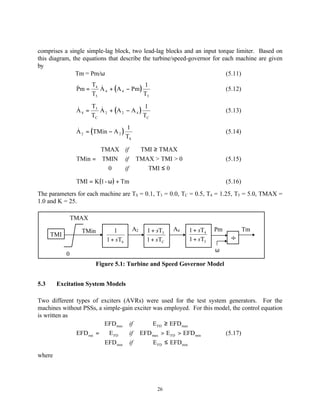
simulations, the turbine/speed governor model shown in Figure 5.1 was used [34]. The model


                                                     25
comprises a single simple-lag block, two lead-lag blocks and an input torque limiter. Based on
this diagram, the equations that describe the turbine/speed-governor for each machine are given
by
               Tm = Pm/ω                                                  (5.11)
                     T &                   1
                 Pm = 4 A 4 + ( A 4 − Pm )
                 &                                                           (5.12)
                     T5                    T5
                      T &                    1
                 A 4 = 3 A 2 + (A 2 − A 4 )
                 &                                                           (5.13)
                      TC                    TC
                                     1
                 A 2 = (TMin − A 2 )
                 &                                                           (5.14)
                                     TS

                        TMAX if            TMI ≥ TMAX
                        
                 TMin =  TMIN if          TMAX > TMI > 0                    (5.15)
                         0                   TMI ≤ 0
                              if

                 TMI = K(1- ω ) + Tm                                         (5.16)
The parameters for each machine are TS = 0.1, T3 = 0.0, TC = 0.5, T4 = 1.25, T5 = 5.0, TMAX =
1.0 and K = 25.

                TMAX

                   TMin         1         A2   1 + sT3   A4   1 + sT4   Pm            Tm
      TMI
                             1 + sTS           1 + sTC        1 + sT5          ÷
                                                                        ω
            0
                        Figure 5.1: Turbine and Speed Governor Model


5.3     Excitation System Models

Two different types of exciters (AVRs) were used for the test system generators. For the
machines without PSSs, a simple-gain exciter was employed. For this model, the control equation
is written as
                        EFD max if          E FD ≥ EFD max
                        
              EFD out =  E FD     if EFD max > E FD > EFD min         (5.17)
                         EFD                E FD ≤ EFD min
                             min  if

where


                                                   26
E FD = K(Vref − VC ) or E FD = − KVC
                                        &         &                                       (5.18)

The parameters for the simple-gain model are K = 200, EFDmax = 20 and EFDmin = -10.0. For the
machines with a PSS, the IEEE ST1-Type exciter shown in Figure 5.2 was used [30]. The
control equations are given by
               VE = Vref + VPSS - VC - VF                              (5.19)
                VF = (KF TF )VR − VFL                                                     (5.20)

                VFL = (KF TF )VR − VFL
                &                                                                         (5.21)
                &
                VFL = VF                                                                  (5.22)

                     VI max        if         VE ≥ VI max
                     
                VI =  VE           if     VI max > VE > VI min                           (5.23)
                      VI
                      min          if         VE < VI min

                &    KAVI − VR
                VR =                                                                      (5.24)
                       TA
                          EFD max        if          &
                                                     VR ≥ EFD max
                &          &                              &
                E FD    =  VR            if     EFD max > VR > EFD min                   (5.25)
                           EFD           if          &
                                                     V < EFD
                               min                      R         min


    Vref       VPSS
                                 VImax                                             EFDmax
   +            +
                            VE      VI                              KA      VR                     EFD
       Σ            Σ                                             1 + sTA
           -            -
               VF
                            VImin
                                                                                 EFDmin
                                    VFL          sKF
       Vc
                                               1 + sTF


                            Figure 5.2: ST1-Type Exciter with PSS Input [33]

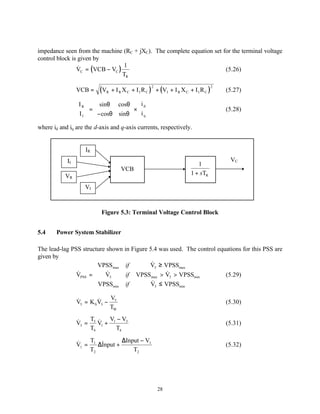
For both types of AVRs, the terminal voltage (VC), as depicted in Figure 5.3, is a function of the
d- and q-axis voltages, which, in turn, depend on the real and imaginary portions of the voltage at
the terminals (VR, VI), the current through the machine connection node (IR, II) and the


                                                             27
impedance seen from the machine (RC + jXC). The complete equation set for the terminal voltage
control block is given by
                VC = ( VCB − VC )
                 &                1
                                                                       (5.26)
                                  TR

                           (VR + I R X C + I I R C )       + (VI + I R X C + I I R C )
                                                       2                                 2
                 VCB =                                                                       (5.27)

                 I R     sinθ cosθ  i d 
                 I  =   − cosθ sinθ  × i                                               (5.28)
                  I                   q
where id and iq are the d-axis and q-axis currents, respectively.


                    IR
            II                                                                                VC
                                                                               1
                                     VCB
           VR                                                               1 + sTR

                    VI


                            Figure 5.3: Terminal Voltage Control Block


5.4    Power System Stabilizer

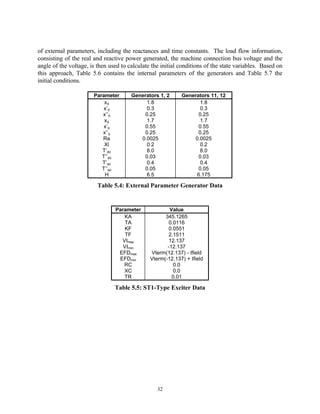
The lead-lag PSS structure shown in Figure 5.4 was used. The control equations for this PSS are
given by
                      VPSSmax if           &
                                           V5 ≥ VPSSmax
               &       &                        &
               VPSS =  V5        if VPSSmax > V5 > VPSSmin             (5.29)
                       VPSS      if        & ≤ VPSS
                                           V5
                            min                      min


                 &        &   V
                 V5 = K S V3 − 5                                                             (5.30)
                              TW

                 &   T & V − V3
                 V3 = 3 V1 + 1                                                               (5.31)
                     T4        T4
                     T           ∆Input − V1
                 V1 = 1 ∆&
                 &       Input +                                                             (5.32)
                     T2              T2


                                                           28
∆ω = ω mach − ω o
                        
               ∆Input = or                                                  (5.33)
                        ∆Pa = P
                               mech − Pelec


The parameters for the PSSs used in this thesis are given in Table 6.9, located in Section 6.3.2.

                                                                        VPSSmax
      ∆Input      1 + sT1    V1      1 + sT3    V3       sK S TW V5               VPSS
                  1 + sT2            1 + sT4             1 + sTW
                                                                  VPSSmin


                      Figure 5.4: Lead-Lag Power System Stabilizer [23]


5.5    Linearized State Equations

Now that all of the nonlinear state equations describing the system have been written, the
linearization of the state equations must be performed to yield the final form of the state space
system that is used in the small-signal stability analysis and the dynamic simulations. Concurrent
with the linearization, elimination of the non-state variables and equations from the generator
model is performed. The nonlinear equations for the generators, namely (5.3-5.6) and (5.9-5.10),
are kept as the state space model, with the elimination of the d- and q-axis current variables
completed by using (5.1), (5.2), (5.7) and (5.8). Passage from the (d, q) generator reference
frame to the (R, I) network reference frame is accomplished through the transformed current
(5.28) and the transformed voltage. The latter is written as
                  VR   sinΘ cosΘ  v d 
                   V  = -cosΘ sinΘ  v                                  (5.34)
                   I                   q 
where VR and VI are the real and imaginary components of the network reference frame and Θ is
the angle between the network and rotor reference frames.

The complete set of state equations in matrix-vector form for the system including a machine is
now given by


                                                 29
&
 ∆λ f   0     a12     a13     a14    a15        a16   ∆λ f   0      b12 
 &  0                                           a 26   ∆λ D   0
 ∆λ D         a 22    a 23    a 24   a 25                                0
                                                                           
 ∆λ Q1   0
   &             a32     a 33    a 34   a 35       a36   ∆λ Q1   0      0  ∆Tm 
 & =                                                            +
                                                   a 46   ∆λ Q2   0     0  ∆EFD 
                                                                                        (5.35)
 ∆λ Q2   0    a 42    a 43    a 44   a 45                                    
 ∆ω   0
   &             a 52    a 53    a 54   a 55       a 56   ∆ω  b41       0
                                                                        
 & 
 ∆Θ  a 61      0       0       0      0          0   ∆Θ   0          0


The equations for the simple-gain exciter from (5.18), the speed-governor control blocks from
(5.11-5.16) and the terminal voltage control block from (5.26-5.28) are not shown in this model.
The A- and B-matrix matrix coefficient expansions for the system shown in (5.35) can be found in
Appendix A, while the complete A-matrix coefficients are shown for the base case load flow in
Appendix B.


                        10         20          3       101        13      120        110
            ~                                                                               ~
         GEN1                                                                              GEN11
                                                       102


                             ~             967 MW            1767 MW             ~
                        GEN2                                                    GEN12

                             Figure 5.5: Two Area, 4-Machine Test System


5.6    Test System

The one-line diagram of the two-area, 4-machine test system used to examine the inter-area
oscillation control problem is shown in Figure 5.5. Originally a 6-bus system in [1], the system
has been modified by the addition of transformers between each generator and the transmission
lines, and now closely resembles the 4-machine system from [11]. In fact, this system was created
especially for the analysis and study of the inter-area oscillation problem [1,11]. This system has
become a reference test system for studying the inter-area oscillation control problem, much like
the 3-machine system from [33] or the “New England” 10-machine system [35] have served as
references for other studies requiring a common, accessible test system.

Visible in the one-line diagram are the four generators, GEN1, GEN2, GEN11 and GEN12, and
their associated 20kV/230kV step-up transformers. There are two loads in the system at buses 3


                                                             30
and 13. The transformer and line impedances for the system are given in Table 5.2, while the
generation, load and voltage data is enumerated in Table 5.3. The per-unit values were calculated
on a 100MVA base.

                      From Bus      To Bus     R (pu)      X (pu)     B/2 (pu)
                        GEN1          10         0.0       0.0167         --
                        GEN2          20         0.0       0.0167         --
                       GEN11         110         0.0       0.0167         --
                       GEN12         120         0.0       0.0167         --
                         10           20       0.0025       0.025     0.021875
                         20            3        0.001       0.01       0.00875
                          3          101        0.011       0.11       0.09625
                          3          102        0.011       0.11       0.09625
                         101          13        0.011       0.11       0.09625
                         102          13        0.011       0.11       0.09625
                         13          120        0.001       0.01       0.00875
                         120         110       0.0025       0.025     0.021875

                      Table 5.2: Impedance Data for 4-Machine System


                  Generator       Voltage       Voltage        Real       Reactive
                      or         Magnitude       Angle        Power        Power
                     Load        (per unit)    (degrees)      (MW)        (MVAR)
                    GEN1           1.03           18.56         700         185
                    GEN2           1.01             8.8         700         235
                   GEN11           1.03            -8.5         719         176
                   GEN12           1.01          -18.69         700         202
                    Load 3         0.96            -6.4         967         100
                   Load 13         0.97          -33.86        1767         100

             Table 5.3: Initial Generation and Load Data for 4-Machine System

Many assumptions are needed to place the power system models into service for the small-signal
analysis. The loads were modeled as constant impedances. The generators were described using
the two-axis model discussed in [11] and [30] given in Section 5.1, and the turbine and speed
governor model from Section 5.2. The excitation system for each of the generators was also
modeled in detail, along with any additional controllers, as shown in Sections 5.3 and 5.4. Finally,
to complete the state matrix formulation, all of the state variables and equations were linearized
around an initial operating point, as developed in Section 5.5.

The external parameters of the generators are given in Table 5.4, while Table 5.5 contains the
exciter parameters. The initial conditions are calculated internally by EUROSTAG. However, it
is also possible to calculate these values given the generator external parameters and the load flow
results using MATLAB [36] with the program “initcond.m” (Appendix C.1), containing the
equations for the method used by EUROSTAG to calculate the initial conditions. The internal
machine parameters, consisting of the resistances and inductances, are first calculated from the set


                                                31
of external parameters, including the reactances and time constants. The load flow information,
consisting of the real and reactive power generated, the machine connection bus voltage and the
angle of the voltage, is then used to calculate the initial conditions of the state variables. Based on
this approach, Table 5.6 contains the internal parameters of the generators and Table 5.7 the
initial conditions.

                       Parameter       Generators 1, 2      Generators 11, 12
                           xd               1.8                    1.8
                           x’d              0.3                    0.3
                          x’’d             0.25                   0.25
                           xq               1.7                    1.7
                           x’q             0.55                   0.55
                          x’’q             0.25                   0.25
                          Ra              0.0025                0.0025
                           Xl               0.2                    0.2
                          T’do              8.0                    8.0
                          T’’do            0.03                   0.03
                          T’qo              0.4                    0.4
                          T’’qo            0.05                   0.05
                           H                6.5                  6.175

                         Table 5.4: External Parameter Generator Data


                                Parameter              Value
                                   KA                345.1265
                                   TA                  0.0116
                                   KF                  0.0551
                                    TF                 2.1511
                                  VImax                12.137
                                   VImin              -12.137
                                 EFDmax        Vterm(12.137) - Ifield
                                 EFDmin        Vterm(-12.137) + Ifield
                                   RC                    0.0
                                   XC                    0.0
                                   TR                   0.01

                                Table 5.5: ST1-Type Exciter Data


                                                  32
Parameter      Gen 1,2, 11,12,
                                      Ra             0.0025
                                       Ld              0.2
                                       Lq              0.2
                                        rf           0.0006
                                       rD            0.0172
                                      rQ1            0.0231
                                      rQ2            0.0241
                                       Lf            0.1123
                                       LD            0.0955
                                      LQ1            0.0547
                                      LQ2            0.9637
                                      Md               1.6
                                      Mq               1.5

                            Table 5.6: Internal Machine Parameters


               Parameter        Gen 1         Gen 2         Gen 12         Gen 11
                  URo          -0.2941        0.5908         0.1065        -0.8224
                   UIo          0.9871       -0.8192         0.9972        -0.6201
                   IRo         -0.0267        0.2648         0.3749        -0.8052
                    IIo         0.8569       -0.8511         0.7957        -0.3461
                  udo          -0.9953        0.9572          -0.97           1.0
                  uqo           0.6927       -0.2182         1.0464        -0.5672
                   ido         -0.1045        0.1087         0.1073         0.1069
                   iqo          0.1044       -0.0896         0.0682         0.0737
                    Θo          0.0293          0.3          -0.442        -1.1667
                  λado          0.0191       -0.0212         0.0187        -0.0199
                  λaqo          0.0235       -0.0205         0.0162         0.0121
                 λQ1o           0.0235       -0.0205         0.0162         0.0121
                 λQ2o           0.0235       -0.0205         0.0162         0.0121
                  λdo           0.1355       -0.1431         0.1376        -0.1392
                  λqo           0.0322       -0.0349          0.032        -0.0333
                    ifo         0.1165       -0.1219         0.1189        -0.1193
                  efdo         -0.1863        0.1951        -0.1903         0.1909
                  tmo          -0.0005       -0.0005        -0.0004         0.0003

                            Table 5.7: Generator Initial Conditions

EUROSTAG was also used to perform the small-signal and time-domain analyses. In brief, this
package calculates the load flow based on the topological data of the power system, then uses the
parameters of the machines in the system coupled with the load flow results to perform the time-
domain simulations. While small-signal analysis is not included in the operational functions of this
package, it is possible to save the state-space model at any instant in time during the dynamic
simulations in a format compatible with that of MATLAB [32]. The use of MATLAB in
conjunction with EUROSTAG provides the tools needed to complete the analysis of the research
performed in this thesis.


                                                33
There are, however, several drawbacks to using the two software packages in this manner. It is
not possible to explicitly see the state equations as they are used in the eigenvalue calculation and
the time-domain simulation. However, it is possible to write all of the equations describing the
machines and their interactions used by the software. While the Y-bus matrix is also not available
as a EUROSTAG output, the derivation of this matrix can be performed in the manner described
in [33]. The discussion of a multi-machine stability problem is given in [33] as well, and this
reference is quoted by the EUROSTAG programmers [30, 32].


                                                 34

Ch45

  • 1.
    4 POWER SYSTEM STABILIZERS Power system stabilizer (PSS) controller design, methods of combining the PSS with the excitation controller (AVR), investigation of many different input signals and the vast field of tuning methodologies are all part of the PSS topic. This thesis is an investigation into modifying the input of a specific type of PSS as applied to a power system, and is not intended to serve as an exhaustive review of the domain of PSS application and design. The references related to this topic, [18-29], provide a survey of the state-of-the-art of this topic. This chapter will focus on providing a review of a few of the technologies and approaches, with the goal of making the case for using this type of controller to solve the low frequency inter-area oscillation problem. Details such as the type of PSS structure selected, tuning methods for controllers with and without the use of SPMs, and input signals considered are given in Chapter 6. 4.1 Control Action and Controller Design The action of a PSS is to extend the angular stability limits of a power system by providing supplemental damping to the oscillation of synchronous machine rotors through the generator excitation. This damping is provided by a electric torque applied to the rotor that is in phase with the speed variation. Once the oscillations are damped, the thermal limit of the tie-lines in the system may then be approached. This supplementary control is very beneficial during line outages and large power transfers [23,24]. However, power system instabilities can arise in certain circumstances due to negative damping effects of the PSS on the rotor. The reason for this is that PSSs are tuned around a steady-state operating point; their damping effect is only valid for small excursions around this operating point. During severe disturbances, a PSS may actually cause the generator under its control to lose synchronism in an attempt to control its excitation field [24]. Input 1 + sT1 1 + sT3 sK STW VPSS 1 + sT2 1 + sT4 1 + sTW Figure 4.1: Lead-Lag Power System Stabilizer [23] 21
  • 2.
    A “lead-lag” PSSstructure is shown in Figure 4.1. The output signal of any PSS is a voltage signal, noted here as VPSS(s), and added as an input signal to the AVR/exciter. For the structure shown in Figure 4.1, this is given by sK S TW (1 + sT1 ) (1 + sT3 ) VPSS(s) = Input(s ) (4.1) (1 + sTW ) (1 + sT2 ) (1 + sT4 ) This particular controller structure contains a washout block, sTW/(1+sTW), used to reduce the over-response of the damping during severe events. Since the PSS must produce a component of electrical torque in phase with the speed deviation, phase lead blocks circuits are used to compensate for the lag (hence, “lead-lag’) between the PSS output and the control action, the electrical torque. The number of lead-lag blocks needed depends on the particular system and the tuning of the PSS. The PSS gain KS is an important factor as the damping provided by the PSS increases in proportion to an increase in the gain up to a certain critical gain value, after which the damping begins to decrease. All of the variables of the PSS must be determined for each type of generator separately because of the dependence on the machine parameters. The power system dynamics also influence the PSS values. The determination of these values is performed by many different types of tuning methodologies, as will be shown in Section 4.3. Other controller designs do exist, such as the “desensitized 4-loop” integrated AVR/PSS controller used by Electricité de France [26] and a recently investigated proportional-integral- derivative (PID) PSS design [27]. Differences in these two designs lie in their respective tuning approaches for the AVR/PSS ensemble; however, the performance of both structures is similar to those using the lead-lag structure. 4.2 Input Signals The input signal for the PSSs in the system is also a point of debate. The signals that have been identified as valuable include deviations in the rotor speed (∆ω = ωmach - ωo), the frequency (∆f), the electrical power (∆Pe) and the accelerating power (∆Pa). Since the main action of the PSS is to control the rotor oscillations, the input signal of rotor speed has been the most frequently advocated in the literature [1,11]. Controllers based on speed deviation would ideally use a differential-type of regulation and a high gain. Since this is impractical in reality, the previously mentioned lead-lag structure is commonly used. However, one of the limitations of the speed- input PSS is that it may excite torsional oscillatory modes [11,23]. A power/speed (∆Pe-ω, or delta-P-omega) PSS design was proposed as a solution to the torsional interaction problem suffered by the speed-input PSS [25]. The power signal used is the generator electrical power, which has high torsional attenuation. Due to this, the gain of the PSS may be increased without the resultant loss of stability, which leads to greater oscillation damping [11]. A frequency-input controller has been investigated as well. However, it has been found that frequency is highly sensitive to the strength of the transmission system - that is, more sensitive when the system is weaker - which may offset the controller action on the electrical torque of the 22
  • 3.
    machine [23]. Otherlimitations include the presence of sudden phase shifts following rapid transients and large signal noise induced by industrial loads [11]. On the other hand, the frequency signal is more sensitive to inter-area oscillations than the speed signal, and may contribute to better oscillation attenuation [23-25]. The use of a power signal as input, either the electrical power (∆Pe) or the accelerating power (∆Pa = Pmech - Pelec), has also been considered due to its low level of torsional interaction. The ∆Pa signal is one of the two involved in the “4-loop” AVR/PSS controller from [26], even though the tuning method related to this design approach is valid for other input signals. 4.3 Control and Tuning The conflicting requirements of local and inter-area mode damping and stability under both small- signal and transient conditions have led to many different approaches for the control and tuning of PSSs. Methods investigated for the control and tuning include state-space/frequency domain techniques [19,20], residue compensation [22], phase compensation/root locus of a lead-lag controller [23-25], desensitization of a robust controller [26], pole-placement for a PID-type controller [27], sparsity techniques for a lead-lag controller [28] and a strict linearization technique for a linear quadratic controller [29]. The diversity of the approaches can be accounted for by the difficulty of satisfying the conflicting design goals, and each method having its own advantages and disadvantages. This is the crux of the problem of low frequency oscillation damping by the application of power system stabilizers. This thesis is not intended to provide a qualitative analysis of each of these techniques; rather, the improvement of the oscillation damping and resulting stability improvement of an existing PSS design through the use of synchronized phasor measurements is the final goal. Through the analysis performed here, it will be shown that the use of synchronized phasor measurements can improve the damping of an inter-area mode beyond that of an “optimally” tuned PSS. It will also be shown that the local and inter-area modes are effectively decoupled, without a loss of stability of either mode. 23
  • 4.
    5 POWER SYSTEM MODELING This chapter presents the models used for the generator, turbine and speed governor, automatic voltage regulators and power system stabilizers followed by a detailed description of the two- area, 4-machine test power system. 5.1 Generator Model There are several models which have been used in modeling synchronous machines for stability studies, some including damper windings and transient flux linkages, some neglecting them. A two-axis model that includes one damper winding in the d-axis (direct axis) and two in the q-axis (quadrature axis) along with the transient and sub-transient characteristics of the machine is used in EUROSTAG [30,31,32], the software package used in part for this research. This model will be discussed here and involves the transformation of the machine variables to a common rotor- based reference frame through the Park’s transformation [11,30,33]. This transformation changes a reference frame fixed with the stator to a rotating reference frame fixed with respect to the rotor, namely the direct axis (d-axis), the quadrature axis (q-axis) and a third axis associated with the zero sequence component current (0-axis). Eventually, the latter is dropped from the model due the fact that the zero sequence current is equal to zero for a balanced system. The dq-axis model includes the transient and sub-transient characteristics of the machine. The latter are governed by & u d = − ra i d + ωλ q − λ d (5.1) & u q = − ra i q + ωλ d − λ q (5.2) & u f = rf i f + λ f (5.3) & 0 = rD i D + λ D (5.4) & 0 = rQ1i Q1 + λ Q1 (5.5) & 0 = rQ2 i Q2 + λ Q2 (5.6) 24
  • 5.
    The common fluxterms are λ AD = M d (i d + i f + i D ) (5.7) ( λ AQ = M q i q + i Q1 + i Q2 ) (5.8) Once the non-state d- and q-axis variables have been eliminated, these equations will encompass four state variables per machine. The final two state equations are provided by the rotor swing equation in first order, ODE form: 2Hω = TM − TE = TM − λ q i d − λ d i q & (5.9) & Θ = ω oω (5.10) These equations represent the x = f ( x, u) model of the system. The final form of these state & equations is given after the linearization is performed in Section 5.5. The variable definitions for (5.1) - (5.10) are summarized in Table 5.1. Variable Units Definitions xd, xq pu d- and q-axes synchronous reactances x’d, x’q pu d- and q-axes transient reactances x’’d, x’’q pu d- and q-axes sub-transient reactances Ra pu stator resistance Xl pu stator leakage inductance T’do, T’qo sec d- and q-axes transient open circuit time constant T’’do, T’’qo sec d- and q-axes sub-transient open circuit time constant H pu sec stored energy at rated speed, inertia constant ud, uq, uf pu d-axis, q-axis terminal and field winding voltages id, iq, if pu d-axis, q-axis armature and field winding currents iD, iQ1, iQ2 pu d- and q-axes damper winding currents lD,lf pu d-axis damper and field winding fluxes lQ1, lQ2 pu q-axis damper winding fluxes rD,rf pu d-axis damper and field winding resistances rQ1,rQ2 pu q-axis damper winding resistances lAD, lAQ pu d- and q-axes mutual fluxes Md, Mq pu d- and q-axes mutual inductances TE Nm electrical torque TM Nm mechanical torque Θ rad generator rotor angle ω rad/sec generator rotor angle speed ωo rad/sec rated generator rotor angle speed Table 5.1: Generator Model Variable Definitions 5.2 Speed Governor Model To provide the mechanical torque and mechanical power variables during the dynamic simulations, the turbine/speed governor model shown in Figure 5.1 was used [34]. The model 25
  • 6.
    comprises a singlesimple-lag block, two lead-lag blocks and an input torque limiter. Based on this diagram, the equations that describe the turbine/speed-governor for each machine are given by Tm = Pm/ω (5.11) T & 1 Pm = 4 A 4 + ( A 4 − Pm ) & (5.12) T5 T5 T & 1 A 4 = 3 A 2 + (A 2 − A 4 ) & (5.13) TC TC 1 A 2 = (TMin − A 2 ) & (5.14) TS TMAX if TMI ≥ TMAX  TMin =  TMIN if TMAX > TMI > 0 (5.15)  0 TMI ≤ 0  if TMI = K(1- ω ) + Tm (5.16) The parameters for each machine are TS = 0.1, T3 = 0.0, TC = 0.5, T4 = 1.25, T5 = 5.0, TMAX = 1.0 and K = 25. TMAX TMin 1 A2 1 + sT3 A4 1 + sT4 Pm Tm TMI 1 + sTS 1 + sTC 1 + sT5 ÷ ω 0 Figure 5.1: Turbine and Speed Governor Model 5.3 Excitation System Models Two different types of exciters (AVRs) were used for the test system generators. For the machines without PSSs, a simple-gain exciter was employed. For this model, the control equation is written as EFD max if E FD ≥ EFD max  EFD out =  E FD if EFD max > E FD > EFD min (5.17)  EFD E FD ≤ EFD min  min if where 26
  • 7.
    E FD =K(Vref − VC ) or E FD = − KVC & & (5.18) The parameters for the simple-gain model are K = 200, EFDmax = 20 and EFDmin = -10.0. For the machines with a PSS, the IEEE ST1-Type exciter shown in Figure 5.2 was used [30]. The control equations are given by VE = Vref + VPSS - VC - VF (5.19) VF = (KF TF )VR − VFL (5.20) VFL = (KF TF )VR − VFL & (5.21) & VFL = VF (5.22) VI max if VE ≥ VI max  VI =  VE if VI max > VE > VI min (5.23)  VI  min if VE < VI min & KAVI − VR VR = (5.24) TA EFD max if & VR ≥ EFD max &  & & E FD =  VR if EFD max > VR > EFD min (5.25)  EFD if & V < EFD  min R min Vref VPSS VImax EFDmax + + VE VI KA VR EFD Σ Σ 1 + sTA - - VF VImin EFDmin VFL sKF Vc 1 + sTF Figure 5.2: ST1-Type Exciter with PSS Input [33] For both types of AVRs, the terminal voltage (VC), as depicted in Figure 5.3, is a function of the d- and q-axis voltages, which, in turn, depend on the real and imaginary portions of the voltage at the terminals (VR, VI), the current through the machine connection node (IR, II) and the 27
  • 8.
    impedance seen fromthe machine (RC + jXC). The complete equation set for the terminal voltage control block is given by VC = ( VCB − VC ) & 1 (5.26) TR (VR + I R X C + I I R C ) + (VI + I R X C + I I R C ) 2 2 VCB = (5.27) I R   sinθ cosθ  i d  I  = − cosθ sinθ  × i  (5.28)  I    q where id and iq are the d-axis and q-axis currents, respectively. IR II VC 1 VCB VR 1 + sTR VI Figure 5.3: Terminal Voltage Control Block 5.4 Power System Stabilizer The lead-lag PSS structure shown in Figure 5.4 was used. The control equations for this PSS are given by VPSSmax if & V5 ≥ VPSSmax &  & & VPSS =  V5 if VPSSmax > V5 > VPSSmin (5.29)  VPSS if & ≤ VPSS V5  min min & & V V5 = K S V3 − 5 (5.30) TW & T & V − V3 V3 = 3 V1 + 1 (5.31) T4 T4 T ∆Input − V1 V1 = 1 ∆& & Input + (5.32) T2 T2 28
  • 9.
    ∆ω = ωmach − ω o  ∆Input = or (5.33) ∆Pa = P  mech − Pelec The parameters for the PSSs used in this thesis are given in Table 6.9, located in Section 6.3.2. VPSSmax ∆Input 1 + sT1 V1 1 + sT3 V3 sK S TW V5 VPSS 1 + sT2 1 + sT4 1 + sTW VPSSmin Figure 5.4: Lead-Lag Power System Stabilizer [23] 5.5 Linearized State Equations Now that all of the nonlinear state equations describing the system have been written, the linearization of the state equations must be performed to yield the final form of the state space system that is used in the small-signal stability analysis and the dynamic simulations. Concurrent with the linearization, elimination of the non-state variables and equations from the generator model is performed. The nonlinear equations for the generators, namely (5.3-5.6) and (5.9-5.10), are kept as the state space model, with the elimination of the d- and q-axis current variables completed by using (5.1), (5.2), (5.7) and (5.8). Passage from the (d, q) generator reference frame to the (R, I) network reference frame is accomplished through the transformed current (5.28) and the transformed voltage. The latter is written as VR   sinΘ cosΘ  v d   V  = -cosΘ sinΘ  v  (5.34)  I   q  where VR and VI are the real and imaginary components of the network reference frame and Θ is the angle between the network and rotor reference frames. The complete set of state equations in matrix-vector form for the system including a machine is now given by 29
  • 10.
    &  ∆λ f  0 a12 a13 a14 a15 a16   ∆λ f   0 b12   &  0 a 26   ∆λ D   0  ∆λ D   a 22 a 23 a 24 a 25 0      ∆λ Q1   0 & a32 a 33 a 34 a 35 a36   ∆λ Q1   0 0  ∆Tm   & = + a 46   ∆λ Q2   0 0  ∆EFD  (5.35)  ∆λ Q2   0 a 42 a 43 a 44 a 45       ∆ω   0 & a 52 a 53 a 54 a 55 a 56   ∆ω  b41 0         &   ∆Θ  a 61 0 0 0 0 0   ∆Θ   0 0 The equations for the simple-gain exciter from (5.18), the speed-governor control blocks from (5.11-5.16) and the terminal voltage control block from (5.26-5.28) are not shown in this model. The A- and B-matrix matrix coefficient expansions for the system shown in (5.35) can be found in Appendix A, while the complete A-matrix coefficients are shown for the base case load flow in Appendix B. 10 20 3 101 13 120 110 ~ ~ GEN1 GEN11 102 ~ 967 MW 1767 MW ~ GEN2 GEN12 Figure 5.5: Two Area, 4-Machine Test System 5.6 Test System The one-line diagram of the two-area, 4-machine test system used to examine the inter-area oscillation control problem is shown in Figure 5.5. Originally a 6-bus system in [1], the system has been modified by the addition of transformers between each generator and the transmission lines, and now closely resembles the 4-machine system from [11]. In fact, this system was created especially for the analysis and study of the inter-area oscillation problem [1,11]. This system has become a reference test system for studying the inter-area oscillation control problem, much like the 3-machine system from [33] or the “New England” 10-machine system [35] have served as references for other studies requiring a common, accessible test system. Visible in the one-line diagram are the four generators, GEN1, GEN2, GEN11 and GEN12, and their associated 20kV/230kV step-up transformers. There are two loads in the system at buses 3 30
  • 11.
    and 13. Thetransformer and line impedances for the system are given in Table 5.2, while the generation, load and voltage data is enumerated in Table 5.3. The per-unit values were calculated on a 100MVA base. From Bus To Bus R (pu) X (pu) B/2 (pu) GEN1 10 0.0 0.0167 -- GEN2 20 0.0 0.0167 -- GEN11 110 0.0 0.0167 -- GEN12 120 0.0 0.0167 -- 10 20 0.0025 0.025 0.021875 20 3 0.001 0.01 0.00875 3 101 0.011 0.11 0.09625 3 102 0.011 0.11 0.09625 101 13 0.011 0.11 0.09625 102 13 0.011 0.11 0.09625 13 120 0.001 0.01 0.00875 120 110 0.0025 0.025 0.021875 Table 5.2: Impedance Data for 4-Machine System Generator Voltage Voltage Real Reactive or Magnitude Angle Power Power Load (per unit) (degrees) (MW) (MVAR) GEN1 1.03 18.56 700 185 GEN2 1.01 8.8 700 235 GEN11 1.03 -8.5 719 176 GEN12 1.01 -18.69 700 202 Load 3 0.96 -6.4 967 100 Load 13 0.97 -33.86 1767 100 Table 5.3: Initial Generation and Load Data for 4-Machine System Many assumptions are needed to place the power system models into service for the small-signal analysis. The loads were modeled as constant impedances. The generators were described using the two-axis model discussed in [11] and [30] given in Section 5.1, and the turbine and speed governor model from Section 5.2. The excitation system for each of the generators was also modeled in detail, along with any additional controllers, as shown in Sections 5.3 and 5.4. Finally, to complete the state matrix formulation, all of the state variables and equations were linearized around an initial operating point, as developed in Section 5.5. The external parameters of the generators are given in Table 5.4, while Table 5.5 contains the exciter parameters. The initial conditions are calculated internally by EUROSTAG. However, it is also possible to calculate these values given the generator external parameters and the load flow results using MATLAB [36] with the program “initcond.m” (Appendix C.1), containing the equations for the method used by EUROSTAG to calculate the initial conditions. The internal machine parameters, consisting of the resistances and inductances, are first calculated from the set 31
  • 12.
    of external parameters,including the reactances and time constants. The load flow information, consisting of the real and reactive power generated, the machine connection bus voltage and the angle of the voltage, is then used to calculate the initial conditions of the state variables. Based on this approach, Table 5.6 contains the internal parameters of the generators and Table 5.7 the initial conditions. Parameter Generators 1, 2 Generators 11, 12 xd 1.8 1.8 x’d 0.3 0.3 x’’d 0.25 0.25 xq 1.7 1.7 x’q 0.55 0.55 x’’q 0.25 0.25 Ra 0.0025 0.0025 Xl 0.2 0.2 T’do 8.0 8.0 T’’do 0.03 0.03 T’qo 0.4 0.4 T’’qo 0.05 0.05 H 6.5 6.175 Table 5.4: External Parameter Generator Data Parameter Value KA 345.1265 TA 0.0116 KF 0.0551 TF 2.1511 VImax 12.137 VImin -12.137 EFDmax Vterm(12.137) - Ifield EFDmin Vterm(-12.137) + Ifield RC 0.0 XC 0.0 TR 0.01 Table 5.5: ST1-Type Exciter Data 32
  • 13.
    Parameter Gen 1,2, 11,12, Ra 0.0025 Ld 0.2 Lq 0.2 rf 0.0006 rD 0.0172 rQ1 0.0231 rQ2 0.0241 Lf 0.1123 LD 0.0955 LQ1 0.0547 LQ2 0.9637 Md 1.6 Mq 1.5 Table 5.6: Internal Machine Parameters Parameter Gen 1 Gen 2 Gen 12 Gen 11 URo -0.2941 0.5908 0.1065 -0.8224 UIo 0.9871 -0.8192 0.9972 -0.6201 IRo -0.0267 0.2648 0.3749 -0.8052 IIo 0.8569 -0.8511 0.7957 -0.3461 udo -0.9953 0.9572 -0.97 1.0 uqo 0.6927 -0.2182 1.0464 -0.5672 ido -0.1045 0.1087 0.1073 0.1069 iqo 0.1044 -0.0896 0.0682 0.0737 Θo 0.0293 0.3 -0.442 -1.1667 λado 0.0191 -0.0212 0.0187 -0.0199 λaqo 0.0235 -0.0205 0.0162 0.0121 λQ1o 0.0235 -0.0205 0.0162 0.0121 λQ2o 0.0235 -0.0205 0.0162 0.0121 λdo 0.1355 -0.1431 0.1376 -0.1392 λqo 0.0322 -0.0349 0.032 -0.0333 ifo 0.1165 -0.1219 0.1189 -0.1193 efdo -0.1863 0.1951 -0.1903 0.1909 tmo -0.0005 -0.0005 -0.0004 0.0003 Table 5.7: Generator Initial Conditions EUROSTAG was also used to perform the small-signal and time-domain analyses. In brief, this package calculates the load flow based on the topological data of the power system, then uses the parameters of the machines in the system coupled with the load flow results to perform the time- domain simulations. While small-signal analysis is not included in the operational functions of this package, it is possible to save the state-space model at any instant in time during the dynamic simulations in a format compatible with that of MATLAB [32]. The use of MATLAB in conjunction with EUROSTAG provides the tools needed to complete the analysis of the research performed in this thesis. 33
  • 14.
    There are, however,several drawbacks to using the two software packages in this manner. It is not possible to explicitly see the state equations as they are used in the eigenvalue calculation and the time-domain simulation. However, it is possible to write all of the equations describing the machines and their interactions used by the software. While the Y-bus matrix is also not available as a EUROSTAG output, the derivation of this matrix can be performed in the manner described in [33]. The discussion of a multi-machine stability problem is given in [33] as well, and this reference is quoted by the EUROSTAG programmers [30, 32]. 34