WELCOME..!!!!!!!
Group IVLeader: Ronnie Rose DuqueJessica S. RodriguezKharen L. LamanMary Jane B. RosalesCatherine G. CabauatanMaricon R. GumanganOrlando C. UggadanMichael AmataRolenCarniyanJohn MichaelBSIT 3-B
RURAL – URBAN COMMUNITY
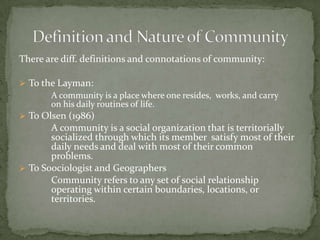
There are diff. definitions and connotations of community:To the Layman:A community is a place where one resides,  works, and carry 	on his daily routines of life.To Olsen (1986)		A community is a social organization that is territorially 	socialized through which its member 	satisfy most of their 	daily needs and deal with most of their common 	problems. To S0ociologist and Geographers		Community refers to any set of social relationship 	operating within certain boundaries, locations, or 	territories.	Definition and Nature of Community
 		In popular usage, the term has often been associated with positive connotations, as in phrases “a sense of community”  or  “community spirit”. It is clear that term is not only  descriptive, but also normative ideological.
Worslet (1987) suggested three(3) broad meanings involved in theorizing about community“Community as locality”
“Network of inter relationship”
“Community spirit” Or “Community feeling”			Although the Philippines at present is characterized by a trend towards urbanization, it still a nation predominantly composed of barrios an barangays. A common way of classifying Philippines communities is a rural-urban dichotomy. The German Sociologist, Ferdinand Toennies, relates the rural communities to familistic and traditional  gemeinschaft and the  urban communities to the contractual and business like gesselhaft.The Nature of the Rural and Urban Community
Rural communities:are localities which are usually small having a 	homogeneity of culture and personal  	relationships.Urban communities:refer to the cities or urban settlement 	characterized by size, density and heterogeneity, 	which combination provide the basis of the 	complex of labor and fundamental changes in the 	nature of social relationships.
The city evolved seven(7) periods of stages: (Light, 1985)Nomadic ExistenceNeolithic PeriodPolisPre-industrial CityIndustrial Revolution and Urban ExplosionMetropolisMegalopolisThe Evolution of the City
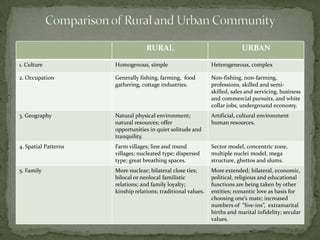
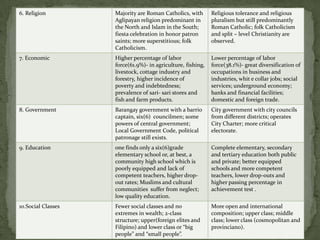
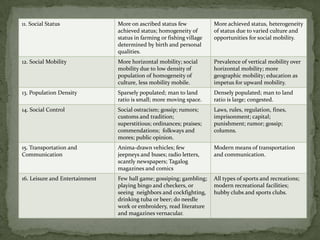
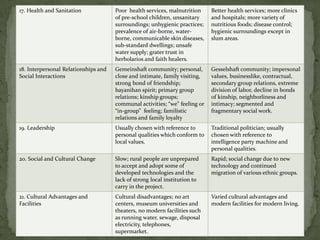
Comparison of Rural and Urban Community
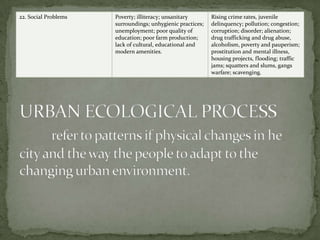
URBAN ECOLOGICAL PROCESSrefer to patterns if physical changes in he city and the way the people to adapt to the changing urban environment.
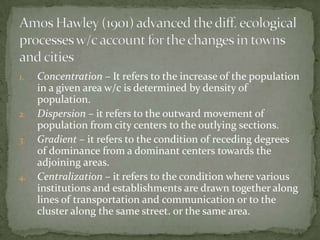
Amos Hawley (1901) advanced the diff. ecological processes w/c account for the changes in towns and citiesConcentration – It refers to the increase of the population in a given area w/c is determined by density of population.Dispersion – it refers to the outward movement of population from city centers to the outlying sections.Gradient – it refers to the condition of receding degrees of dominance from a dominant centers towards the adjoining areas.Centralization – it refers to the condition where various institutions and establishments are drawn together along lines of transportation and communication or to the cluster along the same street. or the same area.
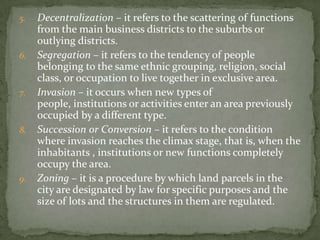
Decentralization – it refers to the scattering of functions from the main business districts to the suburbs or outlying districts.Segregation – it refers to the tendency of people belonging to the same ethnic grouping, religion, social class, or occupation to live together in exclusive area.Invasion – it occurs when new types of people, institutions or activities enter an area previously occupied by a different type.Succession or Conversion – it refers to the condition where invasion reaches the climax stage, that is, when the inhabitants , institutions or new functions completely occupy the area.Zoning – it is a procedure by which land parcels in the city are designated by law for specific purposes and the size of lots and the structures in them are regulated.
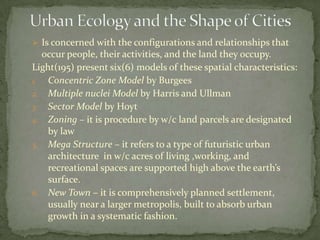
Urban Ecology and the Shape of CitiesIs concerned with the configurations and relationships that occur people, their activities, and the land they occupy.Light(195) present six(6) models of these spatial characteristics:Concentric Zone Model by BurgeesMultiple nuclei Model by Harris and UllmanSector Model by HoytZoning – it is procedure by w/c land parcels are designated by law Mega Structure – it refers to a type of futuristic urban architecture  in w/c acres of living ,working, and recreational spaces are supported high above the earth’s surface.New Town – it is comprehensively planned settlement, usually near a larger metropolis, built to absorb urban growth in a systematic fashion.
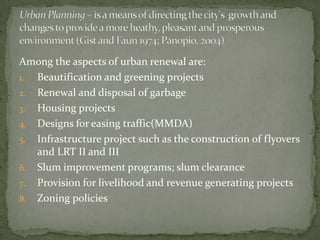
Among the aspects of urban renewal are:Beautification and greening projectsRenewal and disposal of garbageHousing projectsDesigns for easing traffic(MMDA)Infrastructure project such as the construction of flyovers and LRT II and IIISlum improvement programs; slum clearanceProvision for livelihood and revenue generating projectsZoning policies Urban Planning – is a means of directing the city's  growth and changes to provide a more heathy, pleasant and prosperous environment (Gist and Faun 1974; Panopio, 2004)
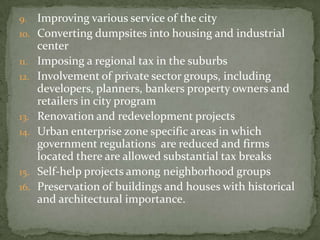
Improving various service of the cityConverting dumpsites into housing and industrial centerImposing a regional tax in the suburbsInvolvement of private sector groups, including developers, planners, bankers property owners and retailers in city programRenovation and redevelopment projects Urban enterprise zone specific areas in which government regulations  are reduced and firms located there are allowed substantial tax breaksSelf-help projects among neighborhood groupsPreservation of buildings and houses with historical and architectural importance.

Power point in ss12

  • 1.
  • 2.
    Group IVLeader: RonnieRose DuqueJessica S. RodriguezKharen L. LamanMary Jane B. RosalesCatherine G. CabauatanMaricon R. GumanganOrlando C. UggadanMichael AmataRolenCarniyanJohn MichaelBSIT 3-B
  • 3.
  • 4.
    There are diff.definitions and connotations of community:To the Layman:A community is a place where one resides, works, and carry on his daily routines of life.To Olsen (1986) A community is a social organization that is territorially socialized through which its member satisfy most of their daily needs and deal with most of their common problems. To S0ociologist and Geographers Community refers to any set of social relationship operating within certain boundaries, locations, or territories. Definition and Nature of Community
  • 5.
    In popularusage, the term has often been associated with positive connotations, as in phrases “a sense of community” or “community spirit”. It is clear that term is not only descriptive, but also normative ideological.
  • 6.
    Worslet (1987) suggestedthree(3) broad meanings involved in theorizing about community“Community as locality”
  • 7.
    “Network of interrelationship”
  • 8.
    “Community spirit” Or“Community feeling” Although the Philippines at present is characterized by a trend towards urbanization, it still a nation predominantly composed of barrios an barangays. A common way of classifying Philippines communities is a rural-urban dichotomy. The German Sociologist, Ferdinand Toennies, relates the rural communities to familistic and traditional gemeinschaft and the urban communities to the contractual and business like gesselhaft.The Nature of the Rural and Urban Community
  • 9.
    Rural communities:are localitieswhich are usually small having a homogeneity of culture and personal relationships.Urban communities:refer to the cities or urban settlement characterized by size, density and heterogeneity, which combination provide the basis of the complex of labor and fundamental changes in the nature of social relationships.
  • 10.
    The city evolvedseven(7) periods of stages: (Light, 1985)Nomadic ExistenceNeolithic PeriodPolisPre-industrial CityIndustrial Revolution and Urban ExplosionMetropolisMegalopolisThe Evolution of the City
  • 11.
    Comparison of Ruraland Urban Community
  • 15.
    URBAN ECOLOGICAL PROCESSreferto patterns if physical changes in he city and the way the people to adapt to the changing urban environment.
  • 16.
    Amos Hawley (1901)advanced the diff. ecological processes w/c account for the changes in towns and citiesConcentration – It refers to the increase of the population in a given area w/c is determined by density of population.Dispersion – it refers to the outward movement of population from city centers to the outlying sections.Gradient – it refers to the condition of receding degrees of dominance from a dominant centers towards the adjoining areas.Centralization – it refers to the condition where various institutions and establishments are drawn together along lines of transportation and communication or to the cluster along the same street. or the same area.
  • 17.
    Decentralization – itrefers to the scattering of functions from the main business districts to the suburbs or outlying districts.Segregation – it refers to the tendency of people belonging to the same ethnic grouping, religion, social class, or occupation to live together in exclusive area.Invasion – it occurs when new types of people, institutions or activities enter an area previously occupied by a different type.Succession or Conversion – it refers to the condition where invasion reaches the climax stage, that is, when the inhabitants , institutions or new functions completely occupy the area.Zoning – it is a procedure by which land parcels in the city are designated by law for specific purposes and the size of lots and the structures in them are regulated.
  • 18.
    Urban Ecology andthe Shape of CitiesIs concerned with the configurations and relationships that occur people, their activities, and the land they occupy.Light(195) present six(6) models of these spatial characteristics:Concentric Zone Model by BurgeesMultiple nuclei Model by Harris and UllmanSector Model by HoytZoning – it is procedure by w/c land parcels are designated by law Mega Structure – it refers to a type of futuristic urban architecture in w/c acres of living ,working, and recreational spaces are supported high above the earth’s surface.New Town – it is comprehensively planned settlement, usually near a larger metropolis, built to absorb urban growth in a systematic fashion.
  • 19.
    Among the aspectsof urban renewal are:Beautification and greening projectsRenewal and disposal of garbageHousing projectsDesigns for easing traffic(MMDA)Infrastructure project such as the construction of flyovers and LRT II and IIISlum improvement programs; slum clearanceProvision for livelihood and revenue generating projectsZoning policies Urban Planning – is a means of directing the city's growth and changes to provide a more heathy, pleasant and prosperous environment (Gist and Faun 1974; Panopio, 2004)
  • 20.
    Improving various serviceof the cityConverting dumpsites into housing and industrial centerImposing a regional tax in the suburbsInvolvement of private sector groups, including developers, planners, bankers property owners and retailers in city programRenovation and redevelopment projects Urban enterprise zone specific areas in which government regulations are reduced and firms located there are allowed substantial tax breaksSelf-help projects among neighborhood groupsPreservation of buildings and houses with historical and architectural importance.