Postmodern Los Angeles
Los Angeles as a postmodern city
●   Instability
●   First of all, the city lies on a geological fault. The city is surrounded by the
    desert.

●   Horizontality
●   a combination of decentralization and recentralization, the peripheralization
    of the center and the centralization of the periphery, the city simultaneously
    being turned inside out and outside in. (Soja, p. 131)

●   Segregation
Los Angeles as a postmodern city
●   Los Angeles has become an archetype of a
    postmodern city;
●   Cities no longer have a recognizable pattern;
●   The postmodern global metropolis is physically and
    socially fragmented;
●   Edge cities are immerging,
●   as an attempt to recentralize the city.
●   Characteristics of edge cities are
●   varied from industial, commercil,
●   relatively poor, and ethnic minorities
Los Angeles as a postmodern city
●   LA does not display the industrial legacy of the
    classic industrial city;
●   The significance of the Central Business
    District(CBD) has been reduced, causing increased
    decentralization, and the formation of multiple nuclei
    model to arise;
●   The spead of the city has led to the wide use of
    automobiles, as a main means of transportation
 Postmodern cities

●   Living in a postmodern age, a need exists to dig
    at truths while grasping at the “contingencies of
    morality and social choice”. Postmodernism
    provides this service. Undoubtedly, diversity,
    technology, synergy, hybridization, and
    multiculturalism all combine to create an urban
    condition different from that that came before.
    The nation and the world has been “de-centered”,
    postmodernism has helped to chip away at the
    “shame” of scholarship pushing one hegemonic
    perspective, granting us the ability to hear voices
    and perspectives previously ignored but now vital
    to the way we live now.
Problems of Los Angeles
●   social problems;
●   environmental problems;
●   graffiti problems;
●   traffic problems;
●   gang problems;
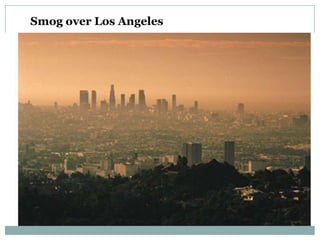
●   smog problems;
●   water problems;
●   pollution problems
Smog over Los Angeles
Trash boom in L.A. river
Scientists about L.A.
Problems and future
William Fulton’s :The
Reluctant Metropolis: The Politics of Urban Growth in Los Angeles
(1997)
A kind of cocoon citizenship that precludes diverse
communities and democratic ways of life:
once inside their cocoon, the suburbanites see no
butterfly- like value in emerging. They only seek to
stay inside forever, petrified in their tracts, like
ancient fossils. So removed are cocoon citizens from
the totality of metropolitan life that they can no
longer see the full range of activities a metropolis
encompasses, or that they are part of it no matter
what they do. All they can do is try to define the
breadth of metropolitan life by what they’ve
observed inside their cocoon. (1997:341).
Norman Klein’s provocative
book The History of Forgetting: Los Angeles and the Erasure of
Memory(1997).
The first myth of Los Angeles, from the 1880s to
1930s, was that of the climate: an untouched
garden of sunshine ripe for development yet
wonderfully devoid of the evils of other major U.S.
cities—pollution, overpopulation, and slums.
The freeway metropolis myth came next, from
1936 to 1949, stressing the need to control an unruly
nature that had led to uneven development
and urban decay
Downtown renewal, justifying the elimination
of ethnic (non-white) enclaves that had “nothing
worth saving” anyway.
Mike Davis’ City of Quartz: Excavating the Future in Los Angeles
(1990)
by hyping Los Angeles as the paradigm of the future
(even in a dystopian vein), they tend to collapse history
into teleology and glamorize the very reality they would
deconstruct. Soja and Jameson, particularly, in the very
eloquence of their different “postmodern mappings” of
Los Angeles, become celebrants of the myth. The city is a
place where everything is possible, nothing is safe and
durable enough to believe in, where constant
synchronicity prevails, and automatic ingenuity of
capital ceaselessly throws up new forms and spectacles .
(1990:86)
Los Angeles was the kind of place where
 everybody was from somewhere else and
 nobody really dropped anchor. It was a
 transient place. People drawn by the dream,
 people running from the nightmare. Twelve
 million people and all of them ready to make
 a break for it if necessary. Figuratively,
 literally, metaphorically -- any way you want
 to look at it -- everybody in L.A. keeps a bag
 packed. Just in case.”
― Michael Connelly, The Brass Verdict
Discussion questions
What do you think makes Los Angeles to a
postmodern city?
L.A. School views the city as a representative of
future urban forms.However there are many
other Western cities, with many of the same
elements as Los Angeles. Do you think that
Los Angeles is a representative of future
urban forms?

Postmodern Los Angeles

  • 1.
  • 2.
    Los Angeles asa postmodern city ● Instability ● First of all, the city lies on a geological fault. The city is surrounded by the desert. ● Horizontality ● a combination of decentralization and recentralization, the peripheralization of the center and the centralization of the periphery, the city simultaneously being turned inside out and outside in. (Soja, p. 131) ● Segregation
  • 3.
    Los Angeles asa postmodern city ● Los Angeles has become an archetype of a postmodern city; ● Cities no longer have a recognizable pattern; ● The postmodern global metropolis is physically and socially fragmented; ● Edge cities are immerging, ● as an attempt to recentralize the city. ● Characteristics of edge cities are ● varied from industial, commercil, ● relatively poor, and ethnic minorities
  • 4.
    Los Angeles asa postmodern city ● LA does not display the industrial legacy of the classic industrial city; ● The significance of the Central Business District(CBD) has been reduced, causing increased decentralization, and the formation of multiple nuclei model to arise; ● The spead of the city has led to the wide use of automobiles, as a main means of transportation
  • 5.
     Postmodern cities ● Living in a postmodern age, a need exists to dig at truths while grasping at the “contingencies of morality and social choice”. Postmodernism provides this service. Undoubtedly, diversity, technology, synergy, hybridization, and multiculturalism all combine to create an urban condition different from that that came before. The nation and the world has been “de-centered”, postmodernism has helped to chip away at the “shame” of scholarship pushing one hegemonic perspective, granting us the ability to hear voices and perspectives previously ignored but now vital to the way we live now.
  • 6.
    Problems of LosAngeles ● social problems; ● environmental problems; ● graffiti problems; ● traffic problems; ● gang problems; ● smog problems; ● water problems; ● pollution problems
  • 7.
  • 8.
    Trash boom inL.A. river
  • 10.
  • 11.
    William Fulton’s :The ReluctantMetropolis: The Politics of Urban Growth in Los Angeles (1997) A kind of cocoon citizenship that precludes diverse communities and democratic ways of life: once inside their cocoon, the suburbanites see no butterfly- like value in emerging. They only seek to stay inside forever, petrified in their tracts, like ancient fossils. So removed are cocoon citizens from the totality of metropolitan life that they can no longer see the full range of activities a metropolis encompasses, or that they are part of it no matter what they do. All they can do is try to define the breadth of metropolitan life by what they’ve observed inside their cocoon. (1997:341).
  • 12.
    Norman Klein’s provocative bookThe History of Forgetting: Los Angeles and the Erasure of Memory(1997). The first myth of Los Angeles, from the 1880s to 1930s, was that of the climate: an untouched garden of sunshine ripe for development yet wonderfully devoid of the evils of other major U.S. cities—pollution, overpopulation, and slums. The freeway metropolis myth came next, from 1936 to 1949, stressing the need to control an unruly nature that had led to uneven development and urban decay Downtown renewal, justifying the elimination of ethnic (non-white) enclaves that had “nothing worth saving” anyway.
  • 13.
    Mike Davis’ Cityof Quartz: Excavating the Future in Los Angeles (1990) by hyping Los Angeles as the paradigm of the future (even in a dystopian vein), they tend to collapse history into teleology and glamorize the very reality they would deconstruct. Soja and Jameson, particularly, in the very eloquence of their different “postmodern mappings” of Los Angeles, become celebrants of the myth. The city is a place where everything is possible, nothing is safe and durable enough to believe in, where constant synchronicity prevails, and automatic ingenuity of capital ceaselessly throws up new forms and spectacles . (1990:86)
  • 14.
    Los Angeles wasthe kind of place where everybody was from somewhere else and nobody really dropped anchor. It was a transient place. People drawn by the dream, people running from the nightmare. Twelve million people and all of them ready to make a break for it if necessary. Figuratively, literally, metaphorically -- any way you want to look at it -- everybody in L.A. keeps a bag packed. Just in case.” ― Michael Connelly, The Brass Verdict
  • 15.
    Discussion questions What doyou think makes Los Angeles to a postmodern city? L.A. School views the city as a representative of future urban forms.However there are many other Western cities, with many of the same elements as Los Angeles. Do you think that Los Angeles is a representative of future urban forms?