Learning Goals
for Chapter11
• Describe the concept of power
• Discuss French and Raven’s
typology of power
• Identify forms and sources of
power in organizations
• Discuss how groups can hold power
• Identify symbols of power and
powerlessness in organizations
• Define organizational politics and
understand the role of political skill
and major influence
• Discuss influence tactics used in
organizations
4.
Warm Up
• Howdo you define
power at work?
• Is there such a
thing as too much
power? Why or
why not?
• Does this vary
based on what
you use your
power for?
5.
Power and Influence
•Power: having the discretion and the means to asymmetrically
enforce one’s will over others
• Power is a source of influence
• Power in organizations can be:
• Formal: based on one’s position in the organization
• Personal: based on the unique characteristics of the individual
6.
Using Power
• Influence:
•Process of affecting the
thoughts, behaviors, and
feelings of another person
• Authority:
• Right to influence another
person
• Zone of indifference:
• Range in which attempts to
influence a person will be
perceived as legitimate and
acted on without a great deal
of thought
7.
BASES OF
POWER
(FRENCH &
RAVEN,
1960)
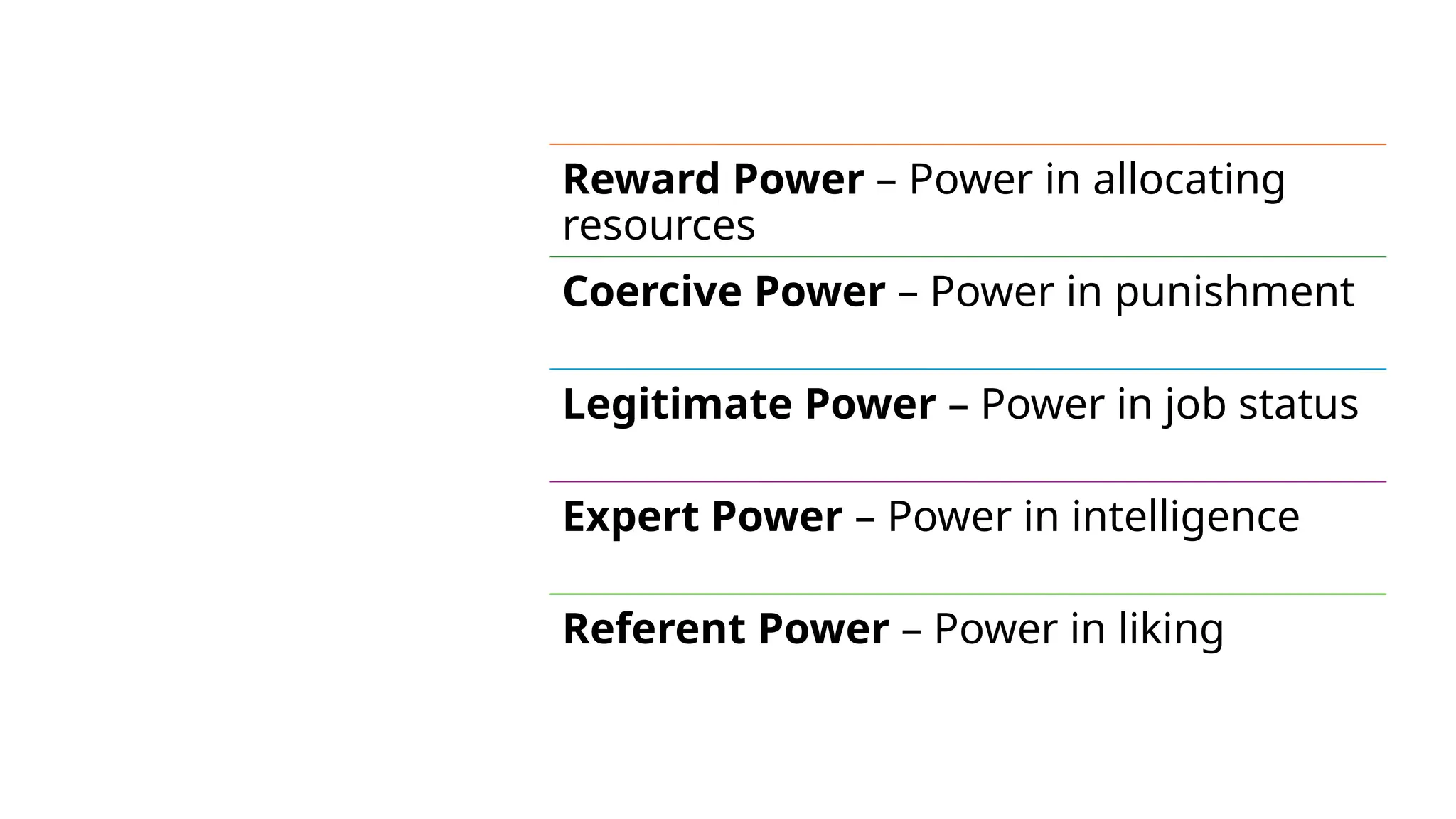
RewardPower – Power in allocating
resources
Coercive Power – Power in punishment
Legitimate Power – Power in job status
Expert Power – Power in intelligence
Referent Power – Power in liking
8.
BASES OF
POWER
• Formal
Coercive– The ability and
willingness to punish others
(this can include threats).
Reward – the ability to provide
incentives or other things
valued.
Legitimate – the ability to
make a request and get a
response due to the nature of
the roles between two people.
9.
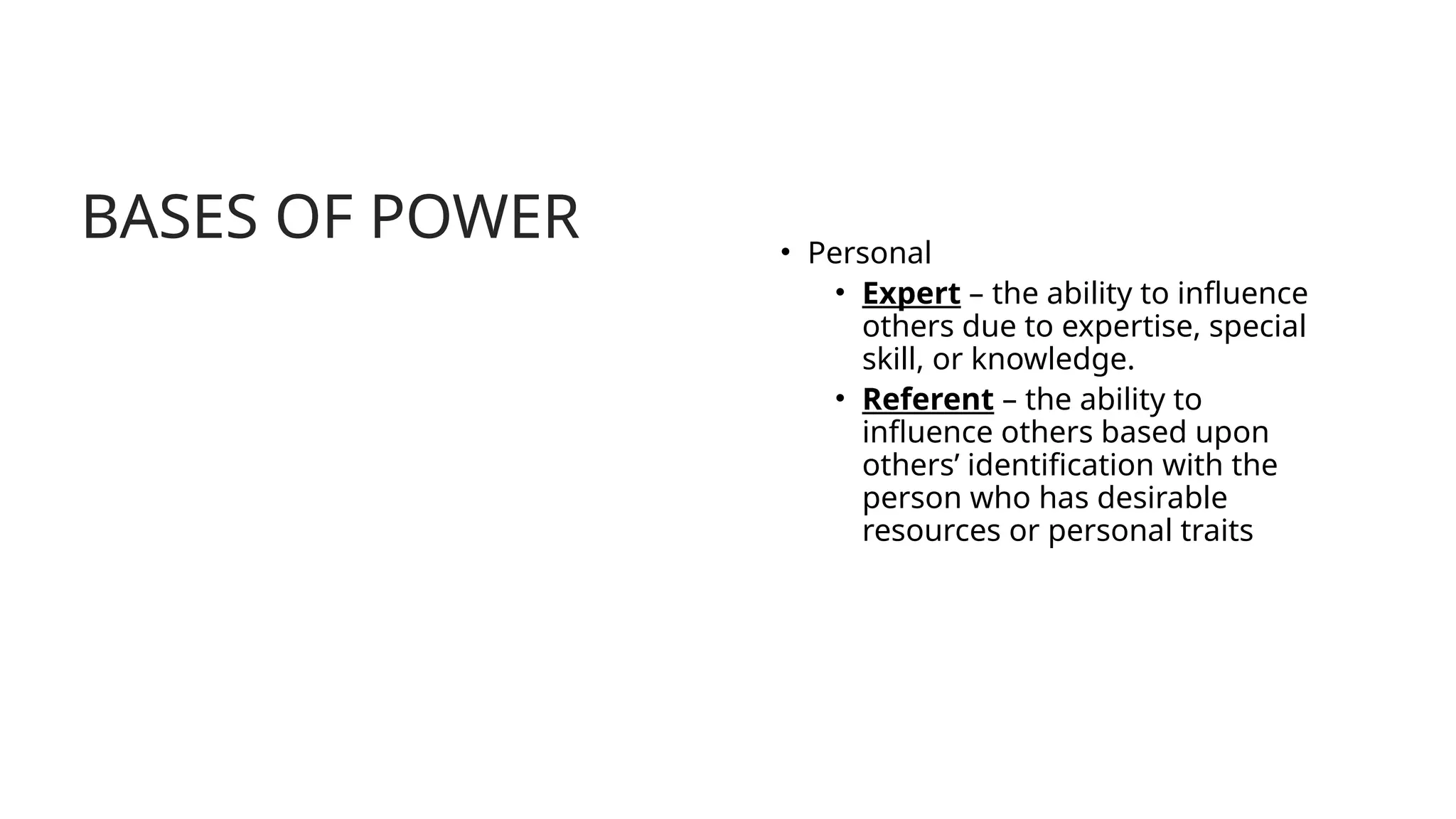
BASES OF POWER• Personal
• Expert – the ability to influence
others due to expertise, special
skill, or knowledge.
• Referent – the ability to
influence others based upon
others’ identification with the
person who has desirable
resources or personal traits
10.
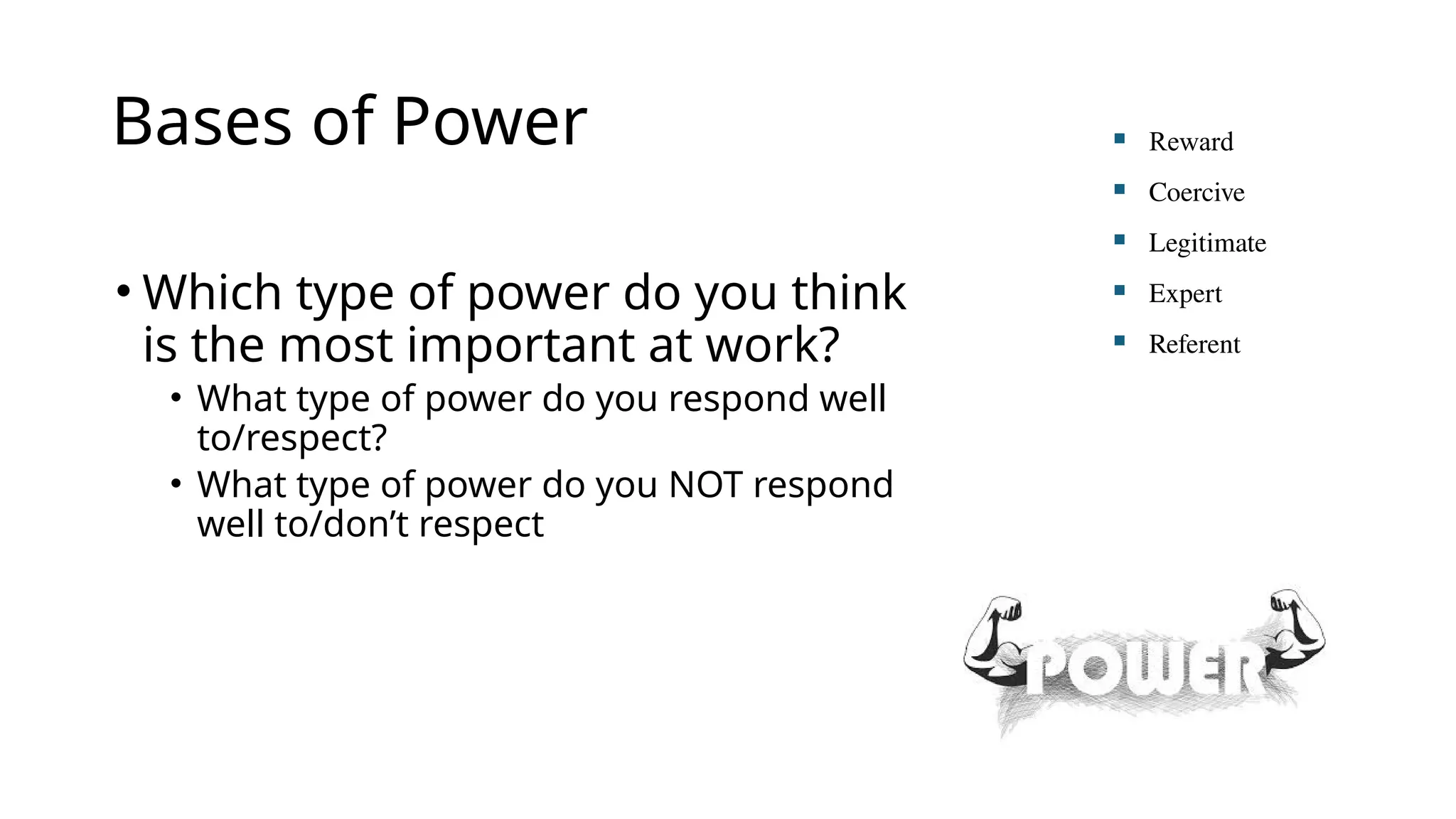
Bases of Power
•Which type of power do you think
is the most important at work?
• What type of power do you respond well
to/respect?
• What type of power do you NOT respond
well to/don’t respect
Reward
Coercive
Legitimate
Expert
Referent
11.
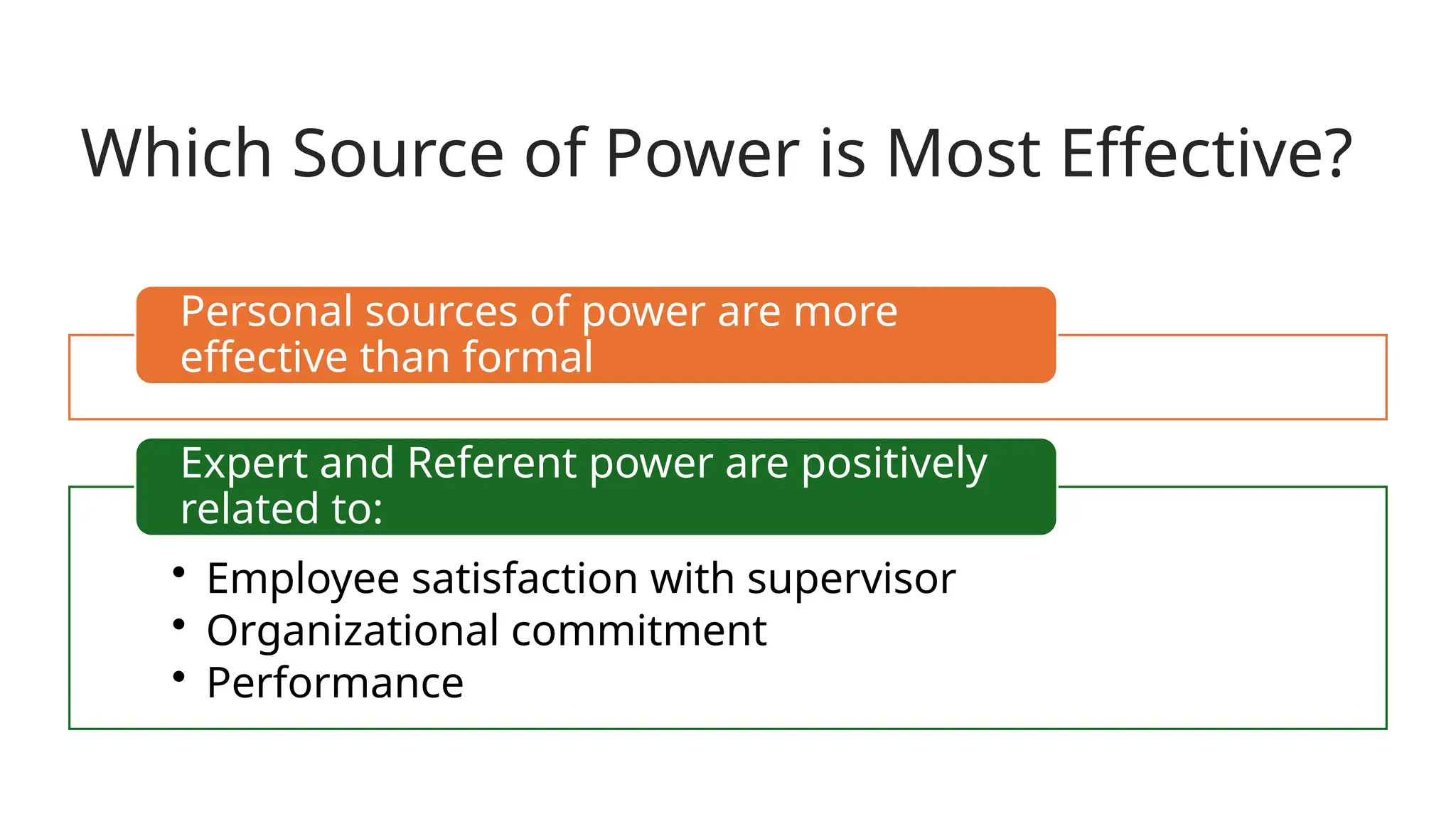
Which Source ofPower is Most Effective?
Personal sources of power are more
effective than formal
• Employee satisfaction with supervisor
• Organizational commitment
• Performance
Expert and Referent power are positively
related to:
12.
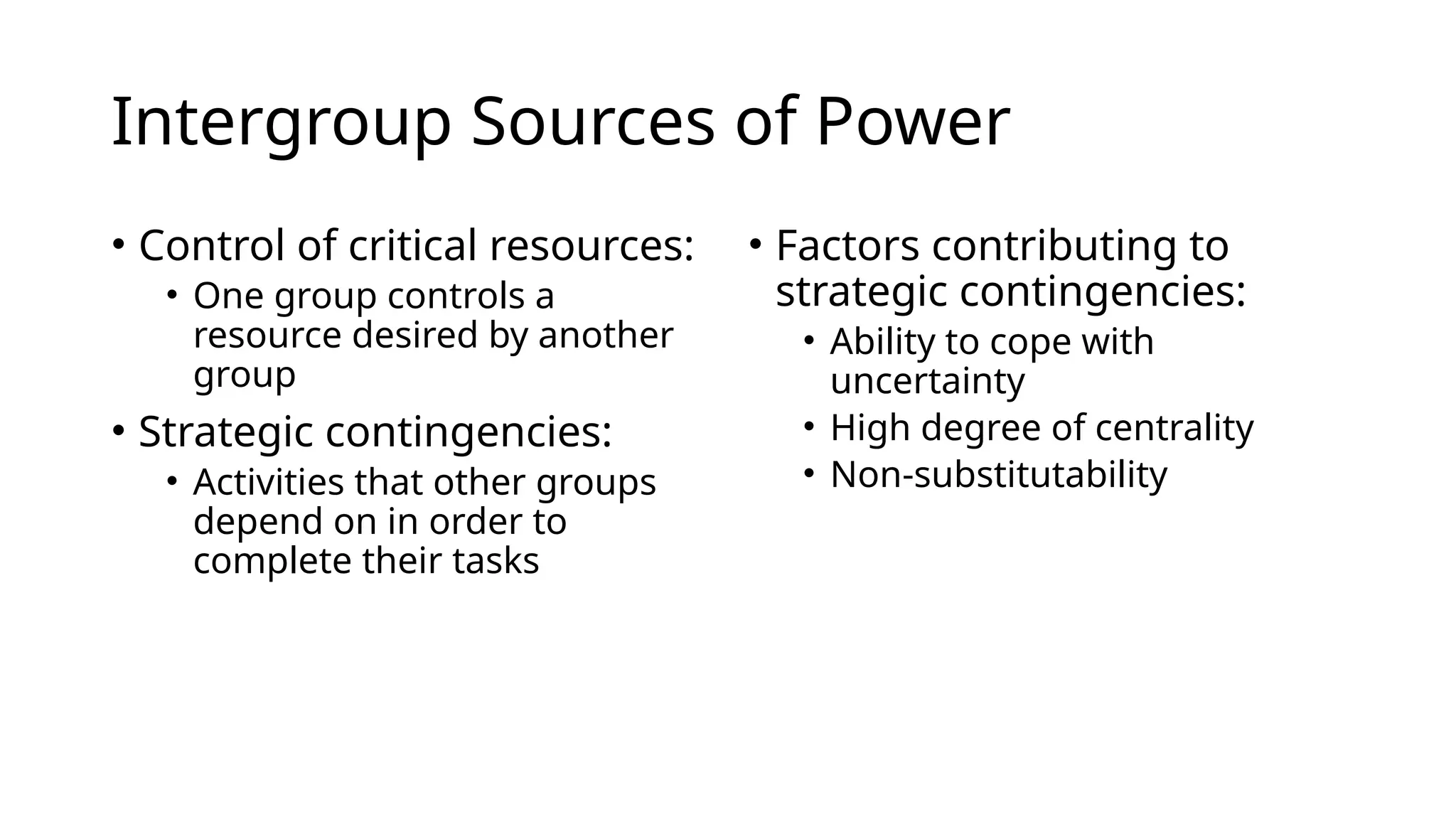
Intergroup Sources ofPower
• Control of critical resources:
• One group controls a
resource desired by another
group
• Strategic contingencies:
• Activities that other groups
depend on in order to
complete their tasks
• Factors contributing to
strategic contingencies:
• Ability to cope with
uncertainty
• High degree of centrality
• Non-substitutability
13.
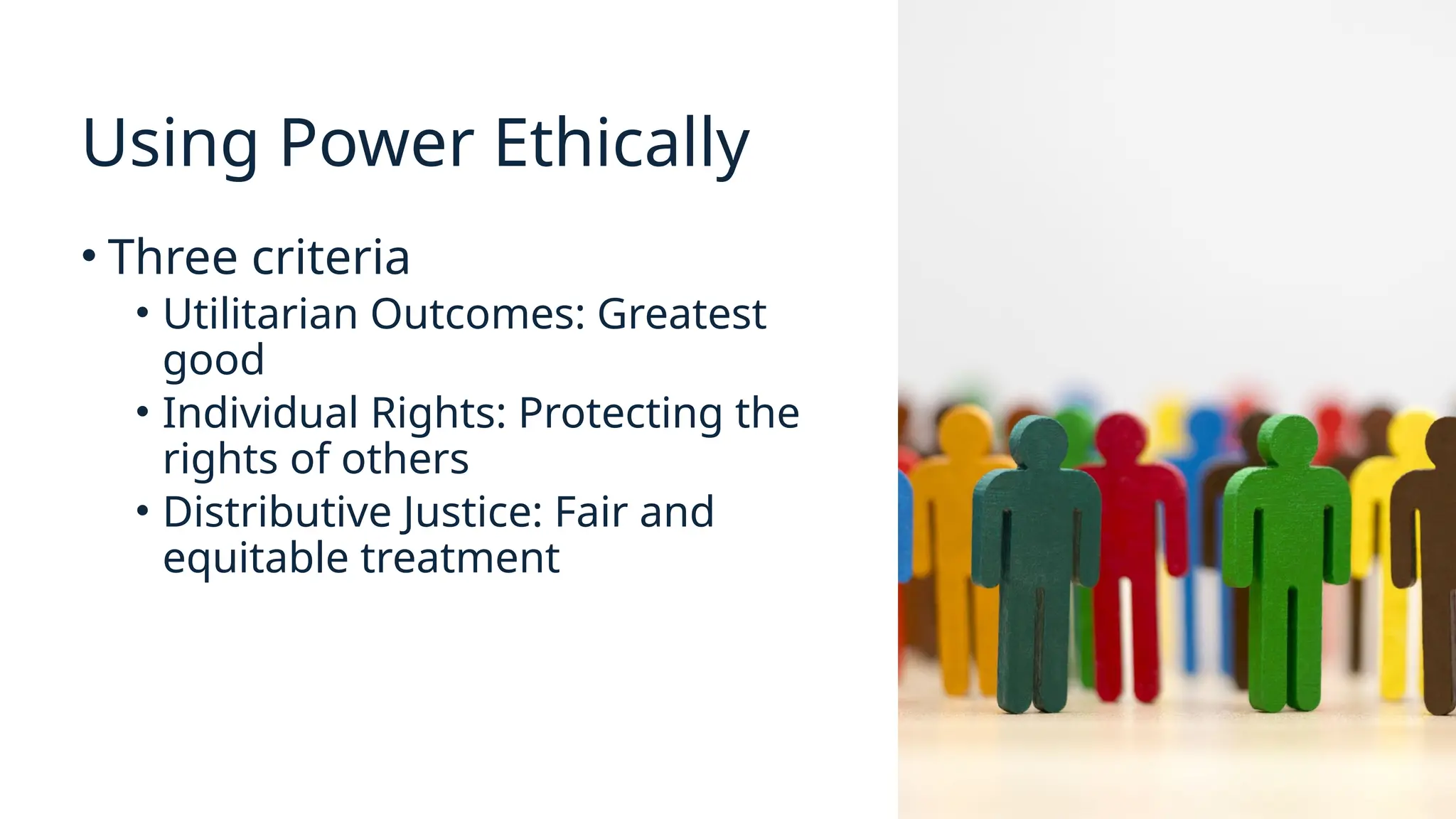
Using Power Ethically
•Three criteria
• Utilitarian Outcomes: Greatest
good
• Individual Rights: Protecting the
rights of others
• Distributive Justice: Fair and
equitable treatment
14.
Other Types of
Power
•Information power
• Access to and control over
important information
• Personal power (Selfish)
• Power used for personal gain
• Social power
• Power used to create
motivation or to accomplish
group goals
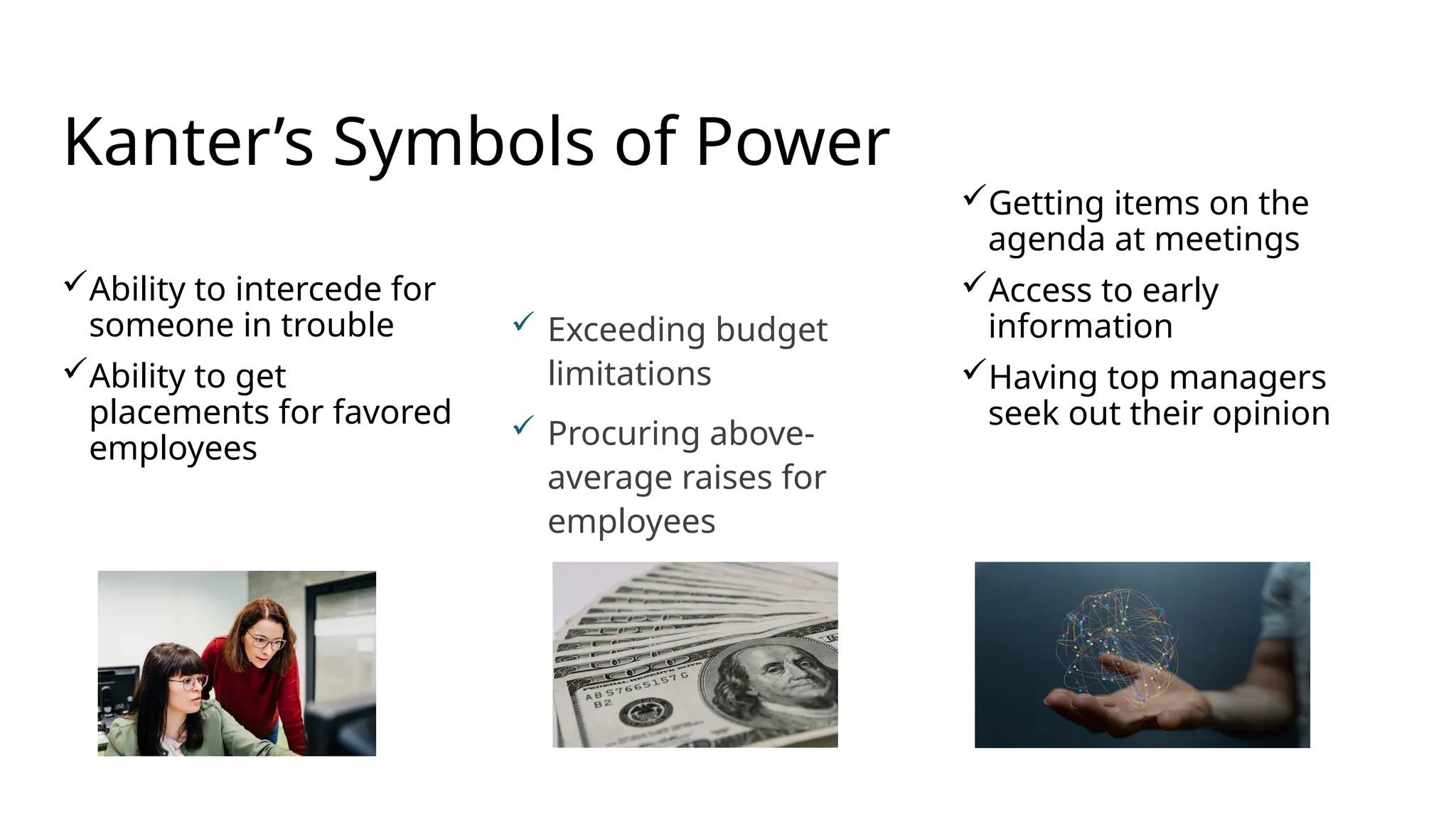
Ability to intercedefor
someone in trouble
Ability to get
placements for favored
employees
Getting items on the
agenda at meetings
Access to early
information
Having top managers
seek out their opinion
Kanter’s Symbols of Power
Exceeding budget
limitations
Procuring above-
average raises for
employees
17.
Kanter’s
Symbols of
Powerlessn
ess
• Threesymptoms:
1) Overly close supervision
2) Inflexible adherence to the rules
3) Tendency to do the job themselves
rather than training others to do it
18.
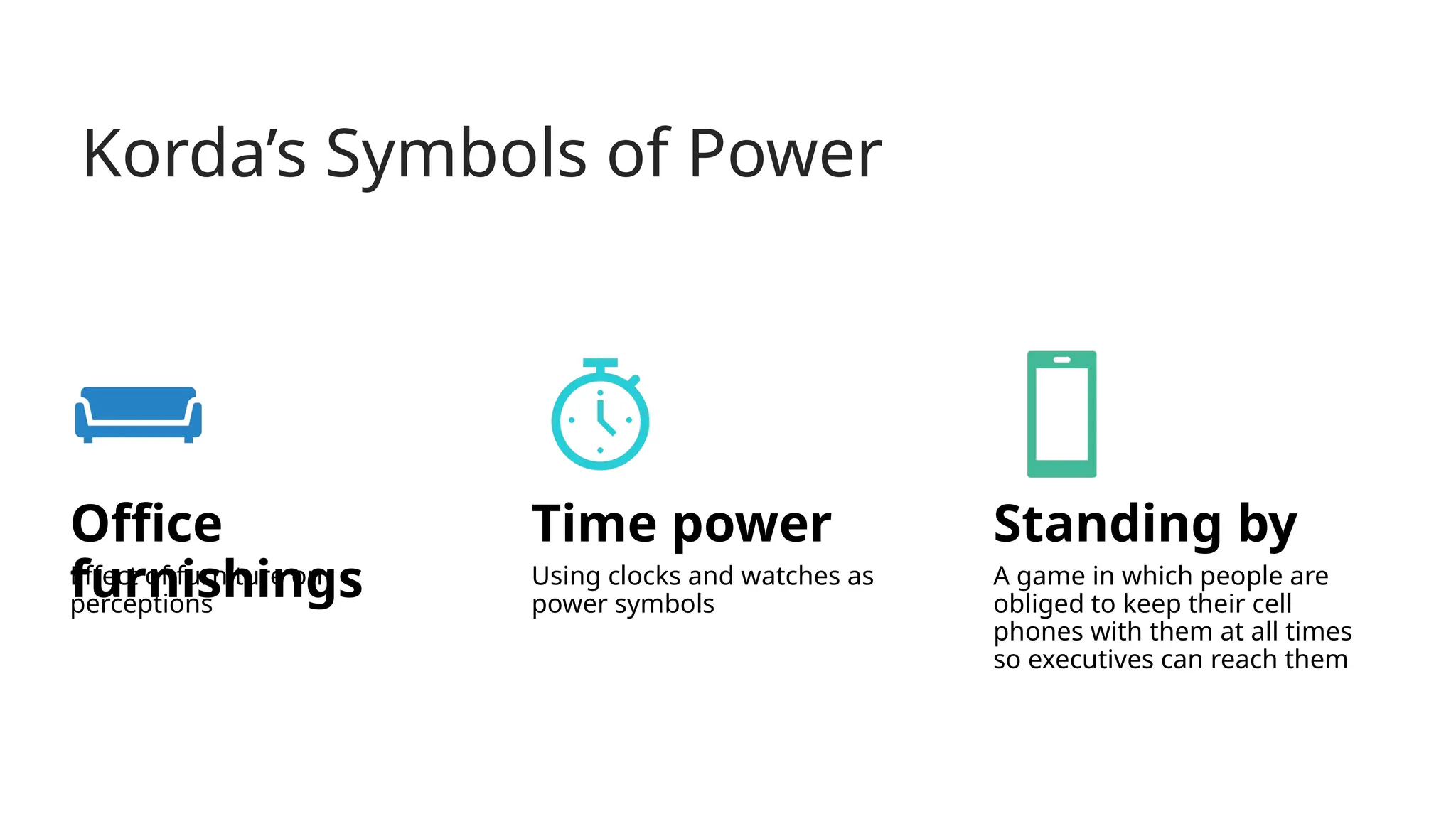
Korda’s Symbols ofPower
Office
furnishings
Effect of furniture on
perceptions
Time power
Using clocks and watches as
power symbols
Standing by
A game in which people are
obliged to keep their cell
phones with them at all times
so executives can reach them
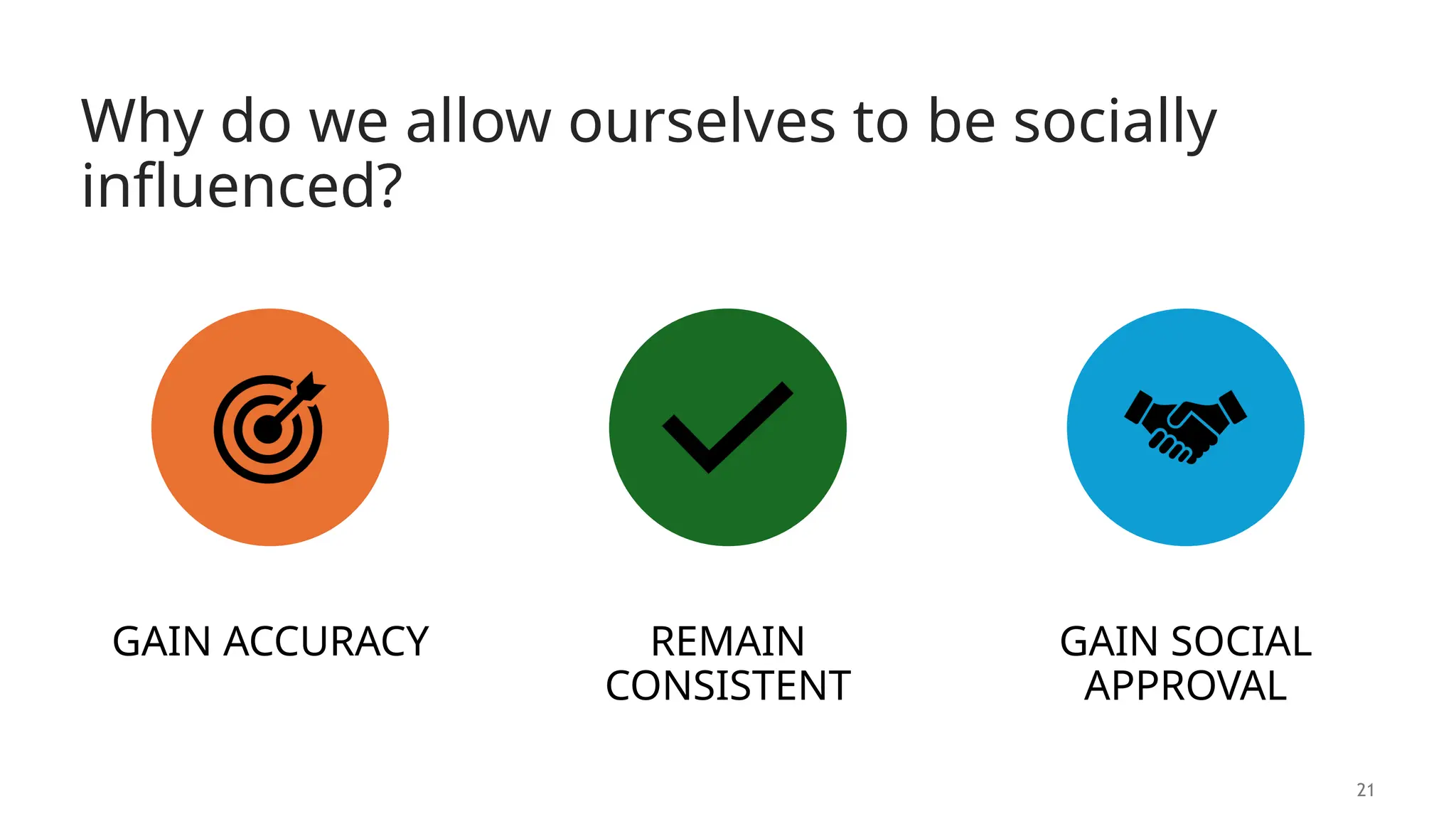
Why do weallow ourselves to be socially
influenced?
21
GAIN ACCURACY REMAIN
CONSISTENT
GAIN SOCIAL
APPROVAL
22.
CIALDINI’S SIX PRINCIPLESOF SOCIAL INFLUENCE
(WHY WE OURSELVES ARE INFLUENCED)
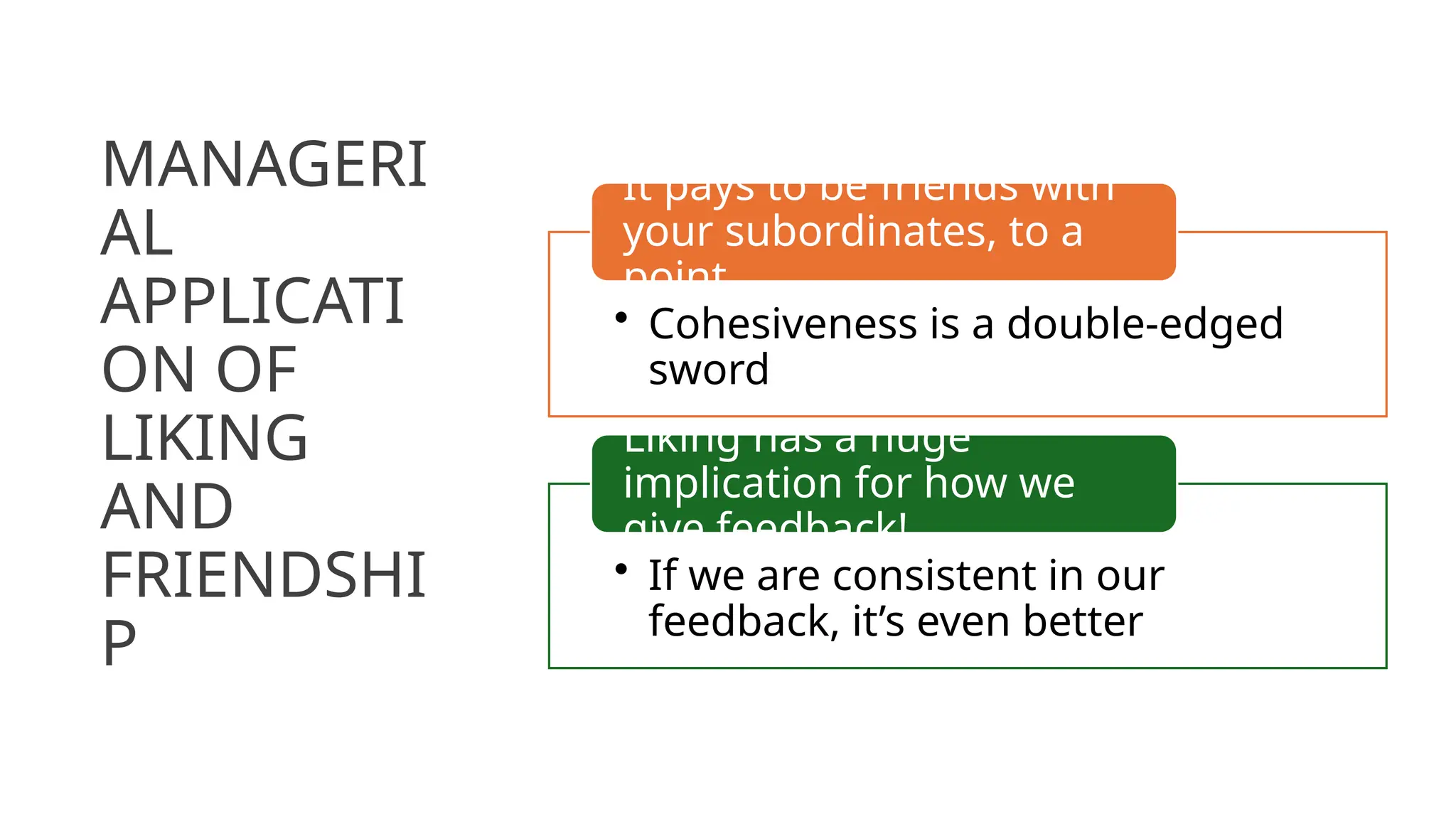
Friendship/Liking
Reciprocity
Social Validation
Commitment/Consistency
Authority
Scarcity
23.
1) PRINCIPLE:
FRIENDSHIP/LIKING
People likethose who like them
If a friend or someone else in your
“ingroup” asks for a favor, it pays
to say yes.
How to increase
liking:
Similarity
Praise/
Compliments
Cooperation
2)
PRINCIPL
E:
RECIPRO
CITY
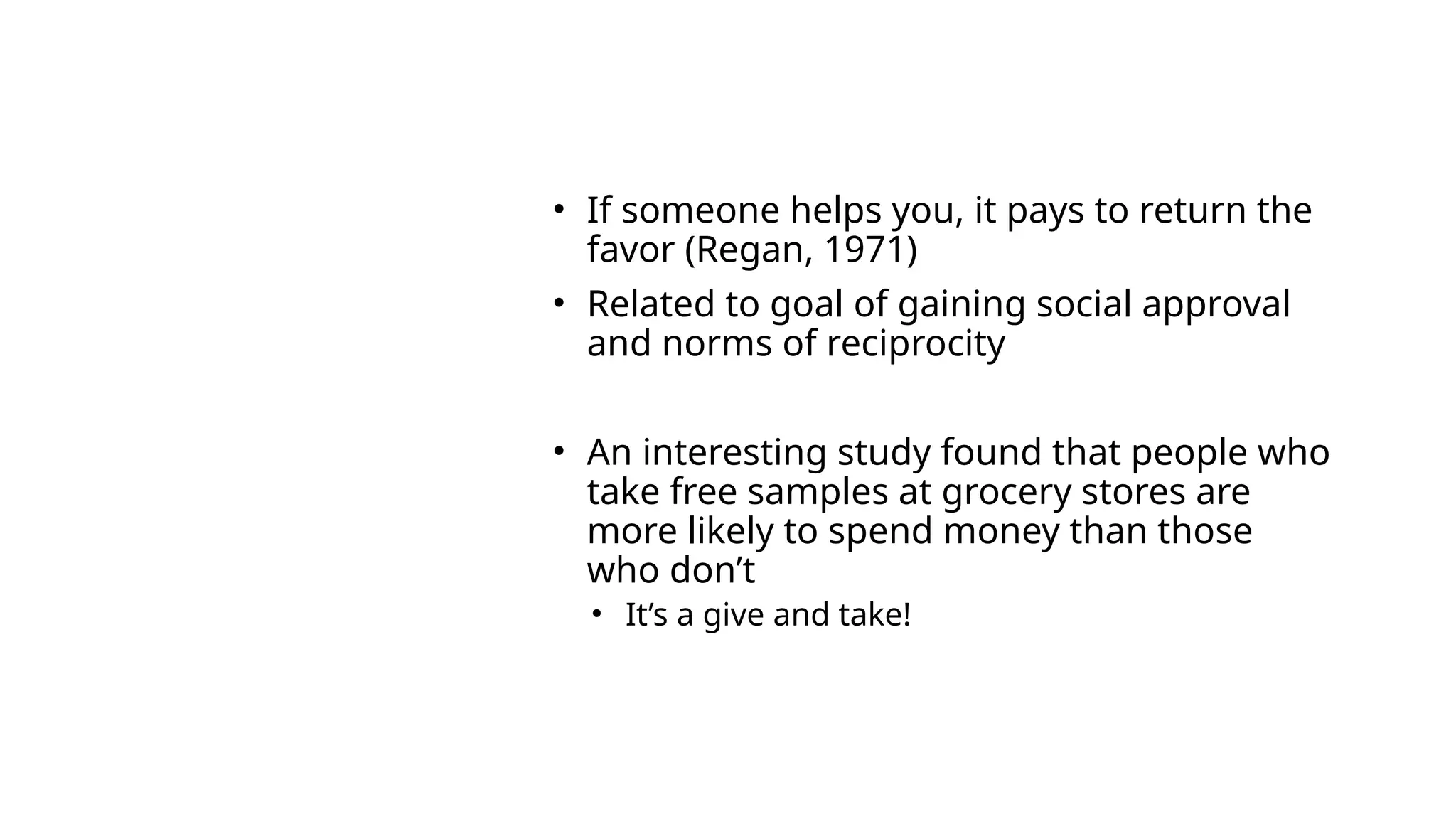
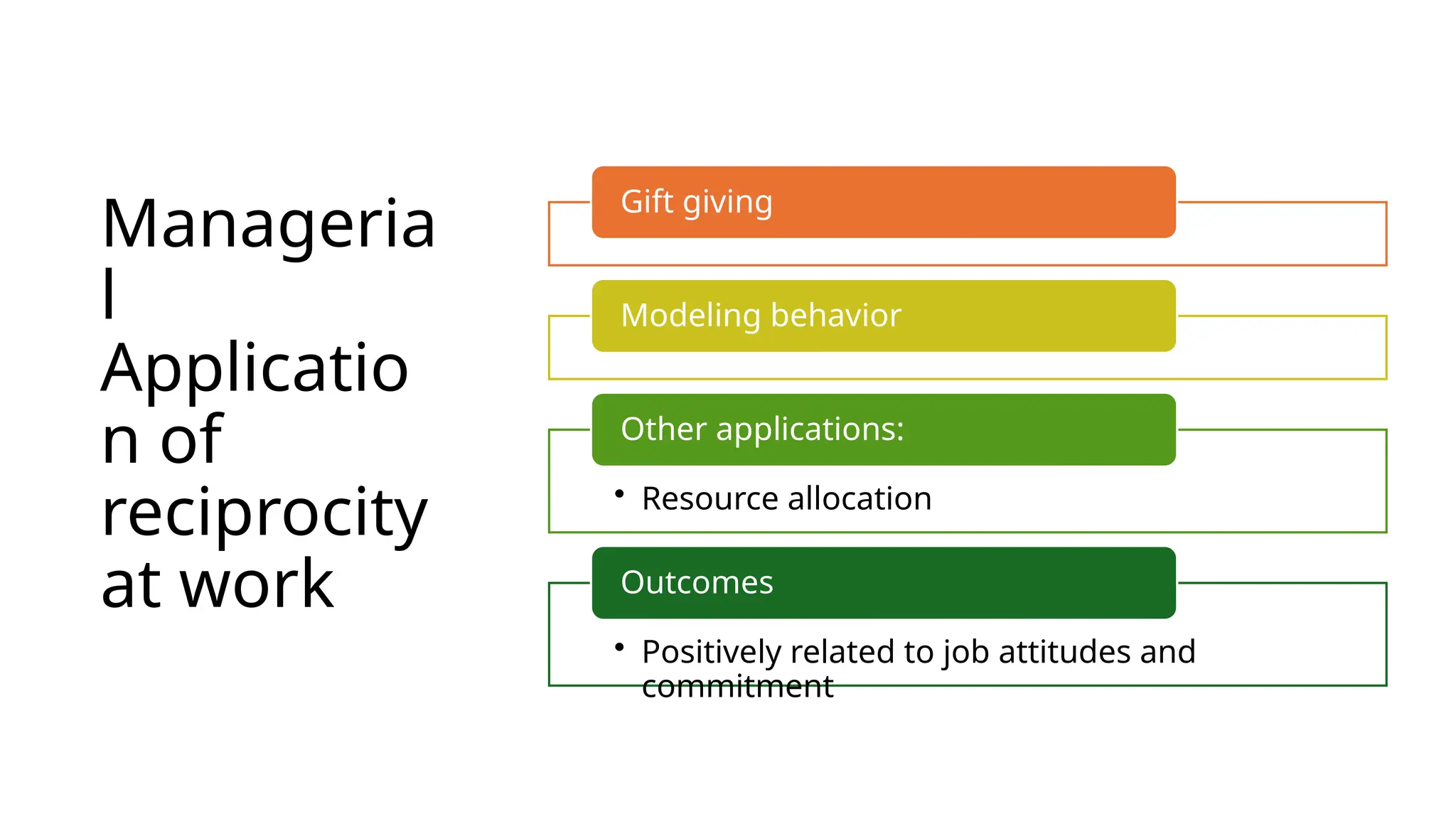
• If someonehelps you, it pays to return the
favor (Regan, 1971)
• Related to goal of gaining social approval
and norms of reciprocity
• An interesting study found that people who
take free samples at grocery stores are
more likely to spend money than those
who don’t
• It’s a give and take!
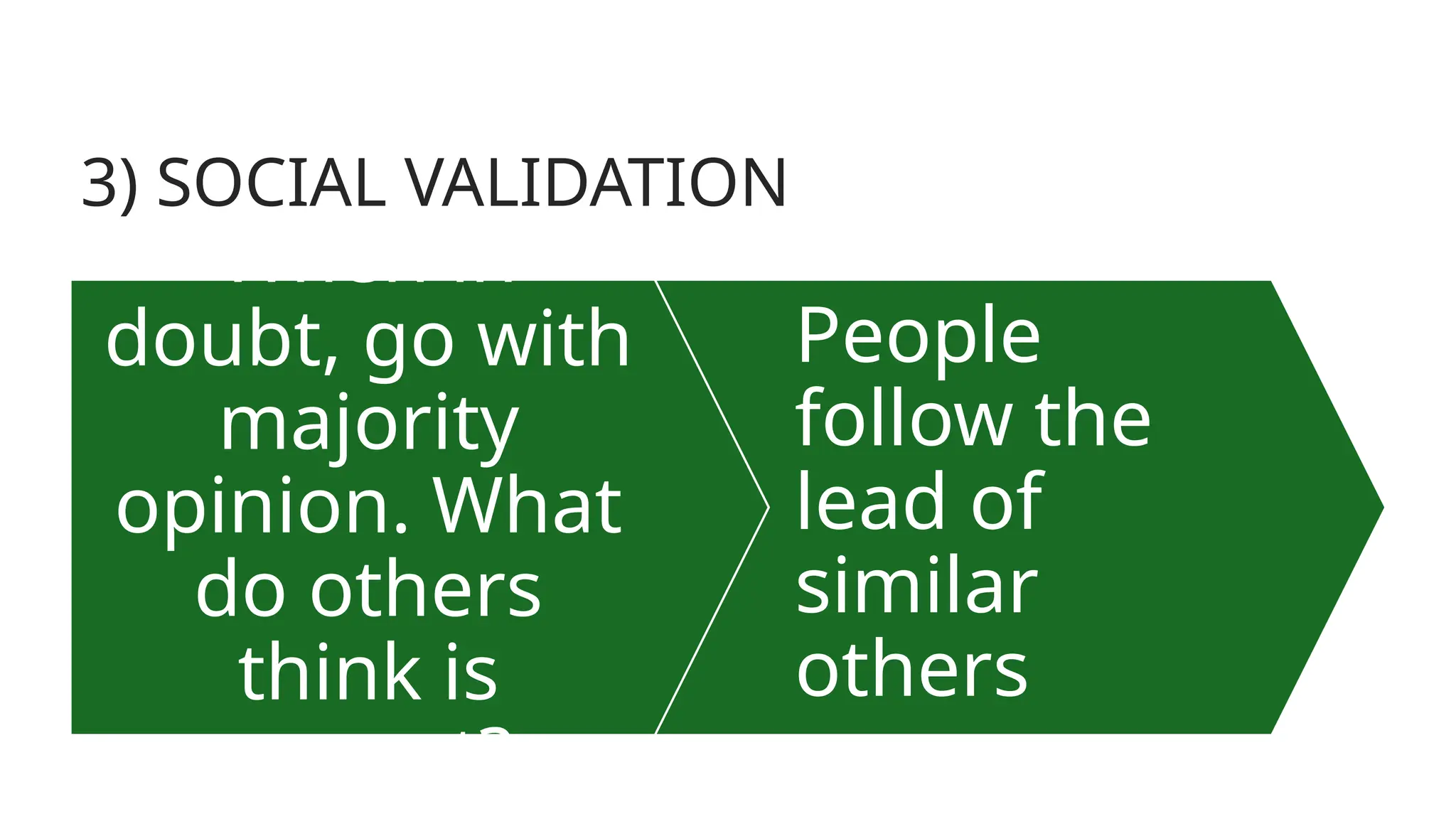
3) SOCIAL VALIDATION
Whenin
doubt, go with
majority
opinion. What
do others
think is
correct?
People
follow the
lead of
similar
others
• Salting the tip
28.
Managerial
application of social
validation
•Use peer power when it’s available
• Influence is often best exerted
horizontally than vertically
• Instead of trying to convince a
group of veteran employees to
get on board with a change that
they are resisting, find one who
supports the initiative and have
them speak up instead of the
boss
29.
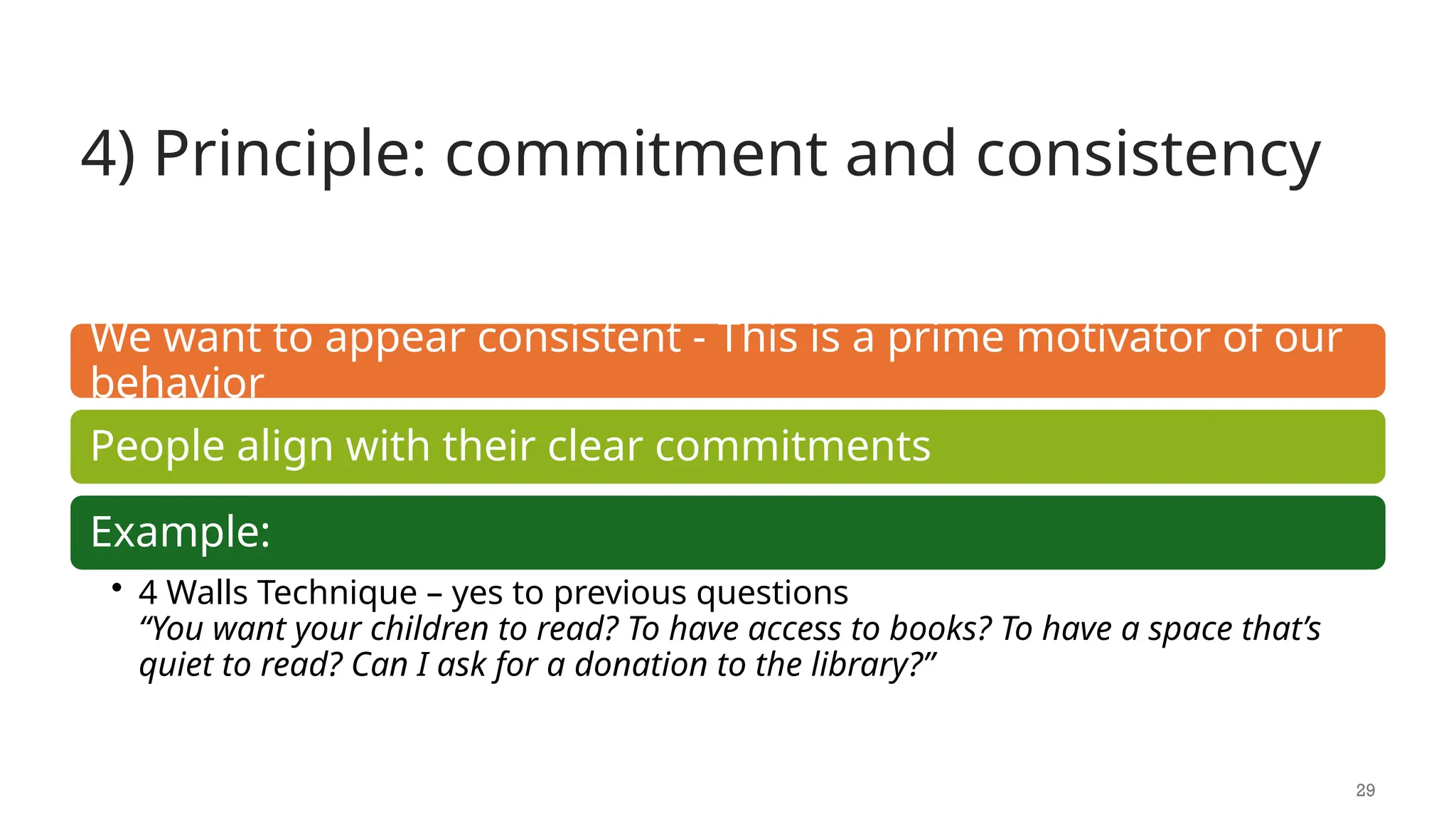
4) Principle: commitmentand consistency
29
We want to appear consistent - This is a prime motivator of our
behavior
People align with their clear commitments
Example:
• 4 Walls Technique – yes to previous questions
“You want your children to read? To have access to books? To have a space that’s
quiet to read? Can I ask for a donation to the library?”
30.
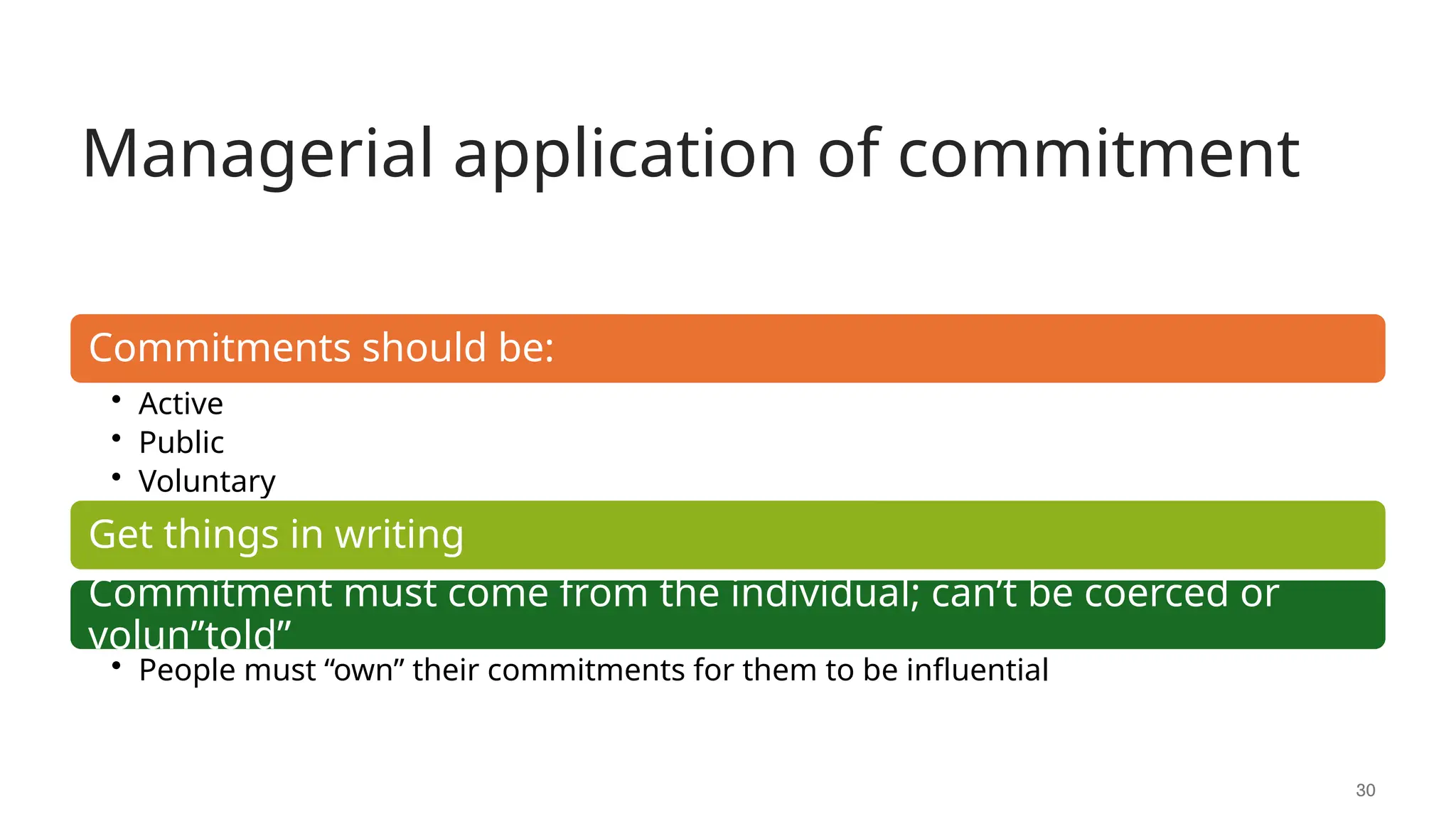
Managerial application ofcommitment
30
Commitments should be:
• Active
• Public
• Voluntary
Get things in writing
Commitment must come from the individual; can’t be coerced or
volun”told”
• People must “own” their commitments for them to be influential
31.
5)
Principle:
Authority
31
People defer toexperts
It pays to follow the suggestions
of a expert authority
Well-selected expert can provide
valuable and efficient short-cut to
good decision-making
32.
Managerial application ofauthority
32
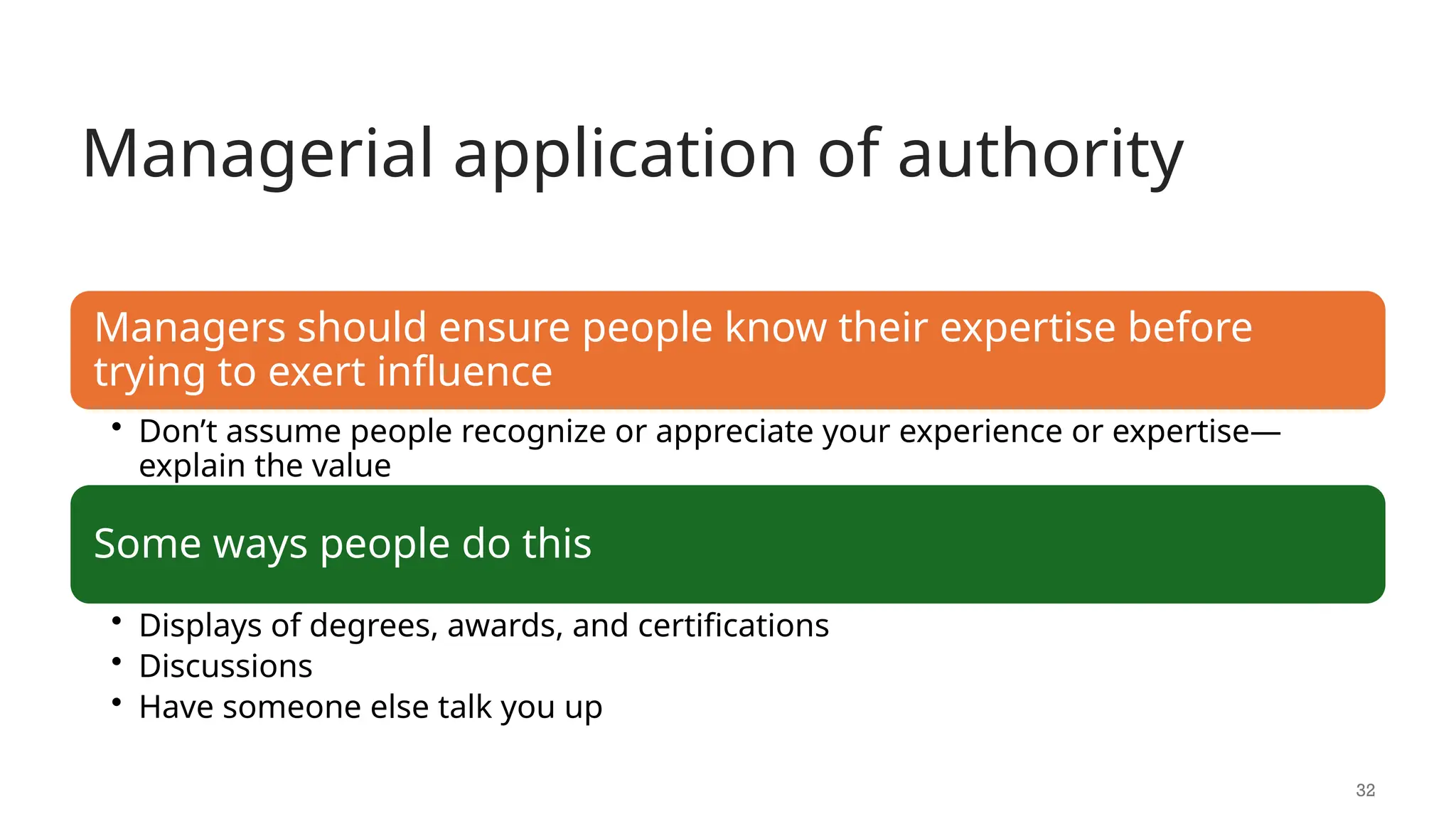
Managers should ensure people know their expertise before
trying to exert influence
• Don’t assume people recognize or appreciate your experience or expertise—
explain the value
Some ways people do this
• Displays of degrees, awards, and certifications
• Discussions
• Have someone else talk you up
33.
6)
Principle:
Scarcity
33
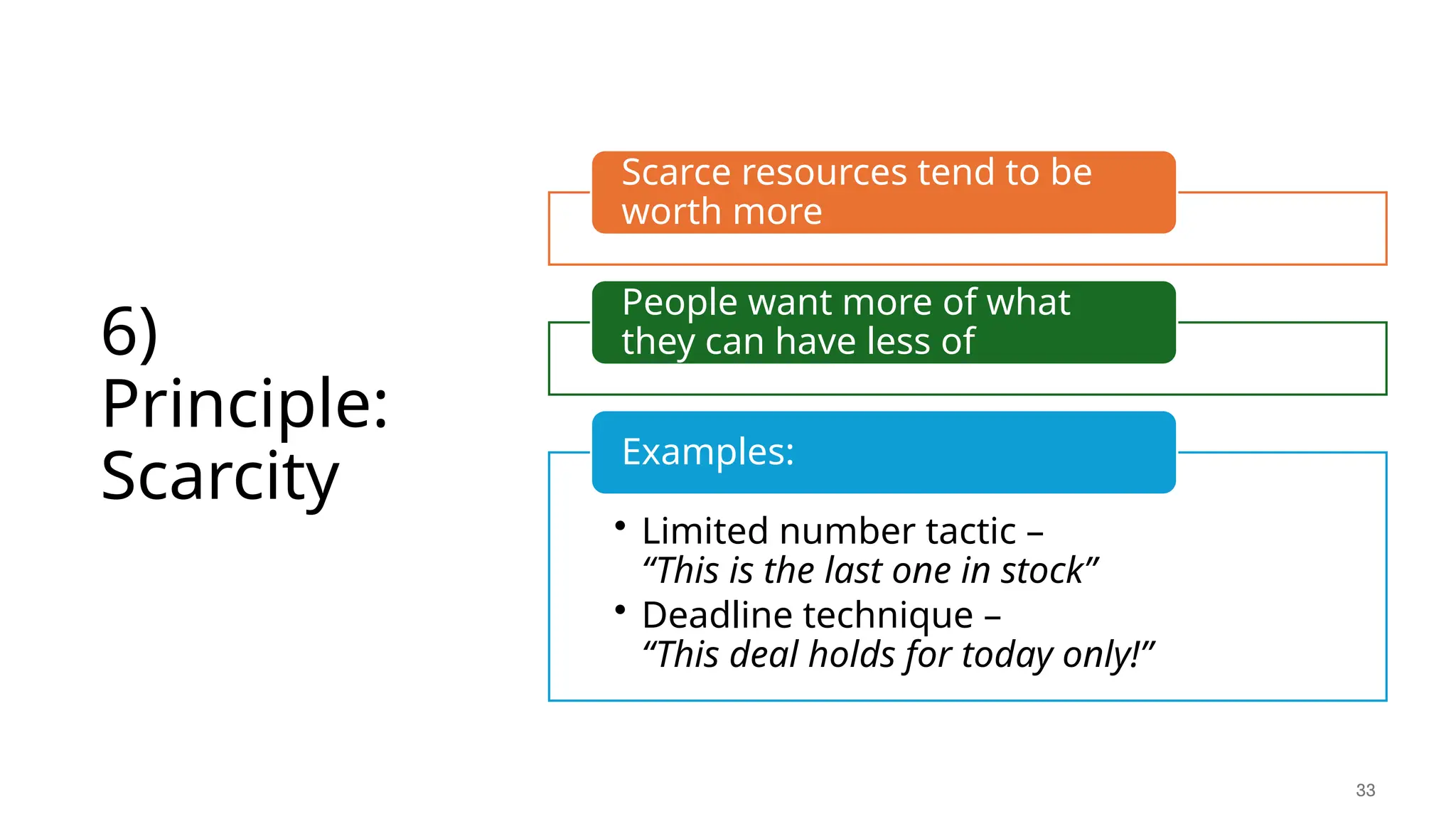
Scarce resources tendto be
worth more
People want more of what
they can have less of
• Limited number tactic –
“This is the last one in stock”
• Deadline technique –
“This deal holds for today only!”
Examples:
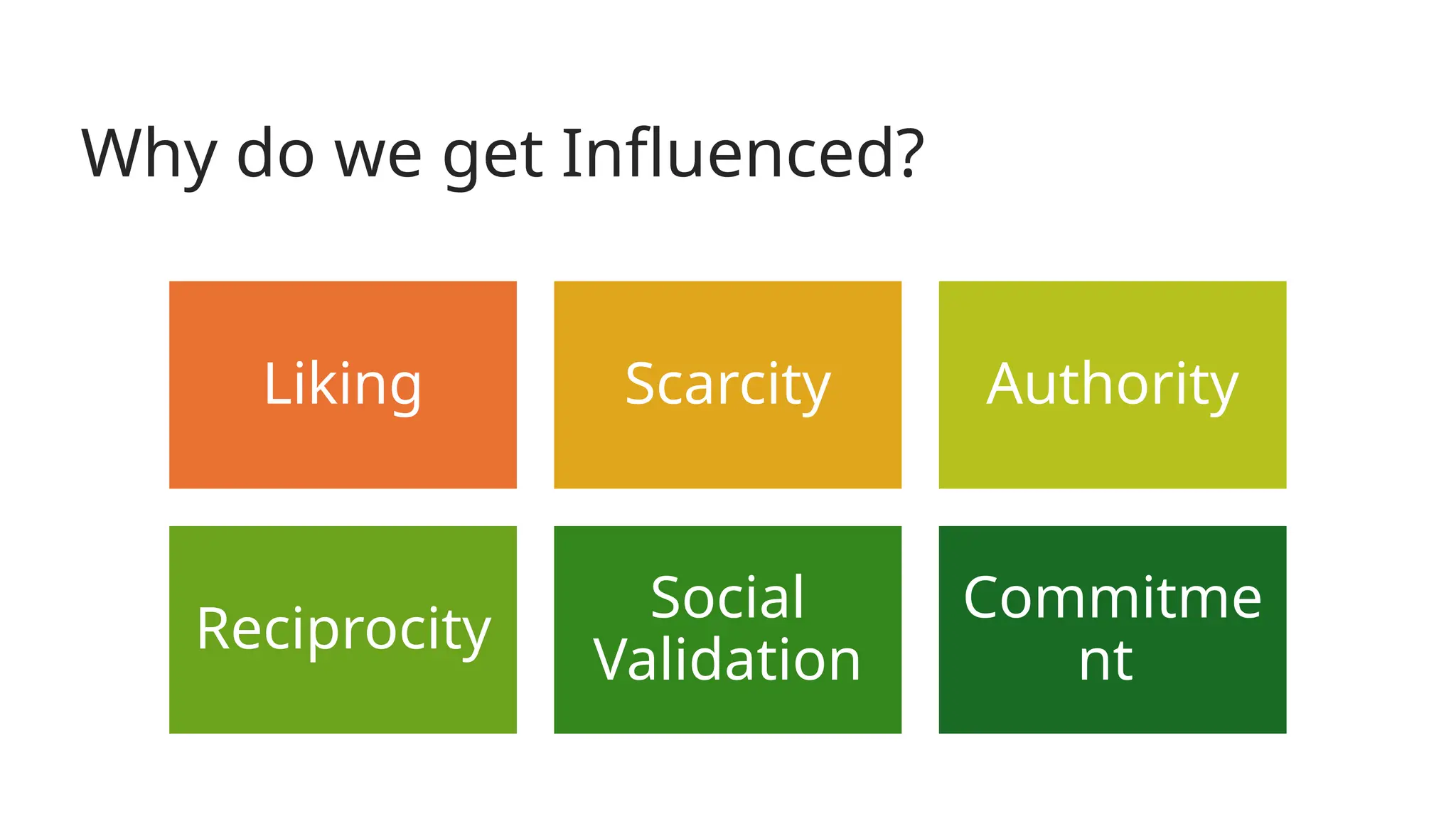
Why do weget Influenced?
Liking Scarcity Authority
Reciprocity
Social
Validation
Commitme
nt
36.
What Are Influence
Tactics?
(Howdo we do the influencing)
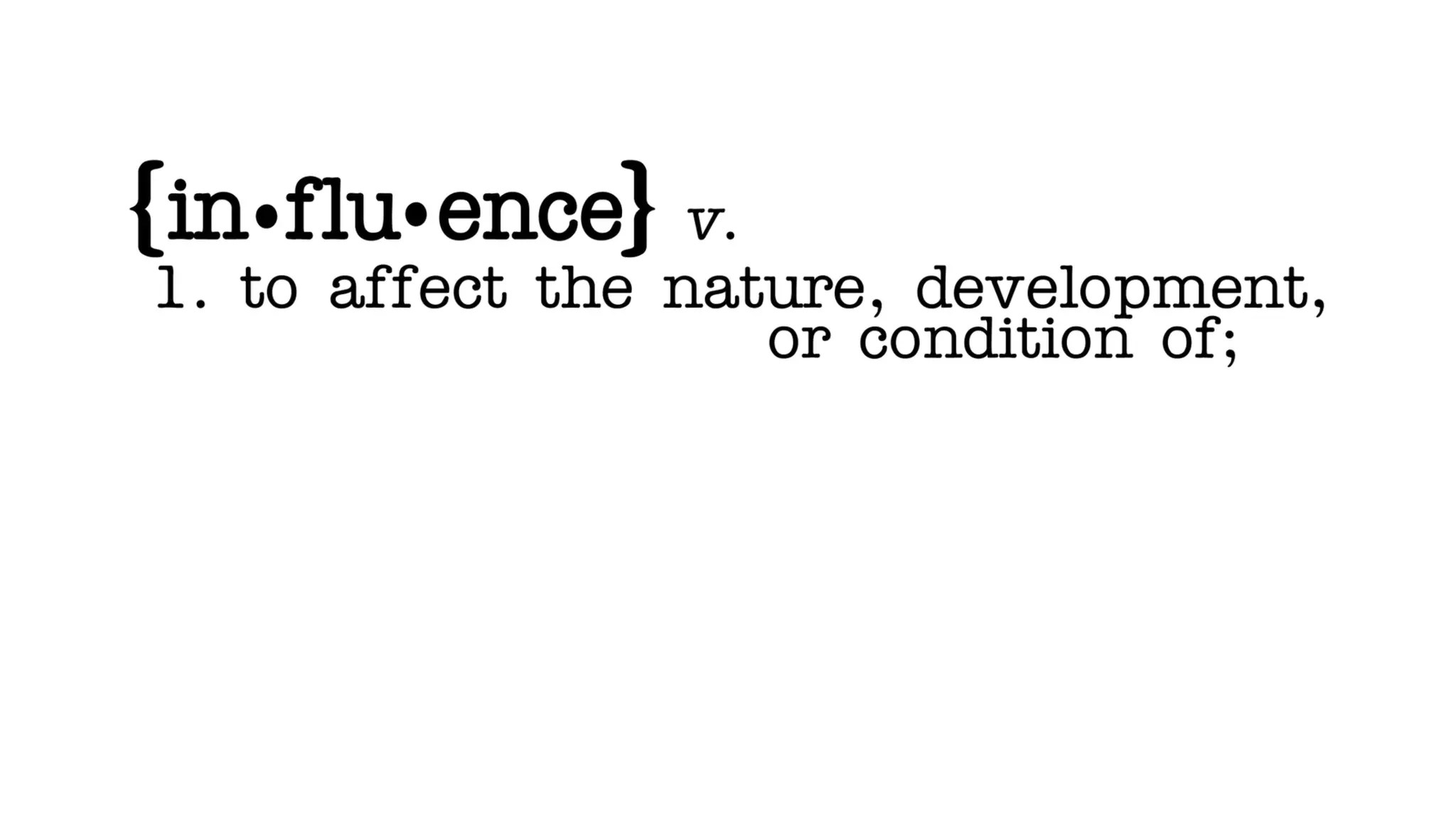
• Influence:
• Process of affecting the
thoughts, behaviors, and
feelings of another person
• Used for impression
management
• Directions of influence
tactics:
• Upward
• Downward
• Lateral
37.
Types of
Influence
Tactics
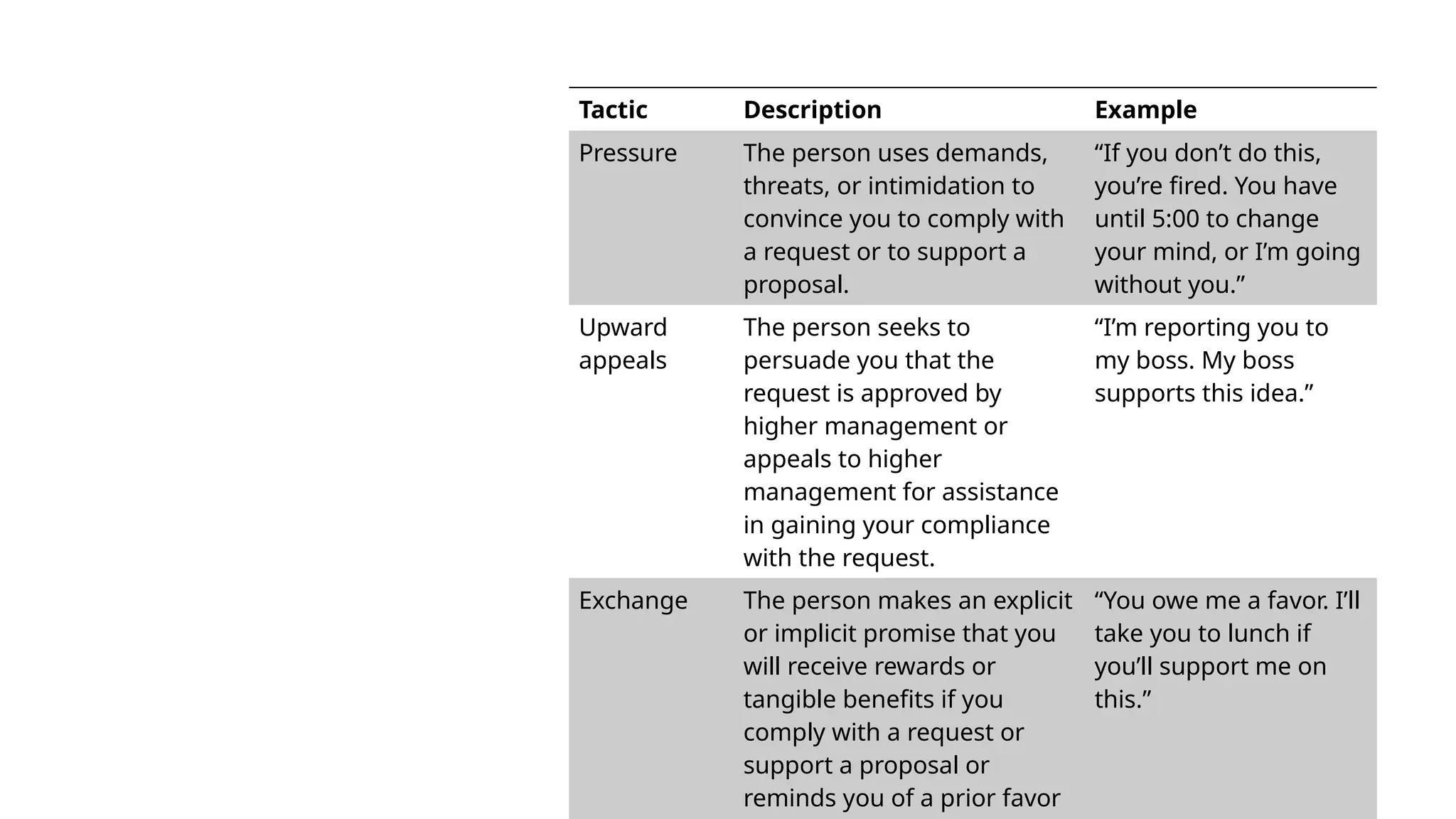
Tactic DescriptionExample
Pressure The person uses demands,
threats, or intimidation to
convince you to comply with
a request or to support a
proposal.
“If you don’t do this,
you’re fired. You have
until 5:00 to change
your mind, or I’m going
without you.”
Upward
appeals
The person seeks to
persuade you that the
request is approved by
higher management or
appeals to higher
management for assistance
in gaining your compliance
with the request.
“I’m reporting you to
my boss. My boss
supports this idea.”
Exchange The person makes an explicit
or implicit promise that you
will receive rewards or
tangible benefits if you
comply with a request or
support a proposal or
reminds you of a prior favor
“You owe me a favor. I’ll
take you to lunch if
you’ll support me on
this.”
38.
Types of
Influence
Tactics
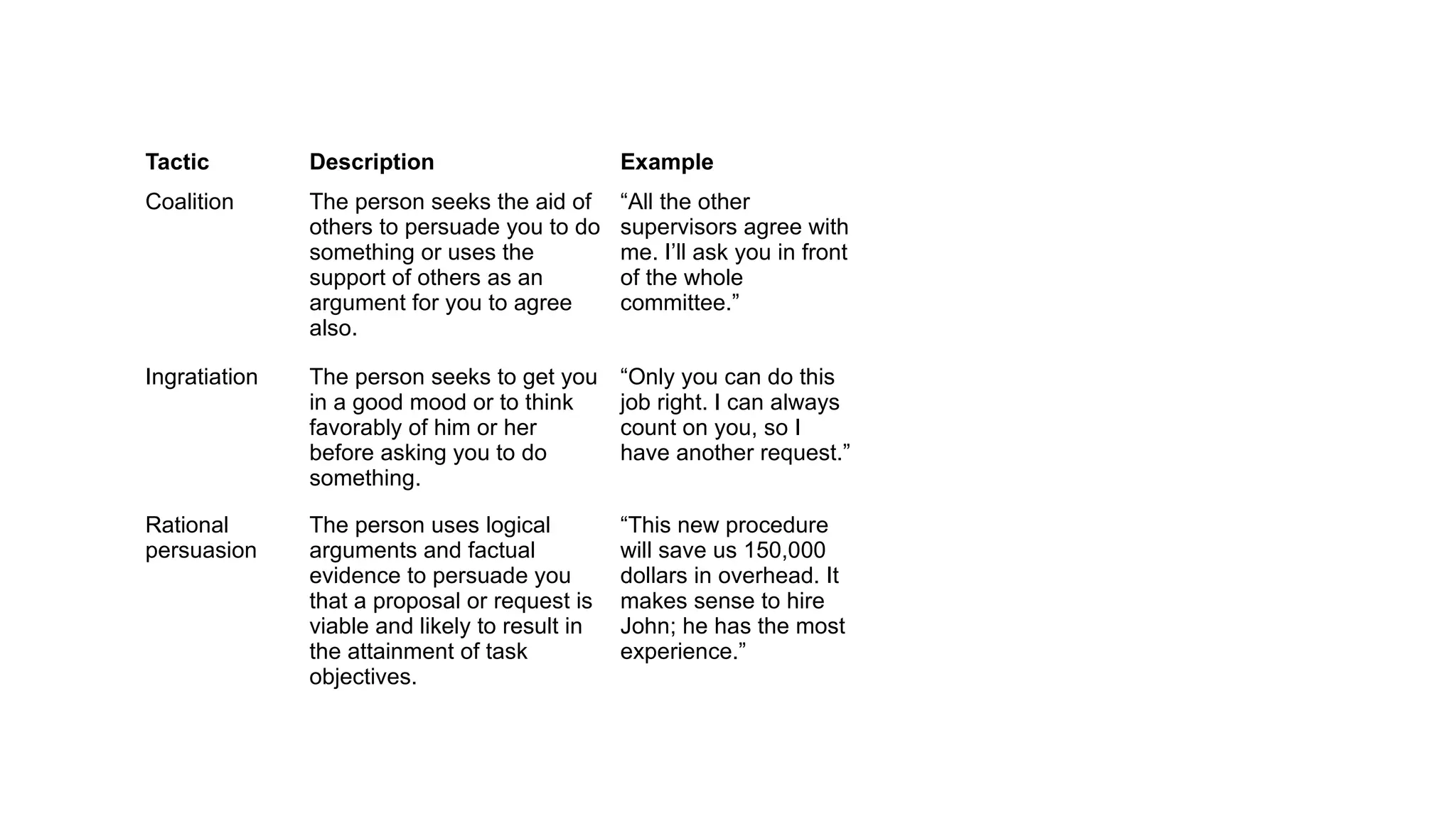
Tactic DescriptionExample
Coalition The person seeks the aid of
others to persuade you to do
something or uses the
support of others as an
argument for you to agree
also.
“All the other
supervisors agree with
me. I’ll ask you in front
of the whole
committee.”
Ingratiation The person seeks to get you
in a good mood or to think
favorably of him or her
before asking you to do
something.
“Only you can do this
job right. I can always
count on you, so I
have another request.”
Rational
persuasion
The person uses logical
arguments and factual
evidence to persuade you
that a proposal or request is
viable and likely to result in
the attainment of task
objectives.
“This new procedure
will save us 150,000
dollars in overhead. It
makes sense to hire
John; he has the most
experience.”
39.
Types of
Influence
Tactics
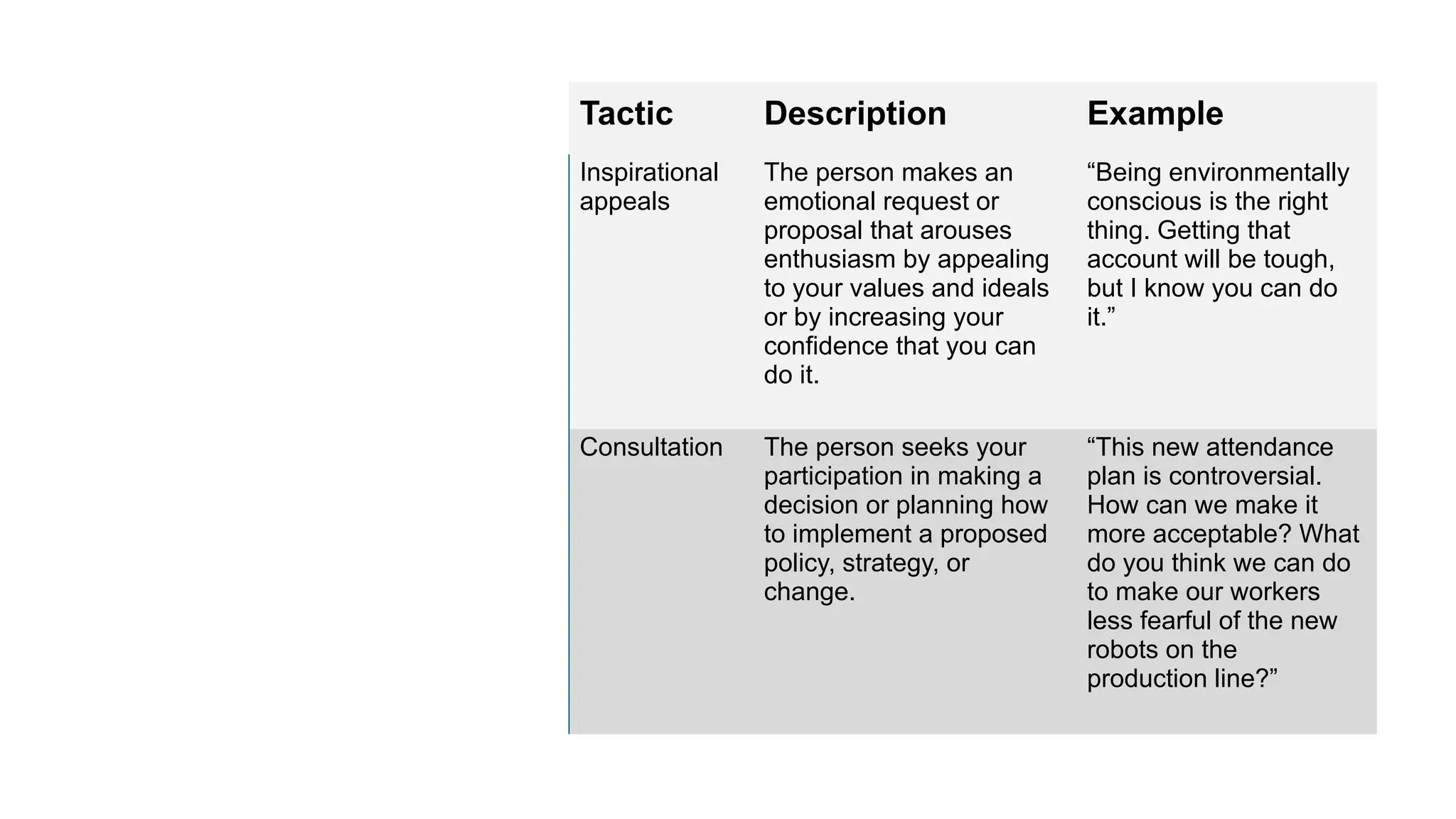
Tactic DescriptionExample
Inspirational
appeals
The person makes an
emotional request or
proposal that arouses
enthusiasm by appealing
to your values and ideals
or by increasing your
confidence that you can
do it.
“Being environmentally
conscious is the right
thing. Getting that
account will be tough,
but I know you can do
it.”
Consultation The person seeks your
participation in making a
decision or planning how
to implement a proposed
policy, strategy, or
change.
“This new attendance
plan is controversial.
How can we make it
more acceptable? What
do you think we can do
to make our workers
less fearful of the new
robots on the
production line?”
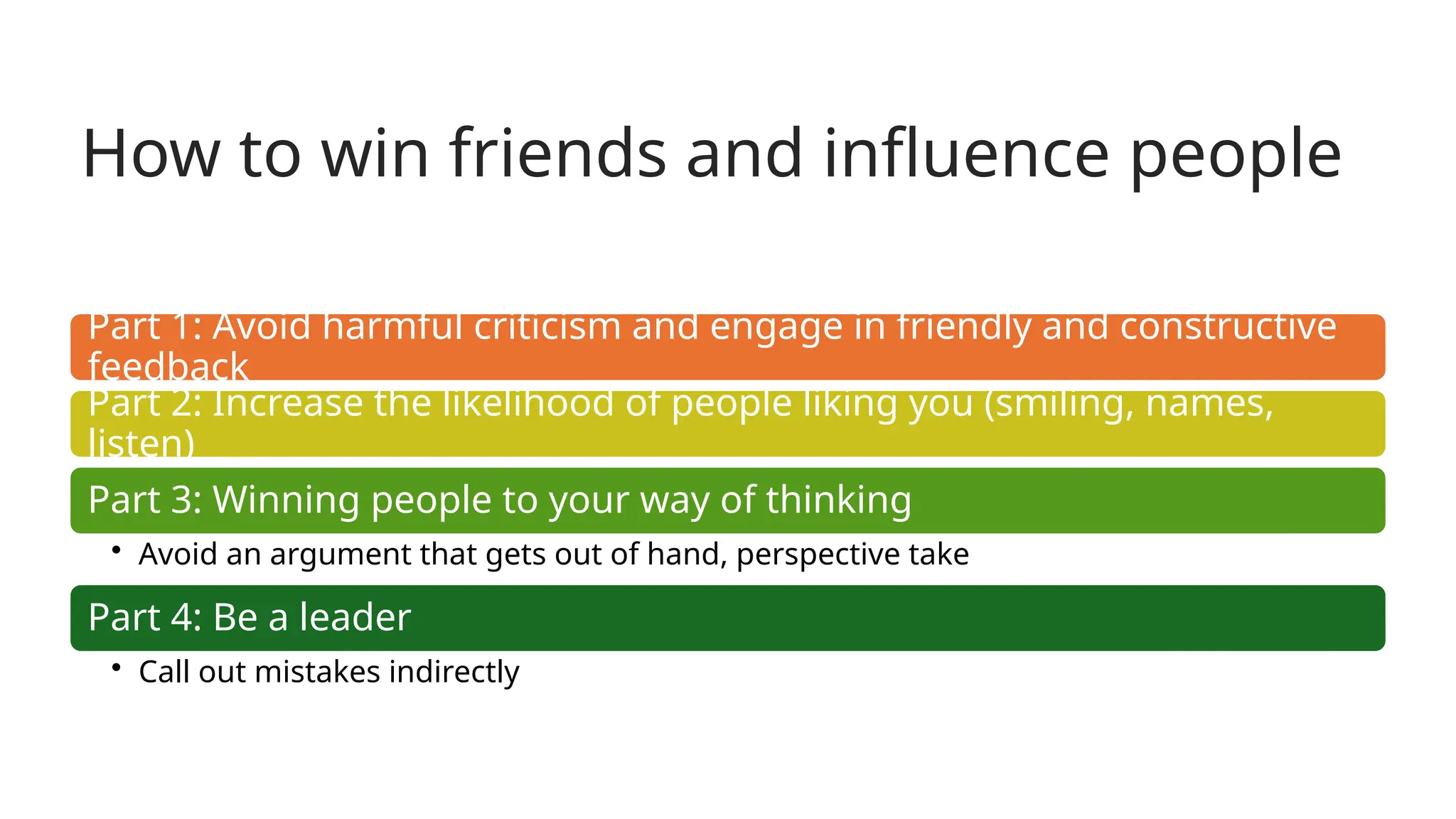
How to winfriends and influence people
Part 1: Avoid harmful criticism and engage in friendly and constructive
feedback
Part 2: Increase the likelihood of people liking you (smiling, names,
listen)
Part 3: Winning people to your way of thinking
• Avoid an argument that gets out of hand, perspective take
Part 4: Be a leader
• Call out mistakes indirectly
43.
Wait a second…
Isinfluence ethical? When
might it be ethical?
When might it cross a line?
44.
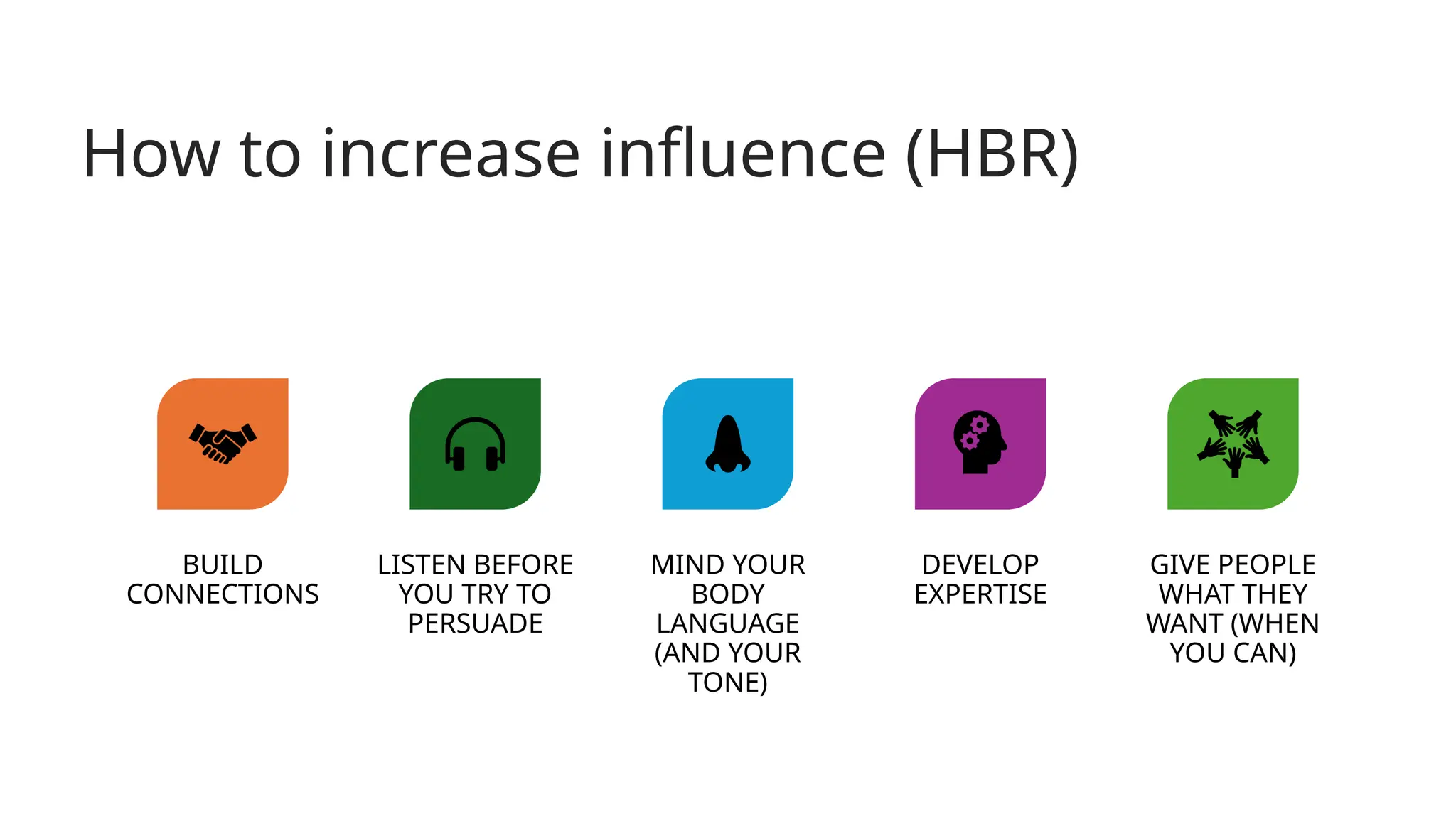
How to increaseinfluence (HBR)
BUILD
CONNECTIONS
LISTEN BEFORE
YOU TRY TO
PERSUADE
MIND YOUR
BODY
LANGUAGE
(AND YOUR
TONE)
DEVELOP
EXPERTISE
GIVE PEOPLE
WHAT THEY
WANT (WHEN
YOU CAN)
45.
Charisma
A charismatic personis
someone who is outgoing,
energetic, and likeable who
naturally draws others to them
What makes these people
charismatic? Can you think of
other examples?
46.
Empowerment
•Power over the…
•CONTENT- tasks and procedures necessary for
work
•CONTEXT - how the job fits into the organization’s
overall structure
47.
Political
Skill
• Getting things
doneoutside of
organizational
bylaws
• Social astuteness
• Interpersonal
Influence
• Networking ability
• Sincerity
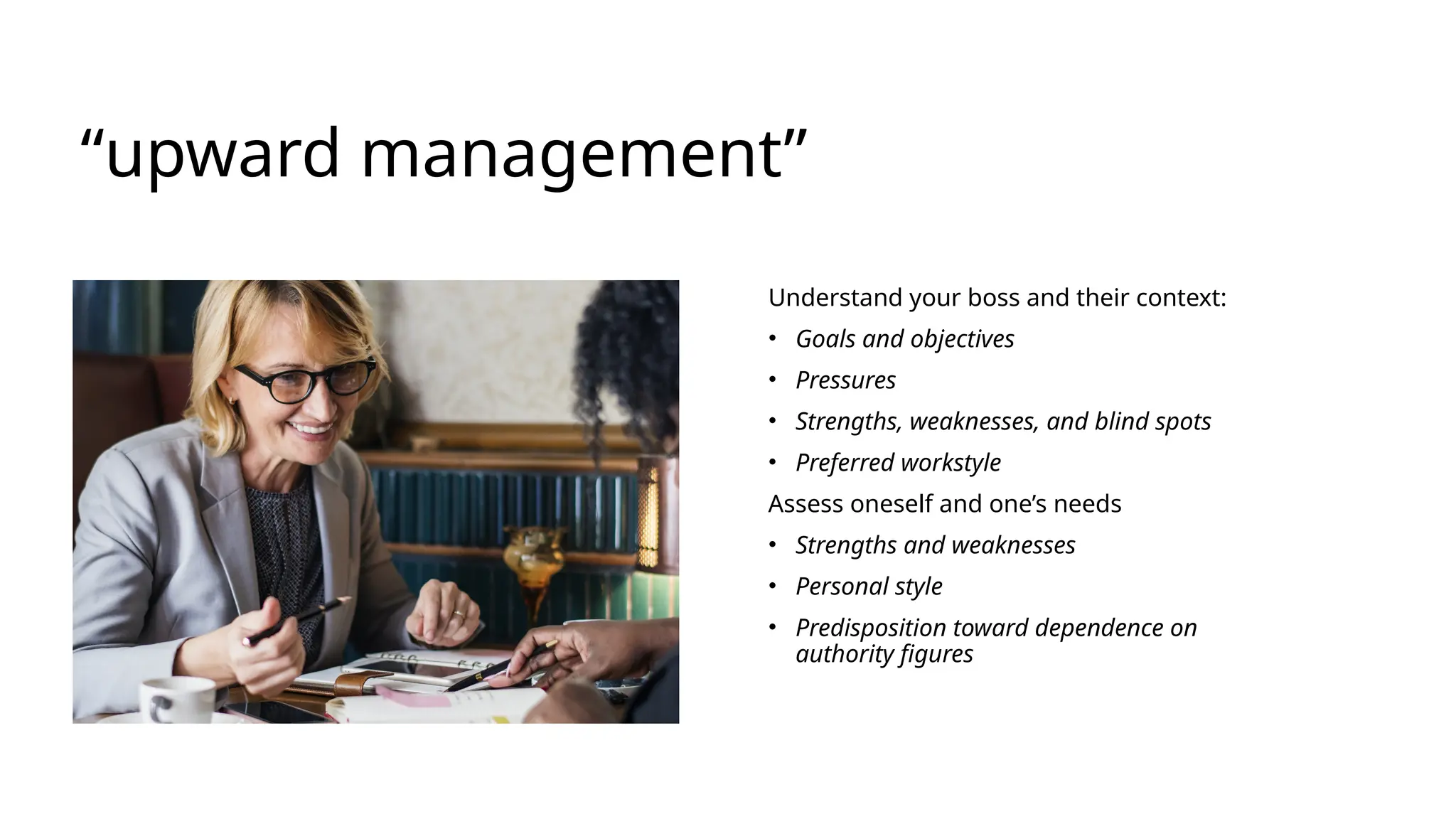
“upward management”
Understand yourboss and their context:
• Goals and objectives
• Pressures
• Strengths, weaknesses, and blind spots
• Preferred workstyle
Assess oneself and one’s needs
• Strengths and weaknesses
• Personal style
• Predisposition toward dependence on
authority figures
50.
“upward
management”
Develop and maintaina
relationship that:
• Fits one’s and the boss’s
needs and styles
• Is characterized by
mutual expectations
• Keeps the boss informed
• Is based on dependability
and honesty
• Selectively uses the boss’s
time and resources
51.
Chapter 11 Summary
•We can draw power from a multitude of different places, and it’s how
we use it that causes influence
• Power can be both tangible and intangible, and formal or personal
• Powerful people advocate for others, and the powerless tend to only
advocate for themselves
• Influence isn’t always a bad thing, but is always something we should
be aware of!
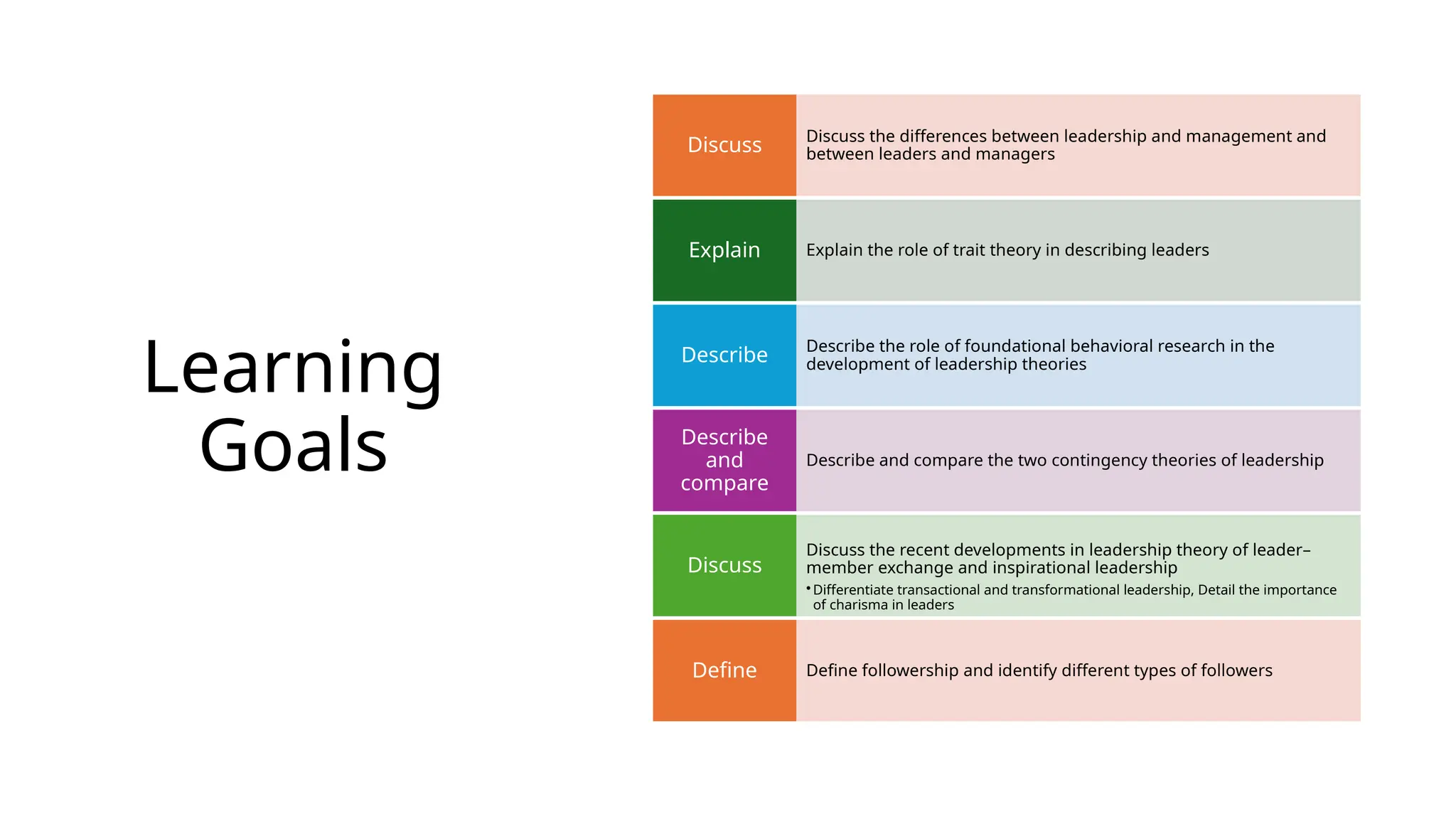
Learning
Goals
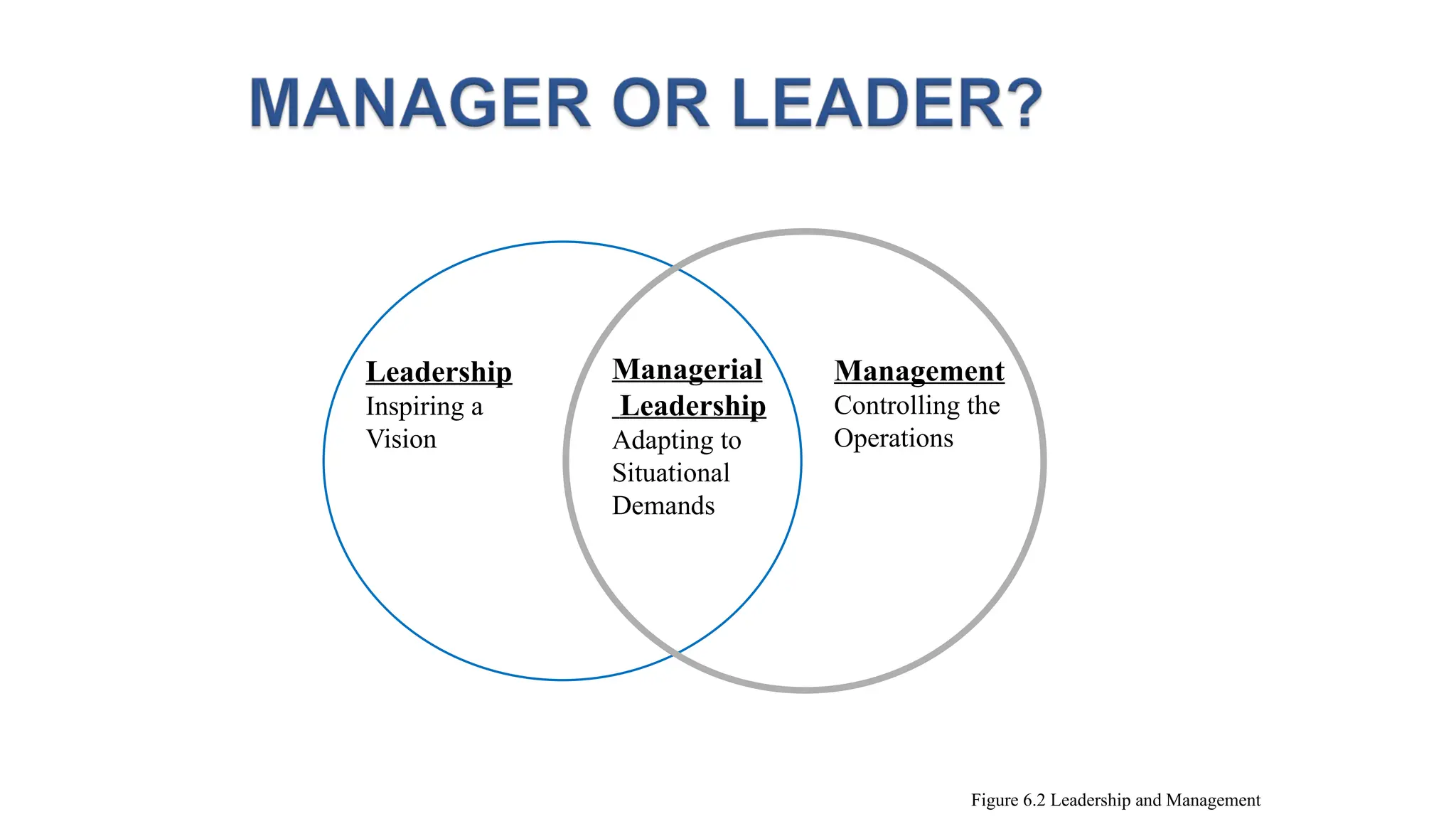
Discuss the differencesbetween leadership and management and
between leaders and managers
Discuss
Explain the role of trait theory in describing leaders
Explain
Describe the role of foundational behavioral research in the
development of leadership theories
Describe
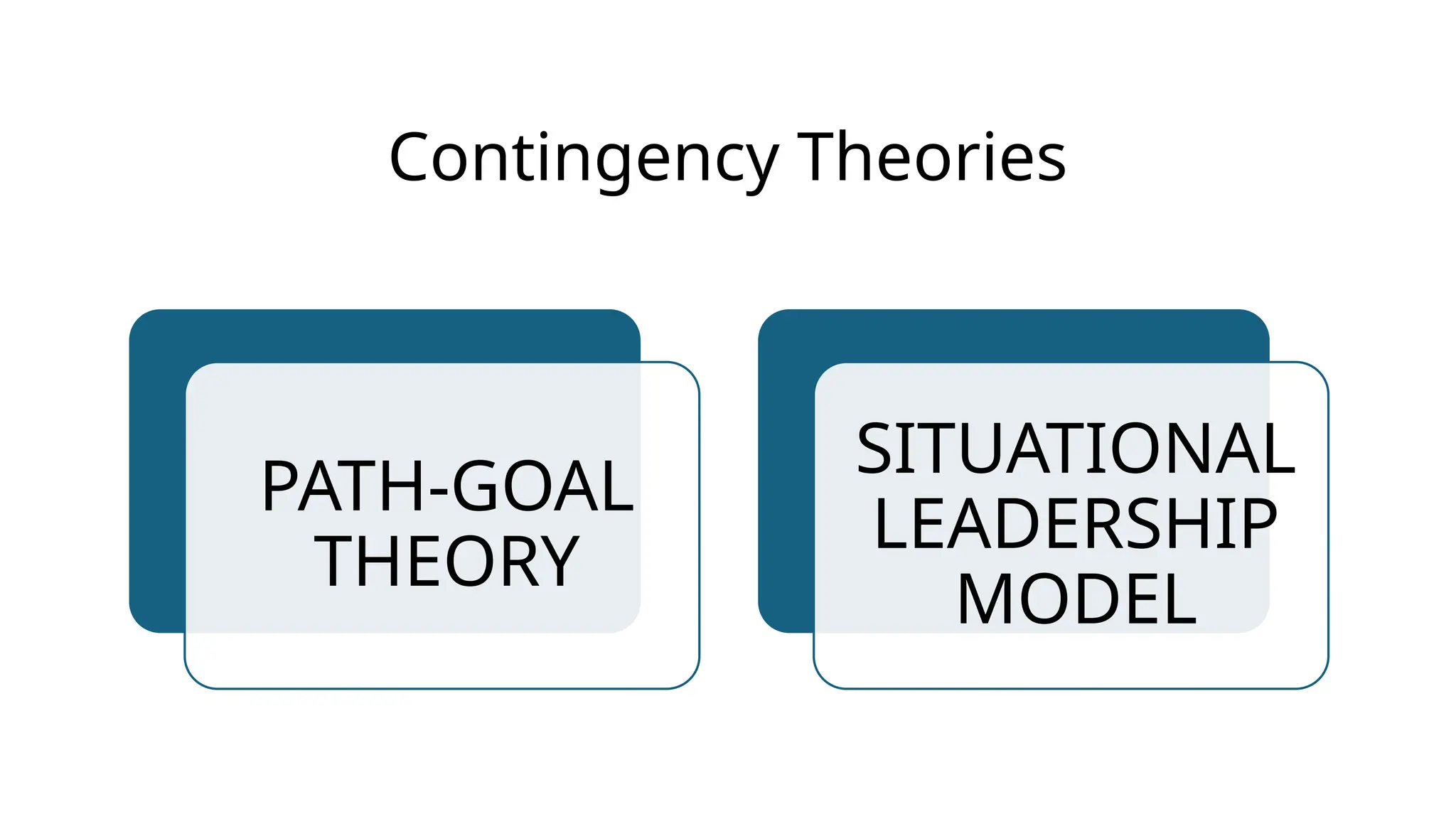
Describe and compare the two contingency theories of leadership
Describe
and
compare
Discuss the recent developments in leadership theory of leader–
member exchange and inspirational leadership
•Differentiate transactional and transformational leadership, Detail the importance
of charisma in leaders
Discuss
Define followership and identify different types of followers
Define
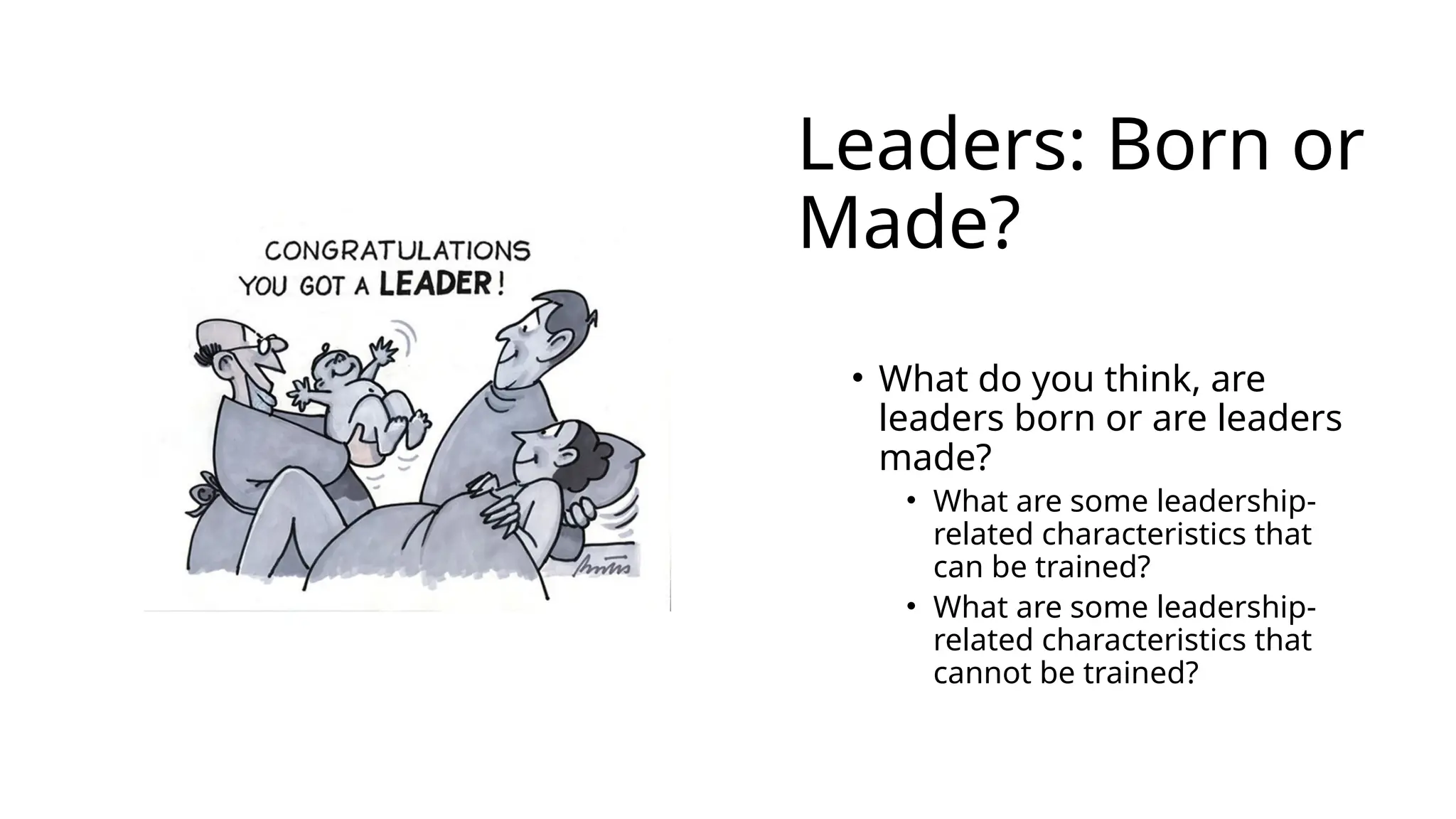
Leaders: Born or
Made?
•What do you think, are
leaders born or are leaders
made?
• What are some leadership-
related characteristics that
can be trained?
• What are some leadership-
related characteristics that
cannot be trained?
57.
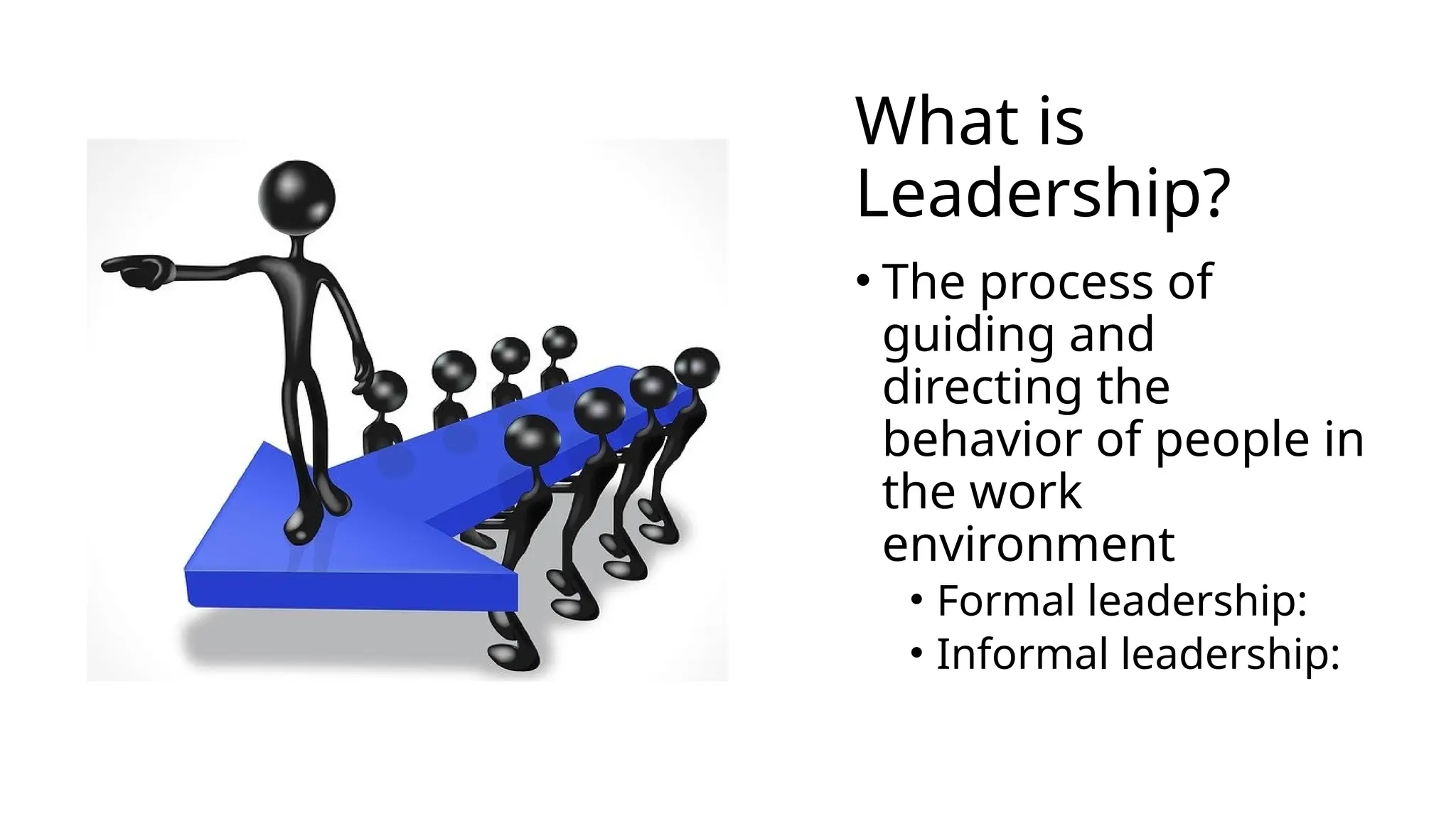
What is
Leadership?
• Theprocess of
guiding and
directing the
behavior of people in
the work
environment
• Formal leadership:
• Informal leadership:
58.
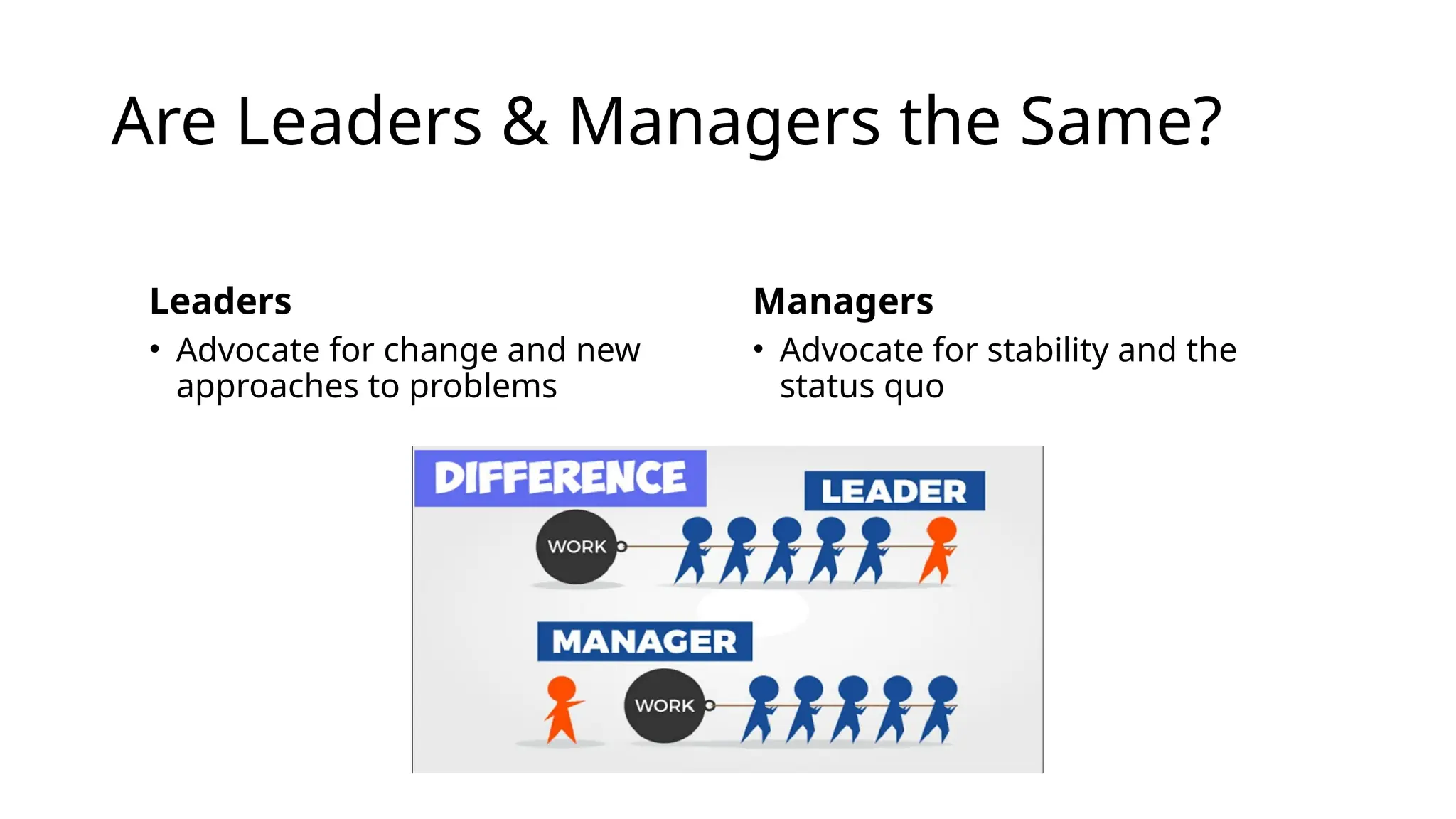
Are Leaders &Managers the Same?
Leaders
• Advocate for change and new
approaches to problems
Managers
• Advocate for stability and the
status quo
59.
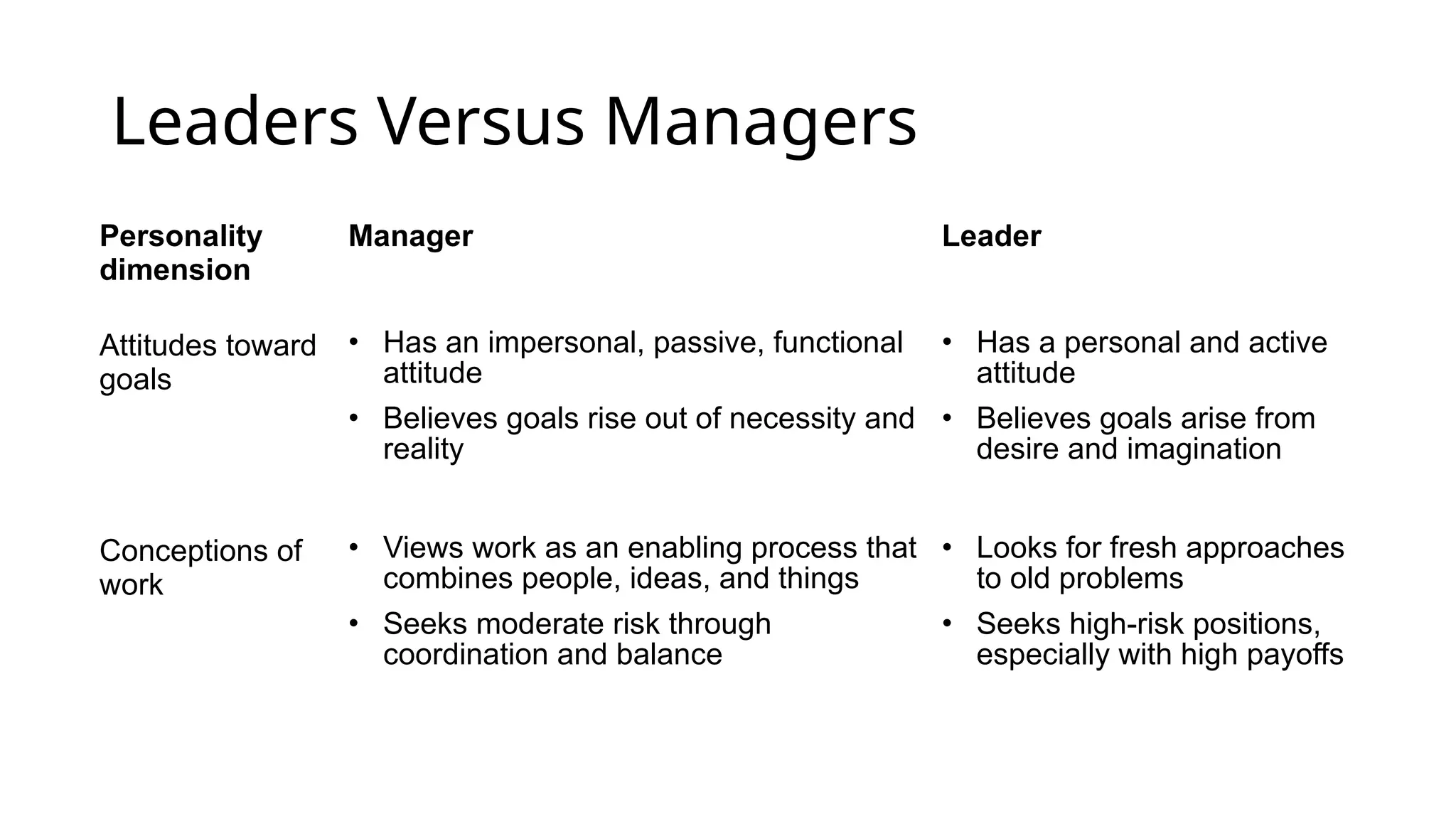
Leaders Versus Managers
Personality
dimension
ManagerLeader
Attitudes toward
goals
• Has an impersonal, passive, functional
attitude
• Believes goals rise out of necessity and
reality
• Has a personal and active
attitude
• Believes goals arise from
desire and imagination
Conceptions of
work
• Views work as an enabling process that
combines people, ideas, and things
• Seeks moderate risk through
coordination and balance
• Looks for fresh approaches
to old problems
• Seeks high-risk positions,
especially with high payoffs
60.
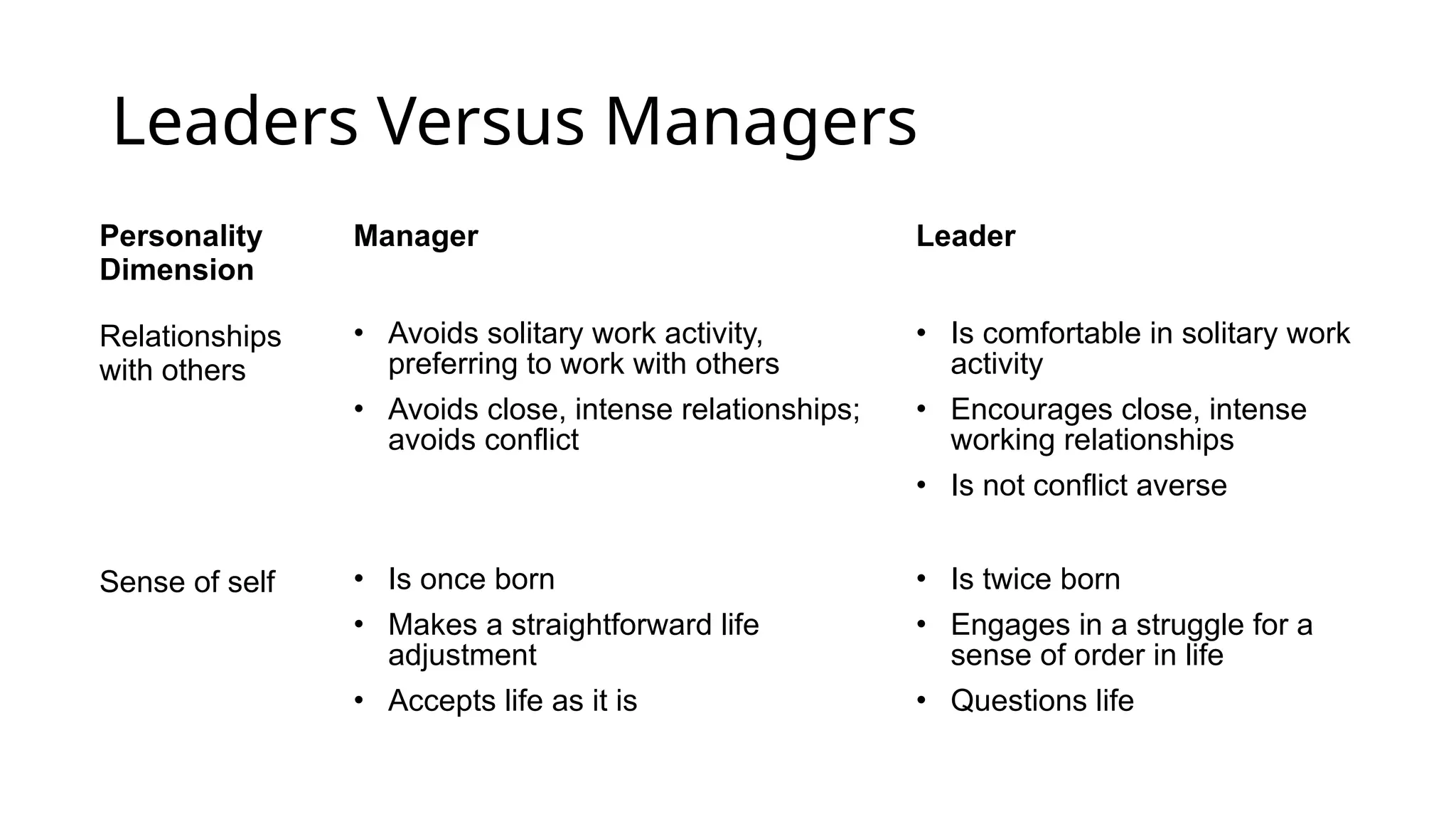
Leaders Versus Managers
Personality
Dimension
ManagerLeader
Relationships
with others
• Avoids solitary work activity,
preferring to work with others
• Avoids close, intense relationships;
avoids conflict
• Is comfortable in solitary work
activity
• Encourages close, intense
working relationships
• Is not conflict averse
Sense of self • Is once born
• Makes a straightforward life
adjustment
• Accepts life as it is
• Is twice born
• Engages in a struggle for a
sense of order in life
• Questions life
61.
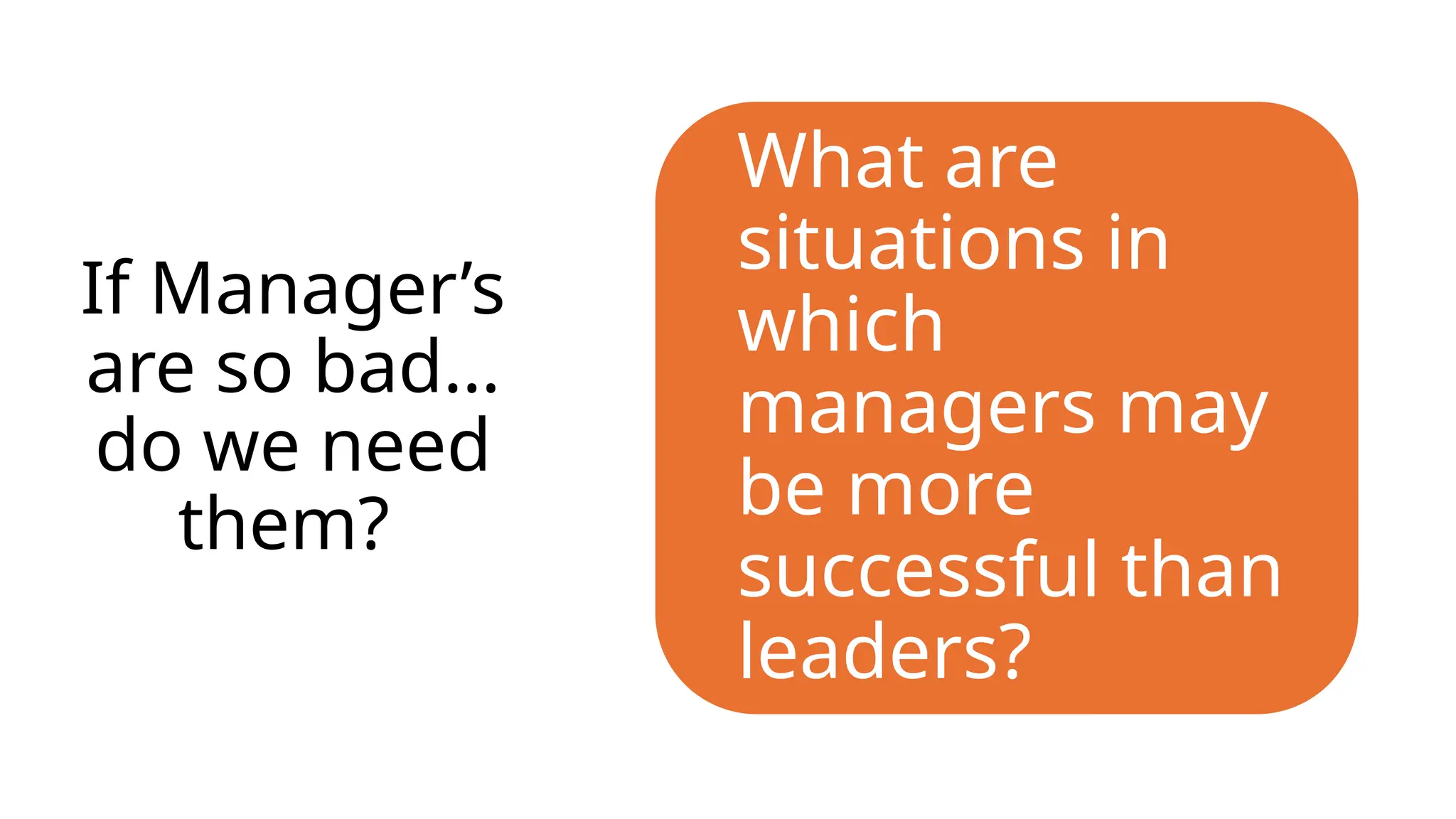
If Manager’s
are sobad…
do we need
them?
What are
situations in
which
managers may
be more
successful than
leaders?
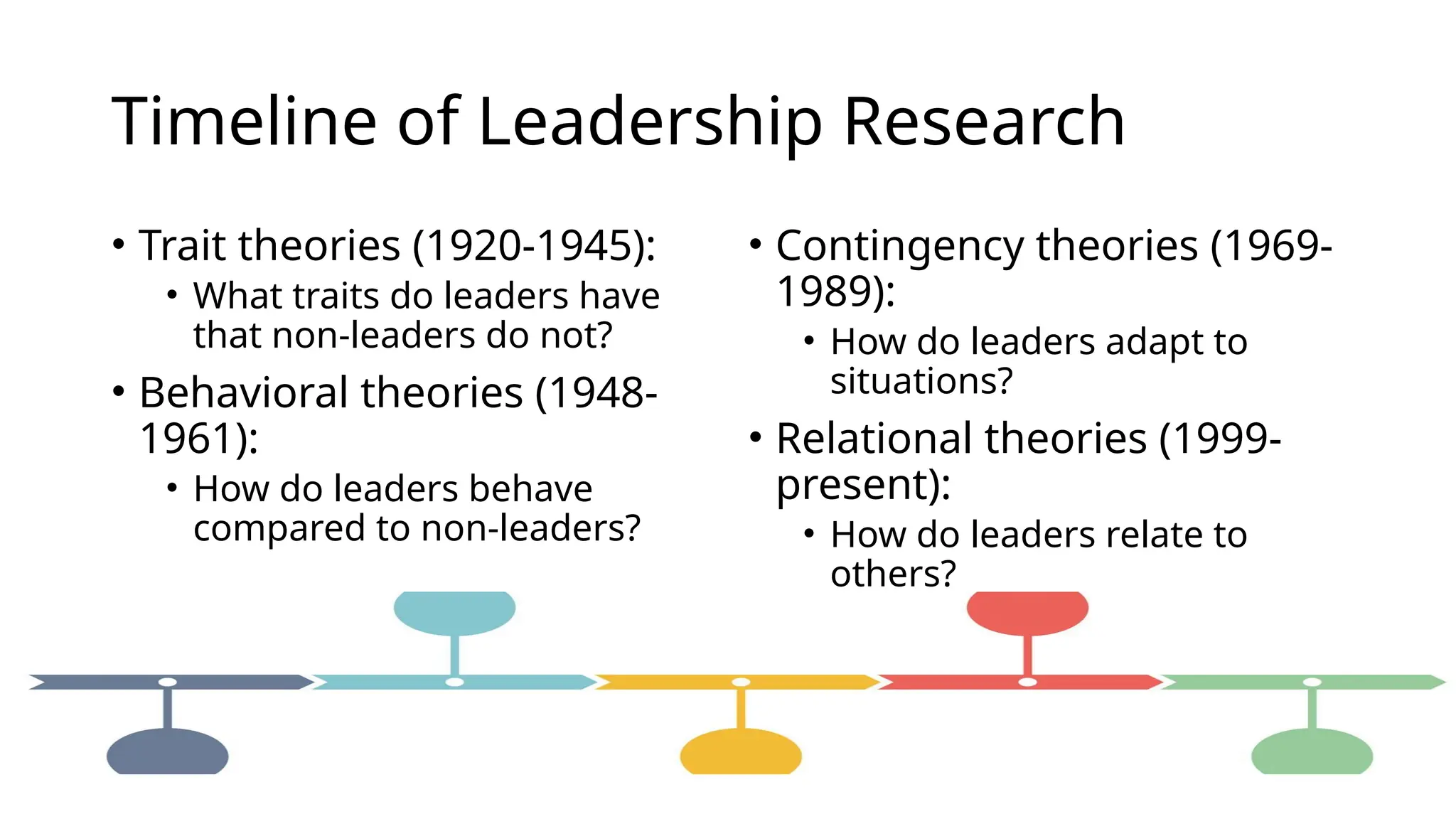
Timeline of LeadershipResearch
• Trait theories (1920-1945):
• What traits do leaders have
that non-leaders do not?
• Behavioral theories (1948-
1961):
• How do leaders behave
compared to non-leaders?
• Contingency theories (1969-
1989):
• How do leaders adapt to
situations?
• Relational theories (1999-
present):
• How do leaders relate to
others?
65.
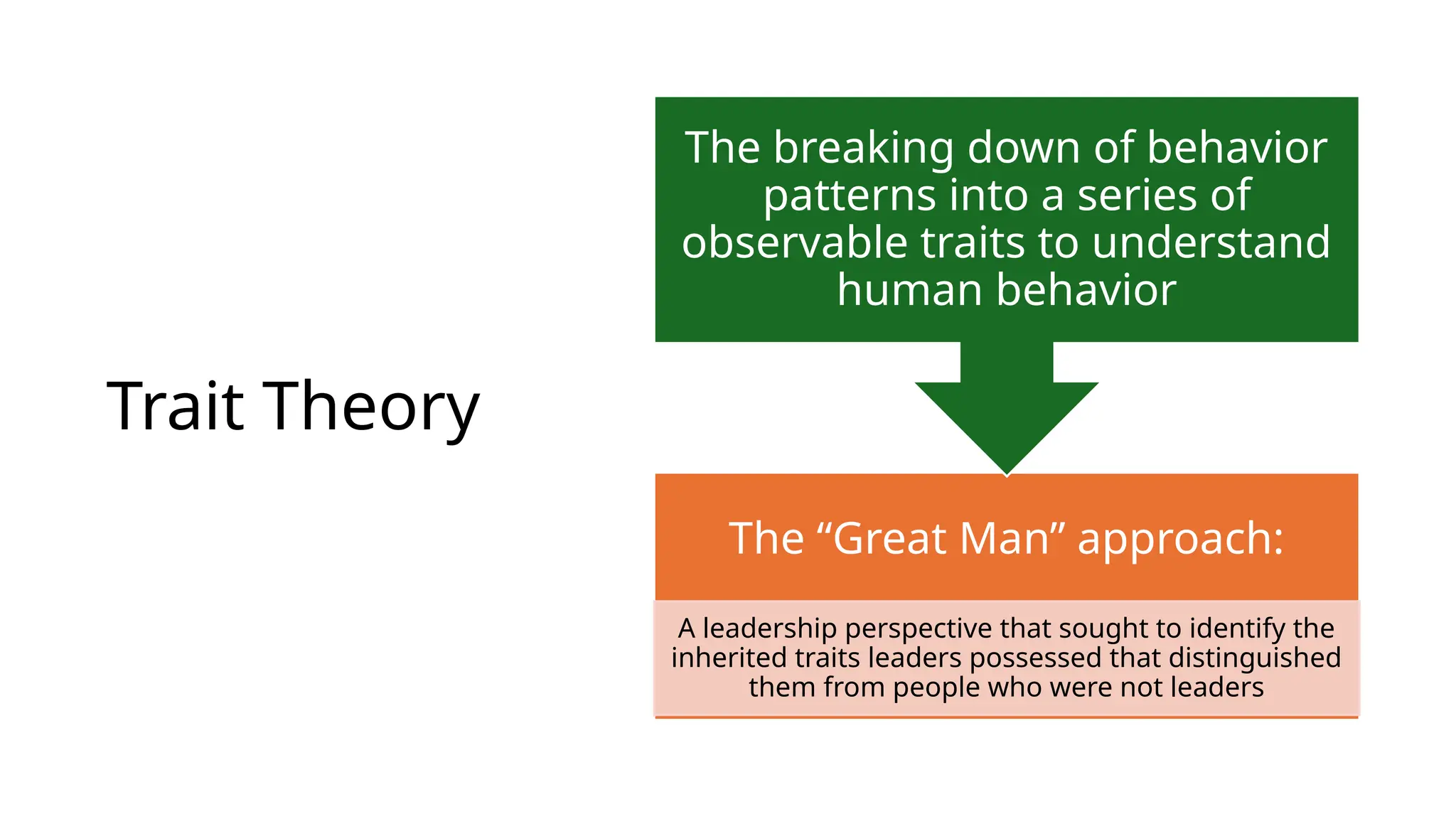
Trait Theory
The “GreatMan” approach:
A leadership perspective that sought to identify the
inherited traits leaders possessed that distinguished
them from people who were not leaders
The breaking down of behavior
patterns into a series of
observable traits to understand
human behavior
66.
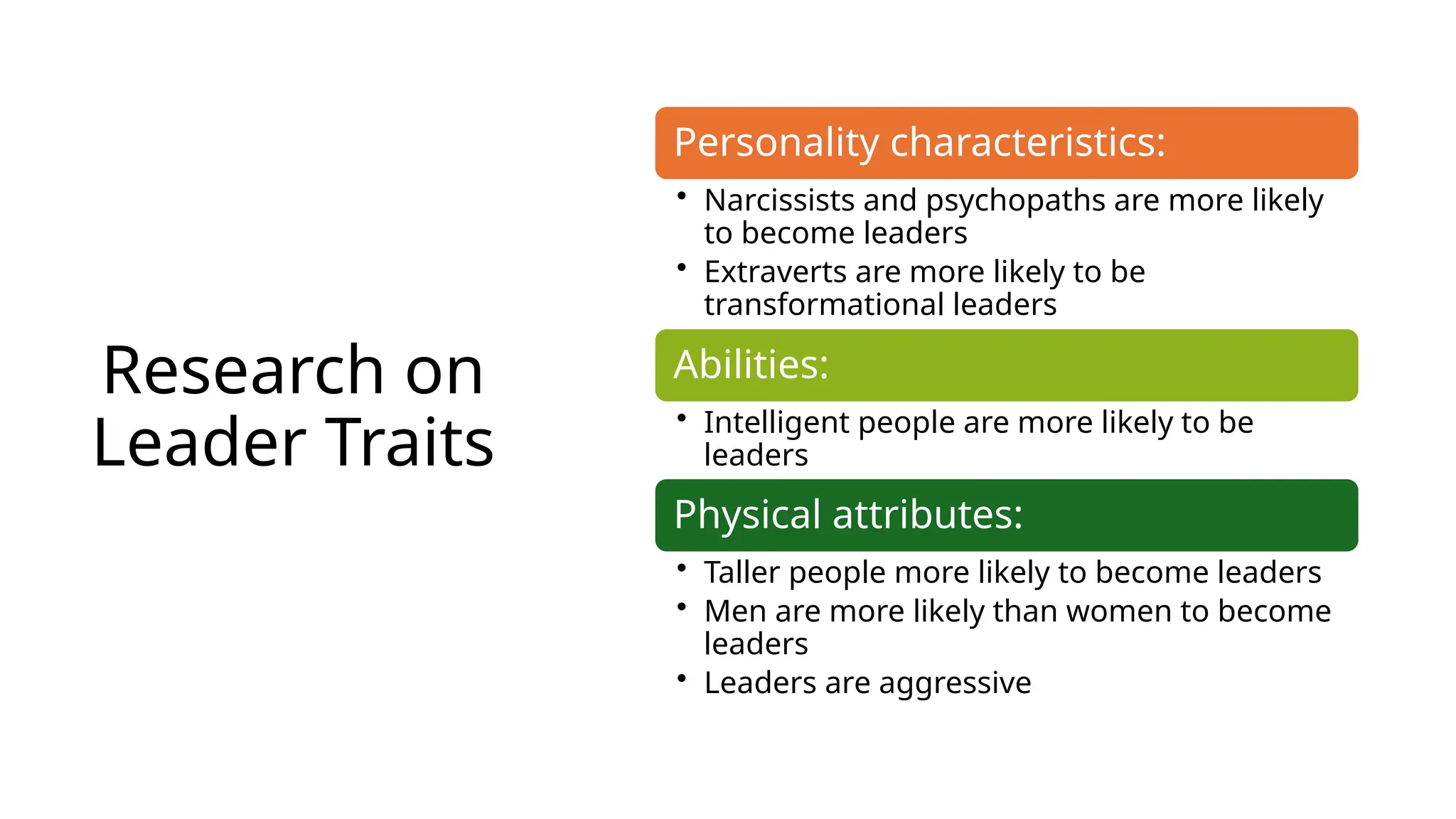
Research on
Leader Traits
Personalitycharacteristics:
• Narcissists and psychopaths are more likely
to become leaders
• Extraverts are more likely to be
transformational leaders
Abilities:
• Intelligent people are more likely to be
leaders
Physical attributes:
• Taller people more likely to become leaders
• Men are more likely than women to become
leaders
• Leaders are aggressive
67.
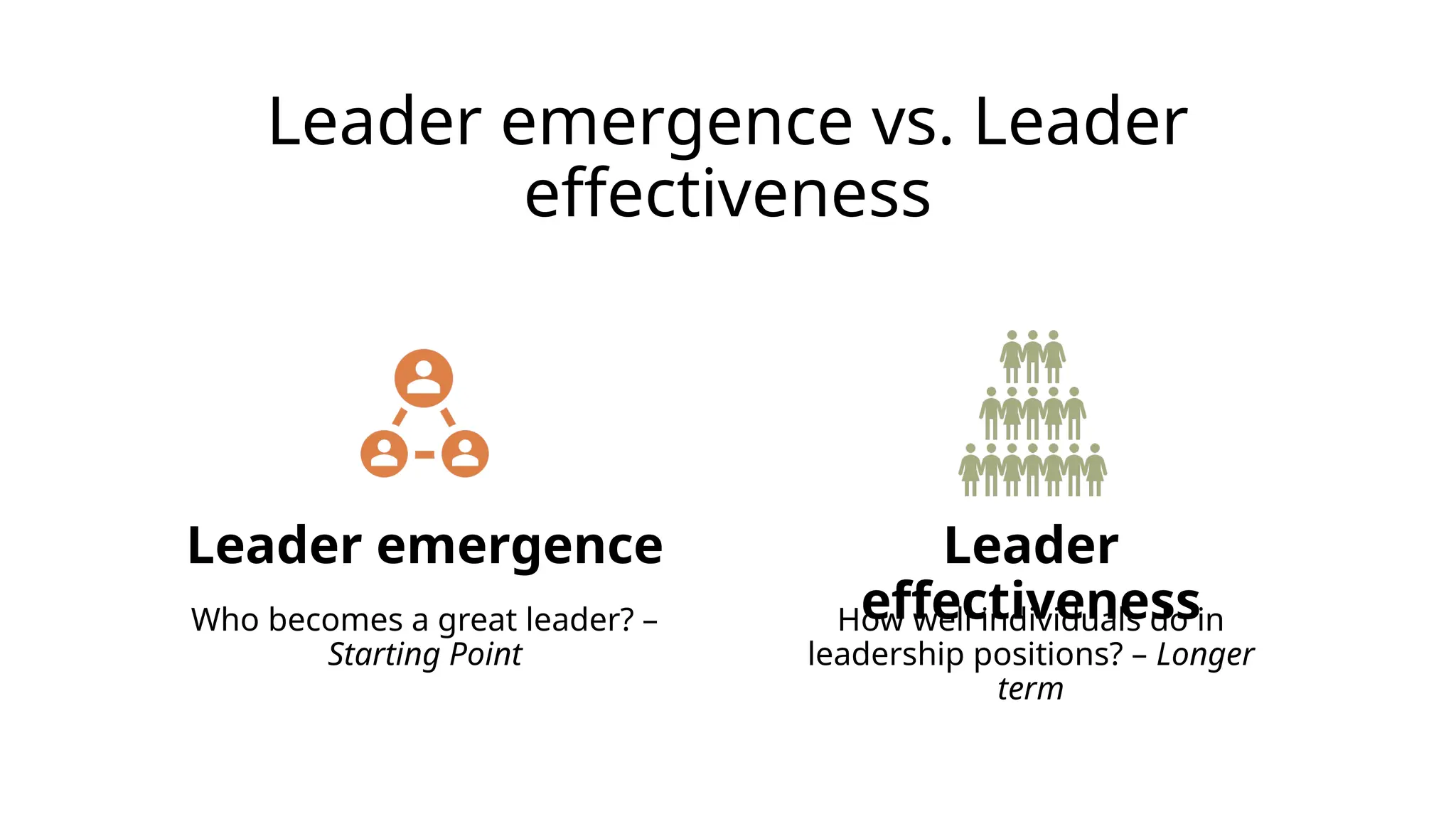
Leader emergence vs.Leader
effectiveness
Leader emergence
Who becomes a great leader? –
Starting Point
Leader
effectiveness
How well individuals do in
leadership positions? – Longer
term
68.
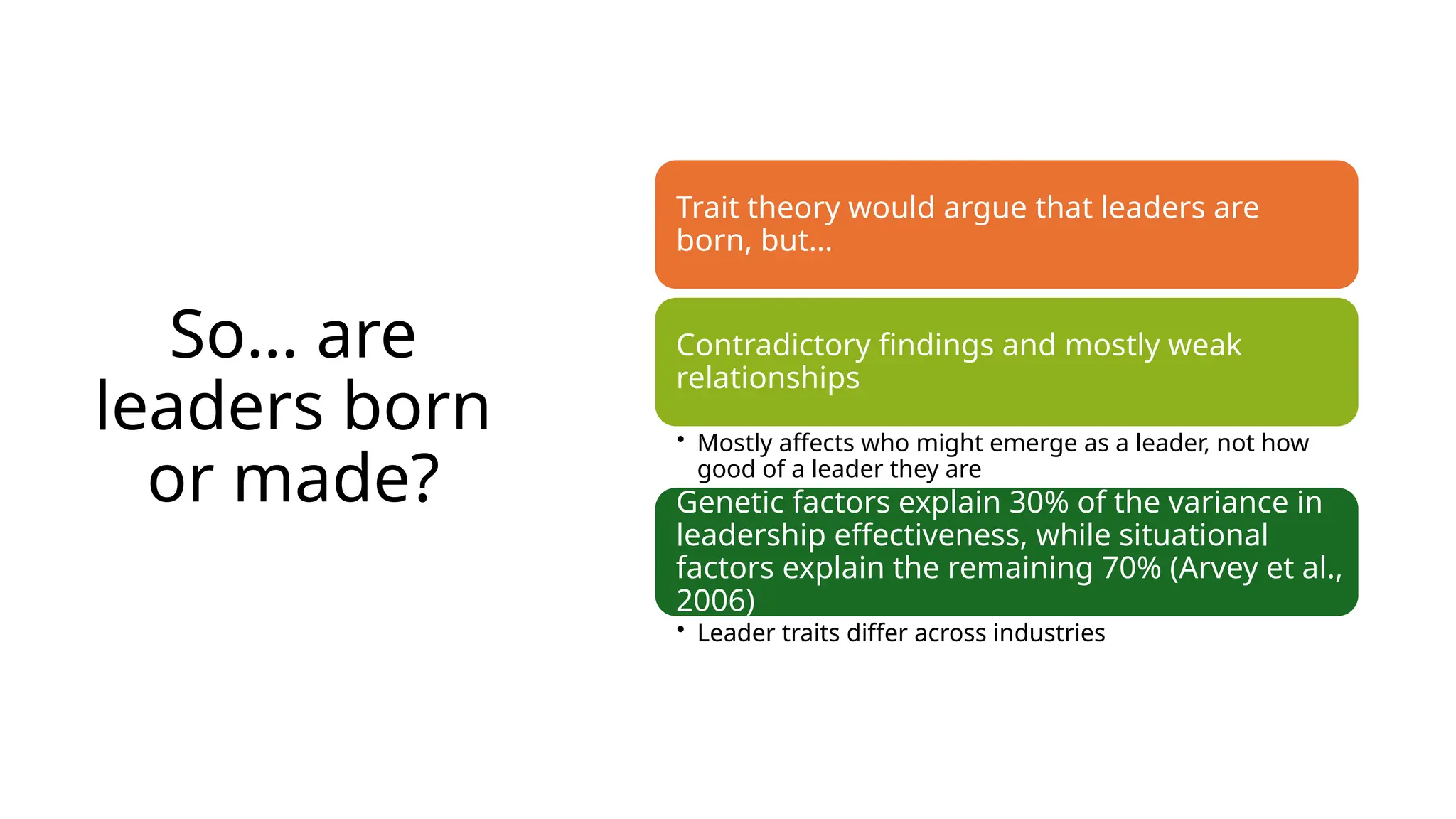
So… are
leaders born
ormade?
Trait theory would argue that leaders are
born, but…
Contradictory findings and mostly weak
relationships
• Mostly affects who might emerge as a leader, not how
good of a leader they are
Genetic factors explain 30% of the variance in
leadership effectiveness, while situational
factors explain the remaining 70% (Arvey et al.,
2006)
• Leader traits differ across industries
69.
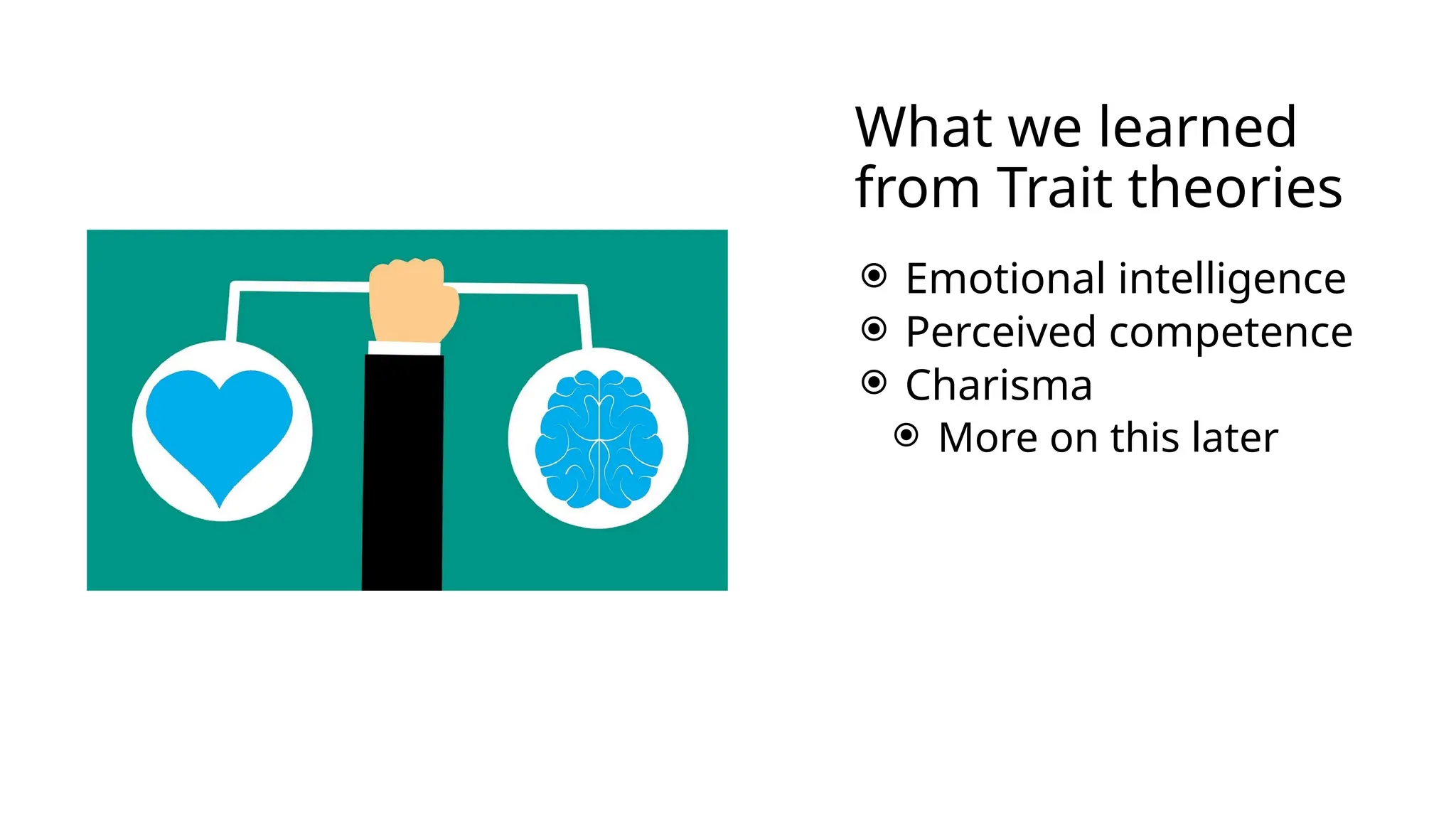
What we learned
fromTrait theories
Emotional intelligence
Perceived competence
Charisma
More on this later
Behavioral
Theories
◦ Assumes peoplecan be trained to lead
◦ Researched the behaviors of specific
leaders
◦ Provides the basis of design for training
programs
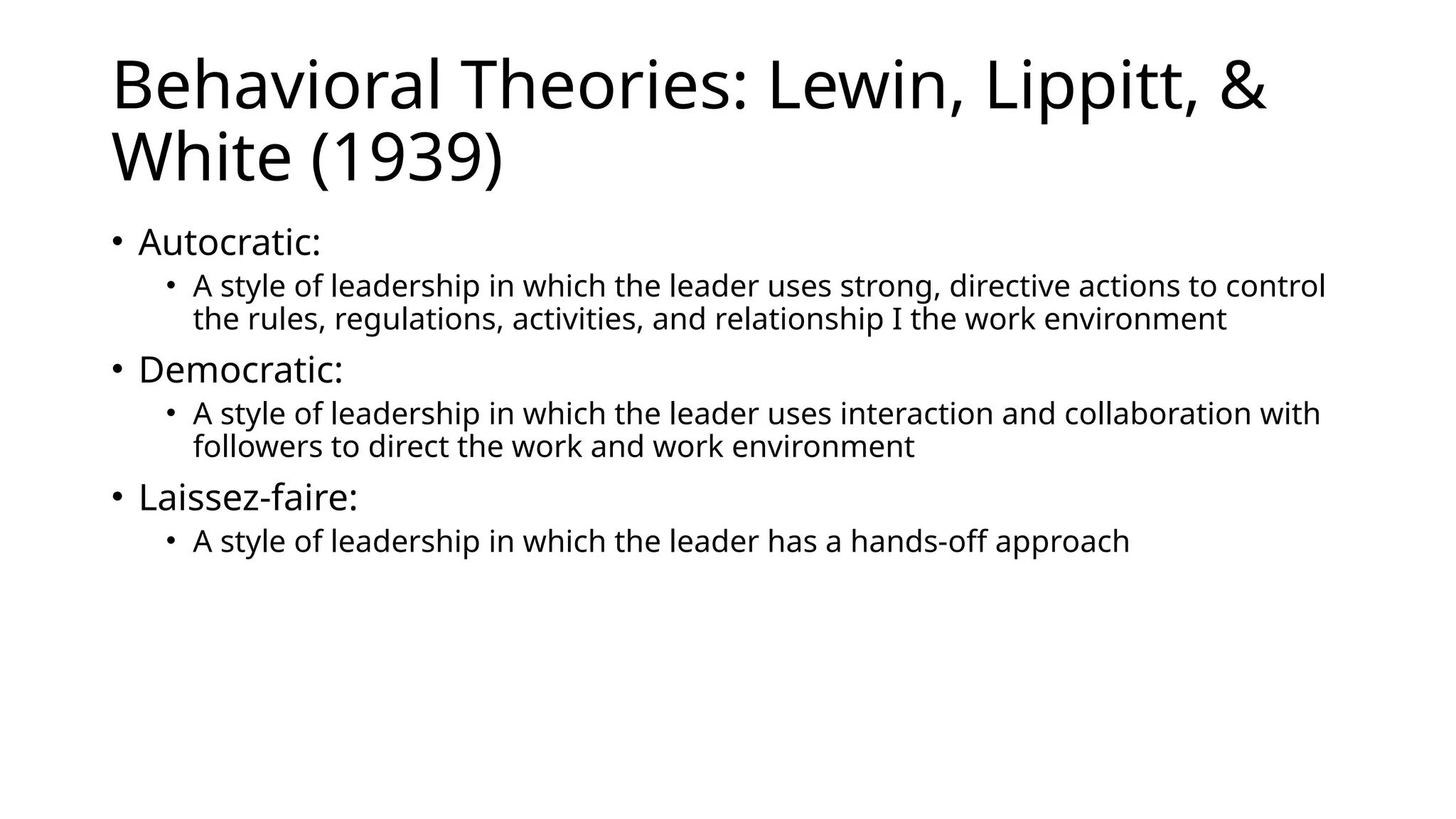
Behavioral Theories: Lewin,Lippitt, &
White (1939)
• Autocratic:
• A style of leadership in which the leader uses strong, directive actions to control
the rules, regulations, activities, and relationship I the work environment
• Democratic:
• A style of leadership in which the leader uses interaction and collaboration with
followers to direct the work and work environment
• Laissez-faire:
• A style of leadership in which the leader has a hands-off approach
74.
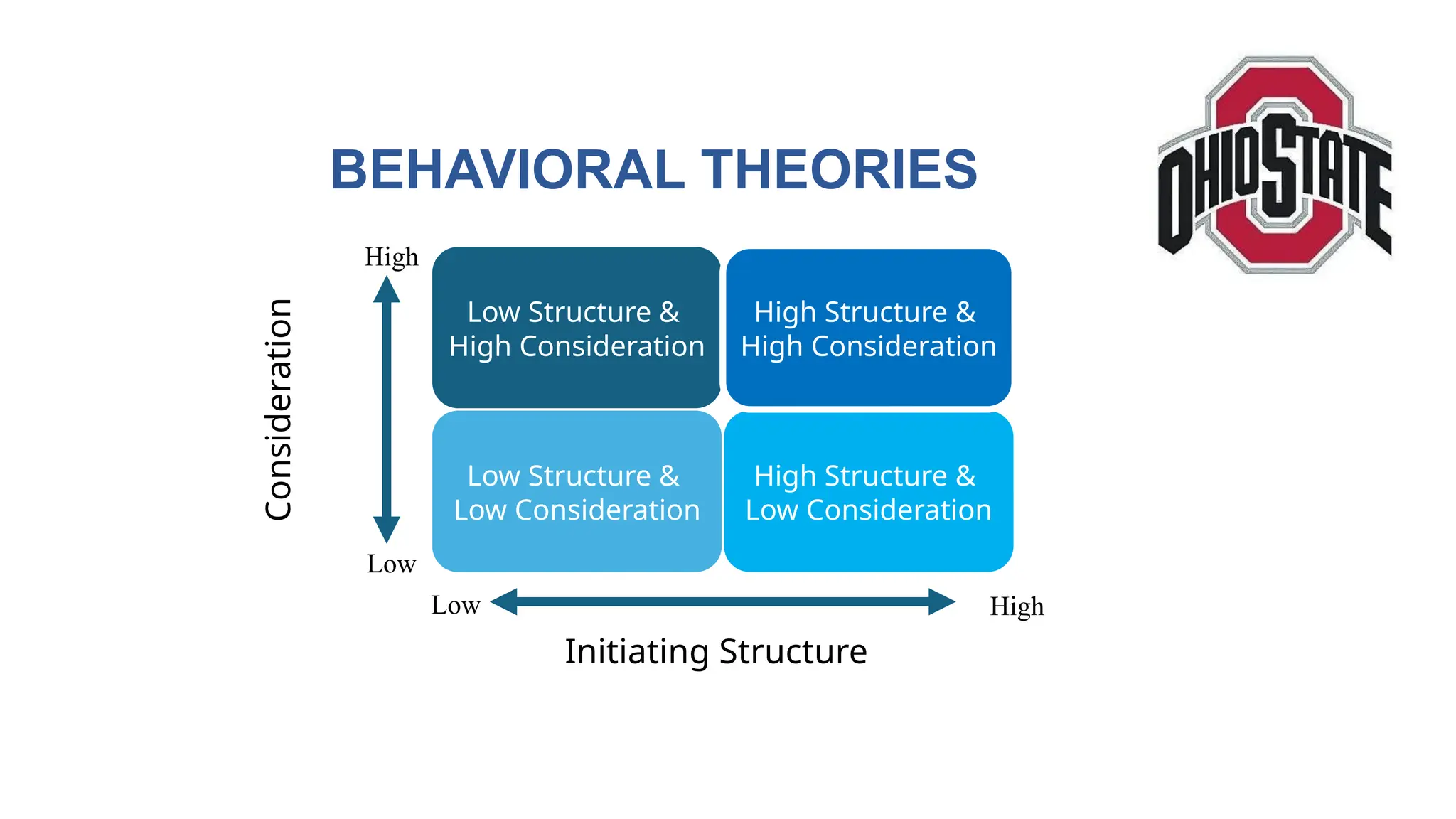
Behavioral Theories: OhioState
• Initiating structure:
• Leader behavior aimed at defining and organizing work
relationships and roles, as well as establishing clear patterns of
organization, communication, and getting things done
• Consideration:
• Leader behavior aimed at nurturing friendly, warm working
relationships as well as encouraging mutual trust and interpersonal
respect within the work unit
75.
BEHAVIORAL THEORIES
Low Structure&
High Consideration
Low Structure &
Low Consideration
High Structure &
Low Consideration
High Structure &
High Consideration
Consideration
Initiating Structure
High
High
Low
Low
76.
Behavioral Theories: Michigan
•Production-oriented:
• Work environment where the focus
is on getting things done
• Employee-oriented:
• Work environment where the focus
is on relationships
Participative leadership: “Let’s do it together!”
77.
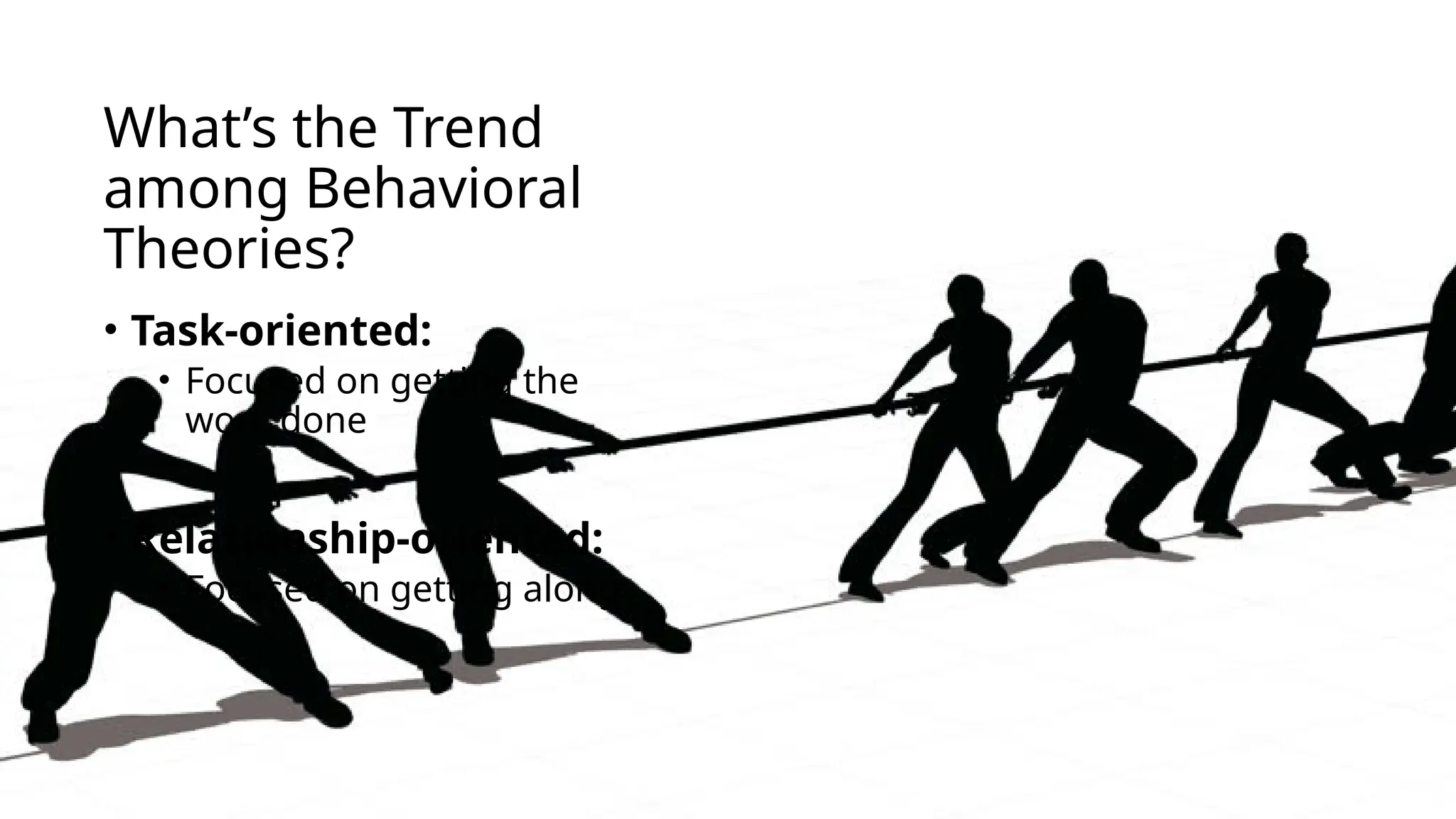
What’s the Trend
amongBehavioral
Theories?
• Task-oriented:
• Focused on getting the
work done
• Relationship-oriented:
• Focused on getting along
78.
Ok this is
great,but
what do
leaders
actually do?
• Think about the best leader you know…
• What do they do that makes them so
great?
• Anything we’ve discussed this
semester?
• Anything they would never do (that
might make them bad leaders?)
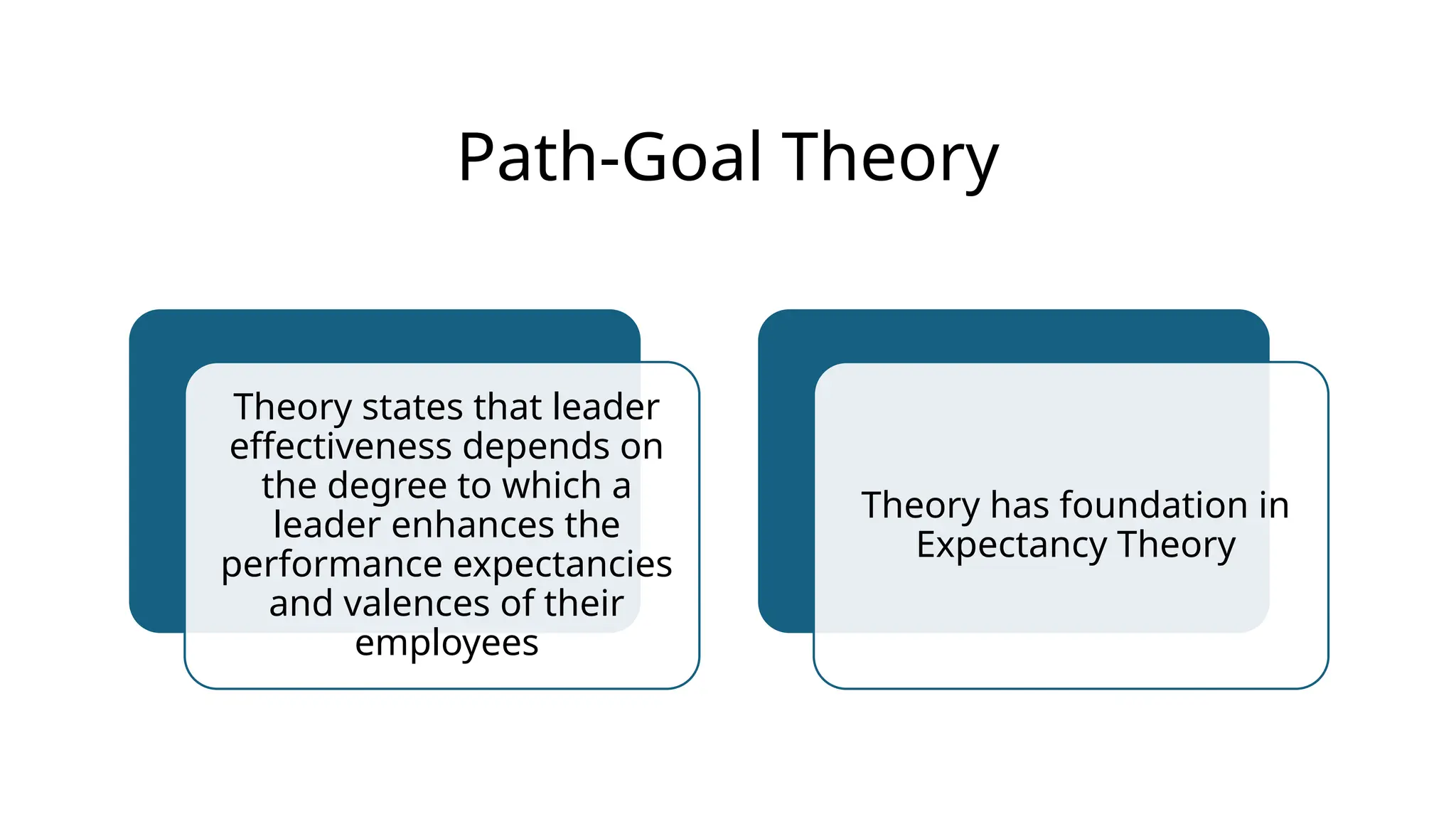
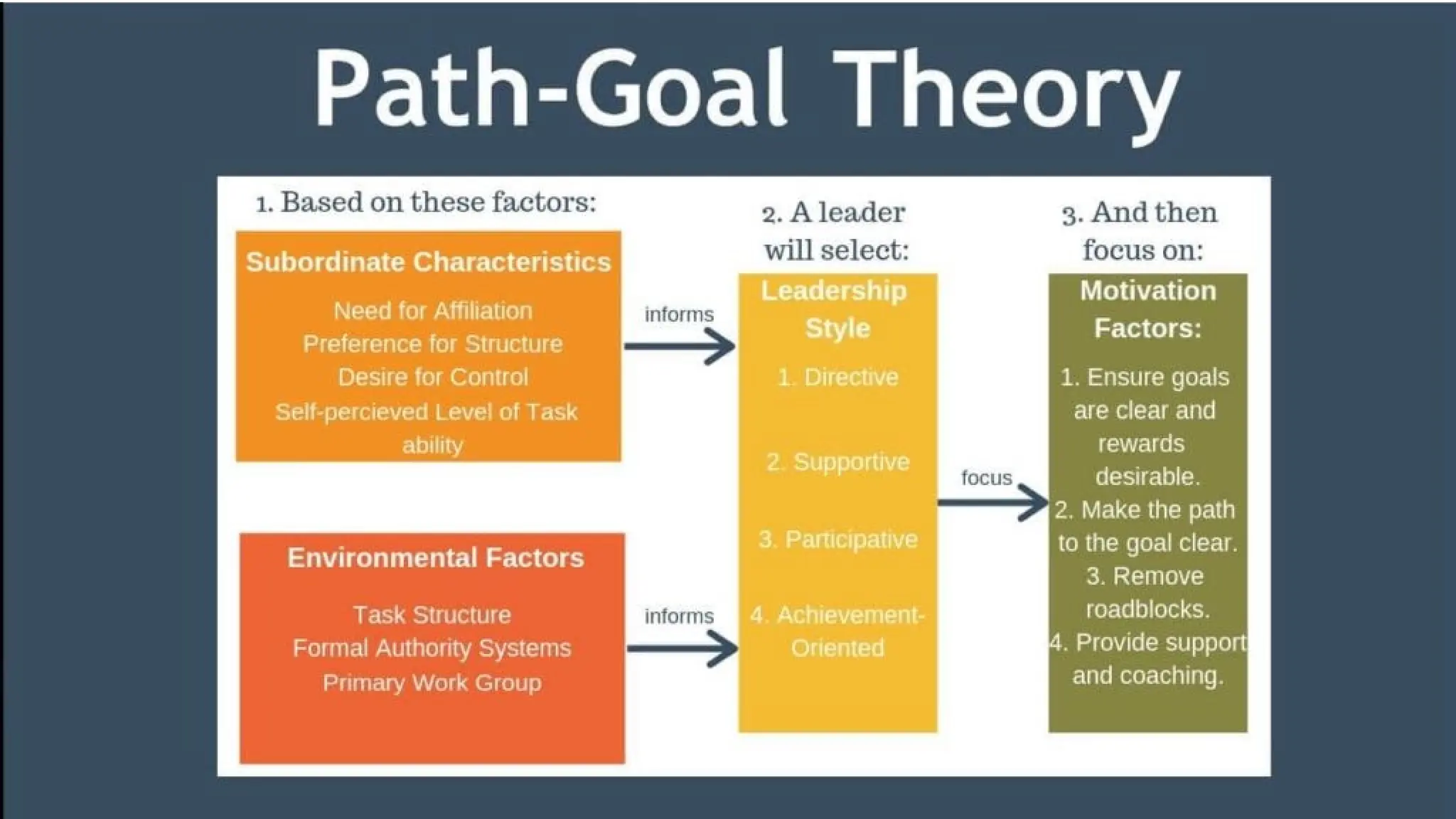
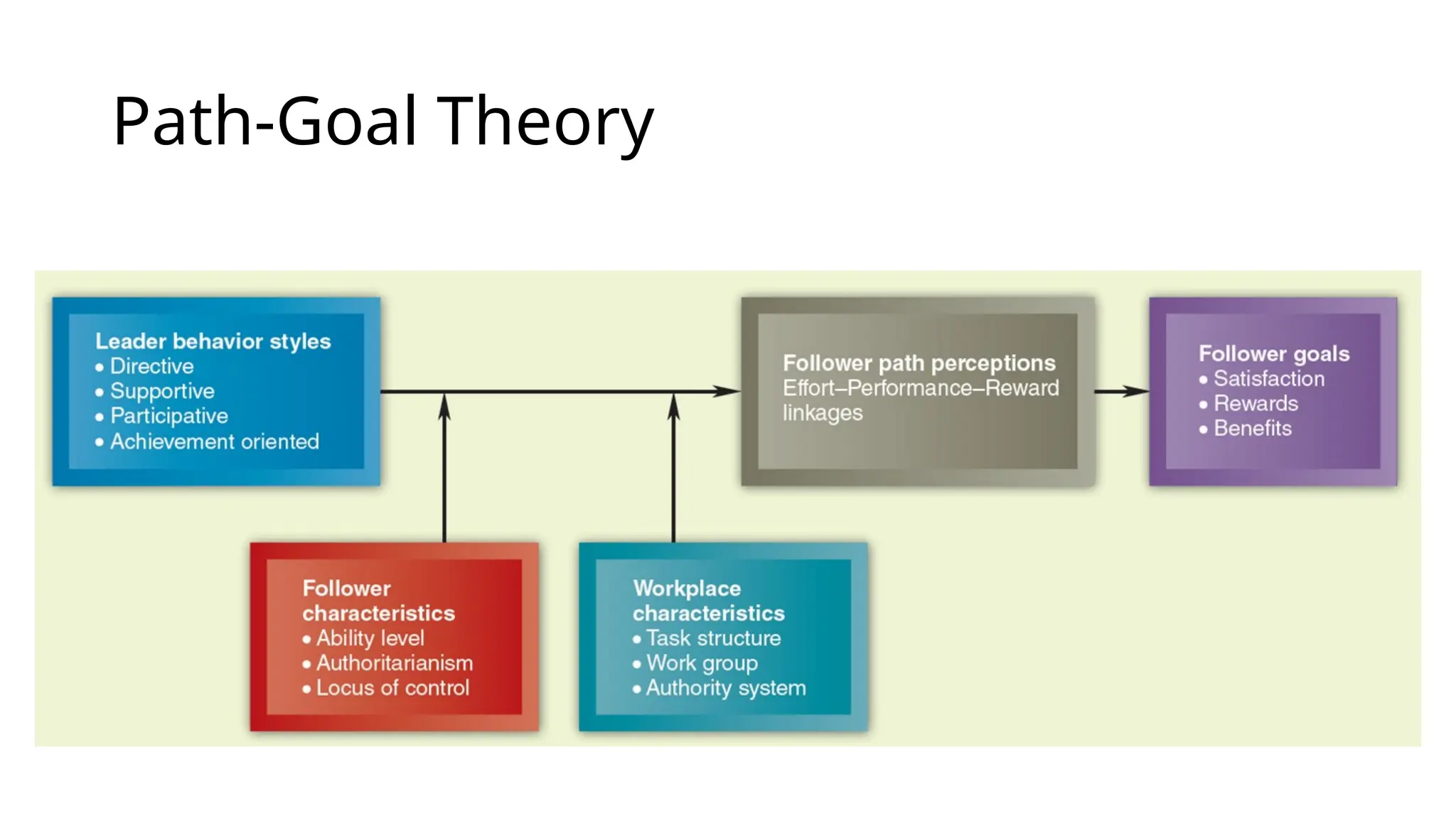
Path-Goal Theory
Theory statesthat leader
effectiveness depends on
the degree to which a
leader enhances the
performance expectancies
and valences of their
employees
Theory has foundation in
Expectancy Theory
84.
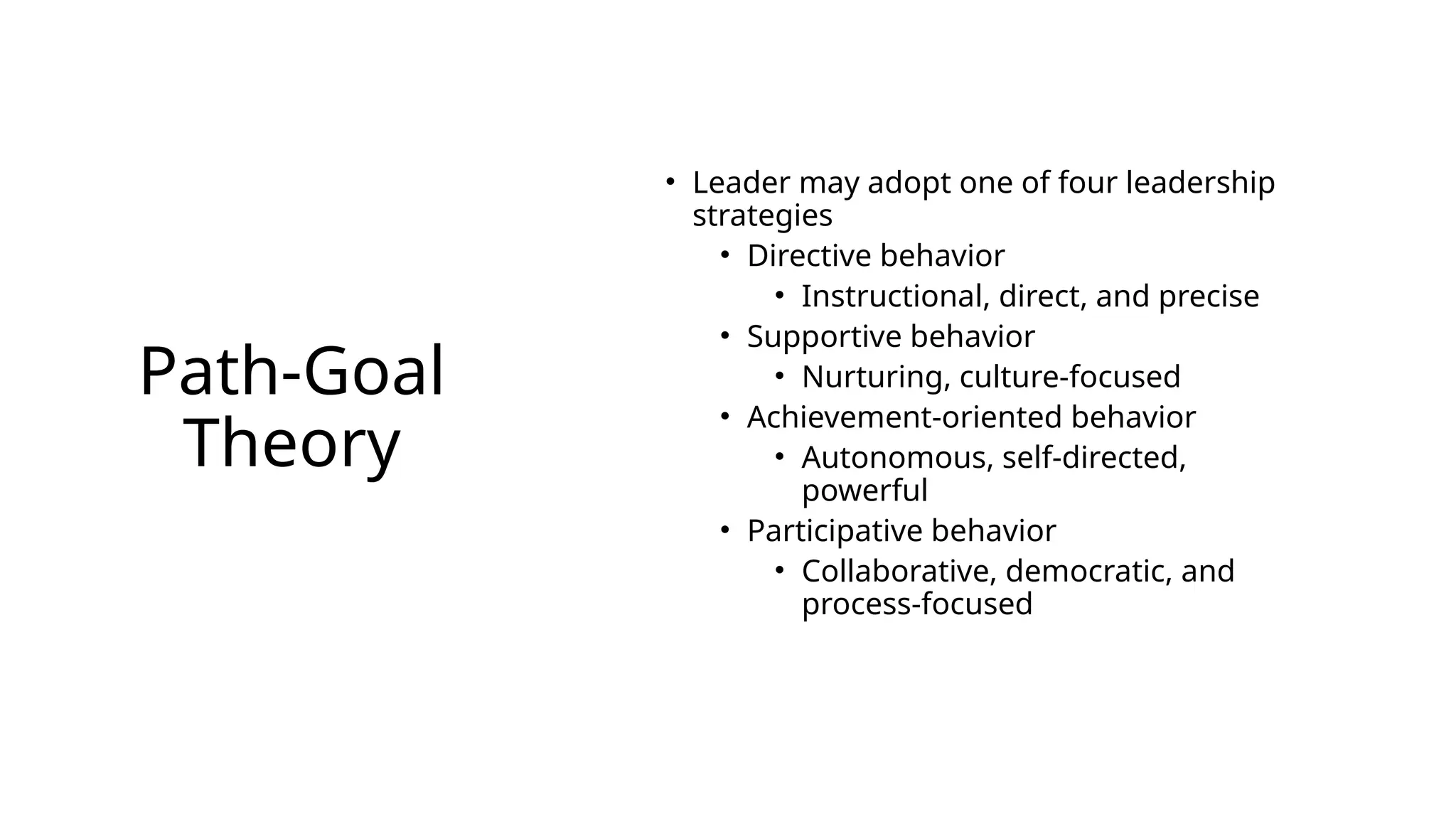
Path-Goal
Theory
• Leader mayadopt one of four leadership
strategies
• Directive behavior
• Instructional, direct, and precise
• Supportive behavior
• Nurturing, culture-focused
• Achievement-oriented behavior
• Autonomous, self-directed,
powerful
• Participative behavior
• Collaborative, democratic, and
process-focused
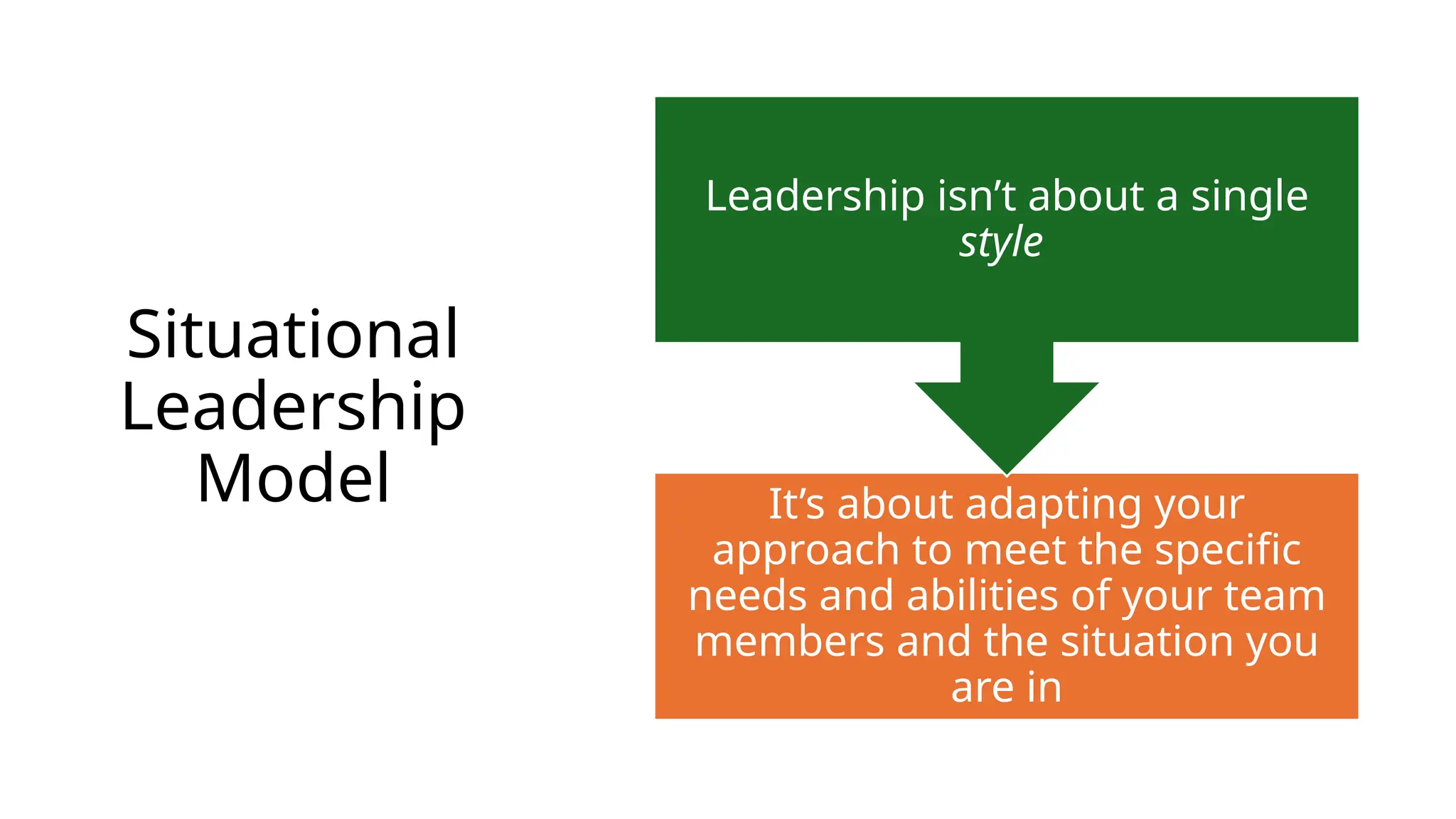
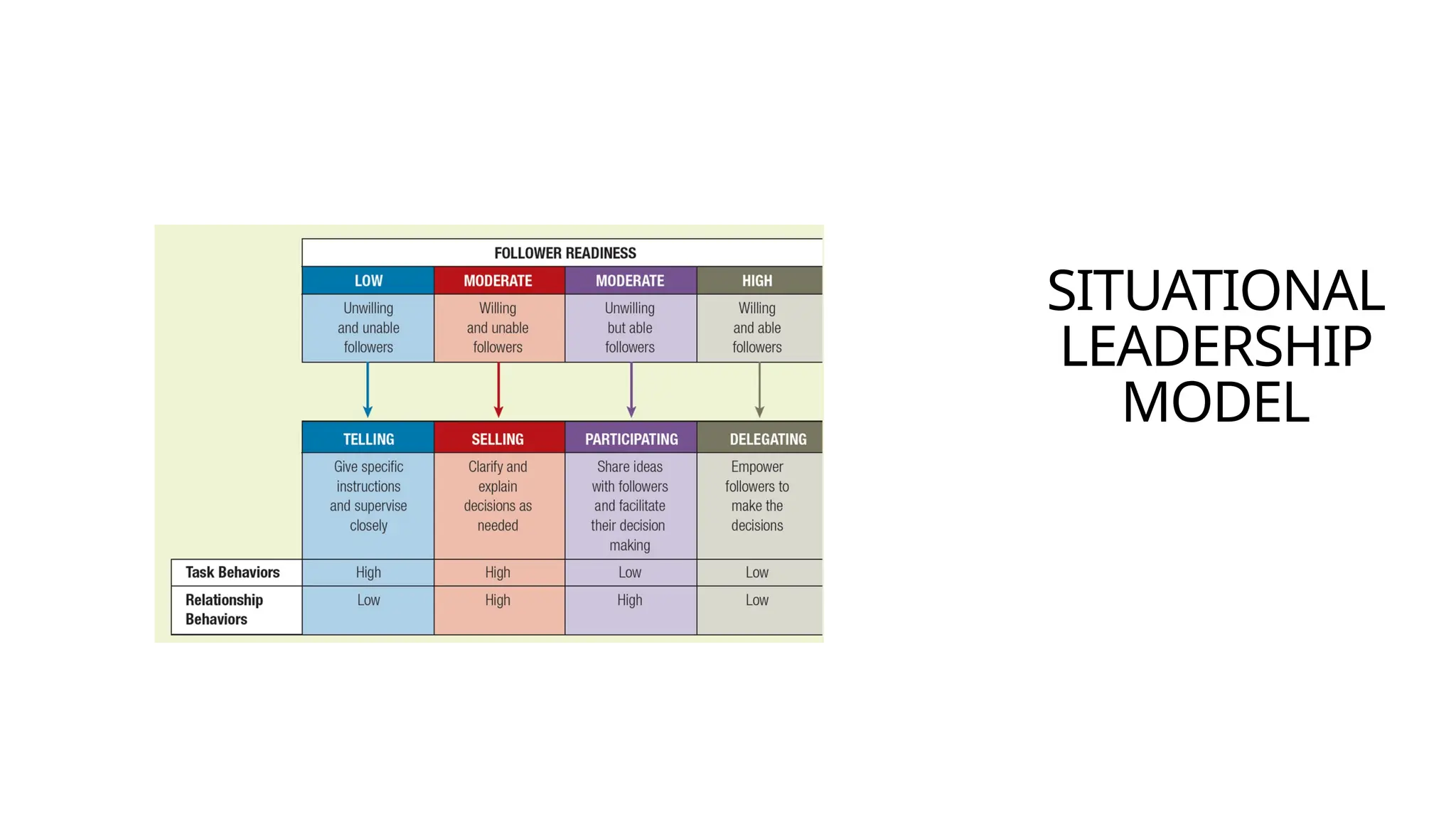
Situational
Leadership
Model It’s aboutadapting your
approach to meet the specific
needs and abilities of your team
members and the situation you
are in
Leadership isn’t about a single
style
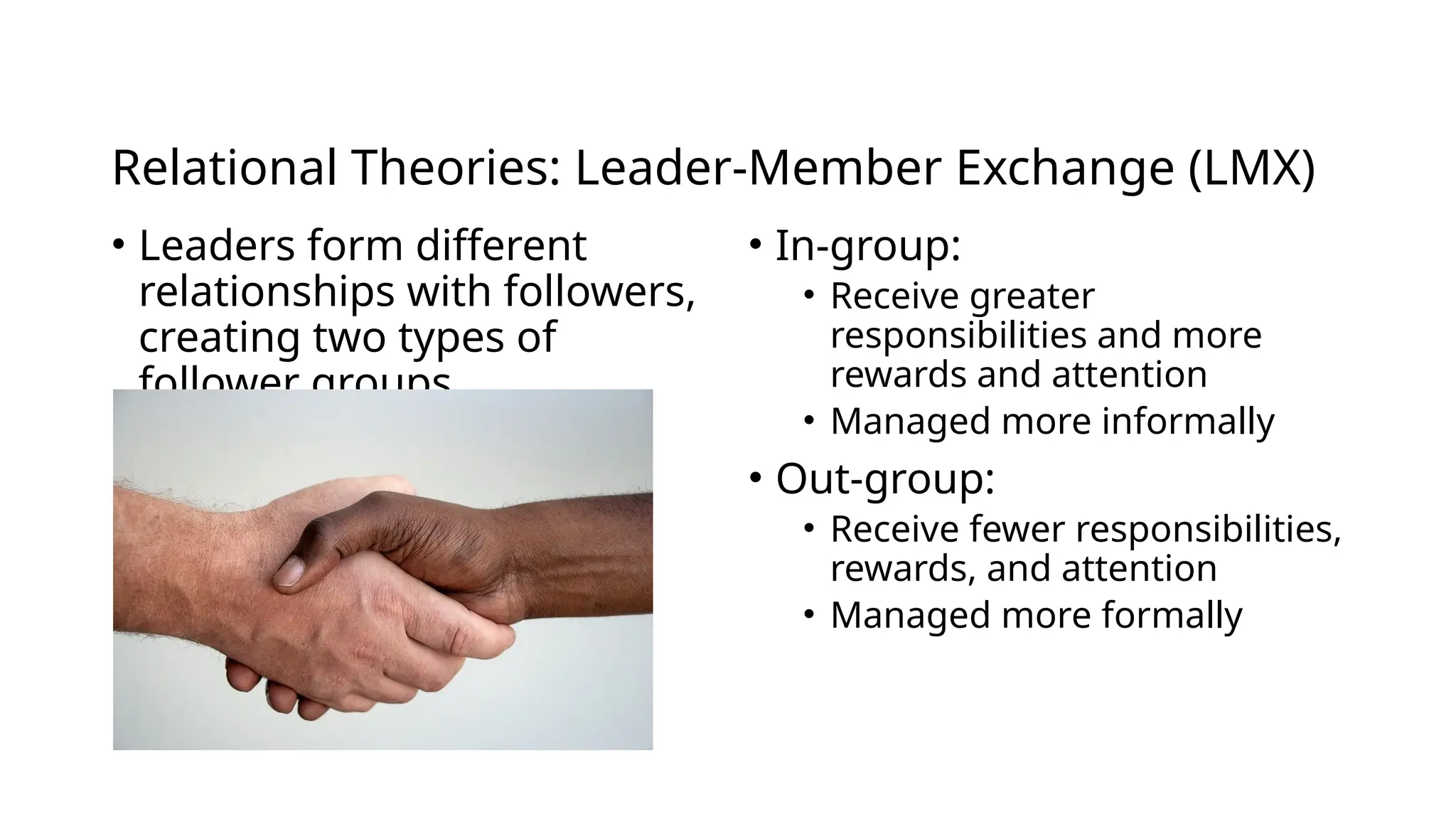
Relational Theories: Leader-MemberExchange (LMX)
• Leaders form different
relationships with followers,
creating two types of
follower groups
• In-group:
• Receive greater
responsibilities and more
rewards and attention
• Managed more informally
• Out-group:
• Receive fewer responsibilities,
rewards, and attention
• Managed more formally
90.
Transformation
al and
Transactional
Leaders
• Motivatetheir followers in the direction
of established goals by clarifying role
and task requirements
• Reward high performance/reprimand
low
Transactional Leaders
• Motivate their followers by inspiring
and motivating them to exceed
expectations, through a positive
organizational culture, and a shared
vision of ethics and values
• Engage in developmental consideration
Transformational Leaders
91.
What do
Transformational
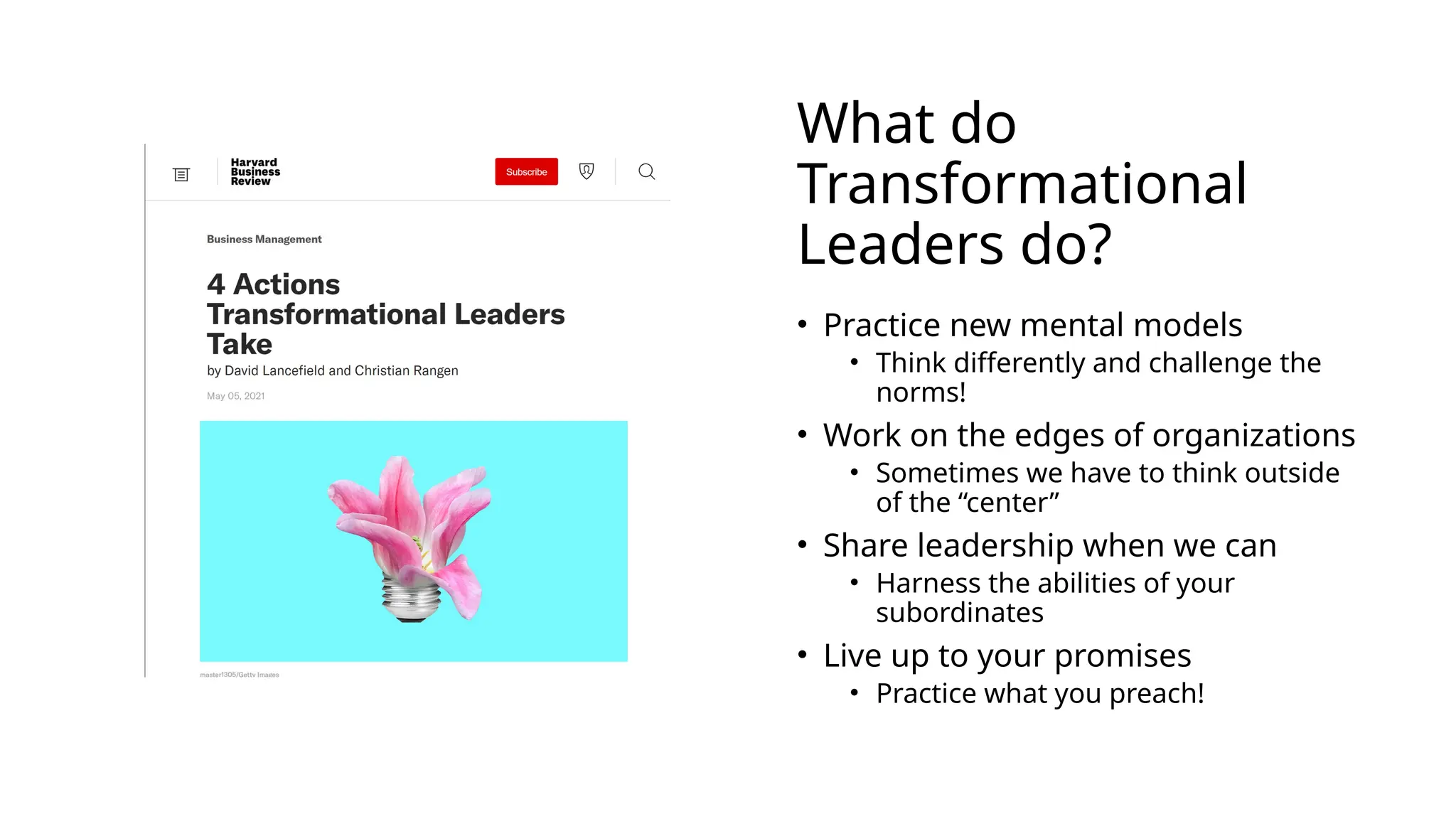
Leaders do?
•Practice new mental models
• Think differently and challenge the
norms!
• Work on the edges of organizations
• Sometimes we have to think outside
of the “center”
• Share leadership when we can
• Harness the abilities of your
subordinates
• Live up to your promises
• Practice what you preach!
Capitalizing
on
Inspiration
Think back tothe last time you
felt inspired
• What made you feel so inspired?
• Was it the message?
• The person?
• The cause?
• The framing?
What other organizational
behavior factors might be
important in inspiring others?
and why?
94.
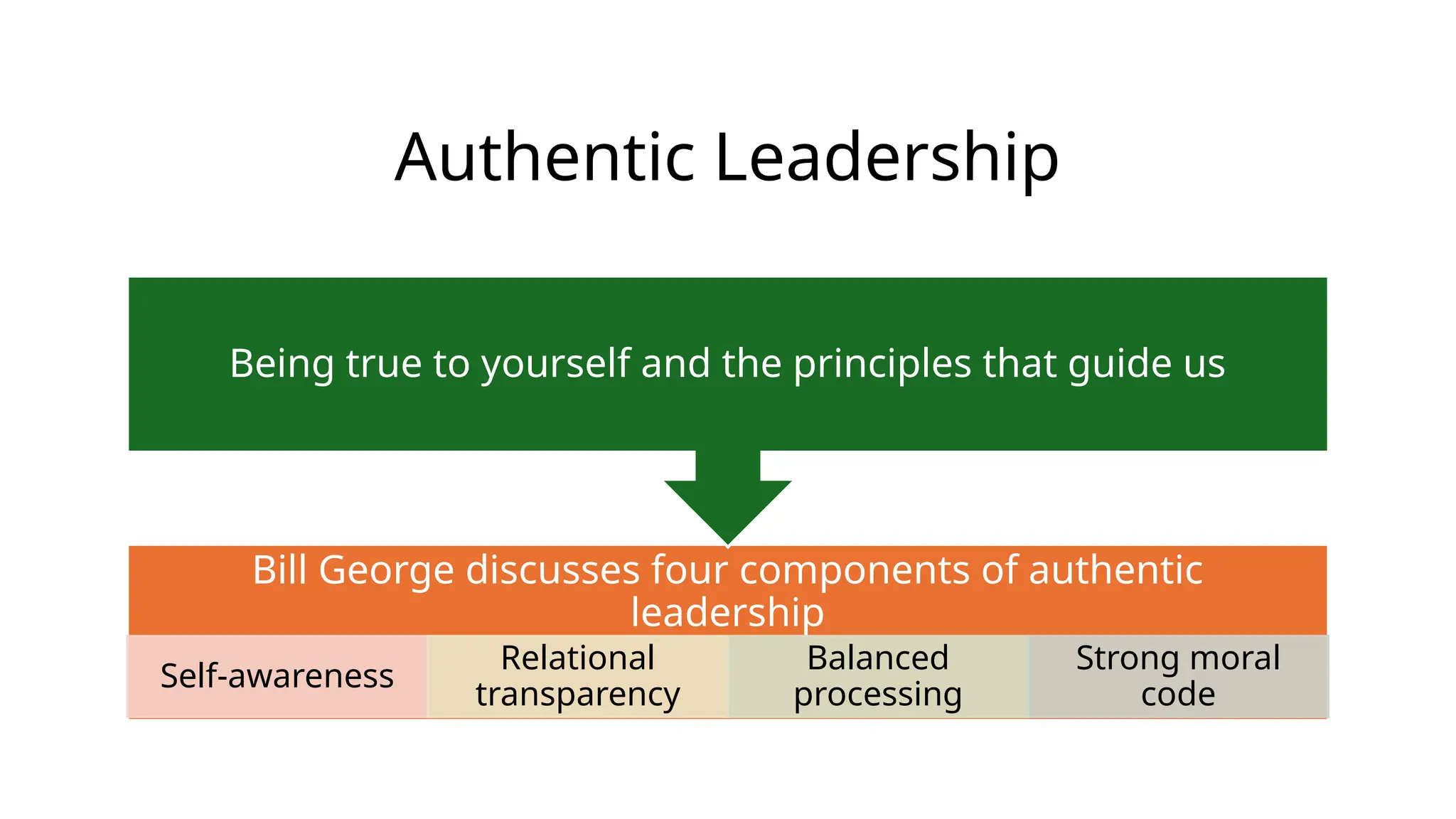
Authentic Leadership
Bill Georgediscusses four components of authentic
leadership
Self-awareness
Relational
transparency
Balanced
processing
Strong moral
code
Being true to yourself and the principles that guide us
95.
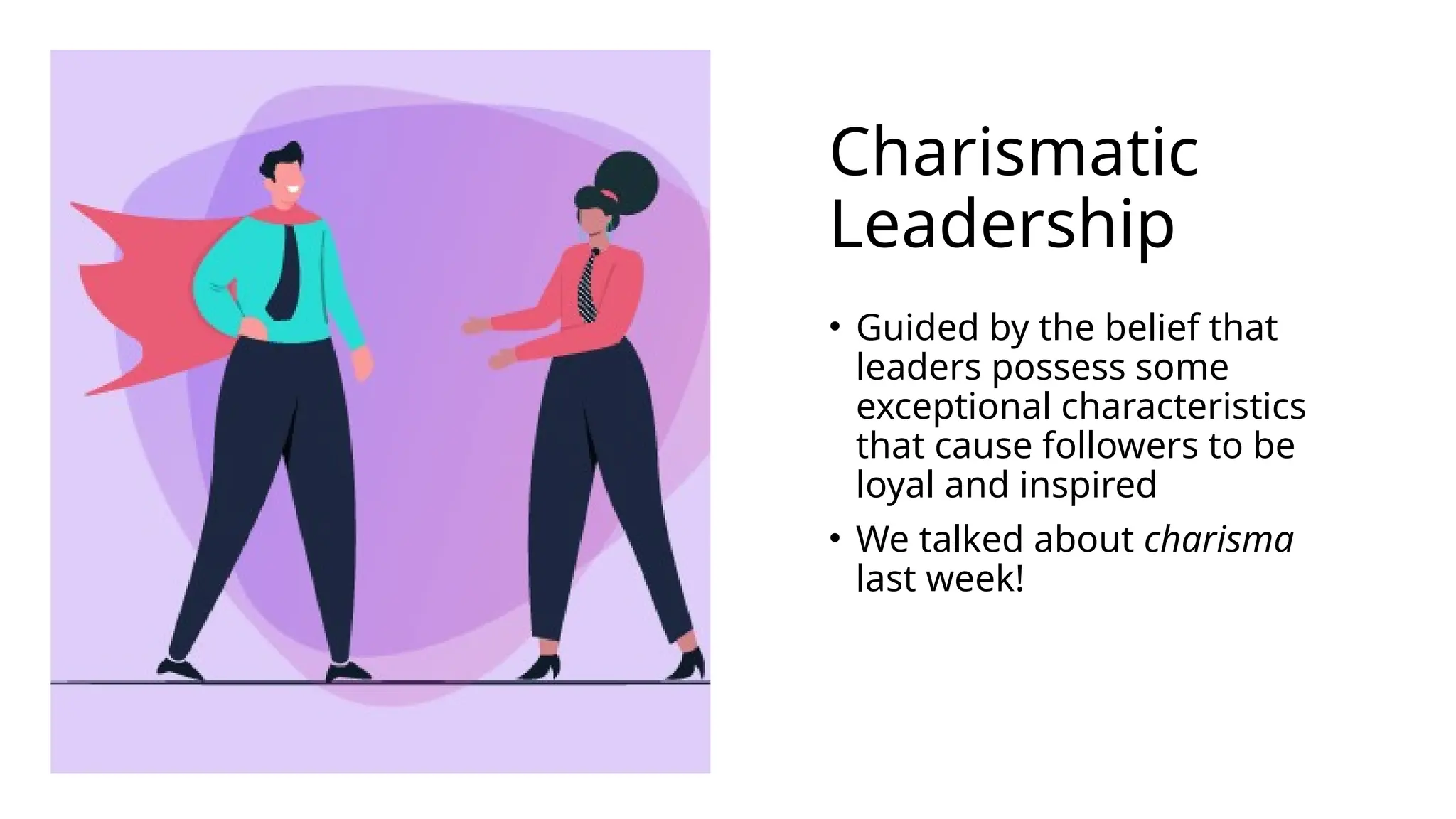
Charismatic
Leadership
• Guided bythe belief that
leaders possess some
exceptional characteristics
that cause followers to be
loyal and inspired
• We talked about charisma
last week!
96.
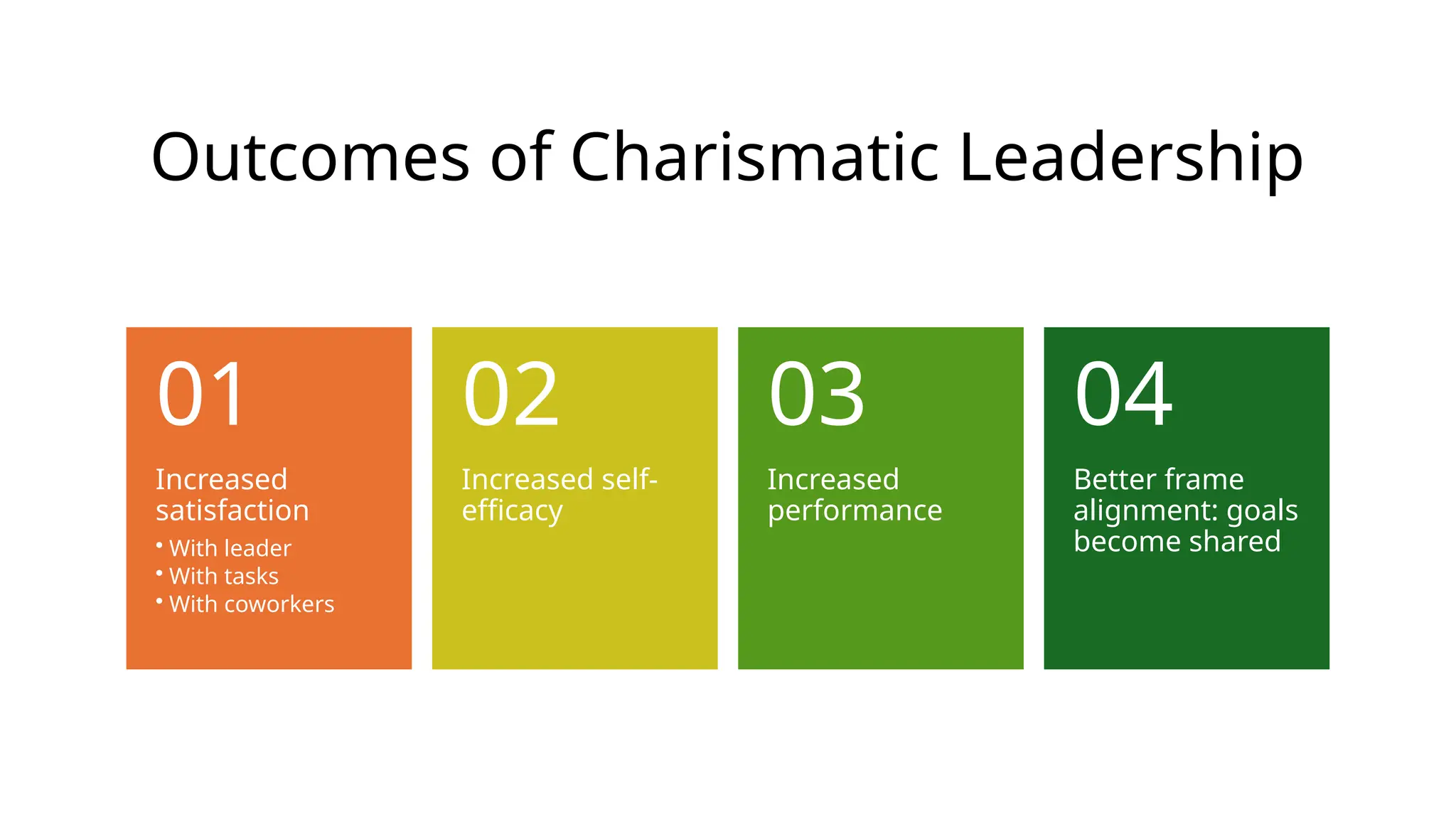
Outcomes of CharismaticLeadership
Increased
satisfaction
• With leader
• With tasks
• With coworkers
01
Increased self-
efficacy
02
Increased
performance
03
Better frame
alignment: goals
become shared
04
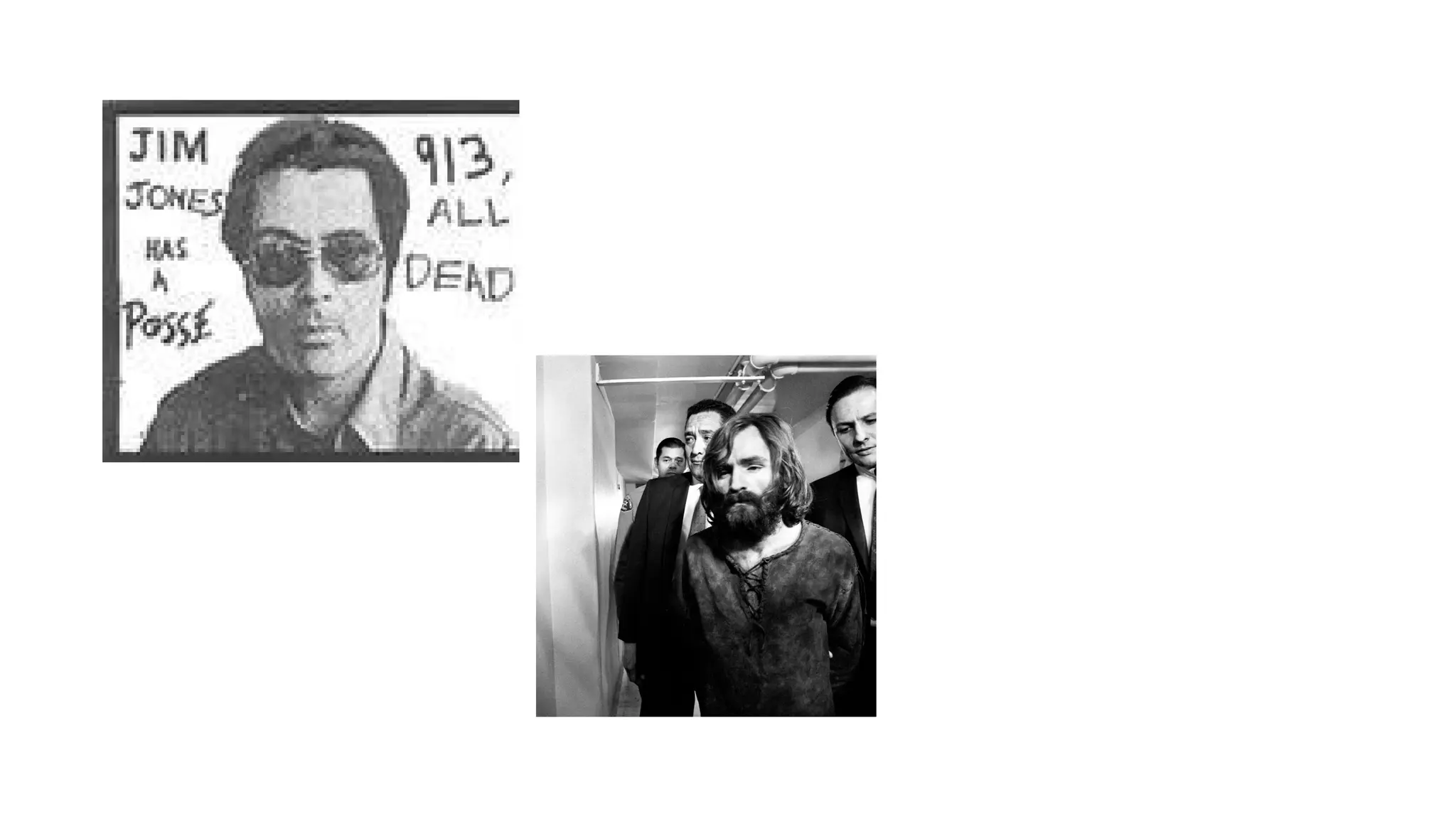
The Dark Sideof
Charisma
• The “Dark Side” of charismatic leaders -
negative charismatics
• Adjustment problems can be behind mask
of likeability
• Commitment is not to ideals, but to
themselves
• Choose grandiose projects to glorify
themselves; ignore modifications even
when there is compelling evidence
• Highly visible actions but not the time with
employees to develop a practical level
• Not skilled/ interested in protégés – vision
is only own identity, fail to develop
competent successors
99.
Taking all of
this
together…
•Three consistent themes in
leadership research:
• Importance of
Influencing and
Motivating Followers
• Importance of
Maintaining Effective
Relationships
• Importance of Making
Efficient Task-Related
Decisions
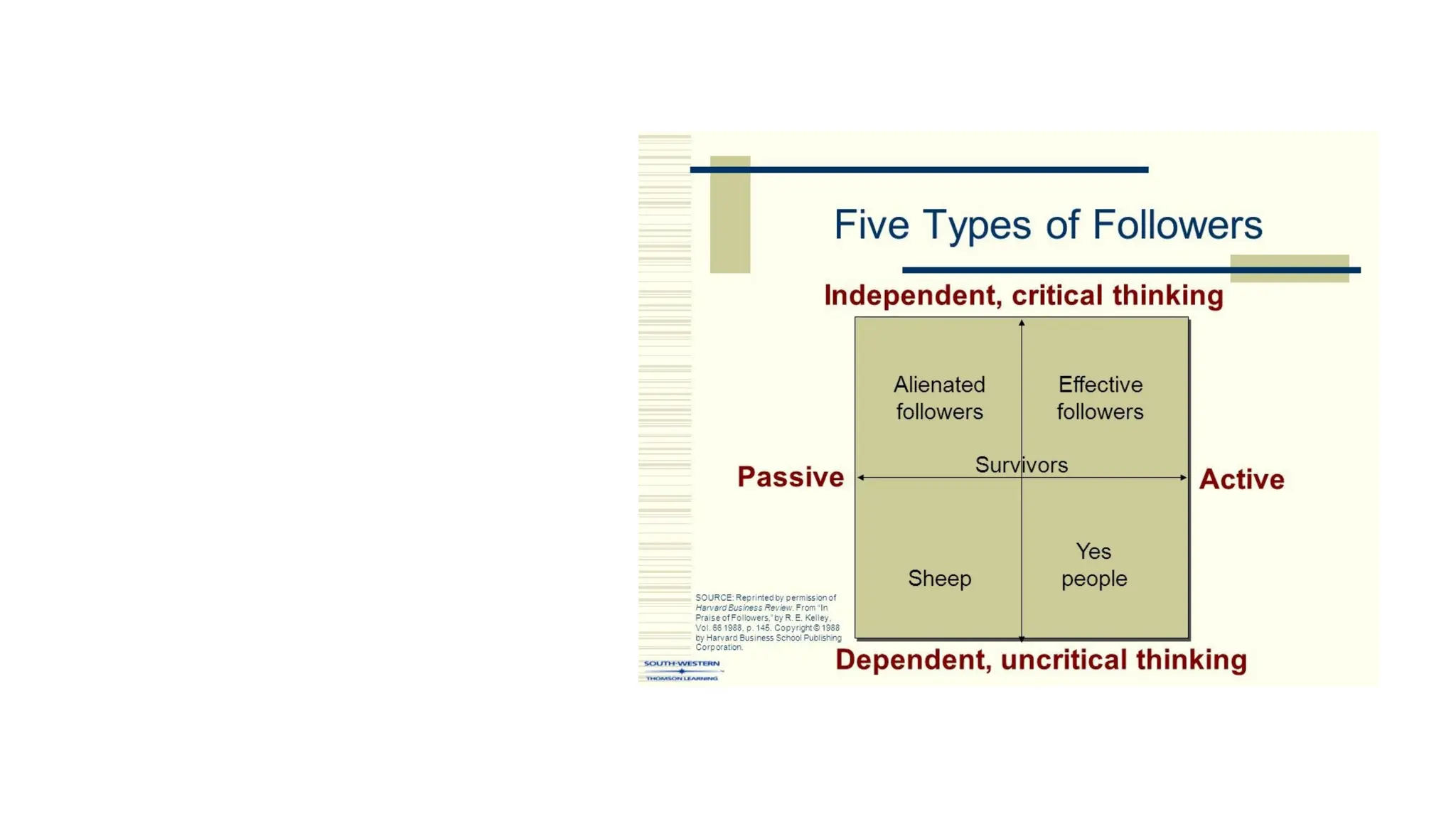
What is Followership?
Processof being guided and
directed by a leader in the work
environment
Followers:
Passive or active?
Critical or non-
critical thinkers?
•Five types:
• Alienated
• Sheep
• Yes people
• Survivors
• Effective
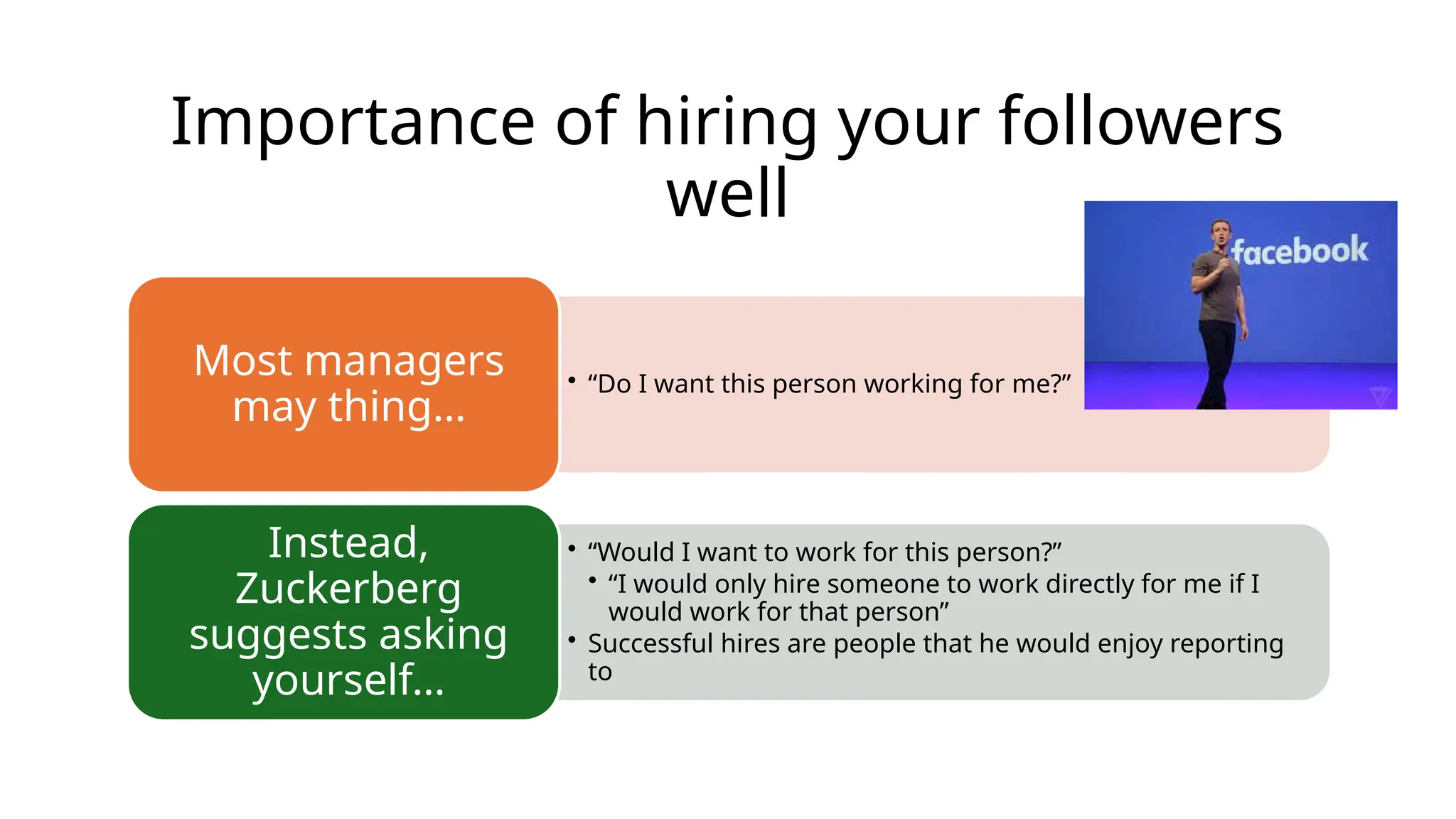
Importance of hiringyour followers
well
• “Do I want this person working for me?”
Most managers
may thing…
• “Would I want to work for this person?”
• “I would only hire someone to work directly for me if I
would work for that person”
• Successful hires are people that he would enjoy reporting
to
Instead,
Zuckerberg
suggests asking
yourself…
107.
Module 12 Summary
•Many theories of leadership
• Leadership skills can be trained and developed
• The hallmarks of leadership are focused on motivation, the
task, and building relationships
• It is just as important to be a great follower as it is to be a
great leader!
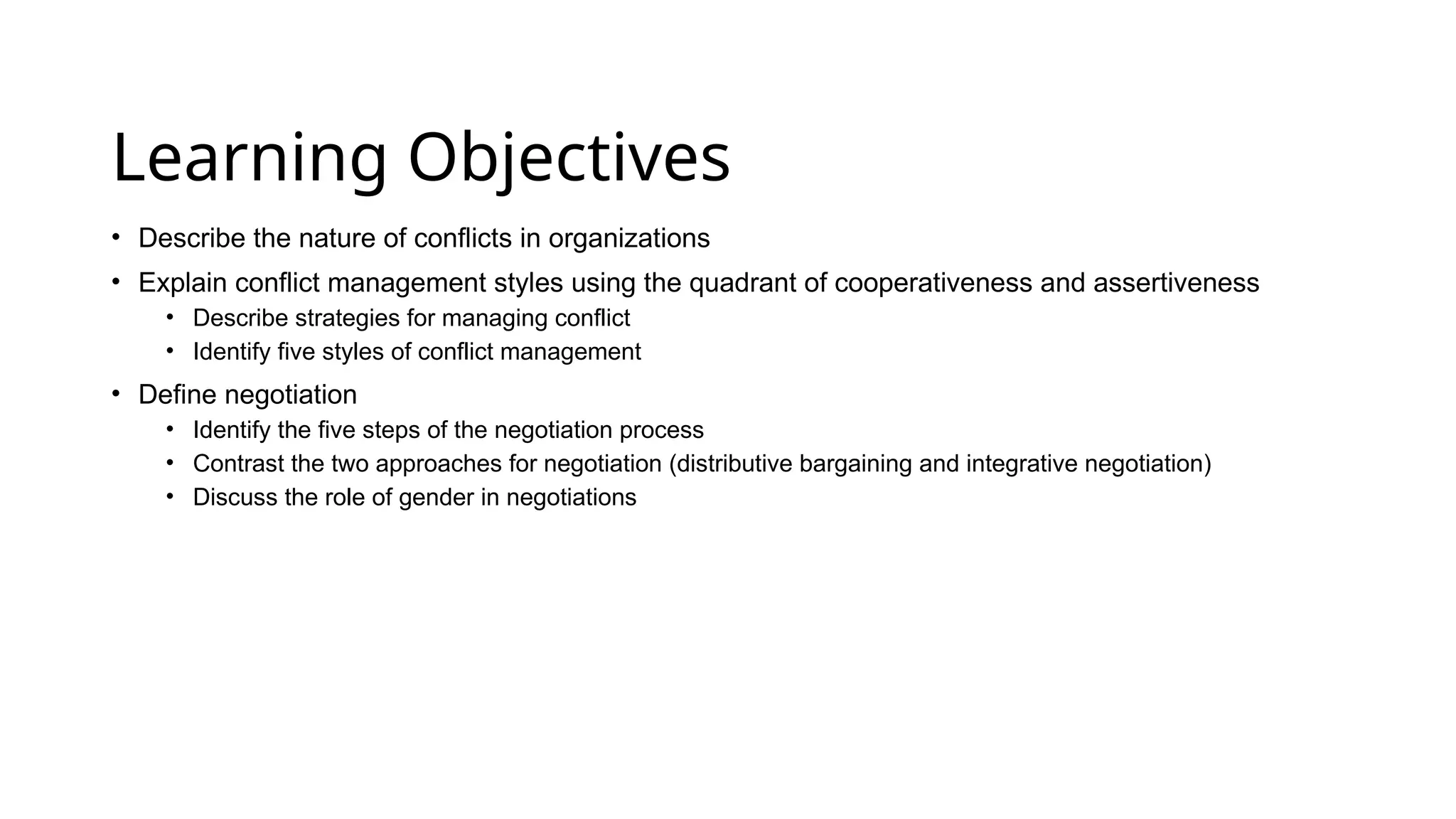
Learning Objectives
• Describethe nature of conflicts in organizations
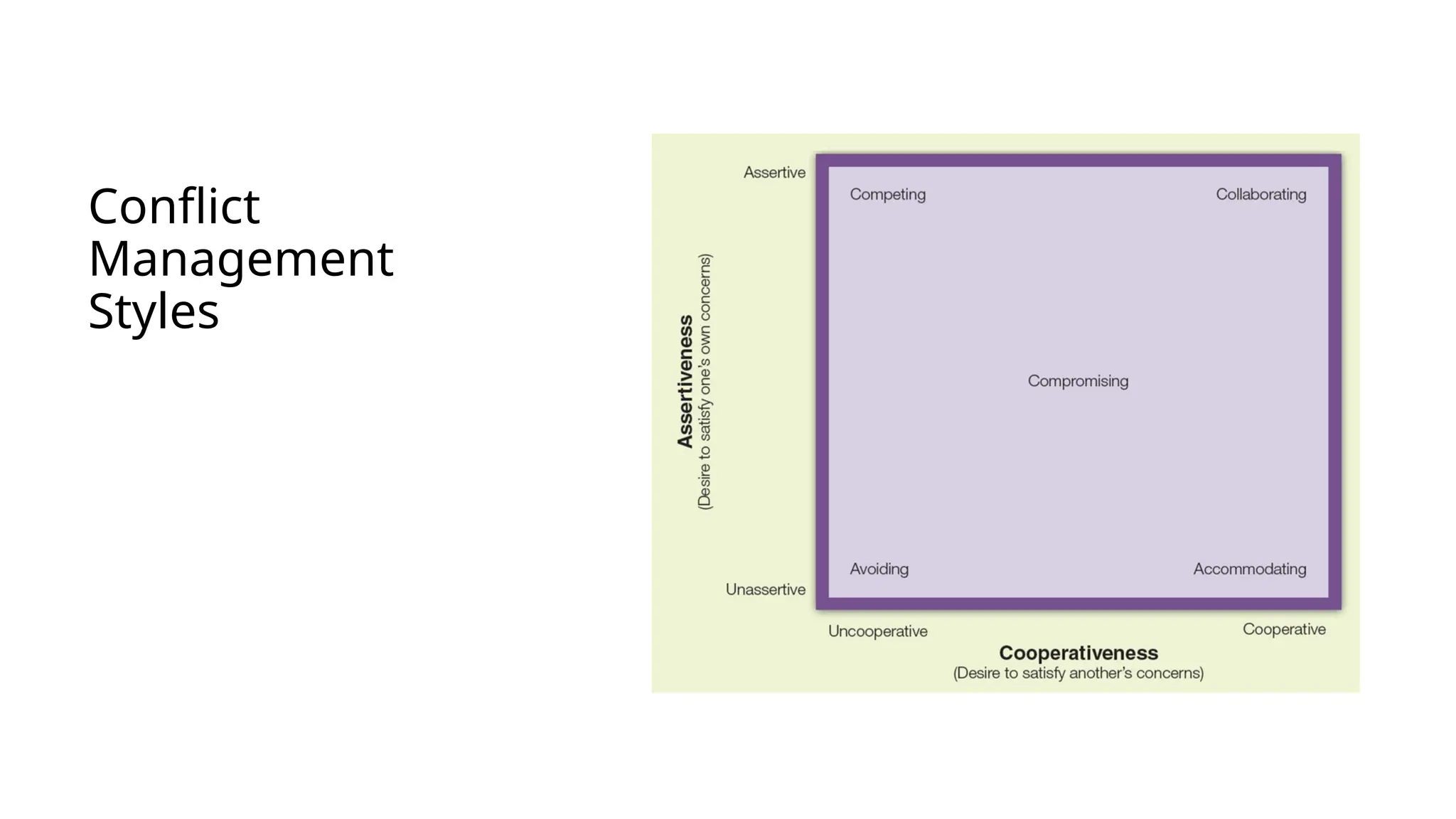
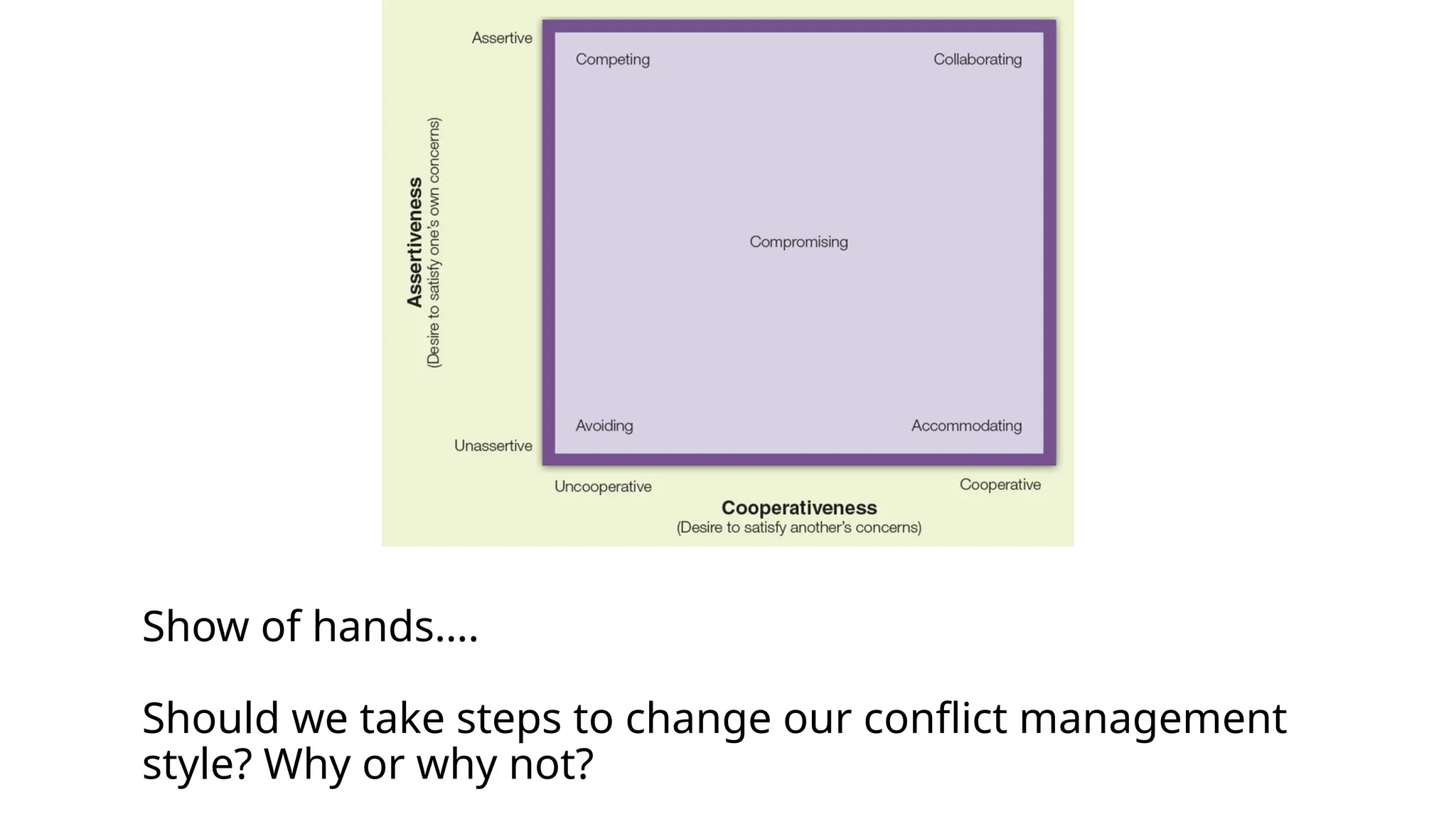
• Explain conflict management styles using the quadrant of cooperativeness and assertiveness
• Describe strategies for managing conflict
• Identify five styles of conflict management
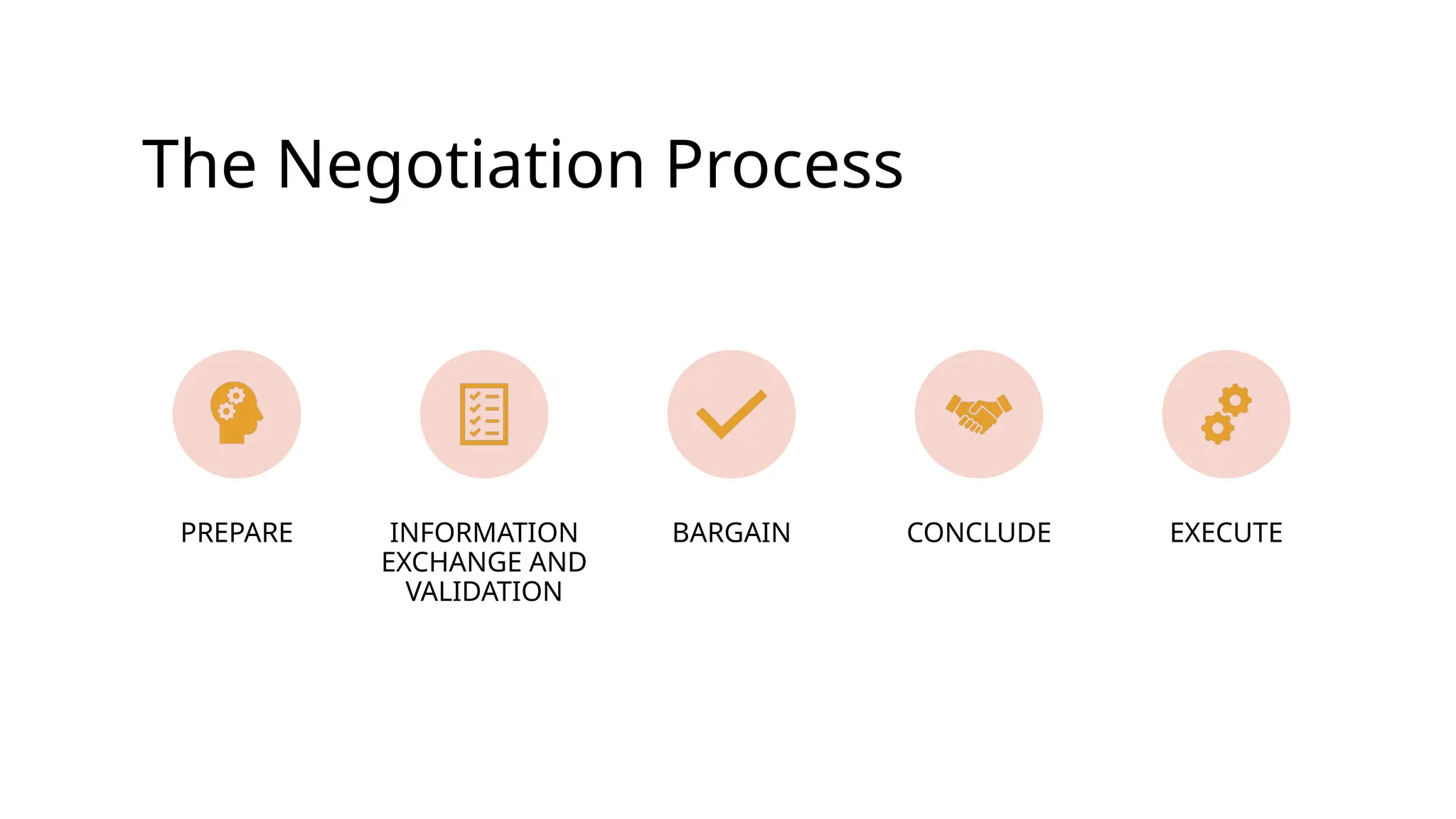
• Define negotiation
• Identify the five steps of the negotiation process
• Contrast the two approaches for negotiation (distributive bargaining and integrative negotiation)
• Discuss the role of gender in negotiations
114.
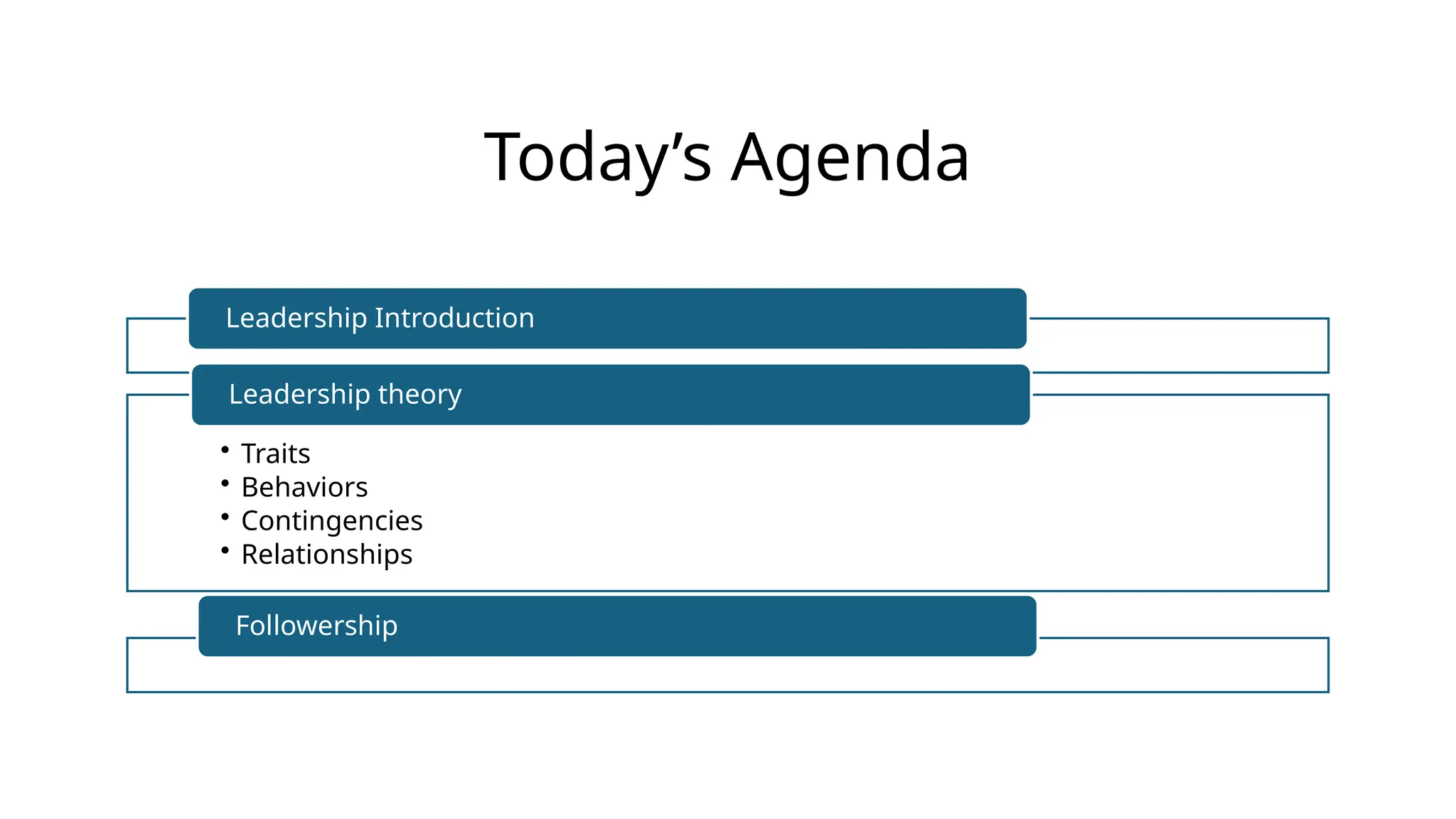
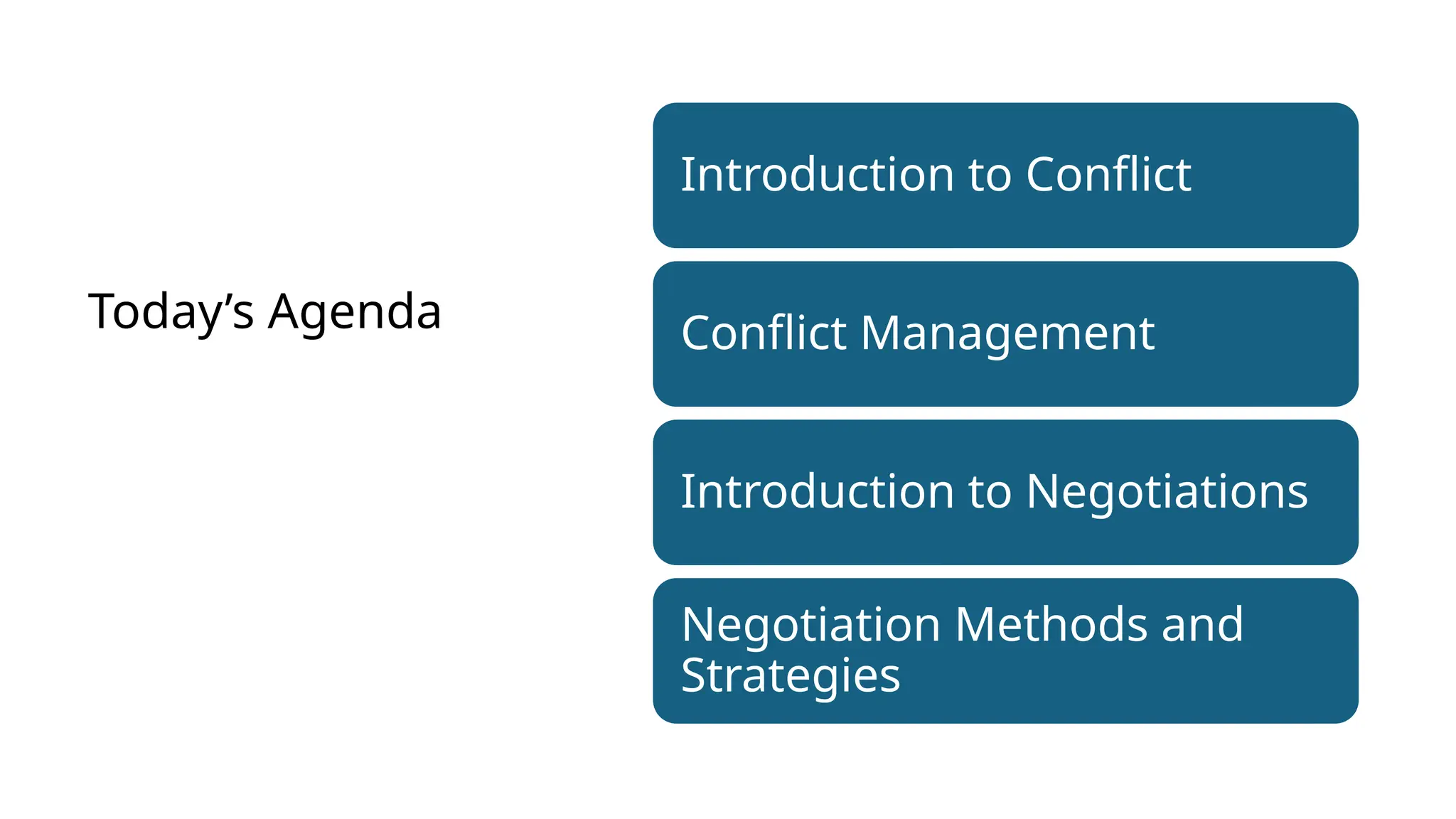
Today’s Agenda
Introduction toConflict
Conflict Management
Introduction to Negotiations
Negotiation Methods and
Strategies
115.
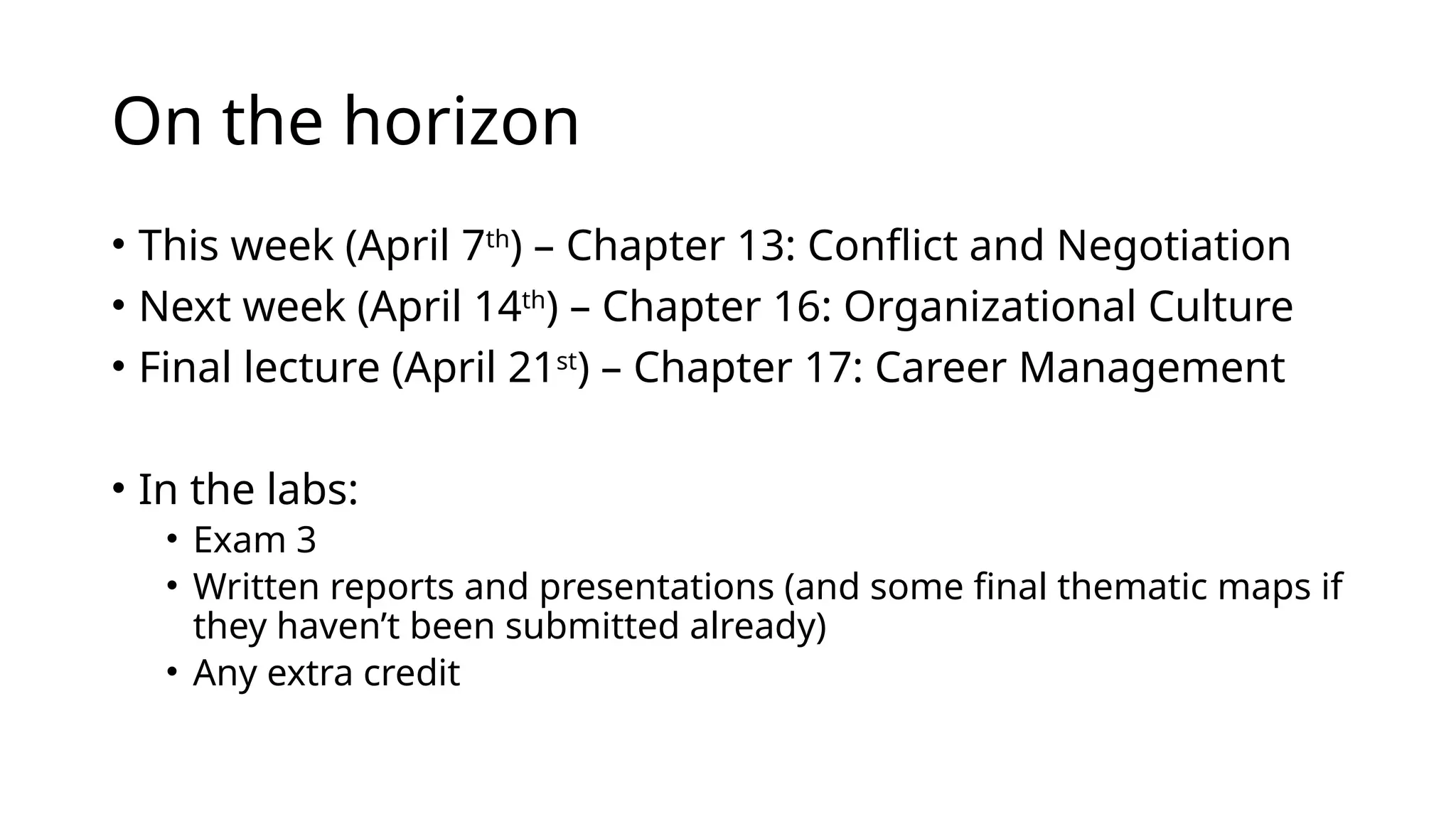
On the horizon
•This week (April 7th
) – Chapter 13: Conflict and Negotiation
• Next week (April 14th
) – Chapter 16: Organizational Culture
• Final lecture (April 21st
) – Chapter 17: Career Management
• In the labs:
• Exam 3
• Written reports and presentations (and some final thematic maps if
they haven’t been submitted already)
• Any extra credit
116.
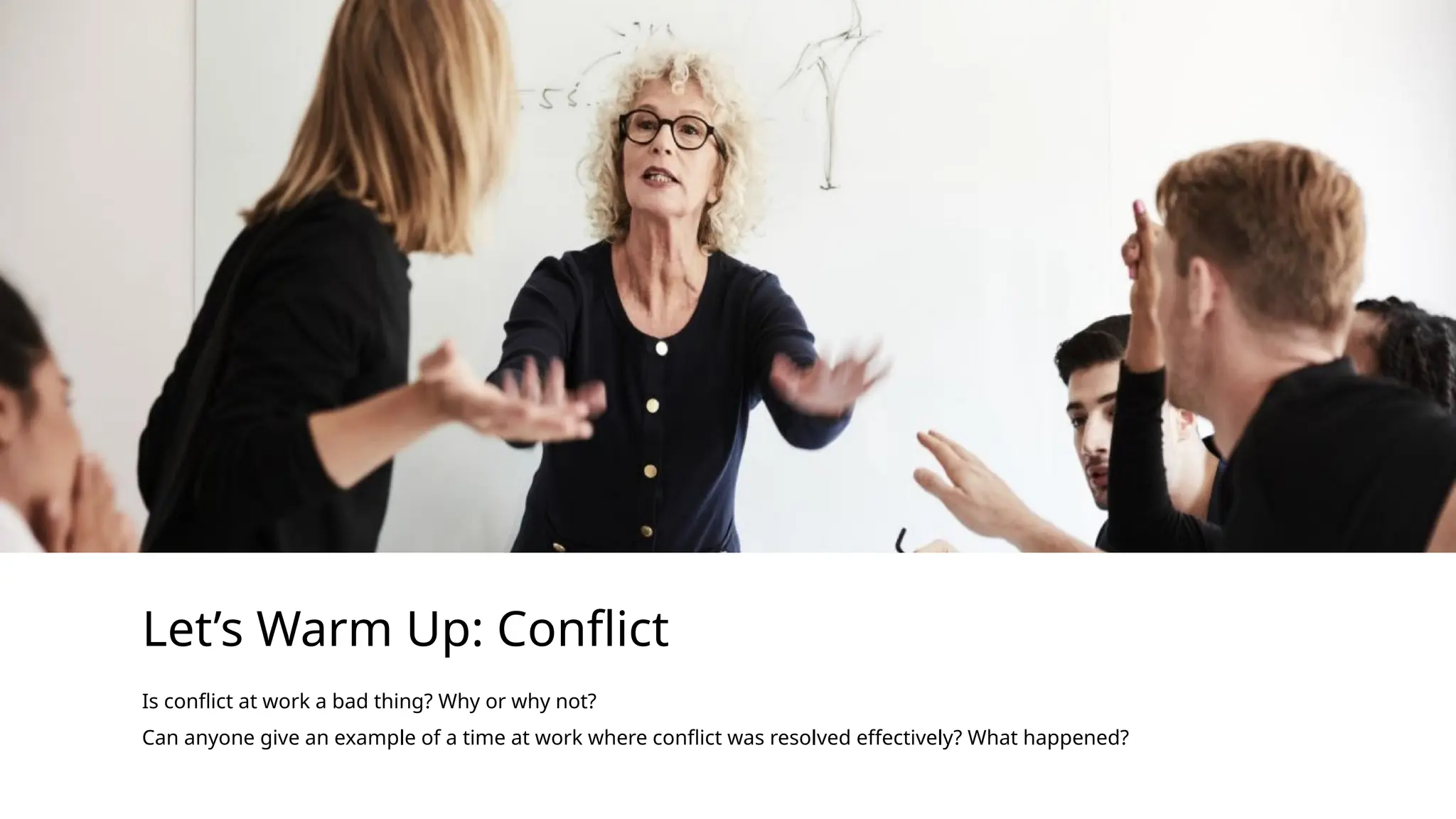
Let’s Warm Up:Conflict
Is conflict at work a bad thing? Why or why not?
Can anyone give an example of a time at work where conflict was resolved effectively? What happened?
117.
What is Conflict?
•Any situation in which incompatible goals, attitudes,
emotions, or behaviors lead to disagreement or opposition
between two or more parties
• Functional conflict:
• Healthy, constructive disagreement between two or more people
• Dysfunctional conflict:
• Unhealthy, destructive disagreement between two or more people
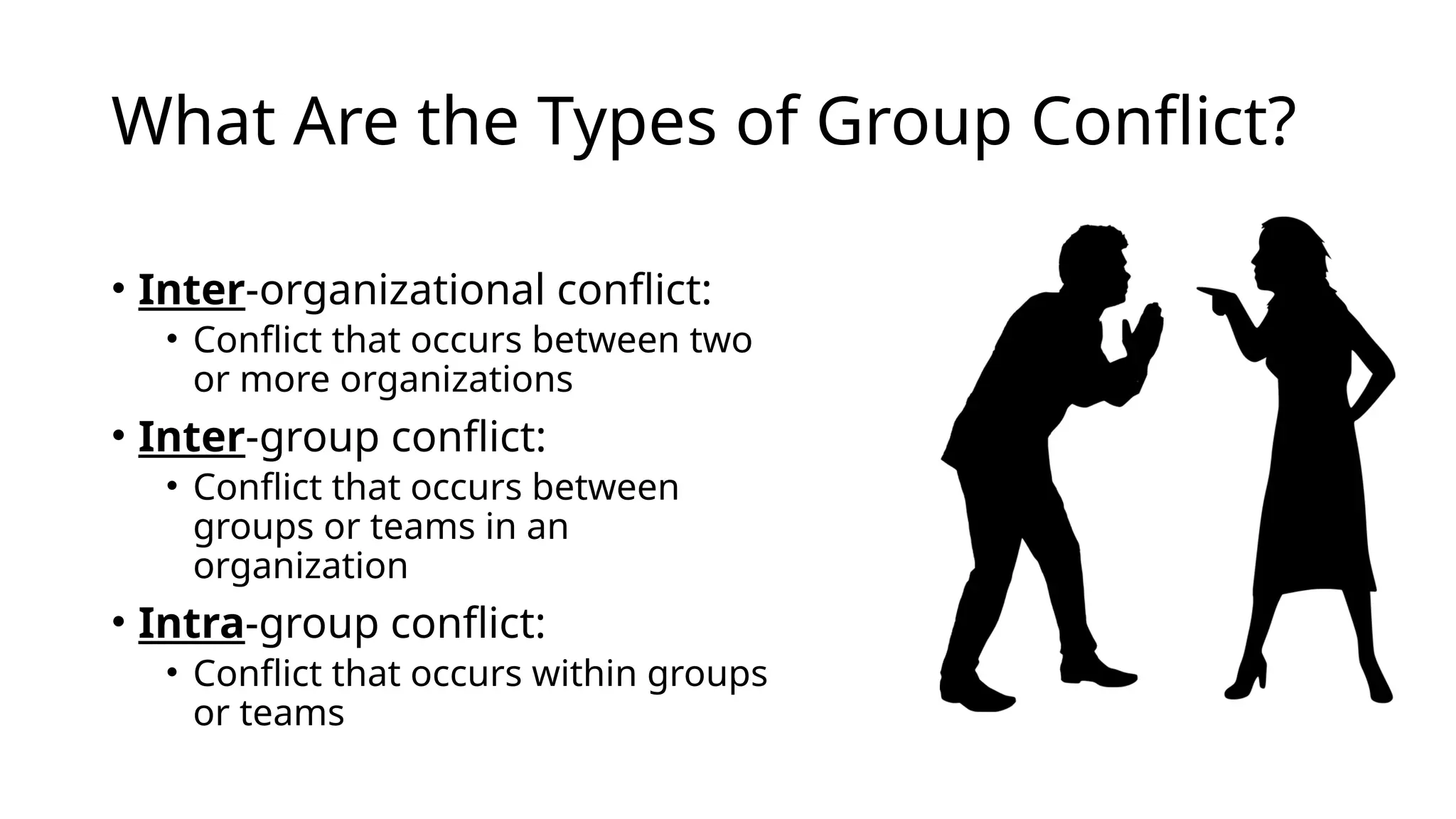
What Are theTypes of Group Conflict?
• Inter-organizational conflict:
• Conflict that occurs between two
or more organizations
• Inter-group conflict:
• Conflict that occurs between
groups or teams in an
organization
• Intra-group conflict:
• Conflict that occurs within groups
or teams
120.
What Are theTypes of Intrapersonal
Conflict?
• Inter-role conflict:
• A person’s experience of conflict among the multiple roles in their
life
• Intra-role conflict:
• Conflict that occurs within a single role
• Person-role conflict:
• Conflict that occurs when a person in a role is expected to perform
behaviors that clash with their personal values
121.
What results fromconflict
at work?
What is the bad? What is the good?
122.
Consequences of
Conflict
The Positive
•Leads to new ideas
• Motivates change
• Helps establish identities
The negative
• Diverts energy from
work
• Wastes resources
• Breaks down cohesion
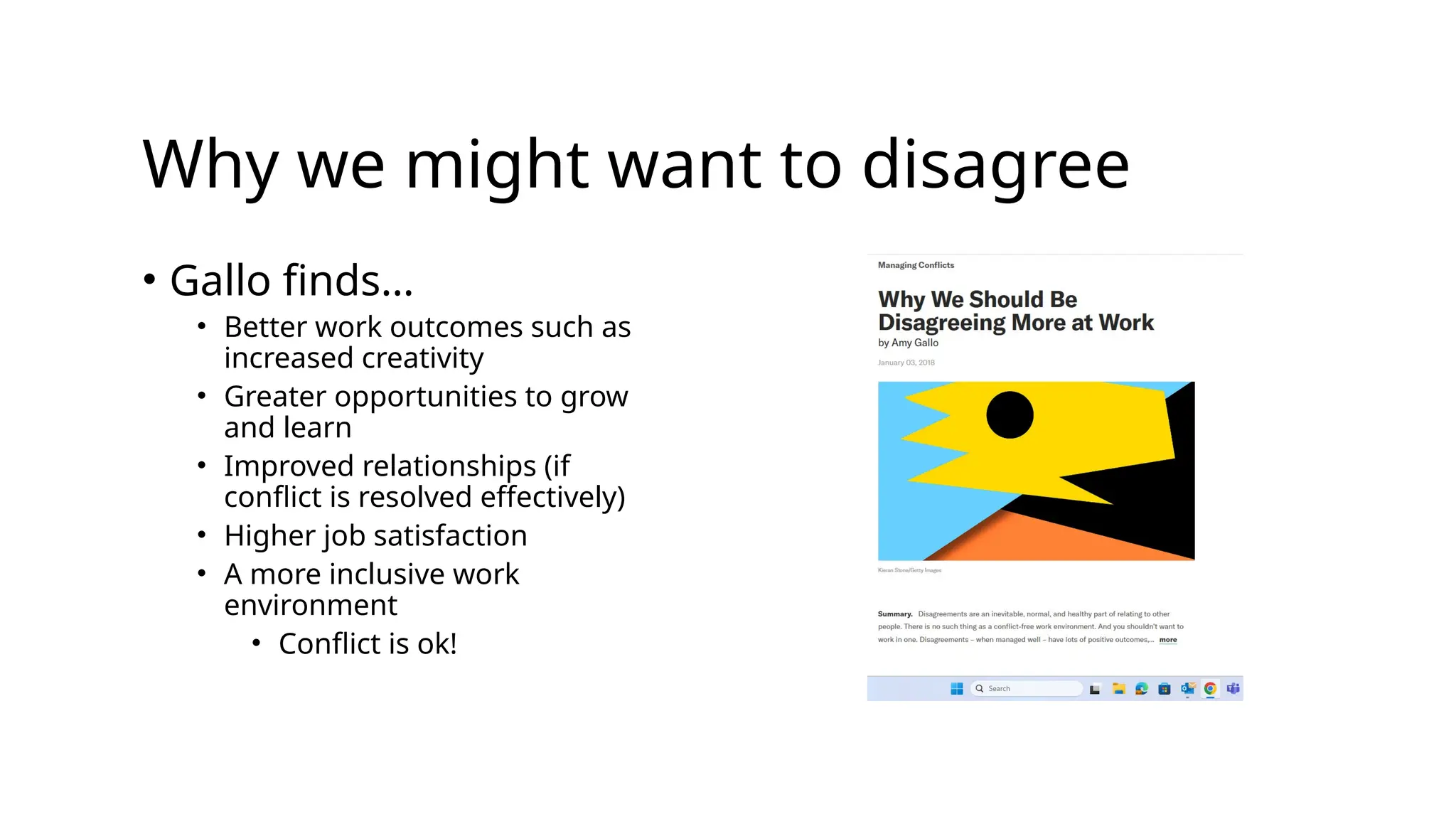
123.
Why we mightwant to disagree
• Gallo finds…
• Better work outcomes such as
increased creativity
• Greater opportunities to grow
and learn
• Improved relationships (if
conflict is resolved effectively)
• Higher job satisfaction
• A more inclusive work
environment
• Conflict is ok!
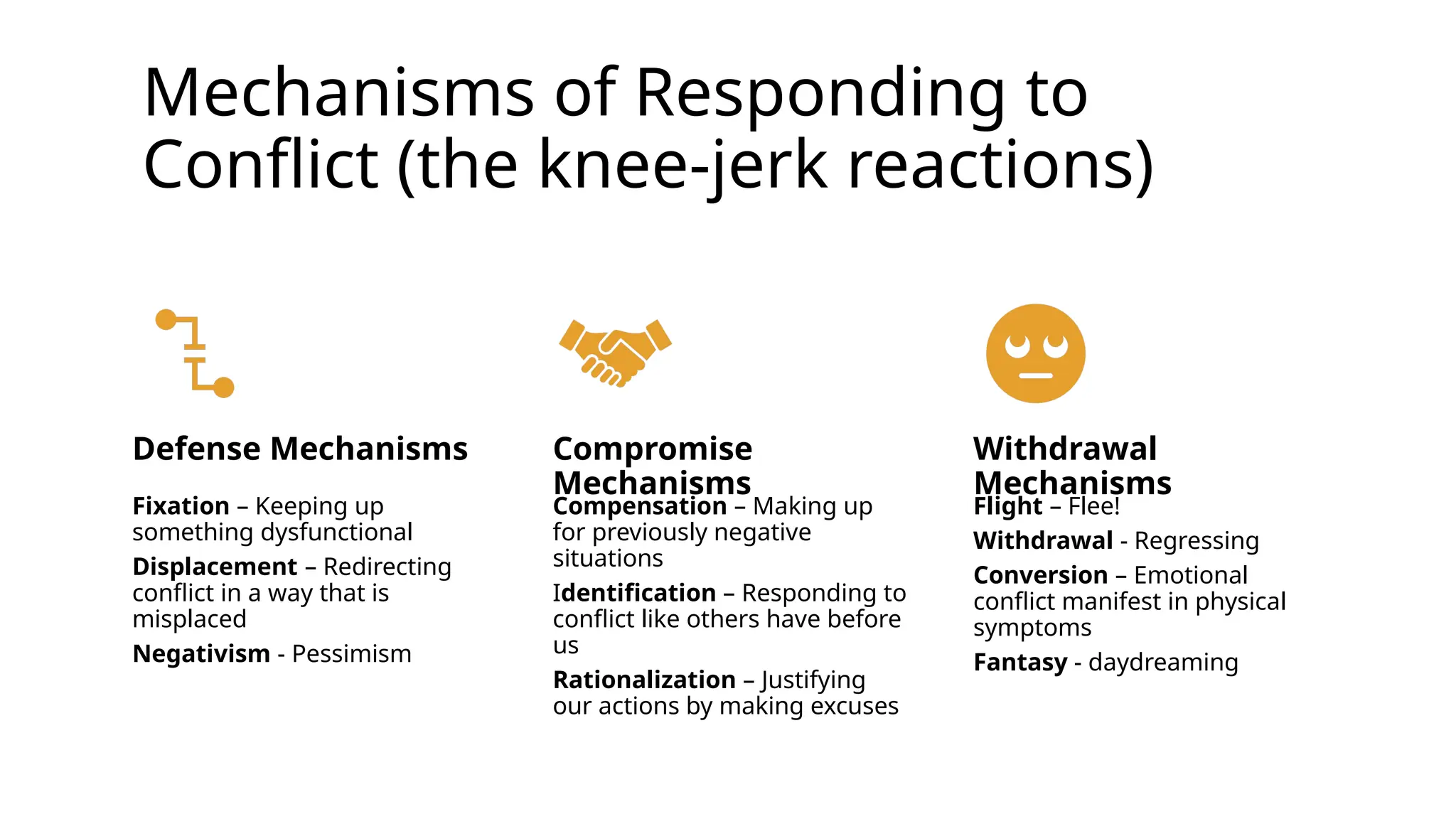
Mechanisms of Respondingto
Conflict (the knee-jerk reactions)
Defense Mechanisms
Fixation – Keeping up
something dysfunctional
Displacement – Redirecting
conflict in a way that is
misplaced
Negativism - Pessimism
Compromise
Mechanisms
Compensation – Making up
for previously negative
situations
Identification – Responding to
conflict like others have before
us
Rationalization – Justifying
our actions by making excuses
Withdrawal
Mechanisms
Flight – Flee!
Withdrawal - Regressing
Conversion – Emotional
conflict manifest in physical
symptoms
Fantasy - daydreaming
126.
Mechanisms of
Responding to
Conflict(the knee-
jerk reactions)
• Defense Mechanisms
• Fixation – Keeping up something dysfunctional
• Displacement – Redirecting conflict in a way that is
misplaced
• Negativism - Pessimism
• Compromise Mechanisms
• Compensation – Making up for previously negative
situations
• Identification – Responding to conflict like others have
before us
• Rationalization – Justifying our actions by making
excuses
• Withdrawal Mechanisms
• Flight – Flee!
• Withdrawal - Regressing
• Conversion – Emotional conflict manifest in physical
symptoms
• Fantasy - daydreaming
What do you think?
What works?
What doesn’t work?
127.
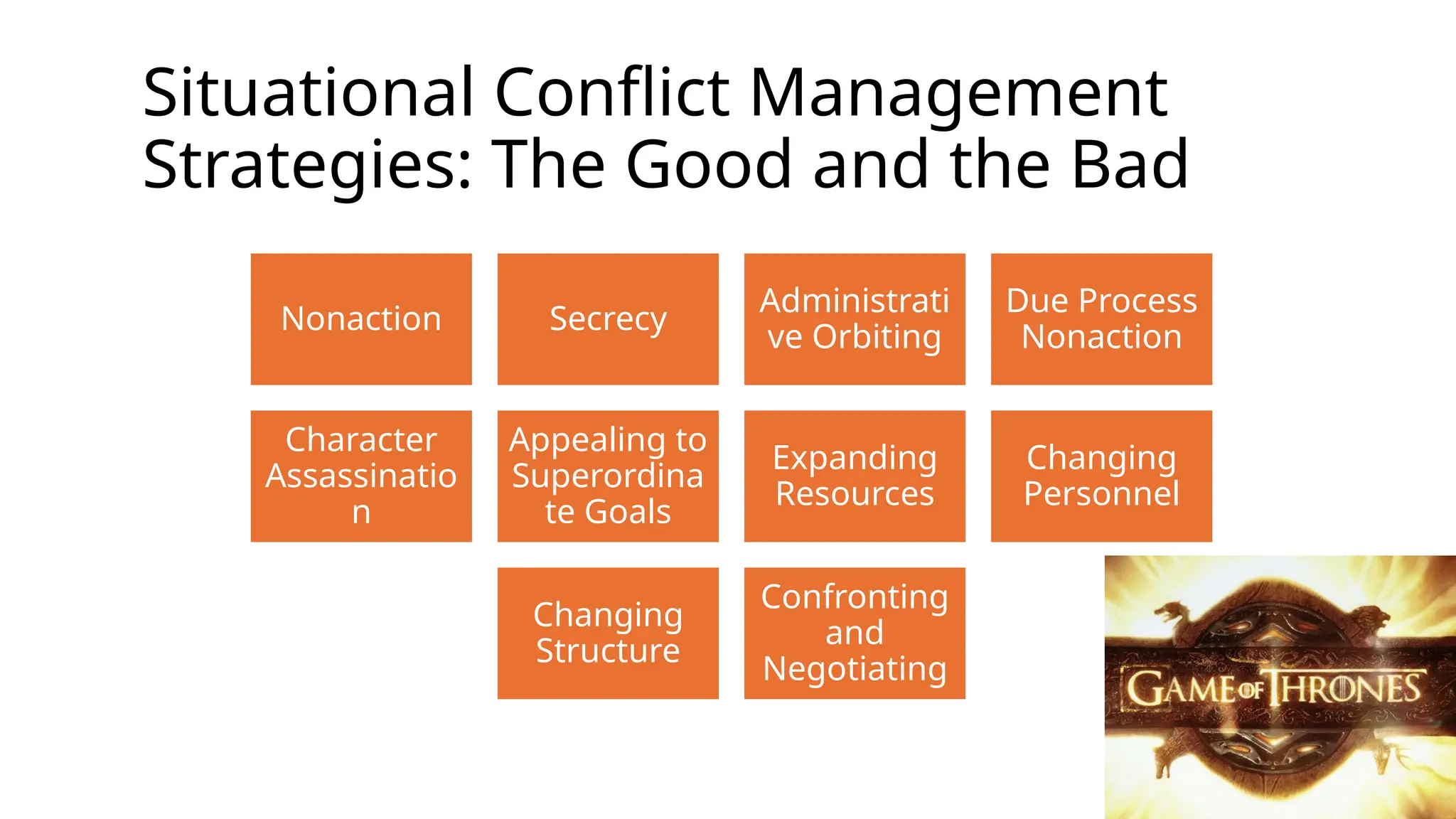
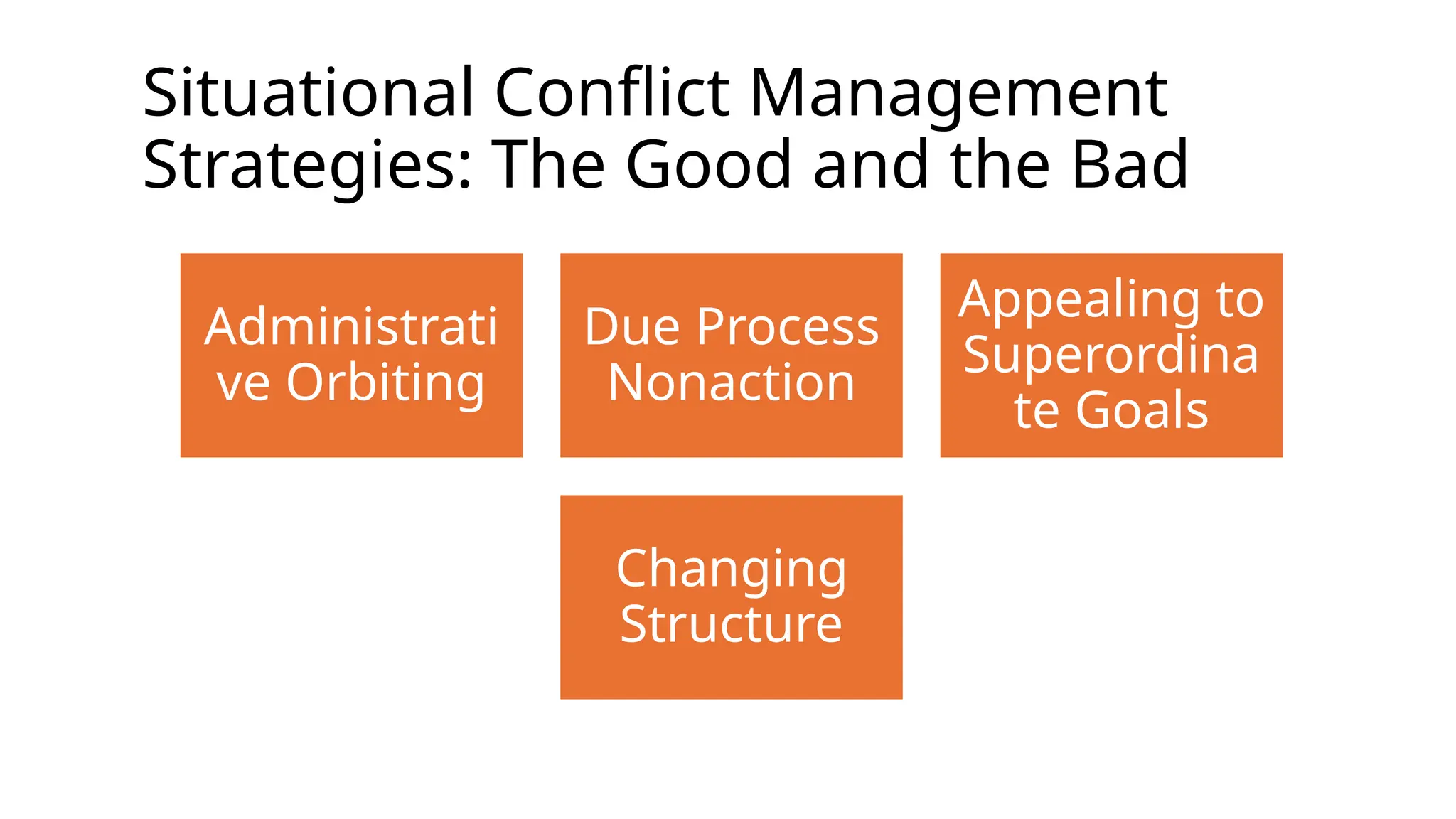
Situational Conflict Management
Strategies:The Good and the Bad
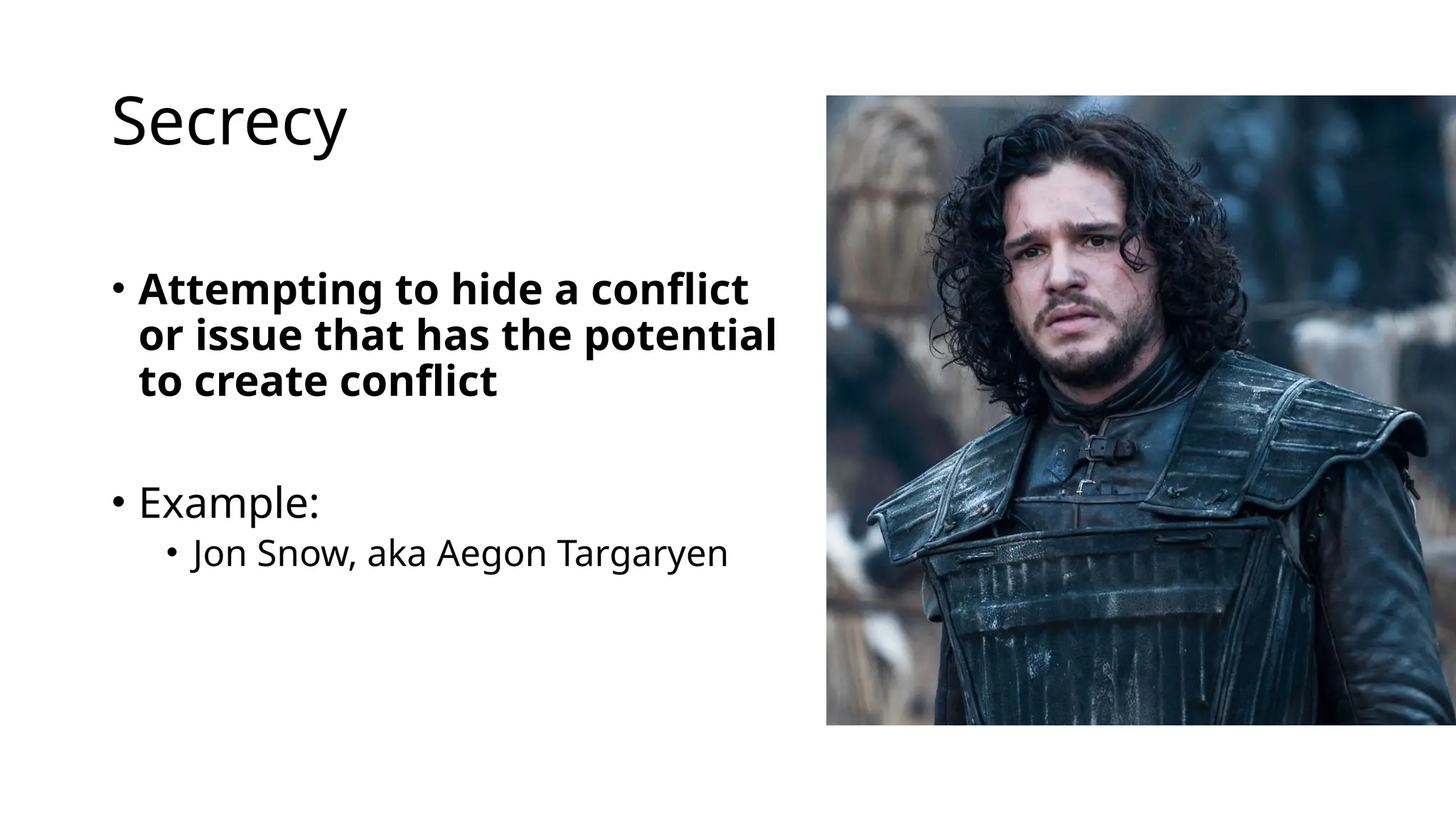
Nonaction Secrecy
Administrati
ve Orbiting
Due Process
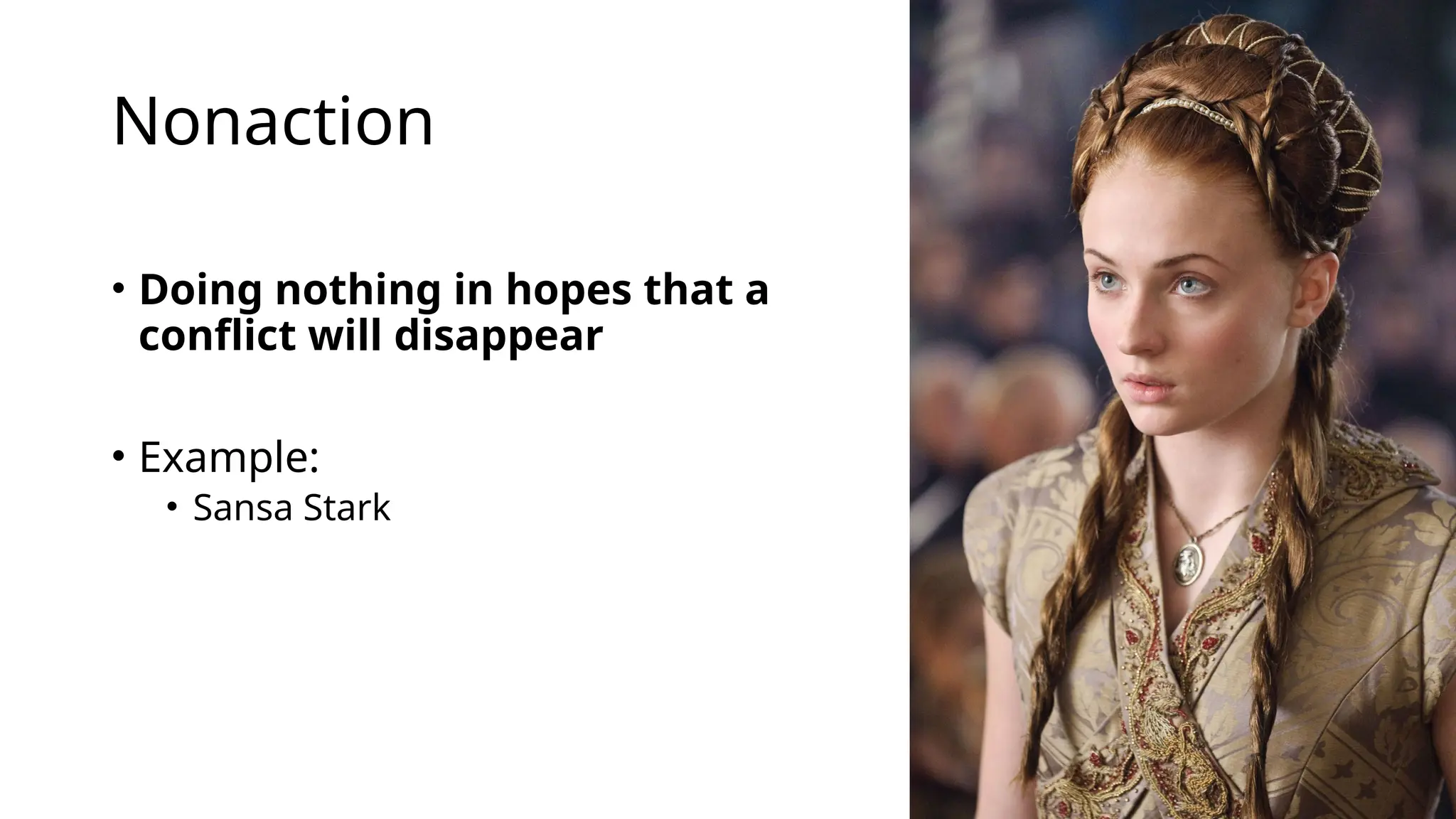
Nonaction
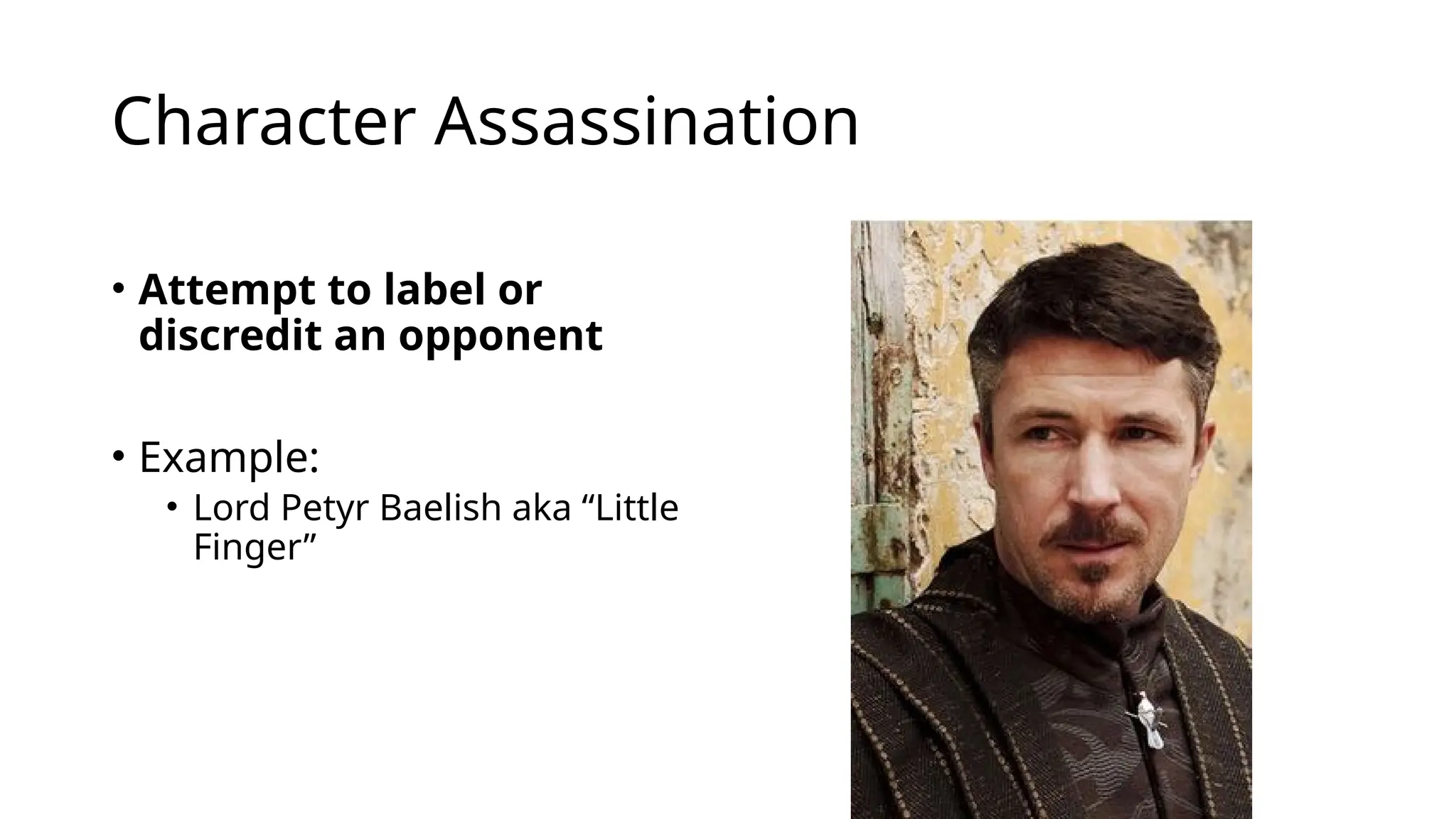
Character
Assassinatio
n
Appealing to
Superordina
te Goals
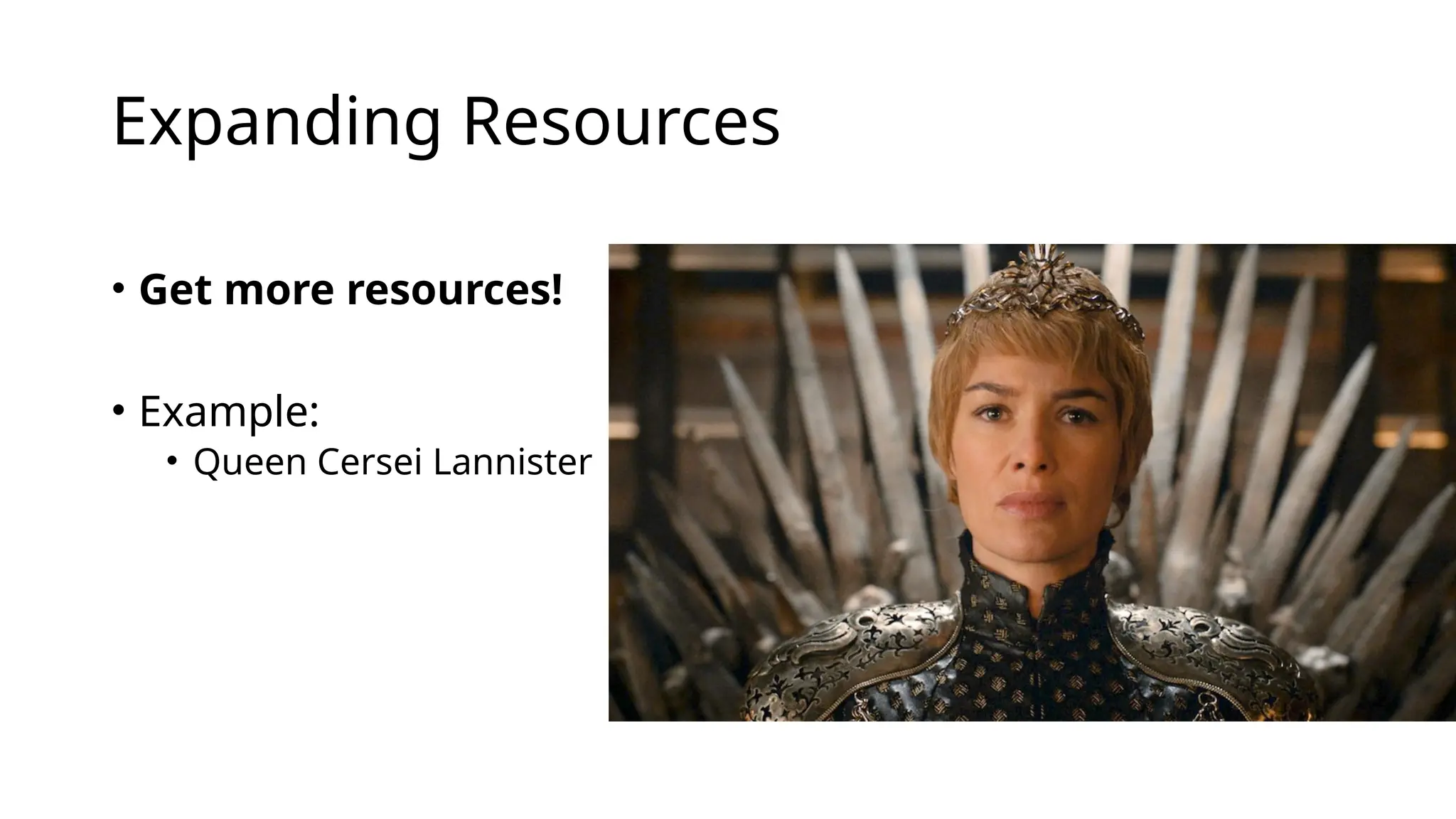
Expanding
Resources
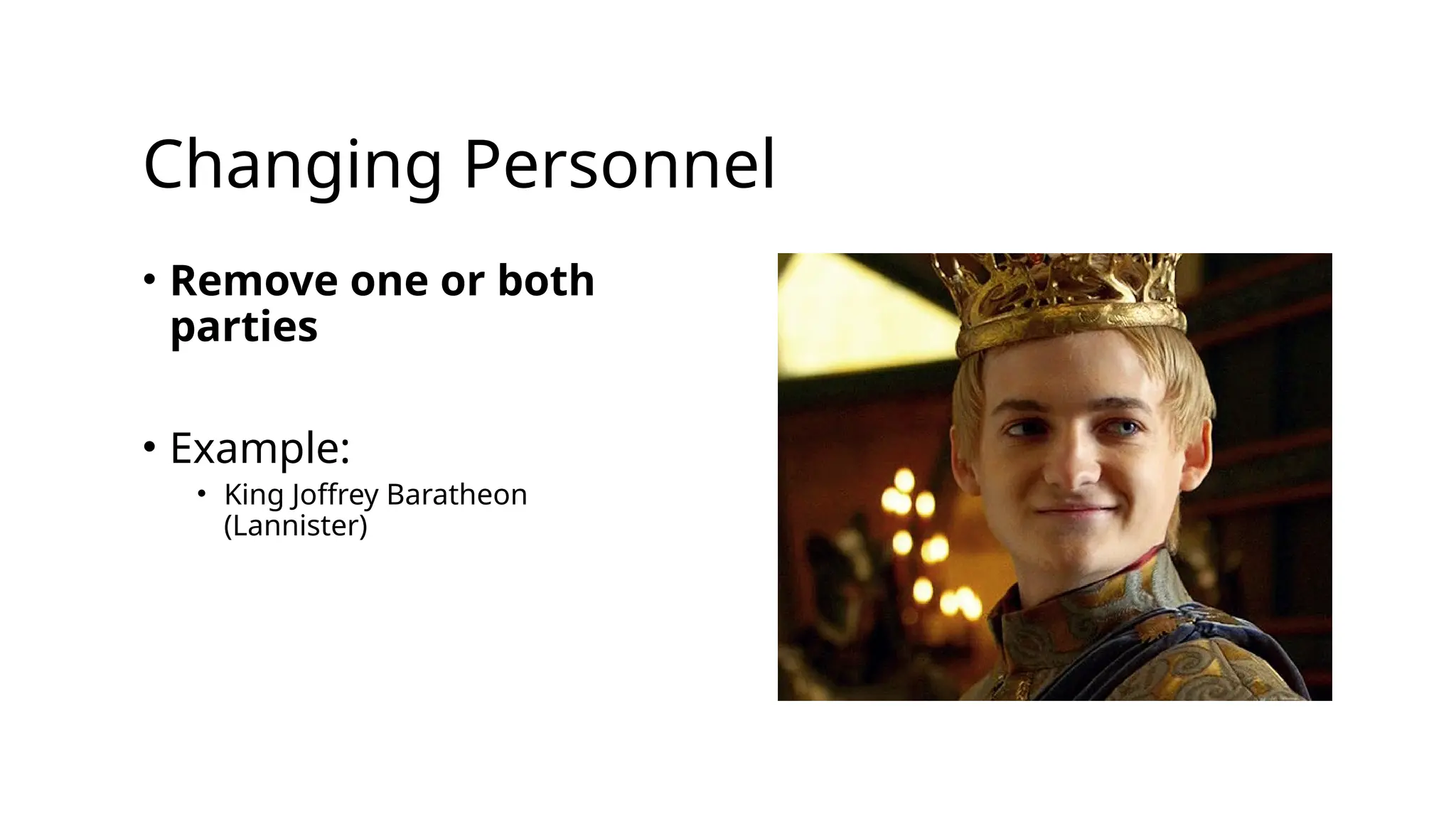
Changing
Personnel
Changing
Structure
Confronting
and
Negotiating
Confronting and Negotiating
•Distributive or
integrative
negotiations
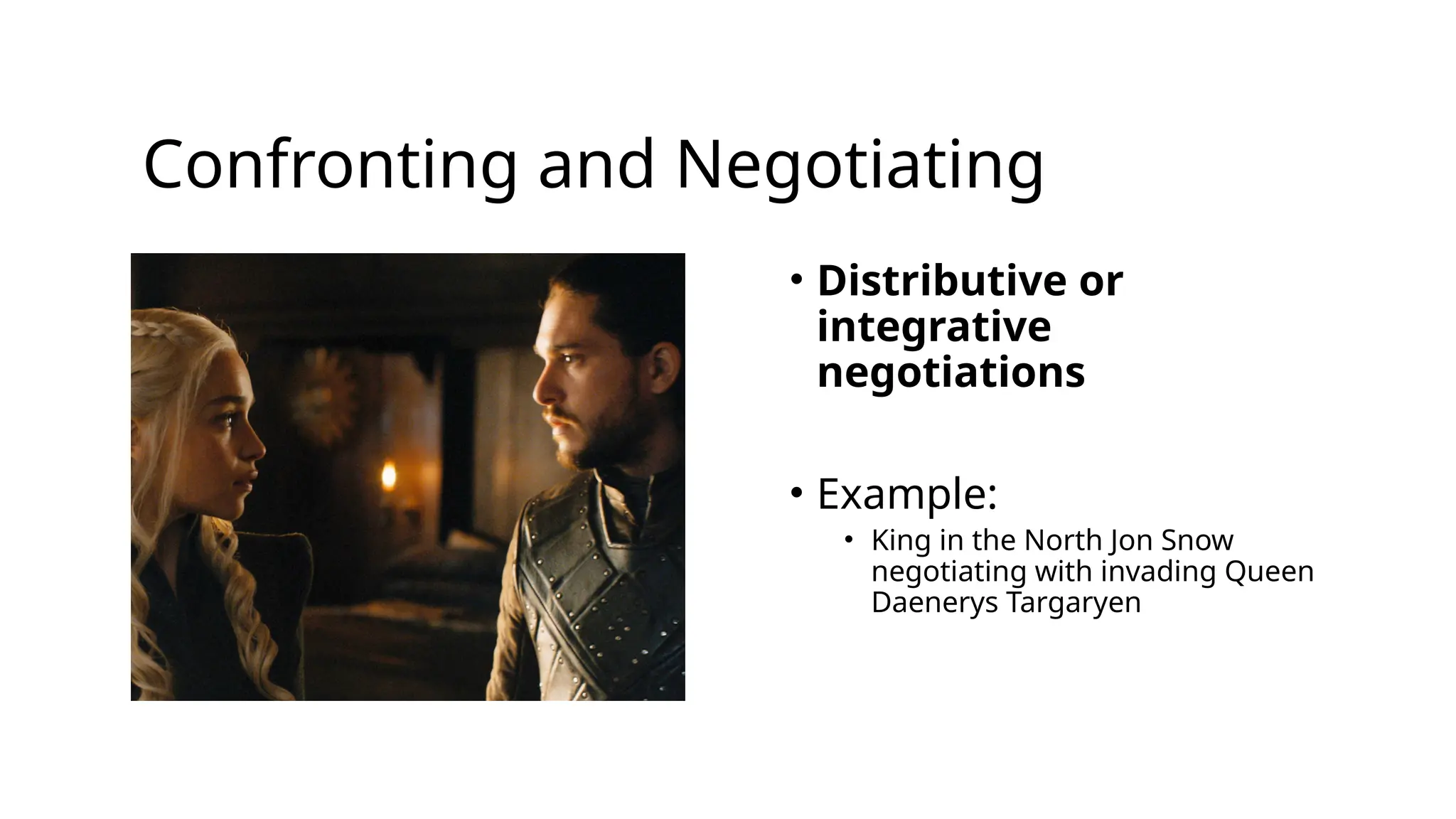
• Example:
• King in the North Jon Snow
negotiating with invading Queen
Daenerys Targaryen
But wait…
What ifthe situation has nothing to do with us?
How might you manage conflict as a bystander? Should
we?
136.
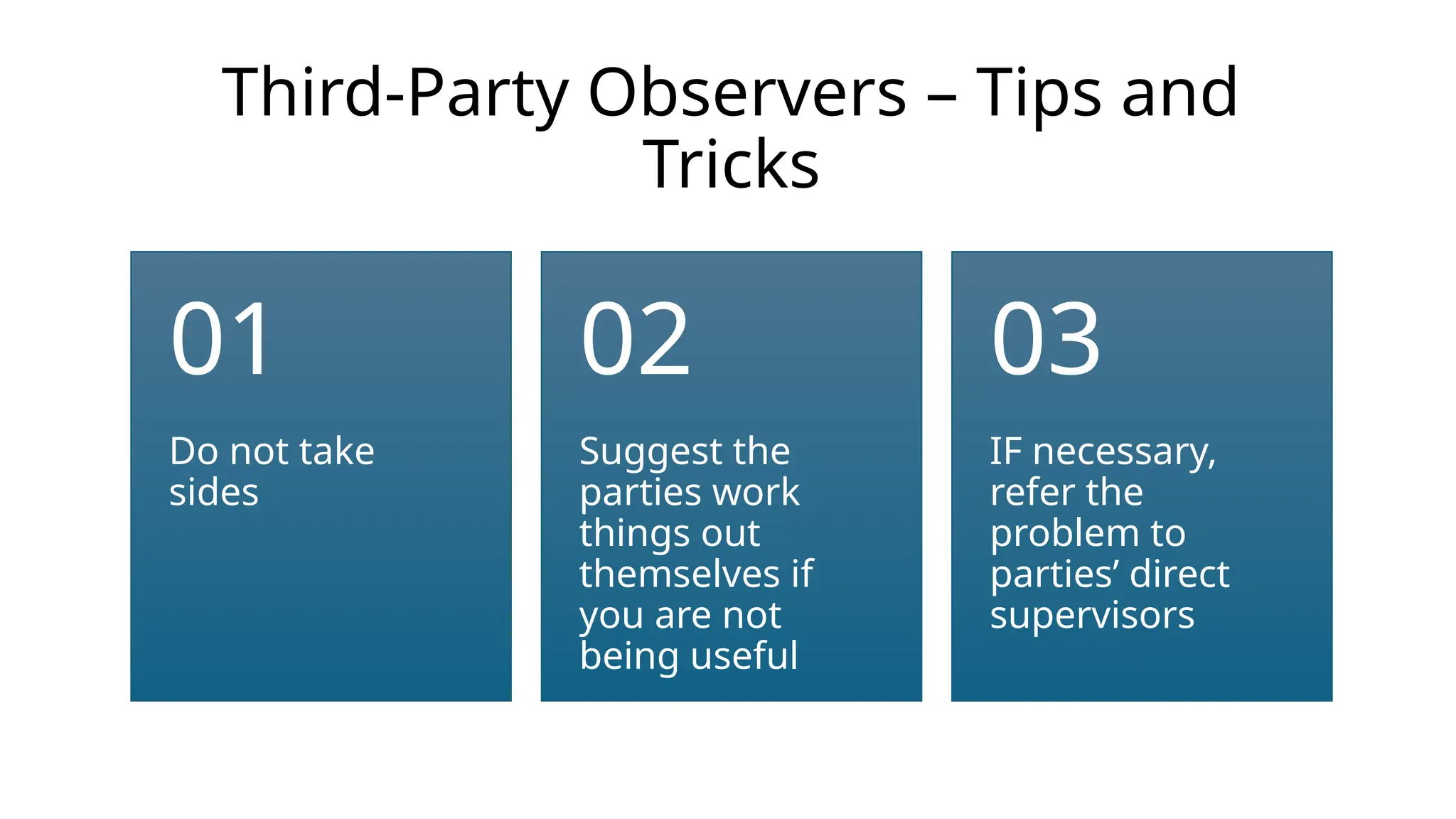
Third-Party Observers –Tips and
Tricks
Do not take
sides
01
Suggest the
parties work
things out
themselves if
you are not
being useful
02
IF necessary,
refer the
problem to
parties’ direct
supervisors
03
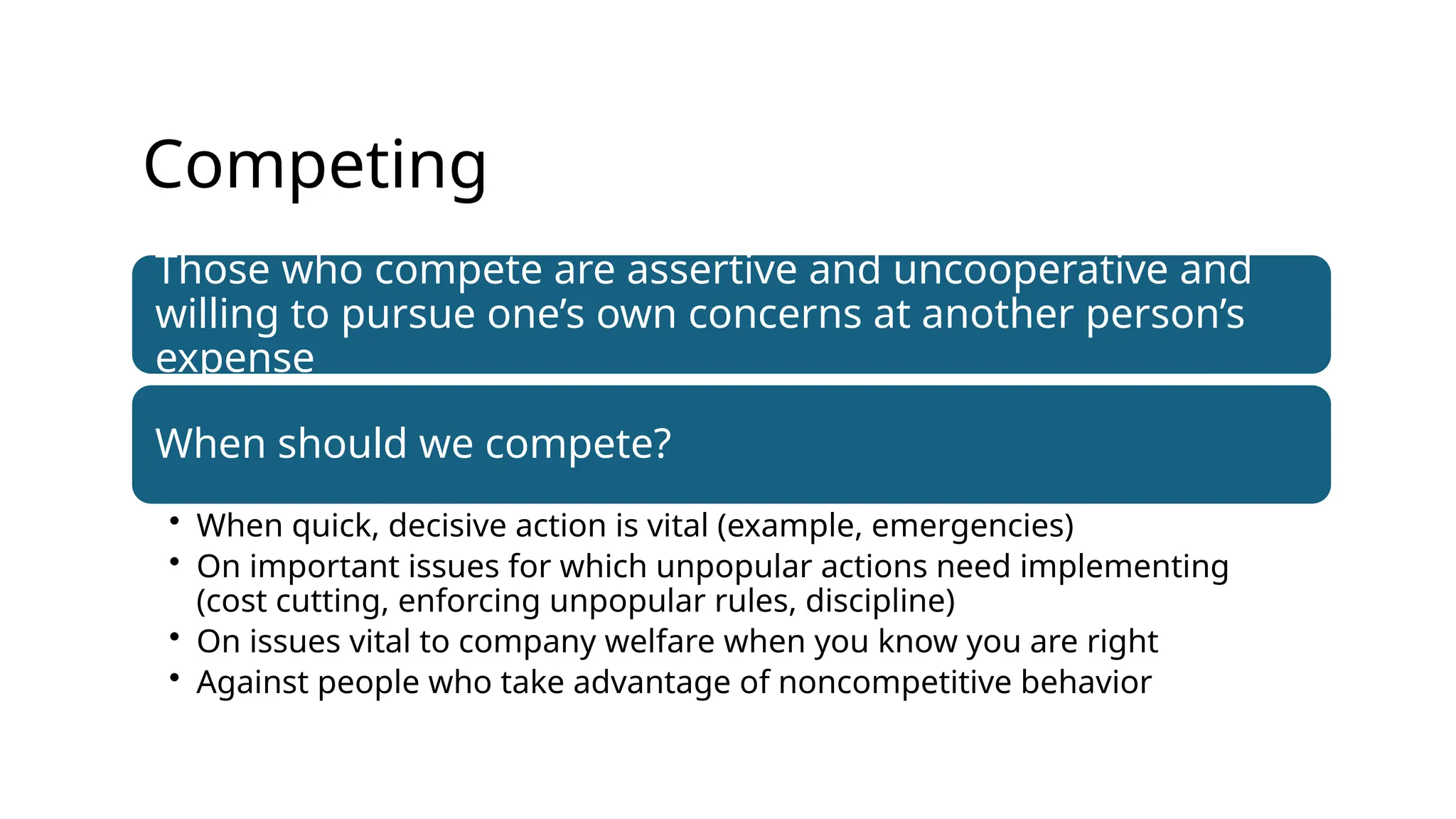
Competing
Those who competeare assertive and uncooperative and
willing to pursue one’s own concerns at another person’s
expense
When should we compete?
• When quick, decisive action is vital (example, emergencies)
• On important issues for which unpopular actions need implementing
(cost cutting, enforcing unpopular rules, discipline)
• On issues vital to company welfare when you know you are right
• Against people who take advantage of noncompetitive behavior
139.
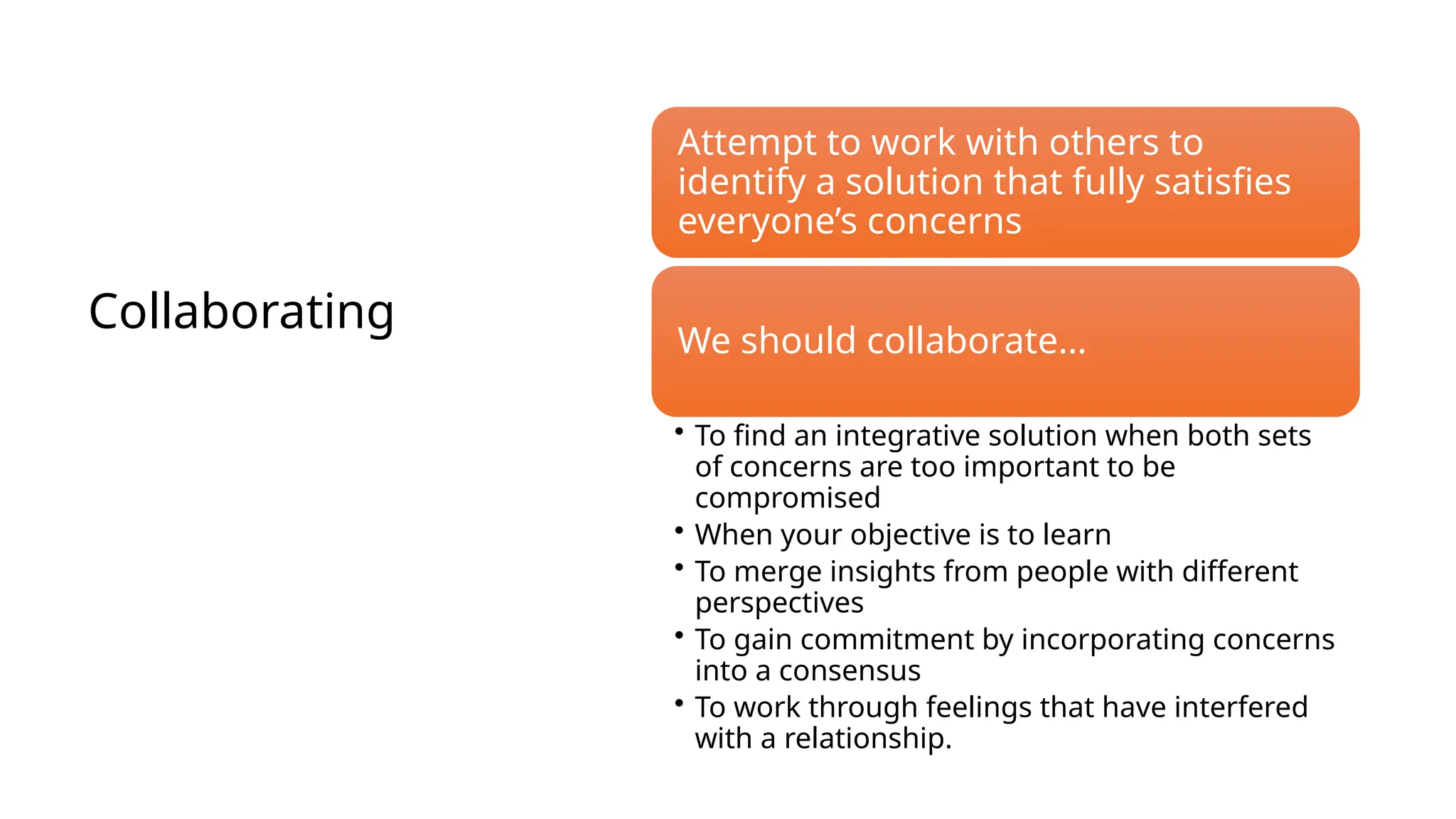
Collaborating
Attempt to workwith others to
identify a solution that fully satisfies
everyone’s concerns
We should collaborate…
• To find an integrative solution when both sets
of concerns are too important to be
compromised
• When your objective is to learn
• To merge insights from people with different
perspectives
• To gain commitment by incorporating concerns
into a consensus
• To work through feelings that have interfered
with a relationship.
140.
Compromising
Find an expedient,mutually acceptable
solution that partially satisfies both
parties in the conflict while maintaining
some assertiveness and
cooperativeness
We should compromise…
• When goals are important but not worth the
effort or potential disruption of more assertive
modes
• When opponents with equal power are committed
to mutually exclusive goals
• To achieve temporary settlements to complex
issues
• To arrive at expedient solutions under time
pressure
• As a backup when collaboration or competition is
unsuccessful
141.
Avoiding
Conflict tend tobe unassertive and
uncooperative while diplomatically
sidestepping an issue or simply
withdrawing from a threatening situation
We tend to avoid…
• When an issue is trivial or more important issues are
pressing
• When you perceive no chance of satisfying your
concerns
• When potential disruption outweighs the benefits of
resolution
• To let people cool down and regain perspective
• When issues seem tangential or symptomatic of
other issues
142.
Accommodating
The opposite ofcompeting, there is an
element of self-sacrifice when
accommodating to satisfy the other
person.
We accommodate when…
• When you find you are wrong—to allow a
better position to be heard, to learn, and to
show your reasonableness
• To build social credits for later issues
• When harmony and stability are especially
important.
• To allow employees to develop by learning from
mistakes.
143.
Show of hands….
Shouldwe take steps to change our conflict management
style? Why or why not?
Negotiation, Love itor Leave it
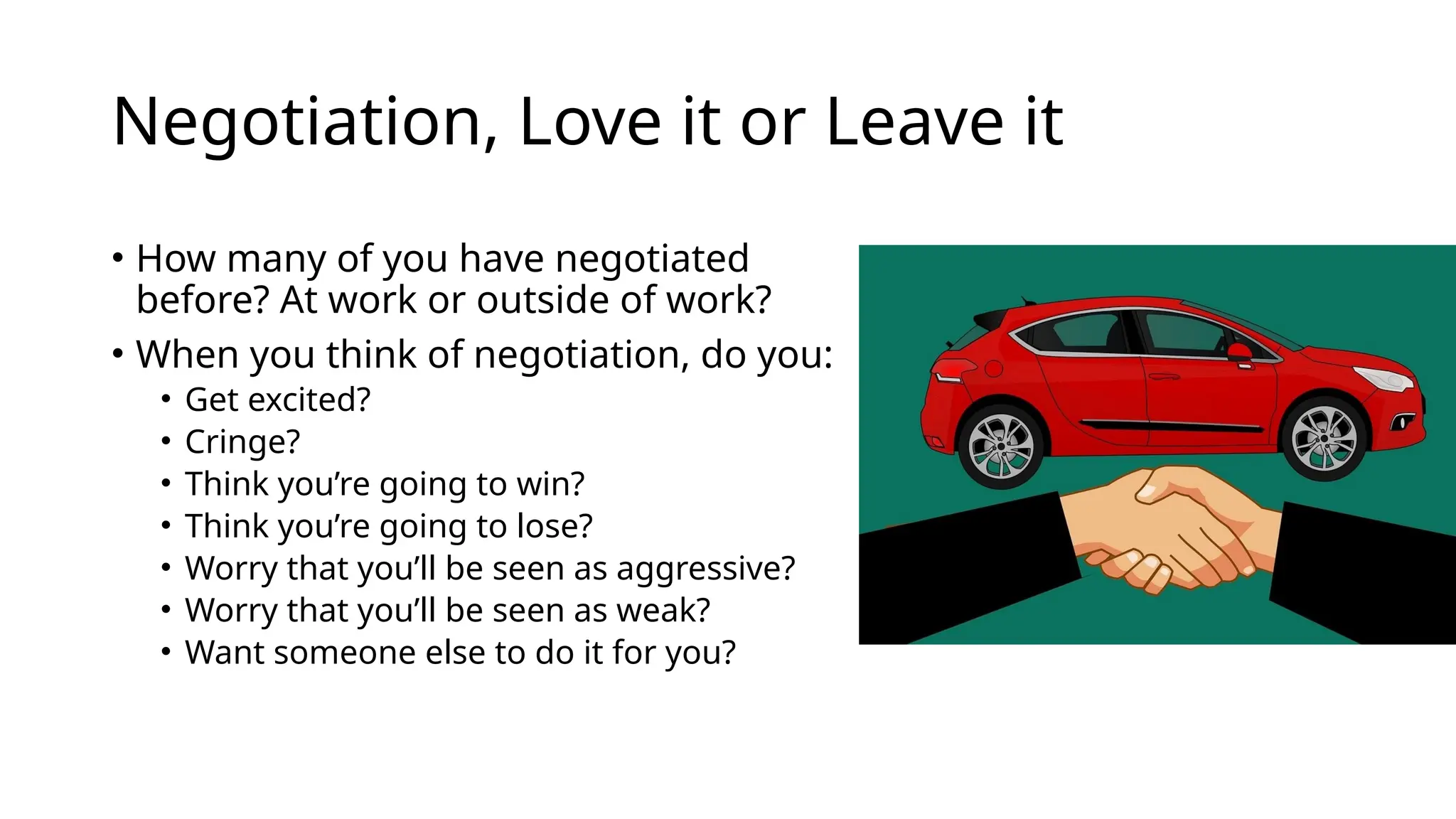
• How many of you have negotiated
before? At work or outside of work?
• When you think of negotiation, do you:
• Get excited?
• Cringe?
• Think you’re going to win?
• Think you’re going to lose?
• Worry that you’ll be seen as aggressive?
• Worry that you’ll be seen as weak?
• Want someone else to do it for you?
146.
Negotiation, Love itor Leave it
Do you enjoy negotiation? Why or why not?
Can you think of anything else we’ve talked about this
semester that might predict negotiation enjoyment (or
success)?
Are there times where we should avoid negotiating?
147.
What is Negotiation?
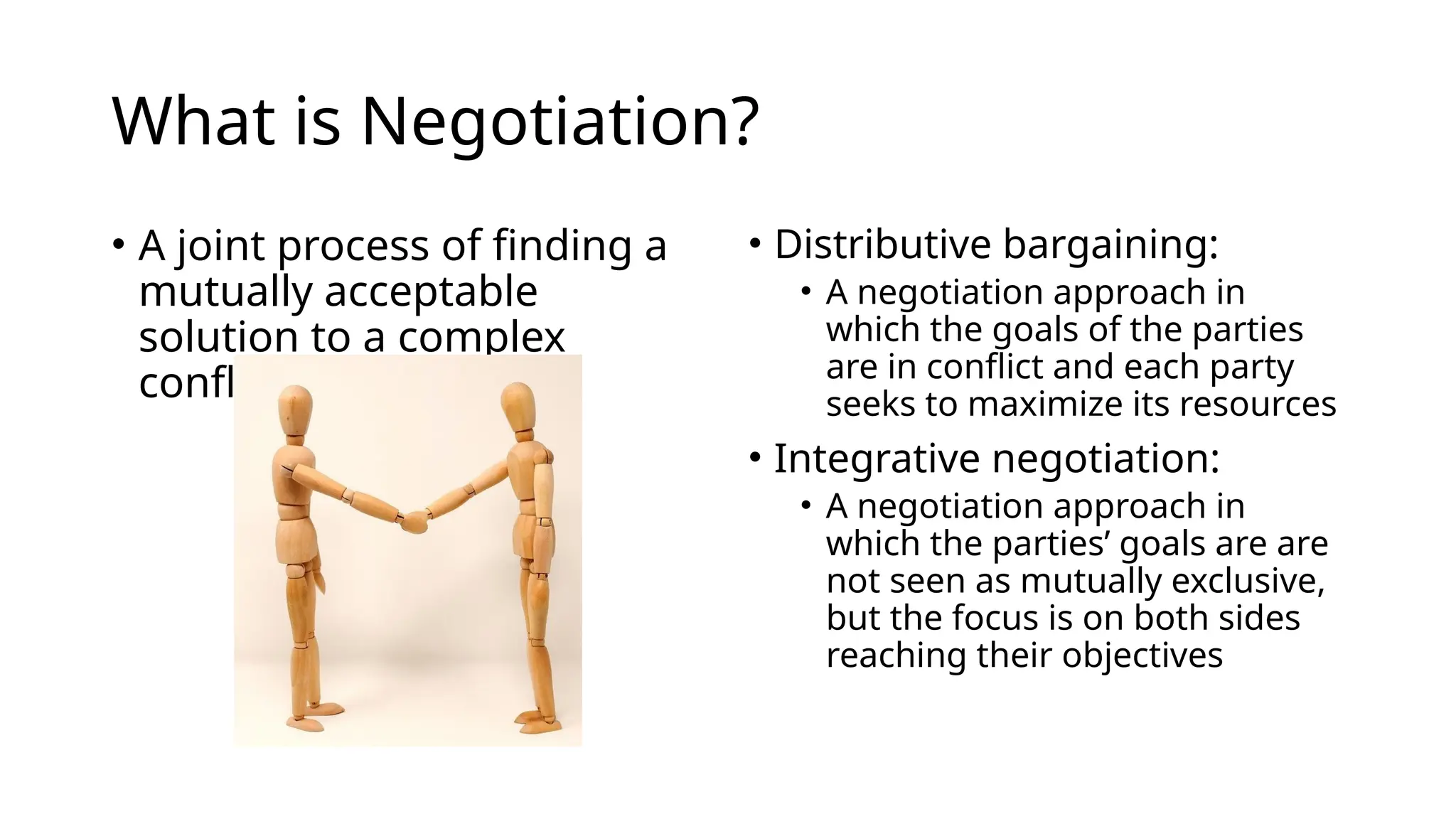
•A joint process of finding a
mutually acceptable
solution to a complex
conflict
• Distributive bargaining:
• A negotiation approach in
which the goals of the parties
are in conflict and each party
seeks to maximize its resources
• Integrative negotiation:
• A negotiation approach in
which the parties’ goals are are
not seen as mutually exclusive,
but the focus is on both sides
reaching their objectives
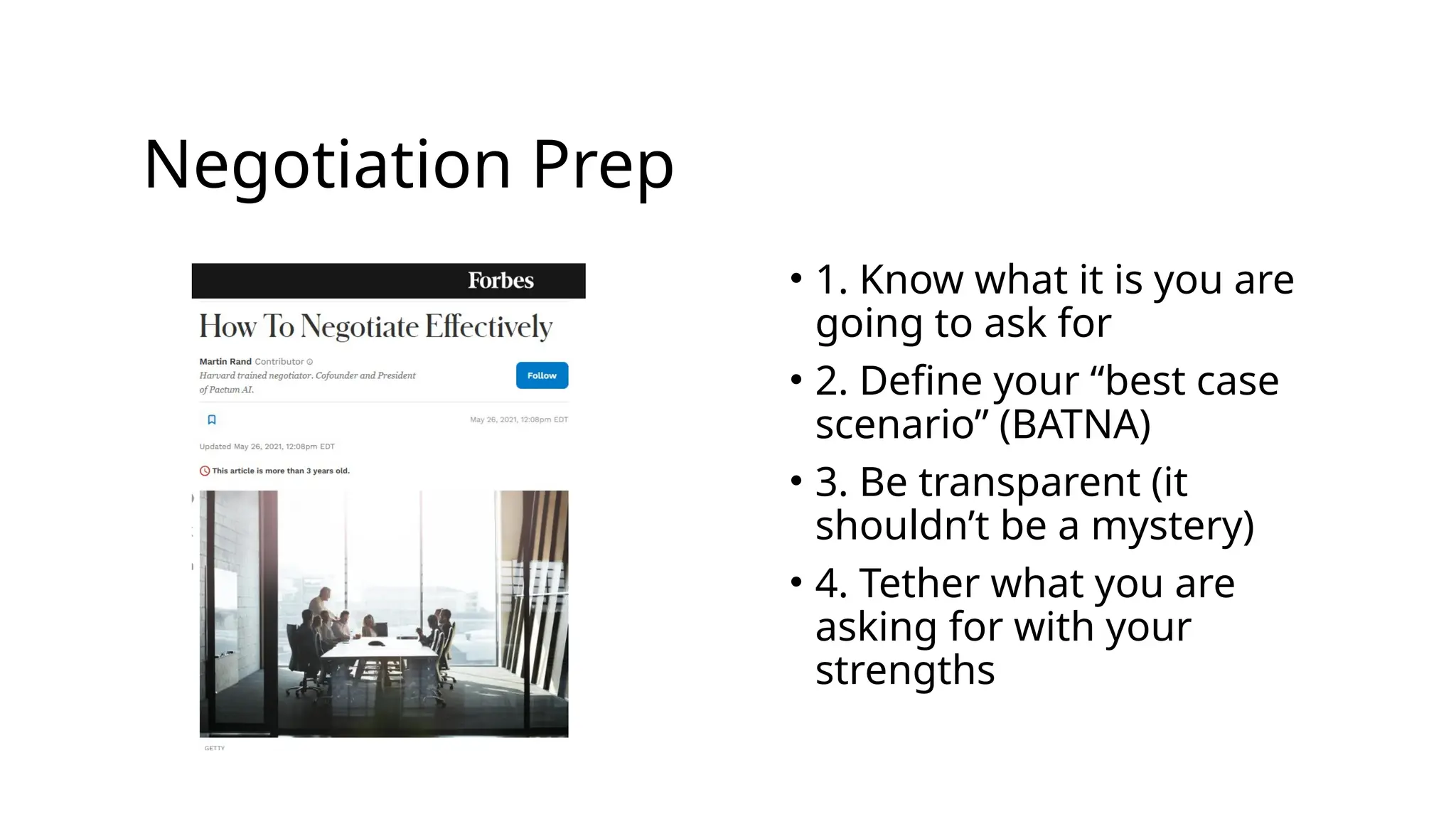
Negotiation Prep
• 1.Know what it is you are
going to ask for
• 2. Define your “best case
scenario” (BATNA)
• 3. Be transparent (it
shouldn’t be a mystery)
• 4. Tether what you are
asking for with your
strengths
152.
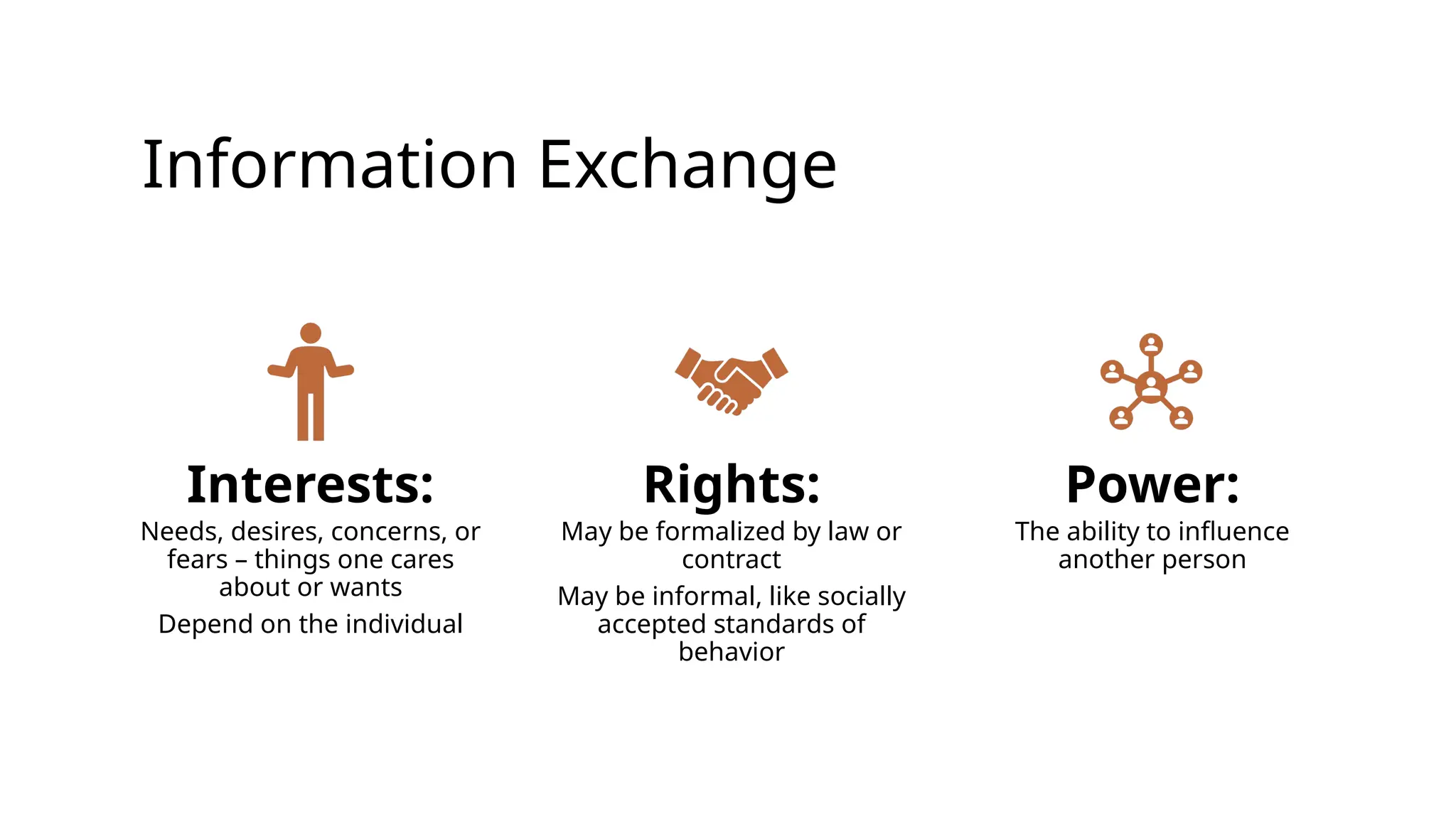
Information Exchange
Interests:
Needs, desires,concerns, or
fears – things one cares
about or wants
Depend on the individual
Rights:
May be formalized by law or
contract
May be informal, like socially
accepted standards of
behavior
Power:
The ability to influence
another person
153.
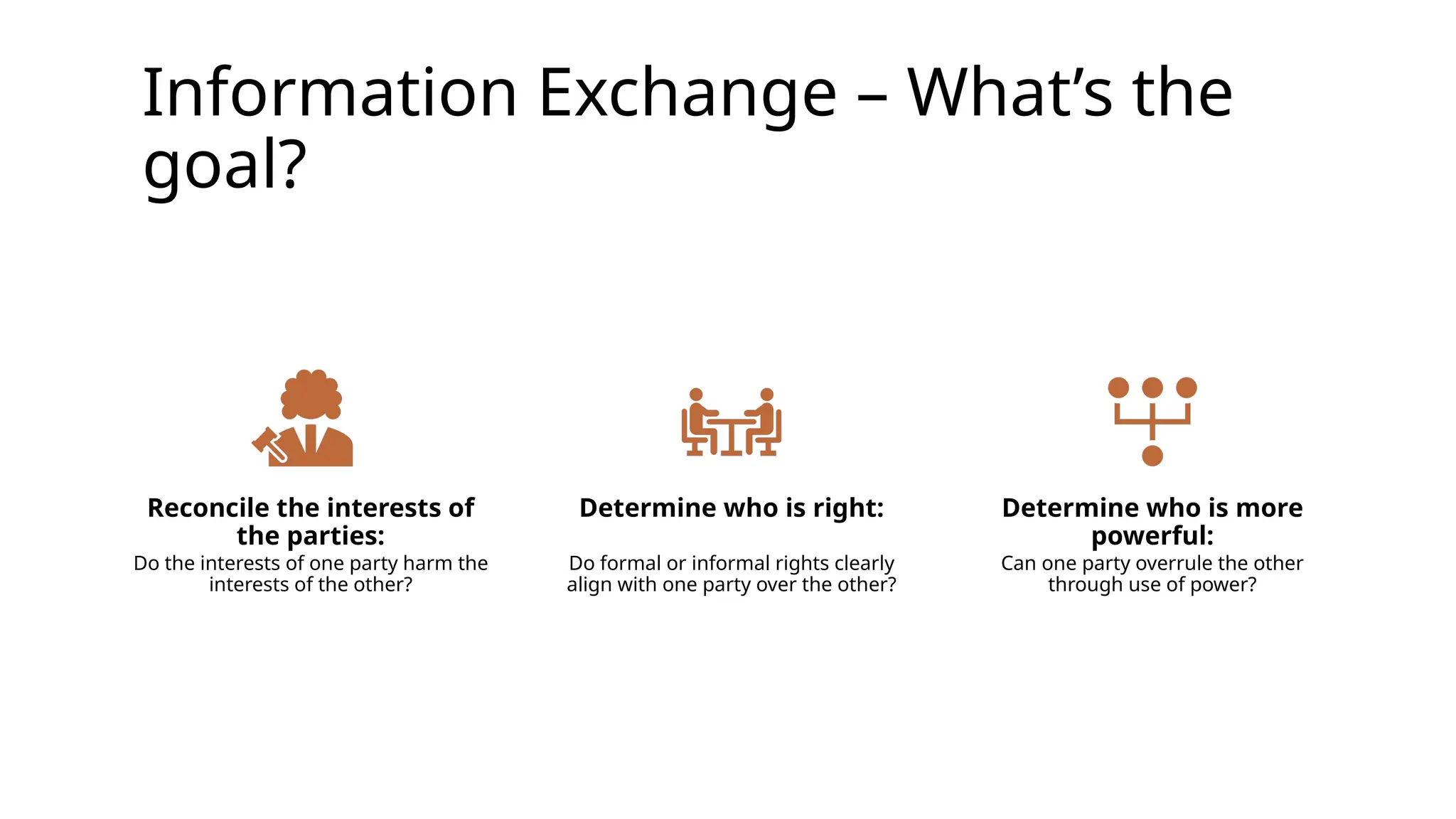
Information Exchange –What’s the
goal?
Reconcile the interests of
the parties:
Do the interests of one party harm the
interests of the other?
Determine who is right:
Do formal or informal rights clearly
align with one party over the other?
Determine who is more
powerful:
Can one party overrule the other
through use of power?
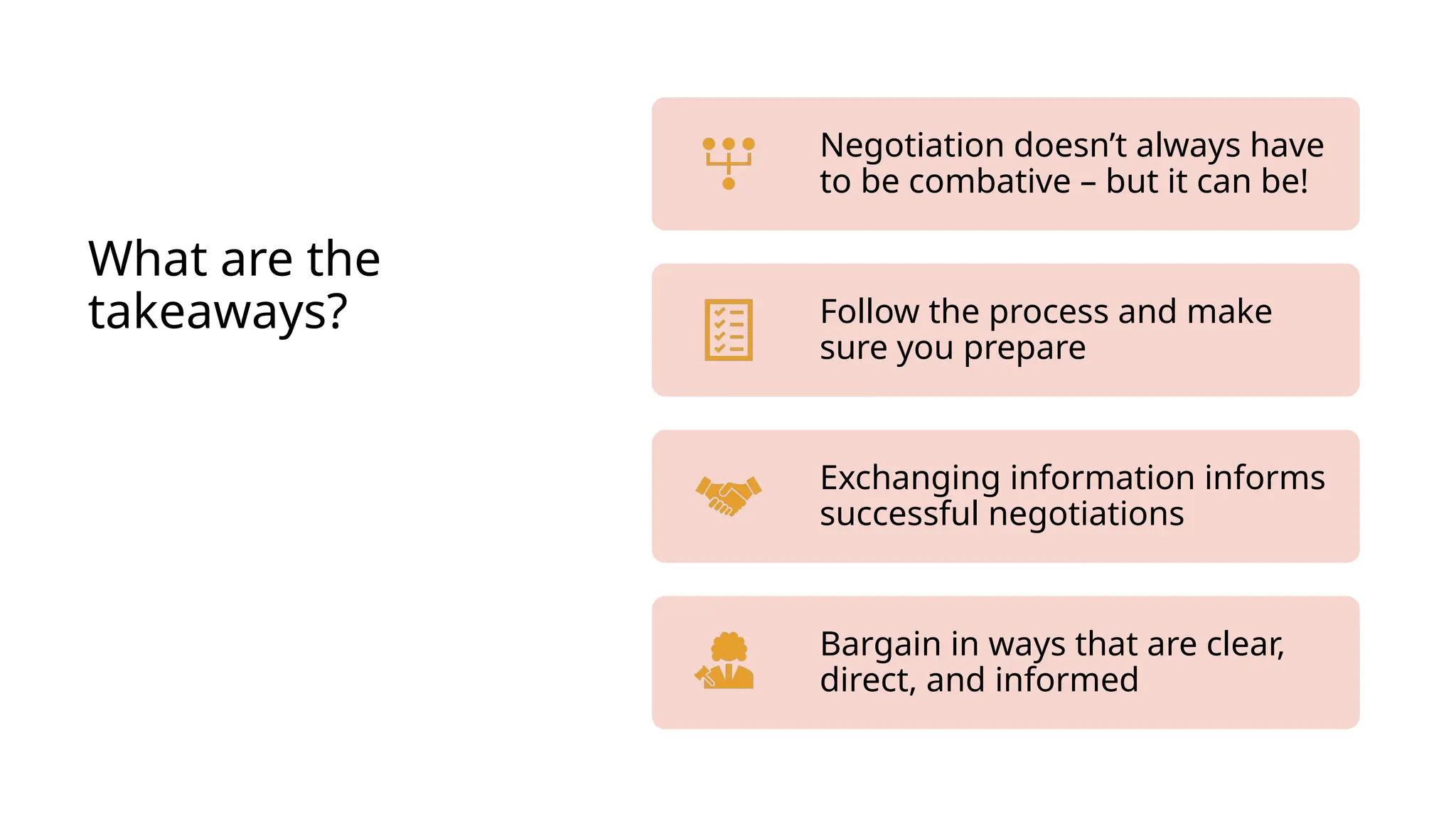
What are the
takeaways?
Negotiationdoesn’t always have
to be combative – but it can be!
Follow the process and make
sure you prepare
Exchanging information informs
successful negotiations
Bargain in ways that are clear,
direct, and informed
156.
Chapter 13 summary
•Managing conflict depends on not just the people, but the
style!
• There are different ways of approaching conflict depending
on how much you care about both parties involved and
advancing their interests (assertiveness vs. cooperativeness)
• We should always try to negotiate!!!
• Negotiation is uncomfortable, but can hopefully get us what
we want
• And if not, it gives us a sense of how receptive our organization is
to our needs!
Learning Objectives
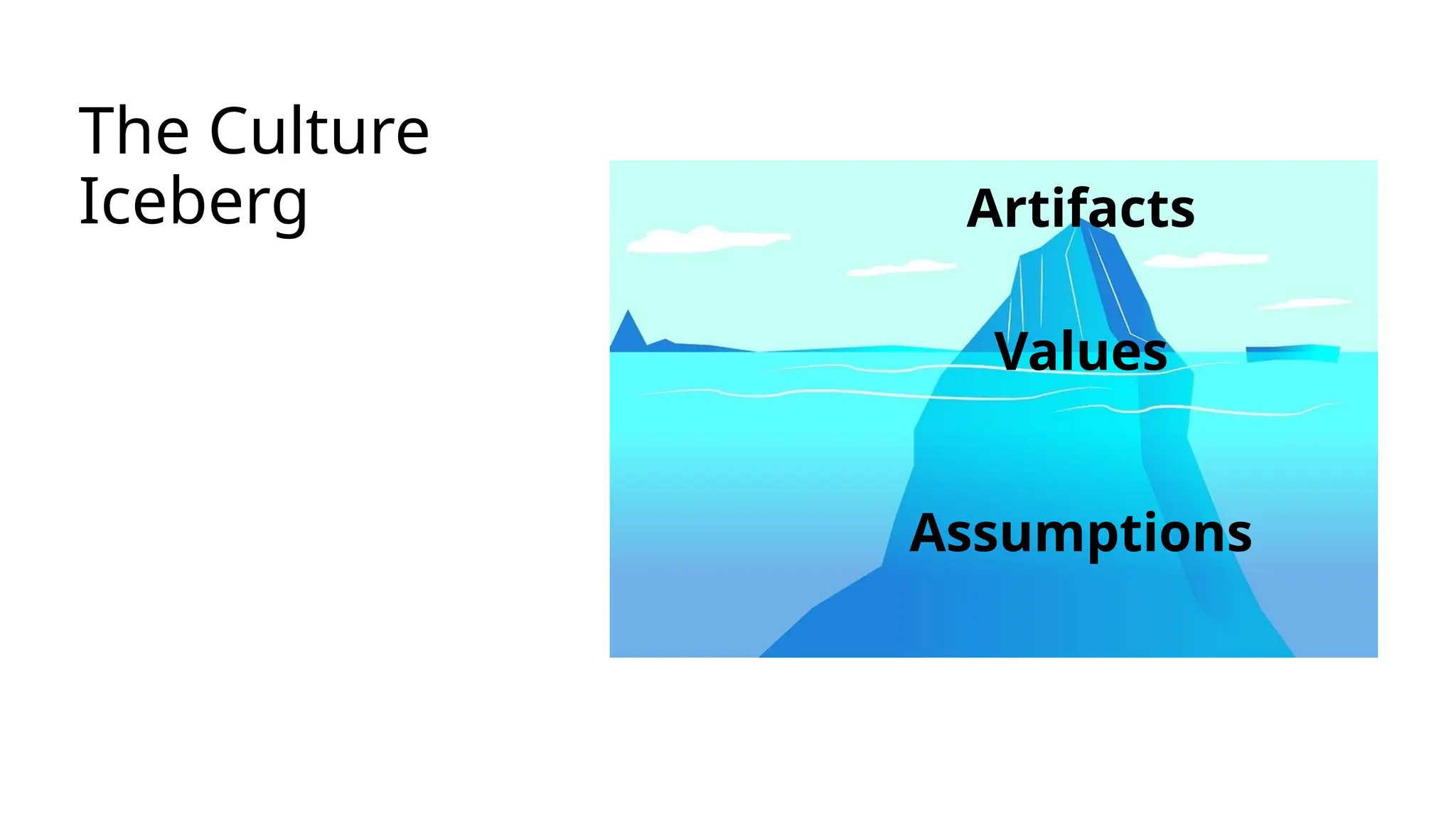
• Identifythe three levels of organizational culture and
evaluate the roles they play in an organization.
• Explain artifacts, values, and assumptions
• Differentiate the six rites of organizational culture
• Describe the three stages of organizational socialization and
the ways culture is communicated at each step
• Differentiate culture from climate
160.
Warm up
• Haveyou every walked into a business and thought “this
seems like a cool place to work”
• Why?
• Alternatively, have you ever walked into a business and
thought “this seems miserable I want to leave immediately”
• Why?
161.
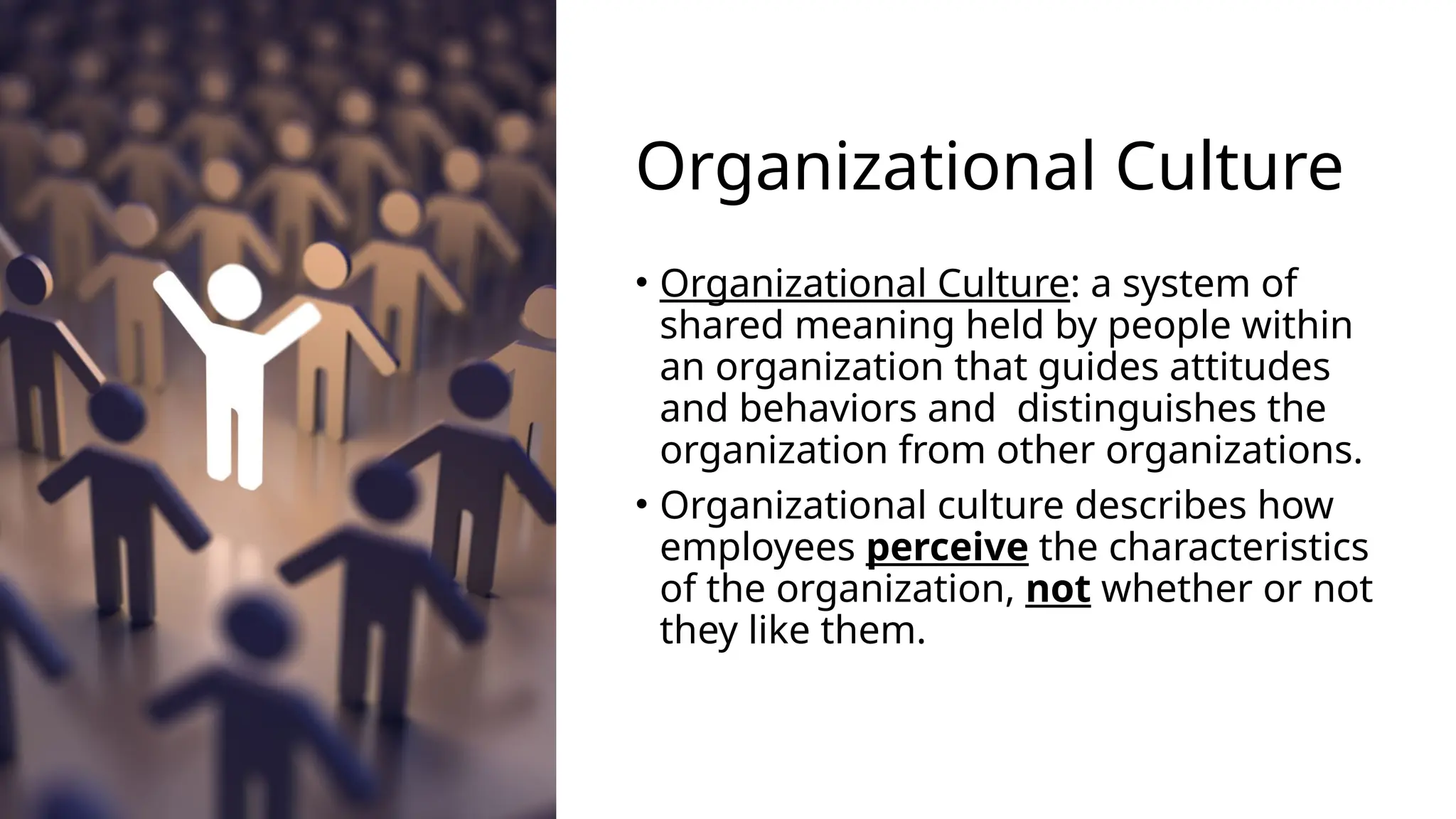
Organizational Culture
• OrganizationalCulture: a system of
shared meaning held by people within
an organization that guides attitudes
and behaviors and distinguishes the
organization from other organizations.
• Organizational culture describes how
employees perceive the characteristics
of the organization, not whether or not
they like them.
162.
Culture in plainEnglish
• From the employees’ perspective, culture summarizes “the way things
are around here” – or “How is this organization different from all other
organizations?”
• Is the big boss human?
• Can employees rise to the top?
• Will I get fired/laid off?
• How will the boss react to mistakes?
• Will the organization help me when I have to move?
• What happens when the boss is caught breaking a rule?
• How will the organization deal with obstacles?
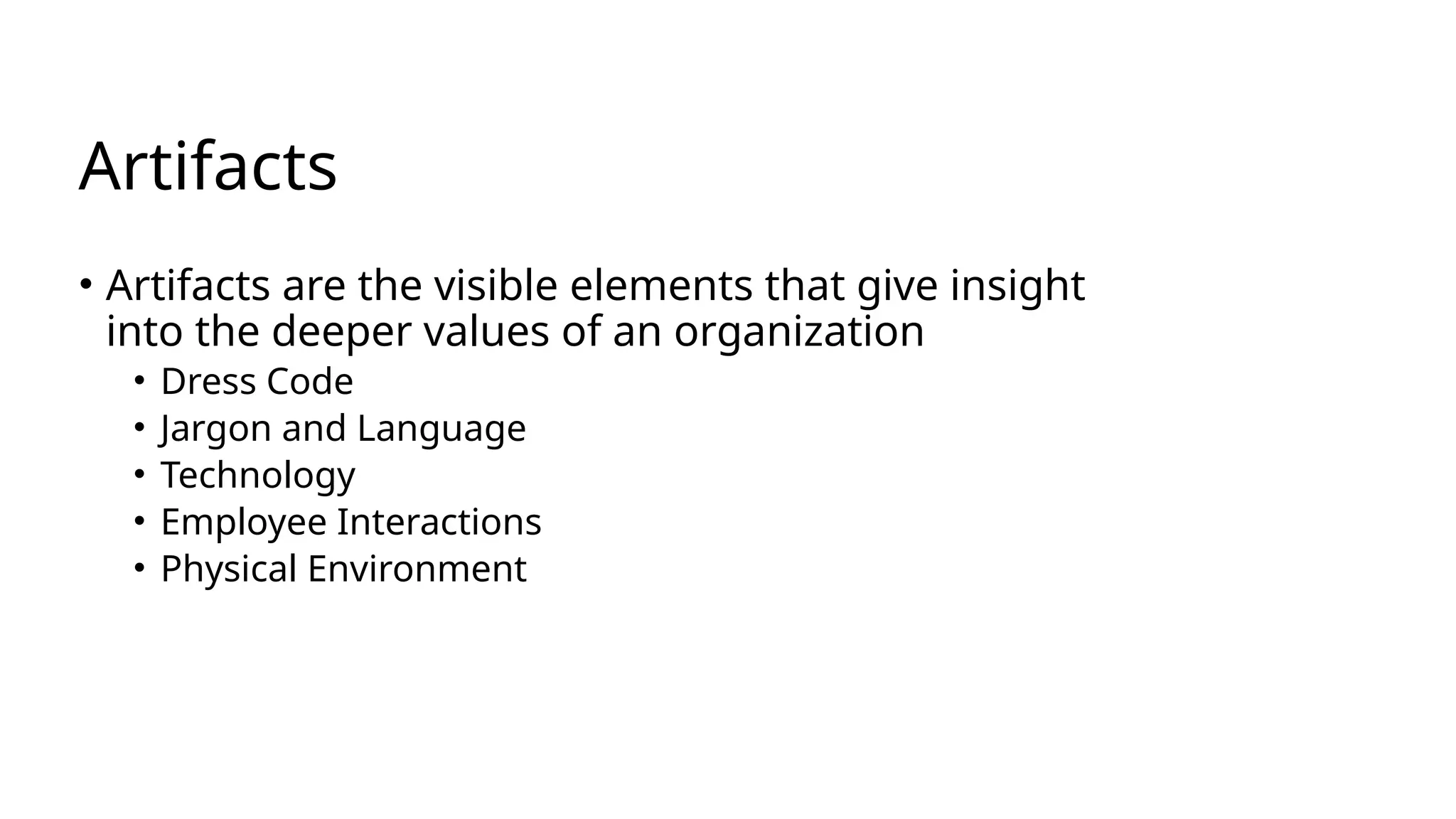
Artifacts
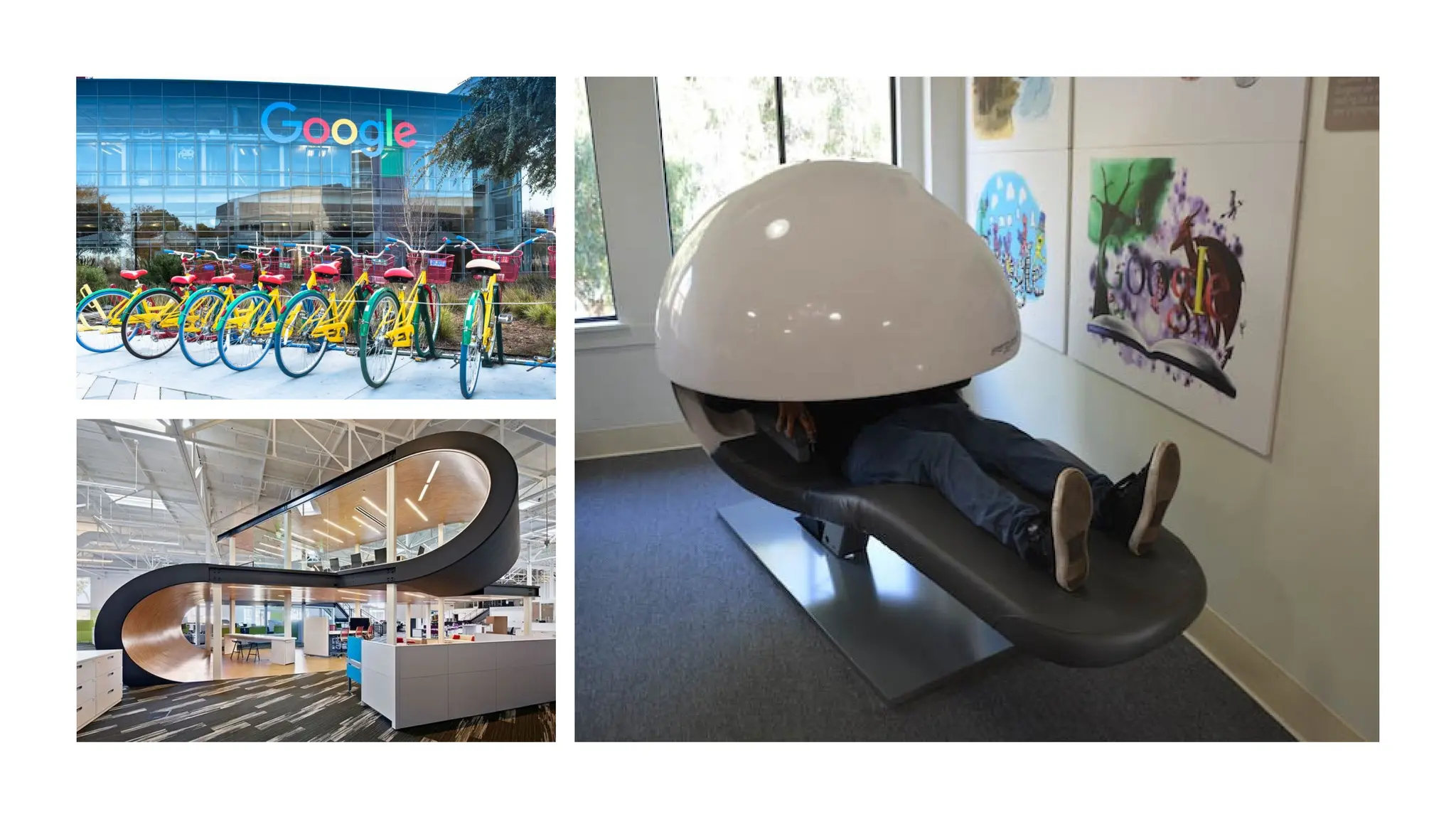
• Artifacts arethe visible elements that give insight
into the deeper values of an organization
• Dress Code
• Jargon and Language
• Technology
• Employee Interactions
• Physical Environment
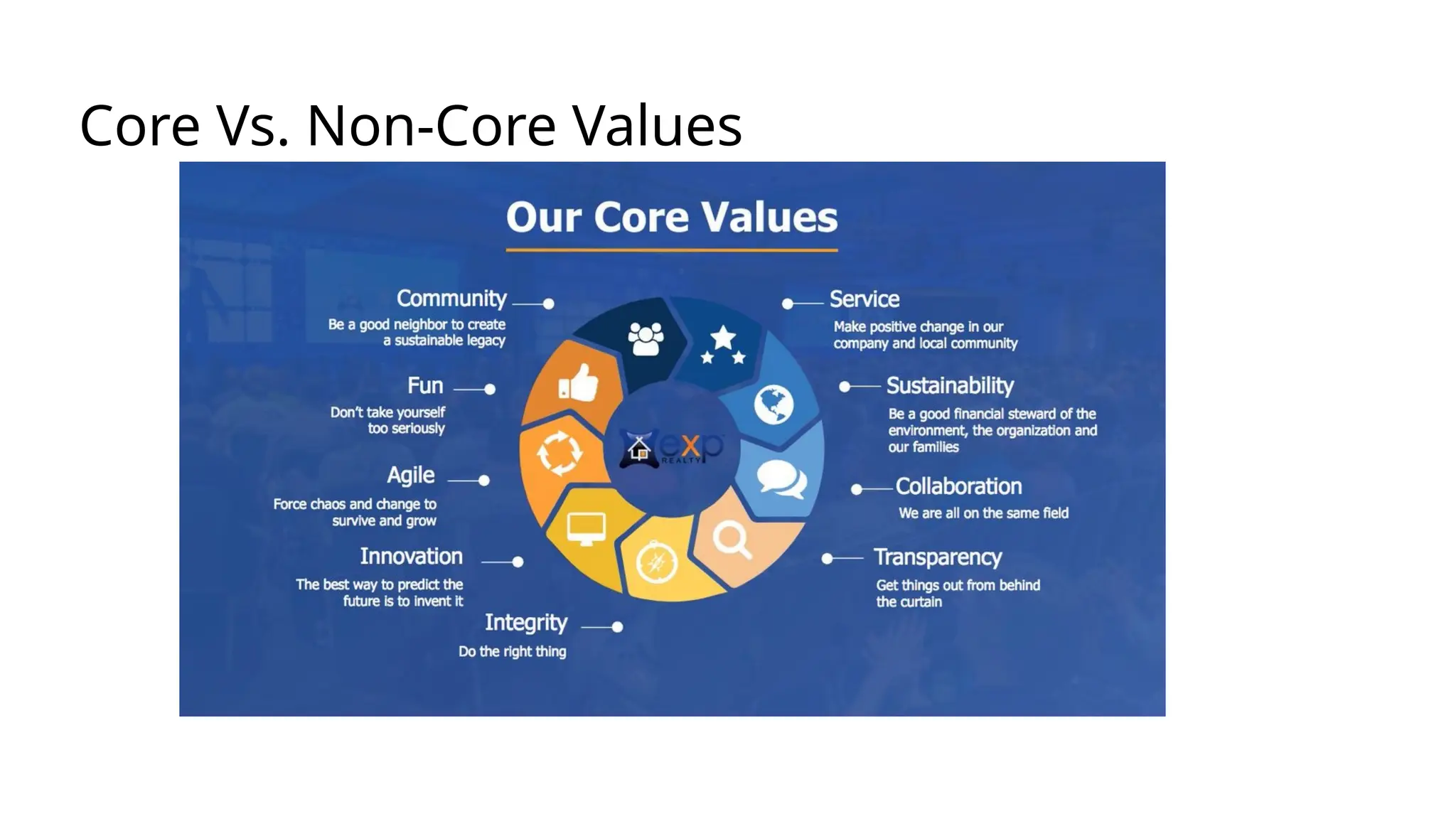
Core Values atZappos
• Let’s check back in with Zappos…
• Deliver WOW (good customer
experiences) through service
• Embrace and drive change
• Create fun and a little weirdness
• Be adventurous, creative, and open
minded
• Build open and honest relationships with
communication
• Build a positive team and family spirit
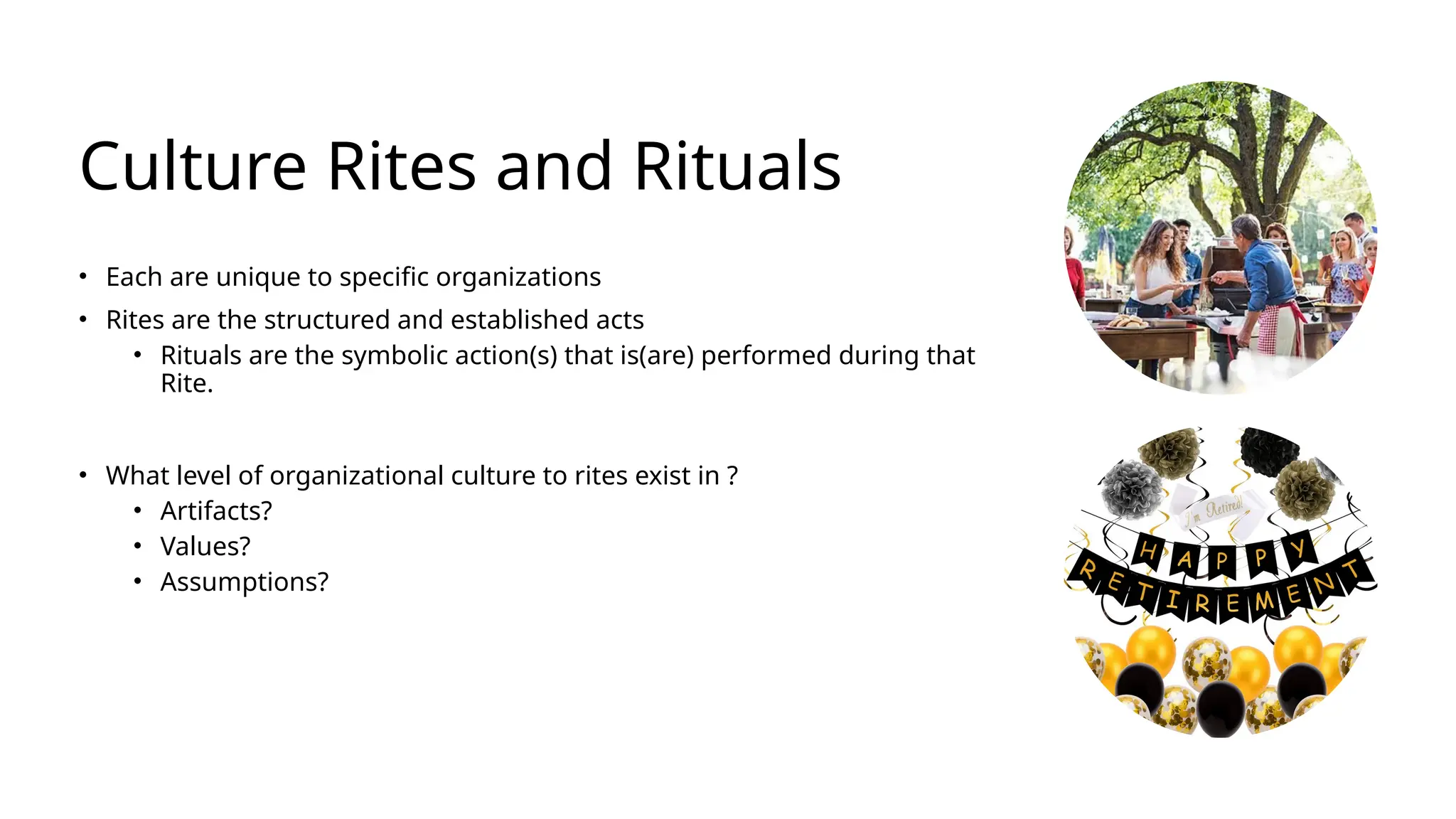
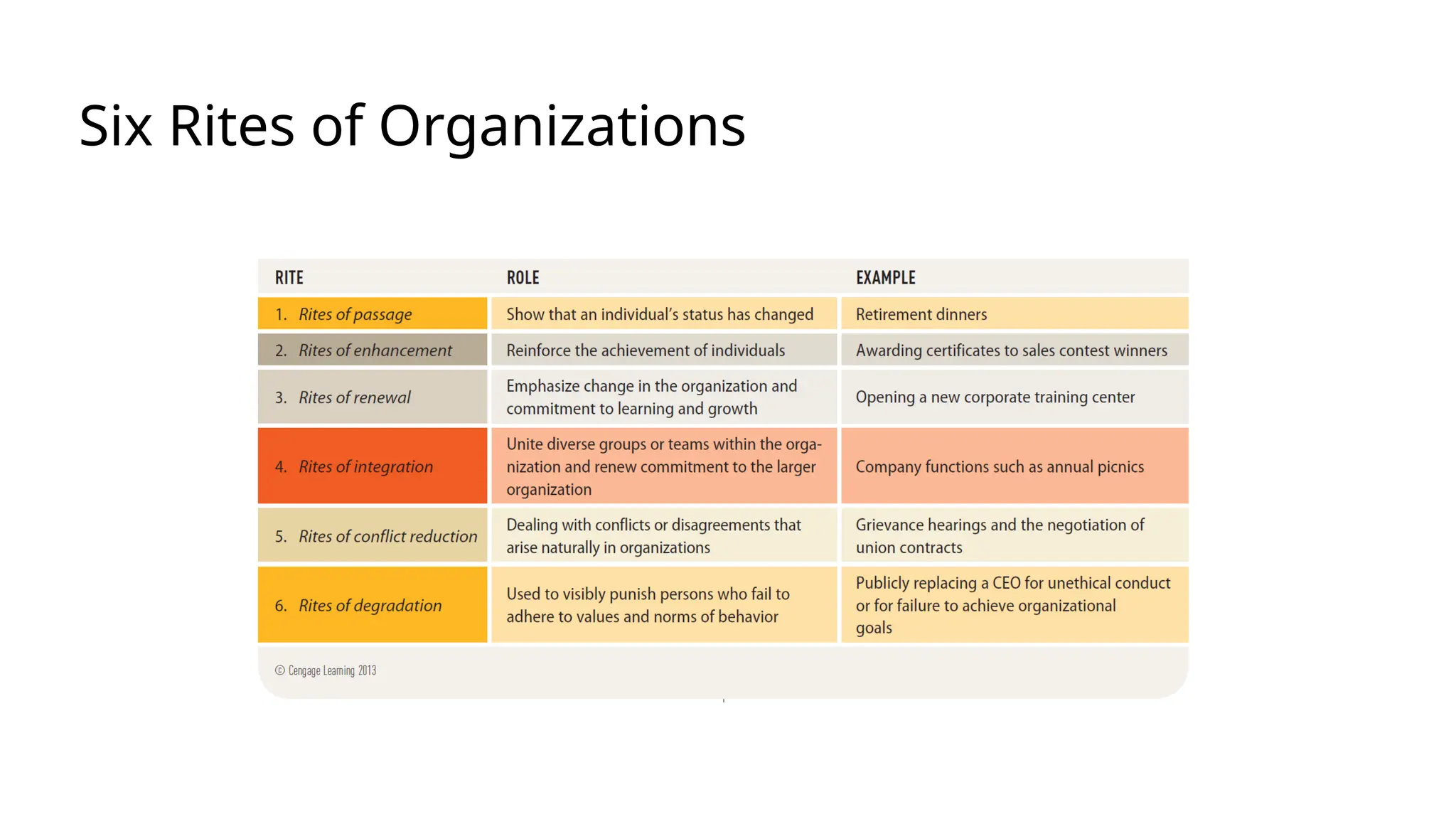
Culture Rites andRituals
• Each are unique to specific organizations
• Rites are the structured and established acts
• Rituals are the symbolic action(s) that is(are) performed during that
Rite.
• What level of organizational culture to rites exist in ?
• Artifacts?
• Values?
• Assumptions?
183.
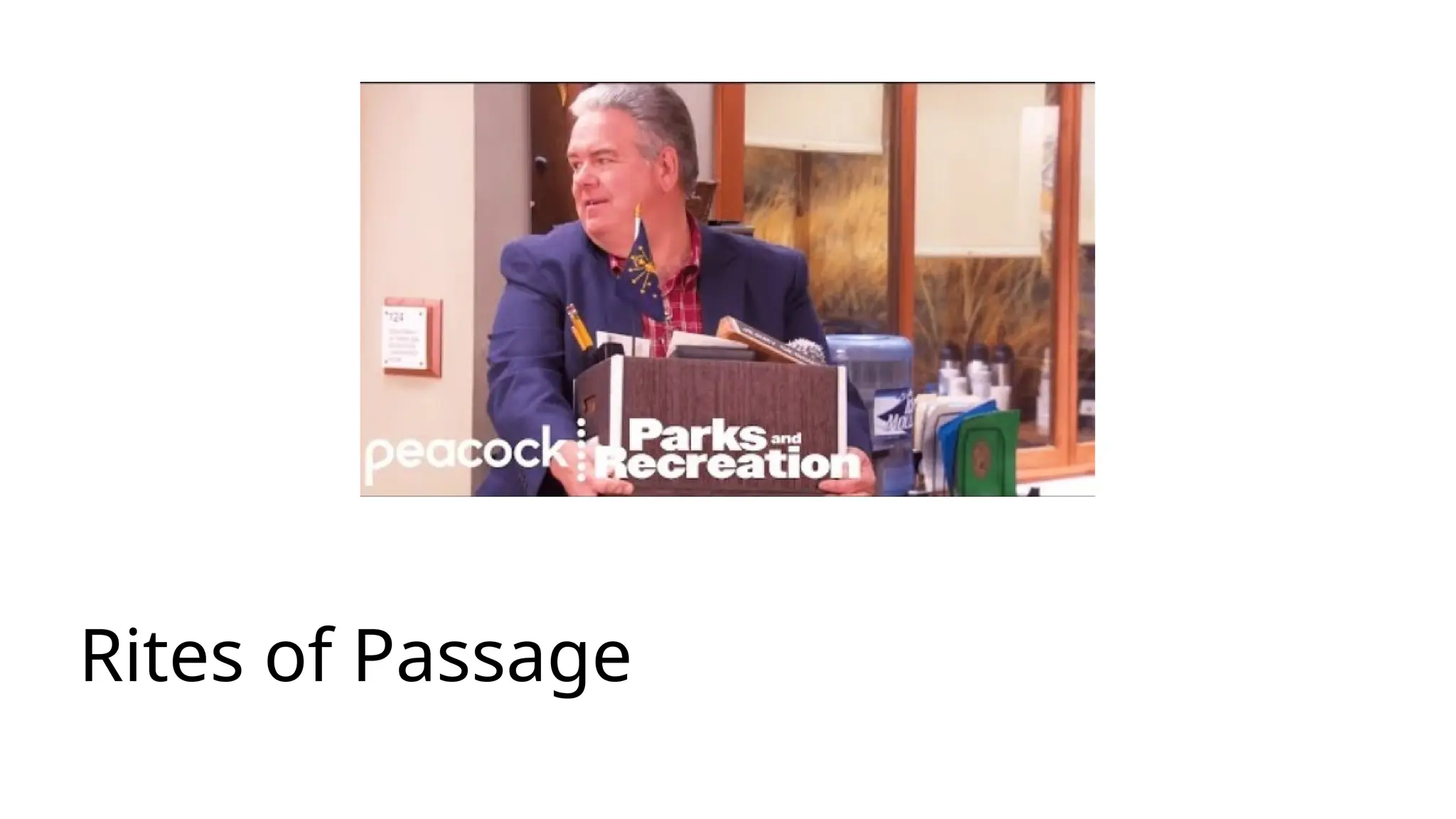
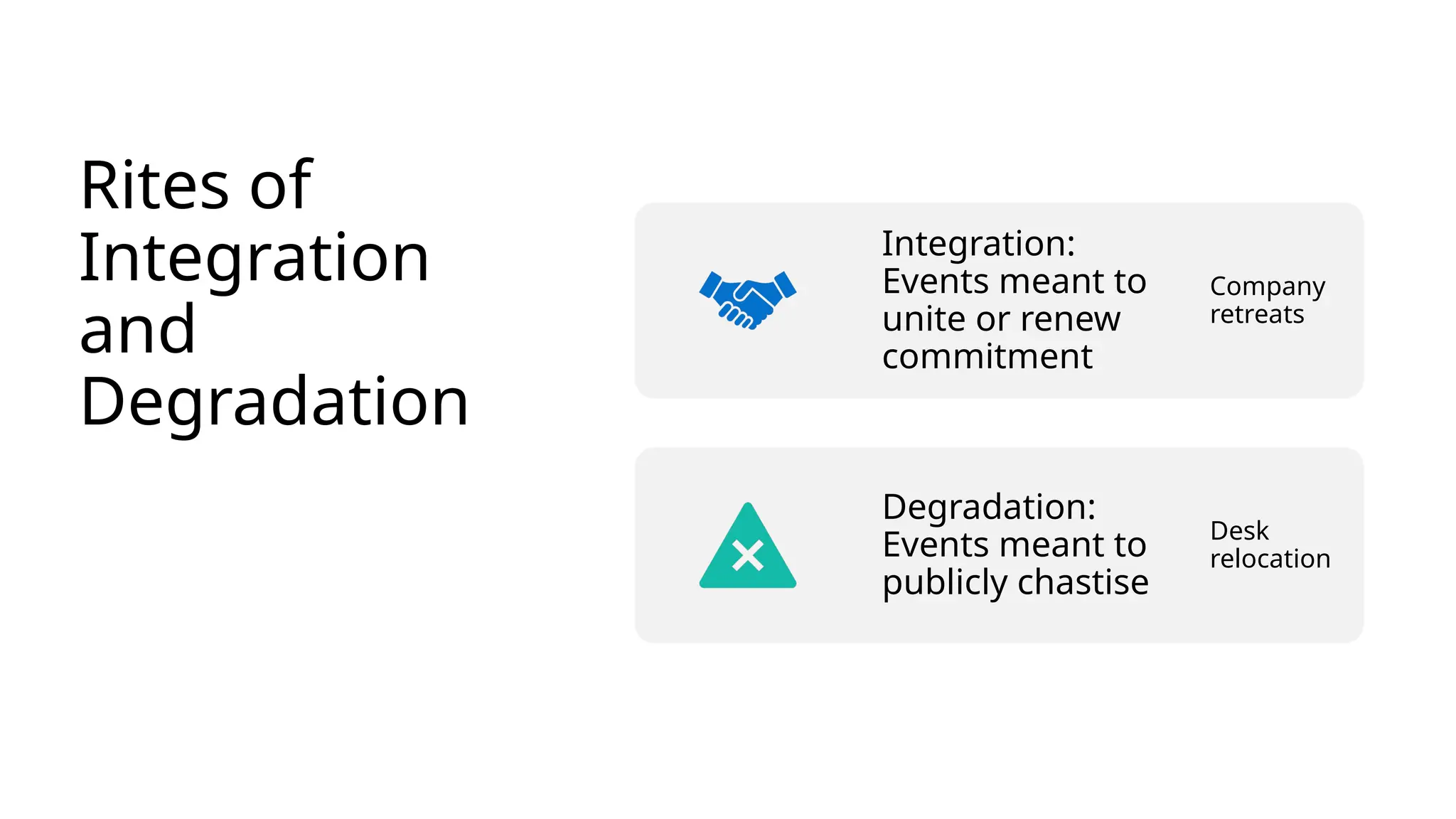
Rites of
Passage
• Ritesof Passage:
Showing that our
status has changed
• Retirement parties
• Promotion events
• New hire mixers
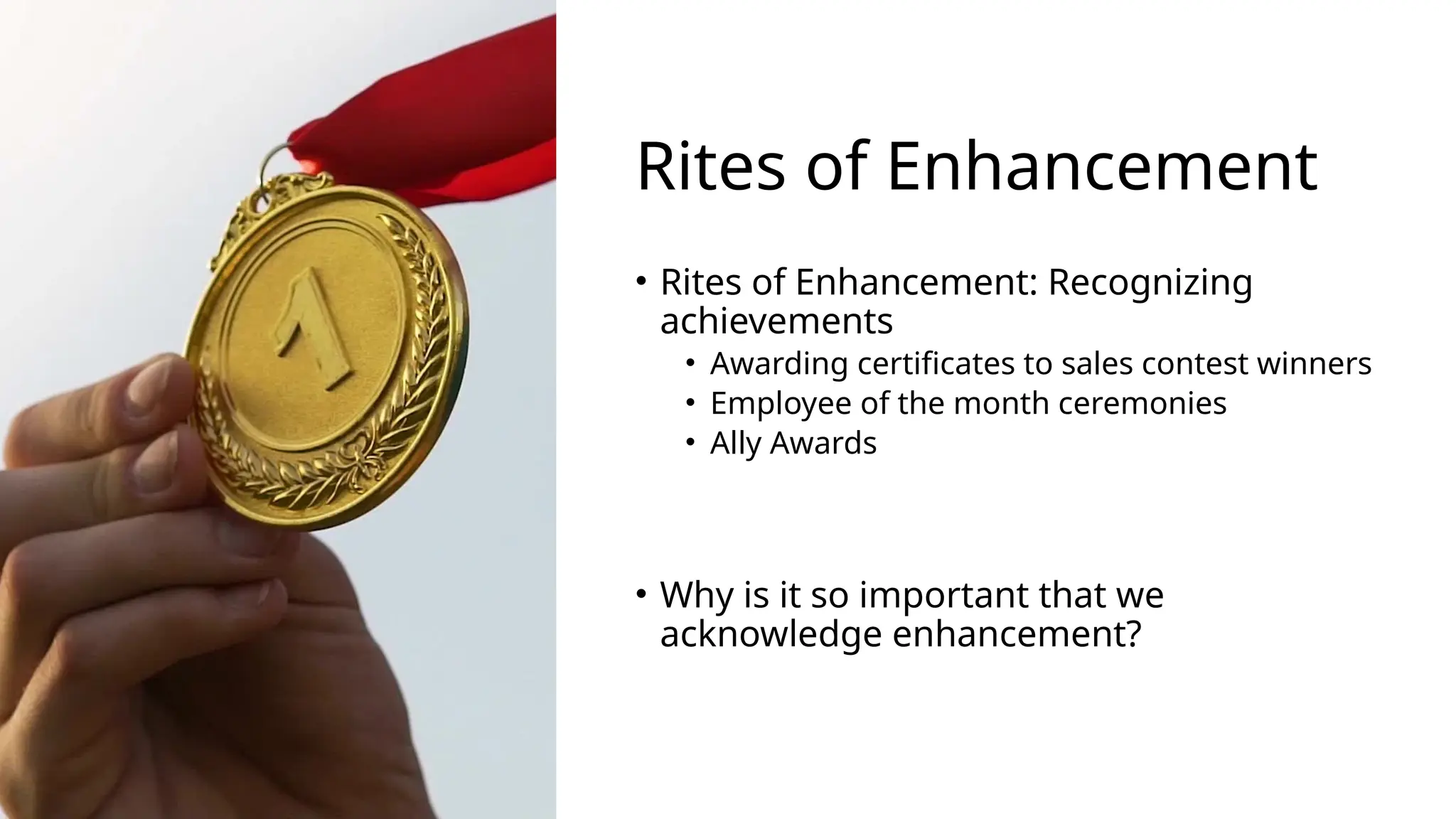
Rites of Enhancement
•Rites of Enhancement: Recognizing
achievements
• Awarding certificates to sales contest winners
• Employee of the month ceremonies
• Ally Awards
• Why is it so important that we
acknowledge enhancement?
186.
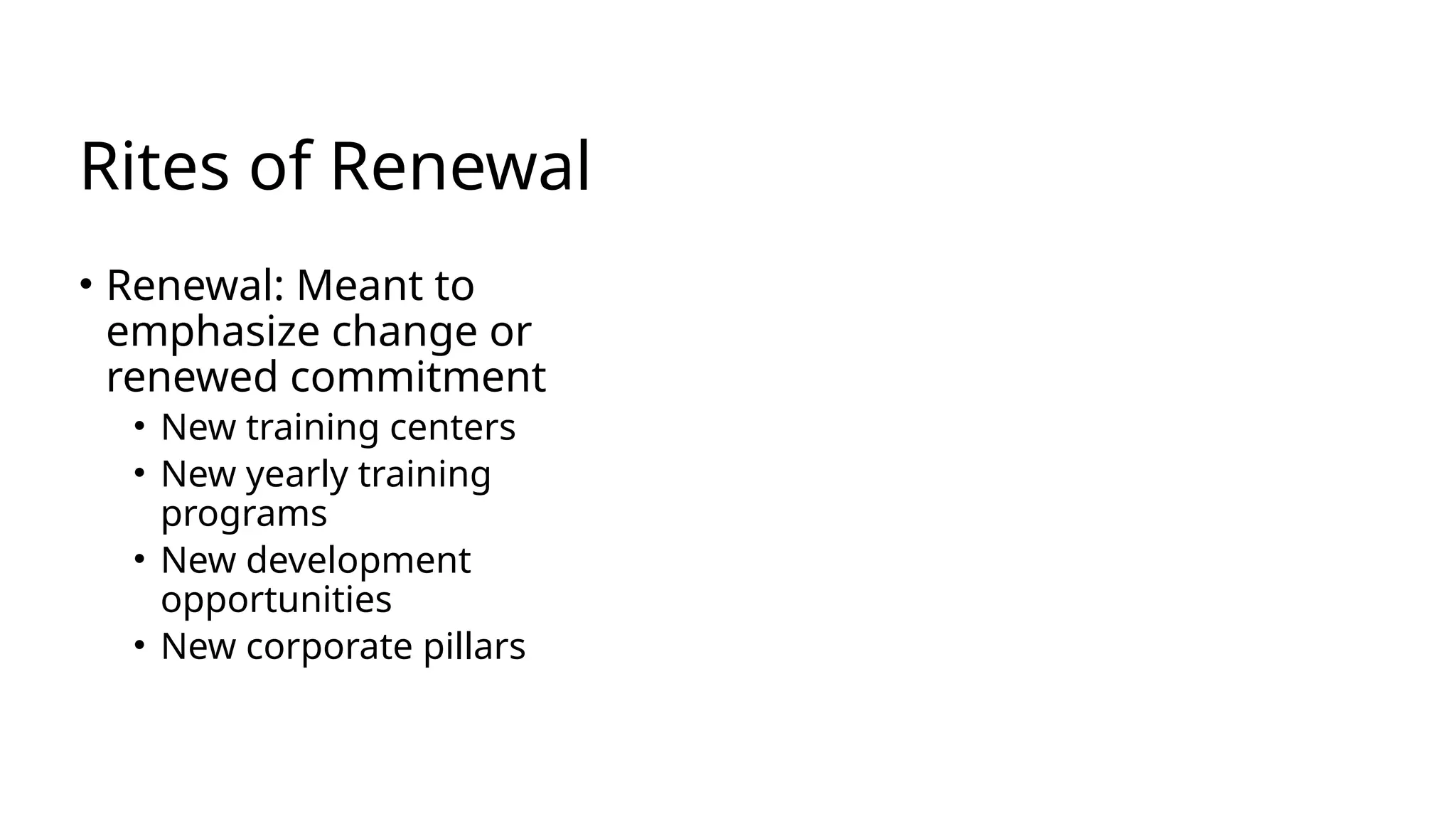
Rites of Renewal
•Renewal: Meant to
emphasize change or
renewed commitment
• New training centers
• New yearly training
programs
• New development
opportunities
• New corporate pillars
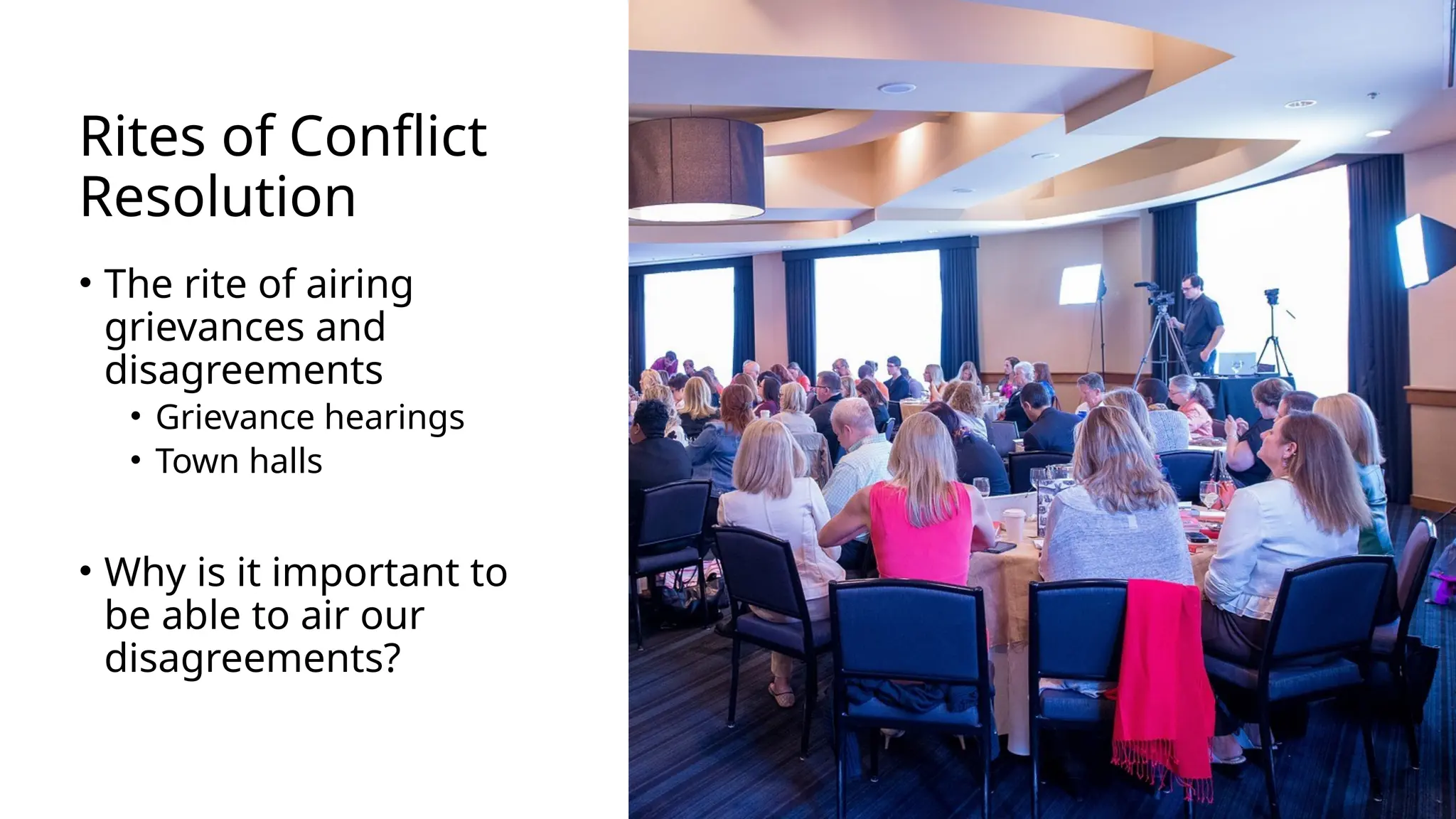
Rites of Conflict
Resolution
•The rite of airing
grievances and
disagreements
• Grievance hearings
• Town halls
• Why is it important to
be able to air our
disagreements?
What Cultures
Do
• DefineOrganizational
Boundaries
• What is this
organization and how is
it different that other
organizations?
192.
Functions of
Organizational
Culture
Provides asense of identity to
members and increases their
commitment to the organization
Serves as a sense-making device for
organization members
Reinforces the values of the
organization
Serves as a control mechanism for
shaping behavior
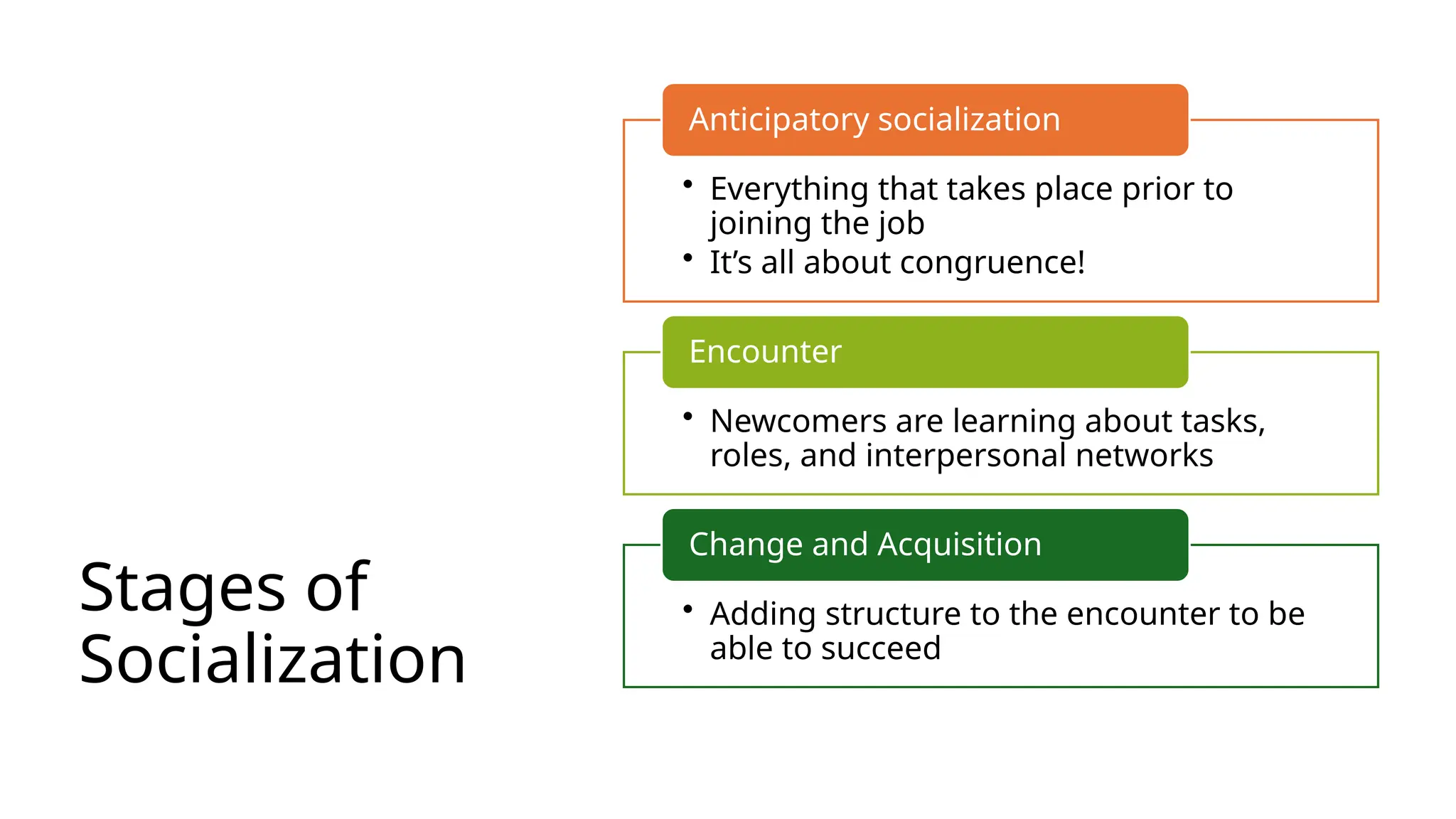
Stages of
Socialization
• Everythingthat takes place prior to
joining the job
• It’s all about congruence!
Anticipatory socialization
• Newcomers are learning about tasks,
roles, and interpersonal networks
Encounter
• Adding structure to the encounter to be
able to succeed
Change and Acquisition
195.
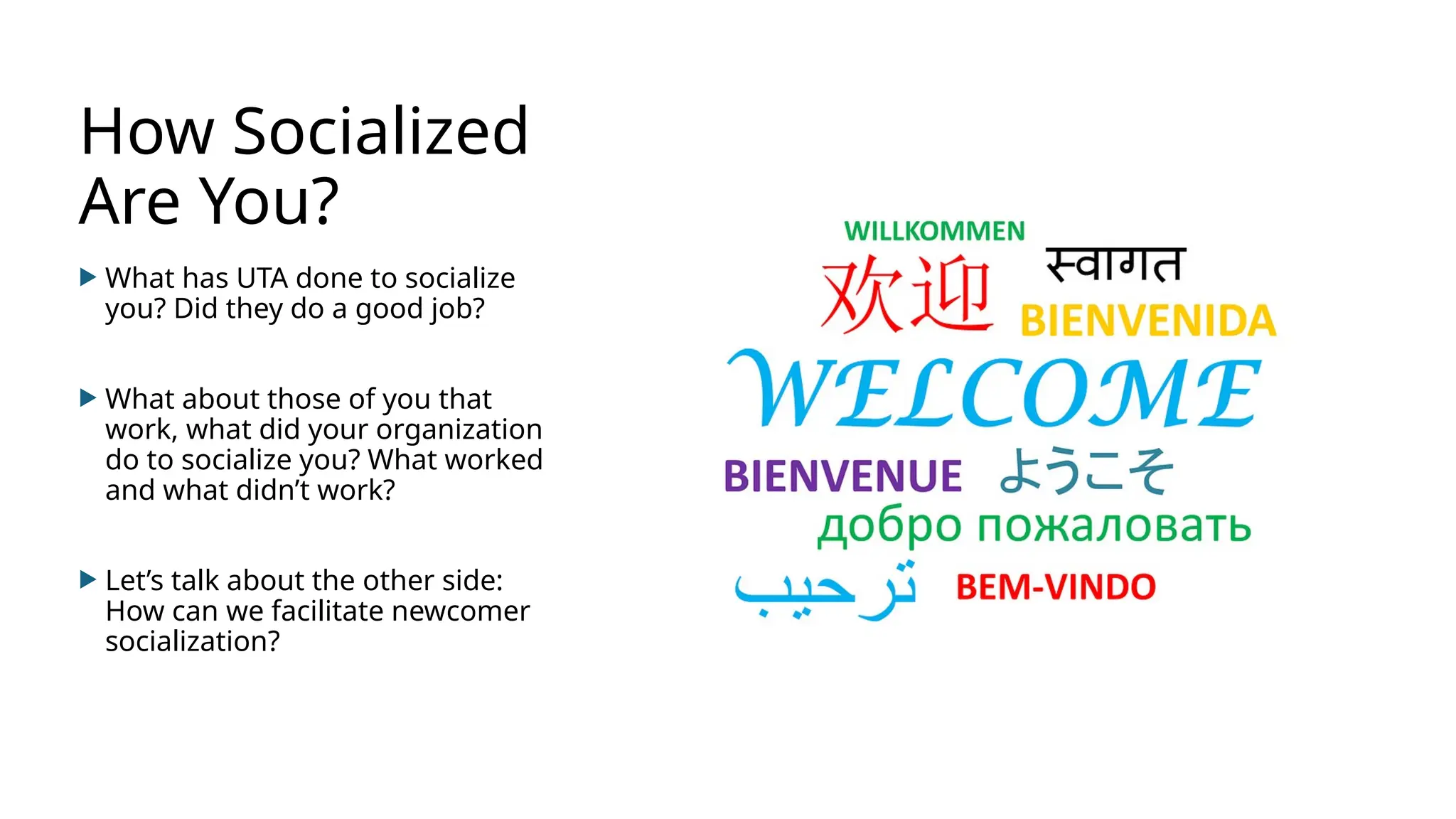
How Socialized
Are You?
What has UTA done to socialize
you? Did they do a good job?
What about those of you that
work, what did your organization
do to socialize you? What worked
and what didn’t work?
Let’s talk about the other side:
How can we facilitate newcomer
socialization?
196.
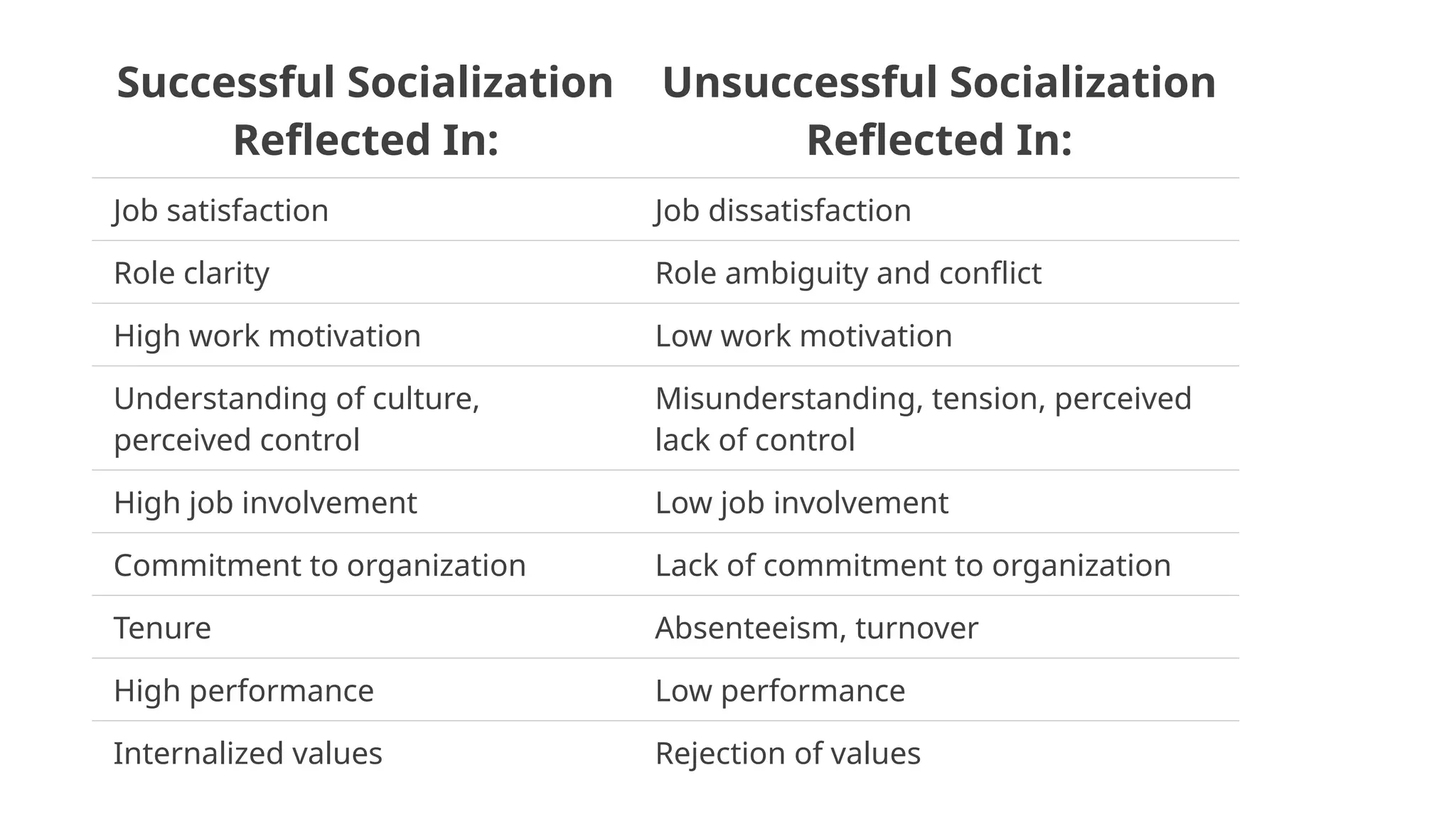
Successful Socialization
Reflected In:
UnsuccessfulSocialization
Reflected In:
Job satisfaction Job dissatisfaction
Role clarity Role ambiguity and conflict
High work motivation Low work motivation
Understanding of culture,
perceived control
Misunderstanding, tension, perceived
lack of control
High job involvement Low job involvement
Commitment to organization Lack of commitment to organization
Tenure Absenteeism, turnover
High performance Low performance
Internalized values Rejection of values
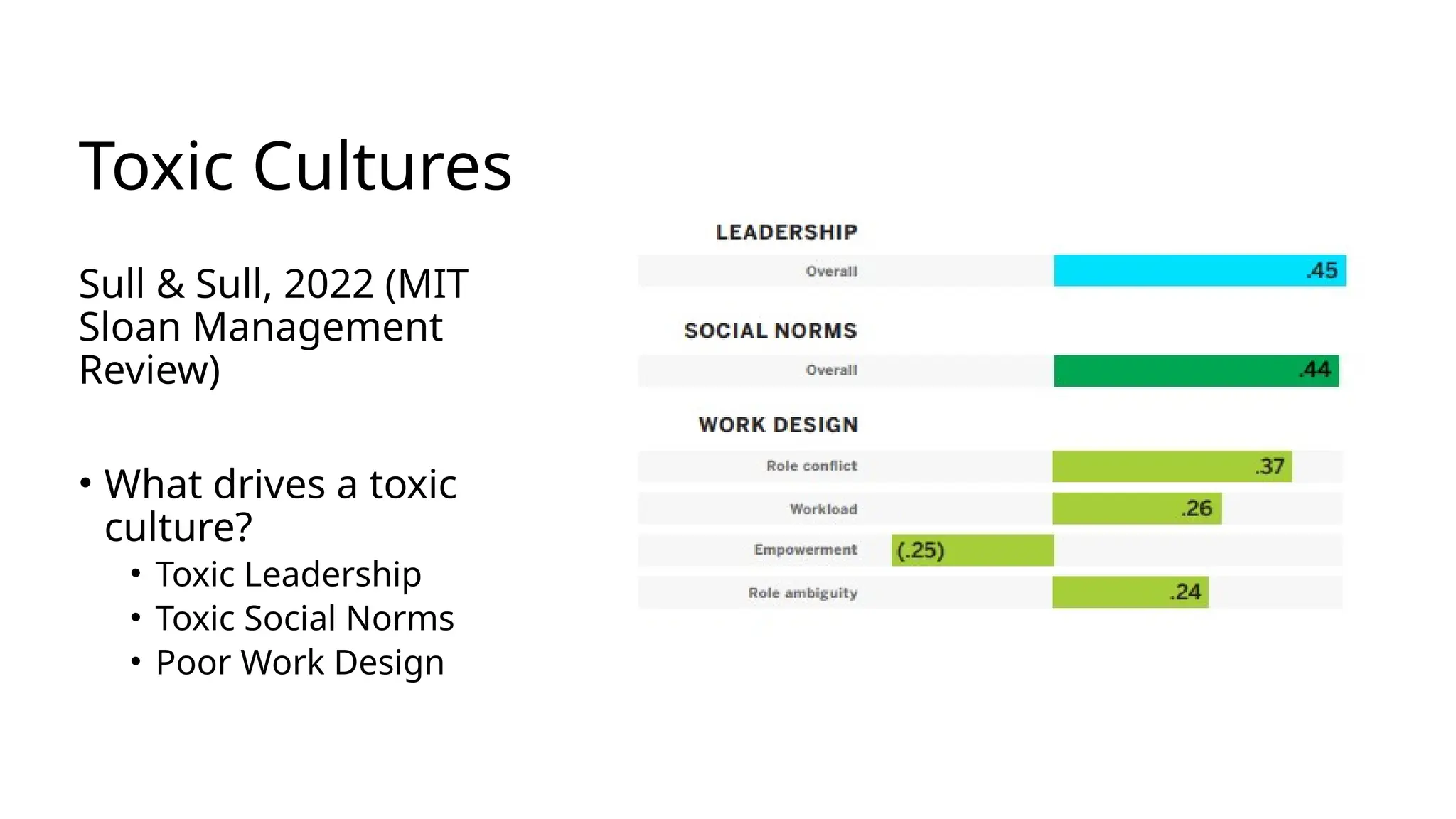
Toxic Cultures
Sull &Sull, 2022 (MIT
Sloan Management
Review)
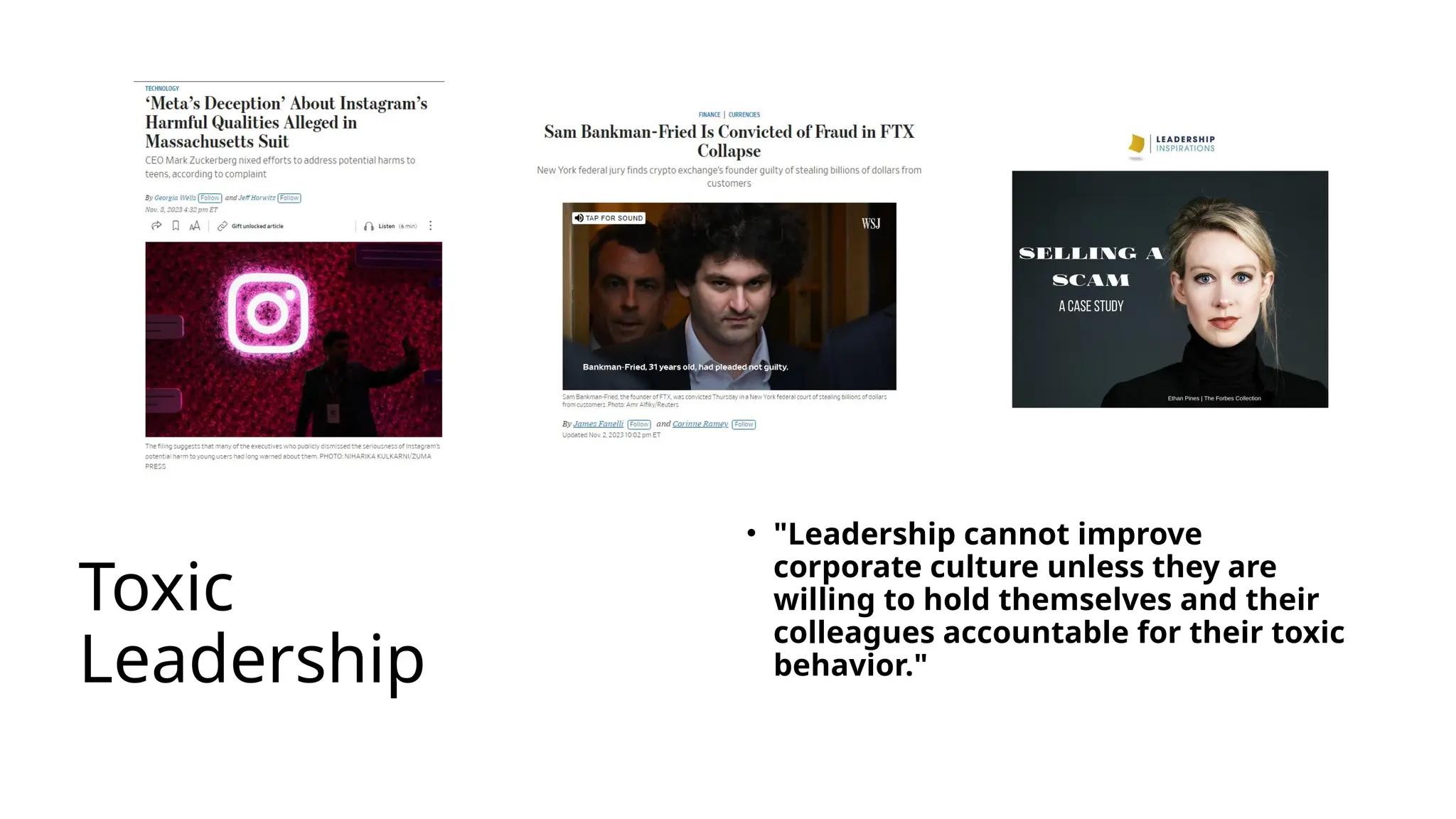
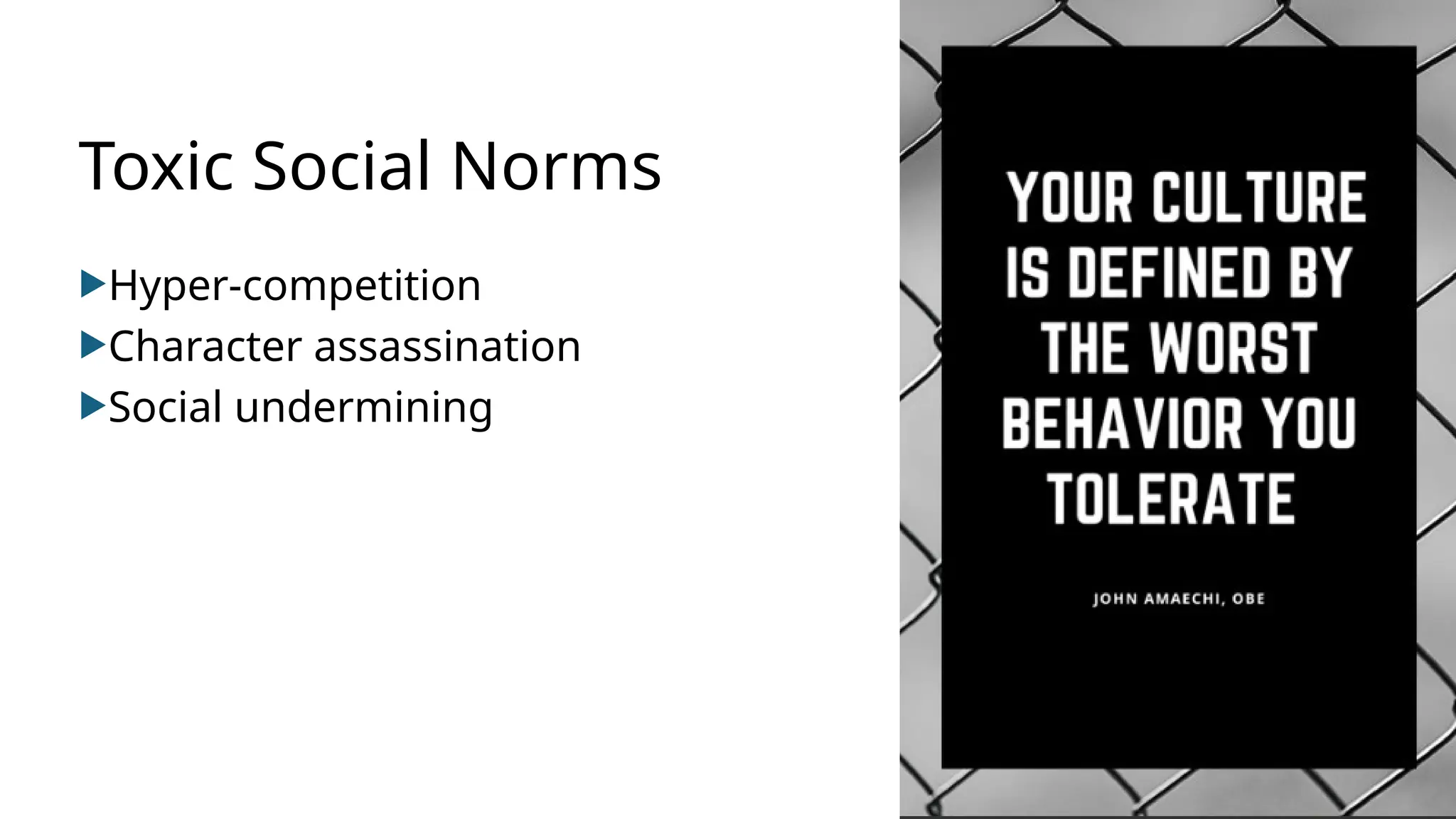
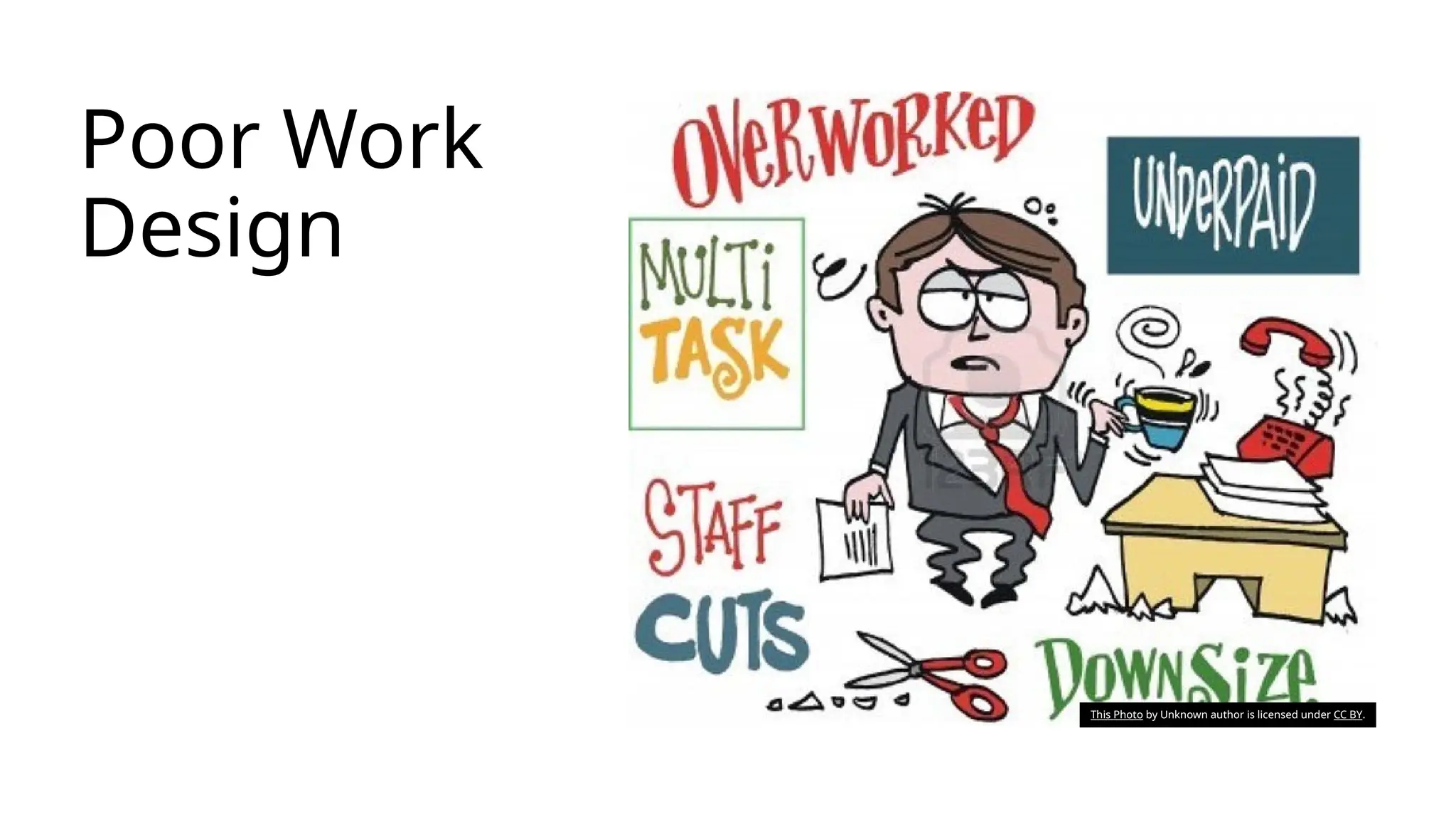
• What drives a toxic
culture?
• Toxic Leadership
• Toxic Social Norms
• Poor Work Design
199.
Toxic
Leadership
• "Leadership cannotimprove
corporate culture unless they are
willing to hold themselves and their
colleagues accountable for their toxic
behavior."
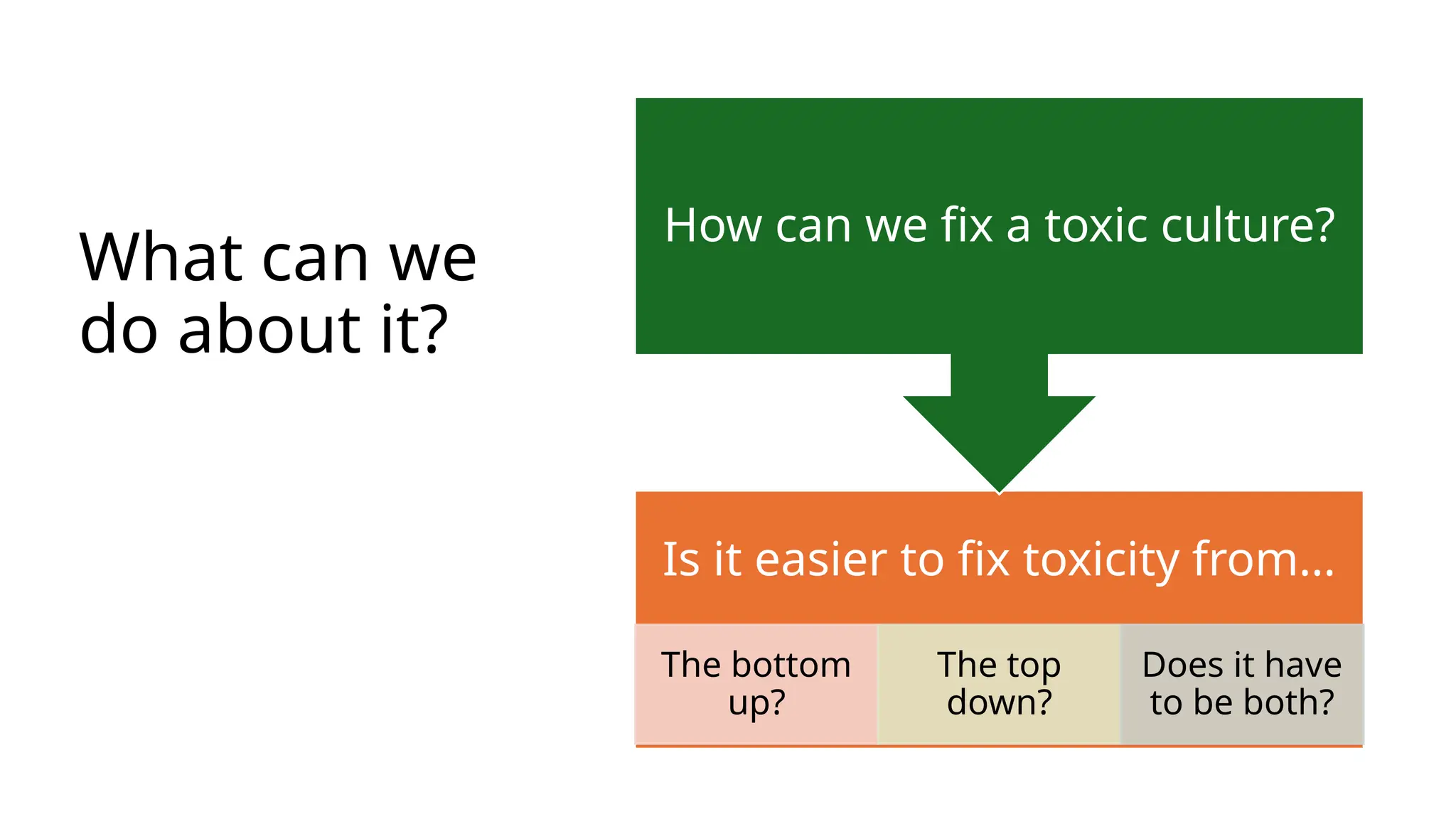
What can we
doabout it?
Is it easier to fix toxicity from…
The bottom
up?
The top
down?
Does it have
to be both?
How can we fix a toxic culture?
204.
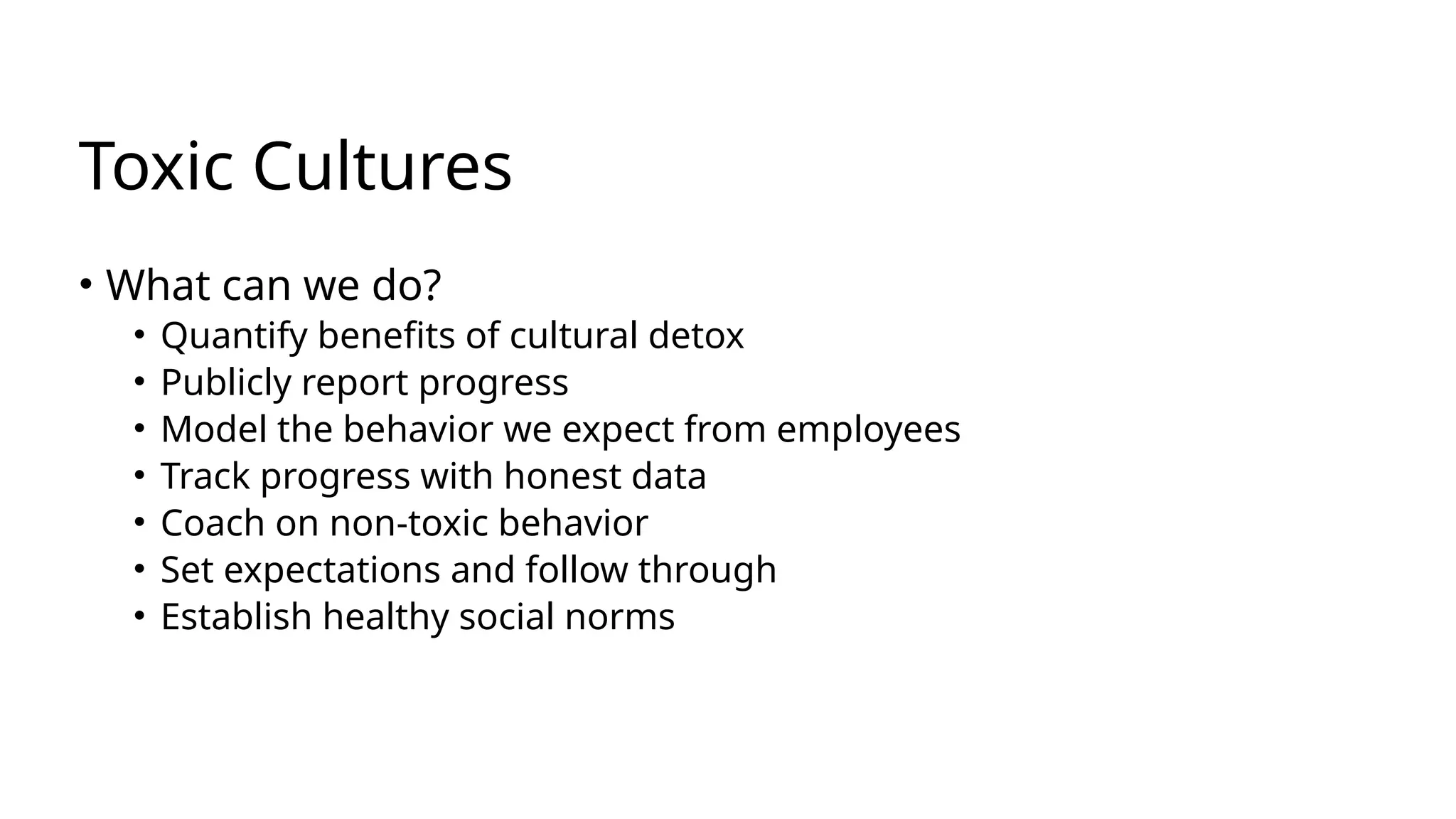
Toxic Cultures
• Whatcan we do?
• Quantify benefits of cultural detox
• Publicly report progress
• Model the behavior we expect from employees
• Track progress with honest data
• Coach on non-toxic behavior
• Set expectations and follow through
• Establish healthy social norms
205.
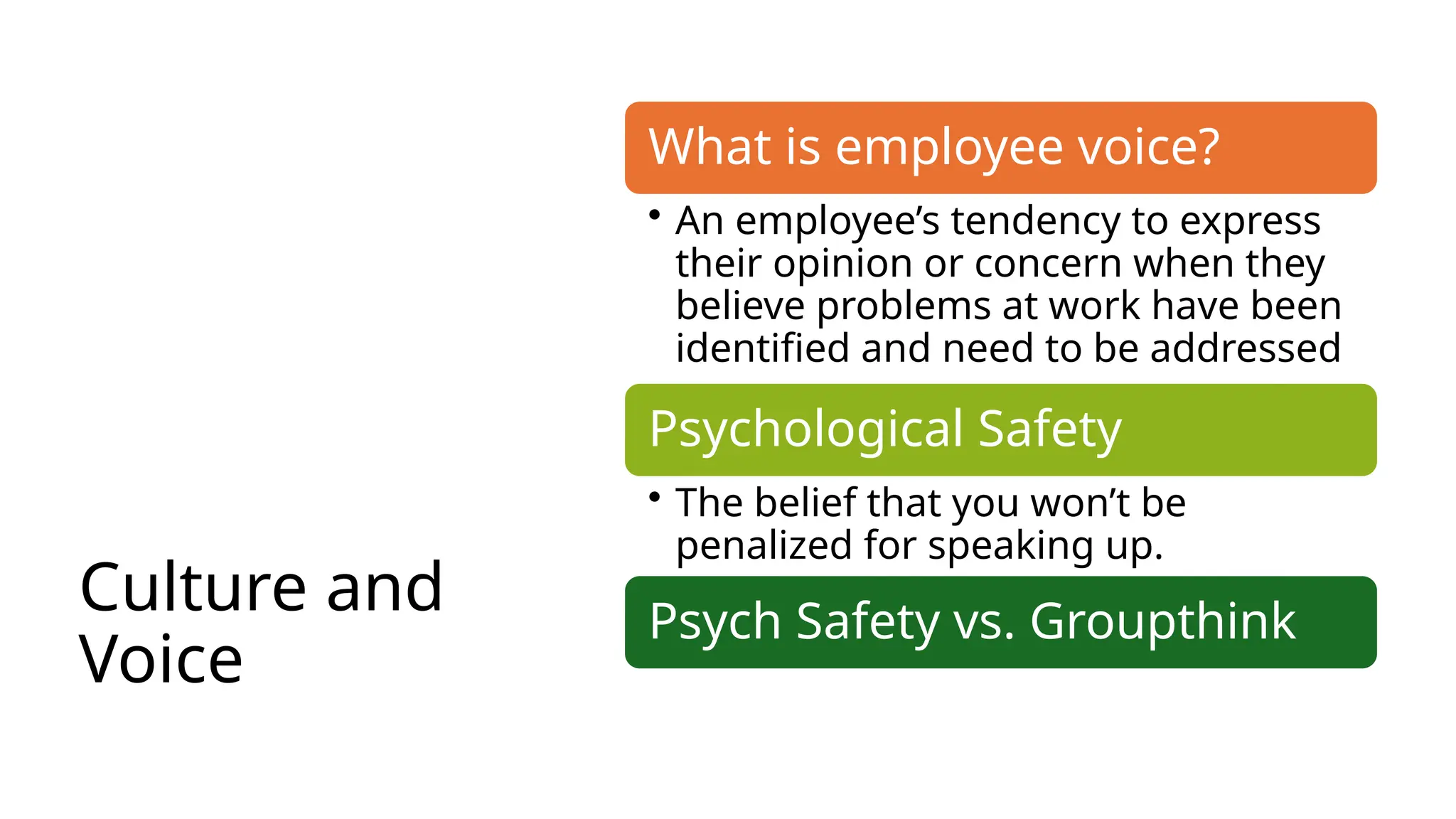
Culture and
Voice
What isemployee voice?
• An employee’s tendency to express
their opinion or concern when they
believe problems at work have been
identified and need to be addressed
Psychological Safety
• The belief that you won’t be
penalized for speaking up.
Psych Safety vs. Groupthink
206.
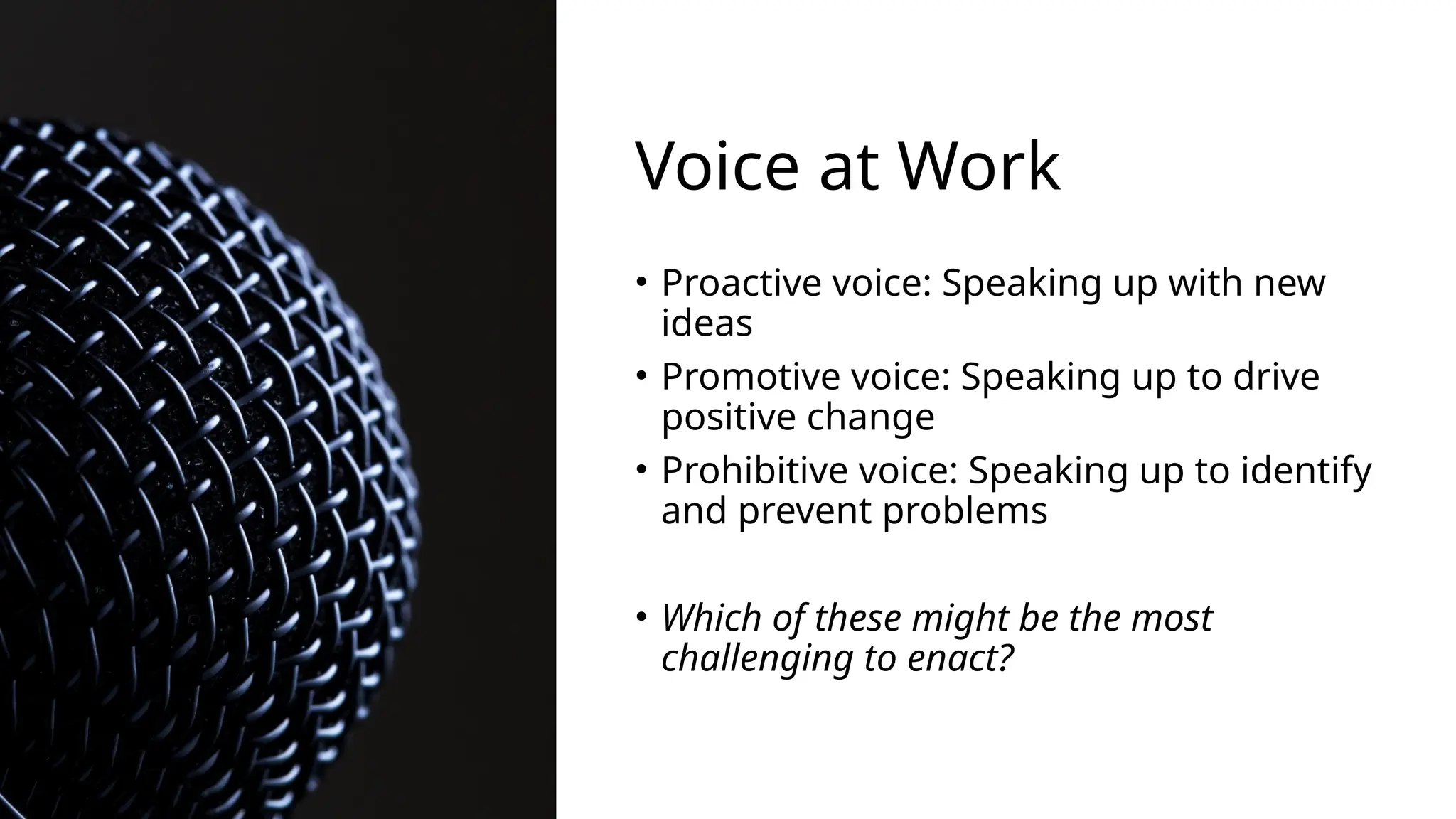
Voice at Work
•Proactive voice: Speaking up with new
ideas
• Promotive voice: Speaking up to drive
positive change
• Prohibitive voice: Speaking up to identify
and prevent problems
• Which of these might be the most
challenging to enact?
207.
Organizational
Climate
• Organizational Culture:a system of
shared general meaning held by people
within an organization
• “How things are done over time”
• Organizational Climate: Current
emotional feeling of existing within your
organization
• “How things are here right now”
208.
Organizational Climate
• Culturevs. Climate
o Culture is deeply rooted in our
organizational history whereas climate
is more often relevant to specific time
o Climate is the mood or temperature of the
organization
o Culture is more stable and evolves (i.e.,
it doesn’t change often) slowly over time
o Climate can be altered more quickly (more
situational)
209.
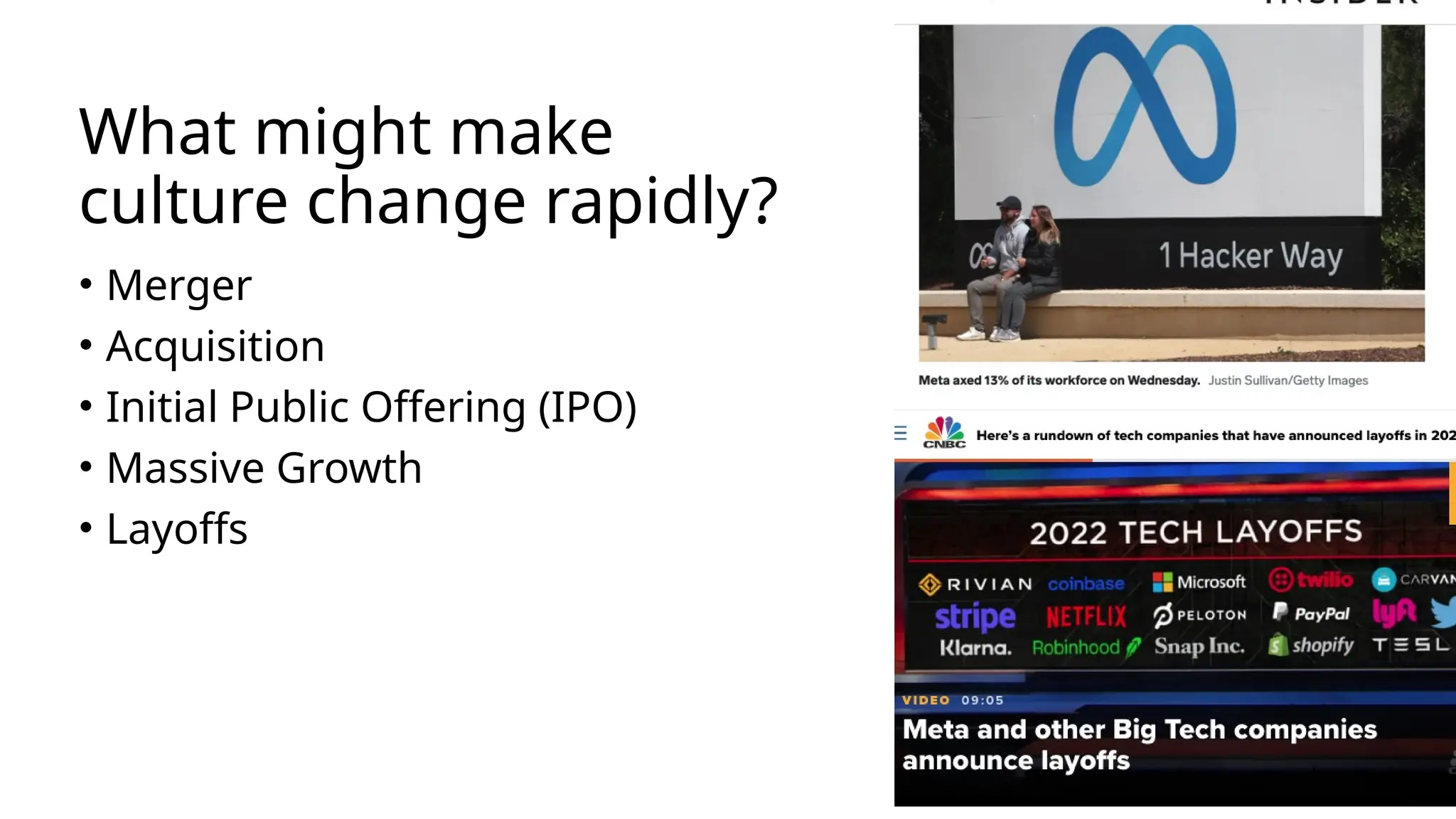
What might make
culturechange rapidly?
• Merger
• Acquisition
• Initial Public Offering (IPO)
• Massive Growth
• Layoffs
210.
Takeaways from
Culture
• Cultureis above, within, and beneath the
surface
• Organizations have rituals that are unique
to their own human capital
• Socializing and onboarding are critical in
driving important job attitudes
• All organizations have a culture, whether it
matches what they signal is a different
story!
• Culture eats strategy for breakfast
211.
See you nextweek
for our last lecture of
the semester!
Learning
Goals
Differentiate the oldand new
career paradigms
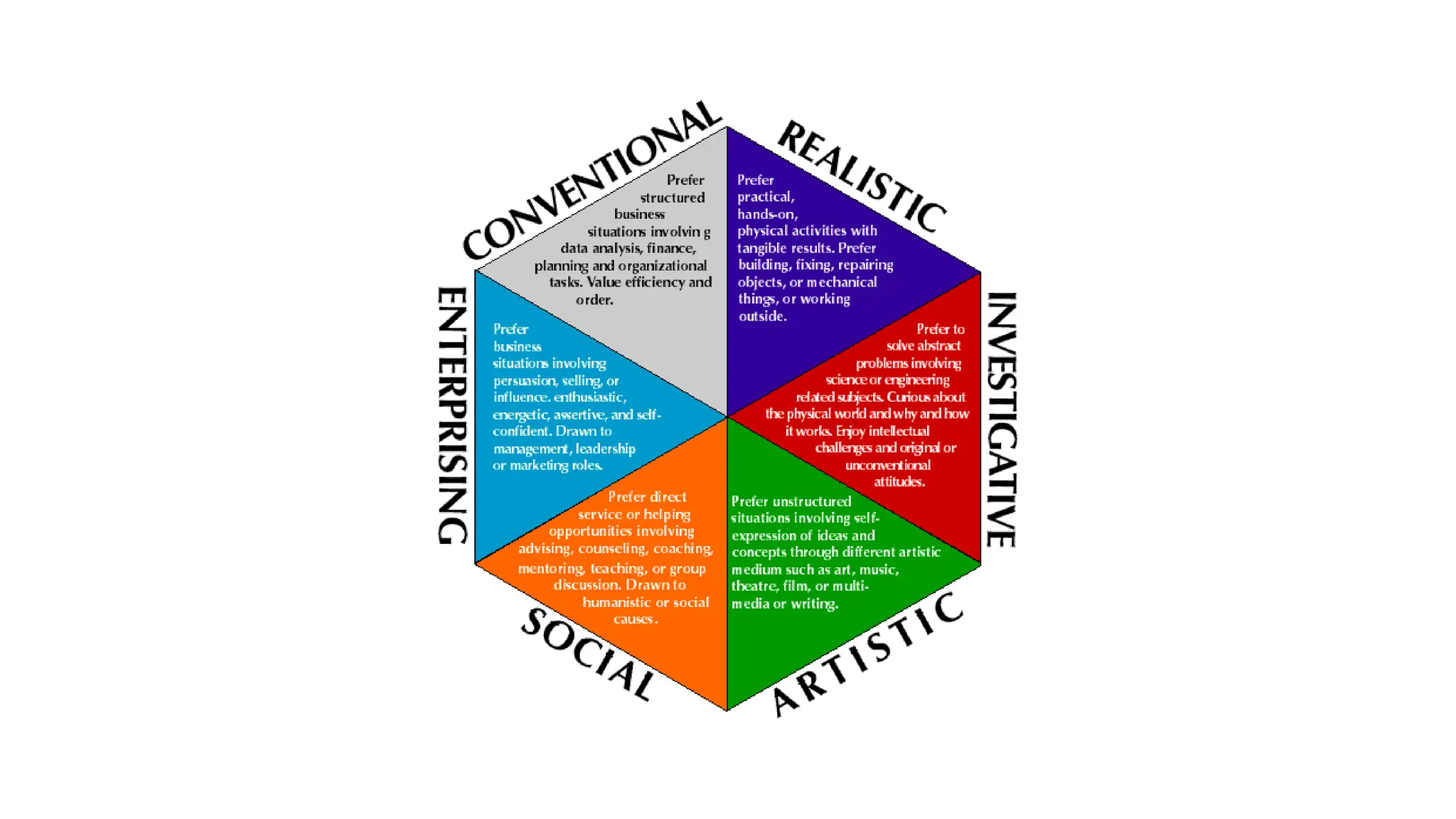
Define the six dimensions of
Holland’s RIASEC model
Explain the career
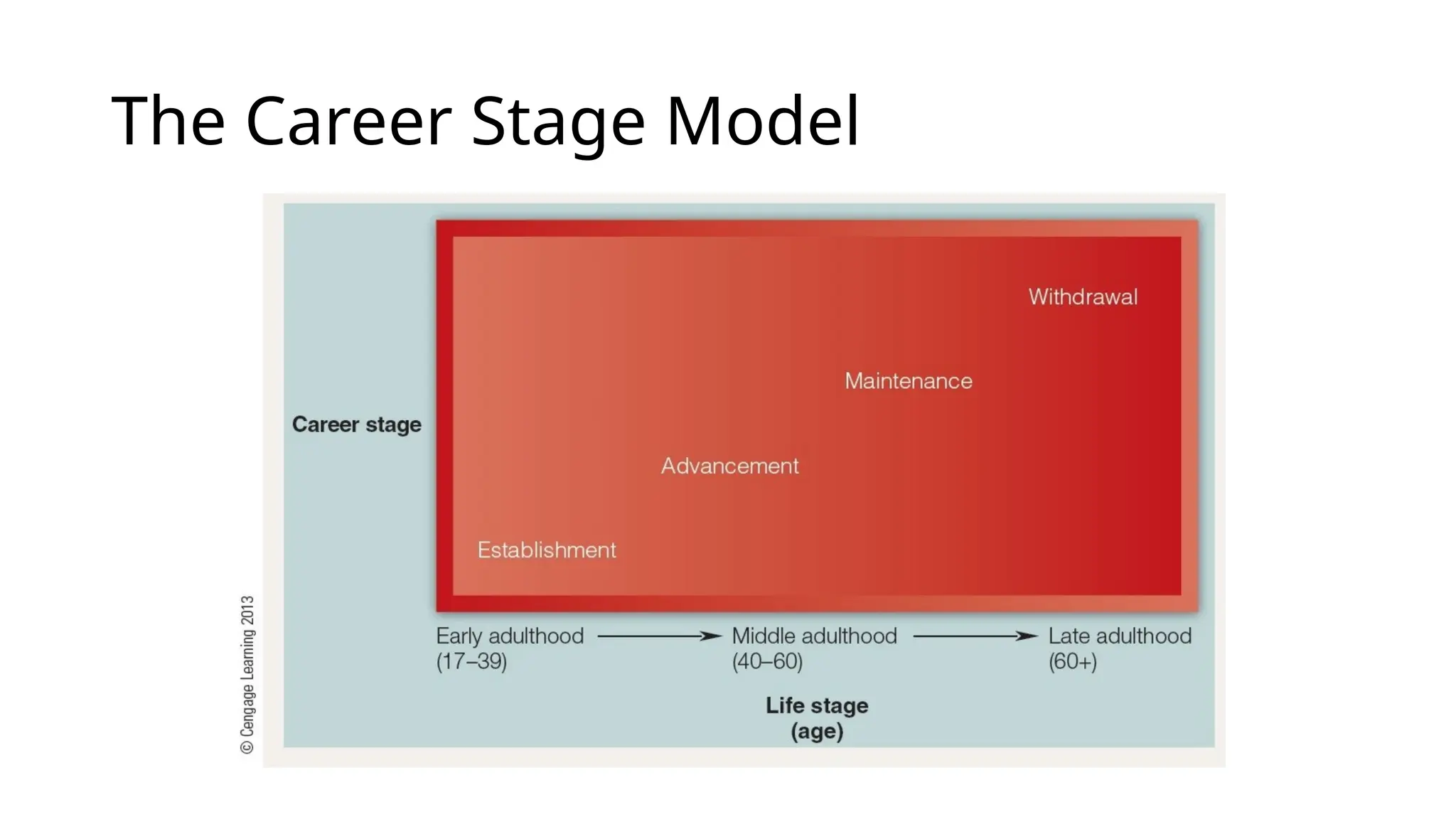
stage model
Describe how individuals
can navigate the
challenges of the
maintenance stage of the
career stage model
Define mentorship and discuss
the functions of a successful
mentor
214.
Housekeepin
g
Today is ourfinal lecture (there is
no scheduled class period next
week)
Office hours extended for next
Monday (11am – 3pm)
Group project
coming to a close!
Written report
Presentation
Peer evaluations
Make sure you fill out your course
evals!
215.
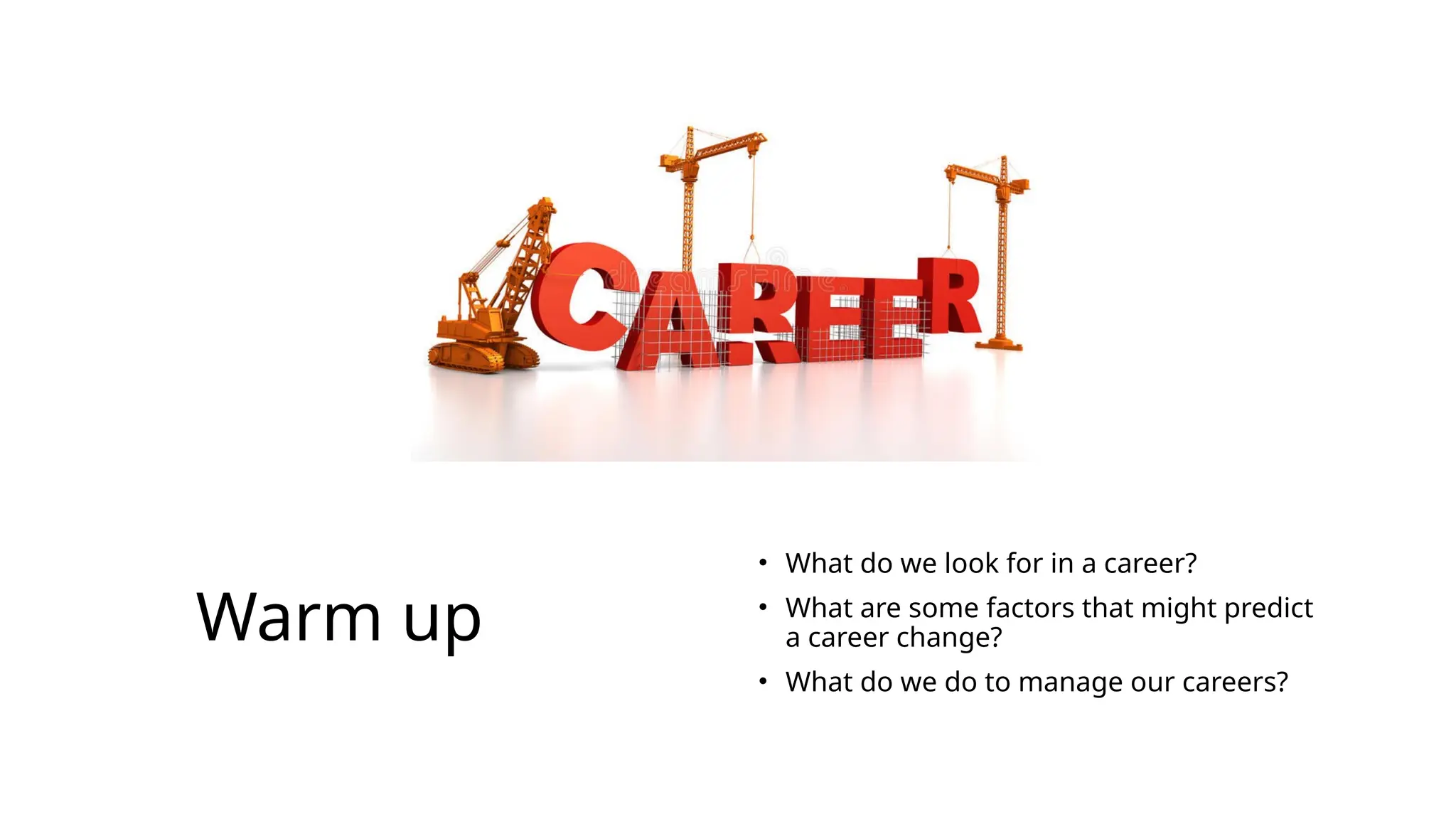
Warm up
• Whatdo we look for in a career?
• What are some factors that might predict
a career change?
• What do we do to manage our careers?
216.
CAREERS
A career isa pattern of work-
related experiences that
spans the course of a
person’s life
218.
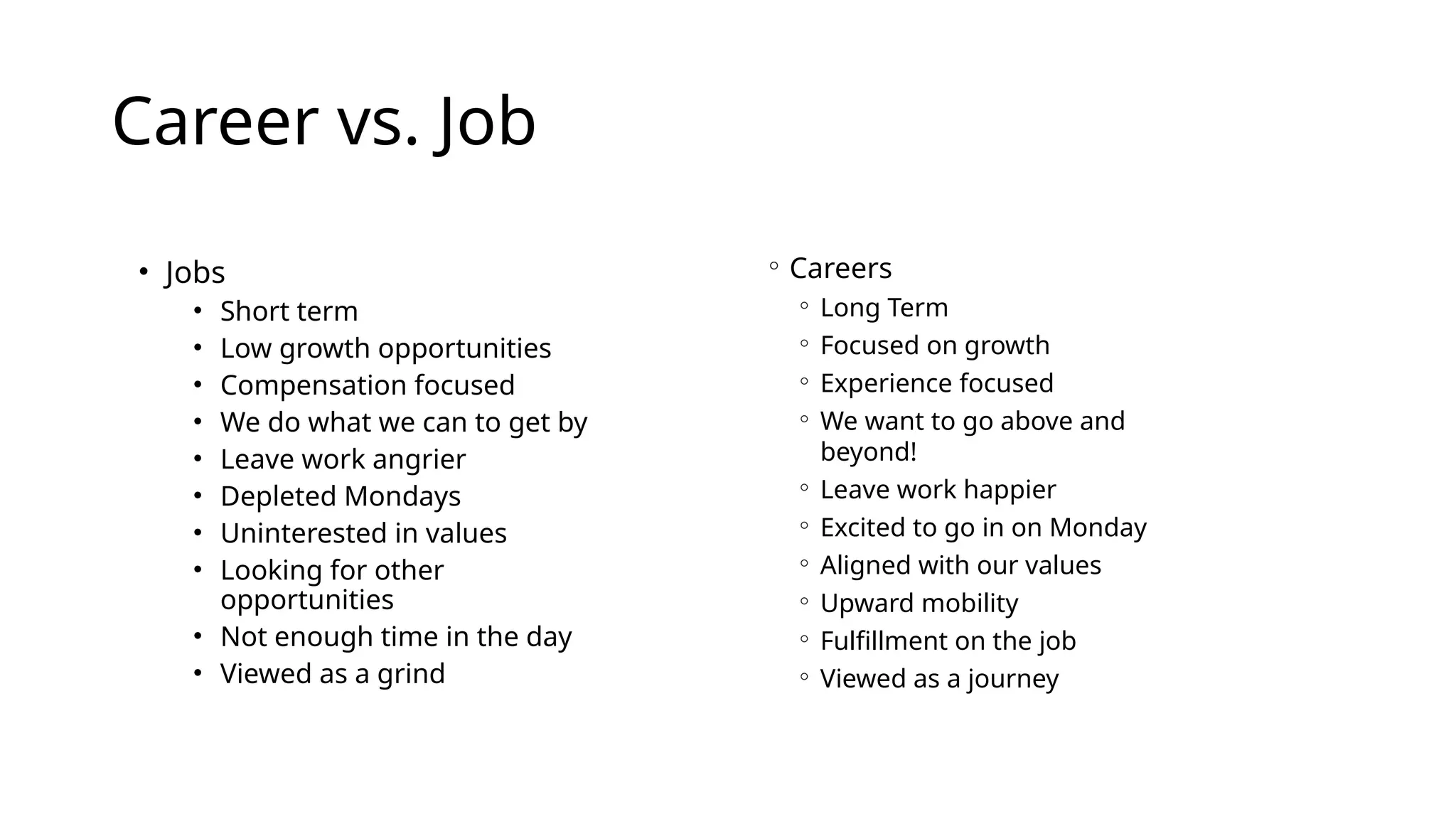
Career vs. Job
•Jobs
• Short term
• Low growth opportunities
• Compensation focused
• We do what we can to get by
• Leave work angrier
• Depleted Mondays
• Uninterested in values
• Looking for other
opportunities
• Not enough time in the day
• Viewed as a grind
◦ Careers
◦ Long Term
◦ Focused on growth
◦ Experience focused
◦ We want to go above and
beyond!
◦ Leave work happier
◦ Excited to go in on Monday
◦ Aligned with our values
◦ Upward mobility
◦ Fulfillment on the job
◦ Viewed as a journey
219.
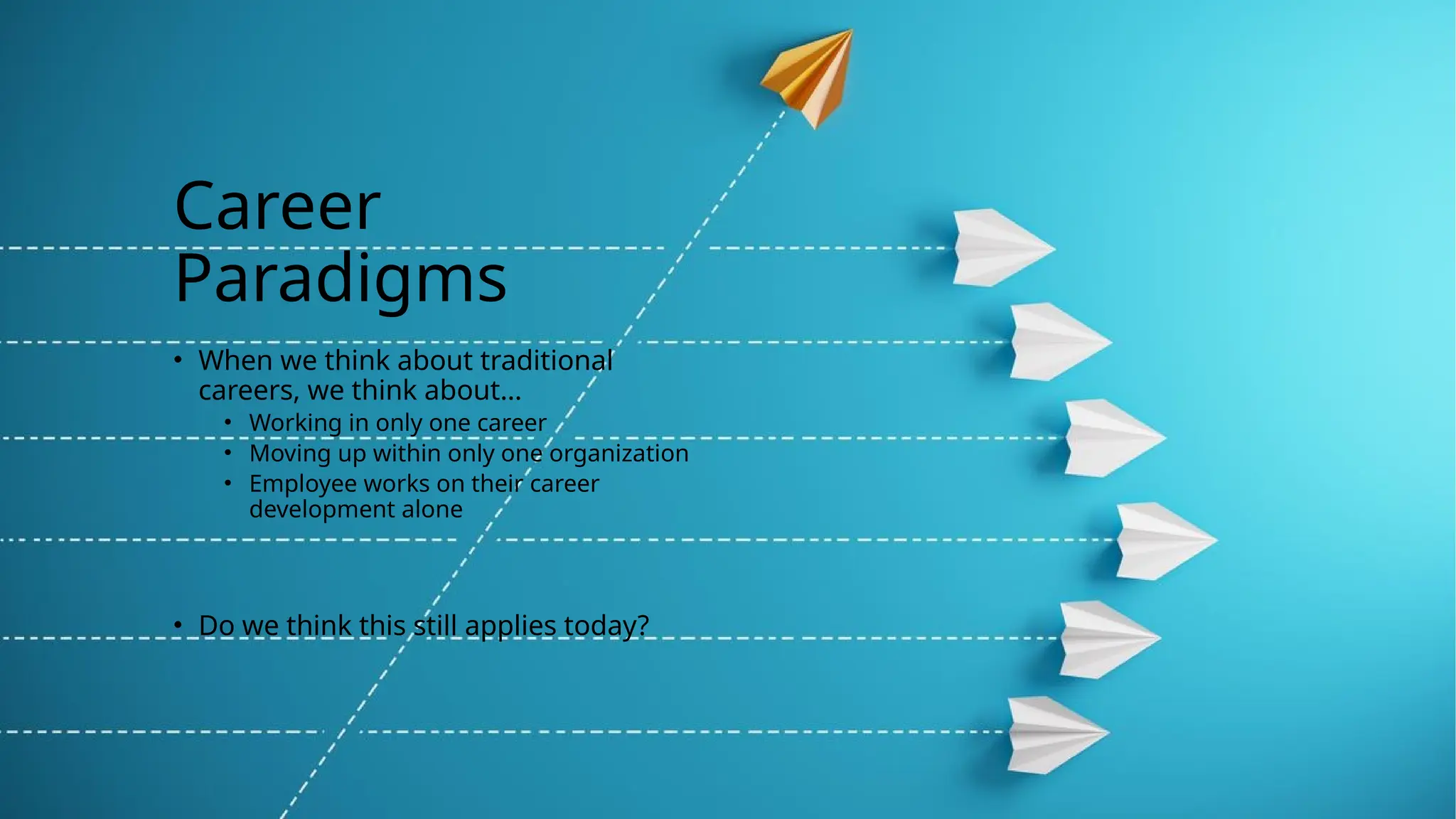
Career
Paradigms
• When wethink about traditional
careers, we think about…
• Working in only one career
• Moving up within only one organization
• Employee works on their career
development alone
• Do we think this still applies today?
220.
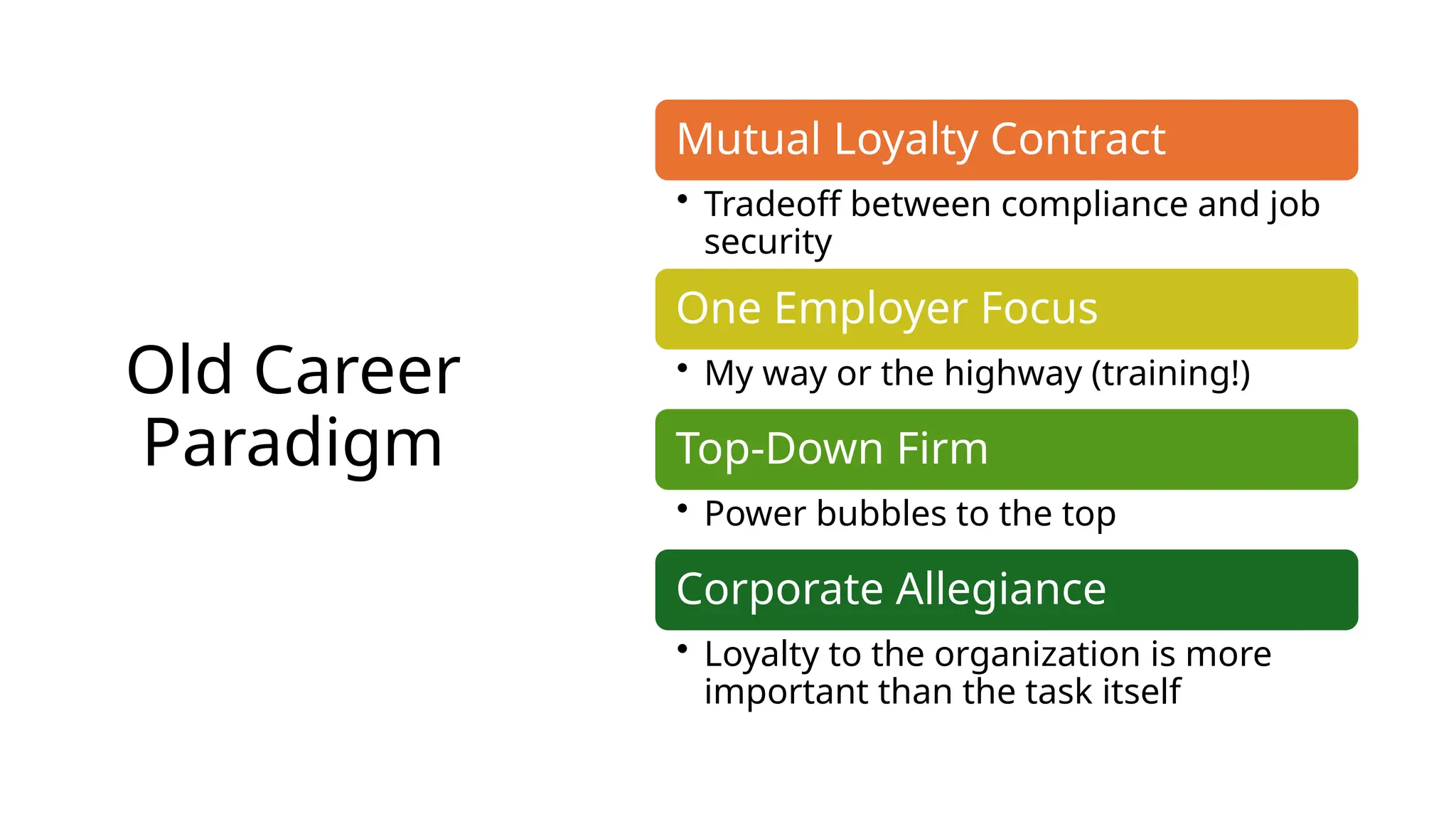
Old Career
Paradigm
Mutual LoyaltyContract
• Tradeoff between compliance and job
security
One Employer Focus
• My way or the highway (training!)
Top-Down Firm
• Power bubbles to the top
Corporate Allegiance
• Loyalty to the organization is more
important than the task itself
221.
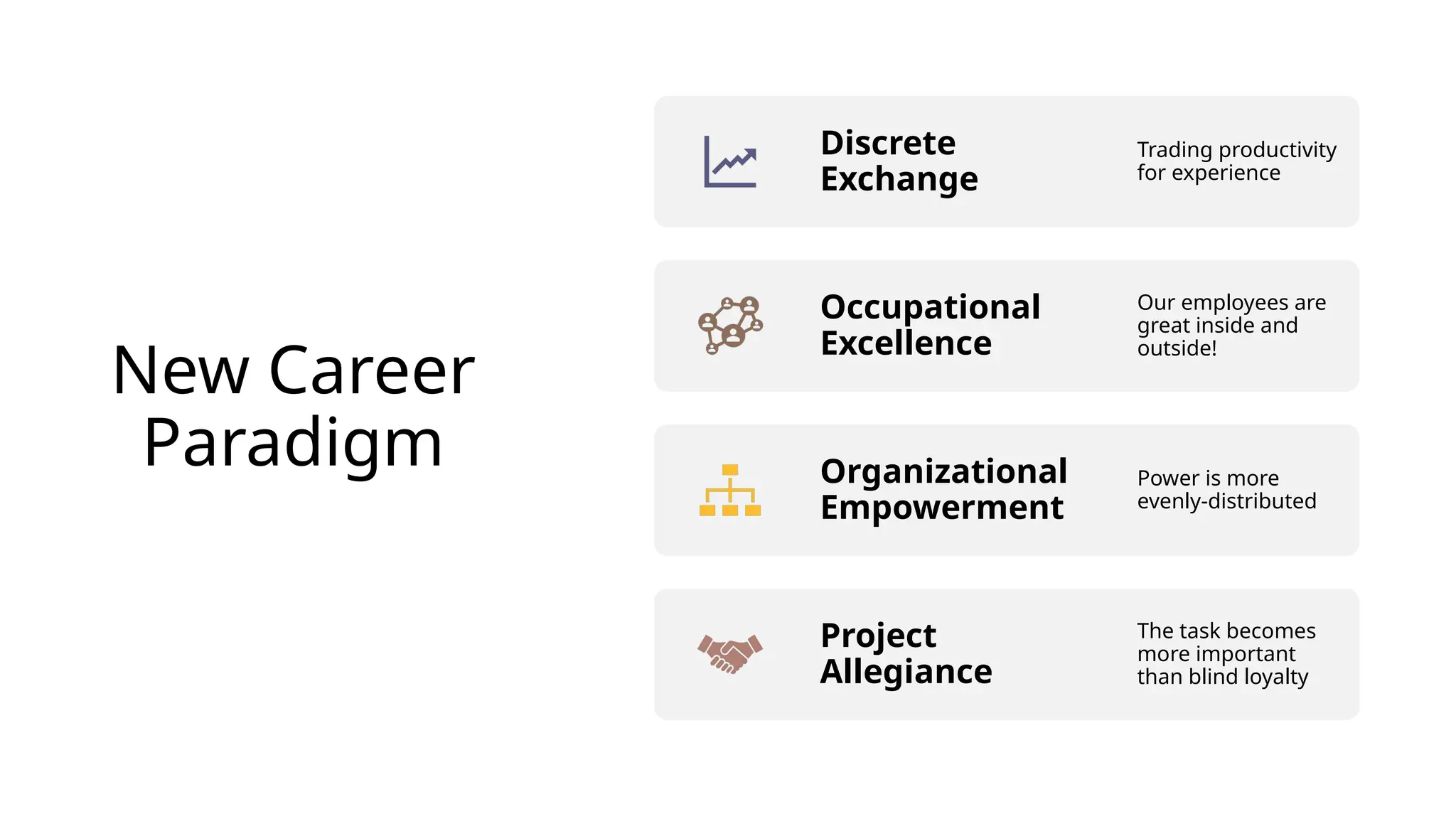
New Career
Paradigm
Discrete
Exchange
Trading productivity
forexperience
Occupational
Excellence
Our employees are
great inside and
outside!
Organizational
Empowerment
Power is more
evenly-distributed
Project
Allegiance
The task becomes
more important
than blind loyalty
222.
Career
Changes
(CNBC,
2022)
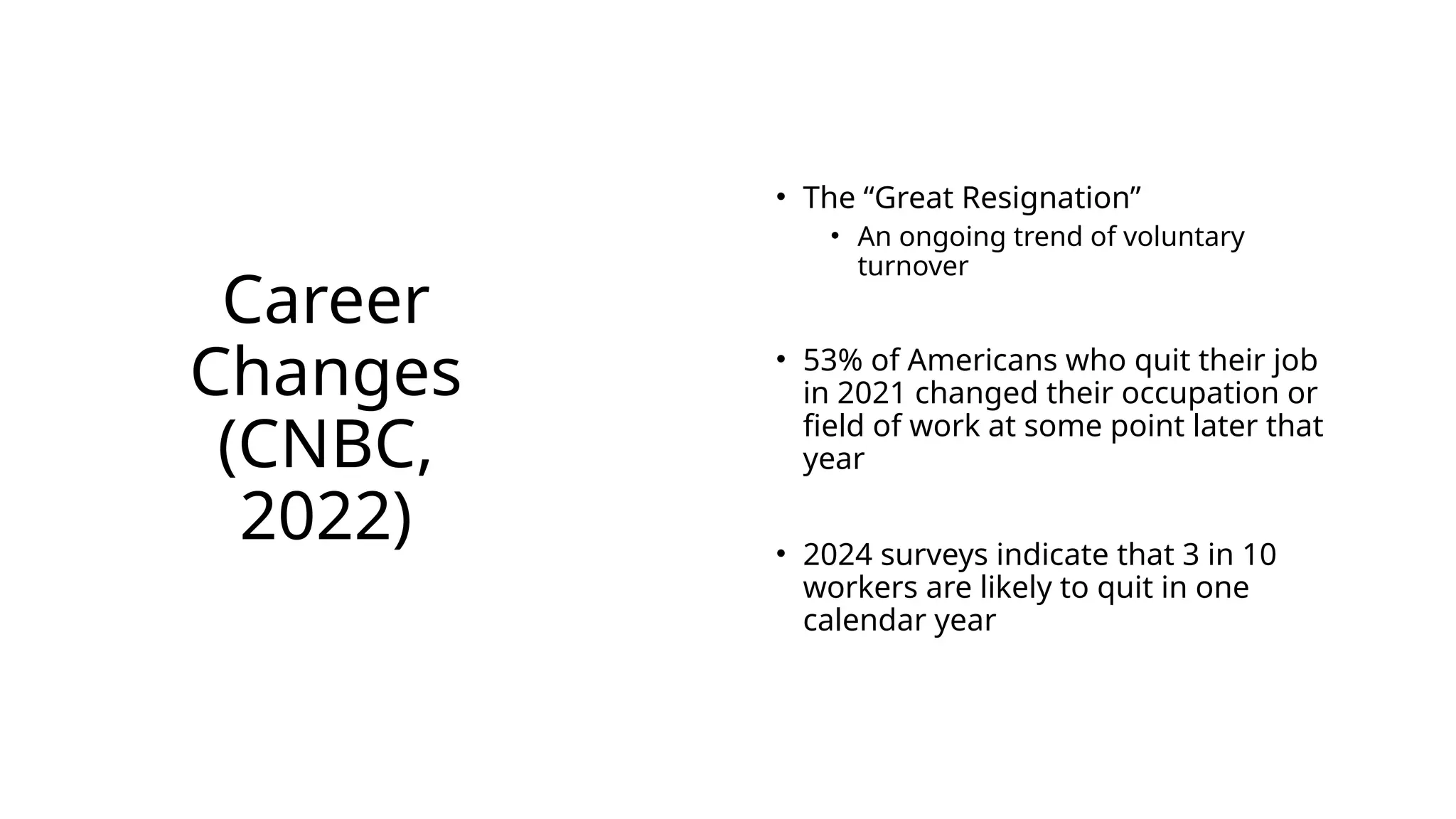
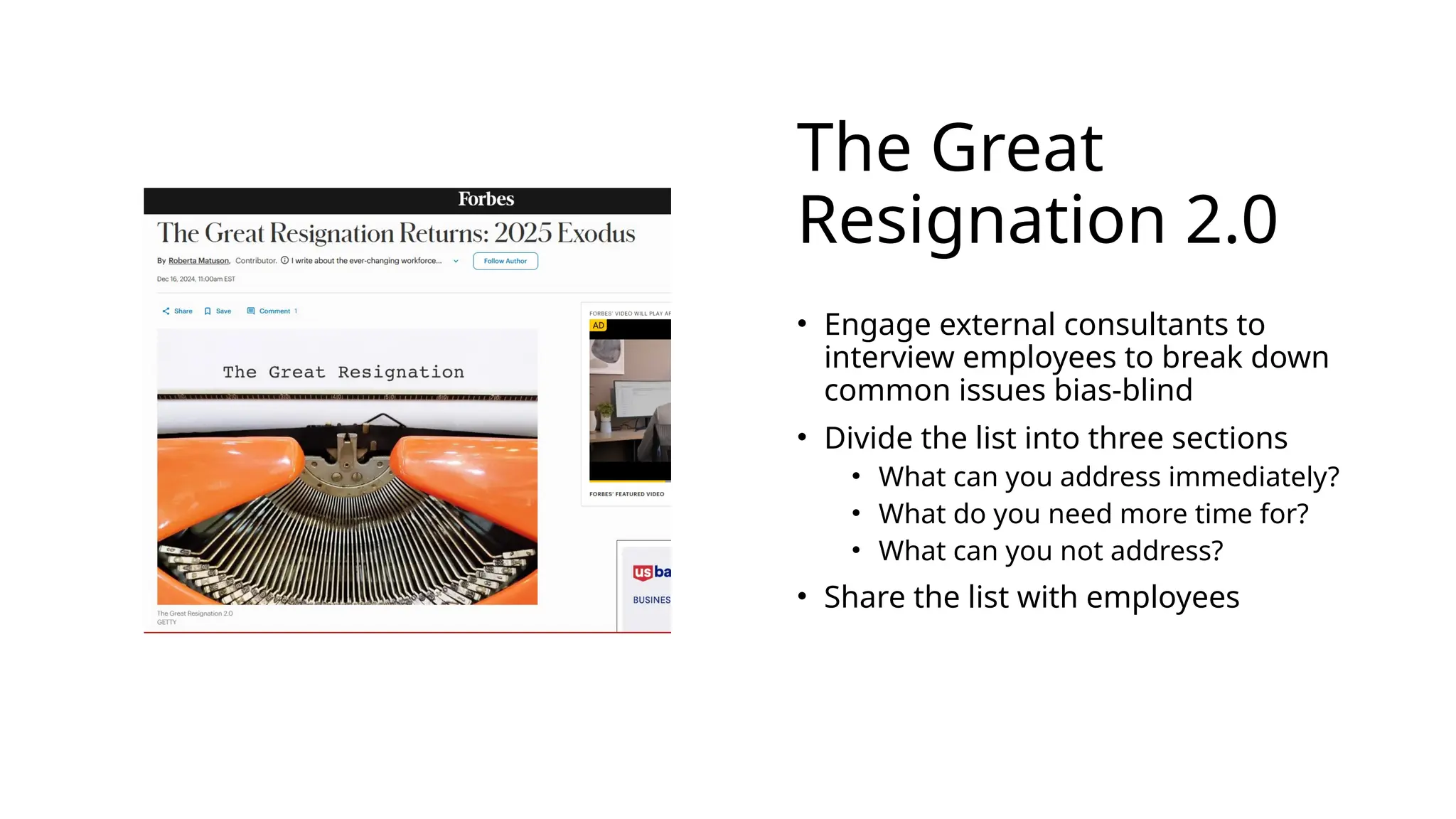
• The “GreatResignation”
• An ongoing trend of voluntary
turnover
• 53% of Americans who quit their job
in 2021 changed their occupation or
field of work at some point later that
year
• 2024 surveys indicate that 3 in 10
workers are likely to quit in one
calendar year
The Great
Resignation 2.0
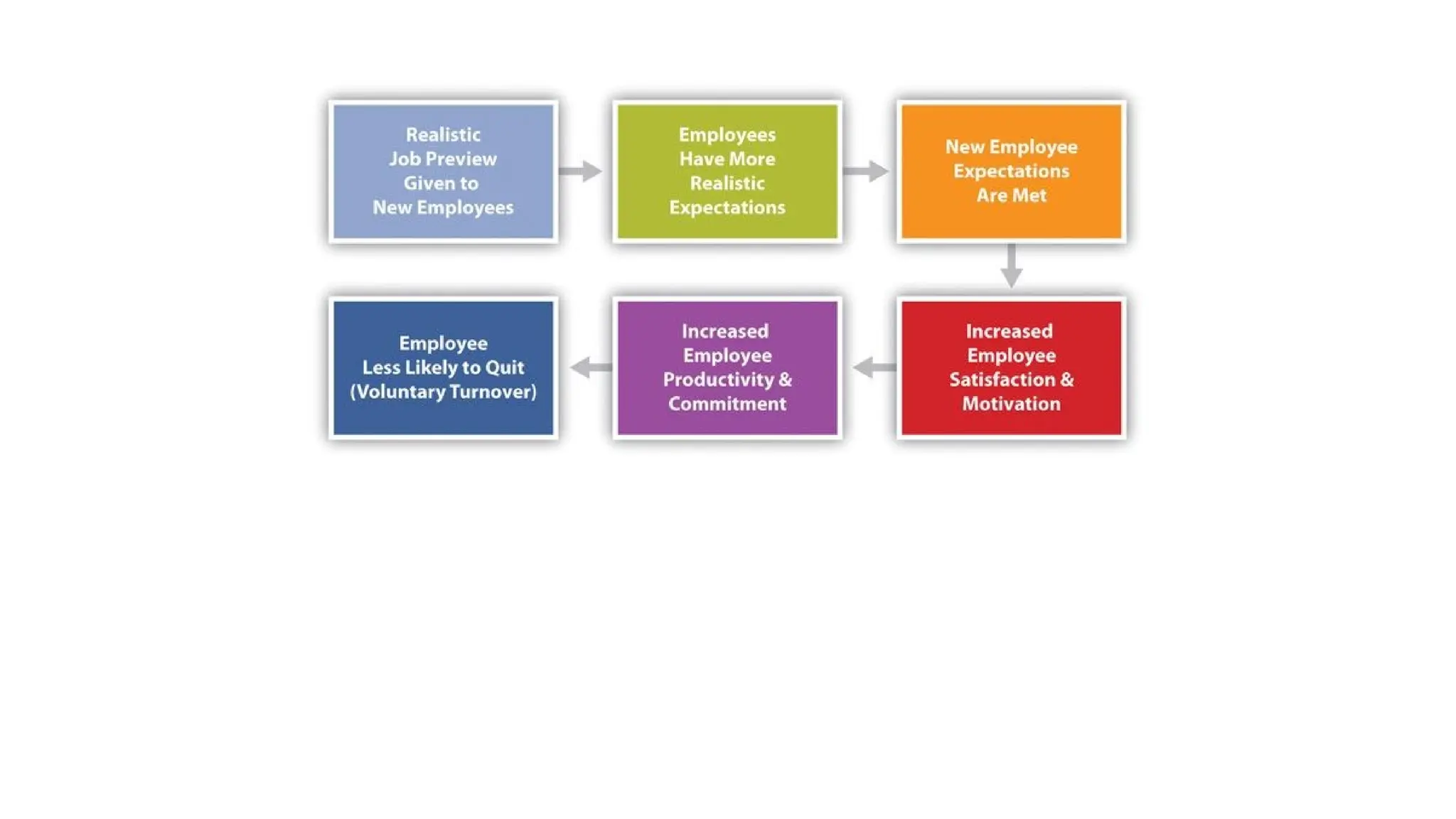
•Engage external consultants to
interview employees to break down
common issues bias-blind
• Divide the list into three sections
• What can you address immediately?
• What do you need more time for?
• What can you not address?
• Share the list with employees
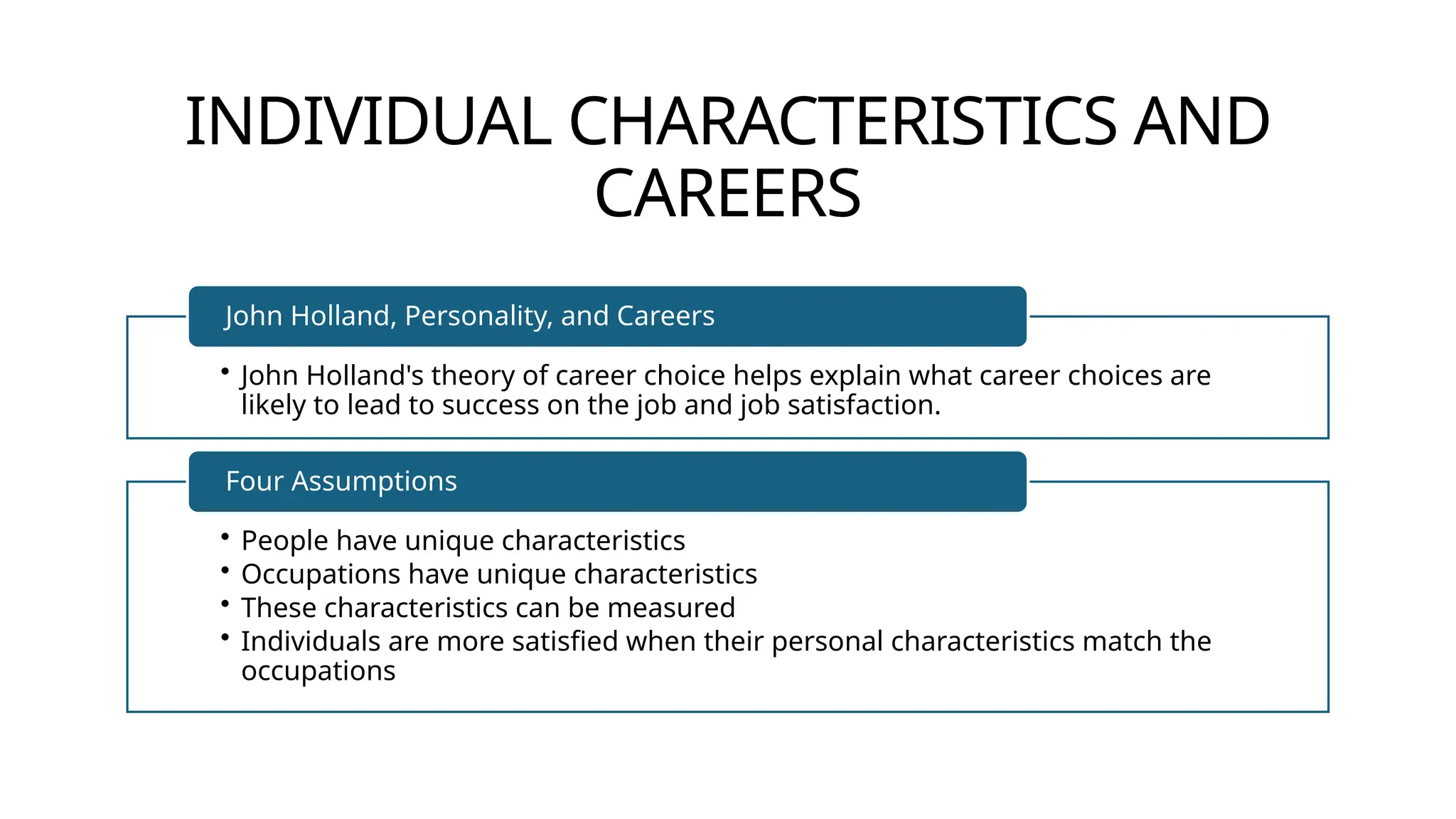
INDIVIDUAL CHARACTERISTICS AND
CAREERS
•John Holland's theory of career choice helps explain what career choices are
likely to lead to success on the job and job satisfaction.
John Holland, Personality, and Careers
• People have unique characteristics
• Occupations have unique characteristics
• These characteristics can be measured
• Individuals are more satisfied when their personal characteristics match the
occupations
Four Assumptions
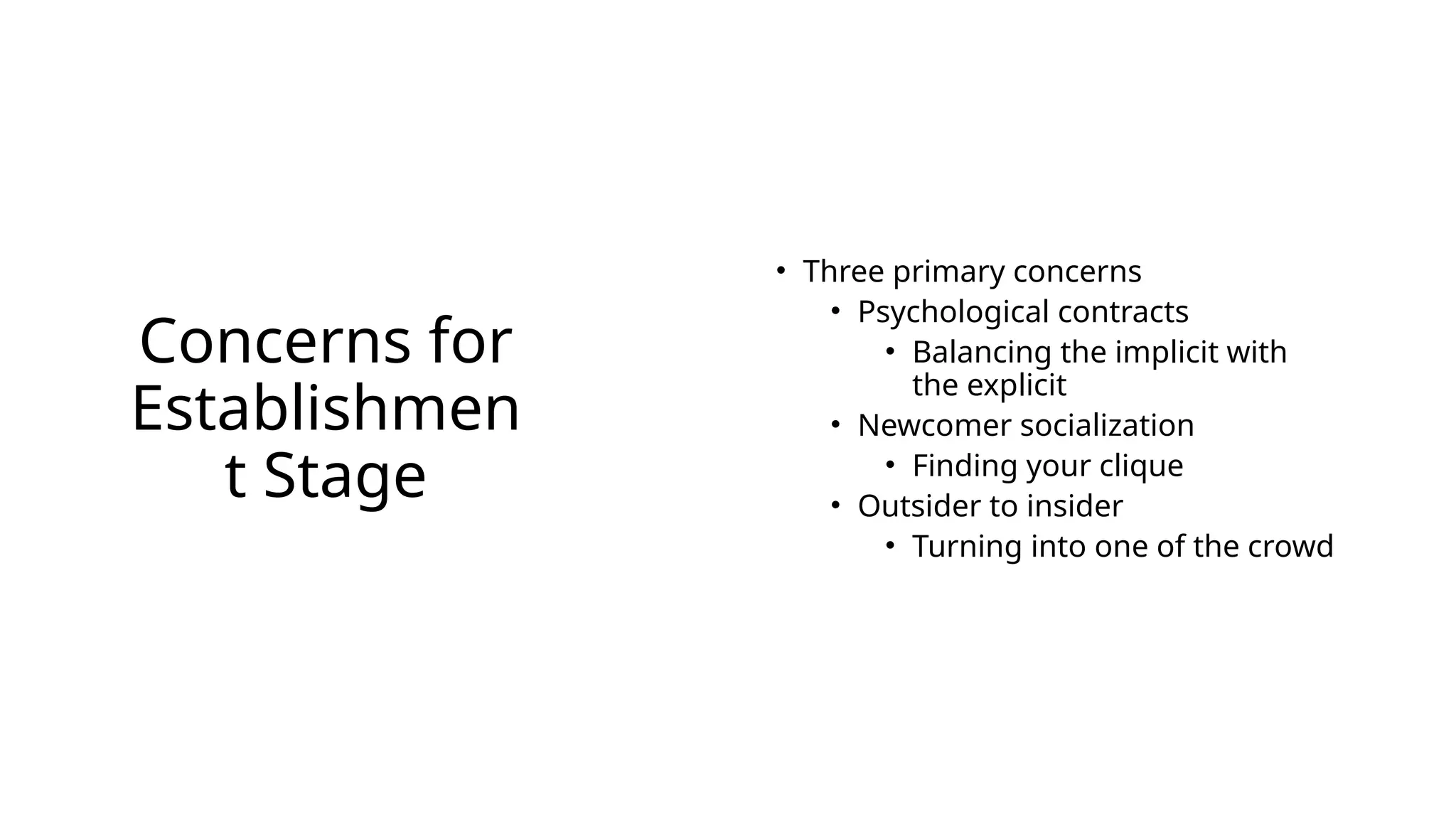
Concerns for
Establishmen
t Stage
•Three primary concerns
• Psychological contracts
• Balancing the implicit with
the explicit
• Newcomer socialization
• Finding your clique
• Outsider to insider
• Turning into one of the crowd
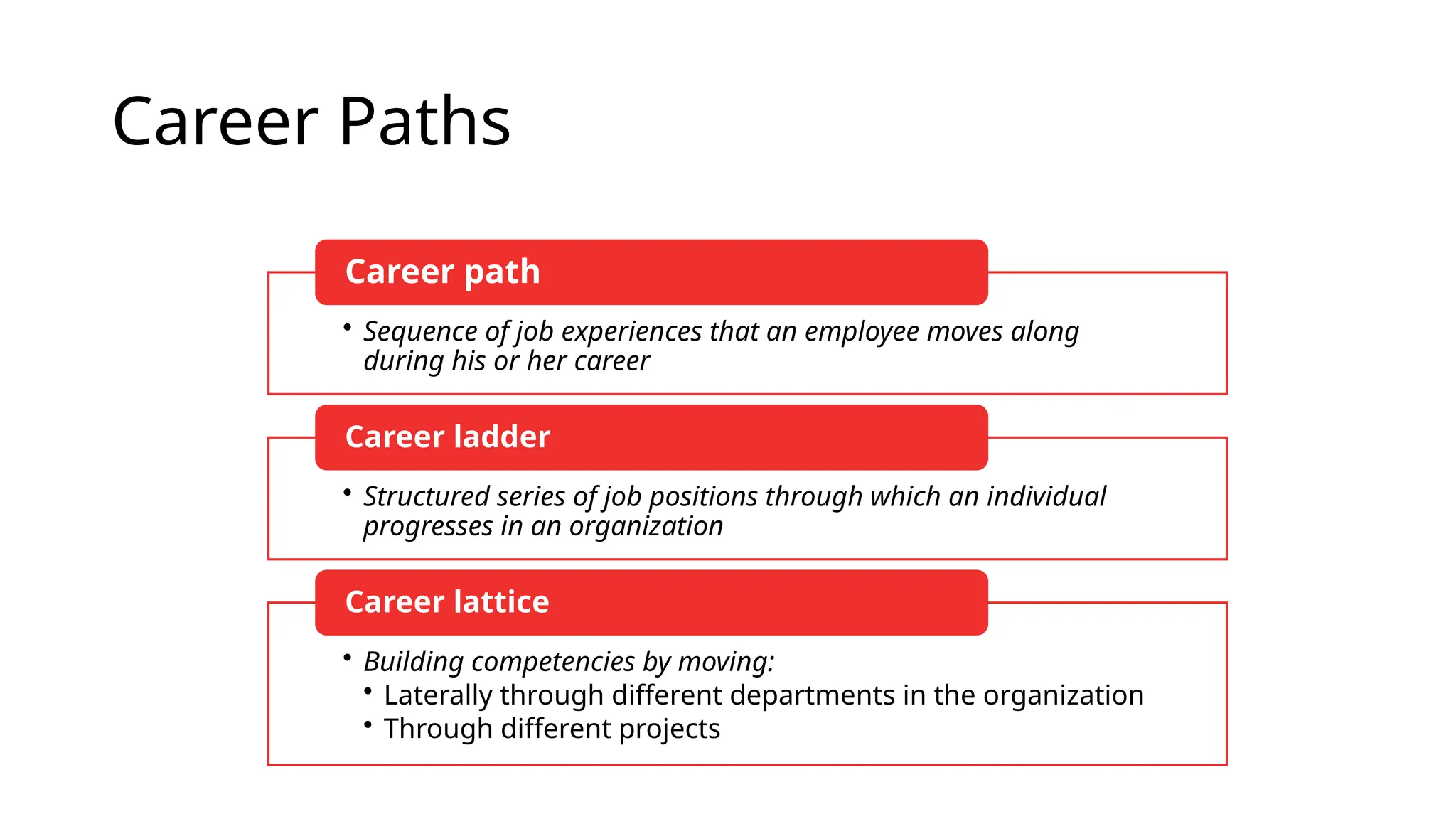
Career Paths
• Sequenceof job experiences that an employee moves along
during his or her career
Career path
• Structured series of job positions through which an individual
progresses in an organization
Career ladder
• Building competencies by moving:
• Laterally through different departments in the organization
• Through different projects
Career lattice
IS IT SUCHA
BAD THING TO
BE IN THE
MAINTENANCE
STAGE?
No!
239.
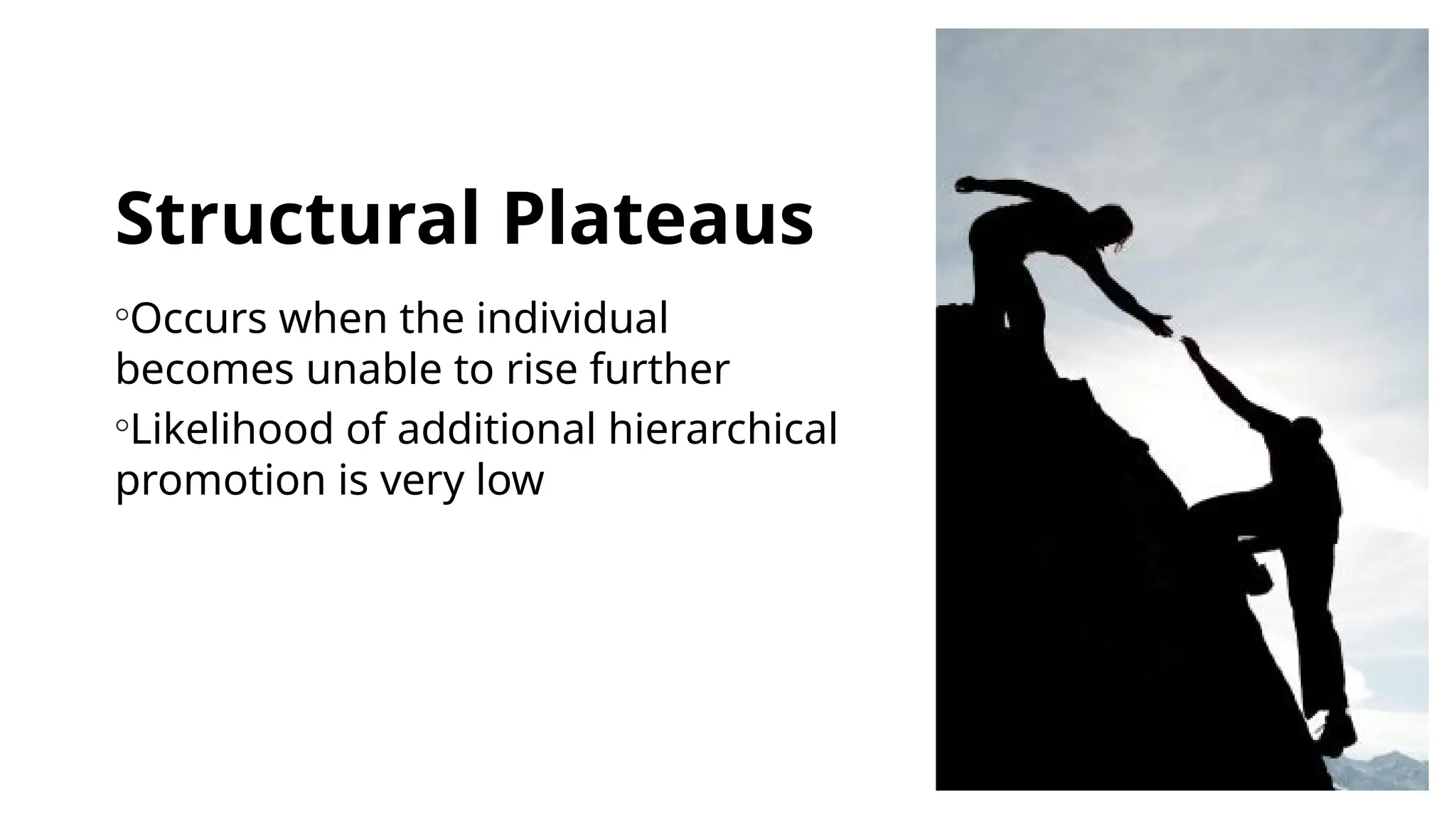
Structural Plateaus
◦Occurs whenthe individual
becomes unable to rise further
◦Likelihood of additional hierarchical
promotion is very low
240.
Content Plateaus
◦Employees whoare proficient in the role
◦Additional development opportunities
unlikely
◦No longer excited or curious about their
work
241.
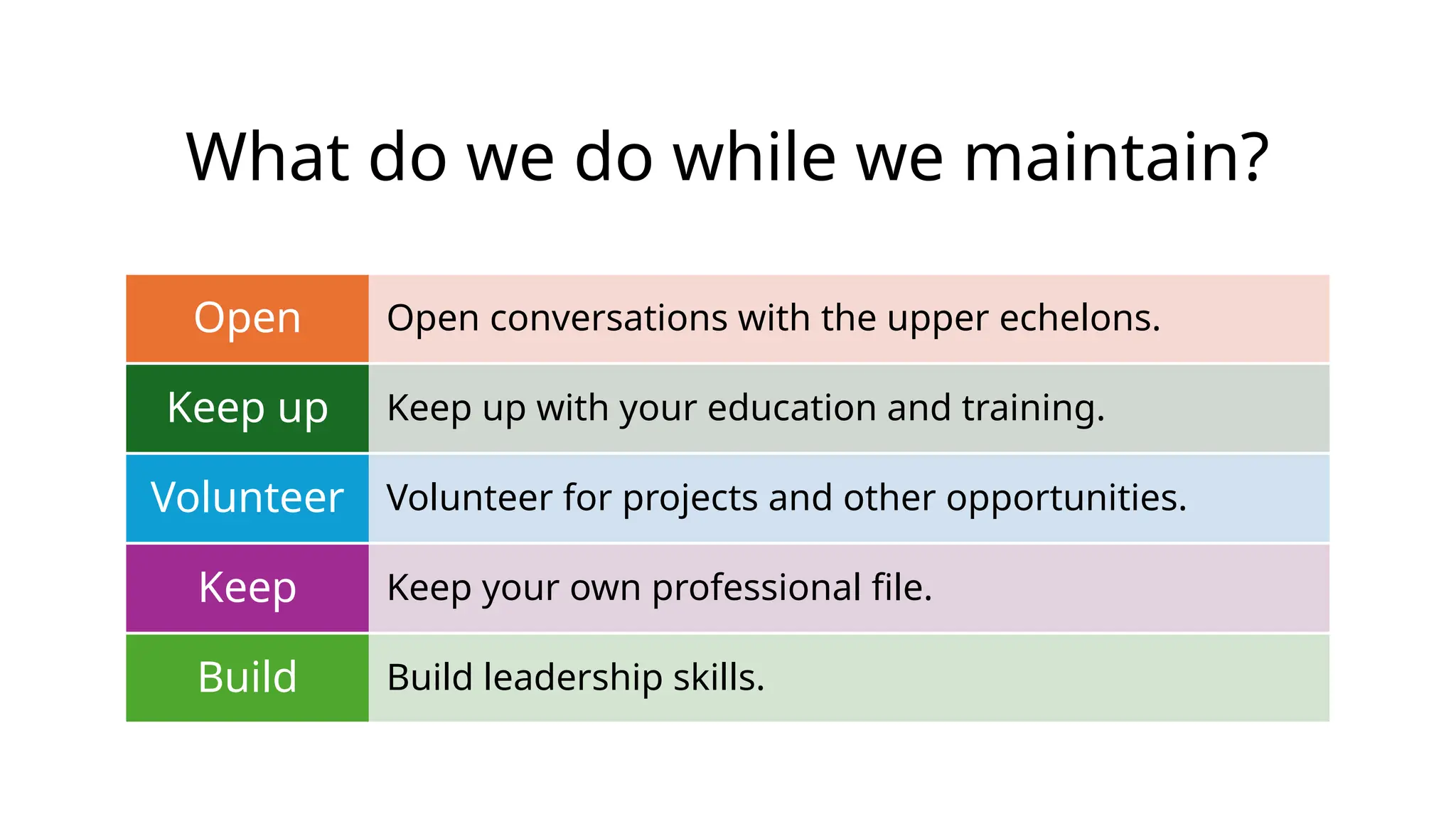
What do wedo while we maintain?
Open conversations with the upper echelons.
Open
Keep up with your education and training.
Keep up
Volunteer for projects and other opportunities.
Volunteer
Keep your own professional file.
Keep
Build leadership skills.
Build
WHAT DO WELOOK
FOR IN A MENTOR?
How is a mentor different from a leader/boss?
244.
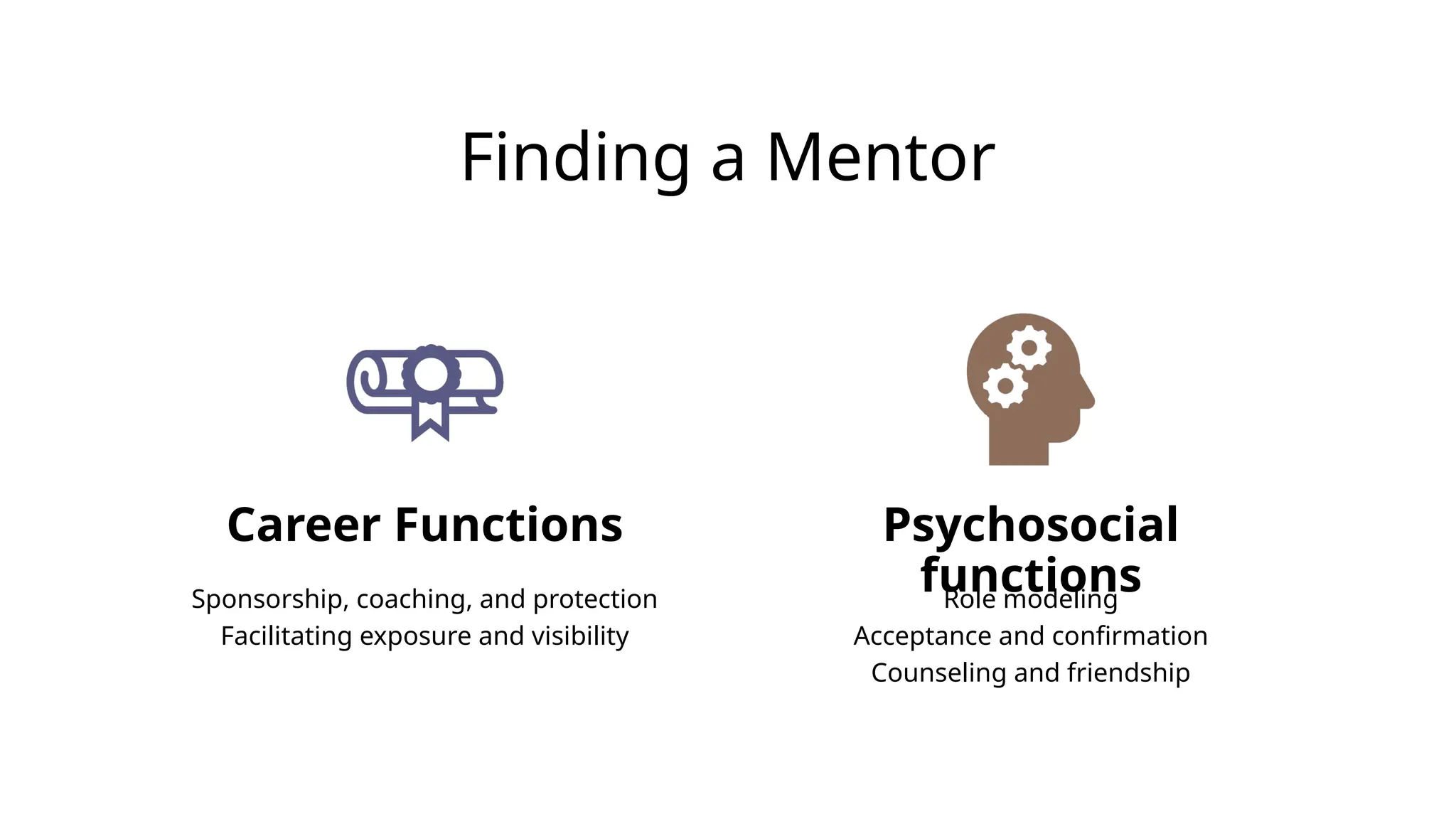
Finding a Mentor
CareerFunctions
Sponsorship, coaching, and protection
Facilitating exposure and visibility
Psychosocial
functions
Role modeling
Acceptance and confirmation
Counseling and friendship
245.
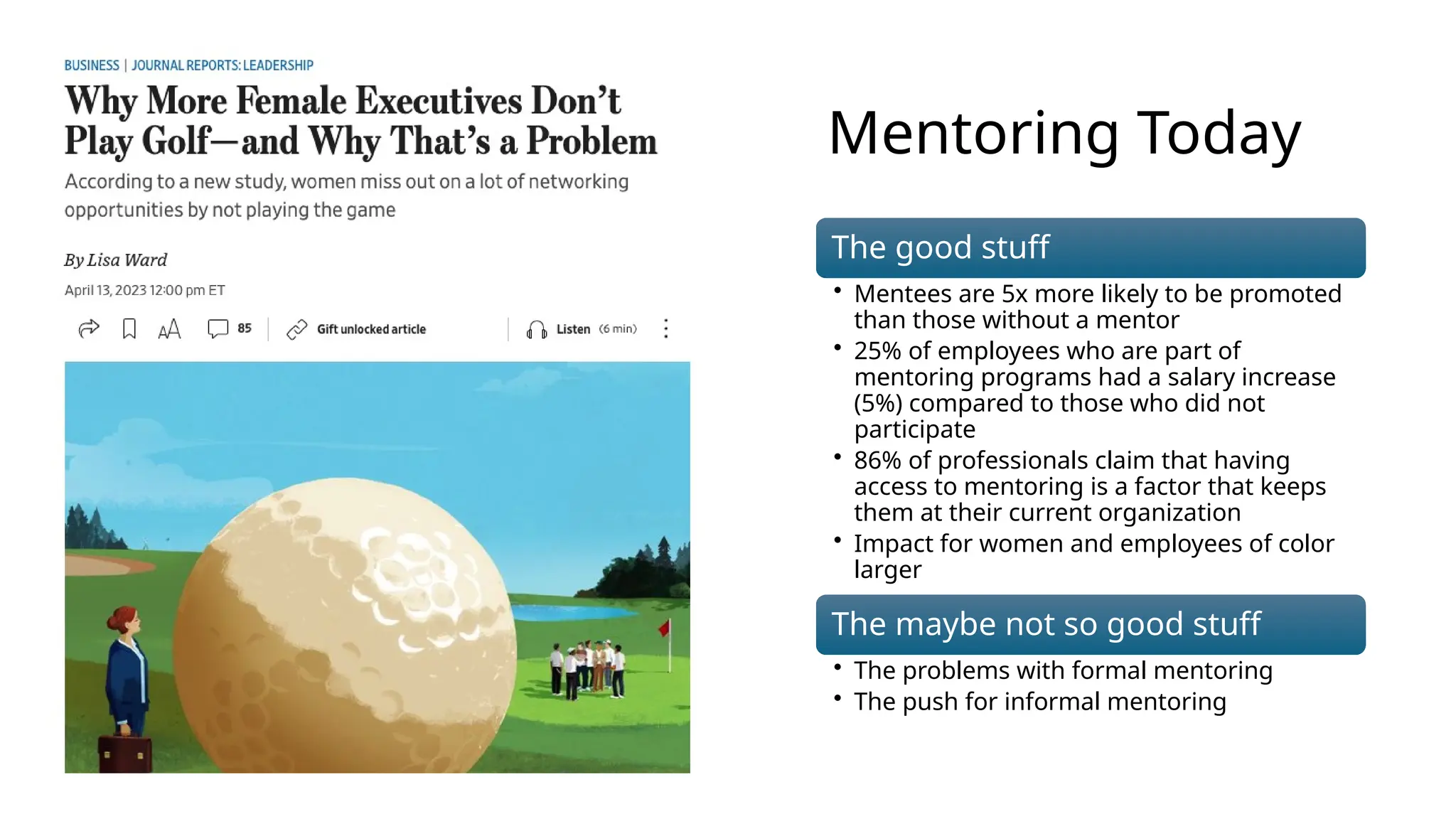
Mentoring Today
The goodstuff
• Mentees are 5x more likely to be promoted
than those without a mentor
• 25% of employees who are part of
mentoring programs had a salary increase
(5%) compared to those who did not
participate
• 86% of professionals claim that having
access to mentoring is a factor that keeps
them at their current organization
• Impact for women and employees of color
larger
The maybe not so good stuff
• The problems with formal mentoring
• The push for informal mentoring
246.
Who
teaches us
to be
mentors?
•We learn from…
• Our own mentors
• Our role models (people we don’t know)
• People outside of work
247.
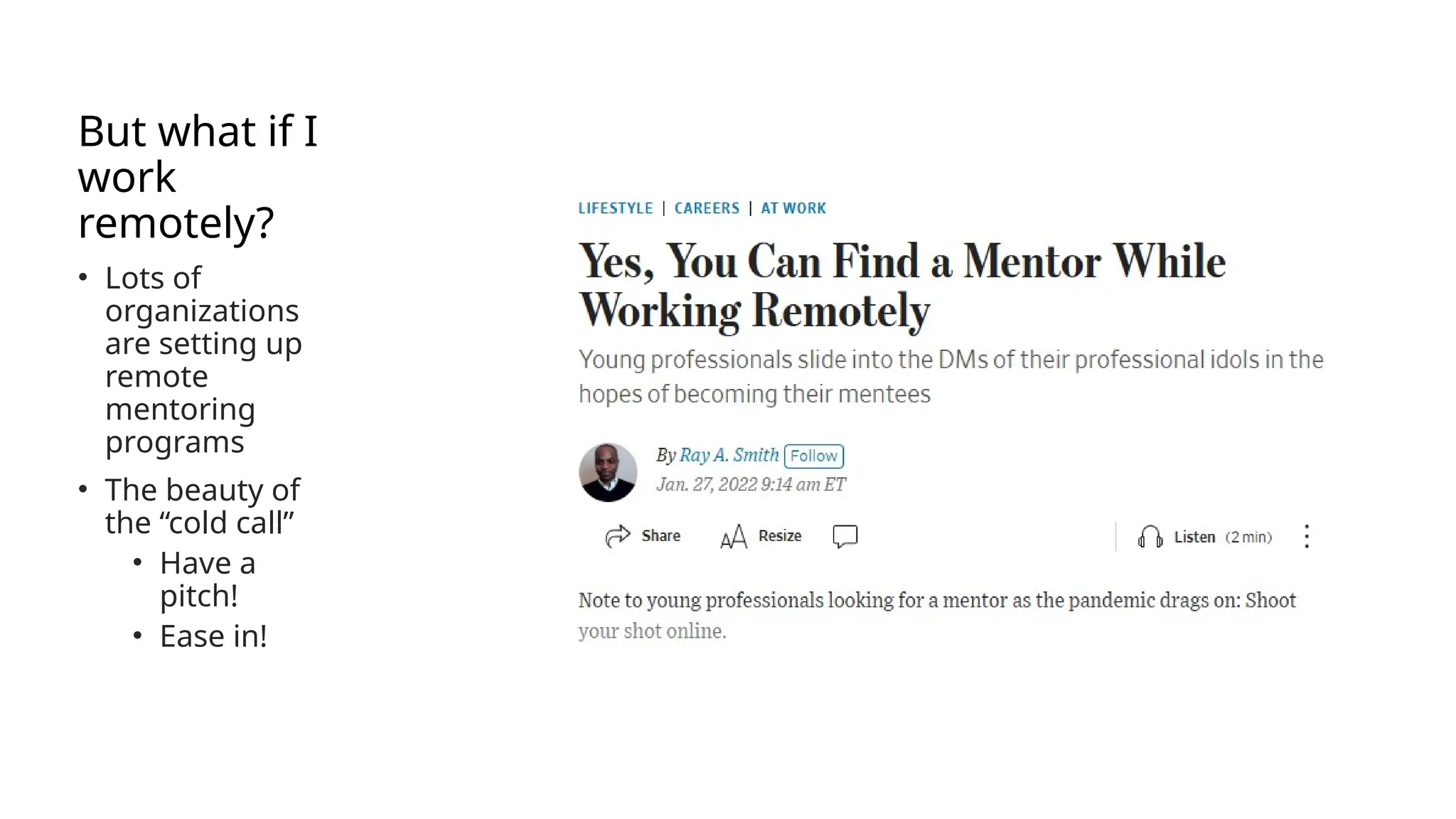
But what ifI
work
remotely?
• Lots of
organizations
are setting up
remote
mentoring
programs
• The beauty of
the “cold call”
• Have a
pitch!
• Ease in!
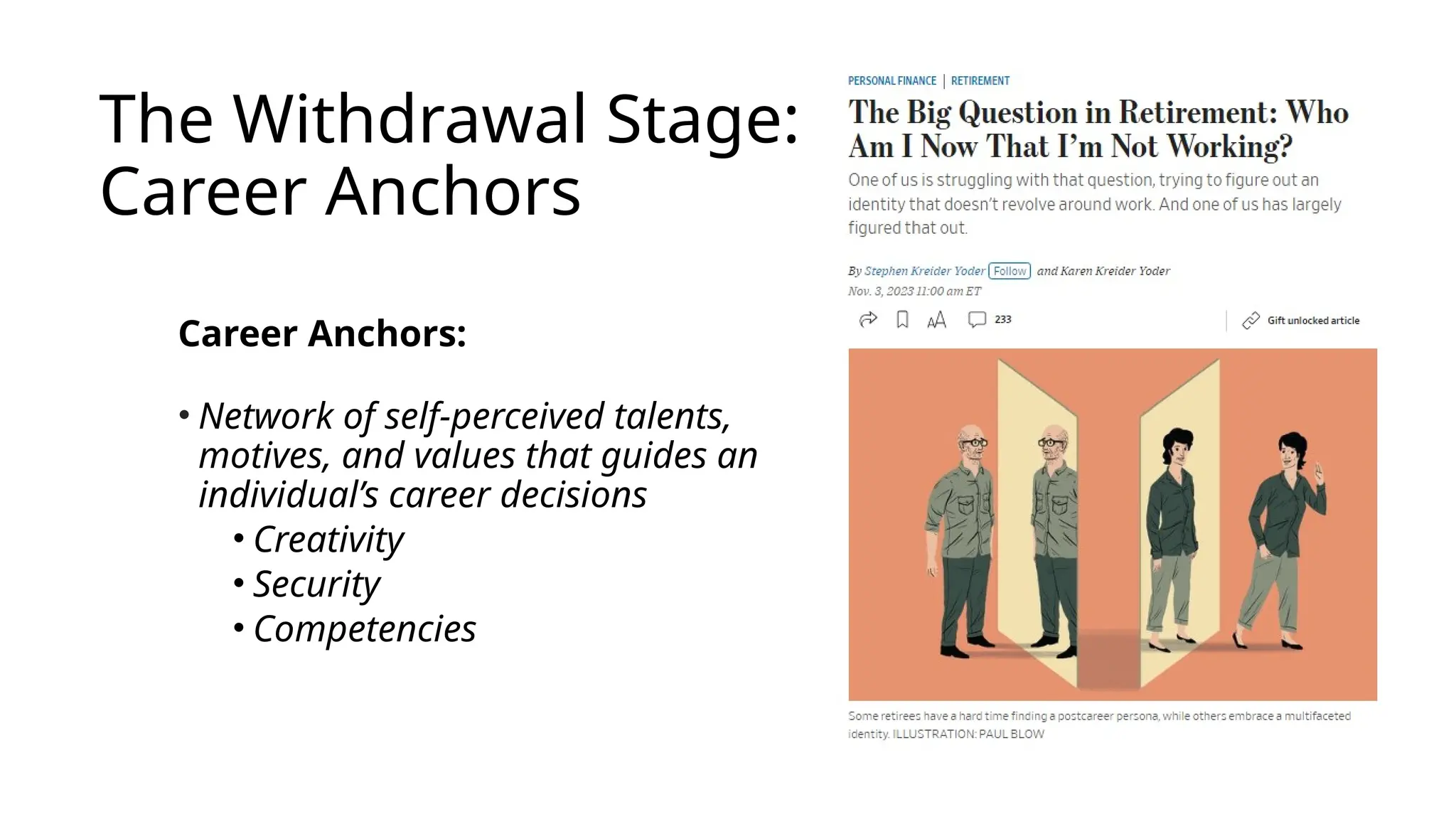
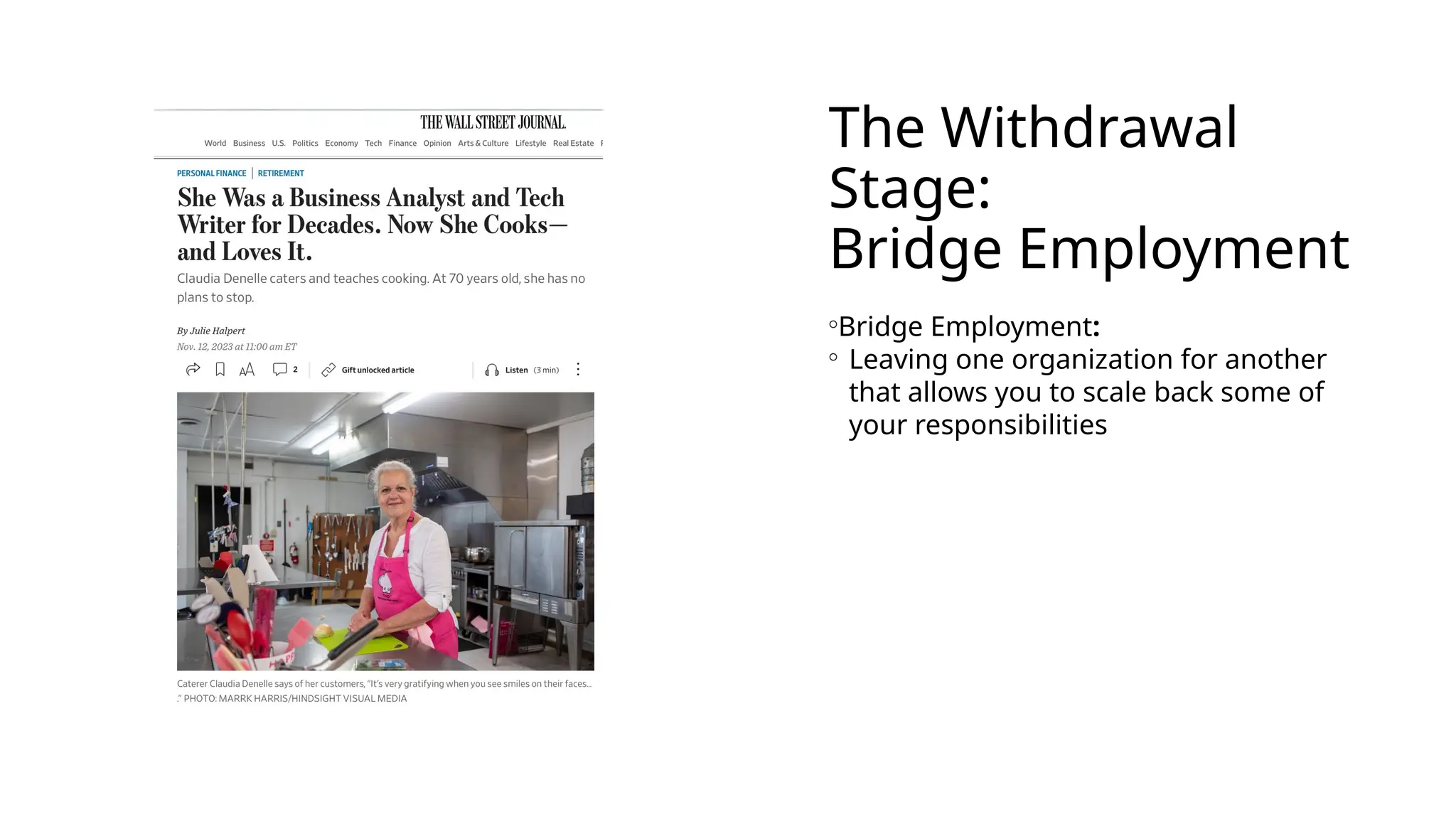
The Withdrawal Stage:
CareerAnchors
Career Anchors:
• Network of self-perceived talents,
motives, and values that guides an
individual’s career decisions
• Creativity
• Security
• Competencies
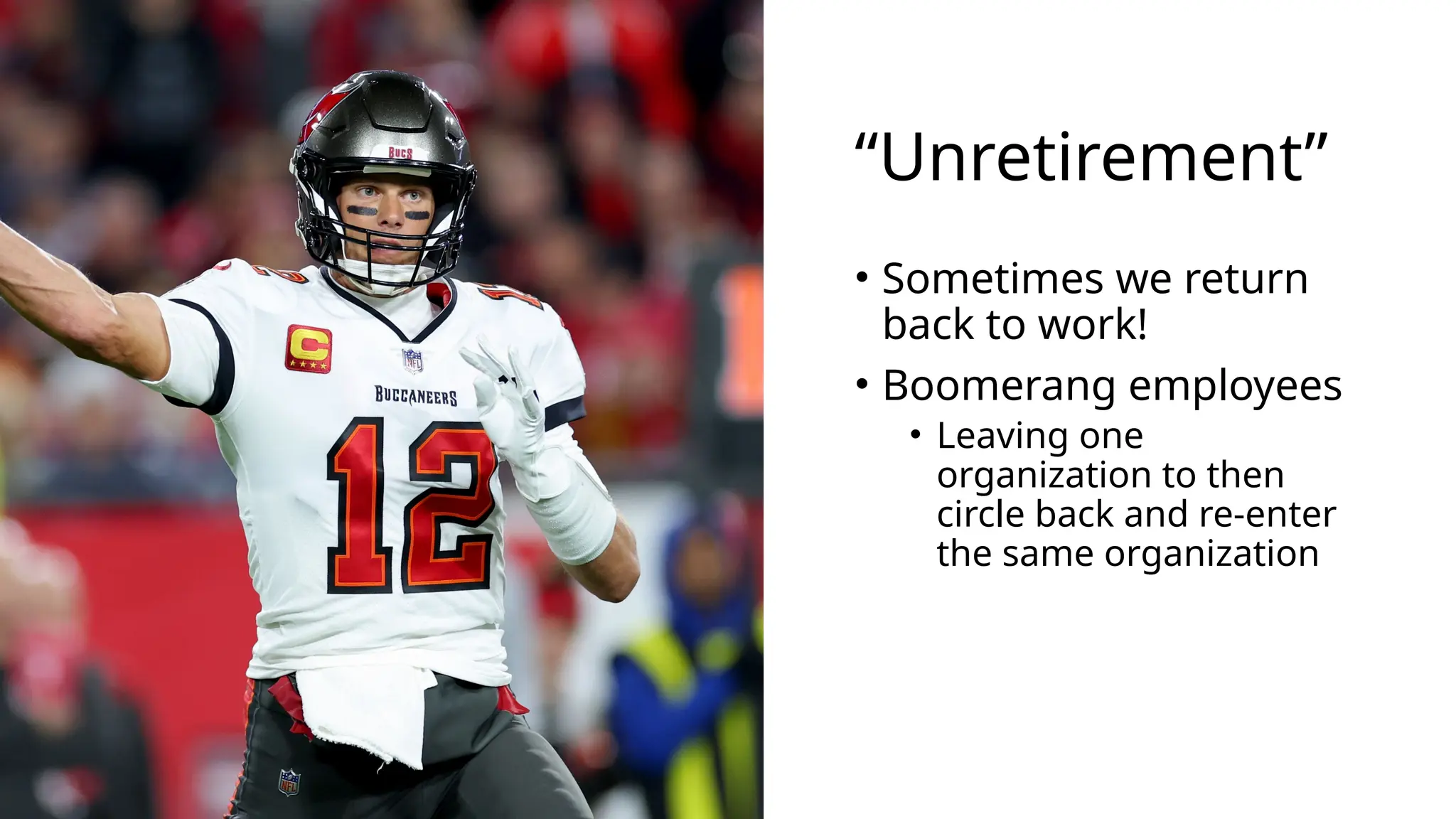
“Unretirement”
• Sometimes wereturn
back to work!
• Boomerang employees
• Leaving one
organization to then
circle back and re-enter
the same organization
253.
Chapter 17 Summary
•We are moving away from the old way of careers and toward a more
flexible career paradigm
• We all go through different stages in our careers at different times
• Each stage comes with its own challenges and obstacles
• Mentors can help us along the way!
• Find a career that matches you! Try not to make yourself match a
career (you may burn out!)
Top Trends ofthe Semester
• 1: Promote a fair and inclusive workplace where employees feel valued (Ch 1 &2)
• 2: Acknowledge the challenges head on to keep our competitive advantage (Ch 2)
• 3: Employees are complex, should be treated as individuals, and are motivated by different things
(Ch 3, 4 and 5)
• 4: Invest time in employees whether it’s training programs, wellness programs, or team building
(Ch 6, 7, and 9)
• 5: Communication is very important; Don’t be afraid to voice concerns at work! (Ch 8 & 11)
• 6: Know your worth, you have a set of experiences that no one else has, and that organizations
value (Ch 3, Ch 5)
• 7: Be a leader, but also know how and when to follow (Ch 12)
• 8: With great (workplace-related) power comes great responsibility (Ch 11)
• 9: Keep tabs on your stress levels, identify issues, and try to make decisions about how to make
your work life more manageable (Ch 7, Ch10)
• 10: Most importantly, use this information to not only understand how you might react to things at
work, but also to explain how others may react.
256.
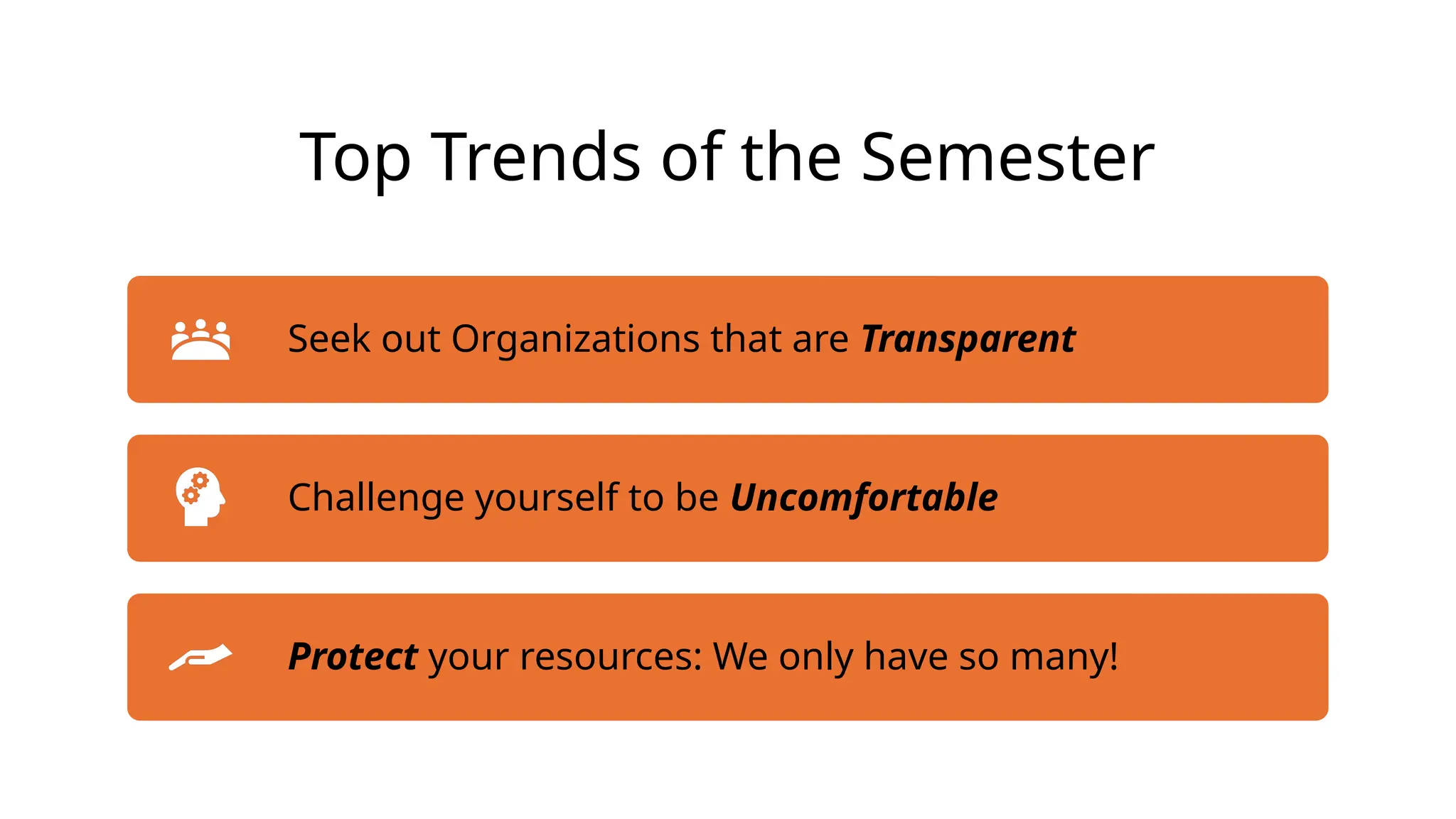
Top Trends ofthe Semester
Seek out Organizations that are Transparent
Challenge yourself to be Uncomfortable
Protect your resources: We only have so many!
257.
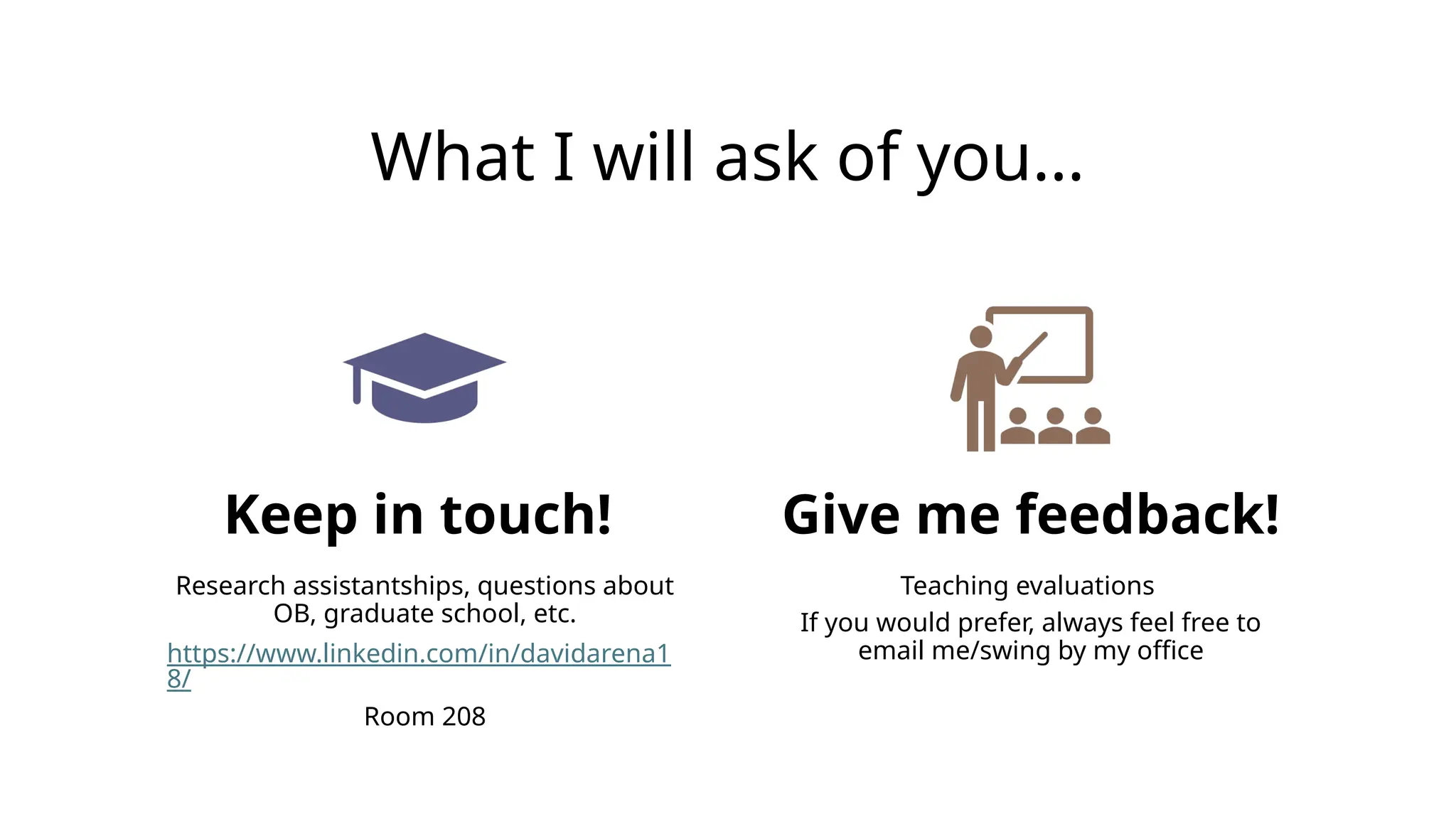
What I willask of you…
Keep in touch!
Research assistantships, questions about
OB, graduate school, etc.
https://www.linkedin.com/in/davidarena1
8/
Room 208
Give me feedback!
Teaching evaluations
If you would prefer, always feel free to
email me/swing by my office