Interactionist
Theory
Interaction
Is a face-to-face process
consisting of actions, reactions, and
mutual adaptation between two or
more individuals. It also includes
animal interaction such as mating.
The interaction includes all
language (including body language)
and mannerisms.
Interactionism
• is a theoretical perspective that derives
social processes (such as conflict,
cooperation, identity formation) from
human interaction.
•It is the study of how individuals act
within society.
Interactionist Theories
Interactionist theory has its origin in
the social psychology of early
twentienth century sociologiss George
Herbert Mead and Charles Horton
Cooley. Mead and Cooley examined
the ways in which the individual in
related to society through ongoing
social interactions
Symbolic Interactionism
Which require mental
processes
Non-Symbolic Interactionism
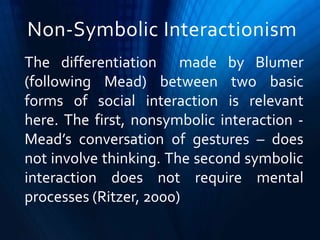
The differentiation made by Blumer
(following Mead) between two basic
forms of social interaction is relevant
here. The first, nonsymbolic interaction -
Mead’s conversation of gestures – does
not involve thinking. The second symbolic
interaction does not require mental
processes (Ritzer, 2000)
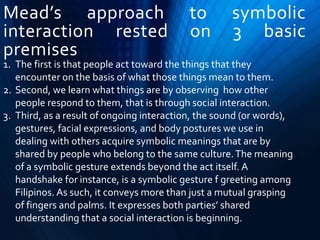
Mead’s approach to symbolic
interaction rested on 3 basic
premises
1. The first is that people act toward the things that they
encounter on the basis of what those things mean to them.
2. Second, we learn what things are by observing how other
people respond to them, that is through social interaction.
3. Third, as a result of ongoing interaction, the sound (or words),
gestures, facial expressions, and body postures we use in
dealing with others acquire symbolic meanings that are by
shared by people who belong to the same culture.The meaning
of a symbolic gesture extends beyond the act itself. A
handshake for instance, is a symbolic gesture f greeting among
Filipinos. As such, it conveys more than just a mutual grasping
of fingers and palms. It expresses both parties’ shared
understanding that a social interaction is beginning.
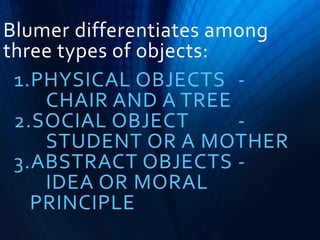
Blumer differentiates among
three types of objects:
1.PHYSICAL OBJECTS -
CHAIR AND A TREE
2.SOCIAL OBJECT -
STUDENT OR A MOTHER
3.ABSTRACT OBJECTS -
IDEA OR MORAL
PRINCIPLE
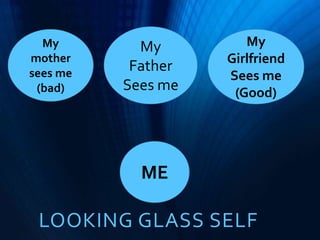
LOOKING GLASS SELF
My
mother
sees me
(bad)
My
Father
Sees me
My
Girlfriend
Sees me
(Good)
ME

Interactionist Theory

  • 1.
  • 2.
    Interaction Is a face-to-faceprocess consisting of actions, reactions, and mutual adaptation between two or more individuals. It also includes animal interaction such as mating. The interaction includes all language (including body language) and mannerisms.
  • 4.
    Interactionism • is atheoretical perspective that derives social processes (such as conflict, cooperation, identity formation) from human interaction. •It is the study of how individuals act within society.
  • 5.
  • 6.
    Interactionist theory hasits origin in the social psychology of early twentienth century sociologiss George Herbert Mead and Charles Horton Cooley. Mead and Cooley examined the ways in which the individual in related to society through ongoing social interactions
  • 12.
  • 15.
    Non-Symbolic Interactionism The differentiationmade by Blumer (following Mead) between two basic forms of social interaction is relevant here. The first, nonsymbolic interaction - Mead’s conversation of gestures – does not involve thinking. The second symbolic interaction does not require mental processes (Ritzer, 2000)
  • 16.
    Mead’s approach tosymbolic interaction rested on 3 basic premises 1. The first is that people act toward the things that they encounter on the basis of what those things mean to them. 2. Second, we learn what things are by observing how other people respond to them, that is through social interaction. 3. Third, as a result of ongoing interaction, the sound (or words), gestures, facial expressions, and body postures we use in dealing with others acquire symbolic meanings that are by shared by people who belong to the same culture.The meaning of a symbolic gesture extends beyond the act itself. A handshake for instance, is a symbolic gesture f greeting among Filipinos. As such, it conveys more than just a mutual grasping of fingers and palms. It expresses both parties’ shared understanding that a social interaction is beginning.
  • 17.
    Blumer differentiates among threetypes of objects: 1.PHYSICAL OBJECTS - CHAIR AND A TREE 2.SOCIAL OBJECT - STUDENT OR A MOTHER 3.ABSTRACT OBJECTS - IDEA OR MORAL PRINCIPLE
  • 18.
    LOOKING GLASS SELF My mother seesme (bad) My Father Sees me My Girlfriend Sees me (Good) ME