









Power Analysis:
Determining Sample Size
for Quantitative Studies
October 28, 2020
Presentation Overview
 Why is sample size important?
 What is statistical power? What is a power analysis?
 Basics of G*Power
 Power analysis examples
 Sample size calculation for advanced analyses
 Questions
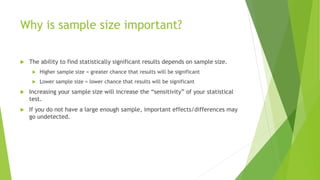
Why is sample size important?
 The ability to find statistically significant results depends on sample size.
 Higher sample size = greater chance that results will be significant
 Lower sample size = lower chance that results will be significant
 Increasing your sample size will increase the “sensitivity” of your statistical
test.
 If you do not have a large enough sample, important effects/differences may
go undetected.
Why is sample size important?
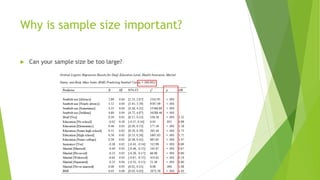
 Can your sample size be too large?
Why is sample size important?
What is statistical power?
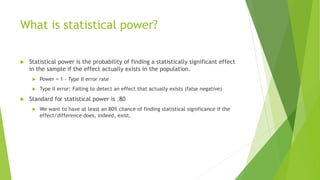
 Statistical power is the probability of finding a statistically significant effect
in the sample if the effect actually exists in the population.
 Power = 1 – Type II error rate
 Type II error: Failing to detect an effect that actually exists (false negative)
 Standard for statistical power is .80
 We want to have at least an 80% chance of finding statistical significance if the
effect/difference does, indeed, exist.
What is a power analysis?
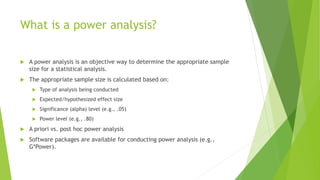
 A power analysis is an objective way to determine the appropriate sample
size for a statistical analysis.
 The appropriate sample size is calculated based on:
 Type of analysis being conducted
 Expected/hypothesized effect size
 Significance (alpha) level (e.g., .05)
 Power level (e.g., .80)
 A priori vs. post hoc power analysis
 Software packages are available for conducting power analysis (e.g.,
G*Power).
Power Analysis Software: G*Power
 https://www.psychologie.hhu.de/arbeitsgruppen/allgemeine-psychologie-
und-arbeitspsychologie/gpower.html
Power Analysis Software: Intellectus
Statistics
 https://analyze.intellectusstatistics.com
Example: t-tests
Example: Analysis of Variance (ANOVA)
Example: Regression
Advanced Analyses
 What if the type of analysis I am doing is not in G*Power?
 Factor analysis
 Structural equation modeling
 “Rules of thumb” (participant to variable ratio)
 Simulation studies (Monte Carlo analysis)
 Wolf, E. J., Harrington, K. M., Clark, S. L., & Miller, M. W. (2013). Sample size
requirements for structural equation models: An evaluation of power, bias, and
solution propriety. Educational and psychological measurement, 73(6), 913-934.
Interested in additional help?
 Schedule a consultation to learn more about what we offer:
 https://app.hubspot.com/meetings/jeanine/dissertation-consultation
Questions?

Power Analysis: Determining Sample Size for Quantitative Studies

  • 1.
    Power Analysis: Determining SampleSize for Quantitative Studies October 28, 2020
  • 2.
    Presentation Overview  Whyis sample size important?  What is statistical power? What is a power analysis?  Basics of G*Power  Power analysis examples  Sample size calculation for advanced analyses  Questions
  • 3.
    Why is samplesize important?  The ability to find statistically significant results depends on sample size.  Higher sample size = greater chance that results will be significant  Lower sample size = lower chance that results will be significant  Increasing your sample size will increase the “sensitivity” of your statistical test.  If you do not have a large enough sample, important effects/differences may go undetected.
  • 4.
    Why is samplesize important?  Can your sample size be too large?
  • 5.
    Why is samplesize important?
  • 6.
    What is statisticalpower?  Statistical power is the probability of finding a statistically significant effect in the sample if the effect actually exists in the population.  Power = 1 – Type II error rate  Type II error: Failing to detect an effect that actually exists (false negative)  Standard for statistical power is .80  We want to have at least an 80% chance of finding statistical significance if the effect/difference does, indeed, exist.
  • 7.
    What is apower analysis?  A power analysis is an objective way to determine the appropriate sample size for a statistical analysis.  The appropriate sample size is calculated based on:  Type of analysis being conducted  Expected/hypothesized effect size  Significance (alpha) level (e.g., .05)  Power level (e.g., .80)  A priori vs. post hoc power analysis  Software packages are available for conducting power analysis (e.g., G*Power).
  • 8.
    Power Analysis Software:G*Power  https://www.psychologie.hhu.de/arbeitsgruppen/allgemeine-psychologie- und-arbeitspsychologie/gpower.html
  • 9.
    Power Analysis Software:Intellectus Statistics  https://analyze.intellectusstatistics.com
  • 10.
  • 11.
    Example: Analysis ofVariance (ANOVA)
  • 12.
  • 13.
    Advanced Analyses  Whatif the type of analysis I am doing is not in G*Power?  Factor analysis  Structural equation modeling  “Rules of thumb” (participant to variable ratio)  Simulation studies (Monte Carlo analysis)  Wolf, E. J., Harrington, K. M., Clark, S. L., & Miller, M. W. (2013). Sample size requirements for structural equation models: An evaluation of power, bias, and solution propriety. Educational and psychological measurement, 73(6), 913-934.
  • 14.
    Interested in additionalhelp?  Schedule a consultation to learn more about what we offer:  https://app.hubspot.com/meetings/jeanine/dissertation-consultation
  • 15.