CHAPTER SIX: SAMPLE SIZE AND
POWER ANALYSIS FOR ANALYTIC
EPIDEMIOLOGY
WHAT IS SAMPLE
SIZE?
This is the sub-population to be studied in order to
make an
inference to a reference population(A broader
population to which the findings from a study are
to be generalized)
In census, the sample size is equal to the
population size. However, in research, because of
time constraint and budget,
a
representati
ve
The larger
the study.
sampl
e
sampl
e
are normally
used.
size the more
accurate
the findings
from a
4
Availability of resources sets the upper limit of
the sample
size.
While the required accuracy sets the lower limit
of sample size
Therefore, an optimum
sample
siz
e
isa
n
essenti
al
compone
nt
ofan
y
researc
h.
5
WHAT IS SAMPLE SIZE
DETERMINATION
Sample size determination is the mathematical
estimation of
the number of subjects/units to be included in a
study.
When a representative sample is taken from a
population,
the finding are generalized to the population.
Optimum sample size determination is
required
following reasons:
forth
e
4. To
5. To
6. To
allow for appropriate analysis
provide the desired level of
accuracy
allow validity of significance
test.
7
HOW LARGE A SAMPLE DO I
NEED?
If the sample is too
small:
2. Even a well conducted study may fail to answer
its research
question
3. It
4. It
ma
y
ma
y
fail to detect important effect or
associations
associ
ate
thi
s
effec
t
orassociati
on
imprecise
ly
8
CONVERSELY
If the sample size is too
large:
2. The study will be difficult and
costly
3. Time constraint
4. Available cases e.g rare
disease.
5. Loss of accuracy.
Hence, optimum sample
size must
commencement of a
study.
b
e
determin
ed
befor
e
9
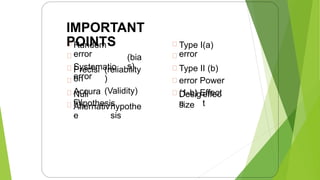
IMPORTANT
POINTS
Random
error
Systematic
error
Type I(a)
error
Type II (b)
error Power
(1-b) Effect
size
(bia
s)
Precisi
on
Accura
cy
(reliability
)
(Validity)
Null
hypothesis
Desig
n
effec
t
Alternativ
e
hypothe
sis
10
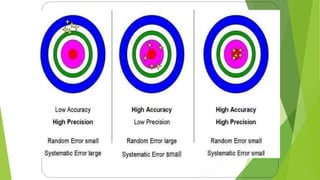
Random error: error that occur by chance. Sources are
sample
variability, subject to subject differences & measurement
errors.
It can be reduced by averaging, increase sample size,
repeating the
experiment.
Systematic error: deviations not due to chance alone.
Several
factors, e.g patient selection criteria may contribute. It
can be
reduced by good study design and conduct of the
experiment.
Precision: the degree to which a variable has the same
value when measured several times. It is a function of
11
12
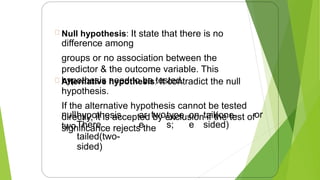
Null hypothesis: It state that there is no
difference among
groups or no association between the
predictor & the outcome variable. This
hypothesis need to be tested.
Alternative hypothesis: It contradict the null
hypothesis.
If the alternative hypothesis cannot be tested
directly, it is accepted by exclusion if the test of
significance rejects the
null
two
hypothesis.
There
tailed(two-
sided)
ar
e
twotype
s;
on
e
tail(one-
sided)
or
13
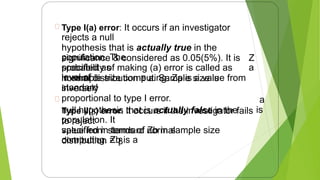
Type I(a) error: It occurs if an investigator
rejects a null
hypothesis that is actually true in the
population. The
probability of making (a) error is called as
level of
significance & considered as 0.05(5%). It is
specified as
in sample size computing. Za is a value from
standard
Z
a
normal distribution ≡ a. Sample size is
inversely
proportional to type I error.
Type II(β) error: it occurs if the investigator fails
to reject
a
null hypothesis that is actually false in the
population. It
specified in terms of Zb in sample size
computing. Zb is a
is
value from standard normal
distribution ≡ β
14
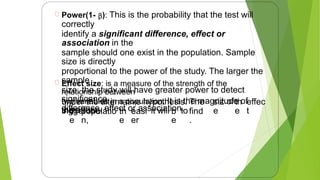
Power(1- β): This is the probability that the test will
correctly
identify a significant difference, effect or
association in the
sample should one exist in the population. Sample
size is directly
proportional to the power of the study. The larger the
sample
size, the study will have greater power to detect
significance
difference, effect or association.
Effect size: is a measure of the strength of the
relationship between
two variables in a population. It is the magnitude of
the effect
under the alternative hypothesis. The
bigger the
siz
e
ofth
e
effec
t
inth
e
populatio
n,
th
e
easi
er
it will b
e
tofind
.
15
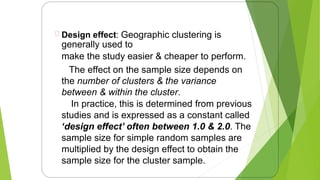
Design effect: Geographic clustering is
generally used to
make the study easier & cheaper to perform.
The effect on the sample size depends on
the number of clusters & the variance
between & within the cluster.
In practice, this is determined from previous
studies and is expressed as a constant called
‘design effect’ often between 1.0 & 2.0. The
sample size for simple random samples are
multiplied by the design effect to obtain the
sample size for the cluster sample.
16
POWER
ANALYSIS
When the estimated sample size can not be
included in a
study, post-hoc power analysis should be
carried out.
The probability of correctly rejecting the null
hypothesis is equal to 1 – β, which is called
power. The power of a test
refers to its
ability to
the power of a
test is looking
for, given its
detect what it is looking for.
our probability of finding what
we are size.
post-
hoc
power analysis is done after a study
has been
carried out to help to explain the results if a study
which did
not find any significant effects.
18
AT WHAT STAGE CAN SAMPLE SIZE
ADDRESSED?
B
E
It can be addressed at two stages:
2. Calculate the optimum sample size required
during the planning stage, while designing the
study, using appropriate approach & information
on some parameters.
3. Or through post-hoc
power
analy
sis
atth
e
stag
e
of
interpretati
on
ofth
e
result
.
19
APPROACH FOR ESTIMATING SAMPLE
SIZE/POWER ANALYSIS
There are many different approaches for
calculating the sample
size for different study designs. Such as case
control design, cohort design, cross sectional
studies, clinical trials, diagnostic test studies
etc.
Within each study design there could be more sub-
designs and the sample size calculation will vary
accordingly.
Therefore, one must use the correct approach for
computing
sample size appropriate to the study design & its
subtype.
th
e
PARAMETERS
Depending upon the approach chosen for
calculating the sample
size, one
also
as;
Hypothesi
s
Precision
Type I
error
Type II
error
Power
Effect size
nee
ds
tospecif
y
som
e
addition
al
paramet
ers
suc
h
24
PROCEDURE FOR CALCULATING SAMPLE
SIZE.
There are four procedures
size:
1. Use of formulae
2. Ready made table
3. Nomograms
4. Computer software
tha
t
coul
d
b
e
use
d
forcalculati
ng
sampl
e
25
USE OF FORMULAE FOR SAMPLE SIZE CALCULATION & POWER
ANALYSIS
There are many formulae for calculating
sample size &
power in different situations for different study
designs.
The appropriate sample size for population-
based study
determined largely by 3 factors
is
1.
The
2.
The
3.
The
estimated prevalence
of the
desired level of
confidence.
variabl
e
ofinteres
t.
accepta
ble
margi
n
of error.
26
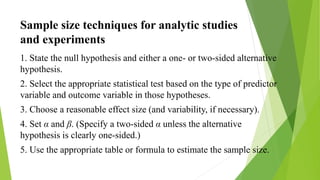
Sample size techniques for analytic studies
and experiments
1. State the null hypothesis and either a one- or two-sided alternative
hypothesis.
2. Select the appropriate statistical test based on the type of predictor
variable and outcome variable in those hypotheses.
3. Choose a reasonable effect size (and variability, if necessary).
4. Set α and β. (Specify a two-sided α unless the alternative
hypothesis is clearly one-sided.)
5. Use the appropriate table or formula to estimate the sample size.
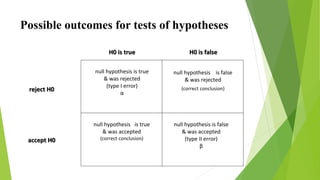
Possible outcomes for tests of hypotheses
null hypothesis is true
& was rejected
(type I error)
α
null hypothesis is false
& was rejected
(correct conclusion)
null hypothesis is true
& was accepted
(correct conclusion)
null hypothesis is false
& was accepted
(type II error)
β
H0 is true H0 is false
reject H0
accept H0
Statistical Power
 Power is the probability that the null hypothesis is rejected, if a
specific alternative hypothesis is true.
 ß represents Type II error, the probability of not rejecting the
null hypothesis when the given alternative is true.
 1-β = power.
 The power of a study should be minimally 80% and often,
studies are designed to have 90-95% power to detect a
particular clinical effect.
What factors affect power?
 α , (usually 90% or 95%); Confidence describes the test’s ability to minimize type-I errors (false
positives)
β , Power: (1 minus type II error): usually 80% or 90%
 Probability that you don’t fail to reject no impact, that you find impact
 Power describes the test’s ability to minimize type-II errors (false negatives)
 As power increases, the chances to say “no impact” when in reality there is positive
impact, declines
 Power analysis can be used to calculate the minimum sample size required to accept the
outcome of a statistical test with a particular level of confidence
 effect size,
 variability
 n
Calculating sample size
 Problem: The research question is whether elderly smokers have a
greater incidence of skin cancer than non-smokers. Are view of
previous literature suggests that the 5-year incidence of skin cancer
is about 0.20 in elderly non-smokers. At α (two-sided) = 0.05 and
power = 0.80, how many smokers and non-smokers will need to be
studied to determine whether the 5-year skin cancer incidence is at
least 0.30 in smokers?
n = 2
2
1
2
2
2
1
1
1
2
/
1
)
(
}
)]
1
(
)
1
(
[
)]
1
(
2
[
{
P
P
P
P
P
P
Z
P
P
Z





 
 

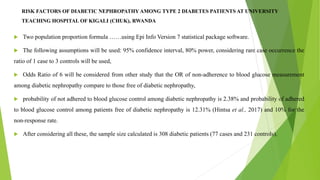
RISK FACTORS OF DIABETIC NEPHROPATHY AMONG TYPE 2 DIABETES PATIENTS AT UNIVERSITY
TEACHING HOSPITAL OF KIGALI (CHUK), RWANDA
 Two population proportion formula ……using Epi Info Version 7 statistical package software.
 The following assumptions will be used: 95% confidence interval, 80% power, considering rare case occurrence the
ratio of 1 case to 3 controls will be used,
 Odds Ratio of 6 will be considered from other study that the OR of non-adherence to blood glucose measurement
among diabetic nephropathy compare to those free of diabetic nephropathy,
 probability of not adhered to blood glucose control among diabetic nephropathy is 2.38% and probability of adhered
to blood glucose control among patients free of diabetic nephropathy is 12.31% (Hintsa et al., 2017) and 10% for the
non-response rate.
 After considering all these, the sample size calculated is 308 diabetic patients (77 cases and 231 controls).
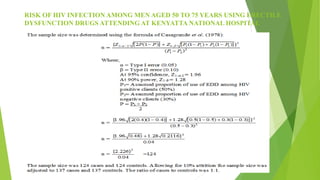
RISK OF HIV INFECTION AMONG MEN AGED 50 TO 75 YEARS USING ERECTILE
DYSFUNCTION DRUGS ATTENDING AT KENYATTA NATIONAL HOSPITAL
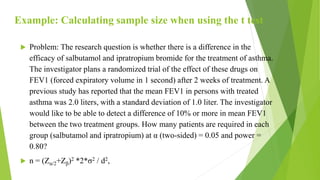
Example: Calculating sample size when using the t test
 Problem: The research question is whether there is a difference in the
efficacy of salbutamol and ipratropium bromide for the treatment of asthma.
The investigator plans a randomized trial of the effect of these drugs on
FEV1 (forced expiratory volume in 1 second) after 2 weeks of treatment. A
previous study has reported that the mean FEV1 in persons with treated
asthma was 2.0 liters, with a standard deviation of 1.0 liter. The investigator
would like to be able to detect a difference of 10% or more in mean FEV1
between the two treatment groups. How many patients are required in each
group (salbutamol and ipratropium) at α (two-sided) = 0.05 and power =
0.80?
 n = (Zα/2+Zβ)2 *2*σ2 / d2,
How to know the power for a specified
sample size using soft wares
 OpenEpi Menu …. EpiInfo
 https://www.stat.ubc.ca/~rollin/stats/ssiz
e/b2.html

MPH CHAPTER 6 Power and sample size.pptx

  • 1.
    CHAPTER SIX: SAMPLESIZE AND POWER ANALYSIS FOR ANALYTIC EPIDEMIOLOGY
  • 2.
    WHAT IS SAMPLE SIZE? Thisis the sub-population to be studied in order to make an inference to a reference population(A broader population to which the findings from a study are to be generalized) In census, the sample size is equal to the population size. However, in research, because of time constraint and budget, a representati ve The larger the study. sampl e sampl e are normally used. size the more accurate the findings from a 4
  • 3.
    Availability of resourcessets the upper limit of the sample size. While the required accuracy sets the lower limit of sample size Therefore, an optimum sample siz e isa n essenti al compone nt ofan y researc h. 5
  • 4.
    WHAT IS SAMPLESIZE DETERMINATION Sample size determination is the mathematical estimation of the number of subjects/units to be included in a study. When a representative sample is taken from a population, the finding are generalized to the population. Optimum sample size determination is required following reasons: forth e 4. To 5. To 6. To allow for appropriate analysis provide the desired level of accuracy allow validity of significance test. 7
  • 5.
    HOW LARGE ASAMPLE DO I NEED? If the sample is too small: 2. Even a well conducted study may fail to answer its research question 3. It 4. It ma y ma y fail to detect important effect or associations associ ate thi s effec t orassociati on imprecise ly 8
  • 6.
    CONVERSELY If the samplesize is too large: 2. The study will be difficult and costly 3. Time constraint 4. Available cases e.g rare disease. 5. Loss of accuracy. Hence, optimum sample size must commencement of a study. b e determin ed befor e 9
  • 7.
    IMPORTANT POINTS Random error Systematic error Type I(a) error Type II(b) error Power (1-b) Effect size (bia s) Precisi on Accura cy (reliability ) (Validity) Null hypothesis Desig n effec t Alternativ e hypothe sis 10
  • 8.
    Random error: errorthat occur by chance. Sources are sample variability, subject to subject differences & measurement errors. It can be reduced by averaging, increase sample size, repeating the experiment. Systematic error: deviations not due to chance alone. Several factors, e.g patient selection criteria may contribute. It can be reduced by good study design and conduct of the experiment. Precision: the degree to which a variable has the same value when measured several times. It is a function of 11
  • 9.
  • 10.
    Null hypothesis: Itstate that there is no difference among groups or no association between the predictor & the outcome variable. This hypothesis need to be tested. Alternative hypothesis: It contradict the null hypothesis. If the alternative hypothesis cannot be tested directly, it is accepted by exclusion if the test of significance rejects the null two hypothesis. There tailed(two- sided) ar e twotype s; on e tail(one- sided) or 13
  • 11.
    Type I(a) error:It occurs if an investigator rejects a null hypothesis that is actually true in the population. The probability of making (a) error is called as level of significance & considered as 0.05(5%). It is specified as in sample size computing. Za is a value from standard Z a normal distribution ≡ a. Sample size is inversely proportional to type I error. Type II(β) error: it occurs if the investigator fails to reject a null hypothesis that is actually false in the population. It specified in terms of Zb in sample size computing. Zb is a is value from standard normal distribution ≡ β 14
  • 12.
    Power(1- β): Thisis the probability that the test will correctly identify a significant difference, effect or association in the sample should one exist in the population. Sample size is directly proportional to the power of the study. The larger the sample size, the study will have greater power to detect significance difference, effect or association. Effect size: is a measure of the strength of the relationship between two variables in a population. It is the magnitude of the effect under the alternative hypothesis. The bigger the siz e ofth e effec t inth e populatio n, th e easi er it will b e tofind . 15
  • 13.
    Design effect: Geographicclustering is generally used to make the study easier & cheaper to perform. The effect on the sample size depends on the number of clusters & the variance between & within the cluster. In practice, this is determined from previous studies and is expressed as a constant called ‘design effect’ often between 1.0 & 2.0. The sample size for simple random samples are multiplied by the design effect to obtain the sample size for the cluster sample. 16
  • 14.
    POWER ANALYSIS When the estimatedsample size can not be included in a study, post-hoc power analysis should be carried out. The probability of correctly rejecting the null hypothesis is equal to 1 – β, which is called power. The power of a test refers to its ability to the power of a test is looking for, given its detect what it is looking for. our probability of finding what we are size. post- hoc power analysis is done after a study has been carried out to help to explain the results if a study which did not find any significant effects. 18
  • 15.
    AT WHAT STAGECAN SAMPLE SIZE ADDRESSED? B E It can be addressed at two stages: 2. Calculate the optimum sample size required during the planning stage, while designing the study, using appropriate approach & information on some parameters. 3. Or through post-hoc power analy sis atth e stag e of interpretati on ofth e result . 19
  • 16.
    APPROACH FOR ESTIMATINGSAMPLE SIZE/POWER ANALYSIS There are many different approaches for calculating the sample size for different study designs. Such as case control design, cohort design, cross sectional studies, clinical trials, diagnostic test studies etc. Within each study design there could be more sub- designs and the sample size calculation will vary accordingly. Therefore, one must use the correct approach for computing sample size appropriate to the study design & its subtype. th e
  • 17.
    PARAMETERS Depending upon theapproach chosen for calculating the sample size, one also as; Hypothesi s Precision Type I error Type II error Power Effect size nee ds tospecif y som e addition al paramet ers suc h 24
  • 18.
    PROCEDURE FOR CALCULATINGSAMPLE SIZE. There are four procedures size: 1. Use of formulae 2. Ready made table 3. Nomograms 4. Computer software tha t coul d b e use d forcalculati ng sampl e 25
  • 19.
    USE OF FORMULAEFOR SAMPLE SIZE CALCULATION & POWER ANALYSIS There are many formulae for calculating sample size & power in different situations for different study designs. The appropriate sample size for population- based study determined largely by 3 factors is 1. The 2. The 3. The estimated prevalence of the desired level of confidence. variabl e ofinteres t. accepta ble margi n of error. 26
  • 20.
    Sample size techniquesfor analytic studies and experiments 1. State the null hypothesis and either a one- or two-sided alternative hypothesis. 2. Select the appropriate statistical test based on the type of predictor variable and outcome variable in those hypotheses. 3. Choose a reasonable effect size (and variability, if necessary). 4. Set α and β. (Specify a two-sided α unless the alternative hypothesis is clearly one-sided.) 5. Use the appropriate table or formula to estimate the sample size.
  • 21.
    Possible outcomes fortests of hypotheses null hypothesis is true & was rejected (type I error) α null hypothesis is false & was rejected (correct conclusion) null hypothesis is true & was accepted (correct conclusion) null hypothesis is false & was accepted (type II error) β H0 is true H0 is false reject H0 accept H0
  • 22.
    Statistical Power  Poweris the probability that the null hypothesis is rejected, if a specific alternative hypothesis is true.  ß represents Type II error, the probability of not rejecting the null hypothesis when the given alternative is true.  1-β = power.  The power of a study should be minimally 80% and often, studies are designed to have 90-95% power to detect a particular clinical effect.
  • 23.
    What factors affectpower?  α , (usually 90% or 95%); Confidence describes the test’s ability to minimize type-I errors (false positives) β , Power: (1 minus type II error): usually 80% or 90%  Probability that you don’t fail to reject no impact, that you find impact  Power describes the test’s ability to minimize type-II errors (false negatives)  As power increases, the chances to say “no impact” when in reality there is positive impact, declines  Power analysis can be used to calculate the minimum sample size required to accept the outcome of a statistical test with a particular level of confidence  effect size,  variability  n
  • 24.
    Calculating sample size Problem: The research question is whether elderly smokers have a greater incidence of skin cancer than non-smokers. Are view of previous literature suggests that the 5-year incidence of skin cancer is about 0.20 in elderly non-smokers. At α (two-sided) = 0.05 and power = 0.80, how many smokers and non-smokers will need to be studied to determine whether the 5-year skin cancer incidence is at least 0.30 in smokers? n = 2 2 1 2 2 2 1 1 1 2 / 1 ) ( } )] 1 ( ) 1 ( [ )] 1 ( 2 [ { P P P P P P Z P P Z          
  • 25.
    RISK FACTORS OFDIABETIC NEPHROPATHY AMONG TYPE 2 DIABETES PATIENTS AT UNIVERSITY TEACHING HOSPITAL OF KIGALI (CHUK), RWANDA  Two population proportion formula ……using Epi Info Version 7 statistical package software.  The following assumptions will be used: 95% confidence interval, 80% power, considering rare case occurrence the ratio of 1 case to 3 controls will be used,  Odds Ratio of 6 will be considered from other study that the OR of non-adherence to blood glucose measurement among diabetic nephropathy compare to those free of diabetic nephropathy,  probability of not adhered to blood glucose control among diabetic nephropathy is 2.38% and probability of adhered to blood glucose control among patients free of diabetic nephropathy is 12.31% (Hintsa et al., 2017) and 10% for the non-response rate.  After considering all these, the sample size calculated is 308 diabetic patients (77 cases and 231 controls).
  • 26.
    RISK OF HIVINFECTION AMONG MEN AGED 50 TO 75 YEARS USING ERECTILE DYSFUNCTION DRUGS ATTENDING AT KENYATTA NATIONAL HOSPITAL
  • 27.
    Example: Calculating samplesize when using the t test  Problem: The research question is whether there is a difference in the efficacy of salbutamol and ipratropium bromide for the treatment of asthma. The investigator plans a randomized trial of the effect of these drugs on FEV1 (forced expiratory volume in 1 second) after 2 weeks of treatment. A previous study has reported that the mean FEV1 in persons with treated asthma was 2.0 liters, with a standard deviation of 1.0 liter. The investigator would like to be able to detect a difference of 10% or more in mean FEV1 between the two treatment groups. How many patients are required in each group (salbutamol and ipratropium) at α (two-sided) = 0.05 and power = 0.80?  n = (Zα/2+Zβ)2 *2*σ2 / d2,
  • 28.
    How to knowthe power for a specified sample size using soft wares  OpenEpi Menu …. EpiInfo  https://www.stat.ubc.ca/~rollin/stats/ssiz e/b2.html