POVERTY
POVERTY IN INDIA
"The biggest enemy of health in the developing
world is poverty."
WHAT IS POVERTY?
• Poverty is hunger.
• Poverty is lack of shelter.
• Poverty is being sick and not being able to see a
doctor.
• Poverty is not having access to school and not
knowing how to read.
• Poverty is not having a job, is fear for the future,
living one day at a time.
• Poverty is losing a child to illness brought about
by unclean water.
• Poverty is powerlessness, lack of representation
and freedom.
• Under Relative poverty the
economic conditions of different
regions or countries is compared.
The capita income and the national
income are the two indicators of
relative poverty. According to the
UNO those countries are treated
poor whose per capita income is
less than US $725 per annum.
• Absolute poverty refers to the
measure of poverty , keeping in
view the per capita intake of
calories and minimum level of
consumption .
• Per capita income :
National income / Population
RELATIVE POVERTY ABSOLUTE
POVERTY
• This method is used by the
government while distributing
food through PDS at the local
level.
• Under this a poverty line is fixed
by the government.
• All the families whose total
income is less than the poverty
line fixed by the government are
considered as BPL.
• Under this the minimum food
requirements for survival is
estimated.
• The food value is converted into
calories.
• The caloric value of food is then
converted into the money value
i.e. in rupees.
• The total equivalent amount is
considered as the poverty line.
MEASUREMENT OF POVERTY :-
EXPENDIURE METHOD INCOME METHOD
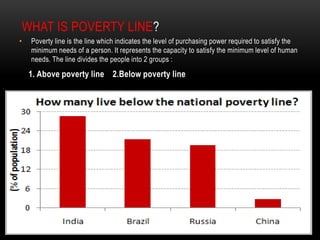
WHAT IS POVERTY LINE?
• Poverty line is the line which indicates the level of purchasing power required to satisfy the
minimum needs of a person. It represents the capacity to satisfy the minimum level of human
needs. The line divides the people into 2 groups :
1. Above poverty line 2.Below poverty line
VULNERABLE GROUP
Poverty and occupation both are co-related. Most of the poor people include agricultural and
casual laborers, the SCs , STs and the physically challenged.
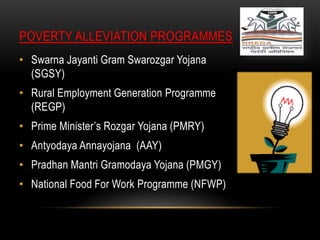
POVERTY ALLEVIATION PROGRAMMES
• Swarna Jayanti Gram Swarozgar Yojana
(SGSY)
• Rural Employment Generation Programme
(REGP)
• Prime Minister’s Rozgar Yojana (PMRY)
• Antyodaya Annayojana (AAY)
• Pradhan Mantri Gramodaya Yojana (PMGY)
• National Food For Work Programme (NFWP)
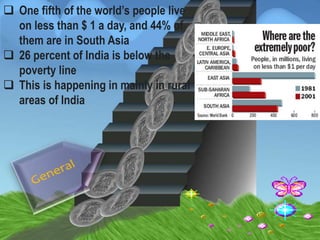
POVERTY IN THE WORLD
 One fifth of the world’s people live
on less than $ 1 a day, and 44% of
them are in South Asia
 26 percent of India is below the
poverty line
 This is happening in mainly in rural
areas of India
FEMALE LITERACY AND INFANT MORTALITY
RATES:-
• Lack of food and health care due to low
income/assets is associated with the higher
probability of a new born child dying between birth
and the age of one
• The High Female illiteracy rate has a major impact
on IMR
• If more women were literate the
• IMR would be much higher
WHY IS THIS HAPPENING?
Even though India’s economy is growing there
wealth distribution is uneven
1/4 of the nation's population earns less than the
government-specified $0.40/day
Unemployment and underemployment
Over-reliance on agriculture
High population growth rate
CULTURAL REASONS :-
• The Caste System(Hindu Religion) prevents people from
educational, ownership, and employment opportunities.
WHAT IS BEING DONE
 Microfinance( very small loans) has helped
India a lot
 There are multiple organization to help feed
them and keep there agriculture going
 The Planning Commission sets up a five year
plan for India to help them achieve goal such
as ending poverty
POSITIVE THINGS HAPPENING IN INDIA:
MIDDLE CLASS
• Currently India adds 40 million people to its middle class
every year
• estimated 300 million Indians now belong to the middle
class
• one-third of them have emerged from poverty in the last
ten years
• It is predicted that by 2025 the Majority of Indians will live
in middle class
FACTS & FIGURES….
• As of 2005, 85.7% of the population lives on less than $2.50 (PPP) a day.
• the Planning Commission of India has estimated that 27.5% of the population
was living below the poverty line in 2004–2005.
• Between 1999 and 2008, the annualized growth rates for Gujarat (8.8%),
Haryana (8.7%), or Delhi (7.4%) were much higher than for Bihar (5.1%), Uttar
Pradesh (4.4%), or Madhya Pradesh (3.5%).Poverty rates in rural Orissa (43%)
and rural Bihar (41%) are higher than in the world's poorest countries such as
Malawi.
• A 2007 report by the state-run National Commission for Enterprises in the
Unorganized Sector (NCEUS) found that 25% of Indians, or 236 million people,
lived on less than 20 rupees per day
STATISTICAL STUDY
THE VIEW BLAMING BRITISH
• The Indian economy was purposely and severely de
industrialized through colonial privatizations, regulations,
tariffs on manufactured or refined Indian goods, taxes,
and direct seizures.
• Not only was Indian industry losing out, but consumers
were forced to rely on expensive British manufactured
goods, especially as barter, local crafts and subsistence
agriculture was discouraged by law.
• British policies in India exacerbated weather conditions to lead to
mass famines which, when taken together, led to between 30 to 60
million deaths from starvation in the Indian colonies.
• Community grain banks were forcibly disabled, land was converted
from food crops for local consumption to cotton, opium, tea, and
grain for export, largely for animal feed.
CAUSES (CONTINUATION) ….
• Unemployment and underemployment, arising in part from protectionist policies
pursued till 1991 that prevented high foreign investment.
• About 60% of the population depends on agriculture whereas the contribution of
agriculture to the GDP is about 18%.
• High population growth rate, although demographers generally agree that this is
a symptom rather than cause of poverty.
• The caste system, under which hundreds of millions of Indians were kept away
from educational, ownership, and employment opportunities, and subjected to
violence for "getting out of line." British rulers encouraged caste privileges and
customs, at least before the 20th century.
General Causes:-
OUTLOOK FOR POVERTY ALLEVIATION
• Poverty alleviation is expected to make better progress in the next 50 years than in
the past, as a trickle-down effect of the growing middle class.
• Increasing stress on education, reservation of seats in government jobs and the
increasing empowerment of women and the economically weaker sections of
society, are also expected to contribute to the alleviation of poverty. It is incorrect to
say that all poverty reduction programmes have failed.
•
• The growth of the middle class indicates that economic prosperity has indeed been
very impressive in India, but the distribution of wealth is not at all even.
• After the liberalization process and moving away from the socialist model, India is
adding 60-70 million people to its middle class every year. At the current rate of
growth, a majority of Indians will be middle-class by 2025.
POVERTY:-
PRESENTED BY :-
Ghanashyam Sekhar
Class 9th
Kendriya Vidyalaya
No-1, Naval Base
Kochi -4

Poverty in World & India

  • 1.
  • 3.
    POVERTY IN INDIA "Thebiggest enemy of health in the developing world is poverty."
  • 4.
    WHAT IS POVERTY? •Poverty is hunger. • Poverty is lack of shelter. • Poverty is being sick and not being able to see a doctor. • Poverty is not having access to school and not knowing how to read. • Poverty is not having a job, is fear for the future, living one day at a time. • Poverty is losing a child to illness brought about by unclean water. • Poverty is powerlessness, lack of representation and freedom.
  • 5.
    • Under Relativepoverty the economic conditions of different regions or countries is compared. The capita income and the national income are the two indicators of relative poverty. According to the UNO those countries are treated poor whose per capita income is less than US $725 per annum. • Absolute poverty refers to the measure of poverty , keeping in view the per capita intake of calories and minimum level of consumption . • Per capita income : National income / Population RELATIVE POVERTY ABSOLUTE POVERTY
  • 6.
    • This methodis used by the government while distributing food through PDS at the local level. • Under this a poverty line is fixed by the government. • All the families whose total income is less than the poverty line fixed by the government are considered as BPL. • Under this the minimum food requirements for survival is estimated. • The food value is converted into calories. • The caloric value of food is then converted into the money value i.e. in rupees. • The total equivalent amount is considered as the poverty line. MEASUREMENT OF POVERTY :- EXPENDIURE METHOD INCOME METHOD
  • 7.
    WHAT IS POVERTYLINE? • Poverty line is the line which indicates the level of purchasing power required to satisfy the minimum needs of a person. It represents the capacity to satisfy the minimum level of human needs. The line divides the people into 2 groups : 1. Above poverty line 2.Below poverty line
  • 8.
    VULNERABLE GROUP Poverty andoccupation both are co-related. Most of the poor people include agricultural and casual laborers, the SCs , STs and the physically challenged.
  • 9.
    POVERTY ALLEVIATION PROGRAMMES •Swarna Jayanti Gram Swarozgar Yojana (SGSY) • Rural Employment Generation Programme (REGP) • Prime Minister’s Rozgar Yojana (PMRY) • Antyodaya Annayojana (AAY) • Pradhan Mantri Gramodaya Yojana (PMGY) • National Food For Work Programme (NFWP)
  • 10.
  • 11.
     One fifthof the world’s people live on less than $ 1 a day, and 44% of them are in South Asia  26 percent of India is below the poverty line  This is happening in mainly in rural areas of India
  • 12.
    FEMALE LITERACY ANDINFANT MORTALITY RATES:- • Lack of food and health care due to low income/assets is associated with the higher probability of a new born child dying between birth and the age of one • The High Female illiteracy rate has a major impact on IMR • If more women were literate the • IMR would be much higher
  • 13.
    WHY IS THISHAPPENING? Even though India’s economy is growing there wealth distribution is uneven 1/4 of the nation's population earns less than the government-specified $0.40/day Unemployment and underemployment Over-reliance on agriculture High population growth rate
  • 14.
    CULTURAL REASONS :- •The Caste System(Hindu Religion) prevents people from educational, ownership, and employment opportunities.
  • 15.
    WHAT IS BEINGDONE  Microfinance( very small loans) has helped India a lot  There are multiple organization to help feed them and keep there agriculture going  The Planning Commission sets up a five year plan for India to help them achieve goal such as ending poverty
  • 16.
    POSITIVE THINGS HAPPENINGIN INDIA: MIDDLE CLASS • Currently India adds 40 million people to its middle class every year • estimated 300 million Indians now belong to the middle class • one-third of them have emerged from poverty in the last ten years • It is predicted that by 2025 the Majority of Indians will live in middle class
  • 17.
    FACTS & FIGURES…. •As of 2005, 85.7% of the population lives on less than $2.50 (PPP) a day. • the Planning Commission of India has estimated that 27.5% of the population was living below the poverty line in 2004–2005. • Between 1999 and 2008, the annualized growth rates for Gujarat (8.8%), Haryana (8.7%), or Delhi (7.4%) were much higher than for Bihar (5.1%), Uttar Pradesh (4.4%), or Madhya Pradesh (3.5%).Poverty rates in rural Orissa (43%) and rural Bihar (41%) are higher than in the world's poorest countries such as Malawi. • A 2007 report by the state-run National Commission for Enterprises in the Unorganized Sector (NCEUS) found that 25% of Indians, or 236 million people, lived on less than 20 rupees per day
  • 18.
  • 20.
    THE VIEW BLAMINGBRITISH • The Indian economy was purposely and severely de industrialized through colonial privatizations, regulations, tariffs on manufactured or refined Indian goods, taxes, and direct seizures. • Not only was Indian industry losing out, but consumers were forced to rely on expensive British manufactured goods, especially as barter, local crafts and subsistence agriculture was discouraged by law.
  • 21.
    • British policiesin India exacerbated weather conditions to lead to mass famines which, when taken together, led to between 30 to 60 million deaths from starvation in the Indian colonies. • Community grain banks were forcibly disabled, land was converted from food crops for local consumption to cotton, opium, tea, and grain for export, largely for animal feed.
  • 22.
    CAUSES (CONTINUATION) …. •Unemployment and underemployment, arising in part from protectionist policies pursued till 1991 that prevented high foreign investment. • About 60% of the population depends on agriculture whereas the contribution of agriculture to the GDP is about 18%. • High population growth rate, although demographers generally agree that this is a symptom rather than cause of poverty. • The caste system, under which hundreds of millions of Indians were kept away from educational, ownership, and employment opportunities, and subjected to violence for "getting out of line." British rulers encouraged caste privileges and customs, at least before the 20th century. General Causes:-
  • 23.
    OUTLOOK FOR POVERTYALLEVIATION • Poverty alleviation is expected to make better progress in the next 50 years than in the past, as a trickle-down effect of the growing middle class. • Increasing stress on education, reservation of seats in government jobs and the increasing empowerment of women and the economically weaker sections of society, are also expected to contribute to the alleviation of poverty. It is incorrect to say that all poverty reduction programmes have failed. • • The growth of the middle class indicates that economic prosperity has indeed been very impressive in India, but the distribution of wealth is not at all even. • After the liberalization process and moving away from the socialist model, India is adding 60-70 million people to its middle class every year. At the current rate of growth, a majority of Indians will be middle-class by 2025.
  • 24.
  • 26.
    PRESENTED BY :- GhanashyamSekhar Class 9th Kendriya Vidyalaya No-1, Naval Base Kochi -4