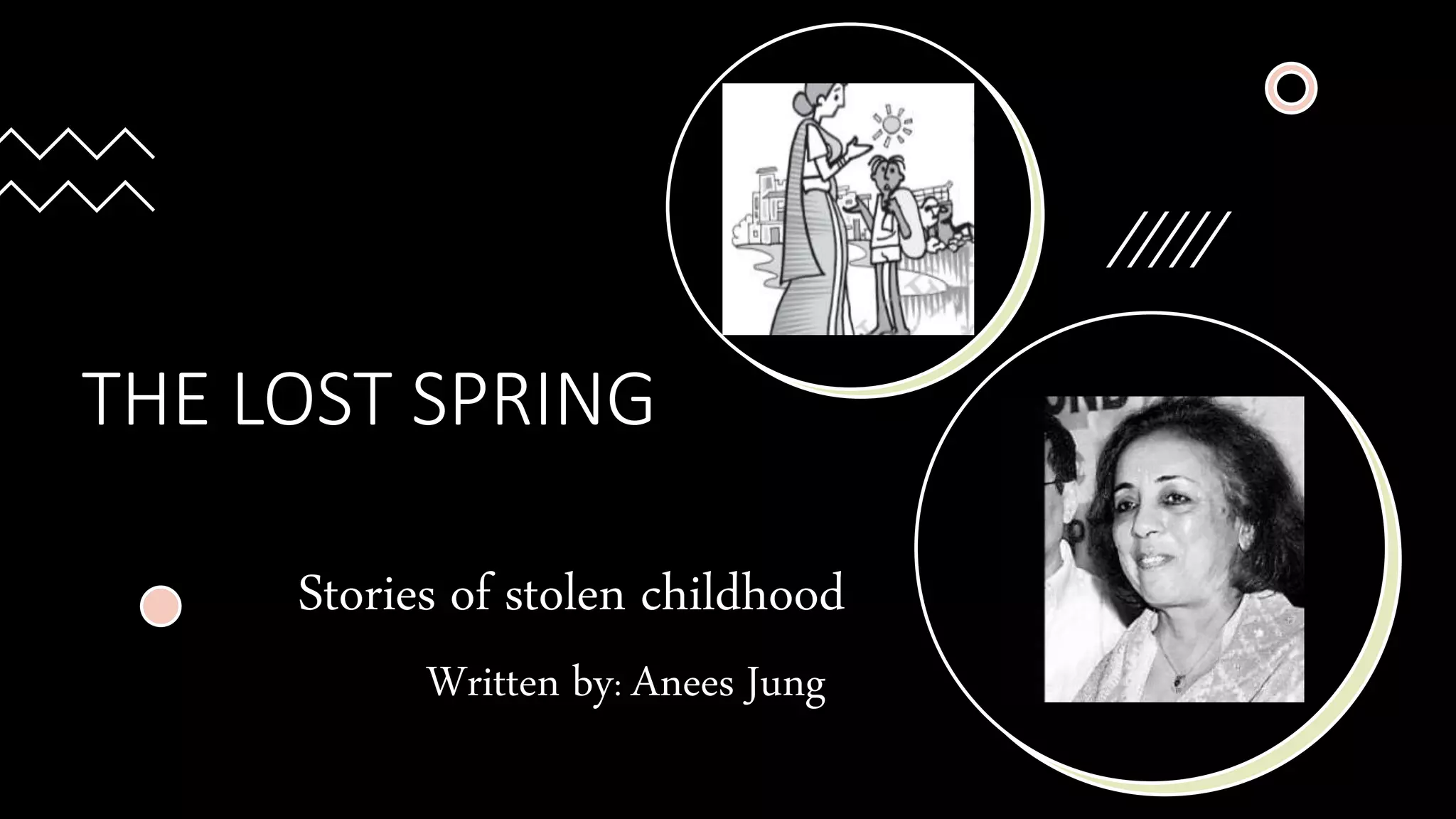
THE LOST SPRING
Stories of stolen childhood
Written by: Anees Jung
ABOUT THE
WRITTER
• Anees Jung is an Indian
woman author, journalist and
columnist for major
newspapers in India and
abroad, whose most noted
work, Unveiling India (1987)
was a detailed chronicle of
the lives of women in India,
noted especially for the
depiction of Muslim women
behind the purdah.
EARLY LIFE AND
EDUCATION
CAREER
Summary
of Lost
Spring
WHO IS SAHEB-E-ALAM IN THE STORY
Saheb-e-Alam was a rag-picker who lived in Seemapuri. His
family had migrated from Dhaka, Bangladesh to India in 1971
with the hope of finding better life conditions. Every morning
he roamed about streets collecting garbage. Many other
boys also accompanied him. His family lived in miserable
conditions. He could not afford to go to school. He did not
have even a pair of slippers to wear. He wished to play lawn
tennis which was beyond his reach. He also found a job at a
tea-stall where he ran various errands for the tea-stall owner.
Though he earned rupees eight hundred monthly along with
meals every day, yet he was not happy working there. His
rag-picking bag was lighter than the canister.He was his own
master; but now he had to work under someone.
CHILD
LABOUR
Child labour or child labor refers to the
exploitation of children through any
form of work that deprives children of
their childhood, interferes with their
ability to attend regular school, and is
mentally, physically, socially and
morally harmful. Such exploitation is
prohibited by legislation worldwide,
although these laws do not consider all
work by children as child labour;
exceptions include work by child
artists, family duties, supervised
training, and some forms of child work
practiced by Amish children, as well as
by indigenous children in the Americas.
Child labour has existed to varying
extents throughout history. During
the 19th and early 20th centuries,
many children aged 5–14 from
poorer families worked in Western
nations and their colonies alike.
These children mainly worked in
agriculture, home-based assembly
operations, factories, mining, and
services such as news boys—some
worked night shifts lasting 12 hours.
With the rise of household income,
availability of schools and passage of
child labour laws, the incidence rates
of child labour fell.
In the world's poorest countries, around
one in four children are engaged in child
labour, the highest number of whom (29
percent) live in sub-saharan Africa. In 2017,
four African nations (Mali, Benin, Chad and
Guinea-Bissau) witnessed over 50 percent
of children aged 5–14 working. Worldwide
agriculture is the largest employer of child
labour. The vast majority of child labour is
found in rural settings and informal urban
economies; children are predominantly
employed by their parents, rather than
factories. Poverty and lack of schools are
considered the primary cause of child
labour.
Globally the incidence of child labour
decreased from 25% to 10% between
1960 and 2003, according to the
World Bank. Nevertheless, the total
number of child labourers remains
high, with UNICEF and ILO
acknowledging an estimated 168
million children aged 5–17 worldwide
were involved in child labour in 2013.
CAUSES
International Labour Organization
(ILO) suggests poverty is the
greatest single cause behind child
labour.[15] For impoverished
households, income from a child's
work is usually crucial for his or her
own survival or for that of the
household. Income from working
children, even if small, may be
between 25 and 40% of the
household income. Other scholars
such as Harsch on African child
labour, and Edmonds and Pavcnik
on global child labour have reached
the same conclusion.
Lack of meaningful alternatives, such as
affordable schools and quality
education, according to ILO,[15] is
another major factor driving children to
harmful labour. Children work because
they have nothing better to do. Many
communities, particularly rural areas
where between 60–70% of child labour
is prevalent, do not possess adequate
school facilities. Even when schools are
sometimes available, they are too far
away, difficult to reach, unaffordable or
the quality of education is so poor that
parents wonder if going to school is
really worth it
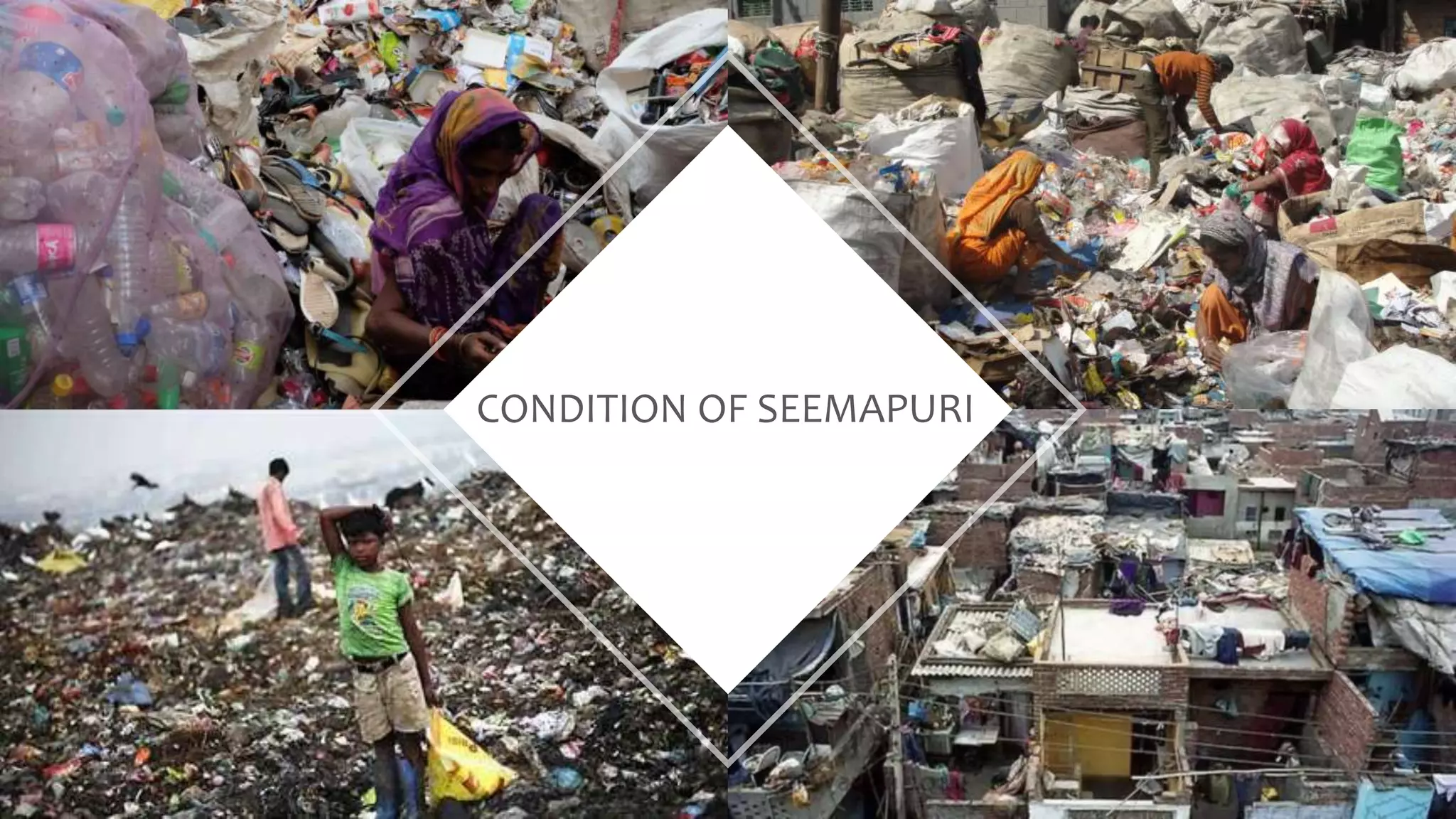
CONDITION OF SEEMAPURI
• Seemapuri is situated on the periphery of Delhi.
About ten thousand ragpickers live here in
structures of mud, with roofs of tin and tarpaulin.
They do not have sewage, drainage or running
water. Children grow up in these small structures
and help their parents in their survival. Rag-
picking is the only way for survival in Seemapuri.
Garbage to them is gold. People here live in utter
poverty. They are devoid of even the basic
amenities of life. Health, education, sports etc. are
not even in their dreams. Their poverty doesn’t
allow them to live a hygienic and healthy life. They
cannot even think of a good life and keep
engaged in ragpicking or some type of menial
jobs. Even small children work as ragpickers in the
midst of danger of a number of diseases.
THANK YOU
DONE BY: KARTHIK KRISHNADAS
The Lost Spring English Class 12

The Lost Spring English Class 12

  • 1.
    THE LOST SPRING Storiesof stolen childhood Written by: Anees Jung
  • 2.
    ABOUT THE WRITTER • AneesJung is an Indian woman author, journalist and columnist for major newspapers in India and abroad, whose most noted work, Unveiling India (1987) was a detailed chronicle of the lives of women in India, noted especially for the depiction of Muslim women behind the purdah.
  • 3.
  • 4.
  • 5.
  • 6.
    WHO IS SAHEB-E-ALAMIN THE STORY Saheb-e-Alam was a rag-picker who lived in Seemapuri. His family had migrated from Dhaka, Bangladesh to India in 1971 with the hope of finding better life conditions. Every morning he roamed about streets collecting garbage. Many other boys also accompanied him. His family lived in miserable conditions. He could not afford to go to school. He did not have even a pair of slippers to wear. He wished to play lawn tennis which was beyond his reach. He also found a job at a tea-stall where he ran various errands for the tea-stall owner. Though he earned rupees eight hundred monthly along with meals every day, yet he was not happy working there. His rag-picking bag was lighter than the canister.He was his own master; but now he had to work under someone.
  • 7.
    CHILD LABOUR Child labour orchild labor refers to the exploitation of children through any form of work that deprives children of their childhood, interferes with their ability to attend regular school, and is mentally, physically, socially and morally harmful. Such exploitation is prohibited by legislation worldwide, although these laws do not consider all work by children as child labour; exceptions include work by child artists, family duties, supervised training, and some forms of child work practiced by Amish children, as well as by indigenous children in the Americas.
  • 8.
    Child labour hasexisted to varying extents throughout history. During the 19th and early 20th centuries, many children aged 5–14 from poorer families worked in Western nations and their colonies alike. These children mainly worked in agriculture, home-based assembly operations, factories, mining, and services such as news boys—some worked night shifts lasting 12 hours. With the rise of household income, availability of schools and passage of child labour laws, the incidence rates of child labour fell.
  • 9.
    In the world'spoorest countries, around one in four children are engaged in child labour, the highest number of whom (29 percent) live in sub-saharan Africa. In 2017, four African nations (Mali, Benin, Chad and Guinea-Bissau) witnessed over 50 percent of children aged 5–14 working. Worldwide agriculture is the largest employer of child labour. The vast majority of child labour is found in rural settings and informal urban economies; children are predominantly employed by their parents, rather than factories. Poverty and lack of schools are considered the primary cause of child labour.
  • 10.
    Globally the incidenceof child labour decreased from 25% to 10% between 1960 and 2003, according to the World Bank. Nevertheless, the total number of child labourers remains high, with UNICEF and ILO acknowledging an estimated 168 million children aged 5–17 worldwide were involved in child labour in 2013.
  • 11.
    CAUSES International Labour Organization (ILO)suggests poverty is the greatest single cause behind child labour.[15] For impoverished households, income from a child's work is usually crucial for his or her own survival or for that of the household. Income from working children, even if small, may be between 25 and 40% of the household income. Other scholars such as Harsch on African child labour, and Edmonds and Pavcnik on global child labour have reached the same conclusion.
  • 12.
    Lack of meaningfulalternatives, such as affordable schools and quality education, according to ILO,[15] is another major factor driving children to harmful labour. Children work because they have nothing better to do. Many communities, particularly rural areas where between 60–70% of child labour is prevalent, do not possess adequate school facilities. Even when schools are sometimes available, they are too far away, difficult to reach, unaffordable or the quality of education is so poor that parents wonder if going to school is really worth it
  • 13.
  • 14.
    • Seemapuri issituated on the periphery of Delhi. About ten thousand ragpickers live here in structures of mud, with roofs of tin and tarpaulin. They do not have sewage, drainage or running water. Children grow up in these small structures and help their parents in their survival. Rag- picking is the only way for survival in Seemapuri. Garbage to them is gold. People here live in utter poverty. They are devoid of even the basic amenities of life. Health, education, sports etc. are not even in their dreams. Their poverty doesn’t allow them to live a hygienic and healthy life. They cannot even think of a good life and keep engaged in ragpicking or some type of menial jobs. Even small children work as ragpickers in the midst of danger of a number of diseases.
  • 15.
    THANK YOU DONE BY:KARTHIK KRISHNADAS