
“Poverty is the worst form of violence”
- M.K Gandhi
 Poverty is a situation where a section of
people are unable to afford minimum basic
needs of life.
 The basic needs of life include food, cloth and
shelter and in today’s world Education and
Health facilities are also important.
 One of the greatest challenge to mankind is
Poverty.
 Poverty is a wide spread evil in the world and
particularly in Asian and African countries.
WHAT IS POVERTY?
 The World Bank estimated 1.29 billion people were
living in absolute poverty in 2008.
 About 400 million people in absolute poverty lived in
India and 173 million people in China. In terms of
percentage of regional population sub-saharan Africa
topped the list with 47% of absolute poverty in 2008.
 UNICEF estimates half the world's children ( 1.1
billion ) live in poverty.
 Between 1990 and 2010, about 663 million people
moved above the absolute poverty level.
ABSOLUTE POVERTYLINE BY THE WORLD BANK
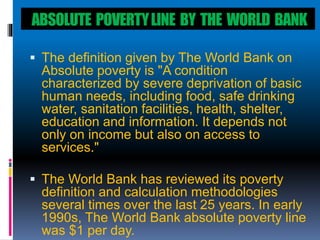
 The definition given by The World Bank on
Absolute poverty is "A condition
characterized by severe deprivation of basic
human needs, including food, safe drinking
water, sanitation facilities, health, shelter,
education and information. It depends not
only on income but also on access to
services."
 The World Bank has reviewed its poverty
definition and calculation methodologies
several times over the last 25 years. In early
1990s, The World Bank absolute poverty line
was $1 per day.
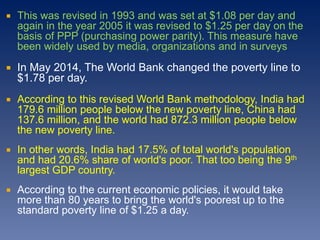
 This was revised in 1993 and was set at $1.08 per day and
again in the year 2005 it was revised to $1.25 per day on the
basis of PPP (purchasing power parity). This measure have
been widely used by media, organizations and in surveys
 In May 2014, The World Bank changed the poverty line to
$1.78 per day.
 According to this revised World Bank methodology, India had
179.6 million people below the new poverty line, China had
137.6 million, and the world had 872.3 million people below
the new poverty line.
 In other words, India had 17.5% of total world's population
and had 20.6% share of world's poor. That too being the 9th
largest GDP country.
 According to the current economic policies, it would take
more than 80 years to bring the world's poorest up to the
standard poverty line of $1.25 a day.
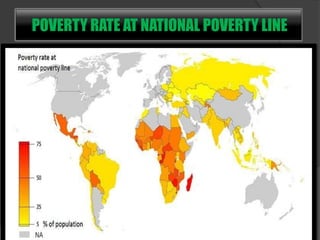
POVERTY RATE AT NATIONAL POVERTY LINE
Here are some shocking facts about Poverty that
will surely surprise you:
 About 22,000 children die each day due to conditions
of poverty.
 Approximately 1.2 billion people — nearly as many as
the entire population of India , still live without access
to electricity.
 Combining results from 27 Sub-Saharan African
countries, 54% of residents are living in extreme
poverty — the highest proportion among global
 About 75% of the world's poor people live in rural areas,
depending on agriculture for their livelihood.
 Sub-Saharan Africa accounts for more than one-third of
the world's extreme poor.
 Israel has the highest poverty rate in the developed world,
about 20.9%, according to a study by the Organization for
Economic Cooperation and Development.
 Even though there is enough food produced worldwide to
provide everyone with an adequate diet, nearly 854 million
people, or 1 in 7, still go hungry.
 Around 1 in 8 people in the world, about 842 million
people, were estimated to be suffering from chronic
hunger between 2011-13.
 About 2.8 billion people still rely on wood, crop waste,
dung and other biomass to cook and to heat their
homes.
 China has achieved more than any other nation in
energy efficiency, the country still faces energy
poverty challenges. Almost 612.8 million people lack
clean fuel for cooking and heating in China.
 More than 6.9 million children died under the age of
five in 2011 — that's about 800 every hour.
 A child born in the world's poorest nations has a 1 in 6
chance of dying before their fifth birthday. In high-
 The richest 85 people in the world control as much
wealth as the poorest half of the world.
 The world's 100 richest people earned enough
money in 2012 to end extreme world poverty four
times over, according to a report by Oxfam.
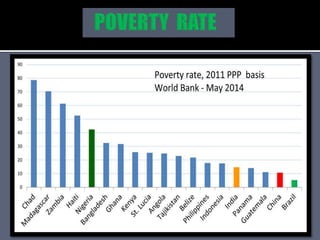
 The top five poorest countries in the world are
India (with 23% of the world's poor), China (13%),
Nigeria (7%), Bangladesh (6%) and the
Democratic Republic of Congo (5%). Adding
another five countries — Indonesia, Pakistan,
Tanzania, Ethiopia and Kenya — would include
 At least 80% of humanity lives on less than $10
per day.
 Over 1 billion people have inadequate access to
water and 2.6 billion lack basic sanitation. Many
times this means no separation of drinking water
and toilet water. That is why 1.8 million children
die every year of diarrhoea.
 With new technologies we now grow enough food
to feed 10 billion people or 1.5 times the world
population. The problem is that most of the world
can't afford to buy that food.
 The top 20% of the world's population accounts
for 75% of the world's income.
 But poverty is not just an issue in the developing
world. There are 16.4 million children living in
poverty in the United States.
 14% of the world population own over 80% of
the world's private financial wealth.
 The 7 richest people in the world make more
than the poorest 41 countries combined
(roughly 567 million people.)
 In 1998 $8 billion dollars was spent on
cosmetics in the United States, $11 billion was
spent on ice cream in the European Union, $17
billion was spent on pet food in Europe and the
US, $100 billion was spent on alcohol in
Europe. In the same year $6 billion was spent
on achieving basic education for all, $9 billion
was spent on basic water and sanitation for all,
and $13 billion was spent on basic health and
nutrition for all.
 If the world spent 10% of what it spends on
defence most of the previously mentioned
issues would be fixed. Currently world spend
Poverty and shocking facts about poverty

Poverty and shocking facts about poverty

  • 1.
    “Poverty is theworst form of violence” - M.K Gandhi
  • 2.
     Poverty isa situation where a section of people are unable to afford minimum basic needs of life.  The basic needs of life include food, cloth and shelter and in today’s world Education and Health facilities are also important.  One of the greatest challenge to mankind is Poverty.  Poverty is a wide spread evil in the world and particularly in Asian and African countries. WHAT IS POVERTY?
  • 3.
     The WorldBank estimated 1.29 billion people were living in absolute poverty in 2008.  About 400 million people in absolute poverty lived in India and 173 million people in China. In terms of percentage of regional population sub-saharan Africa topped the list with 47% of absolute poverty in 2008.  UNICEF estimates half the world's children ( 1.1 billion ) live in poverty.  Between 1990 and 2010, about 663 million people moved above the absolute poverty level.
  • 4.
    ABSOLUTE POVERTYLINE BYTHE WORLD BANK  The definition given by The World Bank on Absolute poverty is "A condition characterized by severe deprivation of basic human needs, including food, safe drinking water, sanitation facilities, health, shelter, education and information. It depends not only on income but also on access to services."  The World Bank has reviewed its poverty definition and calculation methodologies several times over the last 25 years. In early 1990s, The World Bank absolute poverty line was $1 per day.
  • 5.
     This wasrevised in 1993 and was set at $1.08 per day and again in the year 2005 it was revised to $1.25 per day on the basis of PPP (purchasing power parity). This measure have been widely used by media, organizations and in surveys  In May 2014, The World Bank changed the poverty line to $1.78 per day.  According to this revised World Bank methodology, India had 179.6 million people below the new poverty line, China had 137.6 million, and the world had 872.3 million people below the new poverty line.  In other words, India had 17.5% of total world's population and had 20.6% share of world's poor. That too being the 9th largest GDP country.  According to the current economic policies, it would take more than 80 years to bring the world's poorest up to the standard poverty line of $1.25 a day.
  • 7.
    POVERTY RATE ATNATIONAL POVERTY LINE
  • 8.
    Here are someshocking facts about Poverty that will surely surprise you:  About 22,000 children die each day due to conditions of poverty.  Approximately 1.2 billion people — nearly as many as the entire population of India , still live without access to electricity.  Combining results from 27 Sub-Saharan African countries, 54% of residents are living in extreme poverty — the highest proportion among global
  • 9.
     About 75%of the world's poor people live in rural areas, depending on agriculture for their livelihood.  Sub-Saharan Africa accounts for more than one-third of the world's extreme poor.  Israel has the highest poverty rate in the developed world, about 20.9%, according to a study by the Organization for Economic Cooperation and Development.  Even though there is enough food produced worldwide to provide everyone with an adequate diet, nearly 854 million people, or 1 in 7, still go hungry.  Around 1 in 8 people in the world, about 842 million people, were estimated to be suffering from chronic hunger between 2011-13.
  • 10.
     About 2.8billion people still rely on wood, crop waste, dung and other biomass to cook and to heat their homes.  China has achieved more than any other nation in energy efficiency, the country still faces energy poverty challenges. Almost 612.8 million people lack clean fuel for cooking and heating in China.  More than 6.9 million children died under the age of five in 2011 — that's about 800 every hour.  A child born in the world's poorest nations has a 1 in 6 chance of dying before their fifth birthday. In high-
  • 11.
     The richest85 people in the world control as much wealth as the poorest half of the world.  The world's 100 richest people earned enough money in 2012 to end extreme world poverty four times over, according to a report by Oxfam.  The top five poorest countries in the world are India (with 23% of the world's poor), China (13%), Nigeria (7%), Bangladesh (6%) and the Democratic Republic of Congo (5%). Adding another five countries — Indonesia, Pakistan, Tanzania, Ethiopia and Kenya — would include
  • 12.
     At least80% of humanity lives on less than $10 per day.  Over 1 billion people have inadequate access to water and 2.6 billion lack basic sanitation. Many times this means no separation of drinking water and toilet water. That is why 1.8 million children die every year of diarrhoea.  With new technologies we now grow enough food to feed 10 billion people or 1.5 times the world population. The problem is that most of the world can't afford to buy that food.
  • 13.
     The top20% of the world's population accounts for 75% of the world's income.  But poverty is not just an issue in the developing world. There are 16.4 million children living in poverty in the United States.  14% of the world population own over 80% of the world's private financial wealth.  The 7 richest people in the world make more than the poorest 41 countries combined (roughly 567 million people.)
  • 14.
     In 1998$8 billion dollars was spent on cosmetics in the United States, $11 billion was spent on ice cream in the European Union, $17 billion was spent on pet food in Europe and the US, $100 billion was spent on alcohol in Europe. In the same year $6 billion was spent on achieving basic education for all, $9 billion was spent on basic water and sanitation for all, and $13 billion was spent on basic health and nutrition for all.  If the world spent 10% of what it spends on defence most of the previously mentioned issues would be fixed. Currently world spend