POVERTY AROUND THE
WORLD
Group Members:
 Hussnain Ali
 Obaid Ullah
 Hamza Raja
 M.Kamran Rasheed
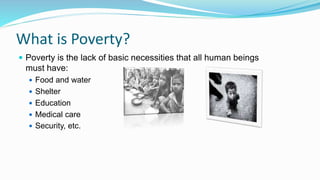
What is Poverty?
 Poverty is the lack of basic necessities that all human beings
must have:
 Food and water
 Shelter
 Education
 Medical care
 Security, etc.
CONT.
 A multi-dimensional issue, poverty exceeds all social, economic, and political
boundaries.
 In 1997 the richest fifth of the world’s population had 74 times the income of the
poorest fifth.
 According to these estimates, 21 percent of people in the developing world
lived at or below $1.25 a day.
People who earn their living by collecting and sorting
garbage and selling them for recycling, Manila, Philippines
Type Of poverty
 Absolute poverty.
Lack of basic Human needs, like clean Water, Nutrition,
Health Care, Education, Clothing and Shelter
 Relative poverty
The Condition of having fewer resources or lesser
income as compared to others within a society or a
country or as compared to worldwide averages
Percentage of people living below
the poverty line
 Europe and Central Asia
3.5%
 Latin America and Caribbean
23.5%
 Sub-Saharan Africa
38.5%
 Middle East and North Africa
4.1%
 South Asia
43.1%
Causes & Effects:
 Unfair trade agreements.
 Lack of technology.
 Lack of investment.
 Rapidly changing prices for their goods.
 Lack of Better Transport.
 Companies look for low-cost countries to invest in. This can mean
that, though there are jobs, they are low-paid.
WAR:
 When a country is at war
(including civil war) basic services like
education are disrupted.
People leave their homes as refugees.
Crops are destroyed.
Unemployment:
 Unemployment leads to financial crisis and reduces the overall
purchasing capacity of a nation. This in turn results in poverty followed by
increasing burden of debt.
 Lack of employment opportunities and the consequential income
disparity bring about mass poverty in most of the developing and under
developed economies of the world.
WORLD POPULATION:
CONT.
 Poverty increases the risk of homelessness.
 There are over 100 million street children worldwide.
Street child in
Bangladesh
Illiteracy:
 Lack Of education
leads to inequality
Problems & Solution:
 Terrorism
 Homelessness
CONT.
Diseases:
Poverty Solutions
 Employment Generation
 Transparency in Government Spending
Zakat
Universal Declaration of Human
Rights
 Everyone has the right to a standard of living adequate for the health and well-
being of him/(her)self and his/(her) family,
 Including:
 food
 clothing
 Housing
 Medical care and necessary social services
 Everyone has the right to education.
Thank You. 

Poverty

  • 1.
  • 2.
    Group Members:  HussnainAli  Obaid Ullah  Hamza Raja  M.Kamran Rasheed
  • 3.
    What is Poverty? Poverty is the lack of basic necessities that all human beings must have:  Food and water  Shelter  Education  Medical care  Security, etc.
  • 4.
    CONT.  A multi-dimensionalissue, poverty exceeds all social, economic, and political boundaries.  In 1997 the richest fifth of the world’s population had 74 times the income of the poorest fifth.  According to these estimates, 21 percent of people in the developing world lived at or below $1.25 a day.
  • 5.
    People who earntheir living by collecting and sorting garbage and selling them for recycling, Manila, Philippines
  • 6.
    Type Of poverty Absolute poverty. Lack of basic Human needs, like clean Water, Nutrition, Health Care, Education, Clothing and Shelter  Relative poverty The Condition of having fewer resources or lesser income as compared to others within a society or a country or as compared to worldwide averages
  • 7.
    Percentage of peopleliving below the poverty line  Europe and Central Asia 3.5%  Latin America and Caribbean 23.5%  Sub-Saharan Africa 38.5%  Middle East and North Africa 4.1%  South Asia 43.1%
  • 8.
    Causes & Effects: Unfair trade agreements.  Lack of technology.  Lack of investment.  Rapidly changing prices for their goods.  Lack of Better Transport.  Companies look for low-cost countries to invest in. This can mean that, though there are jobs, they are low-paid.
  • 9.
    WAR:  When acountry is at war (including civil war) basic services like education are disrupted. People leave their homes as refugees. Crops are destroyed.
  • 10.
    Unemployment:  Unemployment leadsto financial crisis and reduces the overall purchasing capacity of a nation. This in turn results in poverty followed by increasing burden of debt.  Lack of employment opportunities and the consequential income disparity bring about mass poverty in most of the developing and under developed economies of the world.
  • 11.
  • 12.
    CONT.  Poverty increasesthe risk of homelessness.  There are over 100 million street children worldwide. Street child in Bangladesh
  • 13.
    Illiteracy:  Lack Ofeducation leads to inequality
  • 14.
    Problems & Solution: Terrorism  Homelessness
  • 15.
  • 16.
  • 17.
    Poverty Solutions  EmploymentGeneration  Transparency in Government Spending Zakat
  • 18.
    Universal Declaration ofHuman Rights  Everyone has the right to a standard of living adequate for the health and well- being of him/(her)self and his/(her) family,  Including:  food  clothing  Housing  Medical care and necessary social services  Everyone has the right to education.
  • 19.

Editor's Notes

  • #2 NOTE: Want a different image on this slide? Select the picture and delete it. Now click the Pictures icon in the placeholder to insert your own image.