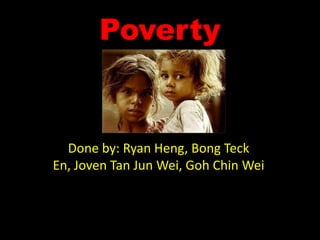
Poverty
Done by: Ryan Heng, Bong Teck
En, Joven Tan Jun Wei, Goh Chin Wei
What is poverty?
Poverty is the state of one who lacks a certain
amount of material possessions or money.
Absolute Poverty or destitution refers to the
deprivation of basic human needs , which
commonly includes food, water , sanitation,
clothing, shelter, health care and education.
Poverty
• Poverty is the inability of getting choices and
opportunities, a violation of human dignity
which also means lack of basic capacity to
participate effectively in society.
• Not having enough to feed and clothe a
family, not having a school or clinic to go
to, not having the land on which to grow one’s
food or a job to earn one’s living, not having
access to credit.
Poverty
• It means insecurity, powerlessness and
exclusion of individuals, households and
communities which also means
insecurity, powerlessness and exclusion of
individuals, households and communities.
Extreme Poverty
• The dollar a day poverty line measured
absolute poverty by the standards of the
world’s poorest countries. The World Bank
defined the new international poverty line as
$1.25 a day for 2005 but have recently been
updated to be $1.25 and $2.50 per day.
Effects of Poverty
• Each year many children and adults die as a
result of a lack of access to clean drinking
water and poor sanitation. Many combinable
diseases and many of the poverty related
diseases spread as a result of inadequate
access to clean drinking water. According to
UNICEF 3,000 children die every
day, worldwide due to contaminated drinking
water and poor sanitation.
Effects Of Poverty
• Contaminated water and inadequate sanitation
are related to diseases of poverty such as
malaria, parasitic diseases, and schistosomiasis.
• These infections act as cofactors that increase
the risk of HIV transmission.
• One of the reasons that water-related diseases
are still occurring because water supplies can be
contacted by contaminated surface water.
Poor Nutrition due to Poverty
• Malnutrition disproportionately affect those in
sub-Saharan Africa. Over 35% of children under
the age of 5 in sub-Saharan Africa show physical
signs of malnutrition.
• Malnutrition, the immune system, and infectious
diseases operate in a cyclical manner: infectious
diseases have deleterious effects on nutritional
status, and nutritional deficiencies can lower the
strength of the immune system which affects the
body’s ability to resist infections.

Poverty

  • 1.
    Poverty Done by: RyanHeng, Bong Teck En, Joven Tan Jun Wei, Goh Chin Wei
  • 2.
    What is poverty? Povertyis the state of one who lacks a certain amount of material possessions or money. Absolute Poverty or destitution refers to the deprivation of basic human needs , which commonly includes food, water , sanitation, clothing, shelter, health care and education.
  • 3.
    Poverty • Poverty isthe inability of getting choices and opportunities, a violation of human dignity which also means lack of basic capacity to participate effectively in society. • Not having enough to feed and clothe a family, not having a school or clinic to go to, not having the land on which to grow one’s food or a job to earn one’s living, not having access to credit.
  • 4.
    Poverty • It meansinsecurity, powerlessness and exclusion of individuals, households and communities which also means insecurity, powerlessness and exclusion of individuals, households and communities.
  • 5.
    Extreme Poverty • Thedollar a day poverty line measured absolute poverty by the standards of the world’s poorest countries. The World Bank defined the new international poverty line as $1.25 a day for 2005 but have recently been updated to be $1.25 and $2.50 per day.
  • 6.
    Effects of Poverty •Each year many children and adults die as a result of a lack of access to clean drinking water and poor sanitation. Many combinable diseases and many of the poverty related diseases spread as a result of inadequate access to clean drinking water. According to UNICEF 3,000 children die every day, worldwide due to contaminated drinking water and poor sanitation.
  • 7.
    Effects Of Poverty •Contaminated water and inadequate sanitation are related to diseases of poverty such as malaria, parasitic diseases, and schistosomiasis. • These infections act as cofactors that increase the risk of HIV transmission. • One of the reasons that water-related diseases are still occurring because water supplies can be contacted by contaminated surface water.
  • 8.
    Poor Nutrition dueto Poverty • Malnutrition disproportionately affect those in sub-Saharan Africa. Over 35% of children under the age of 5 in sub-Saharan Africa show physical signs of malnutrition. • Malnutrition, the immune system, and infectious diseases operate in a cyclical manner: infectious diseases have deleterious effects on nutritional status, and nutritional deficiencies can lower the strength of the immune system which affects the body’s ability to resist infections.