Poverty
Done by: Bong chicken, goh chin wei
Ryan Heng and Joven tan jun wei
Poverty
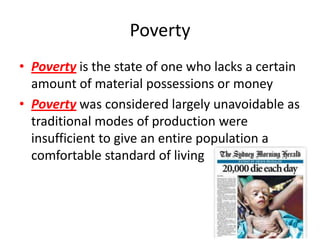
• Poverty is the state of one who lacks a certain
amount of material possessions or money
• Poverty was considered largely unavoidable as
traditional modes of production were
insufficient to give an entire population a
comfortable standard of living
Poverty
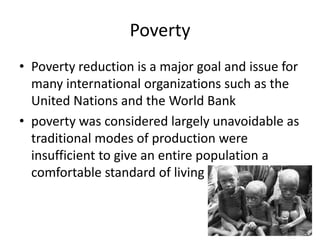
• Poverty reduction is a major goal and issue for
many international organizations such as the
United Nations and the World Bank
• poverty was considered largely unavoidable as
traditional modes of production were
insufficient to give an entire population a
comfortable standard of living
Extreme Poverty
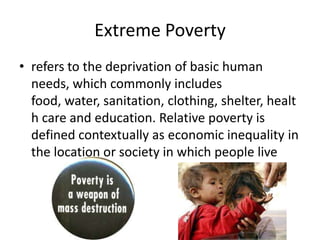
• refers to the deprivation of basic human
needs, which commonly includes
food, water, sanitation, clothing, shelter, healt
h care and education. Relative poverty is
defined contextually as economic inequality in
the location or society in which people live
Effects of poverty
• Widespread diseases and hunger - One third of
deaths, some 18 million people a year or 50,000
per day, are due to poverty-related causes: in
total 270 million people, most of them women
and children, have died as a result of poverty
since 1990. According to the World Health
Organization, hunger and malnutrition are the
single gravest threats to the world's public health
and malnutrition is by far the biggest contributor
to child mortality, present in half of all cases.
Actions people take to stop poverty
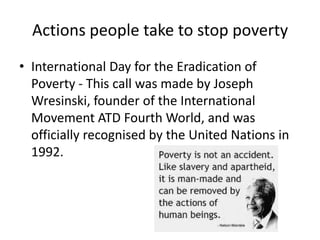
• International Day for the Eradication of
Poverty - This call was made by Joseph
Wresinski, founder of the International
Movement ATD Fourth World, and was
officially recognised by the United Nations in
1992.
Actions people take to stop poverty
• Government Schemes - Conditional cash transfer
(CCT) programs aim to reduce poverty by making
welfare programs conditional upon the receivers'
actions. The government only transfers the
money to persons who meet certain criteria.
• Voluntary Welfare Organisations - Examples
include the Center for Global Development
(CGD), Child Poverty Action Group, End Poverty
Now (EPN), and the United Nations Development
Program Millennium Development Goals
(MDG), Poverty Assessment and Monitoring.

Poverty

  • 1.
    Poverty Done by: Bongchicken, goh chin wei Ryan Heng and Joven tan jun wei
  • 2.
    Poverty • Poverty isthe state of one who lacks a certain amount of material possessions or money • Poverty was considered largely unavoidable as traditional modes of production were insufficient to give an entire population a comfortable standard of living
  • 3.
    Poverty • Poverty reductionis a major goal and issue for many international organizations such as the United Nations and the World Bank • poverty was considered largely unavoidable as traditional modes of production were insufficient to give an entire population a comfortable standard of living
  • 4.
    Extreme Poverty • refersto the deprivation of basic human needs, which commonly includes food, water, sanitation, clothing, shelter, healt h care and education. Relative poverty is defined contextually as economic inequality in the location or society in which people live
  • 5.
    Effects of poverty •Widespread diseases and hunger - One third of deaths, some 18 million people a year or 50,000 per day, are due to poverty-related causes: in total 270 million people, most of them women and children, have died as a result of poverty since 1990. According to the World Health Organization, hunger and malnutrition are the single gravest threats to the world's public health and malnutrition is by far the biggest contributor to child mortality, present in half of all cases.
  • 6.
    Actions people taketo stop poverty • International Day for the Eradication of Poverty - This call was made by Joseph Wresinski, founder of the International Movement ATD Fourth World, and was officially recognised by the United Nations in 1992.
  • 7.
    Actions people taketo stop poverty • Government Schemes - Conditional cash transfer (CCT) programs aim to reduce poverty by making welfare programs conditional upon the receivers' actions. The government only transfers the money to persons who meet certain criteria. • Voluntary Welfare Organisations - Examples include the Center for Global Development (CGD), Child Poverty Action Group, End Poverty Now (EPN), and the United Nations Development Program Millennium Development Goals (MDG), Poverty Assessment and Monitoring.