POVERTYPOVERTY
What is PovertyWhat is Poverty
•Poverty is the world at itsPoverty is the world at its
worst when people areworst when people are
deprived of basicdeprived of basic
everyday things that weeveryday things that we
take for granted like food,take for granted like food,
water shelter, money, andwater shelter, money, and
clothesclothes
PovertyPoverty is ais a HorrifyingHorrifying
thingthing
HOWHOW??
Causes of povertyCauses of poverty
oLack of education
oNatural disasters
oLack of money
oNo opportunities
provided
oOver population
Poverty is also
caused by DRUGS &
ALCOHOL as some
people spend
all their money on
addictions like this.
Major causes of extreme povertyMajor causes of extreme poverty
Hunger & Malnutrition
Limited access to quality health care
Insufficient access to sanitary water
Limited education
Effects of poverty
High Mortality Rates.
Increased health risks and
perpetuation of epidemics such as
HIV/AIDS and Malaria.
Hampers children’s ability to grow &
develop properly and contributes to a
cycle of poverty
Inhibits education and social
advancement
Increased armed conflict
FACTSFACTS1.4 BILLION people in developing1.4 BILLION people in developing
countries live on $1.25 or lesscountries live on $1.25 or less
3 out of every 4 people live on3 out of every 4 people live on
less than $1.25 a dayless than $1.25 a day
22,000 children die every day22,000 children die every day
due to povertydue to poverty
8MILLION people die from lack8MILLION people die from lack
of food and nutrition – aboutof food and nutrition – about
24,000 deaths each day24,000 deaths each day
FACTSFACTS
60% of world’s hungry are women60% of world’s hungry are women
Lack of proper maternal care results inLack of proper maternal care results in
300,000 maternal deaths annually300,000 maternal deaths annually
1 out of 6 infants are born with a low birth1 out of 6 infants are born with a low birth
rate in developing countriesrate in developing countries
Malnutrition causes 1/3 of all child deathsMalnutrition causes 1/3 of all child deaths
resulting in 2.6MILLION deaths per yearresulting in 2.6MILLION deaths per year
Every 5 second a child dies of hunger relatedEvery 5 second a child dies of hunger related
diseasesdiseases
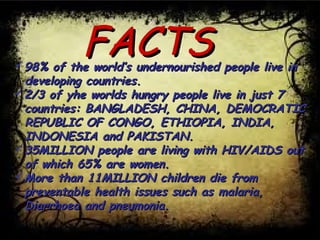
FACTSFACTS98% of the world’s undernourished people live in98% of the world’s undernourished people live in
developing countries.developing countries.
2/3 of yhe worlds hungry people live in just 72/3 of yhe worlds hungry people live in just 7
countries: BANGLADESH, CHINA, DEMOCRATICcountries: BANGLADESH, CHINA, DEMOCRATIC
REPUBLIC OF CONGO, ETHIOPIA, INDIA,REPUBLIC OF CONGO, ETHIOPIA, INDIA,
INDONESIA and PAKISTAN.INDONESIA and PAKISTAN.
35MILLION people are living with HIV/AIDS out35MILLION people are living with HIV/AIDS out
of which 65% are women.of which 65% are women.
More than 11MILLION children die fromMore than 11MILLION children die from
preventable health issues such as malaria,preventable health issues such as malaria,
Diarrhoea and pneumonia.Diarrhoea and pneumonia.
Poverty in INDIAPoverty in INDIA
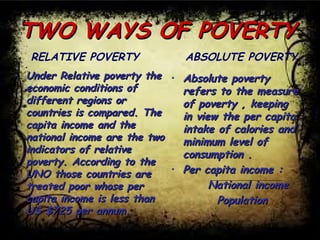
TWO WAYS OF POVERTYTWO WAYS OF POVERTY
• Under Relative poverty theUnder Relative poverty the
economic conditions ofeconomic conditions of
different regions ordifferent regions or
countries is compared. Thecountries is compared. The
capita income and thecapita income and the
national income are the twonational income are the two
indicators of relativeindicators of relative
poverty. According to thepoverty. According to the
UNO those countries areUNO those countries are
treated poor whose pertreated poor whose per
capita income is less thancapita income is less than
US $725 per annum.US $725 per annum.
RELATIVE POVERTY
• Absolute povertyAbsolute poverty
refers to the measurerefers to the measure
of poverty , keepingof poverty , keeping
in view the per capitain view the per capita
intake of calories andintake of calories and
minimum level ofminimum level of
consumption .consumption .
• Per capita income :Per capita income :
National incomeNational income
PopulationPopulation
ABSOLUTE POVERTY
MEASUREMENT OF POVERTYMEASUREMENT OF POVERTY
EXPENDIURE METHOD
• Under this the minimumUnder this the minimum
food requirements forfood requirements for
survival is estimated.survival is estimated.
• The food value is convertedThe food value is converted
into calories.into calories.
• The caloric value of food isThe caloric value of food is
then converted into thethen converted into the
money value i.e. in rupees.money value i.e. in rupees.
• The total equivalent amountThe total equivalent amount
is considered as theis considered as the
poverty line.poverty line.
INCOME METHODINCOME METHOD
• This method is used by theThis method is used by the
government while distributinggovernment while distributing
food through PDS at the localfood through PDS at the local
level.level.
• Under this a poverty line is fixedUnder this a poverty line is fixed
by the government.by the government.
• All the families whose totalAll the families whose total
income is less than the povertyincome is less than the poverty
line fixed by the government areline fixed by the government are
considered as BPL.considered as BPL.
Thank You

Poverty

  • 1.
  • 2.
    What is PovertyWhatis Poverty •Poverty is the world at itsPoverty is the world at its worst when people areworst when people are deprived of basicdeprived of basic everyday things that weeveryday things that we take for granted like food,take for granted like food, water shelter, money, andwater shelter, money, and clothesclothes
  • 5.
    PovertyPoverty is aisa HorrifyingHorrifying thingthing HOWHOW??
  • 8.
    Causes of povertyCausesof poverty oLack of education oNatural disasters oLack of money oNo opportunities provided oOver population Poverty is also caused by DRUGS & ALCOHOL as some people spend all their money on addictions like this.
  • 9.
    Major causes ofextreme povertyMajor causes of extreme poverty Hunger & Malnutrition Limited access to quality health care Insufficient access to sanitary water Limited education
  • 10.
    Effects of poverty HighMortality Rates. Increased health risks and perpetuation of epidemics such as HIV/AIDS and Malaria. Hampers children’s ability to grow & develop properly and contributes to a cycle of poverty Inhibits education and social advancement Increased armed conflict
  • 12.
    FACTSFACTS1.4 BILLION peoplein developing1.4 BILLION people in developing countries live on $1.25 or lesscountries live on $1.25 or less 3 out of every 4 people live on3 out of every 4 people live on less than $1.25 a dayless than $1.25 a day 22,000 children die every day22,000 children die every day due to povertydue to poverty 8MILLION people die from lack8MILLION people die from lack of food and nutrition – aboutof food and nutrition – about 24,000 deaths each day24,000 deaths each day
  • 13.
    FACTSFACTS 60% of world’shungry are women60% of world’s hungry are women Lack of proper maternal care results inLack of proper maternal care results in 300,000 maternal deaths annually300,000 maternal deaths annually 1 out of 6 infants are born with a low birth1 out of 6 infants are born with a low birth rate in developing countriesrate in developing countries Malnutrition causes 1/3 of all child deathsMalnutrition causes 1/3 of all child deaths resulting in 2.6MILLION deaths per yearresulting in 2.6MILLION deaths per year Every 5 second a child dies of hunger relatedEvery 5 second a child dies of hunger related diseasesdiseases
  • 14.
    FACTSFACTS98% of theworld’s undernourished people live in98% of the world’s undernourished people live in developing countries.developing countries. 2/3 of yhe worlds hungry people live in just 72/3 of yhe worlds hungry people live in just 7 countries: BANGLADESH, CHINA, DEMOCRATICcountries: BANGLADESH, CHINA, DEMOCRATIC REPUBLIC OF CONGO, ETHIOPIA, INDIA,REPUBLIC OF CONGO, ETHIOPIA, INDIA, INDONESIA and PAKISTAN.INDONESIA and PAKISTAN. 35MILLION people are living with HIV/AIDS out35MILLION people are living with HIV/AIDS out of which 65% are women.of which 65% are women. More than 11MILLION children die fromMore than 11MILLION children die from preventable health issues such as malaria,preventable health issues such as malaria, Diarrhoea and pneumonia.Diarrhoea and pneumonia.
  • 16.
  • 17.
    TWO WAYS OFPOVERTYTWO WAYS OF POVERTY • Under Relative poverty theUnder Relative poverty the economic conditions ofeconomic conditions of different regions ordifferent regions or countries is compared. Thecountries is compared. The capita income and thecapita income and the national income are the twonational income are the two indicators of relativeindicators of relative poverty. According to thepoverty. According to the UNO those countries areUNO those countries are treated poor whose pertreated poor whose per capita income is less thancapita income is less than US $725 per annum.US $725 per annum. RELATIVE POVERTY • Absolute povertyAbsolute poverty refers to the measurerefers to the measure of poverty , keepingof poverty , keeping in view the per capitain view the per capita intake of calories andintake of calories and minimum level ofminimum level of consumption .consumption . • Per capita income :Per capita income : National incomeNational income PopulationPopulation ABSOLUTE POVERTY
  • 18.
    MEASUREMENT OF POVERTYMEASUREMENTOF POVERTY EXPENDIURE METHOD • Under this the minimumUnder this the minimum food requirements forfood requirements for survival is estimated.survival is estimated. • The food value is convertedThe food value is converted into calories.into calories. • The caloric value of food isThe caloric value of food is then converted into thethen converted into the money value i.e. in rupees.money value i.e. in rupees. • The total equivalent amountThe total equivalent amount is considered as theis considered as the poverty line.poverty line. INCOME METHODINCOME METHOD • This method is used by theThis method is used by the government while distributinggovernment while distributing food through PDS at the localfood through PDS at the local level.level. • Under this a poverty line is fixedUnder this a poverty line is fixed by the government.by the government. • All the families whose totalAll the families whose total income is less than the povertyincome is less than the poverty line fixed by the government areline fixed by the government are considered as BPL.considered as BPL.
  • 25.