Poverty
From The Boys Brigade 
Group:
Yong Chin=Leader
Aaron Chan=Member
Cayden=Memmber
Genesis=Meber
Introduction to poverty
 Poverty is the scarcity or the lack of a certain (variant) amount of material
possessions or money. Poverty is a multifaceted concept, which may include
social, economic, and political elements. Absolute poverty, extreme poverty, or
destitution refers to the complete lack of the means necessary to meet basic
personal needs such as food, clothing and shelter.
 The threshold at which absolute poverty is defined is considered to be about
the same, independent of the person's permanent location or era. On the
other hand, relative poverty occurs when a person who lives in a given country
does not enjoy a certain minimum level of "living standards" as compared to
the rest of the population of that country. Therefore, the threshold at which
relative poverty is defined varies from country to another, or from one society
to another.
Poverty Facts
 Almost half the world - about 3 million people - live on less than USD$2.50 a day,
 The poorest 40 percent of the world's population accounts for 5 percent of global
income. The richest 20 percent accounts for three-quarters of world income.
 According to UNICEF (United Nations International Children's Emergency Fund), 22,000
children die each day due to poverty,
 And they "die quietly in some of the poorest villages on earth, far removed from the
scrutiny and the conscience of the world. Being meek and weak in life makes these
dying multitudes even more invisible in death.“
 Less than one per cent of what the world spent every year on weapons was needed to
put every child into school by the year 2000 and yet it didn't happen.
 According to the Unesco (United Nationals Educational, Scientific and Cultural
Organisation), it was reported that one in five adults is not literate today and two-thirds
of them are women.
Why is there poverty? ):
 The causes of poverty include changing trends in a country’s economy, lack of
education, high divorce rate which causes feminization of poverty, having a culture
of poverty, overpopulation, epidemic diseases such as AIDS and malaria, and
environmental problems such as lack of rainfall.
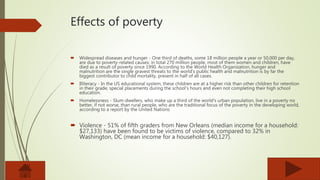
Effects of poverty
 Widespread diseases and hunger - One third of deaths, some 18 million people a year or 50,000 per day,
are due to poverty-related causes: in total 270 million people, most of them women and children, have
died as a result of poverty since 1990. According to the World Health Organization, hunger and
malnutrition are the single gravest threats to the world's public health and malnutrition is by far the
biggest contributor to child mortality, present in half of all cases.
 Illiteracy - In the US educational system, these children are at a higher risk than other children for retention
in their grade, special placements during the school's hours and even not completing their high school
education.
 Homelessness - Slum-dwellers, who make up a third of the world's urban population, live in a poverty no
better, if not worse, than rural people, who are the traditional focus of the poverty in the developing world,
according to a report by the United Nations
 Violence - 51% of fifth graders from New Orleans (median income for a household:
$27,133) have been found to be victims of violence, compared to 32% in
Washington, DC (mean income for a household: $40,127).
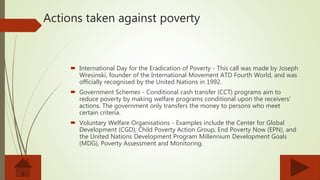
Actions taken against poverty
 International Day for the Eradication of Poverty - This call was made by Joseph
Wresinski, founder of the International Movement ATD Fourth World, and was
officially recognised by the United Nations in 1992.
 Government Schemes - Conditional cash transfer (CCT) programs aim to
reduce poverty by making welfare programs conditional upon the receivers'
actions. The government only transfers the money to persons who meet
certain criteria.
 Voluntary Welfare Organisations - Examples include the Center for Global
Development (CGD), Child Poverty Action Group, End Poverty Now (EPN), and
the United Nations Development Program Millennium Development Goals
(MDG), Poverty Assessment and Monitoring.
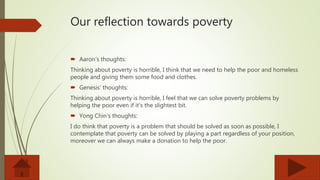
Our reflection towards poverty
 Aaron’s thoughts:
Thinking about poverty is horrible, I think that we need to help the poor and homeless
people and giving them some food and clothes.
 Genesis’ thoughts:
Thinking about poverty is horrible, I feel that we can solve poverty problems by
helping the poor even if it’s the slightest bit.
 Yong Chin’s thoughts:
I do think that poverty is a problem that should be solved as soon as possible, I
contemplate that poverty can be solved by playing a part regardless of your position,
moreover we can always make a donation to help the poor.
Group’s reflection towards poverty
 Altogether regarding our reflections towards poverty, we feel
that poverty is a horrific problem that can cause unimaginable
problems to children and adults alike and should be solved as
soon as possible.

Poverty bb presentation

  • 1.
    Poverty From The BoysBrigade  Group: Yong Chin=Leader Aaron Chan=Member Cayden=Memmber Genesis=Meber
  • 2.
    Introduction to poverty Poverty is the scarcity or the lack of a certain (variant) amount of material possessions or money. Poverty is a multifaceted concept, which may include social, economic, and political elements. Absolute poverty, extreme poverty, or destitution refers to the complete lack of the means necessary to meet basic personal needs such as food, clothing and shelter.  The threshold at which absolute poverty is defined is considered to be about the same, independent of the person's permanent location or era. On the other hand, relative poverty occurs when a person who lives in a given country does not enjoy a certain minimum level of "living standards" as compared to the rest of the population of that country. Therefore, the threshold at which relative poverty is defined varies from country to another, or from one society to another.
  • 3.
    Poverty Facts  Almosthalf the world - about 3 million people - live on less than USD$2.50 a day,  The poorest 40 percent of the world's population accounts for 5 percent of global income. The richest 20 percent accounts for three-quarters of world income.  According to UNICEF (United Nations International Children's Emergency Fund), 22,000 children die each day due to poverty,  And they "die quietly in some of the poorest villages on earth, far removed from the scrutiny and the conscience of the world. Being meek and weak in life makes these dying multitudes even more invisible in death.“  Less than one per cent of what the world spent every year on weapons was needed to put every child into school by the year 2000 and yet it didn't happen.  According to the Unesco (United Nationals Educational, Scientific and Cultural Organisation), it was reported that one in five adults is not literate today and two-thirds of them are women.
  • 4.
    Why is therepoverty? ):  The causes of poverty include changing trends in a country’s economy, lack of education, high divorce rate which causes feminization of poverty, having a culture of poverty, overpopulation, epidemic diseases such as AIDS and malaria, and environmental problems such as lack of rainfall.
  • 5.
    Effects of poverty Widespread diseases and hunger - One third of deaths, some 18 million people a year or 50,000 per day, are due to poverty-related causes: in total 270 million people, most of them women and children, have died as a result of poverty since 1990. According to the World Health Organization, hunger and malnutrition are the single gravest threats to the world's public health and malnutrition is by far the biggest contributor to child mortality, present in half of all cases.  Illiteracy - In the US educational system, these children are at a higher risk than other children for retention in their grade, special placements during the school's hours and even not completing their high school education.  Homelessness - Slum-dwellers, who make up a third of the world's urban population, live in a poverty no better, if not worse, than rural people, who are the traditional focus of the poverty in the developing world, according to a report by the United Nations  Violence - 51% of fifth graders from New Orleans (median income for a household: $27,133) have been found to be victims of violence, compared to 32% in Washington, DC (mean income for a household: $40,127).
  • 6.
    Actions taken againstpoverty  International Day for the Eradication of Poverty - This call was made by Joseph Wresinski, founder of the International Movement ATD Fourth World, and was officially recognised by the United Nations in 1992.  Government Schemes - Conditional cash transfer (CCT) programs aim to reduce poverty by making welfare programs conditional upon the receivers' actions. The government only transfers the money to persons who meet certain criteria.  Voluntary Welfare Organisations - Examples include the Center for Global Development (CGD), Child Poverty Action Group, End Poverty Now (EPN), and the United Nations Development Program Millennium Development Goals (MDG), Poverty Assessment and Monitoring.
  • 7.
    Our reflection towardspoverty  Aaron’s thoughts: Thinking about poverty is horrible, I think that we need to help the poor and homeless people and giving them some food and clothes.  Genesis’ thoughts: Thinking about poverty is horrible, I feel that we can solve poverty problems by helping the poor even if it’s the slightest bit.  Yong Chin’s thoughts: I do think that poverty is a problem that should be solved as soon as possible, I contemplate that poverty can be solved by playing a part regardless of your position, moreover we can always make a donation to help the poor.
  • 8.
    Group’s reflection towardspoverty  Altogether regarding our reflections towards poverty, we feel that poverty is a horrific problem that can cause unimaginable problems to children and adults alike and should be solved as soon as possible.