Pott’s Disease / Tuberculosis of Spine

Pott’s disease is caused when the vertebrae become soft and collapse as the result of caries or osteitis. Typically, this is caused by
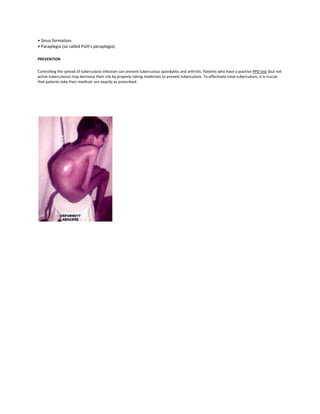
mycobacterium tuberculosis. As a result, a person with Pott's disease often develops kyphosis, which results in a hunchback. This is often
referred to as Pott’s curvature. In some cases, a person with Pott's disease may also develop paralysis, referred to as Pott’s paraplegia, when
the spinal nerves become affected by the curvature.
It is named after Percivall Pott a British surgeon.The lower thoracic and upper lumbar vertebrae are the areas of the spine most often affected.
It is not to be confused with Postural orthostatic tachycardia syndrome, also known as "POTS".
Pott's disease is a presentation of extrapulmonary tuberculosis that affects the spine, a kind of tuberculous arthritis of the intervertebral joints.
More precisely it is called tuberculous spondylitis.Pott’s disease results from haematogenous spread of tuberculosis from other sites, often
pulmonary. The infection then spreads from two adjacent vertebrae into the adjoining disc space. If only one vertebra is affected, the disc is
normal, but if two are involved theintervertebral disc, which is avascular, cannot receive nutrients and collapses. The disc tissue dies and is
broken down by caseation, leading to vertebral narrowing and eventually to vertebral collapse and spinal damage). A dry soft tissue mass often
forms and superinfection is rare.
ETIOLOGY of Tuberculosis of Spine
‱ Causative organism: Mycobacterium tuberculosis.
‱ Spread: Haematogenous. (by blood)
‱ Commonly associated with: Debilitating diseases, AIDS, Drug addiction, Alcoholism.

Symptoms of Tuberculosis of Spine
Symptoms
The onset is gradual.
‱ Back pain is localised.
‱ Restricted spinal movements.
‱ Fever.
‱ Night sweats.
‱ Anorexia.
‱ Weight loss.
Signs
‱ There may be kyphosis. (spinal curvature)
‱ Muscle wasting.
‱ A paravertebral swelling may be seen (spinal mass).
‱ They tend to assume a protective upright, stiff position (pain).
‱ If there is neural involvement there will be neurological signs (tingling, numbness, or feeling of weakness in the leg muscles).
‱ A psoas abscess (may present as a lump in the groin and resemble a hernia).
Differential diagnosis
‱ Pyogenic osteitis of the spine.
‱ Spinal tumours.
INVESTIGATION for Tuberculosis of Spine
Blood
‱ TLC: Leucocytosis.
‱ ESR: raised >100 mm/h
Tuberculin skin test(purified protein derivative [PPD])
‱ positive.
Aspirate from joint space & abscess
‱ Transparency: turbid.
‱ Colour: creamy.
‱ Consistency: cheesy.
‱ WBC: 25000/cc.mm.
Histology
‱ Shows granulomatous tubercle.
X-Ray spine
‱ Narrowed joint space.
‱ shadow of abscess in soft tissue.
‱ Destruction of bone.
‱ Wedge-shaped deformity (collapse of vertebrae anteriorly).

Bone scan
CT of the spine
Bone biopsy
MRI

GENERAL MANAGEMENT for Pott's Disease
‱ Bed rest.
‱ Immobilisation of affected joint by splintage.
‱ Nutritious, high protein diet.
‱ Drainage of abscess.
‱ Surgical decompression.
Physiotherap

Non-operative – antituberculous drugs
Analgesics
Immobilization of the spine region different types of braces and collars
Surgery may be necessary, especially to drain spinal abscesses or debride bony lesions fully or to stabilize the spine.
Physical therapy for pain-relieving modalties, postural education and teaching a home exercise program for strength and flexibility

Complications
‱ Vertebral collapse resulting in kyphosis.
‱ Spinal cord compression.
‱ Sinus formation.
‱ Paraplegia (so called Pott's paraplegia).
PREVENTION
Controlling the spread of tuberculosis infection can prevent tuberculous spondylitis and arthritis. Patients who have a positive PPD test (but not
active tuberculosis) may decrease their risk by properly taking medicines to prevent tuberculosis. To effectively treat tuberculosis, it is crucial
that patients take their medicati ons exactly as prescribed.

Pott's spine

  • 1.
    Pott’s Disease /Tuberculosis of Spine Pott’s disease is caused when the vertebrae become soft and collapse as the result of caries or osteitis. Typically, this is caused by mycobacterium tuberculosis. As a result, a person with Pott's disease often develops kyphosis, which results in a hunchback. This is often referred to as Pott’s curvature. In some cases, a person with Pott's disease may also develop paralysis, referred to as Pott’s paraplegia, when the spinal nerves become affected by the curvature. It is named after Percivall Pott a British surgeon.The lower thoracic and upper lumbar vertebrae are the areas of the spine most often affected. It is not to be confused with Postural orthostatic tachycardia syndrome, also known as "POTS". Pott's disease is a presentation of extrapulmonary tuberculosis that affects the spine, a kind of tuberculous arthritis of the intervertebral joints. More precisely it is called tuberculous spondylitis.Pott’s disease results from haematogenous spread of tuberculosis from other sites, often pulmonary. The infection then spreads from two adjacent vertebrae into the adjoining disc space. If only one vertebra is affected, the disc is normal, but if two are involved theintervertebral disc, which is avascular, cannot receive nutrients and collapses. The disc tissue dies and is broken down by caseation, leading to vertebral narrowing and eventually to vertebral collapse and spinal damage). A dry soft tissue mass often forms and superinfection is rare. ETIOLOGY of Tuberculosis of Spine ‱ Causative organism: Mycobacterium tuberculosis. ‱ Spread: Haematogenous. (by blood) ‱ Commonly associated with: Debilitating diseases, AIDS, Drug addiction, Alcoholism. Symptoms of Tuberculosis of Spine Symptoms The onset is gradual. ‱ Back pain is localised. ‱ Restricted spinal movements. ‱ Fever. ‱ Night sweats. ‱ Anorexia. ‱ Weight loss. Signs ‱ There may be kyphosis. (spinal curvature) ‱ Muscle wasting. ‱ A paravertebral swelling may be seen (spinal mass). ‱ They tend to assume a protective upright, stiff position (pain). ‱ If there is neural involvement there will be neurological signs (tingling, numbness, or feeling of weakness in the leg muscles). ‱ A psoas abscess (may present as a lump in the groin and resemble a hernia). Differential diagnosis ‱ Pyogenic osteitis of the spine. ‱ Spinal tumours. INVESTIGATION for Tuberculosis of Spine Blood
  • 2.
    ‱ TLC: Leucocytosis. ‱ESR: raised >100 mm/h Tuberculin skin test(purified protein derivative [PPD]) ‱ positive. Aspirate from joint space & abscess ‱ Transparency: turbid. ‱ Colour: creamy. ‱ Consistency: cheesy. ‱ WBC: 25000/cc.mm. Histology ‱ Shows granulomatous tubercle. X-Ray spine ‱ Narrowed joint space. ‱ shadow of abscess in soft tissue. ‱ Destruction of bone. ‱ Wedge-shaped deformity (collapse of vertebrae anteriorly). Bone scan CT of the spine Bone biopsy MRI GENERAL MANAGEMENT for Pott's Disease ‱ Bed rest. ‱ Immobilisation of affected joint by splintage. ‱ Nutritious, high protein diet. ‱ Drainage of abscess. ‱ Surgical decompression. Physiotherap Non-operative – antituberculous drugs Analgesics Immobilization of the spine region different types of braces and collars Surgery may be necessary, especially to drain spinal abscesses or debride bony lesions fully or to stabilize the spine. Physical therapy for pain-relieving modalties, postural education and teaching a home exercise program for strength and flexibility Complications ‱ Vertebral collapse resulting in kyphosis. ‱ Spinal cord compression.
  • 3.
    ‱ Sinus formation. ‱Paraplegia (so called Pott's paraplegia). PREVENTION Controlling the spread of tuberculosis infection can prevent tuberculous spondylitis and arthritis. Patients who have a positive PPD test (but not active tuberculosis) may decrease their risk by properly taking medicines to prevent tuberculosis. To effectively treat tuberculosis, it is crucial that patients take their medicati ons exactly as prescribed.