A Glimpse on Osteo-articular
Tuberculosis
Dr Khushwant Singh Rathore
Senior Resident
AIIMS, Jodhpur
The tubercle bacillus has co-existed with
Homo sapiens since time immemorial.

The Vedas and Samhita of Charaka & Sushruta
recognized the disease as “Yakshma”
Tuberculous lesions have been found even in Egyptian
mummies.
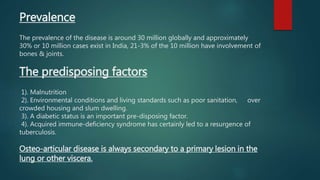
Prevalence
The prevalence of the disease is around 30 million globally and approximately
30% or 10 million cases exist in India, 21-3% of the 10 million have involvement of
bones & joints.
The predisposing factors
1). Malnutrition
2). Environmental conditions and living standards such as poor sanitation, over
crowded housing and slum dwelling.
3). A diabetic status is an important pre-disposing factor.
4). Acquired immune-deficiency syndrome has certainly led to a resurgence of
tuberculosis.
Osteo-articular disease is always secondary to a primary lesion in the
lung or other viscera.
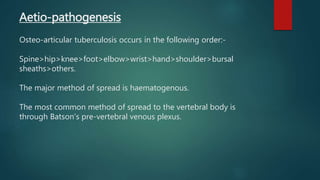
Aetio-pathogenesis
Osteo-articular tuberculosis occurs in the following order:-
Spine>hip>knee>foot>elbow>wrist>hand>shoulder>bursal
sheaths>others.
The major method of spread is haematogenous.
The most common method of spread to the vertebral body is
through Batson's pre-vertebral venous plexus.
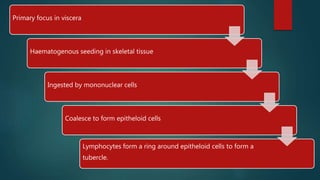
Primary focus in viscera
Haematogenous seeding in skeletal tissue
Ingested by mononuclear cells
Coalesce to form epitheloid cells
Lymphocytes form a ring around epitheloid cells to form a
tubercle.
casseation in centre of tubercle
The host inflammatory response intensifies, resulting in
exudation and liquefaction, and a cold abscess is formed
A cold abscess is composed of serum, leukocytes,
caseation, bone debris, and bacilli.
Abscess tracks along paths of least resistance to
present over skin as swelling which may rupture
to form sinus
Disease Presentations
 Spine – Pott’s disease & Pott’s paraplegia
 Joints - Tubercular arthritis
 Long and flat bones - Tubercular osteomyelitis
 Short bones – Tubercular dactylitis(spina ventosa)
 Tendon sheath & bursae- TB bursitis & tenosynovitis
Tuberculosis of the
Spine
 Most frequent site of osseous involvement by TB
 the disease was first described by Sir Percival Pott in
1779, hence the name Pott's disease
 There has been a resurgence of the disease in the
developed countries following the HIV pandemic.
 Defined - as an infection by Mycobacterium tuberculosis
of one or more of the extradural components of the
spine namely the vertebra, intervertebral disks, paraspinal
soft tissues and epidural space
Introduction
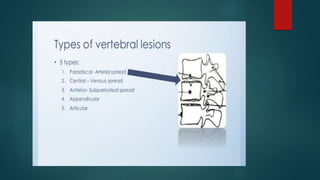
 Usually by hematogenous route
 Peri-vertebral arterial or venous plexus is still in debate, but arterial
route considered more important.
 Primary focus in the lung or other extra-osseous foci such as lymph
nodes, GIT or any other viscera
 Lower thoracic and lumbar vertebrae are most often affected
 Usually two continuous vertebrae are involved but several vertebrae
may be affected, skip lesions and solitary vertebral involvement may
occur
 The so-called skip lesions or a second lesion not contiguous with the
more obvious lesion is seen in 4 -10 % of cases.
Pathophysiology
CLINICAL FEATURES
 PRESENTATION VARIES FROM NON SPECIFIC BACK ACHE TO
CATASTROPHIC PARAPLEGIA
 COMPLAINTS:
PAIN
STIFFNESS
COLD ABSCESS ( IF EVIDENT EXTERNALLY)
PARAPLEGIA
DEFORMITY
CONSTITUTIONAL SYMPTOMS (20-30% patients only)
EXAMINATION
 SHOULD HAVE A HIGH INDEX OF SUSPICION
 AIMS : LOOK FOR FINDINGS OF TB SPINE
 LOCALISE SITE OF LESION
 DETECT COMPLICATIONS- COLD ABSCESS /
PARAPLEGIA
 GAIT : SHORT STEPS
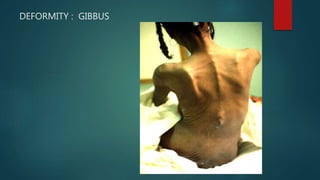
 ATTITUDE & DEFORMITY
 PARAVERTEBRAL SWELLING
 TENDERNESS ON THE AFFECTED SPINE
 REDUCED MOBILITY
DEFORMITY : GIBBUS
NEUROLOGICAL EXAMINATION
 AIMS: DETECT ANY COMPRESSION
LEVEL OF COMPRESSION
SEVERITY OF COMPRESSION
 LIMBS – UPPER OR LOWER BASED ON SITE
MOTOR , SENSORY , REFLEXES , BOWEL AND BLADDER FUNCTIONS
GENERAL EXAMINATION
PHYSICAL EXAMINATION
SYSTEMIC ILLNESS : DM , HYPERTENSION
GENERAL INVESTIGATIONS
 ESR
 MANTOUX
 ELISA : ANTI TB ANTIBODY
 CHEST X RAY : FOR PULMONARY TB
Conventional Radiographs –
 Initial investigation
 often negative in early disease
 More than 30 to 50 % of mineral must be lost before a radiolucent
lesion becomes conspicuous on the plain films and this takes about 2
to 5 months
Imaging modalities
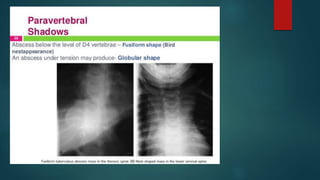
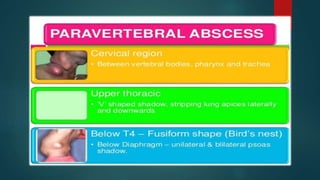
Abscess formation –
 Paravertebral soft tissue opacity
 Usually out of proportion to the degree of osseous destruction
 commonly bilateral and uniform
 may be globular indicating pus under tension
 may be minimal in the central variety of tubercular lesion
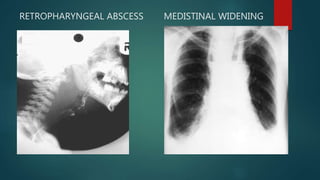
 cervical region - widening of the pre-vertebral soft tissues
 dorsal spine - the posteromedial pleural line is displaced laterally &
the abscess produces as typical fusiform shape called the "birds nest"
appearance
RETROPHARYNGEAL ABSCESS MEDISTINAL WIDENING
Birds nest abscess Psoas Abscess
Advantages –
 early detection of bone and soft tissue changes when plain films are
normal
 better anatomic localization and characterization of lesions
 evaluation of areas difficult to evaluate on plain films such as cranio-
vertebral junction, cervico-dorsal junction, sacrum
 providing guidance for biopsy and surgical approach
Computed Tomography
 modality of choice
 advantages –
 multiplanar capability
 the direct demonstration of early bone marrow involvement or edema
 unsurpassable assessment of spinal canal and neural involvement
 Soft tissue and Intraosseous abscesses are also well demonstrated on
MR imaging
 Higher sensitivity for early infiltrative disease including endplate
changes and marrow infiltration than bone scan and plain films
Magnetic Resonance Imaging
 MRI Scores over CT in-
 Detection of early disease (marrow edema)
 Skip lesions more easily and more often detected. Incidence of multilevel
noncontiguous vertebral tuberculosis is generally reported to be between
1.1 and 16 %
 Detection of epidural, meningeal and cord involvement
 Planning the surgical approach
• COMPLICATIONS
COLD ABSCESS
NEUROLOGICAL COMPLICATIONS : PARAPLEGIA
Types of paraplegia
 EARLY ONSET – during active phase, < 2 years
 INFLAMMATORY EDEMA
 EXTRADURAL PUS & GRANULATION TISSUE – COMMOMN
 SEQUESTRA
 INFARCTION OF SPINAL CORD
 EXTRADURAL GRANULOMA
 LATE ONSET – during healed phase, > 2 years
internal gibbus
recurrence
TREATMENT
What is Middle path regime?(why called middle path)
 Rest in bed
 Chemotherapy (ATT 4HRZE + 8 HRE)(ATT?)
 X-ray & ESR once in 3 months
 MRI/ CT at 6 months interval for 2 years
 Gradual mobilization is encouraged in absence of neural deficits with spinal braces &
back extension exercises at 3 – 9 weeks.
 Abscesses – aspirate when near surface & instil 1gm Streptomycin +/- INH in solution
RX of COLD ABSCESS
 SMALLER ONES SUBSIDE WITH TB THERAPY
 IN SUPERFICIAL ABSCESSES :
 ASPIRATION : USING THICK NEEDLE
 EVACUATION
 PSOAS ABSCESS : drain retroperitoneally
Rx of paraplegia
 CONSERVATIVE : ANTI TB RX , REST TO SPINE ,
 SURGICAL :
 INDICATIONS : PARAPLEGIA IN CONSERVATIVE Rx
 SUDDEN ONSET SEVERE PARAPLEGIA
 SEVERE PARAPLEGIA : IN FLEXION, MOTOR / SENSORY
LOSS > 6 MONTHS OR COMPLETE MOTOR LOSS ONE
MONTH DESPITE CONSERVATIVE Rx
 PARAPLEGIA WITH UNCONTROLLED SPASTICITY
PROCEDURES
 1. COSTO TRANSVERSECTOMY
 2. ANTEROLATERAL DECOMPRESSION
 3. RADICAL DEBRIDEMENT AND ARTHRODESIS
( HONKONG OPERATION)
 4. LAMINECTOMY
 Involvement in about 15 % cases of osteo-articular TB
 Lesions can arise in acetabulum, synovium, femoral epiphysis or
metaphysis or spread to the hip from foci in the greater trochanter or
ischium.
 If upper end of femur involved(being entirely intracapsular), the joint
is involved early in disease
 Erosion or lytic lesions may also occur in the greater trochanter or the
overlying bursa, without involvement of the hip joint for a long period
of time
Tuberculosis of Hip
Clinical - Irritable hip, FABER with APPARENT LENTHENING
Radiography –
 Plain radiograph usually normal
 Displacement of fat planes (effusion)
 Soft tissue swelling and deossification
 Radiologically significant osteoporosis appears 12 to 18 weeks after
onset of symptoms
Stage of synovitis
Ultrasound, CT and MRI
 more sensitive in this stage to detect increased joint space and
accumulation of fluid.
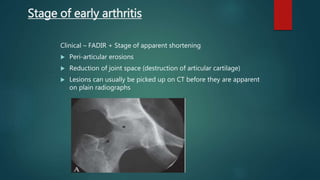
Clinical – FADIR + Stage of apparent shortening
 Peri-articular erosions
 Reduction of joint space (destruction of articular cartilage)
 Lesions can usually be picked up on CT before they are apparent
on plain radiographs
Stage of early arthritis
 Clinical – FADIR + stage of true shortening
 Destruction of articular cartilage, acetabulum, femoral head, capsule
and ligaments
 Capsule may get thickened and contracted
 Upper end of femur may displace upwards and dorsally breaking the
Shenton’s line
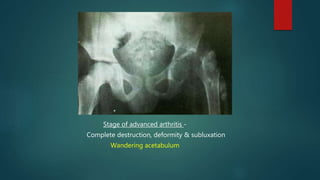
 Lower part of acetabulum empty (Wandering acetabulum)
 If femoral head, neck are grossly destroyed and collapsed in on
enlarged acetabulum, this appearance is called "mortar and pestle"
appearance
Stage of advanced arthritis
Stage of advanced arthritis -
Complete destruction, deformity & subluxation
Wandering acetabulum
Mortar & pestle appearance
• Gross destruction of head
• Enlarged acetabulum
• Management
1. Synovitis + early arthritis
rest+ traction+ ATT
2. advanced arthritis
joint debridement &
achieve favourable ankylosis by traction
if painful ankylosis
excision arthroplasty
arthrodesis
corrective osteotomy
THR(After 2 years)
THANKS

glimpse on osteoarticular T B

  • 1.
    A Glimpse onOsteo-articular Tuberculosis Dr Khushwant Singh Rathore Senior Resident AIIMS, Jodhpur
  • 2.
    The tubercle bacillushas co-existed with Homo sapiens since time immemorial. The Vedas and Samhita of Charaka & Sushruta recognized the disease as “Yakshma” Tuberculous lesions have been found even in Egyptian mummies.
  • 3.
    Prevalence The prevalence ofthe disease is around 30 million globally and approximately 30% or 10 million cases exist in India, 21-3% of the 10 million have involvement of bones & joints. The predisposing factors 1). Malnutrition 2). Environmental conditions and living standards such as poor sanitation, over crowded housing and slum dwelling. 3). A diabetic status is an important pre-disposing factor. 4). Acquired immune-deficiency syndrome has certainly led to a resurgence of tuberculosis. Osteo-articular disease is always secondary to a primary lesion in the lung or other viscera.
  • 4.
    Aetio-pathogenesis Osteo-articular tuberculosis occursin the following order:- Spine>hip>knee>foot>elbow>wrist>hand>shoulder>bursal sheaths>others. The major method of spread is haematogenous. The most common method of spread to the vertebral body is through Batson's pre-vertebral venous plexus.
  • 5.
    Primary focus inviscera Haematogenous seeding in skeletal tissue Ingested by mononuclear cells Coalesce to form epitheloid cells Lymphocytes form a ring around epitheloid cells to form a tubercle.
  • 6.
    casseation in centreof tubercle The host inflammatory response intensifies, resulting in exudation and liquefaction, and a cold abscess is formed A cold abscess is composed of serum, leukocytes, caseation, bone debris, and bacilli. Abscess tracks along paths of least resistance to present over skin as swelling which may rupture to form sinus
  • 7.
    Disease Presentations  Spine– Pott’s disease & Pott’s paraplegia  Joints - Tubercular arthritis  Long and flat bones - Tubercular osteomyelitis  Short bones – Tubercular dactylitis(spina ventosa)  Tendon sheath & bursae- TB bursitis & tenosynovitis
  • 8.
  • 9.
     Most frequentsite of osseous involvement by TB  the disease was first described by Sir Percival Pott in 1779, hence the name Pott's disease  There has been a resurgence of the disease in the developed countries following the HIV pandemic.  Defined - as an infection by Mycobacterium tuberculosis of one or more of the extradural components of the spine namely the vertebra, intervertebral disks, paraspinal soft tissues and epidural space Introduction
  • 10.
     Usually byhematogenous route  Peri-vertebral arterial or venous plexus is still in debate, but arterial route considered more important.  Primary focus in the lung or other extra-osseous foci such as lymph nodes, GIT or any other viscera  Lower thoracic and lumbar vertebrae are most often affected  Usually two continuous vertebrae are involved but several vertebrae may be affected, skip lesions and solitary vertebral involvement may occur  The so-called skip lesions or a second lesion not contiguous with the more obvious lesion is seen in 4 -10 % of cases. Pathophysiology
  • 12.
    CLINICAL FEATURES  PRESENTATIONVARIES FROM NON SPECIFIC BACK ACHE TO CATASTROPHIC PARAPLEGIA  COMPLAINTS: PAIN STIFFNESS COLD ABSCESS ( IF EVIDENT EXTERNALLY) PARAPLEGIA DEFORMITY CONSTITUTIONAL SYMPTOMS (20-30% patients only)
  • 13.
    EXAMINATION  SHOULD HAVEA HIGH INDEX OF SUSPICION  AIMS : LOOK FOR FINDINGS OF TB SPINE  LOCALISE SITE OF LESION  DETECT COMPLICATIONS- COLD ABSCESS / PARAPLEGIA  GAIT : SHORT STEPS  ATTITUDE & DEFORMITY  PARAVERTEBRAL SWELLING  TENDERNESS ON THE AFFECTED SPINE  REDUCED MOBILITY
  • 14.
  • 15.
    NEUROLOGICAL EXAMINATION  AIMS:DETECT ANY COMPRESSION LEVEL OF COMPRESSION SEVERITY OF COMPRESSION  LIMBS – UPPER OR LOWER BASED ON SITE MOTOR , SENSORY , REFLEXES , BOWEL AND BLADDER FUNCTIONS GENERAL EXAMINATION PHYSICAL EXAMINATION SYSTEMIC ILLNESS : DM , HYPERTENSION
  • 16.
    GENERAL INVESTIGATIONS  ESR MANTOUX  ELISA : ANTI TB ANTIBODY  CHEST X RAY : FOR PULMONARY TB
  • 17.
    Conventional Radiographs – Initial investigation  often negative in early disease  More than 30 to 50 % of mineral must be lost before a radiolucent lesion becomes conspicuous on the plain films and this takes about 2 to 5 months Imaging modalities
  • 18.
    Abscess formation – Paravertebral soft tissue opacity  Usually out of proportion to the degree of osseous destruction  commonly bilateral and uniform  may be globular indicating pus under tension  may be minimal in the central variety of tubercular lesion  cervical region - widening of the pre-vertebral soft tissues  dorsal spine - the posteromedial pleural line is displaced laterally & the abscess produces as typical fusiform shape called the "birds nest" appearance
  • 19.
  • 20.
    Birds nest abscessPsoas Abscess
  • 22.
    Advantages –  earlydetection of bone and soft tissue changes when plain films are normal  better anatomic localization and characterization of lesions  evaluation of areas difficult to evaluate on plain films such as cranio- vertebral junction, cervico-dorsal junction, sacrum  providing guidance for biopsy and surgical approach Computed Tomography
  • 23.
     modality ofchoice  advantages –  multiplanar capability  the direct demonstration of early bone marrow involvement or edema  unsurpassable assessment of spinal canal and neural involvement  Soft tissue and Intraosseous abscesses are also well demonstrated on MR imaging  Higher sensitivity for early infiltrative disease including endplate changes and marrow infiltration than bone scan and plain films Magnetic Resonance Imaging
  • 24.
     MRI Scoresover CT in-  Detection of early disease (marrow edema)  Skip lesions more easily and more often detected. Incidence of multilevel noncontiguous vertebral tuberculosis is generally reported to be between 1.1 and 16 %  Detection of epidural, meningeal and cord involvement  Planning the surgical approach
  • 25.
  • 26.
    Types of paraplegia EARLY ONSET – during active phase, < 2 years  INFLAMMATORY EDEMA  EXTRADURAL PUS & GRANULATION TISSUE – COMMOMN  SEQUESTRA  INFARCTION OF SPINAL CORD  EXTRADURAL GRANULOMA  LATE ONSET – during healed phase, > 2 years internal gibbus recurrence
  • 27.
    TREATMENT What is Middlepath regime?(why called middle path)  Rest in bed  Chemotherapy (ATT 4HRZE + 8 HRE)(ATT?)  X-ray & ESR once in 3 months  MRI/ CT at 6 months interval for 2 years  Gradual mobilization is encouraged in absence of neural deficits with spinal braces & back extension exercises at 3 – 9 weeks.  Abscesses – aspirate when near surface & instil 1gm Streptomycin +/- INH in solution
  • 28.
    RX of COLDABSCESS  SMALLER ONES SUBSIDE WITH TB THERAPY  IN SUPERFICIAL ABSCESSES :  ASPIRATION : USING THICK NEEDLE  EVACUATION  PSOAS ABSCESS : drain retroperitoneally
  • 29.
    Rx of paraplegia CONSERVATIVE : ANTI TB RX , REST TO SPINE ,  SURGICAL :  INDICATIONS : PARAPLEGIA IN CONSERVATIVE Rx  SUDDEN ONSET SEVERE PARAPLEGIA  SEVERE PARAPLEGIA : IN FLEXION, MOTOR / SENSORY LOSS > 6 MONTHS OR COMPLETE MOTOR LOSS ONE MONTH DESPITE CONSERVATIVE Rx  PARAPLEGIA WITH UNCONTROLLED SPASTICITY
  • 30.
    PROCEDURES  1. COSTOTRANSVERSECTOMY  2. ANTEROLATERAL DECOMPRESSION  3. RADICAL DEBRIDEMENT AND ARTHRODESIS ( HONKONG OPERATION)  4. LAMINECTOMY
  • 31.
     Involvement inabout 15 % cases of osteo-articular TB  Lesions can arise in acetabulum, synovium, femoral epiphysis or metaphysis or spread to the hip from foci in the greater trochanter or ischium.  If upper end of femur involved(being entirely intracapsular), the joint is involved early in disease  Erosion or lytic lesions may also occur in the greater trochanter or the overlying bursa, without involvement of the hip joint for a long period of time Tuberculosis of Hip
  • 32.
    Clinical - Irritablehip, FABER with APPARENT LENTHENING Radiography –  Plain radiograph usually normal  Displacement of fat planes (effusion)  Soft tissue swelling and deossification  Radiologically significant osteoporosis appears 12 to 18 weeks after onset of symptoms Stage of synovitis
  • 33.
    Ultrasound, CT andMRI  more sensitive in this stage to detect increased joint space and accumulation of fluid.
  • 34.
    Clinical – FADIR+ Stage of apparent shortening  Peri-articular erosions  Reduction of joint space (destruction of articular cartilage)  Lesions can usually be picked up on CT before they are apparent on plain radiographs Stage of early arthritis
  • 35.
     Clinical –FADIR + stage of true shortening  Destruction of articular cartilage, acetabulum, femoral head, capsule and ligaments  Capsule may get thickened and contracted  Upper end of femur may displace upwards and dorsally breaking the Shenton’s line  Lower part of acetabulum empty (Wandering acetabulum)  If femoral head, neck are grossly destroyed and collapsed in on enlarged acetabulum, this appearance is called "mortar and pestle" appearance Stage of advanced arthritis
  • 36.
    Stage of advancedarthritis - Complete destruction, deformity & subluxation Wandering acetabulum
  • 37.
    Mortar & pestleappearance • Gross destruction of head • Enlarged acetabulum
  • 38.
    • Management 1. Synovitis+ early arthritis rest+ traction+ ATT 2. advanced arthritis joint debridement & achieve favourable ankylosis by traction if painful ankylosis excision arthroplasty arthrodesis corrective osteotomy THR(After 2 years)
  • 39.