Diagnosis & Managment
What is a Spinal Compression
Fracture?
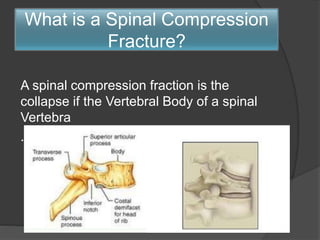
A spinal compression fraction is the
collapse if the Vertebral Body of a spinal
Vertebra
.
Etiology
 Trauma
 Osteoporosis/Osteopenia (bone density
loss)
 Osteomyelitis (Bone infection)
 Pathologic Fractures (Primary or
Metastatic Tumors)
Symptoms
 Patients usually report sudden onset of
localized Back pain which may range
from mild to severe.
 Rarely associated with radicular
symptoms (pain, numbness or tingeling
involving the anterior chest or abdominal
wall, or traveling down an extremity)
 Pain made worse with movement,
improved with remaining still
Diagnosis
Plain Radiograph
(X-Ray)
Plain X-Ray can be
utilized to diagnose the
Presence of Compression
fracture in the Lumbar or
Cervical spine.
Visualization in Thoracic
spine is difficult. Cannot
be utilized to determine
Acuity
Cat
Scan
Computer Aided
Tomography (CAT scan)
is a wonderful tool to
utilize to diagnose
Compression fractures
anywhere within the
spinal column. Cannot
identify Acuity of fracture
MRI with
STIR
sequence
Magnetic Resonance
Imaging (MRI) is probably
the best diagnostic tool, in
that it will readily identify
the presence of a
Compression fracture, AND
determine acuity if STIR
sequence is added. STIR
sequence identifies
surrounding edema,
present in acute fractures
Nuclear
Medicine
Bone
Scan
Bone Scan can be
utilized in conjunction
with other diagnostic
imaging studies to
determine acuity, but is
limiting when utilized
alone for diagnostic
purposes
Conservative Treatment
Medications – NSAIDS,
Opioids, possibly Calcitonin
Back Braces – LSO,
TLSO, Clam Shell
Surgical Options
***Should only be considered if fracture is Acute***
 Vertebroplasty – minimally invasive,
percutaneous injection of bone cement
into the vertebral body for stabilization
 Kyphoplasty – minimally invasive,
percutaneous balloon reduction of
fraction and internal fixation by injection
of bone cement for stabilization
Vertebroplast
y
Vertebroplasty places a
small trocar, through
the skin, down the
pedicle of the Vertebra
in order to fill the
fracture with cement.
No attempt is made to
reduce the fracture
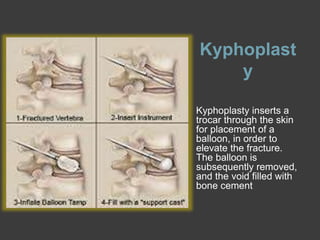
Kyphoplast
y
Kyphoplasty inserts a
trocar through the skin
for placement of a
balloon, in order to
elevate the fracture.
The balloon is
subsequently removed,
and the void filled with
bone cement
Spinal compression fractures

Spinal compression fractures

  • 1.
  • 2.
    What is aSpinal Compression Fracture? A spinal compression fraction is the collapse if the Vertebral Body of a spinal Vertebra .
  • 3.
    Etiology  Trauma  Osteoporosis/Osteopenia(bone density loss)  Osteomyelitis (Bone infection)  Pathologic Fractures (Primary or Metastatic Tumors)
  • 4.
    Symptoms  Patients usuallyreport sudden onset of localized Back pain which may range from mild to severe.  Rarely associated with radicular symptoms (pain, numbness or tingeling involving the anterior chest or abdominal wall, or traveling down an extremity)  Pain made worse with movement, improved with remaining still
  • 5.
  • 6.
    Plain Radiograph (X-Ray) Plain X-Raycan be utilized to diagnose the Presence of Compression fracture in the Lumbar or Cervical spine. Visualization in Thoracic spine is difficult. Cannot be utilized to determine Acuity
  • 7.
    Cat Scan Computer Aided Tomography (CATscan) is a wonderful tool to utilize to diagnose Compression fractures anywhere within the spinal column. Cannot identify Acuity of fracture
  • 8.
    MRI with STIR sequence Magnetic Resonance Imaging(MRI) is probably the best diagnostic tool, in that it will readily identify the presence of a Compression fracture, AND determine acuity if STIR sequence is added. STIR sequence identifies surrounding edema, present in acute fractures
  • 9.
    Nuclear Medicine Bone Scan Bone Scan canbe utilized in conjunction with other diagnostic imaging studies to determine acuity, but is limiting when utilized alone for diagnostic purposes
  • 10.
    Conservative Treatment Medications –NSAIDS, Opioids, possibly Calcitonin Back Braces – LSO, TLSO, Clam Shell
  • 11.
    Surgical Options ***Should onlybe considered if fracture is Acute***  Vertebroplasty – minimally invasive, percutaneous injection of bone cement into the vertebral body for stabilization  Kyphoplasty – minimally invasive, percutaneous balloon reduction of fraction and internal fixation by injection of bone cement for stabilization
  • 12.
    Vertebroplast y Vertebroplasty places a smalltrocar, through the skin, down the pedicle of the Vertebra in order to fill the fracture with cement. No attempt is made to reduce the fracture
  • 13.
    Kyphoplast y Kyphoplasty inserts a trocarthrough the skin for placement of a balloon, in order to elevate the fracture. The balloon is subsequently removed, and the void filled with bone cement