5/6/2017
1
Potato Processing
Md rahmatuzzaman Rana
Assistant Professor, Dept of FET, SUST
• Semi-perishable, contains approx 80% water
• Under tropical and sub-tropical conditions 40-50 % losses occur due
to poor handling and storage.
• Processing of potatoes is advantageous, because it reduce bulkiness
and increase shelf-life.
• Potatoes are processed into-
1. fried products such as wafers/chips etc.;
2. dehydrated products such as dice etc.
3. Frozen products such as French fries, patties, puffs, dice etc.
4. Canned.
Md rahmatuzzaman Rana
Assistant Professor, Dept of FET, SUST
5/6/2017
2
Consideration in potato processing
1. Specific gravity:
 High: chips, French fries. Due to higher yield, low uptake of fat/oil, low
mc need to be removed.
 Low: Canning. Cause firm piece is desirable.
 But!!! too high (1.106) is not suitable for French fries, chips because of
biscuit like hardness and hard chips.
 Measured by-
a) brine solution of known sp. Gravity
b) Hydrometer
c) Archimedes principle
d) Variable load hydrometer
e) Ordinary scale
Md rahmatuzzaman Rana
Assistant Professor, Dept of FET, SUST
Consideration in potato processing
2. Dry matter:
 Important because of its high yield of potato chips or wafers, and
texture of chips and reconstituted dried products.
 Measured by-
a) Oven drying but non-destructive method
Md rahmatuzzaman Rana
Assistant Professor, Dept of FET, SUST
5/6/2017
3
Consideration in potato processing
3. Sugar content
 Sugar content influences the color of the processed products.
 High glucose, fructose containing potatoes are not suitable for chips and
French fries because of the reaction between reducing sugar and amino
acid and causes discoloration
 Generally, freshly harvested mature potatoes contain acceptable level of
reducing sugar but when stored at low temperature (-5 oC) sugar content
increase.
 On the other hand, when stored at ambient temperature then sugar
content are not increased that much but sprouting and weight loss are
excessive.
Md rahmatuzzaman Rana
Assistant Professor, Dept of FET, SUST
Consideration in potato processing
3. Sugar content
 Sugar content influences the color of the processed products.
 High glucose, fructose containing potatoes are not suitable for chips and
French fries because of the reaction between reducing sugar and amino acid
and causes discoloration
 Generally, freshly harvested mature potatoes contain acceptable level of
reducing sugar but when stored at low temperature (-5 oC) sugar content
increase.
 On the other hand, when stored at ambient temperature then sugar content
are not increased that much but sprouting and weight loss are excessive.
 Evaporative cooled storage system has still similar change in sugar content
and problems with lower weight loss but still sprouting problem remained.
Md rahmatuzzaman Rana
Assistant Professor, Dept of FET, SUST
5/6/2017
4
Consideration in potato processing
3. Sugar content
 To overcome these problems potatoes are often treated with CIPC
(Isopropyl-N-chlorophenyl carbamate) and stored at low temperature.
But under this condition potatoes are unfit for processing within short
period.
 Reconditioning: cold stored potatoes are stored at 15-20 oC for 2-3 weeks
and reduction in sugar content take place.
 To overcome unacceptable color problem, chips often fried at lower
temperature but it contain 30 % more oil than normal condition.
 Discoloration due to sugar content is cope up by selection of right variety
which accumulates less sugar content.
Md rahmatuzzaman Rana
Assistant Professor, Dept of FET, SUST
Consideration in potato processing
4. Discoloration
 Problems affecting appearance and acceptability.
 Potatoes and potato products are prone to 3 types of discoloration-
a. Enzymatic discoloration: PPO enzyme acts on polyphenol content in
presence of air and oxygen.
 Exclusion of oxygen and air: inactivating enzyme with heat or lowering
the pH; treat the whole potato with SO2 gas and stored; high conc. of
CO2 also can be used.
 Potash fertilizer often used on field to overcome enzymatic discoloration
but still low dry mater content problem may occur.
 Chemicals like sulfite often use though it has health hazard problems esp.
for asthmatic patient.
Md rahmatuzzaman Rana
Assistant Professor, Dept of FET, SUST
5/6/2017
5
Consideration in potato processing
4. Discoloration
b. After cooking discoloration: Non enzymatic browning reaction take place at high
temperatures.
 It happen due to the formation of dark colored complex of ferric iron and
phenolic compound.
 Factors such as iron content, organic acid, phenolic compounds and pH is less in
immature than mature tubers.
 Darkening can be prevented if the potato in solution is acidic than normal
condition.
 Organic acid such as aspartic acid affects discoloration after cooking attributed to
pH or ability to chelate iron. The more citric acid lesser content of darkening.
 This problems with different varieties can be overcome by storing at high
temeprature or by reconditioning at 3035 oC for two weeks.
Md rahmatuzzaman Rana
Assistant Professor, Dept of FET, SUST
Consideration in potato processing
4. Discoloration
b. Discoloration of fried and dehydrated products: high sugar
content and discolored during dehydration and to turn dark during
storage.
i. Fermentation: excess quantity of sugars can be fermented to lactic
acid by Lactobacillus plantarum.
ii. Washing raw slices in water: 50% of the RS and 40% of free AA are
removed.
Md rahmatuzzaman Rana
Assistant Professor, Dept of FET, SUST
5/6/2017
6
Consideration in potato processing
5. Peeling
 Ideal peeling operation should only remove a very thin outer layer
of the potato, leaving no eyes, blemishes, or other material for
later removal by hand trimming. It should not significantly change
the physical or chemical characteristics of the remaining tissue.
 The effectiveness of peeling determine the yield of finished
product, the amount of waste, and cost of waste disposal.
Md rahmatuzzaman Rana
Assistant Professor, Dept of FET, SUST
Consideration in potato processing
5. Peeling
A. Abrasive peeler: designed to uniformly contact the surface of
tubers with abrasive discs or rollers so that, while peeling, the
losses are minimum.
 The peel fragments are flushed out by water sprays.
 Works best with uniform size of tubers.
 Suitable for chips/wafers, since other peeling processes which use
heat, give a coated layer of tissue, or a visible heat ring.
Md rahmatuzzaman Rana
Assistant Professor, Dept of FET, SUST
5/6/2017
7
Consideration in potato processing
5. Peeling
B. Lye peeling: NaOH solution is used at a high temperature, i.e. 160 oF or
lower temperature, i.e. 120-160 oF.
 Potaoes may be preheated for a short period of time in water at
temperature ranging from 140-190 oF. This minimize cooling effect and
help to maintain uniform temperature.
 Use of low temperature reduces the heat ring or cooked surface layer on
peeled potato.
 Lye peeling softens the surface of the potato and the color changes to
deep yellow due to reaction of the lye with potato constituents.
 After lye peeling, potatoes are washed to remove lye solution.
Md rahmatuzzaman Rana
Assistant Professor, Dept of FET, SUST
Consideration in potato processing
5. Peeling
C. Brine peeling: Brine solution maintained near boiling or saturation
points.
 However, evaporation of water happen continuously hence it is necessary
to prevent over saturation and crystallization.
 Immersion time: 3-10 minutes.
D. Steam peeling: High pressure steam for short time.
 Hydrates potatoes and soften surface tissue and loosen the peel. The
softened tissue removed by brushes or water sprays.
 This method leaves heat ring on outer surface which is not objectionable
for many products exception in chips/wafers.
Md rahmatuzzaman Rana
Assistant Professor, Dept of FET, SUST
5/6/2017
8
Consideration in potato processing
5. Peeling
C. Brine peeling: Brine solution maintained near boiling or saturation
points.
 However, evaporation of water happen continuously hence it is necessary
to prevent over saturation and crystallization.
 Immersion time: 3-10 minutes.
D. Steam peeling: High pressure steam for short time.
 Hydrates potatoes and soften surface tissue and loosen the peel. The
softened tissue removed by brushes or water sprays.
 This method leaves heat ring on outer surface which is not objectionable
for many products exception in chips/wafers.
Md rahmatuzzaman Rana
Assistant Professor, Dept of FET, SUST
The potato verities criteria for processing
1) High degree of maturity, round or oval shape, medium to large
with fleet eyes, and free from diseases.
2) Long dormancy
3) High sp. Gravity and dry matter content.
4) Low sugar content
5) Free from after cooking discoloration
6) Low peeling losses.
Md rahmatuzzaman Rana
Assistant Professor, Dept of FET, SUST
5/6/2017
9
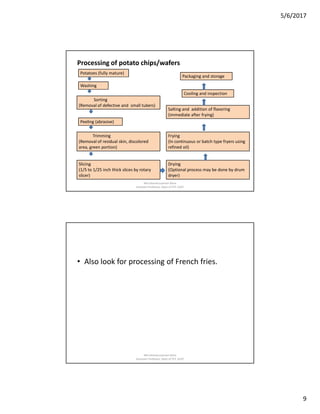
Processing of potato chips/wafers
Potatoes (fully mature)
Washing
Sorting
(Removal of defective and small tubers)
Peeling (abrasive)
Trimming
(Removal of residual skin, discolored
area, green portion)
Slicing
(1/5 to 1/25 inch thick slices by rotary
slicer)
Drying
(Optional process may be done by drum
dryer)
Frying
(In continuous or batch type fryers using
refined oil)
Salting and addition of flavoring
(immediate after frying)
Cooling and inspection
Packaging and storage
Md rahmatuzzaman Rana
Assistant Professor, Dept of FET, SUST
• Also look for processing of French fries.
Md rahmatuzzaman Rana
Assistant Professor, Dept of FET, SUST

Potato Processing

  • 1.
    5/6/2017 1 Potato Processing Md rahmatuzzamanRana Assistant Professor, Dept of FET, SUST • Semi-perishable, contains approx 80% water • Under tropical and sub-tropical conditions 40-50 % losses occur due to poor handling and storage. • Processing of potatoes is advantageous, because it reduce bulkiness and increase shelf-life. • Potatoes are processed into- 1. fried products such as wafers/chips etc.; 2. dehydrated products such as dice etc. 3. Frozen products such as French fries, patties, puffs, dice etc. 4. Canned. Md rahmatuzzaman Rana Assistant Professor, Dept of FET, SUST
  • 2.
    5/6/2017 2 Consideration in potatoprocessing 1. Specific gravity:  High: chips, French fries. Due to higher yield, low uptake of fat/oil, low mc need to be removed.  Low: Canning. Cause firm piece is desirable.  But!!! too high (1.106) is not suitable for French fries, chips because of biscuit like hardness and hard chips.  Measured by- a) brine solution of known sp. Gravity b) Hydrometer c) Archimedes principle d) Variable load hydrometer e) Ordinary scale Md rahmatuzzaman Rana Assistant Professor, Dept of FET, SUST Consideration in potato processing 2. Dry matter:  Important because of its high yield of potato chips or wafers, and texture of chips and reconstituted dried products.  Measured by- a) Oven drying but non-destructive method Md rahmatuzzaman Rana Assistant Professor, Dept of FET, SUST
  • 3.
    5/6/2017 3 Consideration in potatoprocessing 3. Sugar content  Sugar content influences the color of the processed products.  High glucose, fructose containing potatoes are not suitable for chips and French fries because of the reaction between reducing sugar and amino acid and causes discoloration  Generally, freshly harvested mature potatoes contain acceptable level of reducing sugar but when stored at low temperature (-5 oC) sugar content increase.  On the other hand, when stored at ambient temperature then sugar content are not increased that much but sprouting and weight loss are excessive. Md rahmatuzzaman Rana Assistant Professor, Dept of FET, SUST Consideration in potato processing 3. Sugar content  Sugar content influences the color of the processed products.  High glucose, fructose containing potatoes are not suitable for chips and French fries because of the reaction between reducing sugar and amino acid and causes discoloration  Generally, freshly harvested mature potatoes contain acceptable level of reducing sugar but when stored at low temperature (-5 oC) sugar content increase.  On the other hand, when stored at ambient temperature then sugar content are not increased that much but sprouting and weight loss are excessive.  Evaporative cooled storage system has still similar change in sugar content and problems with lower weight loss but still sprouting problem remained. Md rahmatuzzaman Rana Assistant Professor, Dept of FET, SUST
  • 4.
    5/6/2017 4 Consideration in potatoprocessing 3. Sugar content  To overcome these problems potatoes are often treated with CIPC (Isopropyl-N-chlorophenyl carbamate) and stored at low temperature. But under this condition potatoes are unfit for processing within short period.  Reconditioning: cold stored potatoes are stored at 15-20 oC for 2-3 weeks and reduction in sugar content take place.  To overcome unacceptable color problem, chips often fried at lower temperature but it contain 30 % more oil than normal condition.  Discoloration due to sugar content is cope up by selection of right variety which accumulates less sugar content. Md rahmatuzzaman Rana Assistant Professor, Dept of FET, SUST Consideration in potato processing 4. Discoloration  Problems affecting appearance and acceptability.  Potatoes and potato products are prone to 3 types of discoloration- a. Enzymatic discoloration: PPO enzyme acts on polyphenol content in presence of air and oxygen.  Exclusion of oxygen and air: inactivating enzyme with heat or lowering the pH; treat the whole potato with SO2 gas and stored; high conc. of CO2 also can be used.  Potash fertilizer often used on field to overcome enzymatic discoloration but still low dry mater content problem may occur.  Chemicals like sulfite often use though it has health hazard problems esp. for asthmatic patient. Md rahmatuzzaman Rana Assistant Professor, Dept of FET, SUST
  • 5.
    5/6/2017 5 Consideration in potatoprocessing 4. Discoloration b. After cooking discoloration: Non enzymatic browning reaction take place at high temperatures.  It happen due to the formation of dark colored complex of ferric iron and phenolic compound.  Factors such as iron content, organic acid, phenolic compounds and pH is less in immature than mature tubers.  Darkening can be prevented if the potato in solution is acidic than normal condition.  Organic acid such as aspartic acid affects discoloration after cooking attributed to pH or ability to chelate iron. The more citric acid lesser content of darkening.  This problems with different varieties can be overcome by storing at high temeprature or by reconditioning at 3035 oC for two weeks. Md rahmatuzzaman Rana Assistant Professor, Dept of FET, SUST Consideration in potato processing 4. Discoloration b. Discoloration of fried and dehydrated products: high sugar content and discolored during dehydration and to turn dark during storage. i. Fermentation: excess quantity of sugars can be fermented to lactic acid by Lactobacillus plantarum. ii. Washing raw slices in water: 50% of the RS and 40% of free AA are removed. Md rahmatuzzaman Rana Assistant Professor, Dept of FET, SUST
  • 6.
    5/6/2017 6 Consideration in potatoprocessing 5. Peeling  Ideal peeling operation should only remove a very thin outer layer of the potato, leaving no eyes, blemishes, or other material for later removal by hand trimming. It should not significantly change the physical or chemical characteristics of the remaining tissue.  The effectiveness of peeling determine the yield of finished product, the amount of waste, and cost of waste disposal. Md rahmatuzzaman Rana Assistant Professor, Dept of FET, SUST Consideration in potato processing 5. Peeling A. Abrasive peeler: designed to uniformly contact the surface of tubers with abrasive discs or rollers so that, while peeling, the losses are minimum.  The peel fragments are flushed out by water sprays.  Works best with uniform size of tubers.  Suitable for chips/wafers, since other peeling processes which use heat, give a coated layer of tissue, or a visible heat ring. Md rahmatuzzaman Rana Assistant Professor, Dept of FET, SUST
  • 7.
    5/6/2017 7 Consideration in potatoprocessing 5. Peeling B. Lye peeling: NaOH solution is used at a high temperature, i.e. 160 oF or lower temperature, i.e. 120-160 oF.  Potaoes may be preheated for a short period of time in water at temperature ranging from 140-190 oF. This minimize cooling effect and help to maintain uniform temperature.  Use of low temperature reduces the heat ring or cooked surface layer on peeled potato.  Lye peeling softens the surface of the potato and the color changes to deep yellow due to reaction of the lye with potato constituents.  After lye peeling, potatoes are washed to remove lye solution. Md rahmatuzzaman Rana Assistant Professor, Dept of FET, SUST Consideration in potato processing 5. Peeling C. Brine peeling: Brine solution maintained near boiling or saturation points.  However, evaporation of water happen continuously hence it is necessary to prevent over saturation and crystallization.  Immersion time: 3-10 minutes. D. Steam peeling: High pressure steam for short time.  Hydrates potatoes and soften surface tissue and loosen the peel. The softened tissue removed by brushes or water sprays.  This method leaves heat ring on outer surface which is not objectionable for many products exception in chips/wafers. Md rahmatuzzaman Rana Assistant Professor, Dept of FET, SUST
  • 8.
    5/6/2017 8 Consideration in potatoprocessing 5. Peeling C. Brine peeling: Brine solution maintained near boiling or saturation points.  However, evaporation of water happen continuously hence it is necessary to prevent over saturation and crystallization.  Immersion time: 3-10 minutes. D. Steam peeling: High pressure steam for short time.  Hydrates potatoes and soften surface tissue and loosen the peel. The softened tissue removed by brushes or water sprays.  This method leaves heat ring on outer surface which is not objectionable for many products exception in chips/wafers. Md rahmatuzzaman Rana Assistant Professor, Dept of FET, SUST The potato verities criteria for processing 1) High degree of maturity, round or oval shape, medium to large with fleet eyes, and free from diseases. 2) Long dormancy 3) High sp. Gravity and dry matter content. 4) Low sugar content 5) Free from after cooking discoloration 6) Low peeling losses. Md rahmatuzzaman Rana Assistant Professor, Dept of FET, SUST
  • 9.
    5/6/2017 9 Processing of potatochips/wafers Potatoes (fully mature) Washing Sorting (Removal of defective and small tubers) Peeling (abrasive) Trimming (Removal of residual skin, discolored area, green portion) Slicing (1/5 to 1/25 inch thick slices by rotary slicer) Drying (Optional process may be done by drum dryer) Frying (In continuous or batch type fryers using refined oil) Salting and addition of flavoring (immediate after frying) Cooling and inspection Packaging and storage Md rahmatuzzaman Rana Assistant Professor, Dept of FET, SUST • Also look for processing of French fries. Md rahmatuzzaman Rana Assistant Professor, Dept of FET, SUST