POTASSIUM
 Potassium was discovered by Sir Humphrey Davy at
1807 in England.
 Origin of name: from the English word "potash"
(pot ashes) and the Arabic word "qali" meaning
alkali (the origin of the symbol K comes from the
Latin word "kalium")
 Potassium was isolated in 1807 by Sir Humphry
Davy, who obtained it through the electrolysis of
very dry molten caustic potash (KOH, potassium
hydroxide). Potassium collected at the cathode.
Potassium was the first metal isolated by
electrolysis.
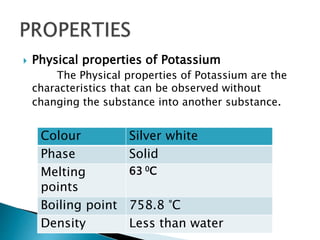
 Physical properties of Potassium
The Physical properties of Potassium are the
characteristics that can be observed without
changing the substance into another substance.
Colour Silver white
Phase Solid
Melting
points
63 0C
Boiling point 758.8 °C
Density Less than water
 Chemical Properties of Potassium
They are the characteristics that determine how
it will react with other substances or change from
one substance to another. Chemical
properties are only observable during a chemical
reaction
Chemical formula K
Reactivity with
water
It reacts with water violently and gives off
hydrogen gas
Reactivity It reacts readily with all acids and with all non-
metals, such as sulphur, chlorine, fluorine,
phosphorus, and nitrogen
Highly or explosively reactive
Compounds Useful compounds include the bromide, KBr, the
cyanide, KCN, Potassium carbonate K2CO3
Substances containing potassium impart a purple
colour to a flame
Oxidation Rapidly oxidizes in air
Alloys Alloyed with sodium as a cooling medium in
nuclear reactors
 The primary function of potassium in your body is
to serve as an electrolyte.
 Potassium is the main electrolyte inside your cell;
along with the sodium outside your cells, it creates
a phenomenon known as the membrane potential.
 The membrane potential allows an electrical
current to pass from one cell to the next.
 Thus potassium play important role in contracts
muscle fibers – including those of your heart – and
transmits nerve signals.
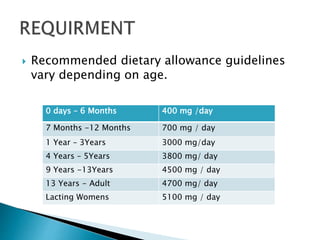
 Recommended dietary allowance guidelines
vary depending on age.
0 days – 6 Months 400 mg /day
7 Months -12 Months 700 mg / day
1 Year – 3Years 3000 mg/day
4 Years – 5Years 3800 mg/ day
9 Years -13Years 4500 mg / day
13 Years - Adult 4700 mg/ day
Lacting Womens 5100 mg / day
Rich sources-
Beans, dark leafy greens, potatoes, squash,
yogurt, fish, avocados, mushrooms, and bananas.
Good sources-
Avocado, beef, pork, poultry, nuts.
Fair sources-
Cereals, egg, fruit juices, milk, wine, yogurt
 Low potassium (hypokalaemia)
Low potassium levels (hypokalaemia) can
cause weakness as cellular processes are affected.
 Low potassium causes
 Dehydration, diarrhoea, excessive
sweating (hyperhidrosis) and laxative abuse are
common causes of low potassium levels.
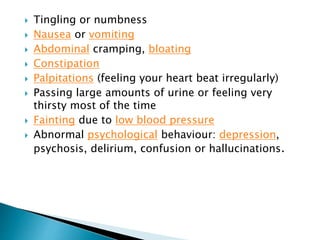
 Symptoms of low potassium are
 . There may be more than one symptom involving
thegastrointestinal (GI) tract, kidneys, muscles, heart
and nerves.
 Weakness, tiredness, or cramping in arm or leg
muscles, sometimes severe enough to cause inability to
move arms or legs due to weakness (much like a
paralysis)
 Tingling or numbness
 Nausea or vomiting
 Abdominal cramping, bloating
 Constipation
 Palpitations (feeling your heart beat irregularly)
 Passing large amounts of urine or feeling very
thirsty most of the time
 Fainting due to low blood pressure
 Abnormal psychological behaviour: depression,
psychosis, delirium, confusion or hallucinations.
Potassium is a mineral that's crucial for life.
Potassium is necessary for the heart, kidneys,
and other organs to work normally.
Hence adequate amount of potassium in
diet with or without supplements, should be
enough to keep you healthy.
Potassium

Potassium

  • 1.
  • 2.
     Potassium wasdiscovered by Sir Humphrey Davy at 1807 in England.  Origin of name: from the English word "potash" (pot ashes) and the Arabic word "qali" meaning alkali (the origin of the symbol K comes from the Latin word "kalium")  Potassium was isolated in 1807 by Sir Humphry Davy, who obtained it through the electrolysis of very dry molten caustic potash (KOH, potassium hydroxide). Potassium collected at the cathode. Potassium was the first metal isolated by electrolysis.
  • 3.
     Physical propertiesof Potassium The Physical properties of Potassium are the characteristics that can be observed without changing the substance into another substance. Colour Silver white Phase Solid Melting points 63 0C Boiling point 758.8 °C Density Less than water
  • 4.
     Chemical Propertiesof Potassium They are the characteristics that determine how it will react with other substances or change from one substance to another. Chemical properties are only observable during a chemical reaction Chemical formula K Reactivity with water It reacts with water violently and gives off hydrogen gas Reactivity It reacts readily with all acids and with all non- metals, such as sulphur, chlorine, fluorine, phosphorus, and nitrogen Highly or explosively reactive Compounds Useful compounds include the bromide, KBr, the cyanide, KCN, Potassium carbonate K2CO3 Substances containing potassium impart a purple colour to a flame Oxidation Rapidly oxidizes in air Alloys Alloyed with sodium as a cooling medium in nuclear reactors
  • 5.
     The primaryfunction of potassium in your body is to serve as an electrolyte.  Potassium is the main electrolyte inside your cell; along with the sodium outside your cells, it creates a phenomenon known as the membrane potential.  The membrane potential allows an electrical current to pass from one cell to the next.  Thus potassium play important role in contracts muscle fibers – including those of your heart – and transmits nerve signals.
  • 6.
     Recommended dietaryallowance guidelines vary depending on age. 0 days – 6 Months 400 mg /day 7 Months -12 Months 700 mg / day 1 Year – 3Years 3000 mg/day 4 Years – 5Years 3800 mg/ day 9 Years -13Years 4500 mg / day 13 Years - Adult 4700 mg/ day Lacting Womens 5100 mg / day
  • 7.
    Rich sources- Beans, darkleafy greens, potatoes, squash, yogurt, fish, avocados, mushrooms, and bananas. Good sources- Avocado, beef, pork, poultry, nuts. Fair sources- Cereals, egg, fruit juices, milk, wine, yogurt
  • 8.
     Low potassium(hypokalaemia) Low potassium levels (hypokalaemia) can cause weakness as cellular processes are affected.  Low potassium causes  Dehydration, diarrhoea, excessive sweating (hyperhidrosis) and laxative abuse are common causes of low potassium levels.  Symptoms of low potassium are  . There may be more than one symptom involving thegastrointestinal (GI) tract, kidneys, muscles, heart and nerves.  Weakness, tiredness, or cramping in arm or leg muscles, sometimes severe enough to cause inability to move arms or legs due to weakness (much like a paralysis)
  • 9.
     Tingling ornumbness  Nausea or vomiting  Abdominal cramping, bloating  Constipation  Palpitations (feeling your heart beat irregularly)  Passing large amounts of urine or feeling very thirsty most of the time  Fainting due to low blood pressure  Abnormal psychological behaviour: depression, psychosis, delirium, confusion or hallucinations.
  • 10.
    Potassium is amineral that's crucial for life. Potassium is necessary for the heart, kidneys, and other organs to work normally. Hence adequate amount of potassium in diet with or without supplements, should be enough to keep you healthy.