HUMAN POSTURE
Posture
Posture is the attitude which is assumed
by body parts to maintain stability and
balance with minimum effort and least
strain during supportive and non
supportive positions.
Types of Posture
:
1
-
Inactive Posture
:
resting positions
.
2
-
Active Posture
:
which could be static or dynamic
.
Standing Posture (Erect Posture)
Although the COG in normal standing posture
is relatively high and presence of a narrow
base of support (both feet width and length)
only a minimal activity of muscular
contraction is required in maintenance of
static standing posture
?
What is the reason of it
?
Factors affecting mechanics of
posture
:
1-Body Physique. Body build i.e. percentage
of fat free component (muscles and bones
to adipose tissue.)
2- Nervous Control of posture.
3- Pathway of line of gravity.
4- Pelvic Inclination.
In normal optimal standing posture the LOG falls
close to not through most joint axes. Which is
counterbalanced by passive tension produced by
ligaments and other soft tissues, joints reaction forces
in addition to active tension produced by minimal
muscular activity.
3-Normal pathway of line of gravity in static
standing posture:
From frontal view
The LOG passes through the body’s center of gravity
which theoretically bisects the body into two equal
halves, with the body weight is equally distributed
between the two feet
.
From lateral view
1
-
Vertex
.
2
-
Passes through the
lobe of the ears
.
3
-
odontoid process
.
4- Anterior to the axis of flex./ext. of the upper cervical:
Creating a flexion moment which is (counter balanced by
tension in ligamentum nuchae and activity of neck extensor
muscles, to keep head in neutral position.
5- Posterior to the cervical spine:
Thus creating extension moment.
6- At the junction of the cervico-dorsal vertebrae:
No moment.
7- Anterior to the body of the dorsal vertebrae: Thus creating
flexion moment.
8- At the junction of the dorso lumbar vertebrae:
No moment.
9- Posterior to the body of the lumbar vertebrae:
Thus creating extension moment. Counter balanced by anterior
longitudinal ligament of the spine.
10-Through 5th
lumbar vertebrae, and posterior to the junction of
the lumbosacral joint:
Thus creating extension moment. Counter balanced by anterior
longitudinal ligament of the spine.
11-Anterior to sacroiliac joint:
Thus creating flexion moment (which tends to
cause the superior portion of the sacrum to
rotate anteriorly and inferiorly and the inferior
portion of the sacrum to rotate in the posterior
direction). Counter balanced by sacrospinous
and sacrotuberous ligaments. In addition to the
sacroiliac ligament which counter balance the
anterior rotation of the upper sacrum.
12-Just behind (through greater trochanter) or via the axis of the
hip joint:
Thus may create extension moment which tends to rotate pelvis
posteriorly on the femoral head. So counterbalanced by
illiopsoas muscle activity and iliofemoral, pubofemoral and
ischiofemoral ligaments.
13- Anterior to the axis of knee joint:
Thus may create extension moment (stabilizing).
Counterbalanced by passive tension in posterior joint capsule
and associated ligaments to prevent hyperextension of knee
joint.
14- 5 cm (2 inches) in the front of the ankle joint at the level of the
tarsal bones:
Creates a dorsiflexion moment counter balanced by calf
muscles to prevent forward motion of tibia.
Changes in Normal LOG Pathway
• If a subject is carrying a mass or a pregnant woman
so LOG moves further anteriorly and there will be
a tendency to fall forward. Counterbalanced by
activities of back extensors.
• If a subject climbs a hill the LOG falls backward,
so the person will move forward to counterbalance
this action. So he shifts the LOG forward and
keeps it within the base of support.
• If a subjects descends a hill, the COG falls in front
of him so he will move the trunk backward with
increase in the lumbar lordotic curve to counteract
the effect of gravity.
• In case of wearing high heeled shoes in normal
standing position, the LOG moves forward more
than usual and thus increase load on calf muscles.
Role of Global and Core Muscle Activity
The muscles of the neck and trunk not only act as prime movers or
as antagonists to movement caused by gravity during dynamic
activity, they are important stabilizers of the spine
.
Without the dynamic stabilizing activity from the trunk muscles, the
spine would collapse in the upright position
.
Both superficial (global) and deep (core) muscles function to
maintain the upright posture
.
The global muscles are the large guy wires that respond to
external loads imposed on the trunk that shift the center of mass
.
Their reaction is direction-specific to control spinal
orientation
.
The global muscles are unable to stabilize individual spinal
segments except through compressive loading because
they have little or no direct attachment to the vertebrae
.
If an individual segment is unstable, compressive loading
from the global guy wires may lead to or perpetuate a
painful situation as stress is placed on the inert tissues at
the end of the range of that segment
The deeper, core muscles, which have segmental
attachments, respond regardless of direction of motion
.
They provide dynamic support to individual segments in
the spine and help maintain each segment in a stable
position so the inert tissues are not stressed at the
limits of motion
.
Both the global and core musculature play critical roles in
providing stability to the multi-segmental spine
.
Role of Muscle Endurance
Only about 10% of maximum contraction is needed to provide
stability in usual situations
.
Slightly more might be needed in a segment damaged by disk
disease or ligamentous laxity when muscles are called on to
compensate for the deficit in the passive support
.
More type I fibers in back muscles making them more of
stabilizing tissues
.
Inactivity changes muscle fiber composition and is said to be
the reason of decreased activity in LBP patients
.
Muscle Control in the Lumbar
Spine
• TrAbd and Multifidi provide segmental control
and stiffness.(local stabilizers)
• First muscles to get active in case of postural
disturbance from rapid extremity movements.
• Intersegmental muscles and deep fibers of the
quadratus lumborum.
POSTURAL
EVALUATION.
Postural Evaluation
• Hyperlordotic Posture:
– Joints involved:
• Lumbar spine, pelvis, hip
– Possible cause:
• Tightened or shortened hip flexor muscles
• Weakened or elongated hip extensors or
abdominals
• Poor postural sense
– Adverse effects:
• ↑ lumbar lordosis
• Anterior pelvic tilt
• Hips assuming a flexed position
Postural Evaluation
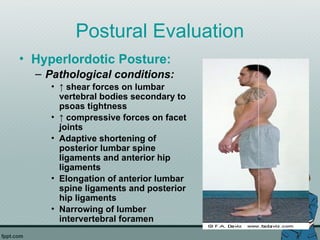
• Hyperlordotic Posture:
– Pathological conditions:
• ↑ shear forces on lumbar
vertebral bodies secondary to
psoas tightness
• ↑ compressive forces on facet
joints
• Adaptive shortening of
posterior lumbar spine
ligaments and anterior hip
ligaments
• Elongation of anterior lumbar
spine ligaments and posterior
hip ligaments
• Narrowing of lumber
intervertebral foramen
Postural Evaluation
• Kypholordotic Posture:
– Similar to hyperlordotic posture:
• ↑ total lumbar lordosis
– Differences:
• Compensatory ↑ in thoracic kyphosis:
– Attempt to maintain spine in position of equilibrium
• Cervical spine: ↑ in lordosis (Forward head
posture)
– Joints involved:
• Pelvis, hip joint, lumbar spine, thoracic spine,
cervical spine
Postural Evaluation
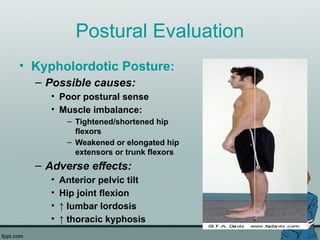
• Kypholordotic Posture:
– Possible causes:
• Poor postural sense
• Muscle imbalance:
– Tightened/shortened hip
flexors
– Weakened or elongated hip
extensors or trunk flexors
– Adverse effects:
• Anterior pelvic tilt
• Hip joint flexion
• ↑ lumbar lordosis
• ↑ thoracic kyphosis
Postural Evaluation
• Kypholordotic Posture:
– Pathological conditions:
• Adaptive shortening of
anterior chest muscles
• Elongation of thoracic
paraspinal muscles
• ↑ compressive forces on
anterior thoracic vertebrae and
posterior lumbar vertebrae
• ↑ tensile forces on
ligamentous structures in
posterior thoracic spine and
anterior lumbar spine
• ↑ facet joint compression
• Forward head posture
• Forward shoulder posture
Postural Evaluation
• Swayback Posture:
– Key: ↑ reliance on ligaments for postural stability
• Joints at end ROM (excessive stress on ligaments)
– Joints involved:
• Knees, hips, lumbar spine, lower thoracic spine, cervical
spine
– Possible causes:
• Ectomorph body: hypomobility of joints
• Poor postural sense
• Tightened/shortened hip extensors
• Weakened or elongated hip flexors or lower abdominals
• ↓ general muscular strength
Postural Evaluation
• Swayback Posture:
– Adverse Effects:
• Genu recurvatum
• Hip joint extension
• Posterior pelvic tilt
• Lumbar spine in neutral
or minimal flexed
position
• ↑ in lower thoracic,
thoracolumbar curvature
Postural Evaluation
• Swayback Posture:
– Pathological Conditions:
• Elongated or ↑ tensile forces
on anterior hip ligaments
and posterior aspect of
lower thoracic spine
• Adapted/shortened or ↑
compressive forces on
posterior hip ligaments and
anterior lower thoracic spine
• ↑ tensile force on posterior
knee and compressive force
on anterior knee
• ↑ shearing forces on L5/S1
• Forward head and shoulder
posture
Postural Evaluation
• Flat Back Posture:
– Key: Lost normal “S” shape spine curvature in
the sagital plane
– Joints:
• Hip joint, lumbar spine, thoracic spine, cervical spine
– Possible causes:
• Shortened/tightened hip extensors, abdominal
musculature
• Weakened, elongated hip flexors
• Poor posture
– Adverse effects:
• Extended hip joint / posterior pelvic tilt
• Extended thoracic spine
• Flexed middle and lower cervical spine, extended upper
cervical spine
Postural Evaluation
•
Flat Back Posture
:
Pathological conditions:
Compressive forces in
posterior hip joint, anterior
lumber and mid-low cervical
spines, posterior thoracic
and upper cervical spines
Elongation of soft tissue
Forward head posture
(compensation for posterior
spine displacement)
Postural Evaluation
Scoliosis:
– Lateral curvature of
spinal column
– Right handed people:
mild R thoracic L
lumbar S curve.
– May b asymmetry in hip
pelvis and lower
extremities.
Muscle impairments
:
• Mobility impairment in structures on the concave side of the
curves.
• Impaired muscle performance due to stretch and weakness in
the musculature on the convex side of the curves.
• If one hip is adducted, the adductor muscles on that side have
decreased flexibility and the abductor muscles are stretched
and weak. The opposite occurs on the contralateral extremity.
• With advanced structural scoliosis, cardiopulmonary
impairment may restrict function.
• Functional/ postural:
spine attempts to
compensate to
maintain the head in a
neutral position and
keep eyes level
• Reversible, changes
with forward bending,
side bending and
positional changes.
– Muscular imbalance,
spasm, pelvic
obliquity, limb-length
discrepancy
• Structural: defect or congenital
bony abnormality of vertebrae
– Neuromuscular diseases
or disorders (e.g., cerebral
palsy, spinal cord injury,
progressive neurological
or muscular diseases),
– osteopathic disorders
(e.g., hemivertebra,
osteomalacia, rickets,
fracture).
Postural Evaluation
Postural Evaluation
• Forward Shoulder Posture:
– Key: characterized by
protraction and elevation of
scapulae and a forward,
rounded position of
shoulders
• May include scapula winging
and IR
• Forward head posture
– Joints:
• Scapulothoracic articulation
• Glenohumeral joint
• Thoracic spine
• Cervical spine
Postural Evaluation
• Forward Shoulder
Posture:
– Possible causes:
• Tightened, shortened pectoral
muscles
• Weakened or elongated
scapular retractors (mid and
low trapezius, rhomboids)
• Poor postural awareness
and/or muscle fatigue
• Large breast development
– Adverse effects:
• Humeral head stress
(displaced anteriorly)
• Forward head posture
Postural Evaluation
• Forward Shoulder Posture:
– Pathological conditions:
• Thoracic outlet syndrome:
– Adaptive shortening of pectoralis minor,
anterior/middle scalenes → compression of
subclavian artery, vein, and medial cord of brachial
plexus
• Abnormal scapulohumeral rhythm and
scapular stability
• Acromioclavicular degeneration
• Bicepital tendonitis
• Impingement syndrome
• Abnormal GH biomechanics
Postural Evaluation
• Scapula Winging:
– Weakness of
serratus anterior,
middle and lower
trapezius
• Long thoracic
nerve
– Biomechanics of
normal arm
movement thrown
off
Postural Evaluation
• Forward Head Posture:
– Key: anterior displacement
of head relative to thorax
– Joints:
• Cervical spine, GH, thoracic
spine
– Possible causes:
• Poor eyesight (need glasses)
• Muscle fatigue/weakness
• Poor postural sense
– Adverse effects:
• Flexion of lower cervical spine
• Flattening of mid cervical spine
• GH motion affected
Postural Evaluation
• Forward Head Posture:
– Pathological conditions:
• Shortened suboccipital muscles, scalenes,
upper trapezius, levator scapula
• Hypomobile upper cervical region
• Abnormal GH biomechanics
• TMJ dysfunction
• Thoracic outlet syndrome (scalene
involvement)
• Forward shoulder posture
• Myofascial pain (posterior cervical muscles)
Leg length discrepancy
:
• An elevated ilium on the long leg (LL) side and lowered on the
short leg (SL) side is the characteristic deviation.
• This puts the LL side in hip adduction with greater shear stress
and the SL side in hip abduction with greater compression
stress.
• The sacroiliac (SI) joint on the LL side is more vertical with
greater shear stress; on the SL side it is more horizontal with
greater compression stress.
• Side bending of the lumbar spine toward the LL side coupled
with rotation in the opposite direction.
• This compresses the intervertebral disk on the LL side and
distracts the disk on the SL side; it also causes torsional stress.
• There is extension and compression of the lumbar facets on the
LL side (concave portion of the curve) and flexion and distraction
of the lumbar facets on the SL side (convex portion of the curve).
• There is narrowing of the intervertebral foramina on the LL side.
• The thoracic and cervical spine has compensatory scoliosis in
the opposite direction.
Muscle Impairments
• Mobility impairment from decreased flexibility in the hip
adductors on the LL side and abductors on the SL side.
• Asymmetrical differences in the iliopsoas, quadratus
lumborum, piriformis, erector spinae, and multifidus
muscles, with those on the concave side of the curve or the
LL side having decreased flexibility.
• Impaired muscle performance from stretched and
weakened muscles including hip adductors on the SL side,
abductors on the LL side, and in general muscles on the
convex side of the curve.
Sources of Symptoms
• Greater shear forces occur in the hip and SI joints on the LL side, which
increases stress in the supporting ligaments and decreases the load-bearing
surface in the joint.
• Degenerative changes occur more frequently in hips on the LL side.
• Stenosis in the lumbar intervertebral foramina on the LL cause vascular
congestion or nerve root irritation.
• Lumbar facet compression and irritation on the LL side.
• Disk breakdown from torsional and asymmetrical forces.
• Muscle tension, fatigue, or spasm in response to asymmetrical loading and
response.
• Lower extremity overuse syndromes.
• Thank you!

POSTURE.pptx......,............. .........

  • 1.
  • 2.
    Posture Posture is theattitude which is assumed by body parts to maintain stability and balance with minimum effort and least strain during supportive and non supportive positions.
  • 3.
    Types of Posture : 1 - InactivePosture : resting positions . 2 - Active Posture : which could be static or dynamic .
  • 4.
    Standing Posture (ErectPosture) Although the COG in normal standing posture is relatively high and presence of a narrow base of support (both feet width and length) only a minimal activity of muscular contraction is required in maintenance of static standing posture ? What is the reason of it ?
  • 5.
    Factors affecting mechanicsof posture : 1-Body Physique. Body build i.e. percentage of fat free component (muscles and bones to adipose tissue.) 2- Nervous Control of posture. 3- Pathway of line of gravity. 4- Pelvic Inclination.
  • 6.
    In normal optimalstanding posture the LOG falls close to not through most joint axes. Which is counterbalanced by passive tension produced by ligaments and other soft tissues, joints reaction forces in addition to active tension produced by minimal muscular activity. 3-Normal pathway of line of gravity in static standing posture:
  • 7.
    From frontal view TheLOG passes through the body’s center of gravity which theoretically bisects the body into two equal halves, with the body weight is equally distributed between the two feet .
  • 8.
    From lateral view 1 - Vertex . 2 - Passesthrough the lobe of the ears . 3 - odontoid process .
  • 9.
    4- Anterior tothe axis of flex./ext. of the upper cervical: Creating a flexion moment which is (counter balanced by tension in ligamentum nuchae and activity of neck extensor muscles, to keep head in neutral position. 5- Posterior to the cervical spine: Thus creating extension moment. 6- At the junction of the cervico-dorsal vertebrae: No moment. 7- Anterior to the body of the dorsal vertebrae: Thus creating flexion moment.
  • 10.
    8- At thejunction of the dorso lumbar vertebrae: No moment. 9- Posterior to the body of the lumbar vertebrae: Thus creating extension moment. Counter balanced by anterior longitudinal ligament of the spine. 10-Through 5th lumbar vertebrae, and posterior to the junction of the lumbosacral joint: Thus creating extension moment. Counter balanced by anterior longitudinal ligament of the spine.
  • 11.
    11-Anterior to sacroiliacjoint: Thus creating flexion moment (which tends to cause the superior portion of the sacrum to rotate anteriorly and inferiorly and the inferior portion of the sacrum to rotate in the posterior direction). Counter balanced by sacrospinous and sacrotuberous ligaments. In addition to the sacroiliac ligament which counter balance the anterior rotation of the upper sacrum.
  • 13.
    12-Just behind (throughgreater trochanter) or via the axis of the hip joint: Thus may create extension moment which tends to rotate pelvis posteriorly on the femoral head. So counterbalanced by illiopsoas muscle activity and iliofemoral, pubofemoral and ischiofemoral ligaments. 13- Anterior to the axis of knee joint: Thus may create extension moment (stabilizing). Counterbalanced by passive tension in posterior joint capsule and associated ligaments to prevent hyperextension of knee joint. 14- 5 cm (2 inches) in the front of the ankle joint at the level of the tarsal bones: Creates a dorsiflexion moment counter balanced by calf muscles to prevent forward motion of tibia.
  • 15.
    Changes in NormalLOG Pathway • If a subject is carrying a mass or a pregnant woman so LOG moves further anteriorly and there will be a tendency to fall forward. Counterbalanced by activities of back extensors. • If a subject climbs a hill the LOG falls backward, so the person will move forward to counterbalance this action. So he shifts the LOG forward and keeps it within the base of support.
  • 16.
    • If asubjects descends a hill, the COG falls in front of him so he will move the trunk backward with increase in the lumbar lordotic curve to counteract the effect of gravity. • In case of wearing high heeled shoes in normal standing position, the LOG moves forward more than usual and thus increase load on calf muscles.
  • 17.
    Role of Globaland Core Muscle Activity The muscles of the neck and trunk not only act as prime movers or as antagonists to movement caused by gravity during dynamic activity, they are important stabilizers of the spine . Without the dynamic stabilizing activity from the trunk muscles, the spine would collapse in the upright position . Both superficial (global) and deep (core) muscles function to maintain the upright posture . The global muscles are the large guy wires that respond to external loads imposed on the trunk that shift the center of mass .
  • 18.
    Their reaction isdirection-specific to control spinal orientation . The global muscles are unable to stabilize individual spinal segments except through compressive loading because they have little or no direct attachment to the vertebrae . If an individual segment is unstable, compressive loading from the global guy wires may lead to or perpetuate a painful situation as stress is placed on the inert tissues at the end of the range of that segment
  • 20.
    The deeper, coremuscles, which have segmental attachments, respond regardless of direction of motion . They provide dynamic support to individual segments in the spine and help maintain each segment in a stable position so the inert tissues are not stressed at the limits of motion . Both the global and core musculature play critical roles in providing stability to the multi-segmental spine .
  • 21.
    Role of MuscleEndurance Only about 10% of maximum contraction is needed to provide stability in usual situations . Slightly more might be needed in a segment damaged by disk disease or ligamentous laxity when muscles are called on to compensate for the deficit in the passive support . More type I fibers in back muscles making them more of stabilizing tissues . Inactivity changes muscle fiber composition and is said to be the reason of decreased activity in LBP patients .
  • 22.
    Muscle Control inthe Lumbar Spine • TrAbd and Multifidi provide segmental control and stiffness.(local stabilizers) • First muscles to get active in case of postural disturbance from rapid extremity movements. • Intersegmental muscles and deep fibers of the quadratus lumborum.
  • 23.
  • 24.
    Postural Evaluation • HyperlordoticPosture: – Joints involved: • Lumbar spine, pelvis, hip – Possible cause: • Tightened or shortened hip flexor muscles • Weakened or elongated hip extensors or abdominals • Poor postural sense – Adverse effects: • ↑ lumbar lordosis • Anterior pelvic tilt • Hips assuming a flexed position
  • 25.
    Postural Evaluation • HyperlordoticPosture: – Pathological conditions: • ↑ shear forces on lumbar vertebral bodies secondary to psoas tightness • ↑ compressive forces on facet joints • Adaptive shortening of posterior lumbar spine ligaments and anterior hip ligaments • Elongation of anterior lumbar spine ligaments and posterior hip ligaments • Narrowing of lumber intervertebral foramen
  • 26.
    Postural Evaluation • KypholordoticPosture: – Similar to hyperlordotic posture: • ↑ total lumbar lordosis – Differences: • Compensatory ↑ in thoracic kyphosis: – Attempt to maintain spine in position of equilibrium • Cervical spine: ↑ in lordosis (Forward head posture) – Joints involved: • Pelvis, hip joint, lumbar spine, thoracic spine, cervical spine
  • 27.
    Postural Evaluation • KypholordoticPosture: – Possible causes: • Poor postural sense • Muscle imbalance: – Tightened/shortened hip flexors – Weakened or elongated hip extensors or trunk flexors – Adverse effects: • Anterior pelvic tilt • Hip joint flexion • ↑ lumbar lordosis • ↑ thoracic kyphosis
  • 28.
    Postural Evaluation • KypholordoticPosture: – Pathological conditions: • Adaptive shortening of anterior chest muscles • Elongation of thoracic paraspinal muscles • ↑ compressive forces on anterior thoracic vertebrae and posterior lumbar vertebrae • ↑ tensile forces on ligamentous structures in posterior thoracic spine and anterior lumbar spine • ↑ facet joint compression • Forward head posture • Forward shoulder posture
  • 30.
    Postural Evaluation • SwaybackPosture: – Key: ↑ reliance on ligaments for postural stability • Joints at end ROM (excessive stress on ligaments) – Joints involved: • Knees, hips, lumbar spine, lower thoracic spine, cervical spine – Possible causes: • Ectomorph body: hypomobility of joints • Poor postural sense • Tightened/shortened hip extensors • Weakened or elongated hip flexors or lower abdominals • ↓ general muscular strength
  • 31.
    Postural Evaluation • SwaybackPosture: – Adverse Effects: • Genu recurvatum • Hip joint extension • Posterior pelvic tilt • Lumbar spine in neutral or minimal flexed position • ↑ in lower thoracic, thoracolumbar curvature
  • 32.
    Postural Evaluation • SwaybackPosture: – Pathological Conditions: • Elongated or ↑ tensile forces on anterior hip ligaments and posterior aspect of lower thoracic spine • Adapted/shortened or ↑ compressive forces on posterior hip ligaments and anterior lower thoracic spine • ↑ tensile force on posterior knee and compressive force on anterior knee • ↑ shearing forces on L5/S1 • Forward head and shoulder posture
  • 33.
    Postural Evaluation • FlatBack Posture: – Key: Lost normal “S” shape spine curvature in the sagital plane – Joints: • Hip joint, lumbar spine, thoracic spine, cervical spine – Possible causes: • Shortened/tightened hip extensors, abdominal musculature • Weakened, elongated hip flexors • Poor posture – Adverse effects: • Extended hip joint / posterior pelvic tilt • Extended thoracic spine • Flexed middle and lower cervical spine, extended upper cervical spine
  • 34.
    Postural Evaluation • Flat BackPosture : Pathological conditions: Compressive forces in posterior hip joint, anterior lumber and mid-low cervical spines, posterior thoracic and upper cervical spines Elongation of soft tissue Forward head posture (compensation for posterior spine displacement)
  • 35.
    Postural Evaluation Scoliosis: – Lateralcurvature of spinal column – Right handed people: mild R thoracic L lumbar S curve. – May b asymmetry in hip pelvis and lower extremities.
  • 36.
    Muscle impairments : • Mobilityimpairment in structures on the concave side of the curves. • Impaired muscle performance due to stretch and weakness in the musculature on the convex side of the curves. • If one hip is adducted, the adductor muscles on that side have decreased flexibility and the abductor muscles are stretched and weak. The opposite occurs on the contralateral extremity. • With advanced structural scoliosis, cardiopulmonary impairment may restrict function.
  • 37.
    • Functional/ postural: spineattempts to compensate to maintain the head in a neutral position and keep eyes level • Reversible, changes with forward bending, side bending and positional changes. – Muscular imbalance, spasm, pelvic obliquity, limb-length discrepancy • Structural: defect or congenital bony abnormality of vertebrae – Neuromuscular diseases or disorders (e.g., cerebral palsy, spinal cord injury, progressive neurological or muscular diseases), – osteopathic disorders (e.g., hemivertebra, osteomalacia, rickets, fracture).
  • 38.
  • 39.
    Postural Evaluation • ForwardShoulder Posture: – Key: characterized by protraction and elevation of scapulae and a forward, rounded position of shoulders • May include scapula winging and IR • Forward head posture – Joints: • Scapulothoracic articulation • Glenohumeral joint • Thoracic spine • Cervical spine
  • 40.
    Postural Evaluation • ForwardShoulder Posture: – Possible causes: • Tightened, shortened pectoral muscles • Weakened or elongated scapular retractors (mid and low trapezius, rhomboids) • Poor postural awareness and/or muscle fatigue • Large breast development – Adverse effects: • Humeral head stress (displaced anteriorly) • Forward head posture
  • 41.
    Postural Evaluation • ForwardShoulder Posture: – Pathological conditions: • Thoracic outlet syndrome: – Adaptive shortening of pectoralis minor, anterior/middle scalenes → compression of subclavian artery, vein, and medial cord of brachial plexus • Abnormal scapulohumeral rhythm and scapular stability • Acromioclavicular degeneration • Bicepital tendonitis • Impingement syndrome • Abnormal GH biomechanics
  • 42.
    Postural Evaluation • ScapulaWinging: – Weakness of serratus anterior, middle and lower trapezius • Long thoracic nerve – Biomechanics of normal arm movement thrown off
  • 43.
    Postural Evaluation • ForwardHead Posture: – Key: anterior displacement of head relative to thorax – Joints: • Cervical spine, GH, thoracic spine – Possible causes: • Poor eyesight (need glasses) • Muscle fatigue/weakness • Poor postural sense – Adverse effects: • Flexion of lower cervical spine • Flattening of mid cervical spine • GH motion affected
  • 44.
    Postural Evaluation • ForwardHead Posture: – Pathological conditions: • Shortened suboccipital muscles, scalenes, upper trapezius, levator scapula • Hypomobile upper cervical region • Abnormal GH biomechanics • TMJ dysfunction • Thoracic outlet syndrome (scalene involvement) • Forward shoulder posture • Myofascial pain (posterior cervical muscles)
  • 46.
    Leg length discrepancy : •An elevated ilium on the long leg (LL) side and lowered on the short leg (SL) side is the characteristic deviation. • This puts the LL side in hip adduction with greater shear stress and the SL side in hip abduction with greater compression stress. • The sacroiliac (SI) joint on the LL side is more vertical with greater shear stress; on the SL side it is more horizontal with greater compression stress. • Side bending of the lumbar spine toward the LL side coupled with rotation in the opposite direction.
  • 47.
    • This compressesthe intervertebral disk on the LL side and distracts the disk on the SL side; it also causes torsional stress. • There is extension and compression of the lumbar facets on the LL side (concave portion of the curve) and flexion and distraction of the lumbar facets on the SL side (convex portion of the curve). • There is narrowing of the intervertebral foramina on the LL side. • The thoracic and cervical spine has compensatory scoliosis in the opposite direction.
  • 48.
    Muscle Impairments • Mobilityimpairment from decreased flexibility in the hip adductors on the LL side and abductors on the SL side. • Asymmetrical differences in the iliopsoas, quadratus lumborum, piriformis, erector spinae, and multifidus muscles, with those on the concave side of the curve or the LL side having decreased flexibility. • Impaired muscle performance from stretched and weakened muscles including hip adductors on the SL side, abductors on the LL side, and in general muscles on the convex side of the curve.
  • 49.
    Sources of Symptoms •Greater shear forces occur in the hip and SI joints on the LL side, which increases stress in the supporting ligaments and decreases the load-bearing surface in the joint. • Degenerative changes occur more frequently in hips on the LL side. • Stenosis in the lumbar intervertebral foramina on the LL cause vascular congestion or nerve root irritation. • Lumbar facet compression and irritation on the LL side. • Disk breakdown from torsional and asymmetrical forces. • Muscle tension, fatigue, or spasm in response to asymmetrical loading and response. • Lower extremity overuse syndromes.
  • 50.