Asthma
Ahikam Devadason J
Outline
• Definition
• Diagnosis
• New Updates from GINA 2019
• Exacerbation management
• New biologicals
• Points to ponder
• References
Defintion
Asthma is a heterogenous disease, usually
characterised by chronic airway inflammation. It is
defined by the history of respiratory symptoms such
as wheeze, shortness of breath, chest tightness and
cough that vary over time and in intensity, together
with variable expiratory airflow limitation
Diagnosis
1. History of variable respiratory symptoms:
wheeze, cough, chest tightness
2. Confirmed expiratory airflow limitation:
• Positive bronchodilator reversibility test
• Excessive variability in twice-daily PEF over 2 weeks
• Significant increase in LFT after 2 weeks of anti-
inflammatory therapy
• Positive exercise challenge test
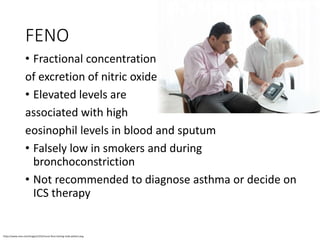
FENO
• Fractional concentration
of excretion of nitric oxide
• Elevated levels are
associated with high
eosinophil levels in blood and sputum
• Falsely low in smokers and during
bronchoconstriction
• Not recommended to diagnose asthma or decide on
ICS therapy
https://www.niox.com/images/1015/nurse-feno-testing-male-patient.png
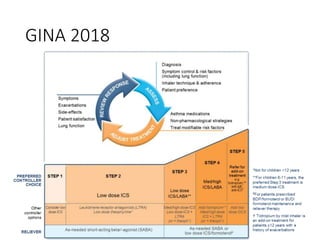
GINA 2018
* Off-label; data only with budesonide-formoterol (bud-form)
† Off-label; separate or combination ICS and SABA inhalers
PREFERRED
CONTROLLER
to prevent exacerbations
and control symptoms
Other
controller options
Other
reliever option
PREFERRED
RELIEVER
STEP 2
Daily low dose inhaled corticosteroid (ICS),
or as-needed low dose ICS-formoterol *
STEP 3
Low dose
ICS-LABA
STEP 4
Medium dose
ICS-LABA
Leukotriene receptor antagonist (LTRA), or
low dose ICS taken whenever SABA taken †
As-needed low dose ICS-formoterol *
As-needed short-acting β2 -agonist (SABA)
Medium dose
ICS, or low dose
ICS+LTRA #
High dose
ICS, add-on
tiotropium, or
add-on LTRA #
Add low dose
OCS, but
consider
side-effects
As-needed low dose ICS-formoterol ‡
Box 3-5A
Adults & adolescents 12+ years
Personalized asthma management:
Assess, Adjust, Review response
Asthma medication options:
Adjust treatment up and down for
individual patient needs
STEP 5
High dose
ICS-LABA
Refer for
phenotypic
assessment
± add-on
therapy,
e.g.tiotropium,
anti-IgE,
anti-IL5/5R,
anti-IL4R
Symptoms
Exacerbations
Side-effects
Lung function
Patient satisfaction
Confirmation of diagnosis if necessary
Symptom control & modifiable
risk factors (including lung function)
Comorbidities
Inhaler technique & adherence
Patient goals
Treatment of modifiable risk
factors & comorbidities
Non-pharmacological strategies
Education & skills training
Asthma medications
1© Global Initiative for Asthma, www.ginasthma.org
STEP 1
As-needed
low dose
ICS-formoterol *
Low dose ICS
taken whenever
SABA is taken†
‡ Low-dose ICS-form is the reliever for patients prescribed
bud-form or BDP-form maintenance and reliever therapy
# Consider adding HDM SLIT for sensitized patients with
allergic rhinitis and FEV >70% predicted
GINA 2019
Problem with SABA only
• Airway inflammation is found in most patients with
asthma
• Regular use increases allergic response and airway
inflammation
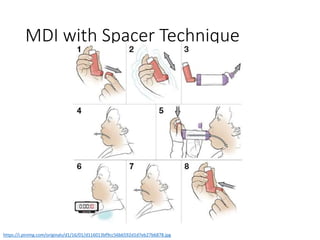
Why spacer is recommended?
• Less deposition of drug in pharynx, hence better
drug delivery
• Less co-ordination needed
MDI with Spacer Technique
https://i.pinimg.com/originals/d1/16/01/d116013bf9cc56b6592d1d7eb27b6878.jpg
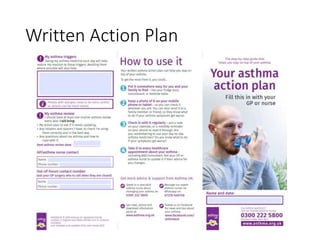
Written Action Plan
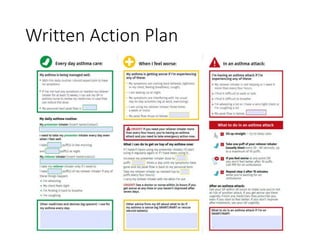
Written Action Plan
Written Action Plan
• However, not shown to decrease exacerbations
Other measures to reduce flare-up
• Smoking cessation
• Weight reduction in obestity
• Food avoidance in confirmed food allergy
Exacerbation
• Acute or sub-acute worsening in symptoms and
lung function from the patient’s usual status.
Exacerbation: Risk Factors
• Medication related: No ICS use, Poor adherence,
Wrong technique, High SABA use
• Comorbidities: Obesity, Sinusitis, GERD, Confirmed
food allergy, anxiety, depression, pregnancy
• Exposures: Smoking, air pollution
• Eosinophilia
• FEV1 < 60% predicted
Status asthmaticus
• SABA: Salbutamol 2.5mg Q20min for 60 min then
Q1H, given with 0.25 to 0.5mg of ipratropium
improve FEV1
• Corticosteroids: IV methylprednisolone 60-125mg
Q6H for 24 hours
• MagSulf: 2gm IV over 20 minutes
• NOT RECOMMENDED: IV aminophylline
• Use of NIV not established as in COPD
Chakraborty RK, Basnet S. Status Asthmaticus. [Updated 2019 Nov 29]. In: StatPearls [Internet]. Treasure Island (FL): StatPearls
Publishing; 2019 Jan-. Available from: https://www.ncbi.nlm.nih.gov/books/NBK526070/
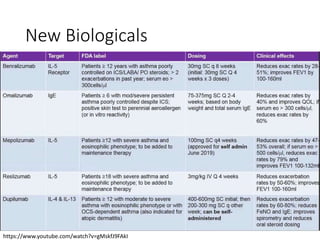
New Biologicals
• Anti IL5 – Mepolizumab, Reslizumab
• Anti IL5 receptor – Benralizumab
• Anti IL4 receptor - Dupilumab
https://www.youtube.com/watch?v=gMskfJ9FAkI
Points to ponder
• Routine use of antibiotics in exacerbations.
• MDI vs Nebuliser in ED
• Using PEFR to categorize severity
• Criteria to admit??
Reference
• © Global Initiative for Asthma, www.ginasthma.org
• Chakraborty RK, Basnet S. Status Asthmaticus.
[Updated 2019 Nov 29]. In: StatPearls [Internet].
Treasure Island (FL): StatPearls Publishing; 2019
Jan-. Available from:
https://www.ncbi.nlm.nih.gov/books/NBK526070/

Asthma - GINA 2019

  • 1.
  • 2.
    Outline • Definition • Diagnosis •New Updates from GINA 2019 • Exacerbation management • New biologicals • Points to ponder • References
  • 3.
    Defintion Asthma is aheterogenous disease, usually characterised by chronic airway inflammation. It is defined by the history of respiratory symptoms such as wheeze, shortness of breath, chest tightness and cough that vary over time and in intensity, together with variable expiratory airflow limitation
  • 4.
    Diagnosis 1. History ofvariable respiratory symptoms: wheeze, cough, chest tightness 2. Confirmed expiratory airflow limitation: • Positive bronchodilator reversibility test • Excessive variability in twice-daily PEF over 2 weeks • Significant increase in LFT after 2 weeks of anti- inflammatory therapy • Positive exercise challenge test
  • 5.
    FENO • Fractional concentration ofexcretion of nitric oxide • Elevated levels are associated with high eosinophil levels in blood and sputum • Falsely low in smokers and during bronchoconstriction • Not recommended to diagnose asthma or decide on ICS therapy https://www.niox.com/images/1015/nurse-feno-testing-male-patient.png
  • 6.
  • 7.
    * Off-label; dataonly with budesonide-formoterol (bud-form) † Off-label; separate or combination ICS and SABA inhalers PREFERRED CONTROLLER to prevent exacerbations and control symptoms Other controller options Other reliever option PREFERRED RELIEVER STEP 2 Daily low dose inhaled corticosteroid (ICS), or as-needed low dose ICS-formoterol * STEP 3 Low dose ICS-LABA STEP 4 Medium dose ICS-LABA Leukotriene receptor antagonist (LTRA), or low dose ICS taken whenever SABA taken † As-needed low dose ICS-formoterol * As-needed short-acting β2 -agonist (SABA) Medium dose ICS, or low dose ICS+LTRA # High dose ICS, add-on tiotropium, or add-on LTRA # Add low dose OCS, but consider side-effects As-needed low dose ICS-formoterol ‡ Box 3-5A Adults & adolescents 12+ years Personalized asthma management: Assess, Adjust, Review response Asthma medication options: Adjust treatment up and down for individual patient needs STEP 5 High dose ICS-LABA Refer for phenotypic assessment ± add-on therapy, e.g.tiotropium, anti-IgE, anti-IL5/5R, anti-IL4R Symptoms Exacerbations Side-effects Lung function Patient satisfaction Confirmation of diagnosis if necessary Symptom control & modifiable risk factors (including lung function) Comorbidities Inhaler technique & adherence Patient goals Treatment of modifiable risk factors & comorbidities Non-pharmacological strategies Education & skills training Asthma medications 1© Global Initiative for Asthma, www.ginasthma.org STEP 1 As-needed low dose ICS-formoterol * Low dose ICS taken whenever SABA is taken† ‡ Low-dose ICS-form is the reliever for patients prescribed bud-form or BDP-form maintenance and reliever therapy # Consider adding HDM SLIT for sensitized patients with allergic rhinitis and FEV >70% predicted GINA 2019
  • 8.
    Problem with SABAonly • Airway inflammation is found in most patients with asthma • Regular use increases allergic response and airway inflammation
  • 9.
    Why spacer isrecommended? • Less deposition of drug in pharynx, hence better drug delivery • Less co-ordination needed
  • 10.
    MDI with SpacerTechnique https://i.pinimg.com/originals/d1/16/01/d116013bf9cc56b6592d1d7eb27b6878.jpg
  • 11.
  • 12.
  • 13.
    Written Action Plan •However, not shown to decrease exacerbations
  • 14.
    Other measures toreduce flare-up • Smoking cessation • Weight reduction in obestity • Food avoidance in confirmed food allergy
  • 15.
    Exacerbation • Acute orsub-acute worsening in symptoms and lung function from the patient’s usual status.
  • 16.
    Exacerbation: Risk Factors •Medication related: No ICS use, Poor adherence, Wrong technique, High SABA use • Comorbidities: Obesity, Sinusitis, GERD, Confirmed food allergy, anxiety, depression, pregnancy • Exposures: Smoking, air pollution • Eosinophilia • FEV1 < 60% predicted
  • 17.
    Status asthmaticus • SABA:Salbutamol 2.5mg Q20min for 60 min then Q1H, given with 0.25 to 0.5mg of ipratropium improve FEV1 • Corticosteroids: IV methylprednisolone 60-125mg Q6H for 24 hours • MagSulf: 2gm IV over 20 minutes • NOT RECOMMENDED: IV aminophylline • Use of NIV not established as in COPD Chakraborty RK, Basnet S. Status Asthmaticus. [Updated 2019 Nov 29]. In: StatPearls [Internet]. Treasure Island (FL): StatPearls Publishing; 2019 Jan-. Available from: https://www.ncbi.nlm.nih.gov/books/NBK526070/
  • 18.
    New Biologicals • AntiIL5 – Mepolizumab, Reslizumab • Anti IL5 receptor – Benralizumab • Anti IL4 receptor - Dupilumab https://www.youtube.com/watch?v=gMskfJ9FAkI
  • 19.
    Points to ponder •Routine use of antibiotics in exacerbations. • MDI vs Nebuliser in ED • Using PEFR to categorize severity • Criteria to admit??
  • 20.
    Reference • © GlobalInitiative for Asthma, www.ginasthma.org • Chakraborty RK, Basnet S. Status Asthmaticus. [Updated 2019 Nov 29]. In: StatPearls [Internet]. Treasure Island (FL): StatPearls Publishing; 2019 Jan-. Available from: https://www.ncbi.nlm.nih.gov/books/NBK526070/

Editor's Notes

  • #8 Comment that we have made the figure in landscape orientation, so that the arrowed circle will always be seen