โšซBUBBLE- is a acronym used todenote the components
of the postpartum maternal nursing assessment.
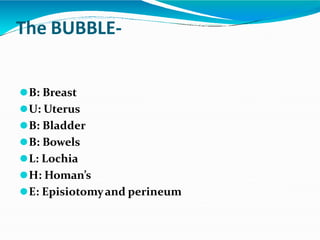
The BUBBLE-
โšซB: Breast
โšซU: Uterus
โšซB: Bladder
โšซB: Bowels
โšซL: Lochia
โšซH: Homanโ€™s
โšซE: Episiotomyand perineum
B: BREAST
โšซBREAST ASSESSMENT:
โšซAssessment includeevaluating the breast in the
postpartum period
โšซThe first step is to determine if the new mamma is
breastfeeding or bottle-feeding: This will guide the
assessmentalong with patienteducation
BREAST EVALUATION :
โšซSize
โšซShape
โšซFirmness
โšซRedness
โšซSymmetry
BOTTLE-FEEDING: LACTATION
SUPPRESSION:
โšซTeach the motherabout breastengorgement. This
usuallyoccursabout 72 hours after birth
โšซThe breastswill bevery tenderwith a feeling of
heaviness
โšซA firm, snug-fitting bra is ideal for thewomanwhose
not breastfeeding. Also this will help, engorgement
maystill occur
โšซIceand cabbage leavescan provide relief. There is an
enzyme in thecabbage leaves that helps
โšซDo notexpress milk as itwill encourageadditional
production
โšซAnywarmthoverthe breastsand stimulationof the
nipples will create a faucet-likeeffect
BREASTFEEDING:
โšซ
โšซFocus on the nipple and areola. The nipple should be
erect, butsomeare flat or inverted. Hopefully, thiswas
identified during the pregnancy in order for shield to
be placed upon them.
โšซAssess the nipples forsigns of bruising, crackling,
chapping. A deep crack or blister may indicate
incorrect placementoranother issue.
โšซAvoid placing wantcold packson the breasts
MASTITIS INFECTION:
โšซNursing Considerations Mastitis is an infectionof the
breastsurrounding theducts thatโ€™scharacterized by
fullness, pain, warmth, and hardness of the breast. Itโ€™s
crucial todifferentiae infection from engorgement.
โšซMastitis may involve fever, while localized symptoms
are limited to specified area that usually appears red
and feels warm and possibly hardened Mastitis needs
to be treated with antibioticsand the patient is usually
encouraged tocontinue breastfeeding. The causeof
infection is associated with stagnant milk in theducts.
In mostcases, the milk is not infected; only theducts.
BREAST AND BOTTLE FEEDING
โšซThedecision to breastor bottle feed is highly personal.
While the benefits of breast milk nutritionally and
physiologically outweigh those of formula, it may not
always be possibleor in the best interestof the mom
and baby to breastfeed. The nurseโ€™s role is to educate
the mom and support the family in whateverchoice is
made, not pass judgment.
BENEFITS OF BOTTLE FEEDING:
โšซBreastfeeding does notalways โ€œcome naturallyโ€ toall
moms- it may bedifficult forsome
โšซMay beconsidered more sociallyacceptable towhip
out a bottle in the middle of a restaurant versus a
breast.
โšซMay beeasier for momswhowork outsideof the
home.
DISADVANTAGES OF BOTTLE
FEEDING:
โšซNopassive immunity
โšซHarder for baby todigest
โšซExpensive, especially if a specialized formula is needed
โšซMoreallergies
โšซOverfeeding iseasier
โšซStool is moreodorous
BENEFITS OF BREAST FEEDING :
โšซPassive immunity
โšซLess incidentsof ear infections (formulapools into the
Eustachian tube)
โšซEasydigestibility
โšซBonding between mom and baby
โšซNocostand alwaysavailableand at the right
temperature
โšซForthe foodies: Some mother mayenjoy being able
toeatan extra 500 calories/day.
โšซBenefits to mother: Release of oxytocin (the โ€œlet-
downโ€) causes the uterus tocontract, which promotes
quickerreturn to pre-pregnancy weight. Italso
decreases risksof ovarian and breastcancer.
BREASTFEEDING TEACHING
โšซPositioning: Holds- chest to chest or tummy to
tummy in someway, grab underthe breasts and push
down and out (taking the milk ducts and pushing it
forward, makea C-Hold around theareola (pull back,
down, and forward while bringing forward).
โšซGeta nice big dropof colostrumon the nipple
โšซTickle the lipwith nipple, shoveas much breastas
possible into the mouthonce itโ€™sopen
โšซ5 to 15 minutesa first topreventsoreness
โšซStartwith the breasts thatwas left from
โšซTry to feed every 2 hours
FORMULA TEACHING :
โšซReady-to-feed: mostexpensive butconvenient
โšซConcentrate: do noteveradd morewateror
concentrate it Powder: followdirections per label
โšซThrow the bottlecontentsoutafter the feeding- do not
save for next feeding
โšซStartoff small byonly preparing 2 ouncesata time
โšซNo need towarm formulaup.
U: UTERUS
UTERINE ASSESSMENT:
โšซ1. FUNDUS: firm or boggy- make a โ€œC-shapeโ€ with
your hand and push up on the lower fundus; if itโ€™s not
stabilized, the uterus can prolapse, or fall into the
vagina. Massageof not firm- secure loweruterine
segment. The concern is for hemorrhage; the primary
causesarea distended bladderand retrained placental
fragments
โšซ2. FUNDAL HEIGHT: where is it in relation to the
umbilicus? โ€œU/Uโ€ or โ€œAt the Uโ€ (1/U = 1 cm above the
umbilicus)- drops onecentimeteror fingerwidth. The
position drops one centimeter every 24 hours for 10
days postpartum
โšซ3. MIDLINE OR DEVIATED TO THE LEFT OR
RIGHT: if deviated, itโ€™s usuallya sign of a full bladder.
โšซ Uterine afterpains of a breastfeeding mom get worse
with each pregnancy
. The uterus is a muscleand the
more it is stretched, the more force is needed in order
tocontract.
โšซNURSING CONSIDERATION: A boggy fundus may
bea sign of uterineatony, which places the patientat
risk fordeveloping a postpartum hemorrhage and
othercomplications.
โšซAlso, fundal location that lies out of range with
anticipated locationaccording topostpartum status
may beanother indication.
โšซThe nurse should perform a uterine massage, which
promotes blood movementoutof the uterus, and also
encourage the patient tovoid, as a full ordistended
bladdercan impede uterine involutionand
contractions.
โšซThe nurse is often in the positionas the first member
health care team to learn of these warning signs and
therefore must take swift action if an issue is
suspected.
B: BLADDER
โšซBLADDER ASSESSMENT:
โšซAsk motherwhen she lastvoided
โšซEstablish aVoiding Schedule to prevent bladder
distensionand urinary stasis
โšซEncourage mom tourinateevery time before she feed
baby (as they may fall asleep)
โšซPOSSIBLE OBSTACLES TO VOIDING:
โšซMother may become soengrossed with baby thatshe
forgets tovoid
โšซInternal inflammation from labor trauma may impair
ability tovoid
โšซMother may hesitate tovoid from fearof pain,
especially if she has an episiotomyorvaginal tearing
โšซC-section patients mayalso have issuewith voiding
following removal of the folly.
โšซ NURSING INTERVENTIONS FOR POSTPARTUM BLADDER
CARE: Peri-bottle- teach mom to always bring the bottle, which
is used for perineal irrigation, to the restroom to use rather than
toilet paper; the bottle is filled with warm (NOT hot) water from
the faucetand occasionally mixed with an antisepticoranalgesic
solution if dered by the providerorpermitted by hospital policy
.
The contents are sprayed on the area following each void/bowel
movementto use ratherthan toilet paper
โšซ Teach motherto use Tuckโ€™s Pads, which contain witch hazel
โšซ Dermaplast is a topical spray, may beapplied to helpcontrol pain
โšซ A straitcath may need to be used if mom doesnโ€™tvoid within an
acceptable time (usually 12 hours postpartum)
WARNING SIGNS:
โšซPerineal area is dark, moist, and bloody, especially
when combined urinary stasis
B: BOWELS
โšซBOWELS ASSESSMENT:
โšซBowels in shock- just moved intosomestrange
positions.
โšซTakea stool softener- donโ€™twant ripping or the
episiotomyor trauma to the C-section incision.
L: LOCHIA
โšซLOCHIAASSESSMENT:
โšซAssess thecolor, odor, and amount
โšซThe lochiacolorshould forward in the progression of
lightness, nevergo backwards
โšซ LOCHIA COLOR
โšซ LOCHIA RUBRA: Bright red, may havesmall clots,
usually lasts 3 days
โšซ LOCHIA SEROSA: Pink, serous, othertissues
โšซ LOCHIAALBA: Tissue, whitish
โšซLOCHIA ODOR
โšซLochia should have โ€œnoodorโ€ or โ€œno foul odorโ€
โšซReal world: virtually all lochia has an unpleasant or at
least a neutral odor associated with it and moms may
be quick todescribe itas โ€œfoulโ€
.
โšซItโ€™s important for the nurse to assess the odor to
eliminatesubjectivepatientdescriptionof the scent
โšซA truly foul odor or a change in odor may be a sign of
infection
โšซLOCHIAAMOUNT:
โšซScant = 2.5 centimeters saturation
โšซLight = < 10 centimeters saturation
โšซ Moderate =๏‚ท > 10 centimeters saturation.
โšซHeavy = pad is completelysaturated within 2 hours
โšซPostpartum hemorrhage is clinicallydefined as a pad
saturated within 15-30 minutes
โšซ The pad is saturated within 15 minutes to be
considered a hemorrhage situation. In the real world, a
pad that becomes saturated within 30 minutes is a
cause foradditional evaluation.
โšซScant saturation in the immediate postpartum period
can be just as concerning as excessive lochia
production. Clots: up tocherry sized areokay, peach or
plum sized is not. Clots are the most common in the
morning following the first void due to the saggy
textureof thevagina, which releases the lochia build-
up from the night.
E: EPISIOTOMY AND PERINEUM
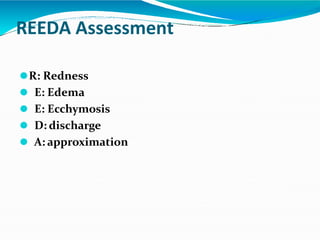
REEDA Assessment
โšซR: Redness
โšซ E: Edema
โšซ E: Ecchymosis
โšซ D: discharge
โšซ A: approximation
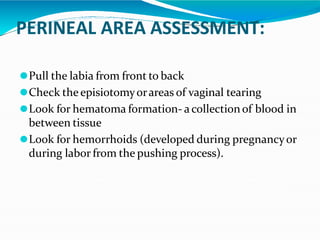
PERINEAL AREA ASSESSMENT:
โšซPull the labia from front to back
โšซCheck the episiotomyorareas of vaginal tearing
โšซLook for hematoma formation- a collection of blood in
between tissue
โšซLook for hemorrhoids (developed during pregnancyor
during labor from the pushing process).
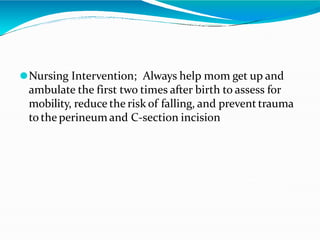
โšซNursing Intervention; Always help mom get up and
ambulate the first two times after birth to assess for
mobility, reduce the risk of falling, and prevent trauma
to the perineum and C-section incision
โšซsection incision
โšซHEMATOMA CARE :
โšซStartwith cold tostop the bleeding, once it stops,
begin warm
โšซContinue to monitor
โšซIf itgetworse, thatactivearea of bleeding is non-
healing and itwill need to beopened and theactive
area is discovered and cauterized
โšซMay notappearso much of an out-pouching as much
as a disfigurement.
โšซHEMORRHOIDS:
โšซVasculature that formsa pouch
โšซColorcan match the skin of the rectal area and may
look more likea blood blisterwhen irritated
โšซSevere hemorrhoids appearas grape clusters
Dermaplastspray
โšซPatient may not be aware, mayonly known that
businessdown there is notas usual
โšซ NURSING INTERVENTIONS:
โšซSeitz Bath: a rotating fluid that moves thewater. May
fit overthecommodeoronecan be performed with no
special equipment using the bathtub other than a
bathing ring. Turn tub on and allow drain to open and
use a ring for circulating water. Itโ€™s very shallow and
only bathes the perineal area.
H: HOMANโ€™S SIGN
โšซAssess for Signsof DVT by the Homanโ€™s Sign
โšซA positive Homanโ€™ssign is indicativeof DVT, although
itโ€™s not the mostreliable indicator.
โšซAll of thecharacteristic changes to maternal clotting
factors are higher than any other point as the body
prepares for labor.
โšซCombine this with being in bed, especially if mom
underwent a C-section, and itโ€™s easy to see why the
postpartumwoman is at such a huge risk for DVT.
PERFORMING THE HOMANโ€™S TEST:
โšซMostcommonlyperformed with the mom in a supine
positionwhile laying in bed
โšซThecalf is flexed ata 90ยฐ angle
โšซThe nurse manipulates the foot in a dorsiflexion
movement
โšซIf pain is felt in thecalf, the Homanโ€™s Sign is said to be
positive.
SIGNS OF DVT:
โšซA sudden and unexplainable pain, usually in the back
of the leg orcalf
โšซTachycardiaand shortnessof breath ordyspnea (from
decreased oxygenation status)
โšซEdema, redness, and warmth localized overthearea of
the DVT (from thevascular builduparound theclot)
PREVENTING A DVT:
โšซDangleat the side of the bed within 6 hours
โšซStand upwithin 8 hours
โšซEncourageambulationat first and independent
walking when ready
POTENTIAL COMPLICATIONS OF A
DVT:
โšซPulmonaryembolism (PE) occurswhen a clot breaks
way from the leg areaand travels to the lungs.
โšซA PE is medical emergency.
E: EMOTIONAL STATUS
โšซEmotional Statusand Bonding Patterns
โšซFluctuations in estrogen levels are blamed for the
emotional roller-coasterthat many momsexperience
after birth.
โšซHigh levelsof stress, increased responsibility, and
sleepdeprivation exacerbate this
โšซBonding refers to the interactions between the
mammaand baby
โšซCare giving of self and baby is an indicatorof
emotional status
COMMON POSTPARTUM
ASSESSMENT FINDINGS:
โšซThe Taking In Phase; May be considered as a self-
focused, re-lived experience. This is different from the
maladaptive.
โšซ Taking Hold Phase; A little bit about the mother, a
little about the baby. The world appears to be revolved
around the babyand mammaas an unit.
โšซ Letting-In Phase; Motherallowsotherpeople in.
COMPARING BLUES,
DEPRESSION, AND PSYCHOSIS
โšซPOSTPARTUM BLUES: Usuallyoccurswithin 2-3
weeks. Mamma may be sensitive, such as crying
during a commercial, mamma mayview itas
humorous in hindsight.
โšซPOSTPARTUM DEPRESSION (PPD): When the
blues moves to the pointwhere mommacanโ€™t care for
herself or the baby.
โšซ POSTPARTUM PSYCHOSIS: A severe form of
depression thatwarrants immediate intervention.
When mamma harms herself or the neonate or
considers doing so. Typically is predicated by
depressiveepisodes.
NURSING INTERVENTIONS:
โšซThe patientshould fill outa form toassess emotional
risks. The form will ask if the patient has a history of
PPD ordepression notassociated with pregnancy.
โšซThereโ€™salways a social workeravailable in theevent
that the patient is acting strangely. The nurse may
need to fill outadocumentsuch as a Risk Assessment
Form
THANK YOU

postnatal assessment.pptx

  • 2.
    โšซBUBBLE- is aacronym used todenote the components of the postpartum maternal nursing assessment.
  • 3.
    The BUBBLE- โšซB: Breast โšซU:Uterus โšซB: Bladder โšซB: Bowels โšซL: Lochia โšซH: Homanโ€™s โšซE: Episiotomyand perineum
  • 4.
    B: BREAST โšซBREAST ASSESSMENT: โšซAssessmentincludeevaluating the breast in the postpartum period
  • 5.
    โšซThe first stepis to determine if the new mamma is breastfeeding or bottle-feeding: This will guide the assessmentalong with patienteducation
  • 6.
  • 7.
    BOTTLE-FEEDING: LACTATION SUPPRESSION: โšซTeach themotherabout breastengorgement. This usuallyoccursabout 72 hours after birth โšซThe breastswill bevery tenderwith a feeling of heaviness โšซA firm, snug-fitting bra is ideal for thewomanwhose not breastfeeding. Also this will help, engorgement maystill occur
  • 8.
    โšซIceand cabbage leavescanprovide relief. There is an enzyme in thecabbage leaves that helps โšซDo notexpress milk as itwill encourageadditional production โšซAnywarmthoverthe breastsand stimulationof the nipples will create a faucet-likeeffect
  • 9.
    BREASTFEEDING: โšซ โšซFocus on thenipple and areola. The nipple should be erect, butsomeare flat or inverted. Hopefully, thiswas identified during the pregnancy in order for shield to be placed upon them.
  • 10.
    โšซAssess the nipplesforsigns of bruising, crackling, chapping. A deep crack or blister may indicate incorrect placementoranother issue. โšซAvoid placing wantcold packson the breasts
  • 11.
    MASTITIS INFECTION: โšซNursing ConsiderationsMastitis is an infectionof the breastsurrounding theducts thatโ€™scharacterized by fullness, pain, warmth, and hardness of the breast. Itโ€™s crucial todifferentiae infection from engorgement.
  • 12.
    โšซMastitis may involvefever, while localized symptoms are limited to specified area that usually appears red and feels warm and possibly hardened Mastitis needs to be treated with antibioticsand the patient is usually encouraged tocontinue breastfeeding. The causeof infection is associated with stagnant milk in theducts. In mostcases, the milk is not infected; only theducts.
  • 13.
  • 14.
    โšซThedecision to breastorbottle feed is highly personal. While the benefits of breast milk nutritionally and physiologically outweigh those of formula, it may not always be possibleor in the best interestof the mom and baby to breastfeed. The nurseโ€™s role is to educate the mom and support the family in whateverchoice is made, not pass judgment.
  • 15.
    BENEFITS OF BOTTLEFEEDING: โšซBreastfeeding does notalways โ€œcome naturallyโ€ toall moms- it may bedifficult forsome โšซMay beconsidered more sociallyacceptable towhip out a bottle in the middle of a restaurant versus a breast. โšซMay beeasier for momswhowork outsideof the home.
  • 16.
    DISADVANTAGES OF BOTTLE FEEDING: โšซNopassiveimmunity โšซHarder for baby todigest โšซExpensive, especially if a specialized formula is needed โšซMoreallergies โšซOverfeeding iseasier โšซStool is moreodorous
  • 17.
    BENEFITS OF BREASTFEEDING : โšซPassive immunity โšซLess incidentsof ear infections (formulapools into the Eustachian tube) โšซEasydigestibility โšซBonding between mom and baby โšซNocostand alwaysavailableand at the right temperature
  • 18.
    โšซForthe foodies: Somemother mayenjoy being able toeatan extra 500 calories/day. โšซBenefits to mother: Release of oxytocin (the โ€œlet- downโ€) causes the uterus tocontract, which promotes quickerreturn to pre-pregnancy weight. Italso decreases risksof ovarian and breastcancer.
  • 19.
  • 20.
    โšซPositioning: Holds- chestto chest or tummy to tummy in someway, grab underthe breasts and push down and out (taking the milk ducts and pushing it forward, makea C-Hold around theareola (pull back, down, and forward while bringing forward).
  • 21.
    โšซGeta nice bigdropof colostrumon the nipple โšซTickle the lipwith nipple, shoveas much breastas possible into the mouthonce itโ€™sopen โšซ5 to 15 minutesa first topreventsoreness โšซStartwith the breasts thatwas left from โšซTry to feed every 2 hours
  • 22.
    FORMULA TEACHING : โšซReady-to-feed:mostexpensive butconvenient โšซConcentrate: do noteveradd morewateror concentrate it Powder: followdirections per label โšซThrow the bottlecontentsoutafter the feeding- do not save for next feeding โšซStartoff small byonly preparing 2 ouncesata time โšซNo need towarm formulaup.
  • 23.
    U: UTERUS UTERINE ASSESSMENT: โšซ1.FUNDUS: firm or boggy- make a โ€œC-shapeโ€ with your hand and push up on the lower fundus; if itโ€™s not stabilized, the uterus can prolapse, or fall into the vagina. Massageof not firm- secure loweruterine segment. The concern is for hemorrhage; the primary causesarea distended bladderand retrained placental fragments
  • 24.
    โšซ2. FUNDAL HEIGHT:where is it in relation to the umbilicus? โ€œU/Uโ€ or โ€œAt the Uโ€ (1/U = 1 cm above the umbilicus)- drops onecentimeteror fingerwidth. The position drops one centimeter every 24 hours for 10 days postpartum
  • 25.
    โšซ3. MIDLINE ORDEVIATED TO THE LEFT OR RIGHT: if deviated, itโ€™s usuallya sign of a full bladder. โšซ Uterine afterpains of a breastfeeding mom get worse with each pregnancy . The uterus is a muscleand the more it is stretched, the more force is needed in order tocontract.
  • 26.
    โšซNURSING CONSIDERATION: Aboggy fundus may bea sign of uterineatony, which places the patientat risk fordeveloping a postpartum hemorrhage and othercomplications. โšซAlso, fundal location that lies out of range with anticipated locationaccording topostpartum status may beanother indication.
  • 27.
    โšซThe nurse shouldperform a uterine massage, which promotes blood movementoutof the uterus, and also encourage the patient tovoid, as a full ordistended bladdercan impede uterine involutionand contractions. โšซThe nurse is often in the positionas the first member health care team to learn of these warning signs and therefore must take swift action if an issue is suspected.
  • 28.
  • 29.
    โšซBLADDER ASSESSMENT: โšซAsk motherwhenshe lastvoided โšซEstablish aVoiding Schedule to prevent bladder distensionand urinary stasis โšซEncourage mom tourinateevery time before she feed baby (as they may fall asleep)
  • 30.
    โšซPOSSIBLE OBSTACLES TOVOIDING: โšซMother may become soengrossed with baby thatshe forgets tovoid โšซInternal inflammation from labor trauma may impair ability tovoid
  • 31.
    โšซMother may hesitatetovoid from fearof pain, especially if she has an episiotomyorvaginal tearing โšซC-section patients mayalso have issuewith voiding following removal of the folly.
  • 32.
    โšซ NURSING INTERVENTIONSFOR POSTPARTUM BLADDER CARE: Peri-bottle- teach mom to always bring the bottle, which is used for perineal irrigation, to the restroom to use rather than toilet paper; the bottle is filled with warm (NOT hot) water from the faucetand occasionally mixed with an antisepticoranalgesic solution if dered by the providerorpermitted by hospital policy . The contents are sprayed on the area following each void/bowel movementto use ratherthan toilet paper โšซ Teach motherto use Tuckโ€™s Pads, which contain witch hazel โšซ Dermaplast is a topical spray, may beapplied to helpcontrol pain โšซ A straitcath may need to be used if mom doesnโ€™tvoid within an acceptable time (usually 12 hours postpartum)
  • 33.
    WARNING SIGNS: โšซPerineal areais dark, moist, and bloody, especially when combined urinary stasis
  • 34.
  • 35.
    โšซBOWELS ASSESSMENT: โšซBowels inshock- just moved intosomestrange positions. โšซTakea stool softener- donโ€™twant ripping or the episiotomyor trauma to the C-section incision.
  • 36.
    L: LOCHIA โšซLOCHIAASSESSMENT: โšซAssess thecolor,odor, and amount โšซThe lochiacolorshould forward in the progression of lightness, nevergo backwards
  • 37.
    โšซ LOCHIA COLOR โšซLOCHIA RUBRA: Bright red, may havesmall clots, usually lasts 3 days โšซ LOCHIA SEROSA: Pink, serous, othertissues โšซ LOCHIAALBA: Tissue, whitish
  • 38.
    โšซLOCHIA ODOR โšซLochia shouldhave โ€œnoodorโ€ or โ€œno foul odorโ€ โšซReal world: virtually all lochia has an unpleasant or at least a neutral odor associated with it and moms may be quick todescribe itas โ€œfoulโ€ . โšซItโ€™s important for the nurse to assess the odor to eliminatesubjectivepatientdescriptionof the scent โšซA truly foul odor or a change in odor may be a sign of infection
  • 39.
    โšซLOCHIAAMOUNT: โšซScant = 2.5centimeters saturation โšซLight = < 10 centimeters saturation โšซ Moderate =๏‚ท > 10 centimeters saturation. โšซHeavy = pad is completelysaturated within 2 hours โšซPostpartum hemorrhage is clinicallydefined as a pad saturated within 15-30 minutes
  • 40.
    โšซ The padis saturated within 15 minutes to be considered a hemorrhage situation. In the real world, a pad that becomes saturated within 30 minutes is a cause foradditional evaluation. โšซScant saturation in the immediate postpartum period can be just as concerning as excessive lochia production. Clots: up tocherry sized areokay, peach or plum sized is not. Clots are the most common in the morning following the first void due to the saggy textureof thevagina, which releases the lochia build- up from the night.
  • 41.
  • 42.
    REEDA Assessment โšซR: Redness โšซE: Edema โšซ E: Ecchymosis โšซ D: discharge โšซ A: approximation
  • 43.
    PERINEAL AREA ASSESSMENT: โšซPullthe labia from front to back โšซCheck the episiotomyorareas of vaginal tearing โšซLook for hematoma formation- a collection of blood in between tissue โšซLook for hemorrhoids (developed during pregnancyor during labor from the pushing process).
  • 44.
    โšซNursing Intervention; Alwayshelp mom get up and ambulate the first two times after birth to assess for mobility, reduce the risk of falling, and prevent trauma to the perineum and C-section incision
  • 45.
    โšซsection incision โšซHEMATOMA CARE: โšซStartwith cold tostop the bleeding, once it stops, begin warm โšซContinue to monitor โšซIf itgetworse, thatactivearea of bleeding is non- healing and itwill need to beopened and theactive area is discovered and cauterized โšซMay notappearso much of an out-pouching as much as a disfigurement.
  • 46.
    โšซHEMORRHOIDS: โšซVasculature that formsapouch โšซColorcan match the skin of the rectal area and may look more likea blood blisterwhen irritated โšซSevere hemorrhoids appearas grape clusters Dermaplastspray โšซPatient may not be aware, mayonly known that businessdown there is notas usual
  • 47.
    โšซ NURSING INTERVENTIONS: โšซSeitzBath: a rotating fluid that moves thewater. May fit overthecommodeoronecan be performed with no special equipment using the bathtub other than a bathing ring. Turn tub on and allow drain to open and use a ring for circulating water. Itโ€™s very shallow and only bathes the perineal area.
  • 48.
    H: HOMANโ€™S SIGN โšซAssessfor Signsof DVT by the Homanโ€™s Sign โšซA positive Homanโ€™ssign is indicativeof DVT, although itโ€™s not the mostreliable indicator. โšซAll of thecharacteristic changes to maternal clotting factors are higher than any other point as the body prepares for labor. โšซCombine this with being in bed, especially if mom underwent a C-section, and itโ€™s easy to see why the postpartumwoman is at such a huge risk for DVT.
  • 49.
    PERFORMING THE HOMANโ€™STEST: โšซMostcommonlyperformed with the mom in a supine positionwhile laying in bed โšซThecalf is flexed ata 90ยฐ angle โšซThe nurse manipulates the foot in a dorsiflexion movement โšซIf pain is felt in thecalf, the Homanโ€™s Sign is said to be positive.
  • 50.
    SIGNS OF DVT: โšซAsudden and unexplainable pain, usually in the back of the leg orcalf โšซTachycardiaand shortnessof breath ordyspnea (from decreased oxygenation status) โšซEdema, redness, and warmth localized overthearea of the DVT (from thevascular builduparound theclot)
  • 51.
    PREVENTING A DVT: โšซDangleatthe side of the bed within 6 hours โšซStand upwithin 8 hours โšซEncourageambulationat first and independent walking when ready
  • 52.
    POTENTIAL COMPLICATIONS OFA DVT: โšซPulmonaryembolism (PE) occurswhen a clot breaks way from the leg areaand travels to the lungs. โšซA PE is medical emergency.
  • 53.
    E: EMOTIONAL STATUS โšซEmotionalStatusand Bonding Patterns โšซFluctuations in estrogen levels are blamed for the emotional roller-coasterthat many momsexperience after birth. โšซHigh levelsof stress, increased responsibility, and sleepdeprivation exacerbate this
  • 54.
    โšซBonding refers tothe interactions between the mammaand baby โšซCare giving of self and baby is an indicatorof emotional status
  • 55.
    COMMON POSTPARTUM ASSESSMENT FINDINGS: โšซTheTaking In Phase; May be considered as a self- focused, re-lived experience. This is different from the maladaptive. โšซ Taking Hold Phase; A little bit about the mother, a little about the baby. The world appears to be revolved around the babyand mammaas an unit. โšซ Letting-In Phase; Motherallowsotherpeople in.
  • 56.
  • 57.
    โšซPOSTPARTUM BLUES: Usuallyoccurswithin2-3 weeks. Mamma may be sensitive, such as crying during a commercial, mamma mayview itas humorous in hindsight.
  • 58.
    โšซPOSTPARTUM DEPRESSION (PPD):When the blues moves to the pointwhere mommacanโ€™t care for herself or the baby.
  • 59.
    โšซ POSTPARTUM PSYCHOSIS:A severe form of depression thatwarrants immediate intervention. When mamma harms herself or the neonate or considers doing so. Typically is predicated by depressiveepisodes.
  • 60.
    NURSING INTERVENTIONS: โšซThe patientshouldfill outa form toassess emotional risks. The form will ask if the patient has a history of PPD ordepression notassociated with pregnancy. โšซThereโ€™salways a social workeravailable in theevent that the patient is acting strangely. The nurse may need to fill outadocumentsuch as a Risk Assessment Form
  • 61.