PRESENTED BY,
MR. KAILASH NAGAR
ASSIST. PROF.
DEPT. OF COMMUNITY HEALTH NSG.
DINSHA PATEL COLLEGE OF NURSING, NADIAD
What do we mean by …….
Antenatal Assessment??
Antenatal/prenatal care
• Systematic supervision of a woman during
pregnancy is called antenatal (prenatal care)
Why is it important?
• Determines the wellbeing of the newborn and
chance for survival (mother history)
AREA OF CONCERNS:
• Pre-conception counselling
• Assessment of risk factors
• Ongoing assessment of fetal well-being
• Ongoing assessment of complications
• Education
• Discussion of birthing care options
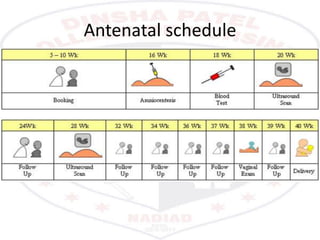
Timing of antenatal visits:
• The first visit should not be deferred beyond
the second missed period.
• Once a month until 28 weeks.
• Twice a month until 36 weeks.
• Every week during the last 4 weeks of
pregnancy.
PROCEDURE AT THE FIRST VISIT
• > Detailed Health History
• > Physical Examination
• > Breast and Pelvic Examination
Vital statistics:
• Name
• Age
• Ward/unit
• IP no
• Address
• Religion
• Occupation
• Education
• LMP
• EDC
• GA
• Obstetric score
• Blood group
• Gravida:
nulligravida
primigravida
multigravida
• Parity:
nullipara
primipara
multipara
grandmultipara
Maternal history
• Present ob. History:
– Diagnosis?
– Planned/unplanned
– Minor disorders
– Immunization
– Exposure to drugs/radiation
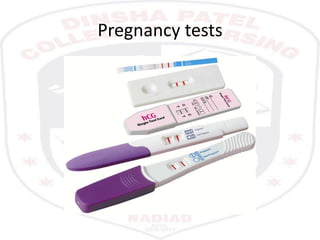
Pregnancy tests
Maternal History and Risk Factors
• Comprehensive maternal history and physical
examination is important to point out the risk
factors.
• Risk factors can be related to mother, during
pregnancy, during labor and delivery, or after
delivery.
• Antenatal assessment starts with determination of
risk factors.
• Better knowledge about risk factors better
preparation to care for the patient.
abortion
• 31% of pregnancies end in miscarriage
• Only rarely would an abortion cause problems
in a subsequent pregnancy
• increased risk of miscarriage only in women
who have had multiple induced abortions.
Risk Factors
• Preterm Birth:
• What is considered preterm??
• The second greatest cause of morbidity and mortality
in neonates.
• Previous preterm birth increases the subsequent
preterm birth:
• 1 prior = 15% of subsequent preterm birth.
• 2 prior = 32% of subsequent preterm birth.
Risk Factors
• Incompetent Cervix:
• Caused by cervical trauma, previous surgery, or may
be congenital.
• Usually leads to membrane rupture and premature
delivery.
• If severe, a suture around the cervical canal is
performed.
Risk Factors
• Maternal Smoking and Alcohol Intake:
• In the US, about 10% of pregnant mothers smoke, drink
alcohol or use drugs.
• Maternal intake of alcohol leads to fetal growth
problems.
• Smoking HBCO decreases availability of oxygen to
placenta and fetus.
Risk Factors
• Maternal Hypertension
• Complicates 6-8% of pregnancies.
• Hypertension during pregnancy (after W24) is termed:
Preeclampsia.
• Preeclampsia (High BP, proteinuria, edema)
• Can lead to placental abruption, and preterm delivery.
Risk Factors
• Diabetes:
• Increase the risk for CV and CNS malformations, and
metabolic disturbances.
• When appears during pregnancy (Gestational
Diabetes Mellitus, GDM).
• Treatment: glycemic control.
Risk Factors
• Infections Diseases:
• Infections can be transmitted to fetus.
• Early screening and detection of the infection is
important.
• Complicated by the rupture of the membrane.
Risk Factors
• Problems in Placenta, UC, and Fetal
Membrane:
• premature rupture : causes 50% of preterm
births.
• UC : Prolapse, short, single artery (3%)
• Placental problems
Antenatal assessment
• Height
• Weight
• Pallor
• Jaundice
• Vital signs
BREAST EXAMINATION
• flat (nipple does not protrude with
stimulation)
• retracted (nipple pulls back slightly)
• inverted (nipple pulls inward when
compressed)
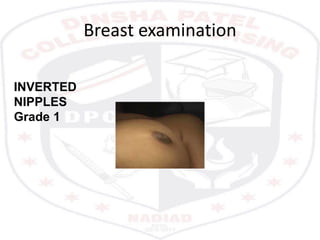
Breast examination
INVERTED
NIPPLES
Grade 1
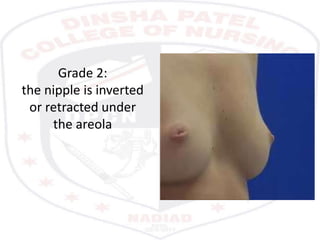
Grade 2:
the nipple is inverted
or retracted under
the areola
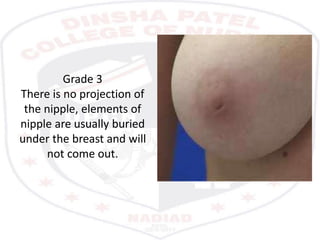
Grade 3
There is no projection of
the nipple, elements of
nipple are usually buried
under the breast and will
not come out.
Abdominal examination
• Inspection
• Size
• Shape
• Contour
• Flank
• Skin
• Bladder
• Fetal movements
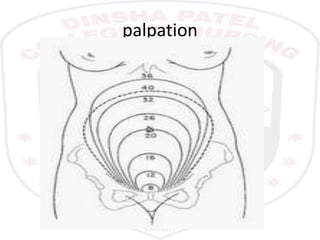
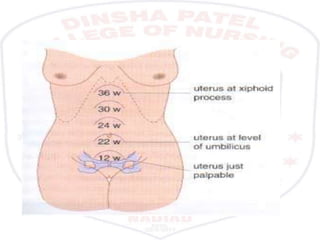
palpation
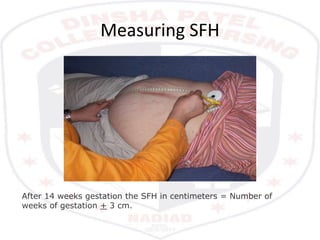
Measuring SFH
After 14 weeks gestation the SFH in centimeters = Number of
weeks of gestation + 3 cm.
Antenatal schedule
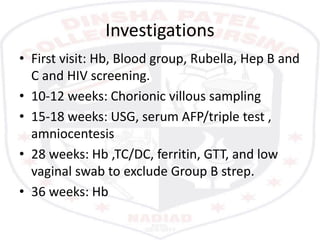
Investigations
• First visit: Hb, Blood group, Rubella, Hep B and
C and HIV screening.
• 10-12 weeks: Chorionic villous sampling
• 15-18 weeks: USG, serum AFP/triple test ,
amniocentesis
• 28 weeks: Hb ,TC/DC, ferritin, GTT, and low
vaginal swab to exclude Group B strep.
• 36 weeks: Hb
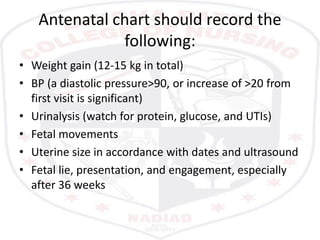
Antenatal chart should record the
following:
• Weight gain (12-15 kg in total)
• BP (a diastolic pressure>90, or increase of >20 from
first visit is significant)
• Urinalysis (watch for protein, glucose, and UTIs)
• Fetal movements
• Uterine size in accordance with dates and ultrasound
• Fetal lie, presentation, and engagement, especially
after 36 weeks
Antenatal Assessment
ULTRASOUND
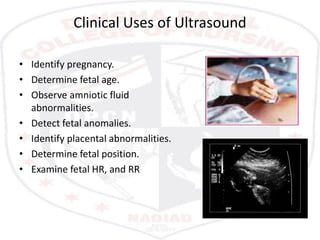
• Uses high frequency sound waves.
• Hand-held transducer is placed directly over the
mother’s abdomen, and reflected waves are
recorded on screen image.
• Can give valuable information about pregnancy and
fetus
Clinical Uses of Ultrasound
• Identify pregnancy.
• Determine fetal age.
• Observe amniotic fluid
abnormalities.
• Detect fetal anomalies.
• Identify placental abnormalities.
• Determine fetal position.
• Examine fetal HR, and RR
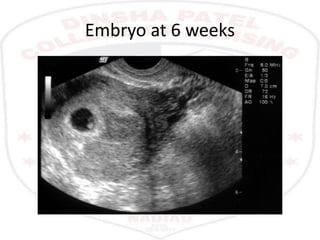
Embryo at 6 weeks
Antenatal Assessment
AMNIOCENTESIS
• Is the procedure of obtaining a sample of amniotic fluid.
• Usually performed after W15 (w15-20).
• A needle is inserted through the skin and uterine wall to
the amniotic sac.
• Insertion is guided by Ultrasound.
• Sample from amniotic fluid is obtained for analysis.
• Very safe procedure (complication rate <1%).
Antenatal Assessment
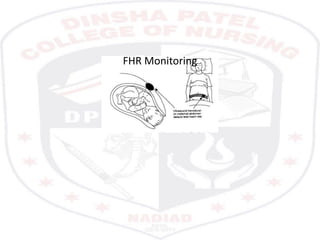
FETAL HEART RATE (FHR) MONITORING
• Heart starts to beat between W16-W20, but beats can
be detected as early as W8.
• Normal 120-160 bpm.
• Becomes very common test.
Antenatal advices
• Diet
• exercise
• Rest and sleep
• Bowel
• Bathing
• Clothing
• Dental care
• Coitus
• Care of breast
• Immunisation
FHR Monitoring

Antenatal assessment

  • 1.
    PRESENTED BY, MR. KAILASHNAGAR ASSIST. PROF. DEPT. OF COMMUNITY HEALTH NSG. DINSHA PATEL COLLEGE OF NURSING, NADIAD
  • 2.
    What do wemean by ……. Antenatal Assessment??
  • 3.
    Antenatal/prenatal care • Systematicsupervision of a woman during pregnancy is called antenatal (prenatal care)
  • 4.
    Why is itimportant? • Determines the wellbeing of the newborn and chance for survival (mother history)
  • 5.
    AREA OF CONCERNS: •Pre-conception counselling • Assessment of risk factors • Ongoing assessment of fetal well-being • Ongoing assessment of complications • Education • Discussion of birthing care options
  • 6.
    Timing of antenatalvisits: • The first visit should not be deferred beyond the second missed period. • Once a month until 28 weeks. • Twice a month until 36 weeks. • Every week during the last 4 weeks of pregnancy.
  • 7.
    PROCEDURE AT THEFIRST VISIT • > Detailed Health History • > Physical Examination • > Breast and Pelvic Examination
  • 8.
    Vital statistics: • Name •Age • Ward/unit • IP no • Address • Religion • Occupation • Education • LMP • EDC • GA • Obstetric score • Blood group
  • 9.
  • 10.
    Maternal history • Presentob. History: – Diagnosis? – Planned/unplanned – Minor disorders – Immunization – Exposure to drugs/radiation
  • 11.
  • 13.
    Maternal History andRisk Factors • Comprehensive maternal history and physical examination is important to point out the risk factors. • Risk factors can be related to mother, during pregnancy, during labor and delivery, or after delivery. • Antenatal assessment starts with determination of risk factors. • Better knowledge about risk factors better preparation to care for the patient.
  • 14.
    abortion • 31% ofpregnancies end in miscarriage • Only rarely would an abortion cause problems in a subsequent pregnancy • increased risk of miscarriage only in women who have had multiple induced abortions.
  • 15.
    Risk Factors • PretermBirth: • What is considered preterm?? • The second greatest cause of morbidity and mortality in neonates. • Previous preterm birth increases the subsequent preterm birth: • 1 prior = 15% of subsequent preterm birth. • 2 prior = 32% of subsequent preterm birth.
  • 16.
    Risk Factors • IncompetentCervix: • Caused by cervical trauma, previous surgery, or may be congenital. • Usually leads to membrane rupture and premature delivery. • If severe, a suture around the cervical canal is performed.
  • 17.
    Risk Factors • MaternalSmoking and Alcohol Intake: • In the US, about 10% of pregnant mothers smoke, drink alcohol or use drugs. • Maternal intake of alcohol leads to fetal growth problems. • Smoking HBCO decreases availability of oxygen to placenta and fetus.
  • 18.
    Risk Factors • MaternalHypertension • Complicates 6-8% of pregnancies. • Hypertension during pregnancy (after W24) is termed: Preeclampsia. • Preeclampsia (High BP, proteinuria, edema) • Can lead to placental abruption, and preterm delivery.
  • 19.
    Risk Factors • Diabetes: •Increase the risk for CV and CNS malformations, and metabolic disturbances. • When appears during pregnancy (Gestational Diabetes Mellitus, GDM). • Treatment: glycemic control.
  • 20.
    Risk Factors • InfectionsDiseases: • Infections can be transmitted to fetus. • Early screening and detection of the infection is important. • Complicated by the rupture of the membrane.
  • 21.
    Risk Factors • Problemsin Placenta, UC, and Fetal Membrane: • premature rupture : causes 50% of preterm births. • UC : Prolapse, short, single artery (3%) • Placental problems
  • 22.
    Antenatal assessment • Height •Weight • Pallor • Jaundice • Vital signs
  • 23.
    BREAST EXAMINATION • flat(nipple does not protrude with stimulation) • retracted (nipple pulls back slightly) • inverted (nipple pulls inward when compressed)
  • 24.
  • 25.
    Grade 2: the nippleis inverted or retracted under the areola
  • 26.
    Grade 3 There isno projection of the nipple, elements of nipple are usually buried under the breast and will not come out.
  • 27.
    Abdominal examination • Inspection •Size • Shape • Contour • Flank • Skin • Bladder • Fetal movements
  • 28.
  • 30.
    Measuring SFH After 14weeks gestation the SFH in centimeters = Number of weeks of gestation + 3 cm.
  • 31.
  • 32.
    Investigations • First visit:Hb, Blood group, Rubella, Hep B and C and HIV screening. • 10-12 weeks: Chorionic villous sampling • 15-18 weeks: USG, serum AFP/triple test , amniocentesis • 28 weeks: Hb ,TC/DC, ferritin, GTT, and low vaginal swab to exclude Group B strep. • 36 weeks: Hb
  • 33.
    Antenatal chart shouldrecord the following: • Weight gain (12-15 kg in total) • BP (a diastolic pressure>90, or increase of >20 from first visit is significant) • Urinalysis (watch for protein, glucose, and UTIs) • Fetal movements • Uterine size in accordance with dates and ultrasound • Fetal lie, presentation, and engagement, especially after 36 weeks
  • 34.
    Antenatal Assessment ULTRASOUND • Useshigh frequency sound waves. • Hand-held transducer is placed directly over the mother’s abdomen, and reflected waves are recorded on screen image. • Can give valuable information about pregnancy and fetus
  • 35.
    Clinical Uses ofUltrasound • Identify pregnancy. • Determine fetal age. • Observe amniotic fluid abnormalities. • Detect fetal anomalies. • Identify placental abnormalities. • Determine fetal position. • Examine fetal HR, and RR
  • 36.
  • 37.
    Antenatal Assessment AMNIOCENTESIS • Isthe procedure of obtaining a sample of amniotic fluid. • Usually performed after W15 (w15-20). • A needle is inserted through the skin and uterine wall to the amniotic sac. • Insertion is guided by Ultrasound. • Sample from amniotic fluid is obtained for analysis. • Very safe procedure (complication rate <1%).
  • 38.
    Antenatal Assessment FETAL HEARTRATE (FHR) MONITORING • Heart starts to beat between W16-W20, but beats can be detected as early as W8. • Normal 120-160 bpm. • Becomes very common test.
  • 39.
    Antenatal advices • Diet •exercise • Rest and sleep • Bowel • Bathing • Clothing • Dental care • Coitus • Care of breast • Immunisation
  • 40.