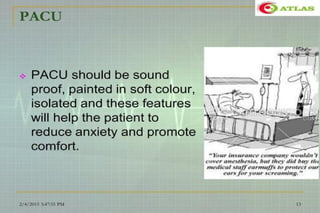
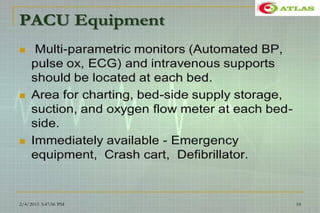
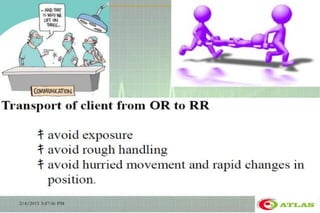
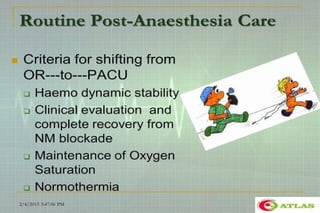
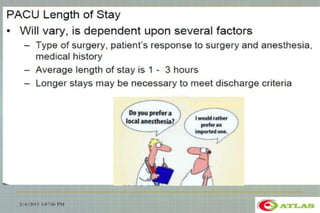
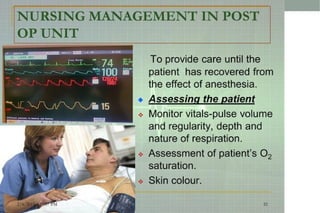
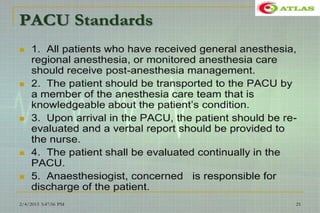
Postoperative Assessment and care
Gemechis Akuma
Lecturer at WU IHS, Dept. of Anesthesia (BSc, MSC in ACA)
Nekemte, Oromia
Objectives..
Objectives..
• At the end of the session the students will be able to:
1. Explain a common approach to emergency medical problems encountered in the
postoperative period.
2. Identify post-operative respiratory and hemodynamic problems and explain how to
manage these problems.
3. Explain the predisposing factors, differential diagnosis and management of PONV.
4. Identify the causes and treatments of post-operative agitation and delirium.
5. Identify the causes of delayed emergence and know how to deal with this problem.
6. Explain about different approaches of post-Operative pain management
Postoperative stage
• At the end of the operation, the patient is either extubated
in the OT (and an OPA inserted if needed) or transferred
to the recovery room with an LMA still in situ.?
• All patients receive supplemental oxygen during transfer.
• Many patients who do not have a general
anesthesia/sedation bypass the recovery room and go
straight from the OT to the surgical daycare unit
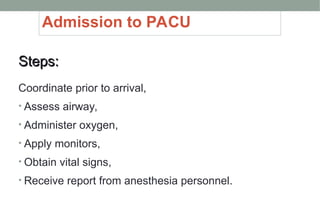
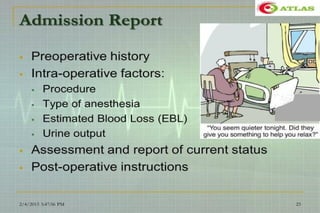
Admission to PACU
Steps:
Steps:
Coordinate prior to arrival,
• Assess airway,
• Administer oxygen,
• Apply monitors,
• Obtain vital signs,
• Receive report from anesthesia personnel.
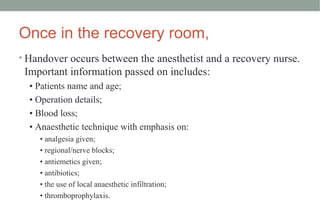
Once in the recovery room,
• Handover occurs between the anesthetist and a recovery nurse.
Important information passed on includes:
• Patients name and age;
• Operation details;
• Blood loss;
• Anaesthetic technique with emphasis on:
• analgesia given;
• regional/nerve blocks;
• antiemetics given;
• antibiotics;
• the use of local anaesthetic infiltration;
• thromboprophylaxis.
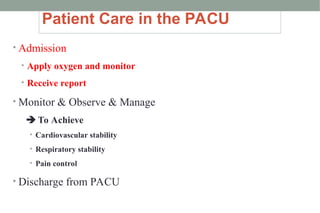
Patient Care in the PACU
• Admission
• Apply oxygen and monitor
• Receive report
• Monitor & Observe & Manage
 To Achieve
• Cardiovascular stability
• Respiratory stability
• Pain control
• Discharge from PACU
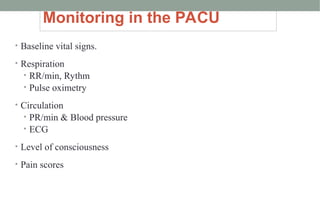
Monitoring in the PACU
• Baseline vital signs.
• Respiration
• RR/min, Rythm
• Pulse oximetry
• Circulation
• PR/min & Blood pressure
• ECG
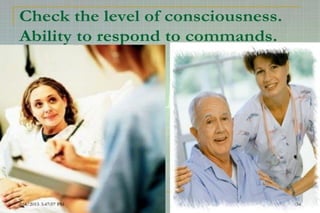
• Level of consciousness
• Pain scores
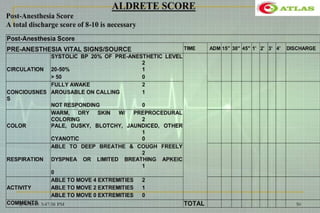
Initial Assessment
1. Color
2. Respiration
3. Circulation
4. Consciousness
5. Activity
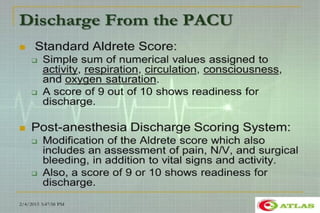
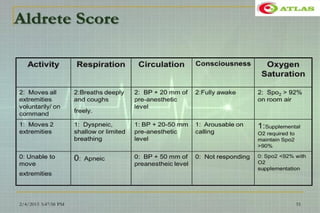
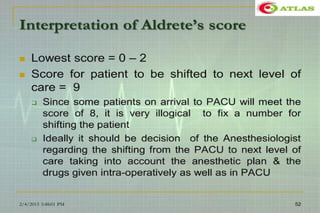
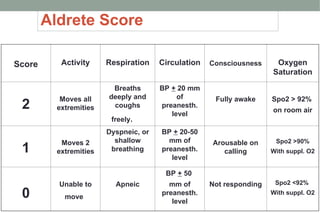
Aldrete Score
Score Activity Respiration Circulation Consciousness Oxygen
Saturation
2
Moves all
extremities
Breaths
deeply and
coughs
freely.
BP + 20 mm
of
preanesth.
level
Fully awake Spo2 > 92%
on room air
1
Moves 2
extremities
Dyspneic, or
shallow
breathing
BP + 20-50
mm of
preanesth.
level
Arousable on
calling
Spo2 >90%
With suppl. O2
0
Unable to
move
Apneic
BP + 50
mm of
preanesth.
level
Not responding Spo2 <92%
With suppl. O2
Common PACU Problems
• Airway obstruction
• Hypoxemia
• Hypoventilation
• Hypotension
• Hypertension
• Cardiac dysrhythmias
• Hyper/Hypothermia
• Bleeding
• Agitation
• Delayed recovery
• “PONV”
• Pain
• Oliguria
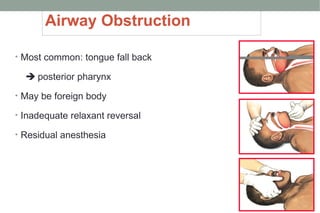
Airway Obstruction
• Most common: tongue fall back
 posterior pharynx
• May be foreign body
• Inadequate relaxant reversal
• Residual anesthesia
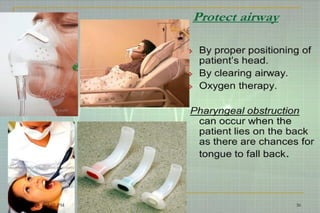
Management of Airway Obstruction
• Patient’s stimulation,
• Suction,
• Oral Airway,
• Nasal Airway,
• Others:
• Tracheal intubation
• Cricothyroidotomy
• Tracheotomy
Hypoventilation
• Residual anesthesia
• Narcotics
• Inhalation agent
• Muscle Relaxant
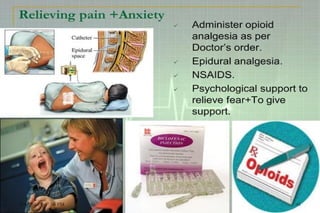
• Post oper - Analgesia
• Intravenous
• Epidural
Treatment of Hypoventilation
• Close observation,
• Assess the problem,
• Treatment of the cause:
• Reverse (or Antidote):
• Muscle relaxant  Neostigmine
• Opioids  Naloxone
• Midazolam  Anexate
Hypertension
• Common causes: e.g.
• Pain
• Full Bladder
• Hypertensive patients
• Fluid overload
• Excessive use of vasopressors
Treatment of Hypertension
• Effective pain control
• Sedation
• Anti-hypertensives:
• Beta blockers
• Alpha blockers
• Hydralazine (Apresoline)
• Calcium channel blockers
Hypotension
• Decreased venous return
• Hypovolemia,
•  fluid intake
•  losses
• Bleeding
• Sympathectomy,
• 3rd space loss,
• Left ventricular dysfunction
Treatment of Hypotension
• Initially treat with fluid bolus,
• + Vasopressors,
• + Correction of the cause
Dysrhythmias
• Secondary to
• Hypoxemia
• Hypercarbia
• Hypothermia
• Acidosis
• Catecholamines
• Electrolyte abnormalities.
Treatment of Dysrhythmia
• Identify and treat the cause,
• Assure oxygenation,
• Pharmacological
Urine Output
• Oliguria
• Hypovolemia,
• Surgical trauma,
• Impaired renal function,
• Mechanical blocking of catheter.
• Treatment:
• Assess catheter patency
• Fluid bolus
• Diuretics e.g. Lasix
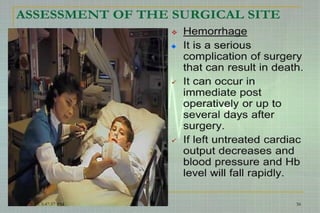
Post op Bleeding
Causes:
•Usually Surgical Problem,
•Coagulopathy,
•Drug induced
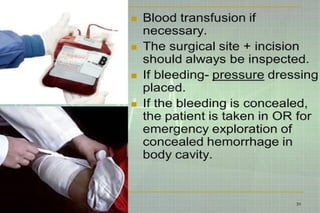
Treatment of Post op Bleeding
Treatment:
• Start i.v. lines  push fluids
• Blood sample,
- CBC,
- Cross matching,
- Coagulopathy
• Notify the surgeon,
• Correction of the cause
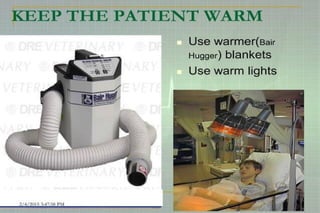
Hypothermia
• Most of patients will arrive cold
• Treatment:
• Get baseline temperature
• Actively rewarm
• Administer oxygen if shivering
• Take care for:
• Pediatric,
• Geriatric.
Altered Mental Status
• Reaction to drugs?
• Drugs e.g. sedatives, anticholinergics
• Intoxication / Drug abusers
• Pain
• Full bladder
• Hypoventilation
• Low COP
• CVA
Treatment of Altered Mental Status
• Reassurances,
• Always protect the patient,
• Evaluate the cause,
• Treatment of symptoms,
• Sedatives / Opioids if necessary.
Delayed Recovery
• Systematic evaluation
• Pre-op status
• Intraoperative events
• Ventilation
• Response to Stimulation
• Cardiovascular status
Delayed Recovery
• The most common cause:
• Residual anesthesia  Consider reversal
• Hypothermia,
• Metabolic e.g. diabetic coma,
• Underlying psychiatric problem
• CVA
Postoperative Nausea & Vomiting
“PONV”
• Commonest complication in postop
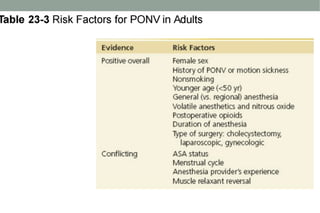
• Risk factors
• Type & duration of surgery,
• Type of anesthesia,
• Drugs
• Hormone levels,
• Medical problems,
• Autonomic involvement.
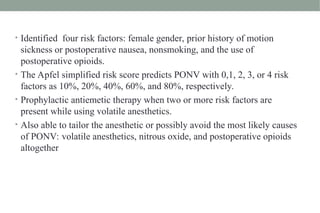
• Identified four risk factors: female gender, prior history of motion
sickness or postoperative nausea, nonsmoking, and the use of
postoperative opioids.
• The Apfel simplified risk score predicts PONV with 0,1, 2, 3, or 4 risk
factors as 10%, 20%, 40%, 60%, and 80%, respectively.
• Prophylactic antiemetic therapy when two or more risk factors are
present while using volatile anesthetics.
• Also able to tailor the anesthetic or possibly avoid the most likely causes
of PONV: volatile anesthetics, nitrous oxide, and postoperative opioids
altogether
Prevention of PONV
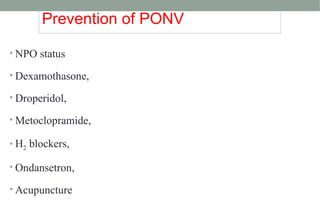
• NPO status
• Dexamothasone,
• Droperidol,
• Metoclopramide,
• H2 blockers,
• Ondansetron,
• Acupuncture
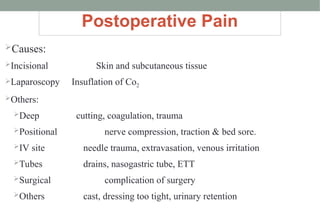
Causes:
Incisional Skin and subcutaneous tissue
Laparoscopy Insuflation of Co2
Others:
Deep cutting, coagulation, trauma
Positional nerve compression, traction & bed sore.
IV site needle trauma, extravasation, venous irritation
Tubes drains, nasogastric tube, ETT
Surgical complication of surgery
Others cast, dressing too tight, urinary retention
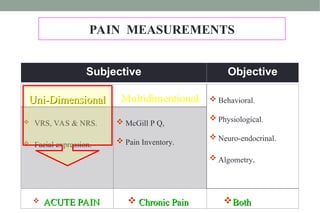
Postoperative Pain
Subjective Objective
Uni-Dimensional
Uni-Dimensional Multidimentional  Behavioral.
 Physiological.
 Neuro-endocrinal.
 Algometry.
 VRS, VAS & NRS.
 Facial expression.
 McGill P Q,
 Pain Inventory.
 ACUTE PAIN
ACUTE PAIN  Chronic Pain
Chronic Pain Both
Both
PAIN MEASUREMENTS
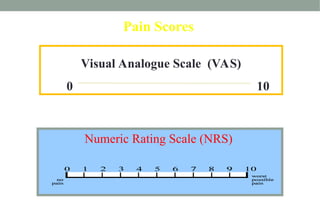
Numeric Rating Scale (NRS)
Visual Analogue Scale (VAS)
0 10
Pain Scores
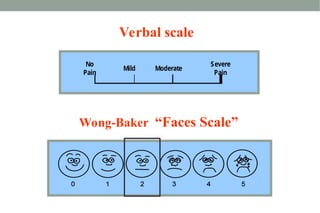
Wong-Baker “Faces Scale”
Verbal scale
No
Pain
Mild Moderate
Severe
Pain
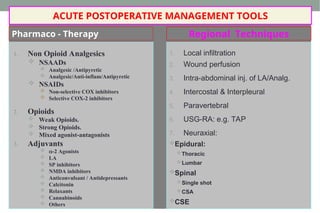
Pharmaco - Therapy
1. Local infiltration
2. Wound perfusion
3. Intra-abdominal inj. of LA/Analg.
4. Intercostal & Interpleural
5. Paravertebral
6. USG-RA: e.g. TAP
7. Neuraxial:
Epidural:
Thoracic
Lumbar
Spinal
Single shot
CSA
CSE
1. Non Opioid Analgesics
 NSAADs
 Analgesic /Antipyretic
 Analgesic/Anti-inflam/Antipyretic
 NSAIDs
 Non-selective COX inhibitors
 Selective COX-2 inhibitors
2. Opioids
 Weak Opioids.
 Strong Opioids.
 Mixed agonist-antagonists
3. Adjuvants
 -2 Agonists
 LA
 SP inhibitors
 NMDA inhibitors
 Anticonvulsant / Antidepressants
 Calcitonin
 Relaxants
 Cannabinoids
 Others
Regional Techniques
ACUTE POSTOPERATIVE MANAGEMENT TOOLS
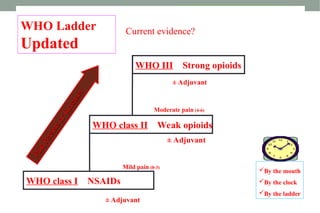
WHO III Strong opioids
Mild pain (0-3)
Moderate pain (4-6)
Severe pain (7-10)
± Adjuvant
± Adjuvant
± Adjuvant
P
a
i
n
P
e
r
s
i
s
t
s
o
r
I
n
c
r
e
a
s
e
s
P
a
i
n
P
e
r
s
i
s
t
s
o
r
I
n
c
r
e
a
s
e
s
WHO IV Interventional
By the mouth
By the clock
By the ladder
Current evidence?
WHO Ladder
Updated
WHO class II Weak opioids
WHO class I NSAIDs
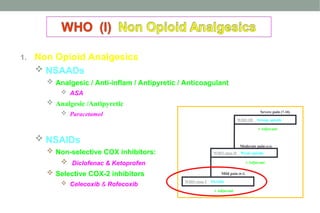
1. Non Opioid Analgesics
 NSAADs
 Analgesic / Anti-inflam / Antipyretic / Anticoagulant
 ASA
 Analgesic /Antipyretic
 Paracetamol
 NSAIDs
 Non-selective COX inhibitors:
 Diclofenac & Ketoprofen
 Selective COX-2 inhibitors
 Celecoxib & Rofecoxib
WHO class I NSAIDs
WHO class II Weak opioids
WHO III Strong opioids
Mild pain (0-3)
Moderate pain (4-6)
± Adjuvant
± Adjuvant
± Adjuvant
Severe pain (7-10)
Scientific Evidence – NON OPIOID ANALGESICS
1. Paracetamol:
1. is an effective analgesic for acute pain; the incidence of adverse effects
comparable to placebo (Level I [Cochrane Review]).
2. Paracetamol / NSAIDs given in addition to PCA Opioids   Opioid
consumption (Level I).
2. NSAIDs:
1. are effective in the treatment of acute postoperative (Level I ).
2. With careful patient selection and monitoring, the incidence of renal
impairment is low (Level I [Cochrane Review]).
3. NSAIDs + Paracetamol improve analgesia compared with paracetamol
alone (Level I).
Acute Pain Management - Scientific Evidence - AAGBI Guidelines 2010
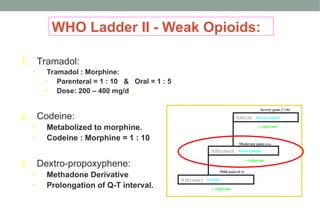
WHO Ladder II - Weak Opioids:
1. Tramadol:
• Tramadol : Morphine:
• Parenteral = 1 : 10 & Oral = 1 : 5
• Dose: 200 – 400 mg/d
2. Codeine:
• Metabolized to morphine.
• Codeine : Morphine = 1 : 10
3. Dextro-propoxyphene:
• Methadone Derivative
• Prolongation of Q-T interval.
WHO class I NSAIDs
WHO class II Weak opioids
WHO III Strong opioids
Mild pain (0-3)
Moderate pain (4-6)
± Adjuvant
± Adjuvant
± Adjuvant
Severe pain (7-10)
Scientific Evidence – WEAK
OPIOIDS
1. Tramadol:
 has a lower risk of respiratory depression & impairs GIT motor
function < other opioids
(Level II).
 is an effective treatment for neuropathic pain
(Level I [Cochrane Review]).
2. Dextropropoxyphene:
 has low analgesic efficacy
(Level I [Cochrane Review]).
Acute Pain Management - Scientific Evidence - AAGBI Guidelines 2010
WHO class I NSAIDs
WHO class II Weak opioids
WHO III Strong opioids
Mild pain (0-3)
Moderate pain (4-6)
± Adjuvant
± Adjuvant
± Adjuvant
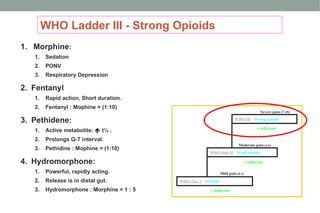
WHO Ladder III - Strong Opioids
1. Morphine:
1. Sedation
2. PONV
3. Respiratory Depression
2. Fentanyl
1. Rapid action, Short duration.
2. Fentanyl : Mophine = (1:10)
3. Pethidene:
1. Active metabolite:  t½ .
2. Prolongs Q-T interval.
3. Pethidine : Mophine = (1:10)
4. Hydromorphone:
1. Powerful, rapidly acting.
2. Release is in distal gut.
3. Hydromorphone : Morphine = 1 : 5
Severe pain (7-10)
WHO III Strong opioids
Mild pain (0-3)
Moderate pain (4-6)
Severe pain (7-10)
± Adjuvant
± Adjuvant
± Adjuvant
WHO IV Interventional
WHO class II Weak opioids
WHO class I NSAIDs
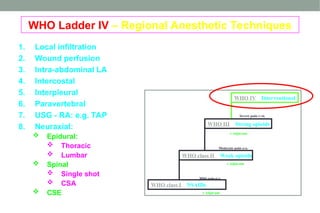
WHO Ladder IV – Regional Anesthetic Techniques
1. Local infiltration
2. Wound perfusion
3. Intra-abdominal LA
4. Intercostal
5. Interpleural
6. Paravertebral
7. USG - RA: e.g. TAP
8. Neuraxial:
 Epidural:
 Thoracic
 Lumbar
 Spinal
 Single shot
 CSA
 CSE
Neuraxial (Spinal / Epidural)
(LA / Opioids / others)
• Advantages:
• Provide prolonged & effective analgesia
• Side effects
• Respiratory depression.
• N/V.
• Pruritis.
• Urinary retention.
+
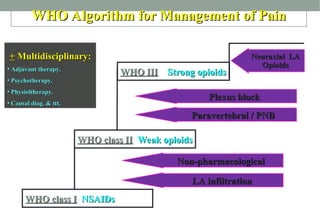
+ Multidisciplinary:
Multidisciplinary:
• Adjuvant therapy.
Adjuvant therapy.
• Psychotherapy.
Psychotherapy.
• Physioltherapy.
Physioltherapy.
• Causal diag. & ttt.
Causal diag. & ttt.
WHO class I
WHO class I NSAIDs
NSAIDs
WHO class II
WHO class II Weak opioids
Weak opioids
WHO III
WHO III Strong opioids
Strong opioids
LA infiltration
LA infiltration
Non-pharmacological
Non-pharmacological
Paravertebral / PNB
Paravertebral / PNB
Neuraxial LA
Neuraxial LA
Opioids
Opioids
WHO Algorithm for Management of Pain
Plexus block
Plexus block
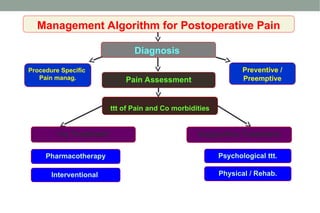
Diagnosis
Procedure Specific
Pain manag. Pain Assessment
Preventive /
Preemptive
ttt of Pain and Co morbidities
1ry Treatment Supportive Treatment
Pharmacotherapy
Interventional
Psychological ttt.
Physical / Rehab.
Management Algorithm for Postoperative Pain
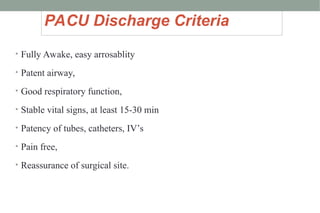
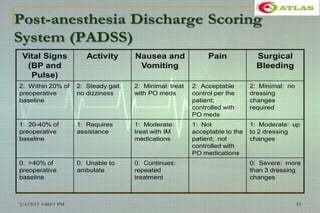
PACU Discharge Criteria
• Fully Awake, easy arrosablity
• Patent airway,
• Good respiratory function,
• Stable vital signs, at least 15-30 min
• Patency of tubes, catheters, IV’s
• Pain free,
• Reassurance of surgical site.
Reference
Reference.
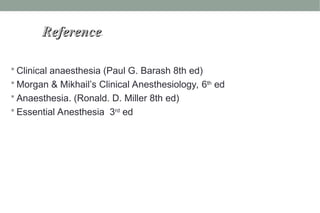
 Clinical anaesthesia (Paul G. Barash 8th ed)
 Morgan & Mikhail’s Clinical Anesthesiology, 6th
ed
 Anaesthesia. (Ronald. D. Miller 8th ed)
 Essential Anesthesia 3rd
ed
T
THANK YOU!
HANK YOU!
?
?
WHO was first anesthetist?
When it was started? mid 1840?
God was first: “And the Lord God caused a deep sleep
to fall upon Adam, and he slept.” (Genesis 2:21).
A date is not mentioned?.

2. Postoperative assessment and management.ppt

  • 1.
    Postoperative Assessment andcare Gemechis Akuma Lecturer at WU IHS, Dept. of Anesthesia (BSc, MSC in ACA) Nekemte, Oromia
  • 2.
    Objectives.. Objectives.. • At theend of the session the students will be able to: 1. Explain a common approach to emergency medical problems encountered in the postoperative period. 2. Identify post-operative respiratory and hemodynamic problems and explain how to manage these problems. 3. Explain the predisposing factors, differential diagnosis and management of PONV. 4. Identify the causes and treatments of post-operative agitation and delirium. 5. Identify the causes of delayed emergence and know how to deal with this problem. 6. Explain about different approaches of post-Operative pain management
  • 16.
    Postoperative stage • Atthe end of the operation, the patient is either extubated in the OT (and an OPA inserted if needed) or transferred to the recovery room with an LMA still in situ.? • All patients receive supplemental oxygen during transfer. • Many patients who do not have a general anesthesia/sedation bypass the recovery room and go straight from the OT to the surgical daycare unit
  • 17.
    Admission to PACU Steps: Steps: Coordinateprior to arrival, • Assess airway, • Administer oxygen, • Apply monitors, • Obtain vital signs, • Receive report from anesthesia personnel.
  • 19.
    Once in therecovery room, • Handover occurs between the anesthetist and a recovery nurse. Important information passed on includes: • Patients name and age; • Operation details; • Blood loss; • Anaesthetic technique with emphasis on: • analgesia given; • regional/nerve blocks; • antiemetics given; • antibiotics; • the use of local anaesthetic infiltration; • thromboprophylaxis.
  • 20.
    Patient Care inthe PACU • Admission • Apply oxygen and monitor • Receive report • Monitor & Observe & Manage  To Achieve • Cardiovascular stability • Respiratory stability • Pain control • Discharge from PACU
  • 21.
    Monitoring in thePACU • Baseline vital signs. • Respiration • RR/min, Rythm • Pulse oximetry • Circulation • PR/min & Blood pressure • ECG • Level of consciousness • Pain scores
  • 22.
    Initial Assessment 1. Color 2.Respiration 3. Circulation 4. Consciousness 5. Activity
  • 23.
    Aldrete Score Score ActivityRespiration Circulation Consciousness Oxygen Saturation 2 Moves all extremities Breaths deeply and coughs freely. BP + 20 mm of preanesth. level Fully awake Spo2 > 92% on room air 1 Moves 2 extremities Dyspneic, or shallow breathing BP + 20-50 mm of preanesth. level Arousable on calling Spo2 >90% With suppl. O2 0 Unable to move Apneic BP + 50 mm of preanesth. level Not responding Spo2 <92% With suppl. O2
  • 24.
    Common PACU Problems •Airway obstruction • Hypoxemia • Hypoventilation • Hypotension • Hypertension • Cardiac dysrhythmias • Hyper/Hypothermia • Bleeding • Agitation • Delayed recovery • “PONV” • Pain • Oliguria
  • 25.
    Airway Obstruction • Mostcommon: tongue fall back  posterior pharynx • May be foreign body • Inadequate relaxant reversal • Residual anesthesia
  • 26.
    Management of AirwayObstruction • Patient’s stimulation, • Suction, • Oral Airway, • Nasal Airway, • Others: • Tracheal intubation • Cricothyroidotomy • Tracheotomy
  • 28.
    Hypoventilation • Residual anesthesia •Narcotics • Inhalation agent • Muscle Relaxant • Post oper - Analgesia • Intravenous • Epidural
  • 29.
    Treatment of Hypoventilation •Close observation, • Assess the problem, • Treatment of the cause: • Reverse (or Antidote): • Muscle relaxant  Neostigmine • Opioids  Naloxone • Midazolam  Anexate
  • 30.
    Hypertension • Common causes:e.g. • Pain • Full Bladder • Hypertensive patients • Fluid overload • Excessive use of vasopressors
  • 31.
    Treatment of Hypertension •Effective pain control • Sedation • Anti-hypertensives: • Beta blockers • Alpha blockers • Hydralazine (Apresoline) • Calcium channel blockers
  • 32.
    Hypotension • Decreased venousreturn • Hypovolemia, •  fluid intake •  losses • Bleeding • Sympathectomy, • 3rd space loss, • Left ventricular dysfunction
  • 33.
    Treatment of Hypotension •Initially treat with fluid bolus, • + Vasopressors, • + Correction of the cause
  • 36.
    Dysrhythmias • Secondary to •Hypoxemia • Hypercarbia • Hypothermia • Acidosis • Catecholamines • Electrolyte abnormalities.
  • 37.
    Treatment of Dysrhythmia •Identify and treat the cause, • Assure oxygenation, • Pharmacological
  • 38.
    Urine Output • Oliguria •Hypovolemia, • Surgical trauma, • Impaired renal function, • Mechanical blocking of catheter. • Treatment: • Assess catheter patency • Fluid bolus • Diuretics e.g. Lasix
  • 39.
    Post op Bleeding Causes: •UsuallySurgical Problem, •Coagulopathy, •Drug induced
  • 42.
    Treatment of Postop Bleeding Treatment: • Start i.v. lines  push fluids • Blood sample, - CBC, - Cross matching, - Coagulopathy • Notify the surgeon, • Correction of the cause
  • 43.
    Hypothermia • Most ofpatients will arrive cold • Treatment: • Get baseline temperature • Actively rewarm • Administer oxygen if shivering • Take care for: • Pediatric, • Geriatric.
  • 45.
    Altered Mental Status •Reaction to drugs? • Drugs e.g. sedatives, anticholinergics • Intoxication / Drug abusers • Pain • Full bladder • Hypoventilation • Low COP • CVA
  • 47.
    Treatment of AlteredMental Status • Reassurances, • Always protect the patient, • Evaluate the cause, • Treatment of symptoms, • Sedatives / Opioids if necessary.
  • 49.
    Delayed Recovery • Systematicevaluation • Pre-op status • Intraoperative events • Ventilation • Response to Stimulation • Cardiovascular status
  • 50.
    Delayed Recovery • Themost common cause: • Residual anesthesia  Consider reversal • Hypothermia, • Metabolic e.g. diabetic coma, • Underlying psychiatric problem • CVA
  • 51.
    Postoperative Nausea &Vomiting “PONV” • Commonest complication in postop • Risk factors • Type & duration of surgery, • Type of anesthesia, • Drugs • Hormone levels, • Medical problems, • Autonomic involvement.
  • 52.
    • Identified fourrisk factors: female gender, prior history of motion sickness or postoperative nausea, nonsmoking, and the use of postoperative opioids. • The Apfel simplified risk score predicts PONV with 0,1, 2, 3, or 4 risk factors as 10%, 20%, 40%, 60%, and 80%, respectively. • Prophylactic antiemetic therapy when two or more risk factors are present while using volatile anesthetics. • Also able to tailor the anesthetic or possibly avoid the most likely causes of PONV: volatile anesthetics, nitrous oxide, and postoperative opioids altogether
  • 54.
    Prevention of PONV •NPO status • Dexamothasone, • Droperidol, • Metoclopramide, • H2 blockers, • Ondansetron, • Acupuncture
  • 55.
    Causes: Incisional Skin andsubcutaneous tissue Laparoscopy Insuflation of Co2 Others: Deep cutting, coagulation, trauma Positional nerve compression, traction & bed sore. IV site needle trauma, extravasation, venous irritation Tubes drains, nasogastric tube, ETT Surgical complication of surgery Others cast, dressing too tight, urinary retention Postoperative Pain
  • 56.
    Subjective Objective Uni-Dimensional Uni-Dimensional Multidimentional Behavioral.  Physiological.  Neuro-endocrinal.  Algometry.  VRS, VAS & NRS.  Facial expression.  McGill P Q,  Pain Inventory.  ACUTE PAIN ACUTE PAIN  Chronic Pain Chronic Pain Both Both PAIN MEASUREMENTS
  • 57.
    Numeric Rating Scale(NRS) Visual Analogue Scale (VAS) 0 10 Pain Scores
  • 58.
    Wong-Baker “Faces Scale” Verbalscale No Pain Mild Moderate Severe Pain
  • 59.
    Pharmaco - Therapy 1.Local infiltration 2. Wound perfusion 3. Intra-abdominal inj. of LA/Analg. 4. Intercostal & Interpleural 5. Paravertebral 6. USG-RA: e.g. TAP 7. Neuraxial: Epidural: Thoracic Lumbar Spinal Single shot CSA CSE 1. Non Opioid Analgesics  NSAADs  Analgesic /Antipyretic  Analgesic/Anti-inflam/Antipyretic  NSAIDs  Non-selective COX inhibitors  Selective COX-2 inhibitors 2. Opioids  Weak Opioids.  Strong Opioids.  Mixed agonist-antagonists 3. Adjuvants  -2 Agonists  LA  SP inhibitors  NMDA inhibitors  Anticonvulsant / Antidepressants  Calcitonin  Relaxants  Cannabinoids  Others Regional Techniques ACUTE POSTOPERATIVE MANAGEMENT TOOLS
  • 60.
    WHO III Strongopioids Mild pain (0-3) Moderate pain (4-6) Severe pain (7-10) ± Adjuvant ± Adjuvant ± Adjuvant P a i n P e r s i s t s o r I n c r e a s e s P a i n P e r s i s t s o r I n c r e a s e s WHO IV Interventional By the mouth By the clock By the ladder Current evidence? WHO Ladder Updated WHO class II Weak opioids WHO class I NSAIDs
  • 61.
    1. Non OpioidAnalgesics  NSAADs  Analgesic / Anti-inflam / Antipyretic / Anticoagulant  ASA  Analgesic /Antipyretic  Paracetamol  NSAIDs  Non-selective COX inhibitors:  Diclofenac & Ketoprofen  Selective COX-2 inhibitors  Celecoxib & Rofecoxib WHO class I NSAIDs WHO class II Weak opioids WHO III Strong opioids Mild pain (0-3) Moderate pain (4-6) ± Adjuvant ± Adjuvant ± Adjuvant Severe pain (7-10)
  • 62.
    Scientific Evidence –NON OPIOID ANALGESICS 1. Paracetamol: 1. is an effective analgesic for acute pain; the incidence of adverse effects comparable to placebo (Level I [Cochrane Review]). 2. Paracetamol / NSAIDs given in addition to PCA Opioids   Opioid consumption (Level I). 2. NSAIDs: 1. are effective in the treatment of acute postoperative (Level I ). 2. With careful patient selection and monitoring, the incidence of renal impairment is low (Level I [Cochrane Review]). 3. NSAIDs + Paracetamol improve analgesia compared with paracetamol alone (Level I). Acute Pain Management - Scientific Evidence - AAGBI Guidelines 2010
  • 63.
    WHO Ladder II- Weak Opioids: 1. Tramadol: • Tramadol : Morphine: • Parenteral = 1 : 10 & Oral = 1 : 5 • Dose: 200 – 400 mg/d 2. Codeine: • Metabolized to morphine. • Codeine : Morphine = 1 : 10 3. Dextro-propoxyphene: • Methadone Derivative • Prolongation of Q-T interval. WHO class I NSAIDs WHO class II Weak opioids WHO III Strong opioids Mild pain (0-3) Moderate pain (4-6) ± Adjuvant ± Adjuvant ± Adjuvant Severe pain (7-10)
  • 64.
    Scientific Evidence –WEAK OPIOIDS 1. Tramadol:  has a lower risk of respiratory depression & impairs GIT motor function < other opioids (Level II).  is an effective treatment for neuropathic pain (Level I [Cochrane Review]). 2. Dextropropoxyphene:  has low analgesic efficacy (Level I [Cochrane Review]). Acute Pain Management - Scientific Evidence - AAGBI Guidelines 2010
  • 65.
    WHO class INSAIDs WHO class II Weak opioids WHO III Strong opioids Mild pain (0-3) Moderate pain (4-6) ± Adjuvant ± Adjuvant ± Adjuvant WHO Ladder III - Strong Opioids 1. Morphine: 1. Sedation 2. PONV 3. Respiratory Depression 2. Fentanyl 1. Rapid action, Short duration. 2. Fentanyl : Mophine = (1:10) 3. Pethidene: 1. Active metabolite:  t½ . 2. Prolongs Q-T interval. 3. Pethidine : Mophine = (1:10) 4. Hydromorphone: 1. Powerful, rapidly acting. 2. Release is in distal gut. 3. Hydromorphone : Morphine = 1 : 5 Severe pain (7-10)
  • 66.
    WHO III Strongopioids Mild pain (0-3) Moderate pain (4-6) Severe pain (7-10) ± Adjuvant ± Adjuvant ± Adjuvant WHO IV Interventional WHO class II Weak opioids WHO class I NSAIDs WHO Ladder IV – Regional Anesthetic Techniques 1. Local infiltration 2. Wound perfusion 3. Intra-abdominal LA 4. Intercostal 5. Interpleural 6. Paravertebral 7. USG - RA: e.g. TAP 8. Neuraxial:  Epidural:  Thoracic  Lumbar  Spinal  Single shot  CSA  CSE
  • 67.
    Neuraxial (Spinal /Epidural) (LA / Opioids / others) • Advantages: • Provide prolonged & effective analgesia • Side effects • Respiratory depression. • N/V. • Pruritis. • Urinary retention.
  • 68.
    + + Multidisciplinary: Multidisciplinary: • Adjuvanttherapy. Adjuvant therapy. • Psychotherapy. Psychotherapy. • Physioltherapy. Physioltherapy. • Causal diag. & ttt. Causal diag. & ttt. WHO class I WHO class I NSAIDs NSAIDs WHO class II WHO class II Weak opioids Weak opioids WHO III WHO III Strong opioids Strong opioids LA infiltration LA infiltration Non-pharmacological Non-pharmacological Paravertebral / PNB Paravertebral / PNB Neuraxial LA Neuraxial LA Opioids Opioids WHO Algorithm for Management of Pain WHO Algorithm for Management of Pain Plexus block Plexus block
  • 69.
    Diagnosis Procedure Specific Pain manag.Pain Assessment Preventive / Preemptive ttt of Pain and Co morbidities 1ry Treatment Supportive Treatment Pharmacotherapy Interventional Psychological ttt. Physical / Rehab. Management Algorithm for Postoperative Pain
  • 70.
    PACU Discharge Criteria •Fully Awake, easy arrosablity • Patent airway, • Good respiratory function, • Stable vital signs, at least 15-30 min • Patency of tubes, catheters, IV’s • Pain free, • Reassurance of surgical site.
  • 79.
    Reference Reference.  Clinical anaesthesia(Paul G. Barash 8th ed)  Morgan & Mikhail’s Clinical Anesthesiology, 6th ed  Anaesthesia. (Ronald. D. Miller 8th ed)  Essential Anesthesia 3rd ed
  • 80.
    T THANK YOU! HANK YOU! ? ? WHOwas first anesthetist? When it was started? mid 1840? God was first: “And the Lord God caused a deep sleep to fall upon Adam, and he slept.” (Genesis 2:21). A date is not mentioned?.

Editor's Notes

  • #15 Standard I All patients should receive appropriate care Standard II All patients will be accompanied by one of anesthesia team Standard III The patient will be reevaluated & report given to the nurse Standard IV The patient shall be continually monitored in the PACU Standard V A physician will signing for the patient out of the PACU
  • #63 They can relief pain when we increase the dose but with significantly higher incidence of side effects. Members are: Tramadol: Equi-potency to morphine: 1:10 Parenteral. 1:5 Oral. Codeine: Metabolized to morphine. Equi-potency to morphine: (1:10). Hydrocodone: Metabolized to Hydromorphine. Equi-potency to morphine: (1:2). Dextro-propoxyphene: Methadone Drivative, can cause prolongation of Q-T interval. Tramadol hydrochloride: Dose is 100 mg. Equivalent to 100 mg. pethidine. Less postoperative respiratory depression. Nausea and vomiting is the prominent side effect. Efficient in reduction of postoperative shivering. It is always needed to start with weak opioids before giving strong opioids particularly in cancer patients. They are weak as their affinity to opioid receptors is very much less than strong opioids. Codeine has to be metabolized to morphine in the body to act. A process which is dependant of metabolic enzymes mainly the Cytochrome oxidase enzyme. Enzyme inhibitors as cimetidine, quinidine, and antifungal drugs can block this reaction and inhibit codeine analgesia. Dose of codeine is 200 mg, every 4-6 hours.Dose of dihydrocodiene is 10-20 mg every 4-6 hours Tramadol on the other hand, is a very weak opioid analgesic. Its analgesia is dependant on potentiation by its serotonergic and noradrenergic effect. It is only potent as an analgesic because of this potentiation that makes it as potent as pethidine. It is also characterized by the absence of tolerance. A very useful weak opioid particularly effective in neuropathic pain. Dose is 50 mg-100 mg every 6 hours. Dextropropxyphene: is a weak opioid, its maine side effect is persistent constipation.Dose is 300 mg every 4-6 hours.
  • #65 Morphine: available in. Immediate release( 4 hourly). Controlled release (12-hourly). Sustained release (24-hour dosing). Morphine is a universal opioid agonist, binding to cerebral OR4 is responsible for tolerance. Oxycodone: Active on -opioid receptors: important in visceral and Neuropathic pain. Double phase of action of SR form: a rapid initial followed by a slow phase. Equianalgesic dose with morphine for opioid rotation is 2:3. Fentanyl: (available in a TTS & Transmucosal formulation): No first path liver metabolism. Has a specific  & opioid receptor binding effect, and no OR4 binding. Opioid receptor side effects are generally 1/3 of morphine. Pharmacokinetic and Pharmacodynamic Considerations 1. With opioid drugs, four to five half-lives are required to approach steady state plasma concentrations. Methadone,and levorphanol have relatively long half-lives: Methadone: from 12 to more than 100 hours. Levorphanol : from 12 to 16 hours. Many days may be required to stabilize on methadone after a dose is selected, with possible cumulative toxicity. 2. Transdermal fentanyl has a long apparent half-life (about 24 hours), which results from continued absorption of drug from a subcutaneous depot after the patch is removed. Controlled-release formulations reach steady state relatively quickly. The transdermal system, for example, usually approaches steady state after 2 to 3 days and the controlled-release morphine and oxycodone preparations approach steady state after 1 to 2 days. Analgesic duration following a dose is only loosely related to half-life: Most opioids require a dosing interval of 3 to 4 hours.