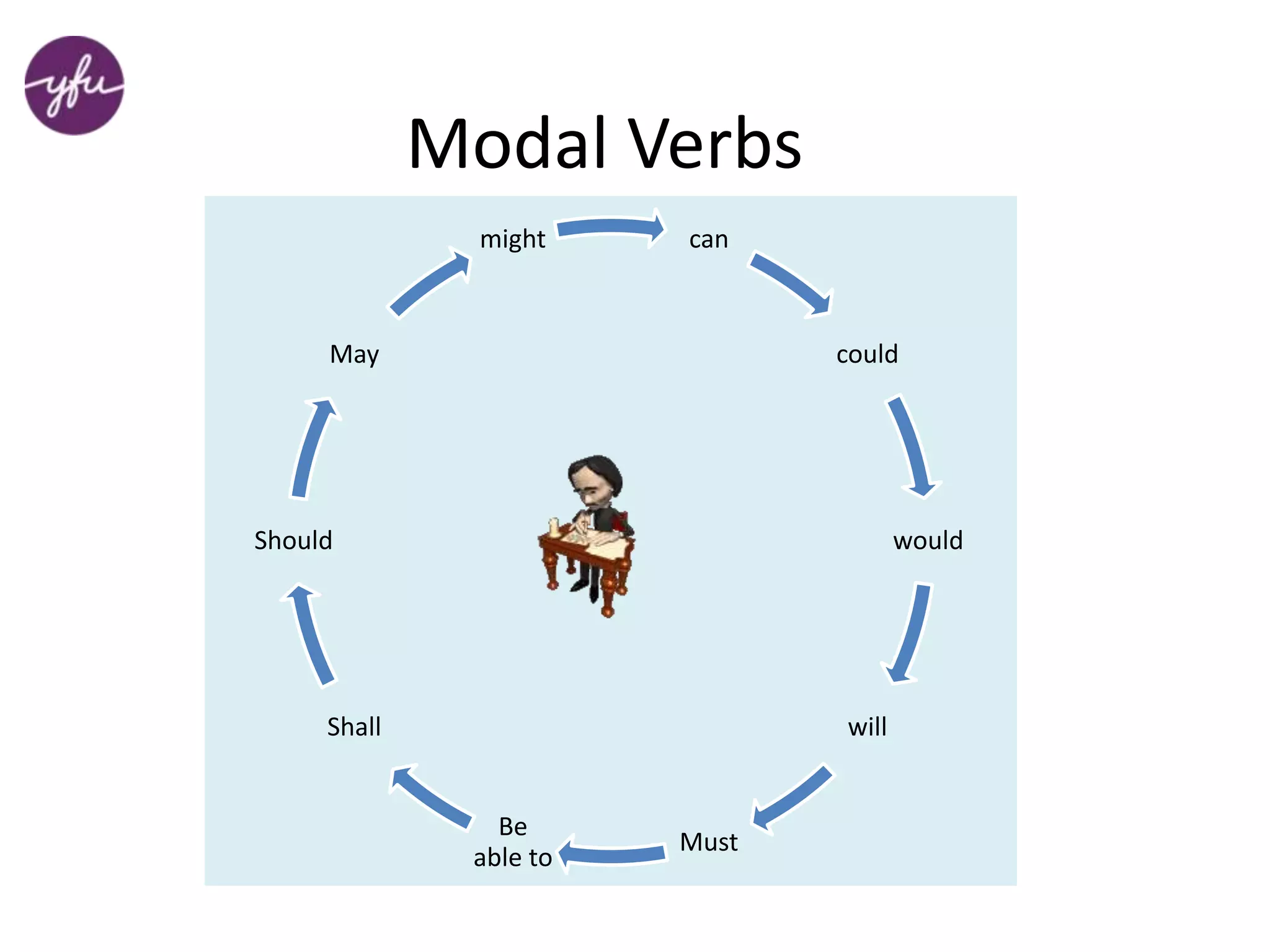
Modal Verbs
can
could
would
will
Must
Be
able to
Shall
Should
May
might
modal verbs express a variety of ideas
• Ability/Lack of Ability
• Possibility / Impossibility
• Ask Permission / Give Permission
• Make a suggestion
Ability 1
can could be able to
Model sentences for present and future situations:
can/can’t + base form of the verb
may and might + base form (used to express present or future possibility. May expresses
a higher degree of certainty:
Lisa can write very well
I can help you with that test next week
Ann can’t speak Russian
Mike is able to solve most of the problems
The support team will be able to help you in about ten minutes
I won’t be able to visit you next summer
Ability 2
can could be able to
Model sentences for past situations:
could / couldn’t + base form of the verb
When I was a child I could climb trees (general ability in the past - could)
I wasn’t able to visit her in the hospital (a specific situation in the past – be able to)
He hasn’t been able to finish his homework yet (a specific situation started in the past)
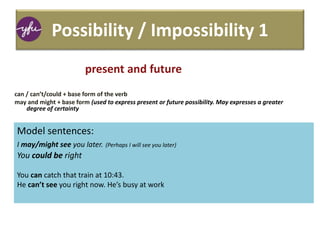
Possibility / Impossibility 1
can / can’t/could + base form of the verb
may and might + base form (used to express present or future possibility. May expresses a greater
degree of certainty
Model sentences:
I may/might see you later. (Perhaps I will see you later)
You could be right
You can catch that train at 10:43.
He can’t see you right now. He’s busy at work
present and future
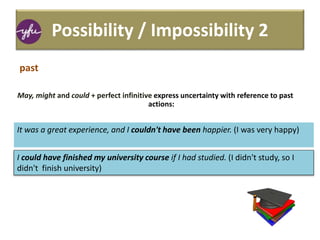
Possibility / Impossibility 2
May, might and could + perfect infinitive express uncertainty with reference to past
actions:
It was a great experience, and I couldn't have been happier. (I was very happy)
I could have finished my university course if I had studied. (I didn't study, so I
didn't finish university)
past
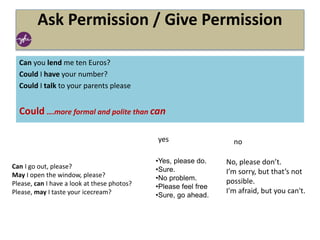
Ask Permission / Give Permission
Can you lend me ten Euros?
Could I have your number?
Could I talk to your parents please
Could ….more formal and polite than can
Can I go out, please?
May I open the window, please?
Please, can I have a look at these photos?
Please, may I taste your icecream?
•Yes, please do.
•Sure.
•No problem.
•Please feel free
•Sure, go ahead.
No, please don’t.
I’m sorry, but that’s not
possible.
I'm afraid, but you can't.
yes no
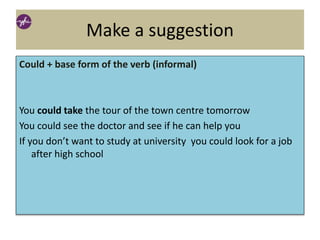
Make a suggestion
Could + base form of the verb (informal)
You could take the tour of the town centre tomorrow
You could see the doctor and see if he can help you
If you don’t want to study at university you could look for a job
after high school
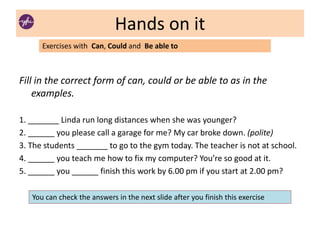
Hands on it
Fill in the correct form of can, could or be able to as in the
examples.
1. _______ Linda run long distances when she was younger?
2. ______ you please call a garage for me? My car broke down. (polite)
3. The students _______ to go to the gym today. The teacher is not at school.
4. ______ you teach me how to fix my computer? You’re so good at it.
5. ______ you ______ finish this work by 6.00 pm if you start at 2.00 pm?
Exercises with Can, Could and Be able to
You can check the answers in the next slide after you finish this exercise
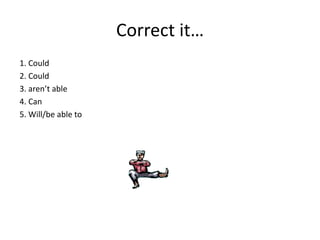
Correct it…
1. Could
2. Could
3. aren’t able
4. Can
5. Will/be able to

Pp on modals 1

  • 1.
  • 2.
    modal verbs expressa variety of ideas • Ability/Lack of Ability • Possibility / Impossibility • Ask Permission / Give Permission • Make a suggestion
  • 3.
    Ability 1 can couldbe able to Model sentences for present and future situations: can/can’t + base form of the verb may and might + base form (used to express present or future possibility. May expresses a higher degree of certainty: Lisa can write very well I can help you with that test next week Ann can’t speak Russian Mike is able to solve most of the problems The support team will be able to help you in about ten minutes I won’t be able to visit you next summer
  • 4.
    Ability 2 can couldbe able to Model sentences for past situations: could / couldn’t + base form of the verb When I was a child I could climb trees (general ability in the past - could) I wasn’t able to visit her in the hospital (a specific situation in the past – be able to) He hasn’t been able to finish his homework yet (a specific situation started in the past)
  • 5.
    Possibility / Impossibility1 can / can’t/could + base form of the verb may and might + base form (used to express present or future possibility. May expresses a greater degree of certainty Model sentences: I may/might see you later. (Perhaps I will see you later) You could be right You can catch that train at 10:43. He can’t see you right now. He’s busy at work present and future
  • 6.
    Possibility / Impossibility2 May, might and could + perfect infinitive express uncertainty with reference to past actions: It was a great experience, and I couldn't have been happier. (I was very happy) I could have finished my university course if I had studied. (I didn't study, so I didn't finish university) past
  • 7.
    Ask Permission /Give Permission Can you lend me ten Euros? Could I have your number? Could I talk to your parents please Could ….more formal and polite than can Can I go out, please? May I open the window, please? Please, can I have a look at these photos? Please, may I taste your icecream? •Yes, please do. •Sure. •No problem. •Please feel free •Sure, go ahead. No, please don’t. I’m sorry, but that’s not possible. I'm afraid, but you can't. yes no
  • 8.
    Make a suggestion Could+ base form of the verb (informal) You could take the tour of the town centre tomorrow You could see the doctor and see if he can help you If you don’t want to study at university you could look for a job after high school
  • 9.
    Hands on it Fillin the correct form of can, could or be able to as in the examples. 1. _______ Linda run long distances when she was younger? 2. ______ you please call a garage for me? My car broke down. (polite) 3. The students _______ to go to the gym today. The teacher is not at school. 4. ______ you teach me how to fix my computer? You’re so good at it. 5. ______ you ______ finish this work by 6.00 pm if you start at 2.00 pm? Exercises with Can, Could and Be able to You can check the answers in the next slide after you finish this exercise
  • 10.
    Correct it… 1. Could 2.Could 3. aren’t able 4. Can 5. Will/be able to