“Sowhat if today
were the last day of
the rest of your life?”
Goals
 Thought   provoking
 Informative
 Practical
 Fun
Skill 1


Find a quiet place in your mind.
Now take deep slow belly breaths.
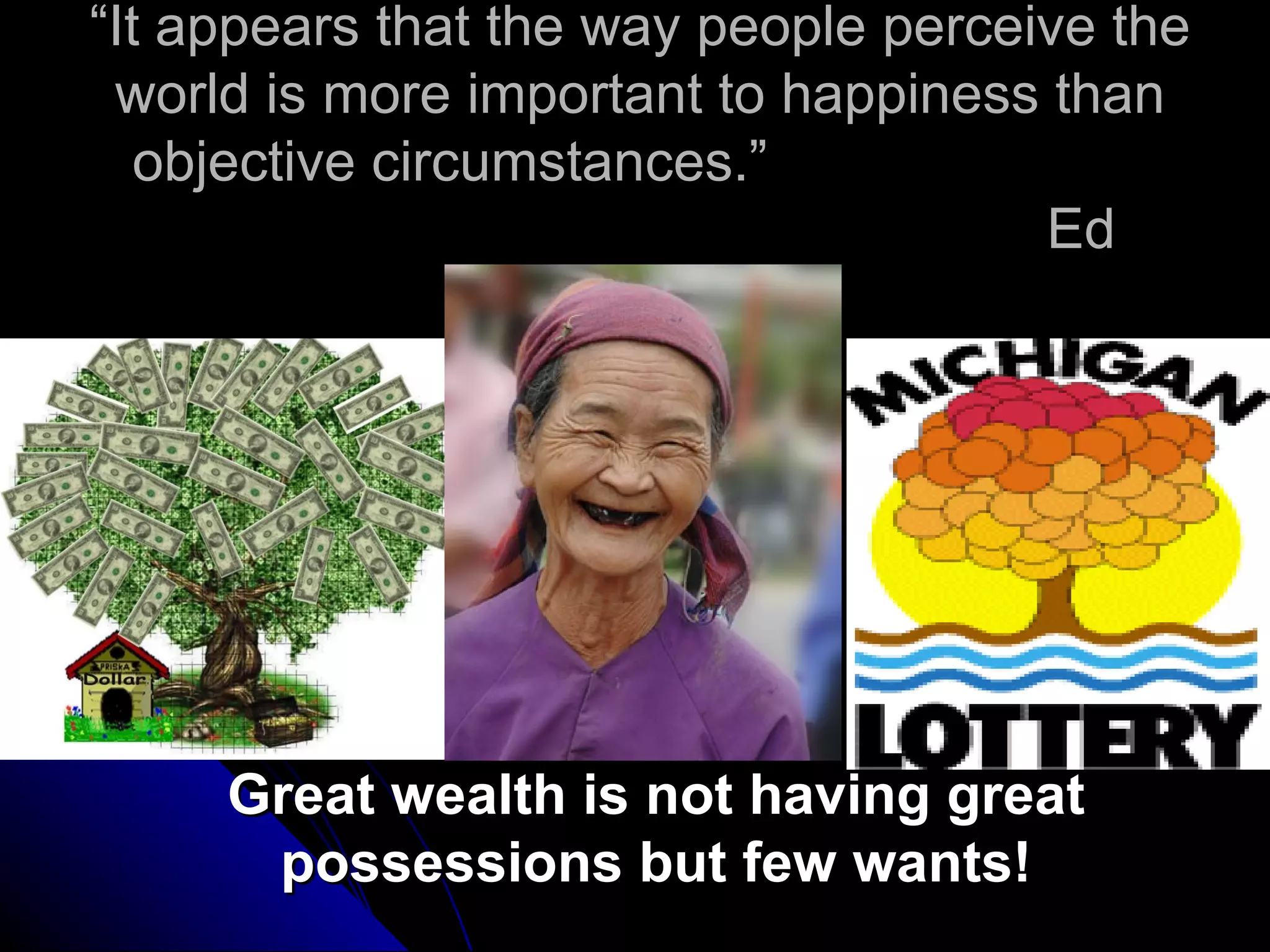
“It appears that the way people perceive the
 world is more important to happiness than
   objective circumstances.”
                                      Ed
                    Diener


     Great wealth is not having great
      possessions but few wants!
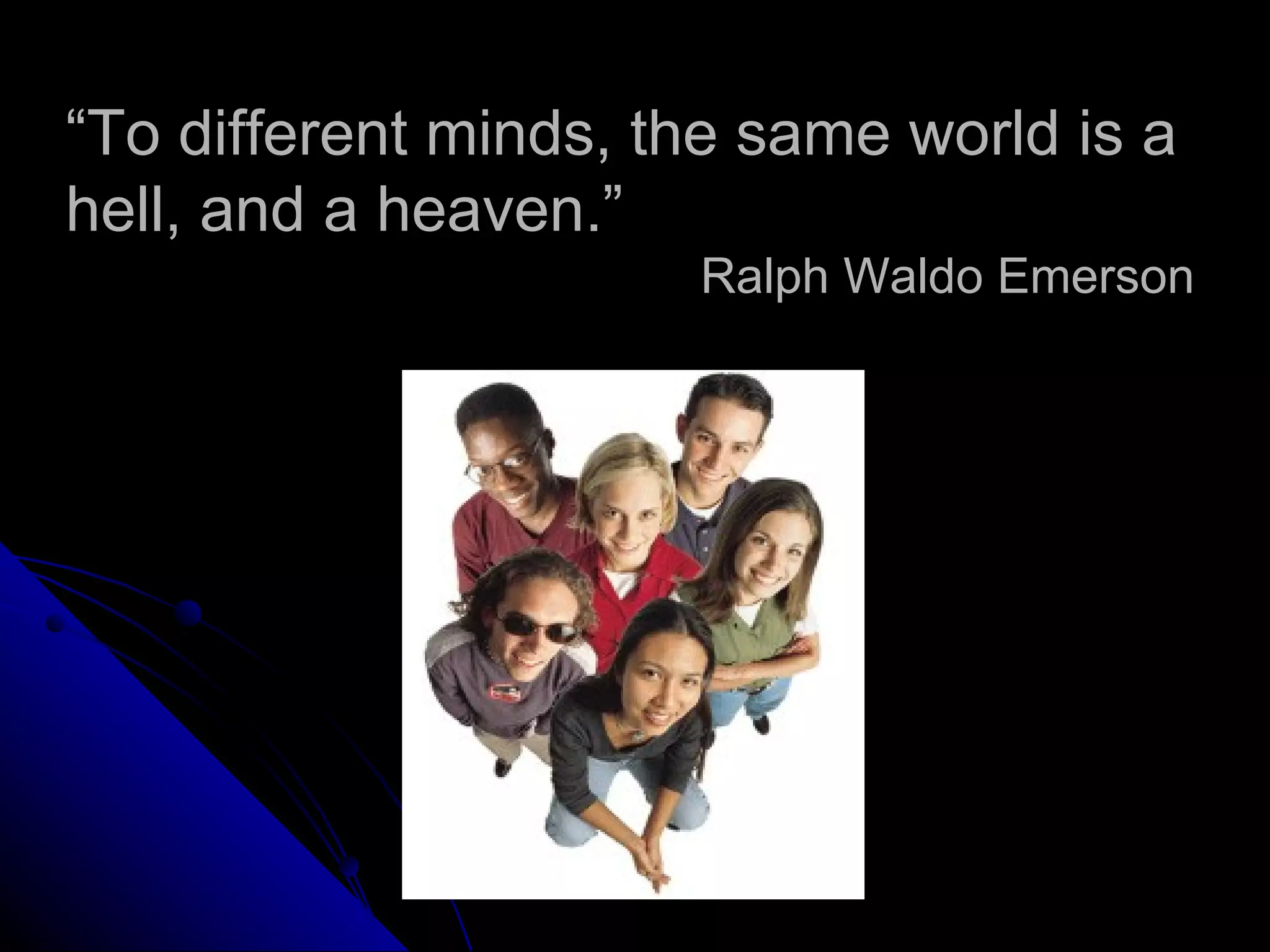
“To different minds, the same world is a
hell, and a heaven.”
                      Ralph Waldo Emerson
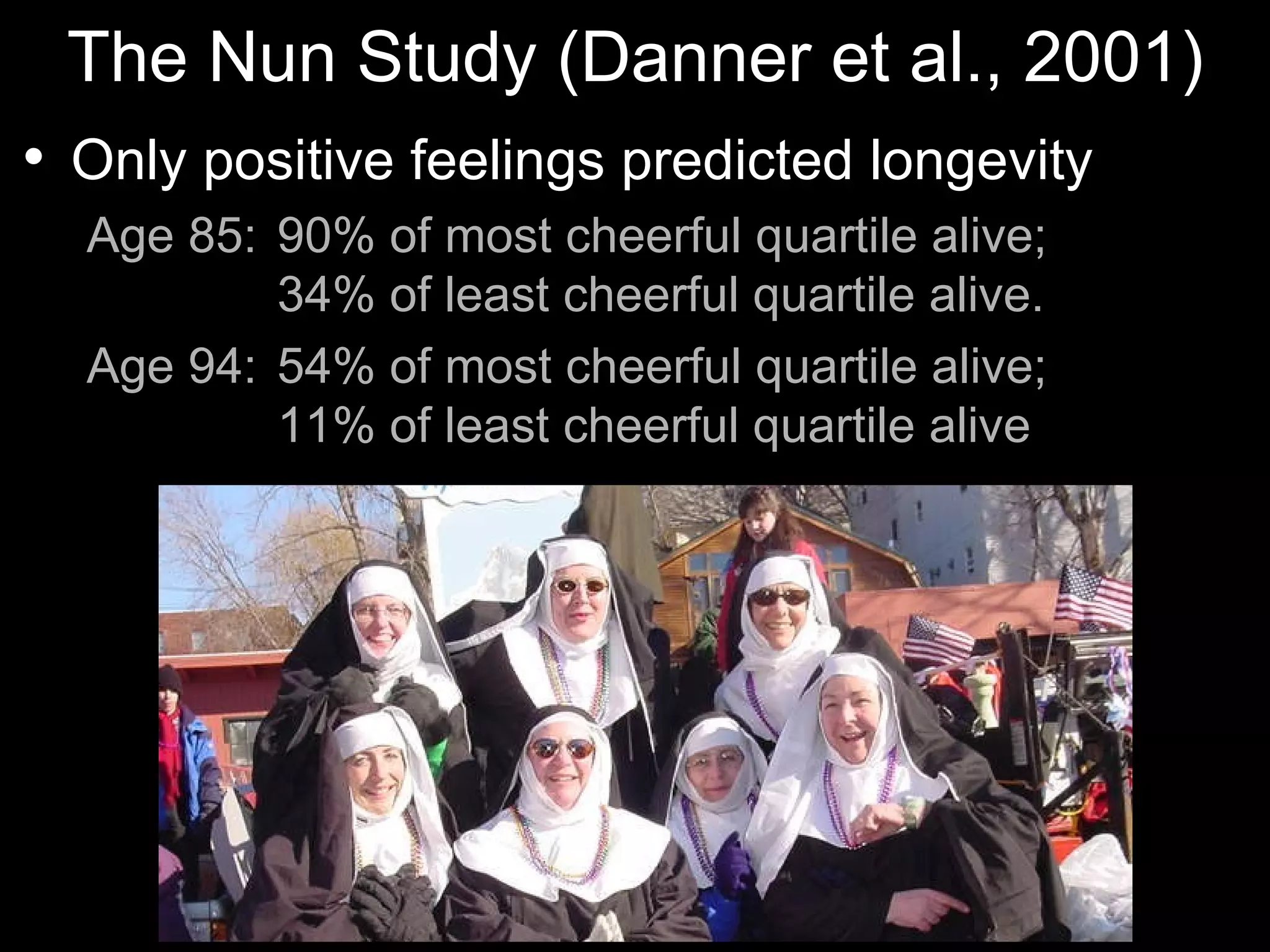
The Nun Study (Danner et al., 2001)
   Only positive feelings predicted longevity
    Age 85: 90% of most cheerful quartile alive;
            34% of least cheerful quartile alive.
    Age 94: 54% of most cheerful quartile alive;
            11% of least cheerful quartile alive
Two Types of People in the World
   The Fault Finder
“The fault-finder will find faults even in paradise”
                                 Henry David Thoreau
    Could lead to resignation


   The Merit-finder
“The invariable mark of wisdom is to see the miraculous
in the common.”
                             Ralph Waldo Emerson
       Could lead to detachment
       The need to respect reality
The positive elements of being a
                   Merit Finder
   Well-being (Thompson, 1985)
   Health
       Affleck et al. (1987)
       Bower (1988)
       King & Miner (2000)
   Longevity
Happiness
Obstacles
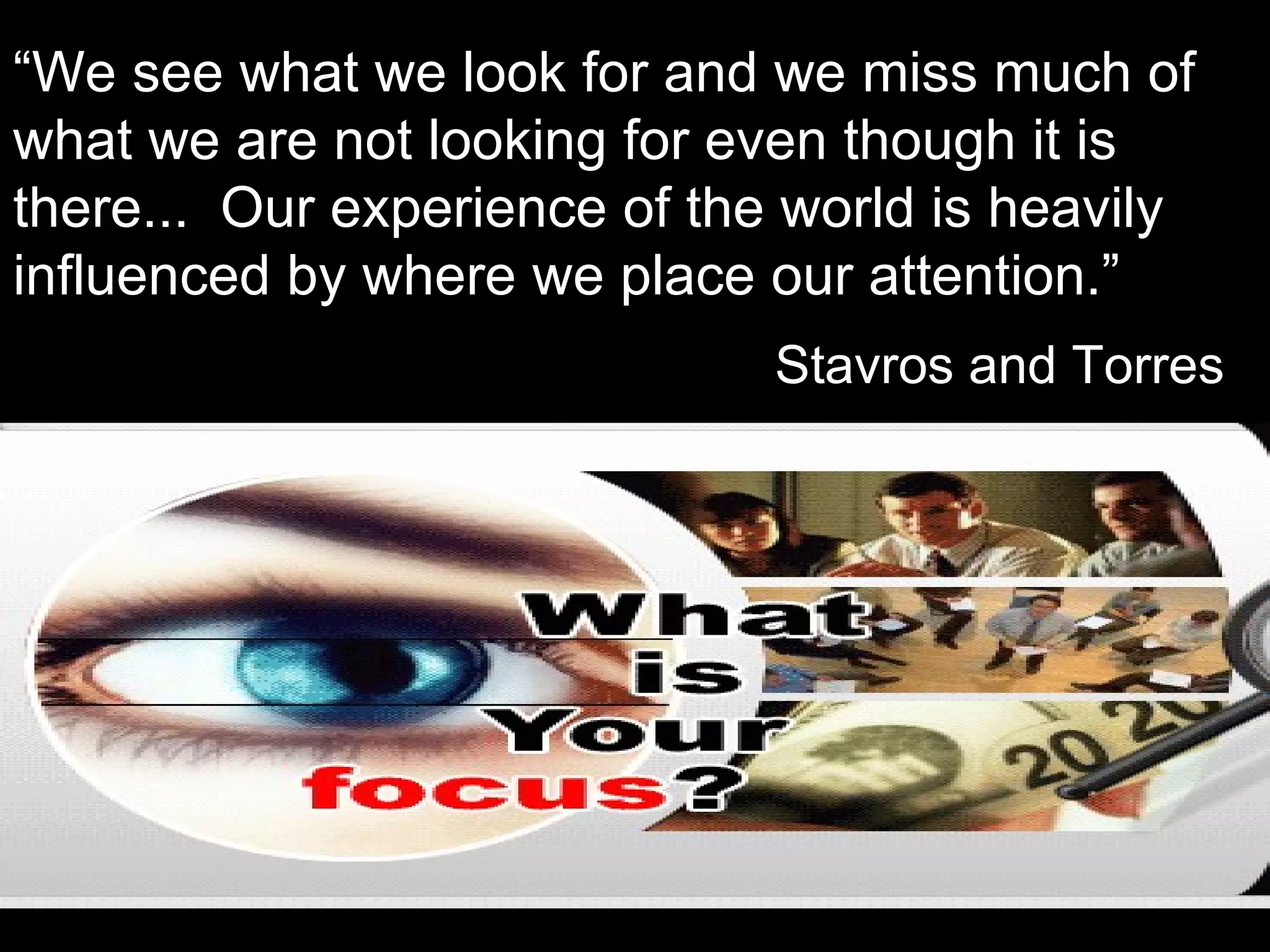
“We see what we look for and we miss much of
what we are not looking for even though it is
there... Our experience of the world is heavily
influenced by where we place our attention.”
                              Stavros and Torres
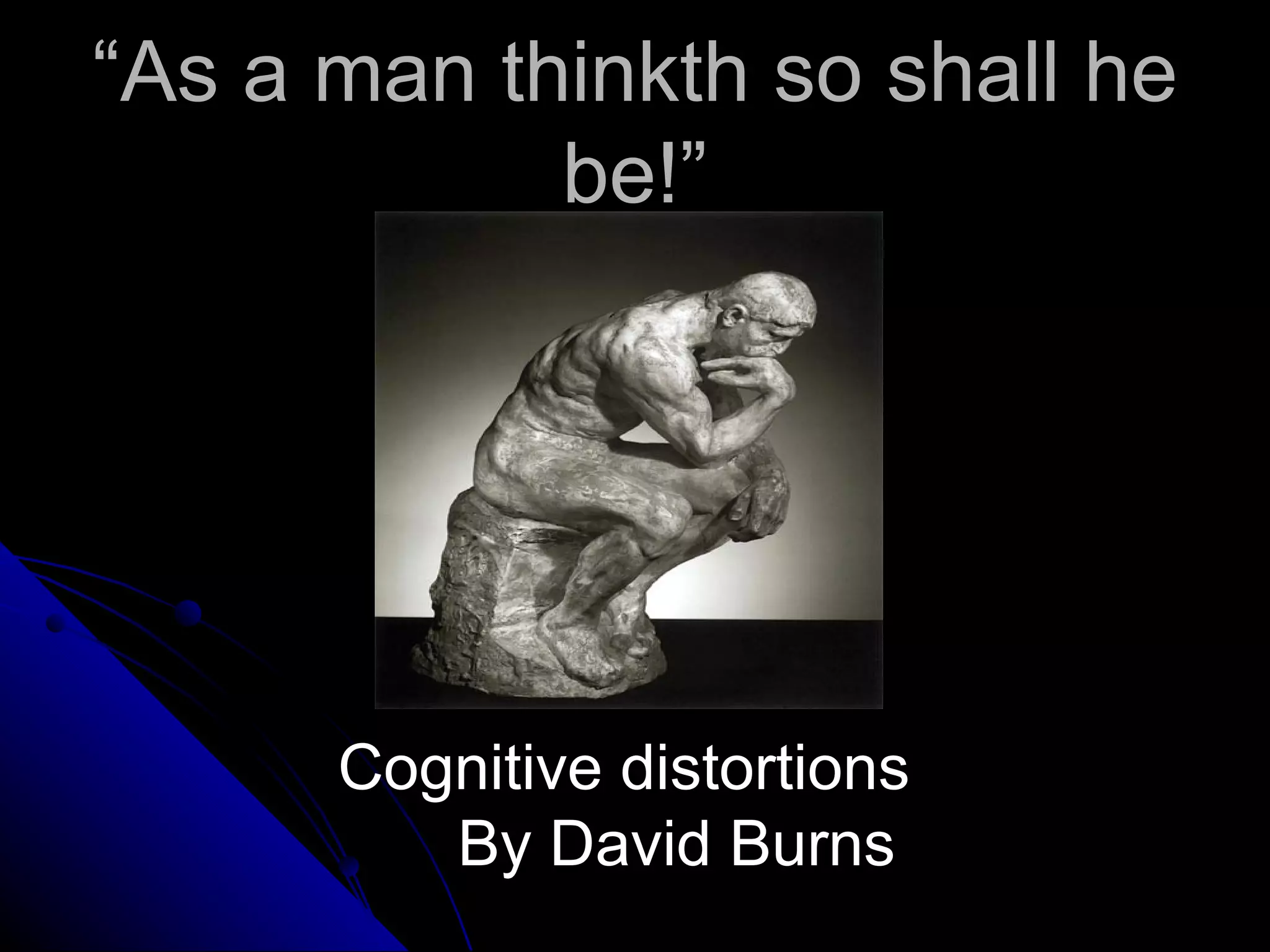
“As a man thinkth so shall he
            be!”


      Cognitive distortions
         By David Burns
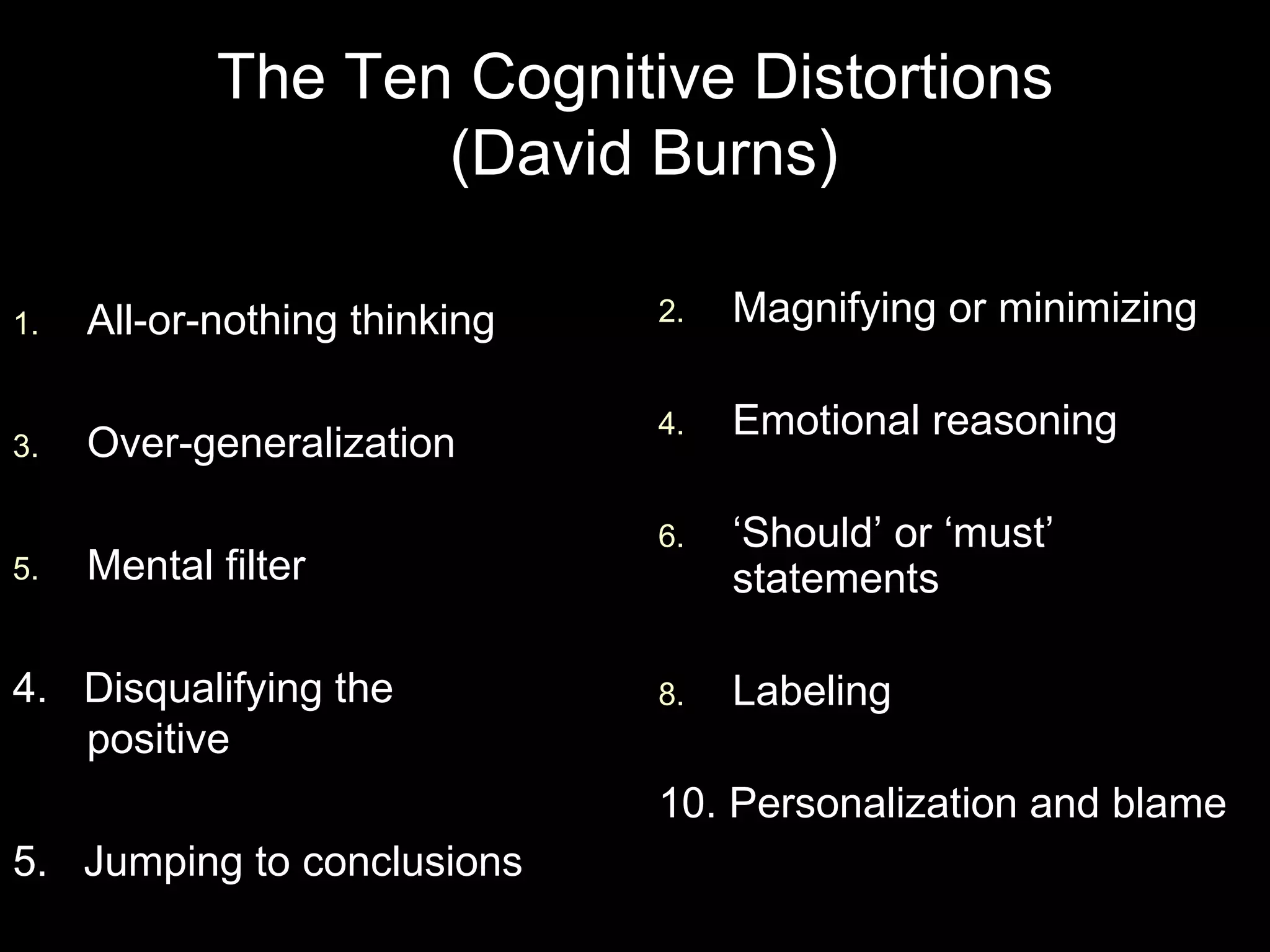
The Ten Cognitive Distortions
                   (David Burns)

1.   All-or-nothing thinking   2.   Magnifying or minimizing

                               4.   Emotional reasoning
3.   Over-generalization

                               6.   ‘Should’ or ‘must’
5.   Mental filter                  statements

4. Disqualifying the           8.   Labeling
   positive
                               10. Personalization and blame
5. Jumping to conclusions
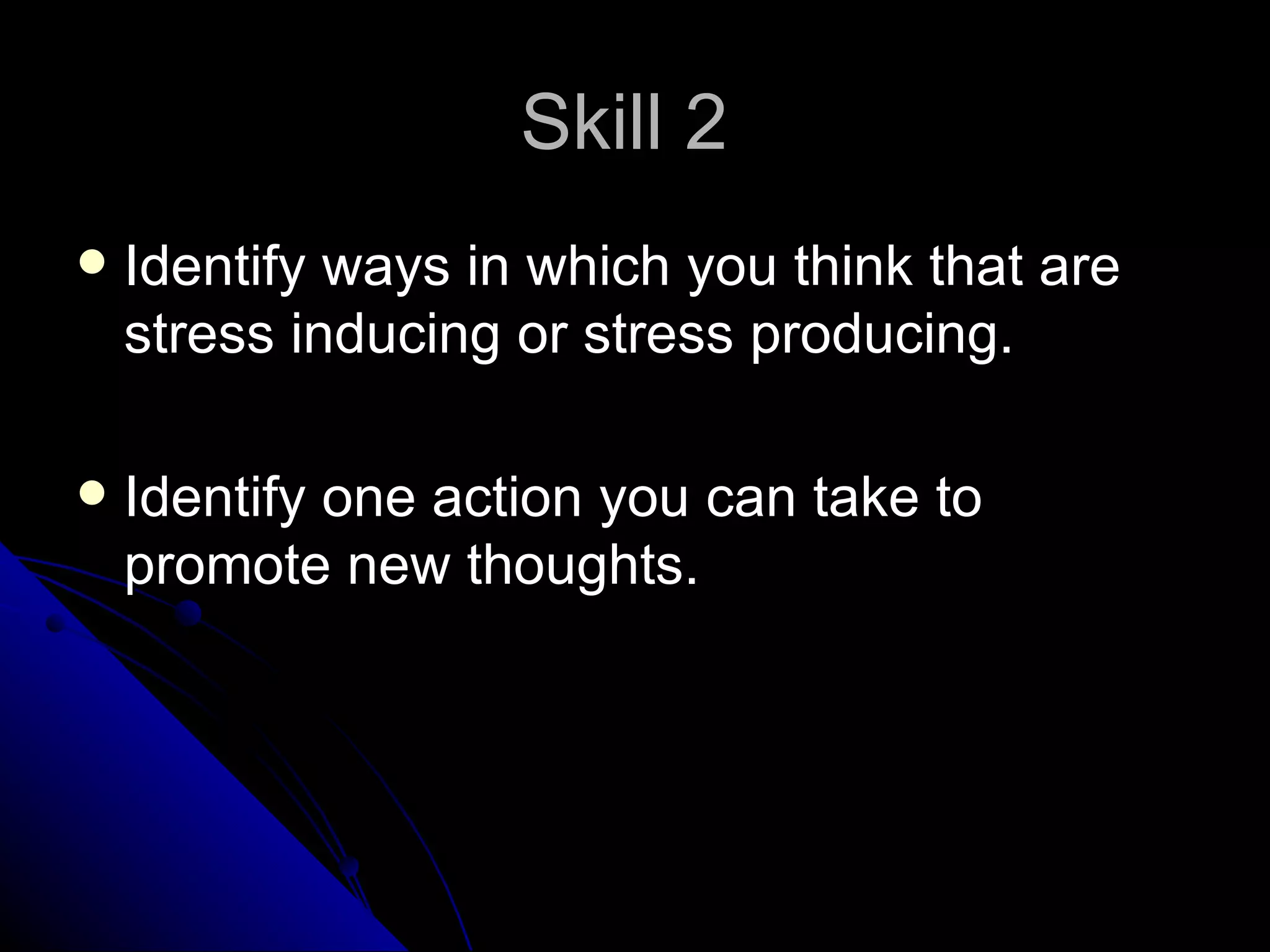
Skill 2
   Identify ways in which you think that are
    stress inducing or stress producing.

   Identify one action you can take to
    promote new thoughts.
Actions:
      Change the Way You think!
Seek actions that promote positive attitudes.
      Help others
      Exercise
      Be mindful
      Value self
      Become empowered - Reduce helplessness

     What     actions can you take?
Other Distortions
   By our nature we focus on the unique for
    self preservation. For survival we focus
    on:
        Danger
        Change

 The    media filters these realities to
    play on our inherent preferences
    for the unique.
Media bias tends to:

       Magnify rather than report all

       Accentuates the negative

       It tends to be detached from the
        greater reality

       Focuses on the negative 10%
We need to remember:


Focus creates reality.

Change your focus and you
 change your reality.
Actions:
Change the focus of your attention.
   to news, art and the media!


 Be more selective
 Look for good news
 Question the bad news
 Bring balance to your use of the media.
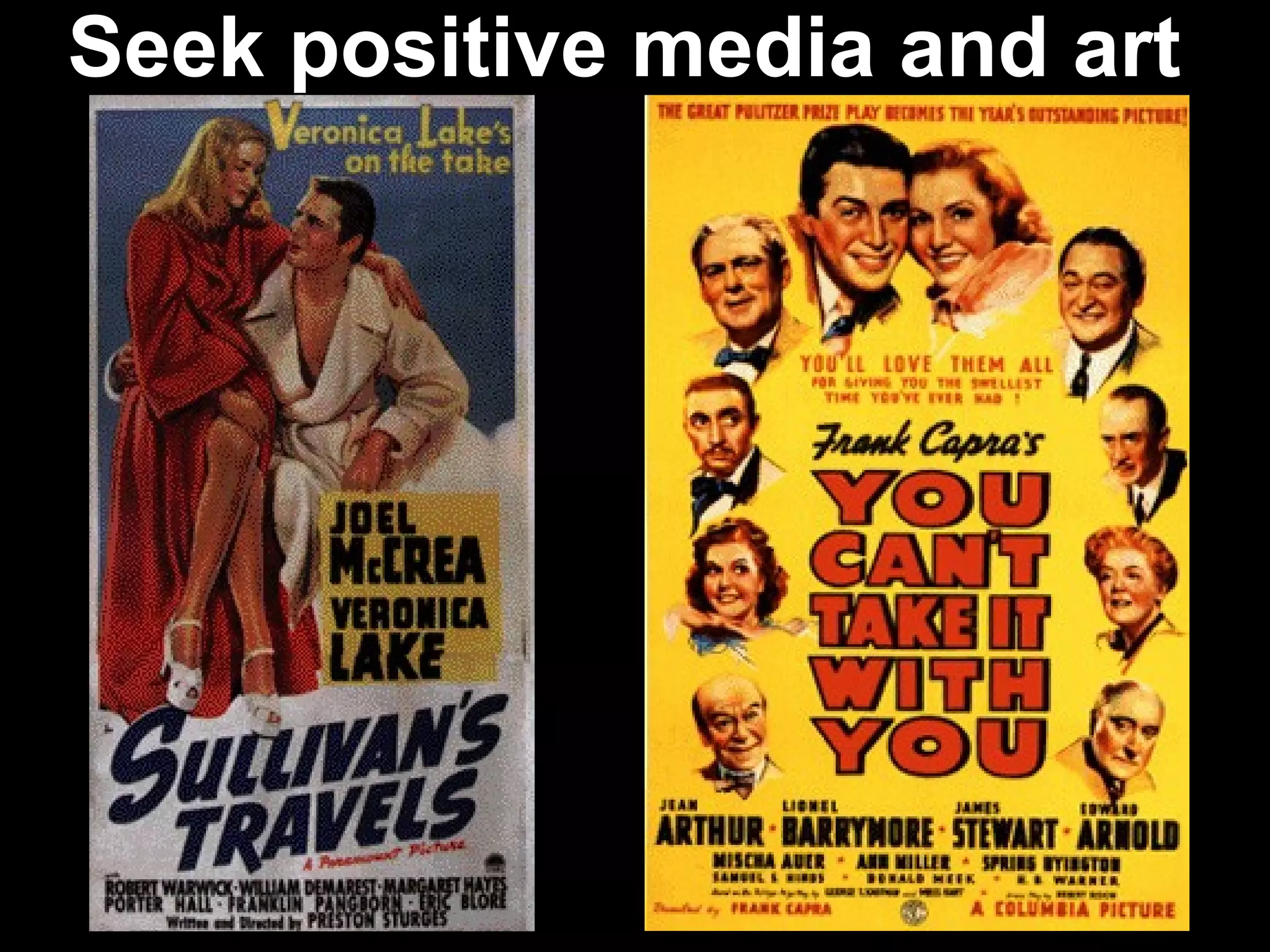
Seek positive media and art
Seek Good News
Happiness
Thoughts
A Matter of Interpretation

“Never let a good crisis go to waste.”
                          Anne Harbison


“Things don’t necessarily happen for the
best, but some people are able to make the
best of things that happen.”
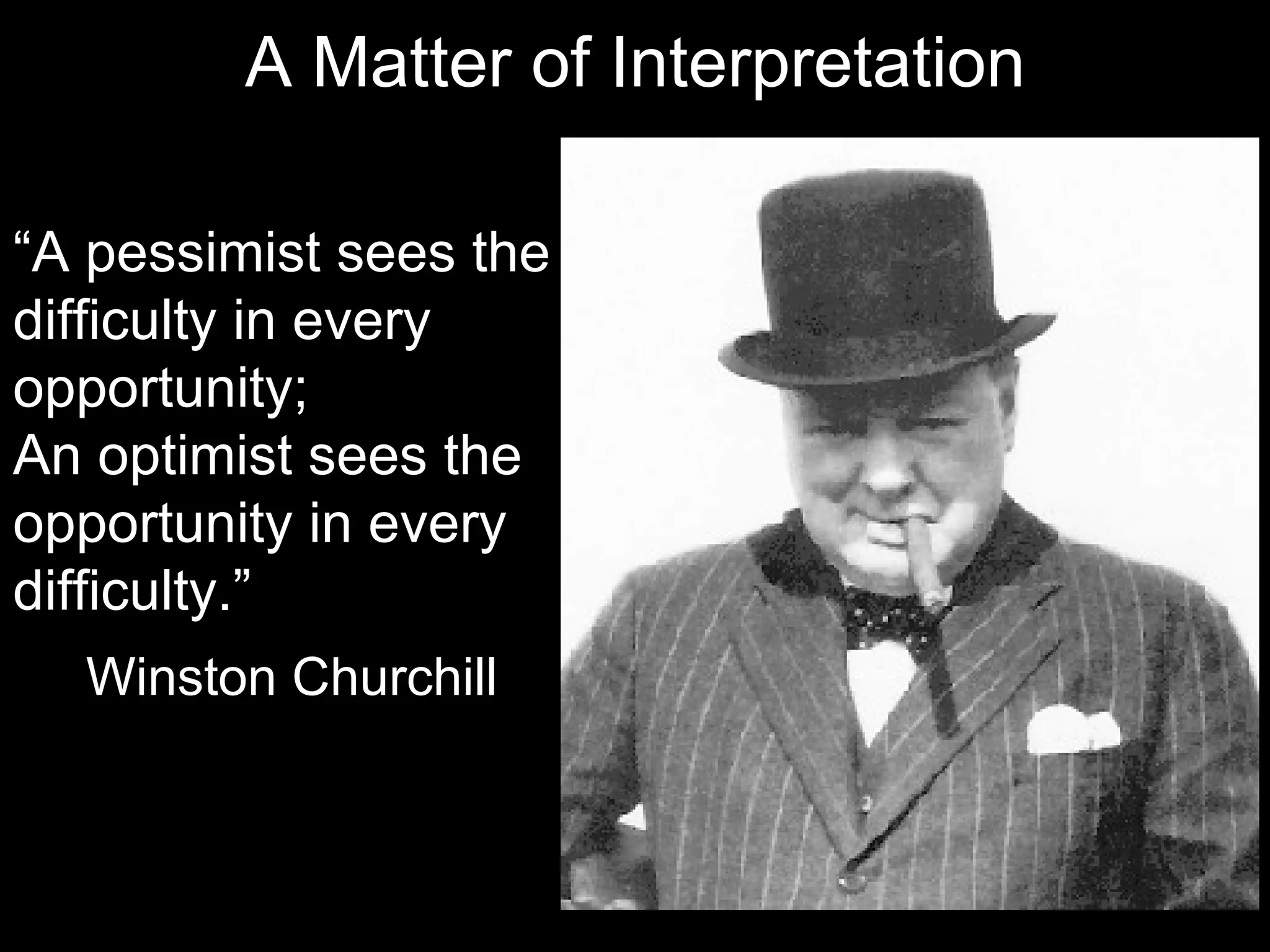
A Matter of Interpretation

“A pessimist sees the
difficulty in every
opportunity;
An optimist sees the
opportunity in every
difficulty.”
  Winston Churchill
HOW MANY OF YOU
    WORRY?
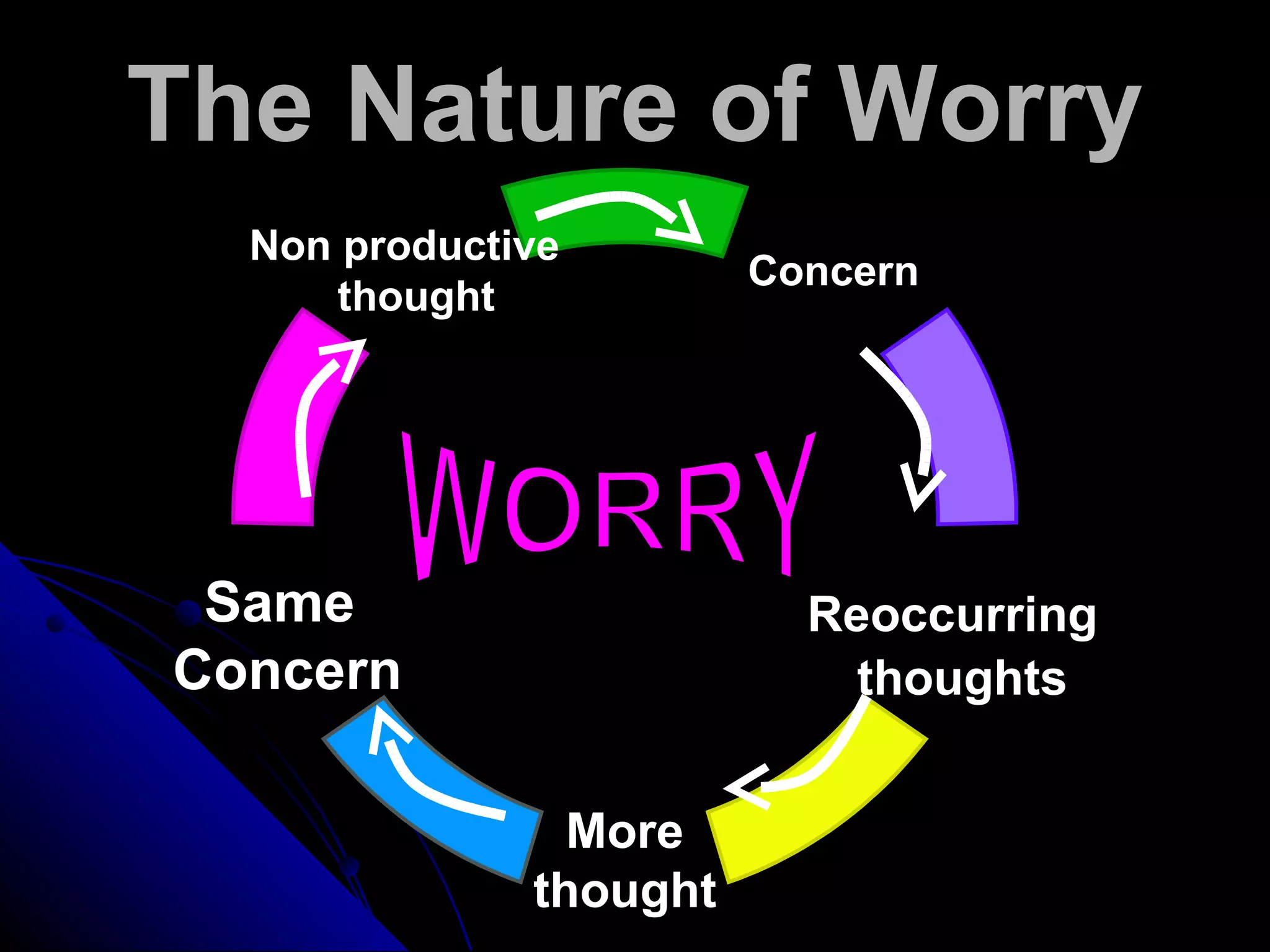
The Nature of Worry
  Non productive
                        Concern
      thought


 Same                     Reoccurring
Concern                     thoughts


                More
              thought
“If I always think,

what I always thought,

I will always feel

what I always felt!”
Seek Action!
Breaking the cycle of worry can be a
 conscious action or an unconscious
           stroke of luck!

Either way an ACTION is required.
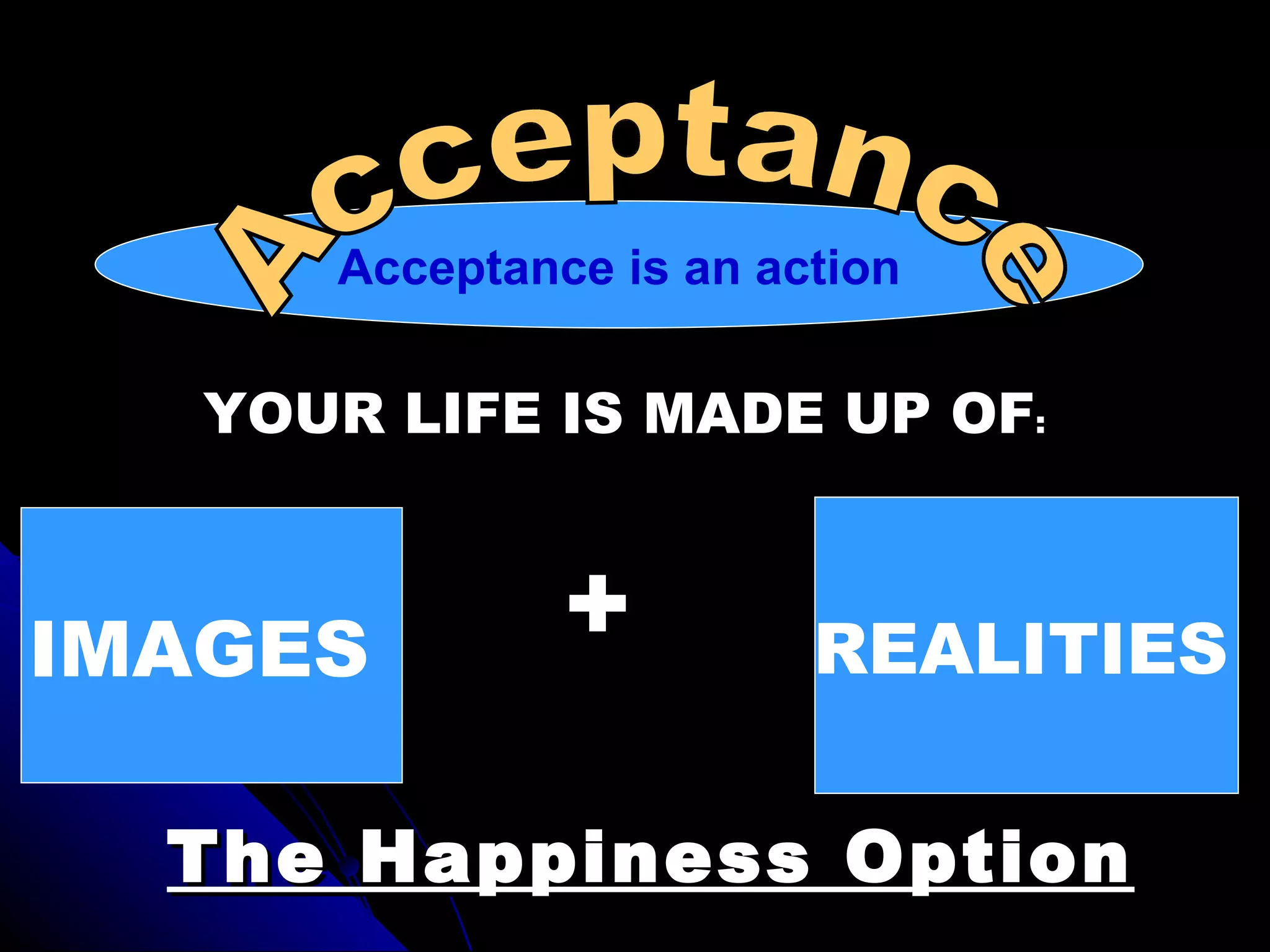
Acceptance is an action


   YOUR LIFE IS MADE UP OF:


IMAGES         +         REALITIES

  The Happiness Option
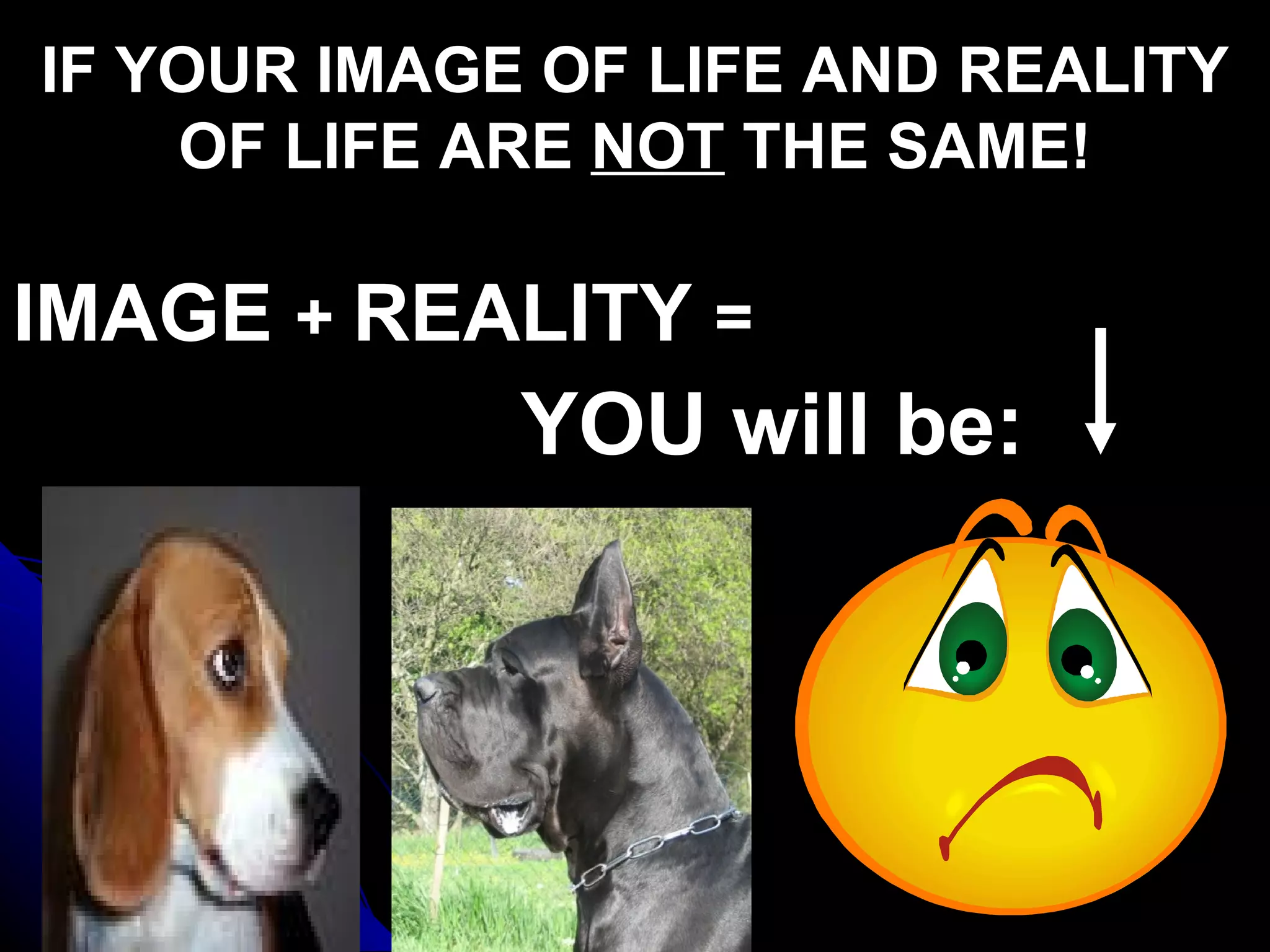
IF YOUR IMAGE OF LIFE AND REALITY
    OF LIFE ARE NOT THE SAME!

IMAGE + REALITY =
             YOU will be:
Options:
Make a change…
You have choices:
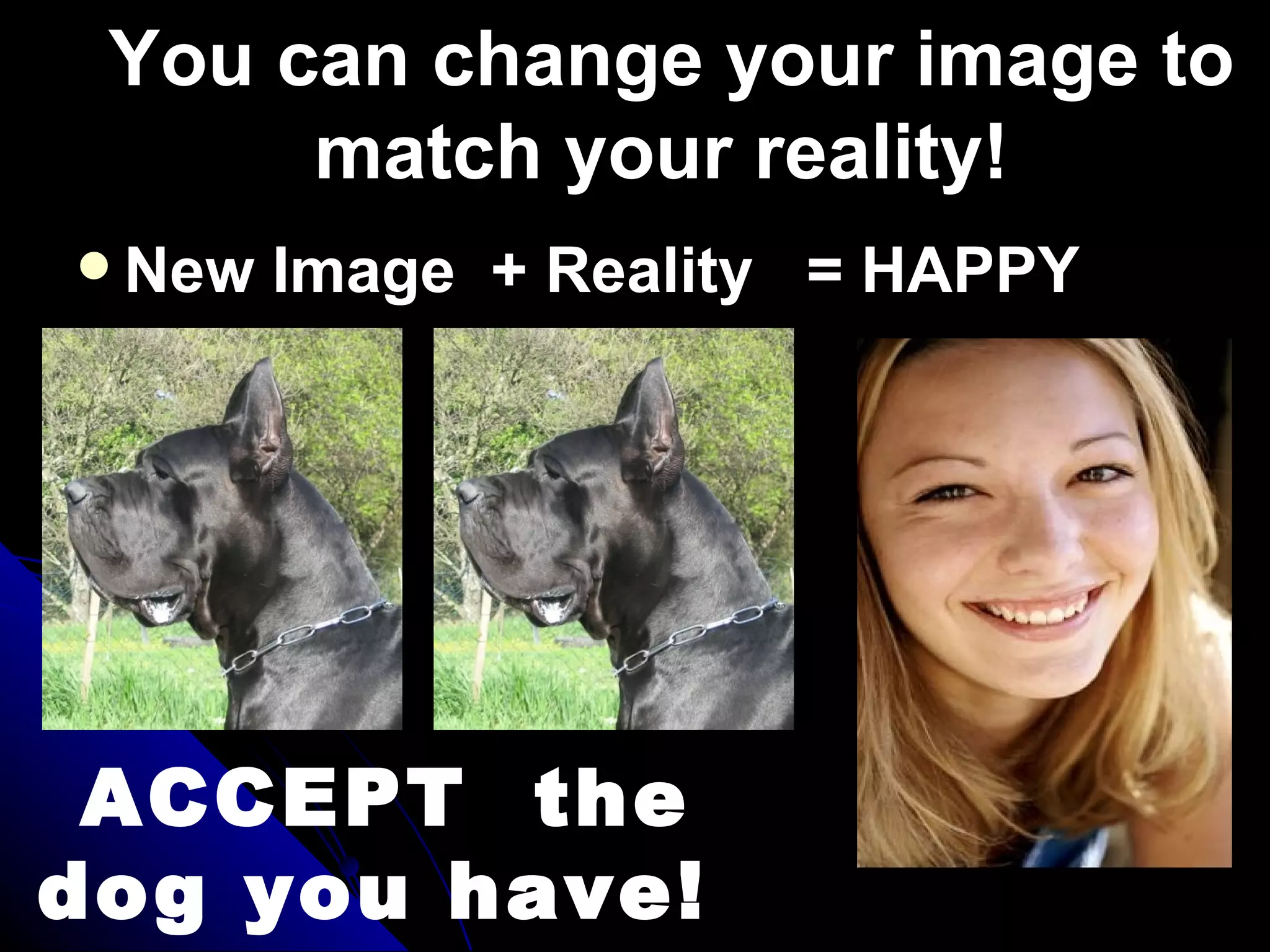
You can change your image to
      match your reality!
 New   Image + Reality = HAPPY


 ACCEPT the
dog you have!
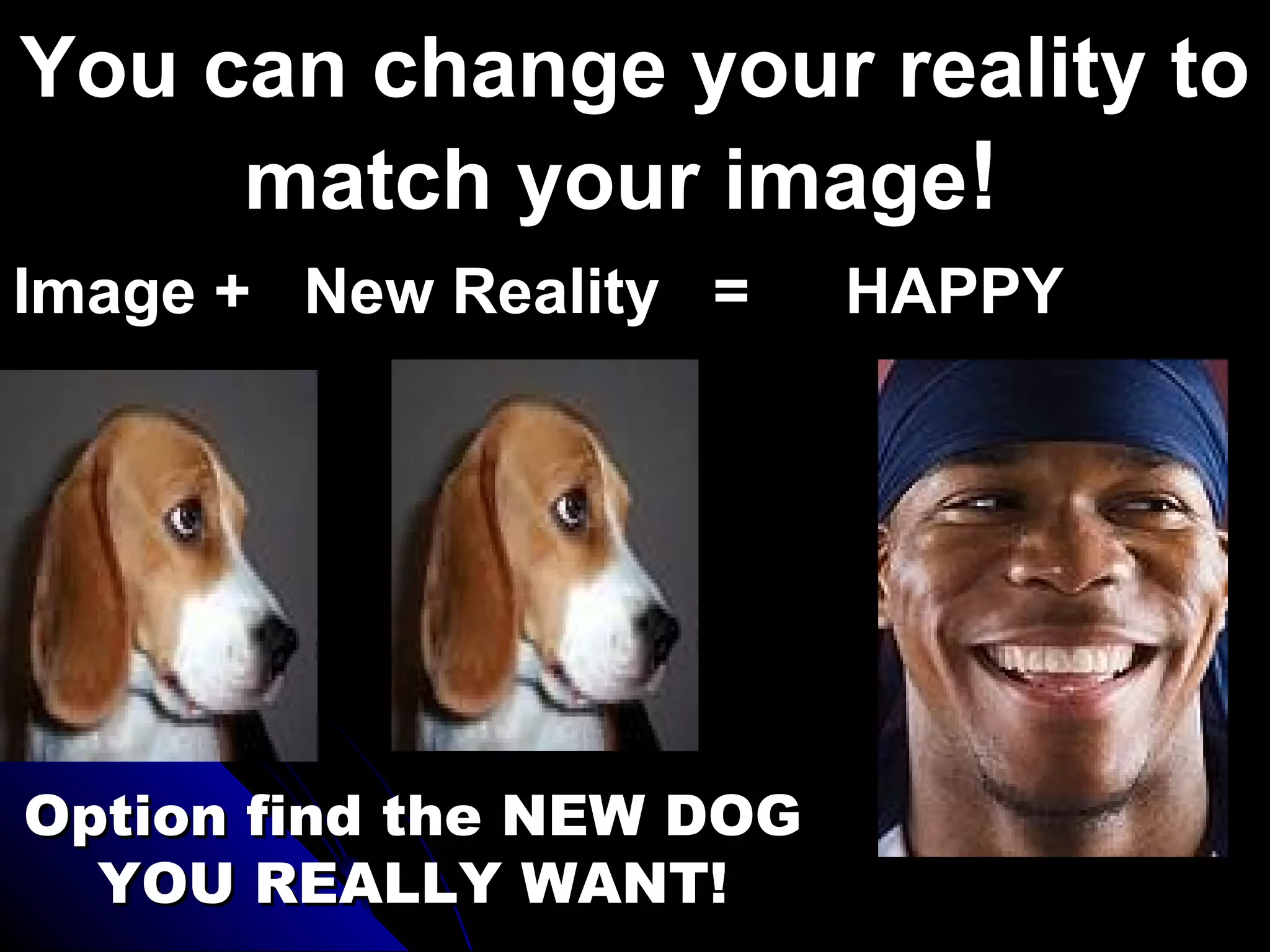
You can change your reality to
     match your image!
Image + New Reality =     HAPPY


Option find the NEW DOG
  YOU REALLY WANT!
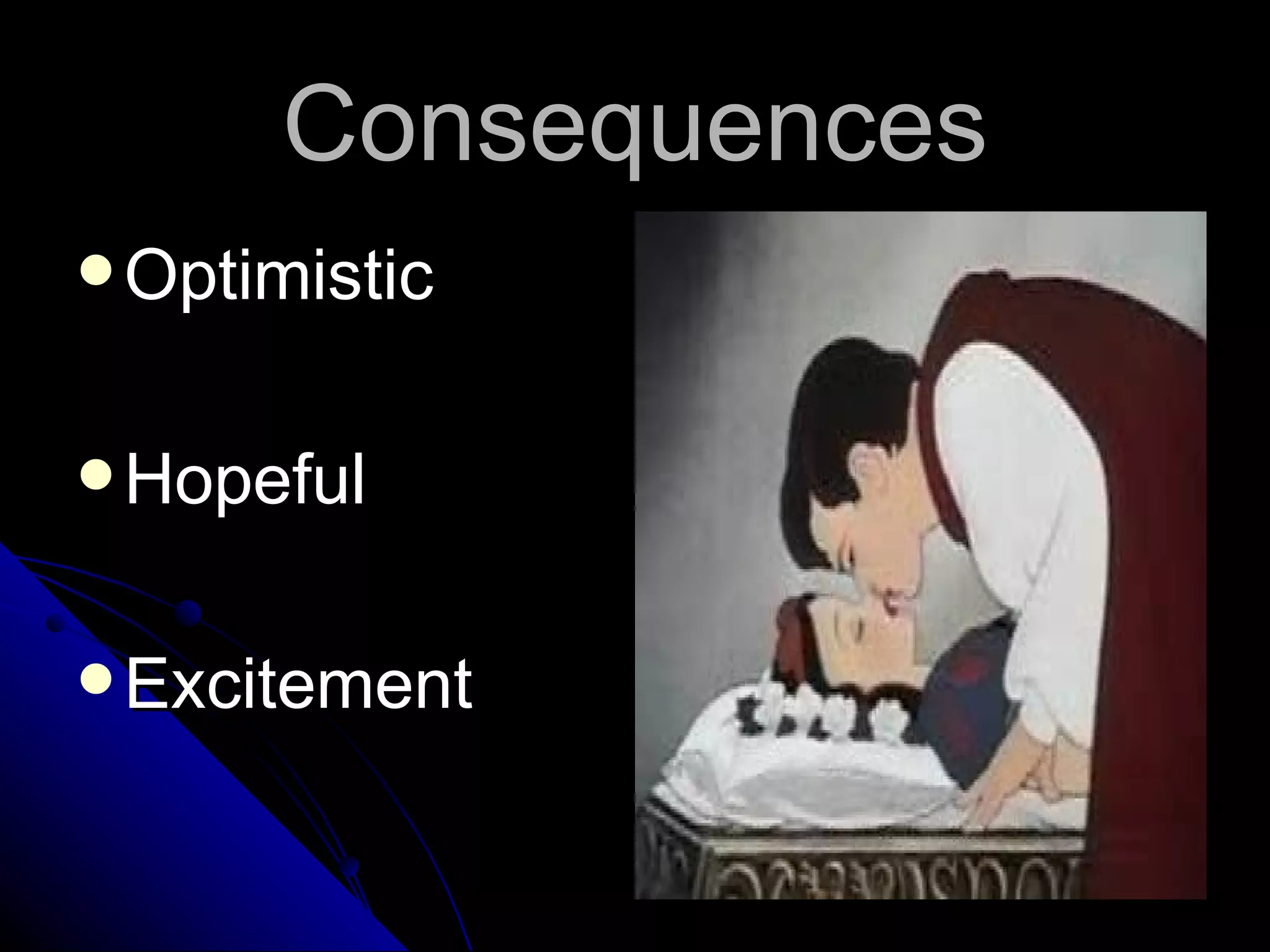
Consequences
 Optimistic


 Hopeful


 Excitement
DO YOU HAVE ANY DOGS IN YOUR
            LIFE
       YOU DON’T WANT?
More Actions:
           Research on Gratitude
   Emmons and McCullough (2002)
       Four groups: gratitude, hassles, superior,
        control
       Psychological and health benefits
   Physiological benefits (McCraty & Childre
    2004)
   Benefits of trait gratefulness
   Maintaining freshness through mindful
    focus
Learning to be Grateful
“You say grace before meals. All right. But I say grace
before the concert and the opera, and grace before the
play and pantomime, and grace before I open a book,
and grace before sketching, painting, swimming,
fencing, boxing, walking, playing, dancing, and grace
before I dip the pen in the ink.”


“Gratitude has produced the most purely joyful moments
that have been known to man.”
                                 G. K. Chesterton
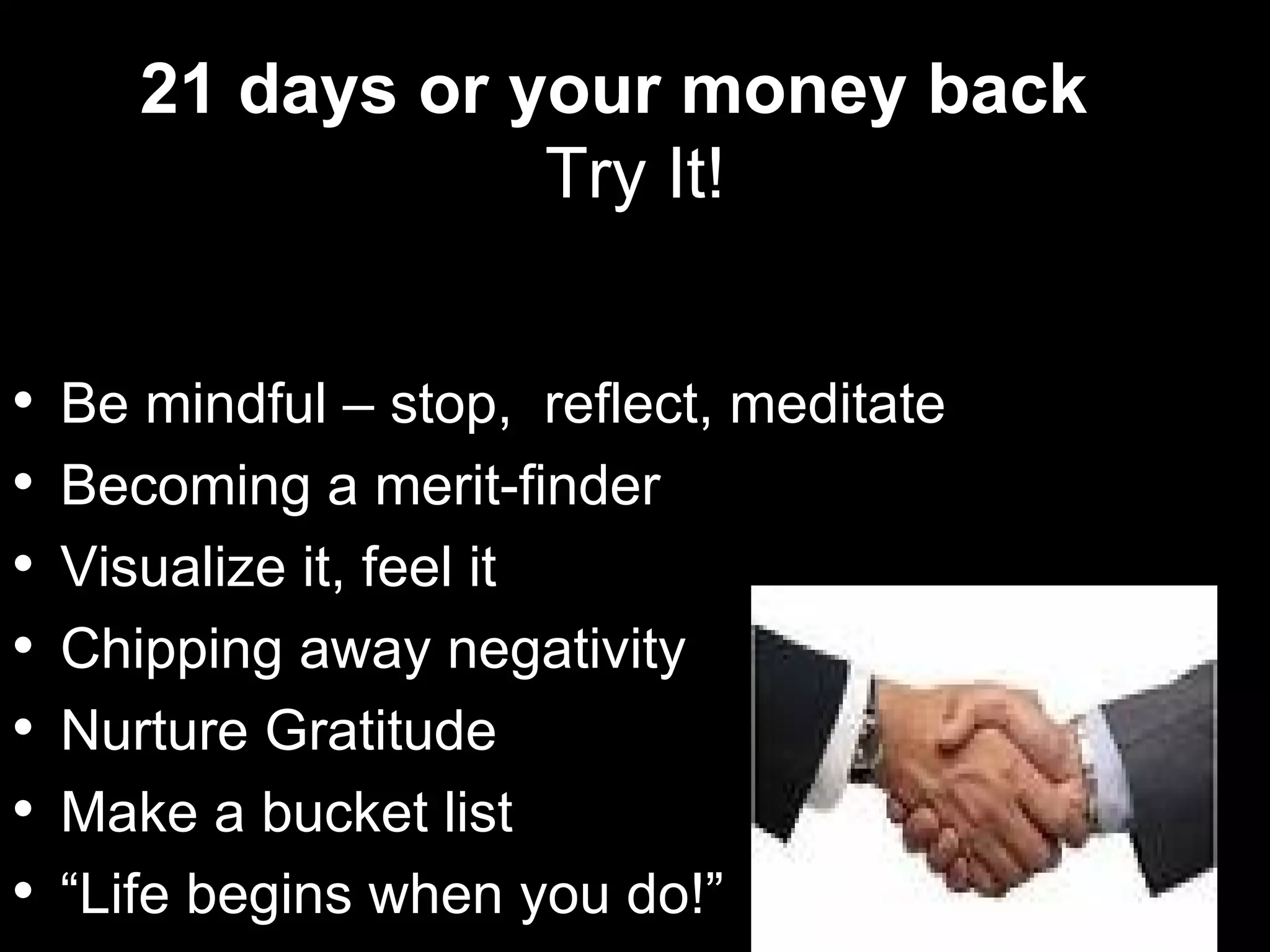
21 days or your money back
                   Try It!


   Be mindful – stop, reflect, meditate
   Becoming a merit-finder
   Visualize it, feel it
   Chipping away negativity
   Nurture Gratitude
   Make a bucket list
   “Life begins when you do!”
Summary of Options
 Deep breathing
 Thought distortions
 Rituals
 Worry/Sleep
 Acceptance
 Gratitude
 21 days or your money back
Bibliography and Recommendations

• Danner, D., Snowdon, D., and Friesen, W. (2001).
Positive emotions in early life and longevity: Finding
from the nun study. Journal of Personality and Social
Psychology, 80, 804-813.
• Emmons R. A. & McCullough M. E. (2004). The
Psychology of Gratitude. Oxford University Press.
• Seligman, M. (2002). Authentic Happiness. Free
Press.
• Brother David Steindl-Rast (1984). Gratefulness, the
Heart of Prayer. Paulist Press.
• Wiseman, R (2003). The Luck Factor. Miramax.
• Wiseman’s website: http://www.luckfactor.co.uk/

Understanding Purpose, Time and Money

  • 1.
    “Sowhat if today werethe last day of the rest of your life?”
  • 2.
    Goals  Thought provoking  Informative  Practical  Fun
  • 3.
    Skill 1 Find aquiet place in your mind. Now take deep slow belly breaths.
  • 4.
    “It appears thatthe way people perceive the world is more important to happiness than objective circumstances.” Ed Diener Great wealth is not having great possessions but few wants!
  • 5.
    “To different minds,the same world is a hell, and a heaven.” Ralph Waldo Emerson
  • 6.
    The Nun Study(Danner et al., 2001)  Only positive feelings predicted longevity Age 85: 90% of most cheerful quartile alive; 34% of least cheerful quartile alive. Age 94: 54% of most cheerful quartile alive; 11% of least cheerful quartile alive
  • 7.
    Two Types ofPeople in the World  The Fault Finder “The fault-finder will find faults even in paradise” Henry David Thoreau  Could lead to resignation  The Merit-finder “The invariable mark of wisdom is to see the miraculous in the common.” Ralph Waldo Emerson  Could lead to detachment  The need to respect reality
  • 8.
    The positive elementsof being a Merit Finder  Well-being (Thompson, 1985)  Health  Affleck et al. (1987)  Bower (1988)  King & Miner (2000)  Longevity
  • 10.
  • 11.
    “We see whatwe look for and we miss much of what we are not looking for even though it is there... Our experience of the world is heavily influenced by where we place our attention.” Stavros and Torres
  • 12.
    “As a manthinkth so shall he be!” Cognitive distortions By David Burns
  • 13.
    The Ten CognitiveDistortions (David Burns) 1. All-or-nothing thinking 2. Magnifying or minimizing 4. Emotional reasoning 3. Over-generalization 6. ‘Should’ or ‘must’ 5. Mental filter statements 4. Disqualifying the 8. Labeling positive 10. Personalization and blame 5. Jumping to conclusions
  • 14.
    Skill 2  Identify ways in which you think that are stress inducing or stress producing.  Identify one action you can take to promote new thoughts.
  • 15.
    Actions: Change the Way You think! Seek actions that promote positive attitudes.  Help others  Exercise  Be mindful  Value self  Become empowered - Reduce helplessness What actions can you take?
  • 16.
    Other Distortions  By our nature we focus on the unique for self preservation. For survival we focus on: Danger Change  The media filters these realities to play on our inherent preferences for the unique.
  • 17.
    Media bias tendsto:   Magnify rather than report all  Accentuates the negative  It tends to be detached from the greater reality  Focuses on the negative 10%
  • 19.
    We need toremember: Focus creates reality. Change your focus and you change your reality.
  • 20.
    Actions: Change the focusof your attention. to news, art and the media!  Be more selective  Look for good news  Question the bad news  Bring balance to your use of the media.
  • 21.
  • 22.
  • 23.
  • 24.
    A Matter ofInterpretation “Never let a good crisis go to waste.” Anne Harbison “Things don’t necessarily happen for the best, but some people are able to make the best of things that happen.”
  • 25.
    A Matter ofInterpretation “A pessimist sees the difficulty in every opportunity; An optimist sees the opportunity in every difficulty.” Winston Churchill
  • 27.
    HOW MANY OFYOU WORRY?
  • 28.
    The Nature ofWorry Non productive Concern thought Same Reoccurring Concern thoughts More thought
  • 29.
    “If I alwaysthink, what I always thought, I will always feel what I always felt!”
  • 30.
    Seek Action! Breaking thecycle of worry can be a conscious action or an unconscious stroke of luck! Either way an ACTION is required.
  • 31.
    Acceptance is anaction YOUR LIFE IS MADE UP OF: IMAGES + REALITIES The Happiness Option
  • 32.
    IF YOUR IMAGEOF LIFE AND REALITY OF LIFE ARE NOT THE SAME! IMAGE + REALITY = YOU will be:
  • 33.
  • 34.
    You can changeyour image to match your reality!  New Image + Reality = HAPPY ACCEPT the dog you have!
  • 35.
    You can changeyour reality to match your image! Image + New Reality = HAPPY Option find the NEW DOG YOU REALLY WANT!
  • 36.
  • 37.
    DO YOU HAVEANY DOGS IN YOUR LIFE YOU DON’T WANT?
  • 38.
    More Actions: Research on Gratitude  Emmons and McCullough (2002)  Four groups: gratitude, hassles, superior, control  Psychological and health benefits  Physiological benefits (McCraty & Childre 2004)  Benefits of trait gratefulness  Maintaining freshness through mindful focus
  • 39.
    Learning to beGrateful “You say grace before meals. All right. But I say grace before the concert and the opera, and grace before the play and pantomime, and grace before I open a book, and grace before sketching, painting, swimming, fencing, boxing, walking, playing, dancing, and grace before I dip the pen in the ink.” “Gratitude has produced the most purely joyful moments that have been known to man.” G. K. Chesterton
  • 41.
    21 days oryour money back Try It!  Be mindful – stop, reflect, meditate  Becoming a merit-finder  Visualize it, feel it  Chipping away negativity  Nurture Gratitude  Make a bucket list  “Life begins when you do!”
  • 42.
    Summary of Options Deep breathing  Thought distortions  Rituals  Worry/Sleep  Acceptance  Gratitude  21 days or your money back
  • 43.
    Bibliography and Recommendations •Danner, D., Snowdon, D., and Friesen, W. (2001). Positive emotions in early life and longevity: Finding from the nun study. Journal of Personality and Social Psychology, 80, 804-813. • Emmons R. A. & McCullough M. E. (2004). The Psychology of Gratitude. Oxford University Press. • Seligman, M. (2002). Authentic Happiness. Free Press. • Brother David Steindl-Rast (1984). Gratefulness, the Heart of Prayer. Paulist Press. • Wiseman, R (2003). The Luck Factor. Miramax. • Wiseman’s website: http://www.luckfactor.co.uk/