The World of Adverbs
Introduction
Adverbs are a type of word that modify or describe verbs,
adjectives, or other adverbs in a sentence. They provide
additional information about the manner, time, place,
frequency, or degree of an action or description. Adverbs can
greatly enhance the meaning and clarity of a sentence, and
are an essential component of effective communication.
Types of adverbs
Adverbs are words that modify verbs, adjectives, and other adverbs. They
provide additional information about how, where, when, how much, or how often
something happens.
There are five main types of adverbs:
1. Manner adverbs describe how something is done. For example: quickly,
slowly, carefully.
2. Place adverbs describe where something happens. For example: here, there,
everywhere.
3. Time adverbs describe when something happens. For example: now, later,
soon.
4 Degree adverbs describe the intensity or degree of something. For example:
very, extremely, somewhat.
5. Frequency adverbs describe how often something happens. For example:
always, never, rarely.
Adverbial Phrases
An adverbial phrase is a group of words that functions as
an adverb in a sentence. It can modify a verb, adjective, or
another adverb, and it provides additional information
about time, place, manner, or degree.
Examples of adverbial phrases include:
• In the morning
• With great care
• At the park
Adverbial phrases can be placed at the
beginning, middle, or end of a sentence,
depending on the intended emphasis.
It's important to note that they should
be placed as close as possible to the
word they are modifying.
Positioning of Adverbs
Adverbs can be placed in different
positions within a sentence, and
where they are placed can affect
the meaning of the sentence.
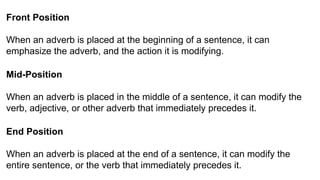
Front Position
When an adverb is placed at the beginning of a sentence, it can
emphasize the adverb, and the action it is modifying.
Mid-Position
When an adverb is placed in the middle of a sentence, it can modify the
verb, adjective, or other adverb that immediately precedes it.
End Position
When an adverb is placed at the end of a sentence, it can modify the
entire sentence, or the verb that immediately precedes it.
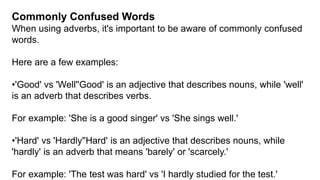
Commonly Confused Words
When using adverbs, it's important to be aware of commonly confused
words.
Here are a few examples:
•'Good' vs 'Well''Good' is an adjective that describes nouns, while 'well'
is an adverb that describes verbs.
For example: 'She is a good singer' vs 'She sings well.'
•'Hard' vs 'Hardly''Hard' is an adjective that describes nouns, while
'hardly' is an adverb that means 'barely' or 'scarcely.'
For example: 'The test was hard' vs 'I hardly studied for the test.'
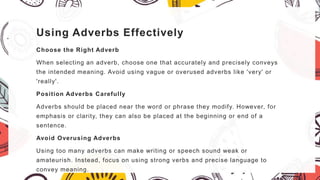
Using Adverbs Effectively
Choose the Right Adverb
When selecting an adverb, choose one that accurately and precisely conveys
the intended meaning. Avoid using vague or overused adverbs like 'very' or
'really'.
Position Adverbs Carefully
Adverbs should be placed near the word or phrase they modify. However, for
emphasis or clarity, they can also be placed at the beginning or end of a
sentence.
Avoid Overusing Adverbs
Using too many adverbs can make writing or speech sound weak or
amateurish. Instead, focus on using strong verbs and precise language to
convey meaning.
Conclusion
In conclusion, adverbs are an important part of the English
language, providing additional information about verbs, adjectives,
and other adverbs. By understanding the different types of adverbs,
their positioning, and how to use them effectively, we can improve
our writing and communication skills. Remember to avoid commonly
confused words and use adverbial phrases when appropriate. With
practice and attention to detail, we can all become masters of
adverb usage. Thank you for listening to this presentation on
adverbs.
Thank
you
Reporter: Ethan Matthew R. Cañon

Adverbs_Cañon.pptx

  • 1.
    The World ofAdverbs
  • 2.
    Introduction Adverbs are atype of word that modify or describe verbs, adjectives, or other adverbs in a sentence. They provide additional information about the manner, time, place, frequency, or degree of an action or description. Adverbs can greatly enhance the meaning and clarity of a sentence, and are an essential component of effective communication.
  • 3.
    Types of adverbs Adverbsare words that modify verbs, adjectives, and other adverbs. They provide additional information about how, where, when, how much, or how often something happens. There are five main types of adverbs: 1. Manner adverbs describe how something is done. For example: quickly, slowly, carefully. 2. Place adverbs describe where something happens. For example: here, there, everywhere. 3. Time adverbs describe when something happens. For example: now, later, soon. 4 Degree adverbs describe the intensity or degree of something. For example: very, extremely, somewhat. 5. Frequency adverbs describe how often something happens. For example: always, never, rarely.
  • 4.
    Adverbial Phrases An adverbialphrase is a group of words that functions as an adverb in a sentence. It can modify a verb, adjective, or another adverb, and it provides additional information about time, place, manner, or degree. Examples of adverbial phrases include: • In the morning • With great care • At the park
  • 5.
    Adverbial phrases canbe placed at the beginning, middle, or end of a sentence, depending on the intended emphasis. It's important to note that they should be placed as close as possible to the word they are modifying.
  • 6.
    Positioning of Adverbs Adverbscan be placed in different positions within a sentence, and where they are placed can affect the meaning of the sentence.
  • 7.
    Front Position When anadverb is placed at the beginning of a sentence, it can emphasize the adverb, and the action it is modifying. Mid-Position When an adverb is placed in the middle of a sentence, it can modify the verb, adjective, or other adverb that immediately precedes it. End Position When an adverb is placed at the end of a sentence, it can modify the entire sentence, or the verb that immediately precedes it.
  • 8.
    Commonly Confused Words Whenusing adverbs, it's important to be aware of commonly confused words. Here are a few examples: •'Good' vs 'Well''Good' is an adjective that describes nouns, while 'well' is an adverb that describes verbs. For example: 'She is a good singer' vs 'She sings well.' •'Hard' vs 'Hardly''Hard' is an adjective that describes nouns, while 'hardly' is an adverb that means 'barely' or 'scarcely.' For example: 'The test was hard' vs 'I hardly studied for the test.'
  • 9.
    Using Adverbs Effectively Choosethe Right Adverb When selecting an adverb, choose one that accurately and precisely conveys the intended meaning. Avoid using vague or overused adverbs like 'very' or 'really'. Position Adverbs Carefully Adverbs should be placed near the word or phrase they modify. However, for emphasis or clarity, they can also be placed at the beginning or end of a sentence. Avoid Overusing Adverbs Using too many adverbs can make writing or speech sound weak or amateurish. Instead, focus on using strong verbs and precise language to convey meaning.
  • 10.
    Conclusion In conclusion, adverbsare an important part of the English language, providing additional information about verbs, adjectives, and other adverbs. By understanding the different types of adverbs, their positioning, and how to use them effectively, we can improve our writing and communication skills. Remember to avoid commonly confused words and use adverbial phrases when appropriate. With practice and attention to detail, we can all become masters of adverb usage. Thank you for listening to this presentation on adverbs.
  • 11.