Good Practices Manual – english version -
Portugal
Projetos da Ação 2 – Parcerias entre Escolas
Programa ERASMUS+
Contrato Financeiro N.º 2016-1-IT02-KA219-024069_5
2016 - 2018
Agrupamento de Escolas de Vieira de Leiria
R.D. Luis Pereira Coutinho
2430-909 Vieira de Leiria
Portugal
"The European Commission support for the production of this publication does
not constitute an endorsement of the contents which reflects the views only of
the authors, and the Commission cannot be held responsible for any use which
may be made of the information contained therein."
LIST OF AUTHORS
Letizia Foschi (coordinator, Italy)
Cinzia di Giorgio (supervisor, Italy)
Emanuela Onofri (supervisor and lesson plans, Italy)
Cristina di Brandimarte (lesson plans, Italy)
Cinzia di Giorgio (lesson plans, Italy)
Paola Sardella (lesson plans, Italy)
Josefina Fernandez (coordinator and lesson plans, Spain)
Livia Dioșan (coordinator and lesson plans, Romania)
Nicoleta Apostol (supervisor and lesson plans, Romania)
Monica Incze (lesson plans, Romania)
Anca Rancov (lesson plans, Romania)
Vasiu Diana (lesson plans, Romania)
Rodica Olteanu-Moldovan (lesson plans, Romania)
Celina Almășan (lesson plans, Romania)
Andreea Șarlea (lesson plans, Romania)
Georgeta Mărginean (lesson plans, Romania)
Grosu Elena (lesson plans, Romania)
Feraru Stelian (lesson plans, Romania)
Boris Rancov (lesson plans, Romania)
Anamaria Fiț (lesson plans, Romania)
Ioana Brok (lesson plans, Romania)
Păcurar Florin (lesson plans, Romania)
Păcurar Alexandra (lesson plans, Romania)
Jose Soares (coordinator, Portugal)
Rosalia Gomes (lesson plans, Portugal)
Ana Mendes (lesson plans, Portugal)
Hermínia Sapateiro (lesson plans, Portugal)
Katarzyna Wesierska (coordinator, Poland)
Honorata Antosiewicz (lesson plans, Poland)
Malgorzata Jagodzinska (lesson plans, Poland)
Anna Sokolowska (lesson plans, Poland)
Elzbieta Wychucka (lesson plans, Poland)
Malgorzata Gozdziak (lesson plans, Poland)
Malgorzata Witoslawska-Filipek (lesson plans, Poland)
Jolanta Stosio (lesson plans, Poland)
Índex
1. Introduction .......................................................................................................................... 5
2. Partners in this project:........................................................... Erro! Marcador não definido.
2.1. Comprehensive Institute of Alba Adriatica, Alba Adriatica, Italy (coordinator).. Erro!
Marcador não definido.
2.2. Ceip Gloria Arenillas, Zaragoza, Spain (partner).....................................................8
2.3. Art School"Regina Maria", Alba Iulia, Romania (partner)........... Erro! Marcador não
definido.
2.4. Vieira de Leiria Grouping School , Vieira de Leiria, Portugal (partner) Erro! Marcador
não definido.
2.5. Szkola Podstawowa nr. 2 im. Jana Kochanowskiego, Zabki, Poland (partner) .......11
3. General idea of the project ..................................................................................................... 12
4. Project objectives.................................................................................................................... 13
5. Expected impacts .................................................................................................................... 14
6. Educational Requirements and standarts............................................................................... 15
7. Target-groups.......................................................................................................................... 15
8. Transnational character of the project ................................................................................... 15
9. Innovation Project................................................................................................................... 16
10. Learning Methodologies ....................................................................................................... 17
10.1. Part 1: TEACHING AND LEARNING OF NATIVE AND FOREIGN LANGUAGES THROUGH
MUSIC
……………………………………………………………………………………………………………………………Err
o! Marcador não definido.
10.1.1. ARGUMENT ............................................................................................................. 17
10.2 PART 2: TEACHING AND LEARNING SCIENCE BY MUSIC.... Erro! Marcador não definido.
10.2.1. ARGUMENT ............................................................................................................. 48
10.3. PART 3: TEACHING AND LEARNING OF MATHEMATICS AND INFORMATION
TECHNOLOGY AND COMMUNICATION THROUGH MUSIC........ Erro! Marcador não definido.
10.3.1. ARGUMENT ............................................................................................................. 78
10.4. PART 4: AN INCLUSIVE SCHOOL THROUGH MUSIC– CROSS-COMPREHENSIVE SKILLS
Erro! Marcador não definido.
10.4.1. ARGUMENT ........................................................................................................... 100
10.5.PART 5: LEARN to LEARN – LEARNING THROUGH MUSIC – CROSS-COMPREHENSIVE
SKILLS 127
10.5.1. ARGUMENT ........................................................................................................... 127
11. Main results and impacts .................................................................................................... 152
1. Introduction
Music is… Life Long Learning
This handbook shows different school subjects teaching-learning methodologies for native
language, science, mathematics and information technology through music. Those methods
were developed, applied, tested and validated over two years in five European schools in Italy,
Spain, Romania, Portugal and Poland. Those methodologies were corroborated by applying
them in groups of students from pre-school, elementary school, middle school and high
school. The classes were prepared and taught by teachers from different levels and also from
different school subjects (science, maths, I.T., history, foreign languages, native languages,
physics, etc.…), from music teachers, and also psychologists and sociologists. In Vieira de Leiria
grouping schools more than 80 teachers and about 600 students were involved in activities
during these two years in the Music is… Life Long Learning project implementation, which final
result was this handbook.
Music is… Life Long Learning is a strategic partnership project between European schools which
have received funding from the Erasmus + project, Key Action 2 project and with the financial
contract number 2016-1-IT02-KA219-024069_5. The Erasmus + program is a European Union
program for education, training, youth and sport for the period 2014-2020. In Portugal, the
program is coordinated by the National Agency for Erasmus + Education and Training.
Music is ... Life Long Learning is a project which goal is to achieve the key competences in the
field of education established by the European Union in several fields through music. Students
from the 5 countries who took part in this project, between 2016 and 2018, participated in
numerous learning activities using music.
The beneficiaries of this project were schools from different levels of Education (preschool to
High School), students, teachers from different curricular areas, students’ families who were
involved and who participated in these learning events (national and international) and local
school communities that were involved in different and diverse learning moments and in the
diffusion of the activities.
2. Partners in this project
2.1. Comprehensive Institute of Alba Adriatica, Alba Adriatica, Italy
(coordinator)
Italian school: Introduction
Comprehensive Institute of Alba Adriatica
The Comprehensive School of Alba Adriatica (Te) is a State school with pupils of Nursery
School, Primary and Secondary of First Instance, for a total of about 1200 units (300 children,
550 primary and 350 secondary). Since 1992 the Institute is on the musical direction that gives
pupils the opportunity to study different instruments: piano, violin, guitar and flute; also for over
twenty years a ceramic laboratory in line with the local tradition Castellana is active.
The context is characterized by an important rate of instability of the population: the
area is a strong migratory process that generates continuous streams from a plurality of
backgrounds, cultures and traditions; register, in fact, during the year new registrations and
transfers to and from other locations. In the current year, the percentage of pupils with non-
Italian citizenship is around 19,23% of the total population. (Albania, Romania, Chinese).
In accordance with the musical Address, all the institute's schools have initiated projects
for two decades to develop the musical sensibility of pupils through instrumental and choral
practice, in continuity between the various orders, participating in various national projects (
"Music 2020 "," DM8 / 11 "," musical Scenes "," Opera Domani 2015 ") and realizing the
expansion of training activities in the artistic and musical field, through interdisciplinary
educational courses in music, theater, dance, as tools for ' education and pupils' well-being. The
Institute also collaborates with centers, organizations and associations operating in the territory,
to strengthen the school inclusion and customization of educational pathways, for which there
are agreements with: local social services, rehabilitation centers and multidisciplinary Unit of
the ASL .
Since 2012 the Institute has initiated the revision of the educational path educational
planning according to the New Directions. Through networks of schools training courses were
activated for skill development that has contributed to the drafting of a vertical curriculum
Institute.
Different experiences of European character: Comenius Project "Unity in Diversity"
2010-2012, Etwinning with mobility "Online Friends" 2012-2013, Etwinning with mobility
"Actors for a Year" 2013-2014, Etwinning no mobility "Let's be Cooks "2013-2014, Erasmus +"
EU Stress Free Schools "from 2014 to 2016 is currently underway. Through them, the Institute
has broadened the job prospects which have derived benefit teachers, students, families and
the realities in the area.
The Headmaster has a degree in Biological Sciences, was Professor of Science for 30
years in the secondary school of second degree at the Technical Institute of Nereto and high
schools and Giulianova Nereto. While teaching in High School oversaw the coordination of the
teaching of the Joint Educational Project - PEC - "Chemistry versus language: from laboratory
experiments integration between peoples", Socrates Programme, Sub-Action Language E, in
collaboration with Liceo Polycladico of Edessa - Greece, built in 1998; was also Project
Coordinator of the European Educational - PEE - "Living Healthly", Socrates Programme,
Comenius Sub-program, led by the "Robert Haveman Ober Schule" in Berlin, from 1998 to 2001.
The teacher coordinator holds the Diploma of Master diploma, the diploma of technical
and commercial maturity, a Bachelor's degree in Modern Foreign Languages and Literature and
the Diploma of qualification to the secondary SISS. And 'role teacher in the primary school of
Alba Capital since 2006, teaches English and Mathematics. Expert in L2 English, has participated
in all European projects (Comenius, Etwinning with and without mobility, Erasmus +) which took
part in the school and currently coordinates the participation as a school partner Erasmus +
"Stress Free Schools Eu", makes use of valuable and effective collaboration of the teachers of
the Erasmus + working group, specialized in English language and in music education. Especially
the music team includes: Professor Mariapaola Sardella Professor of Music Education of
Secondary School of First Instance, graduated in DAMS, carrying less piano, specialized on the
support and qualified teacher of music in secondary first and second able; Prof. Alessandro
Ascani teacher musical instrument (violin) music address the secondary level, graduated in Violin
and Viola (old system), Bienno II level to address teaching and Biennium II interpretative level
and composition, of post-graduate diploma "History of music" and advanced diploma "Archives
and music library science", the training course on musical "Stage" for Orchestra Professors; the
teacher Cinzia Di Giorgio, teacher of primary school, graduated in violin with the old system has
a degree of second level in musical disciplines "Disciplinary sector Violin"; the teacher Emanuela
Onofri the kindergarten teacher has a degree in Arts, Conservatory diploma in cello, several
training courses on the teaching of music, including Diambrini, Lameiro, Dalcroze. Numerous
other courses attended by teachers for the teaching of music and instrumental practice. The
Sardella teachers, Di Giorgio and Onofri started a training program called MusicainMovimento
the Dalcroze method.
Precisely for cross-fertilization and verticality of the project are active and integral part
of the working group of the teachers of the various disciplines of primary school and also
experience of kindergarten fields.
2.2. Ceip Gloria Arenillas, Zaragoza, SPAIN (partner)
Spanish School : Introduction
Ceip Gloria Arenillas, Zaragoça
Ceip Gloria Arenillas is a small public school, kindergarten and primary, with 160
students aged 3 to 12 years, with a staff of 14 teachers, among which there are two English
teachers and one music teacher. Most of the students are local, only some of them come from
South America and Africa and are well integrated into the community. The Institute is located in
a working-class neighborhood, the socio-economic level is not very high.
In recent years learning music has reached an important role: there is a large choir of
the school, some students study different instruments and a part of them attended regular
classes at the local conservatory. In addition there are various projects which connect the music
to other areas of learning.
As mentioned earlier, a team of teachers under the direction of music teacher brought
some projects forward using music to facilitate learning in other areas. The desire to deepen this
aspect of teaching has become more and more insistent, and in the consolidated time gradually
more profitable studies.
The music teacher works at the same time as Professor of Music Education at the
University of Zaragoza. He graduated in music pedagogy and music theory and a doctorate in a
program of the theme of development of verbal language and music in pre-school with the
Thesis: The oral language awareness process and wrote music in a class of kindergarten.
The research objective was to create educational environments that facilitate the
process of teaching-learning of the linguistic fact, from an approach in which the language and
the music showed their complementarity and mutual enrichment, in a co-equal approach
between speeches. In this process the song occupies the axis of each unit because it connects
and merges both speeches naturally. It took place in early childhood education with
their generalist teachers, led by the music specialist, who acted as an observer in the classroom.
2.3.Art School"Regina Maria", Alba Iulia, Romania (partner)
Romania School : Introduction
Art School ”Regina Maria”, Alba Iulia
Liceul de Arte “Regina Maria”, Alba Iulia is the only educational institution with artistic
specialities from Alba County: specialized music, fine arts and architecture.
The school mission is the promotion of value in the artistic field and transference of the
fondness for beauty for students and community. Within this context, the student feels competent,
connected to others, autonomous and prosperous. Students are the messengers of spirituality and
creativity, always presenting the results of their work at musical and visual events revealing an
outstanding accuracy and bringing joy and rising the cultural standards of the city and the Centre
region.
Art, as an endless process of creation, requires ambition, perseverance and talent. Liceul
de Arte makes the most of students’ artistic potential in order to change their perception of
themselves and of the world, as well as integrating them in a global and diverse society.
The general fields of study are: language and communication (Romanian, English,
French), mathematics and natural sciences (mathematics, physics, chemistry, biology,
information technology), man and society (history, geography, religion, logic, argumentation and
communication, psychology, economy, philosophy, entrepreneurial education, social education,
civics), arts, technologies, sports, counseling and guidance. The structure of the specialised
artistic education is different for each speciality – music, fine and decorative arts, visual arts and
architecture.
The subjects for the specialities studied are:
1. Music (primary, secondary and high school levels): piano, string instruments (violin, viola,
cello, guitar), woodwind and brass instruments (flute, clarinet, trumpet), vocal music (classic,
jazz, folkloric), theoretical subjects, history of music, theory and solfeggi, harmony, chamber
music, ensembles (choir, orchestra, folkloric), rhythmics.
2. Fine arts (secondary and high school levels) and architecture (high school level): drawing,
painting, sculpture, ceramics, colour, modelling, history of arts, study groups according to the
specialities.
Liceul de Arte “Regina Maria” is one of the most valuable artistic institutions from Alba County
due to the remarkable results obtained throughout the years regarding the confrontation within
the specialized regional, national and international olympiads, contests and festivals, as well as
the presence of our graduates at prestigious institutions of higher education from Romania and
abroad, along with the integration of the students on the working market in their specialized study
fields. Hundreds of prizes and awards are won annually at county, regional, national and
international contests (in the school year 2017-2018 alone, students won more than 200 prizes).
The school sustained the development of community relations by establishing
collaborations with representative institutions of the local community (City Hall, School County
Inspectorate, County Council, Police, Firefighters), with economic agents from the county in
order to arrange the space necessary for the exhibition of students’ works, by carrying out
common programmes with the kindergartens from the city, by signing partnerships with The
Unification Museum, ASTRA Association, “Lucian Blaga” County Library, “1 Decembrie 1918”
University Alba Iulia, Alba Community Foundation, as well as with various schools from Alba
county and other counties too.
Liceul de Arte „Regina Maria” emphasizes the importance of teamwork, self-study and
collaboration took place during the music, the fine arts and the architecture courses, this being
one of the main objectives of the institution. Students are integrated into the atmosphere after art
school and years offer them the opportunity to become familiar with the public art and its
implications for the artist's work. Every day spent in school becomes the page of a novel about
the discovery of the influence of art on the personal and professional growth of the students. The
school provides the following specific areas of education: instrumental music, vocal art, classical
singing, folklore, jazz music.
Students of Liceul de Arte Regina Maria belong to different ethnic groups (Romanians,
Hungarians, Germans, Moldavians, Italians, Espanhards, Gypsies), coming from different social
and economic backgrounds, from both rural and urban areas, many of them being commuters.
Students also belong to different religions: Christian, orthodox, greek-Catholic, Roman Catholic,
Protestant, Pentecostal, Adventist, Baptist etc.
The quality management is based on the entire community of teachers working together towards
achieving the institution's objectives. The school has tools for monitoring, evaluation and
implementation of quality control strategies by teachers in order to improve the teaching and
learning process, whose influence extends to the families and the communities from which
students come.
2.4. Vieira de Leiria Grouping School , Vieira de Leiria, Portugal (partner)
Portuguese School: Introduction
Vieira de Leiria Grouping School
The Agrupamento de Escolas de Vieira de Leiria is located in the west coast in the town
of Marinha Grande. The school is situated within the great Mediterranean scrub forest consists
of the Pinhal de Leiria and is very close to the banks of the River Lis and the mouth of the river
on the Atlantic Ocean. This group is made up of nursery schools, 1st cycle, 2nd cycle, 3rd cycle
and secondary. The students come from the town and surrounding areas, among them some
migrant children from countries of Eastern Europe, China and some Portuguese-speaking
countries.
This group of schools is frequented by students from 3 years to 18 years of age. Schools
have different classrooms, one classroom for music education, many with multimedia projector,
various materials for the practice of teaching experiments, a reprographic, notebooks, a school
library, a games room and playgrounds. Schools have different spaces where students can play
including a small recreational park. There are teachers with various specializations. Educators in
kindergarten and 1st cycle teachers are specialized in different areas of teaching such as
literature, mathematics, science, sports and art, the teachers of the second cycle are experts in
literature, mathematics, history, English, music , sports and art. Schools have different operating
assistants and other staff that helps in the cleaning and maintenance of the garden spaces.
The student population is made up of students from different social strata and the vast
majority are children of workers of the glass molds and plastic industries and some services.
There are several needy students and benefiting from social support of the municipality.
The school program is quite varied and beyond the structural curriculum subjects,
students of elementary schools have their curriculum enriched, from the age of six years, with
learning music, physical education, technologies of 'information and communication
technologies (ICT), dance and English.
School performance in national examinations are in line with the average observed at
national level, but the school is working to improve these results and to counter the downward
trend of recent years and is considered very important to involve students, teachers and families
in new projects that enable new approaches to the teaching of science and mathematics. The
importance of education in the different types of art in the development of the curriculum the
student has achieved a greater expression in schools, recognizing gradually, the value of its
interrelationship with other areas of education, such as mathematics, science and literature.
And 'strong awareness that early contact with the different forms of expression, with particular
attention to expression and music education are fundamental contributions to the construction
of active individuals in their learning, educated, a good citizen, with the knowledge and skills to
take over one's life, with a critical spirit of all that surrounds them.
In recent years the school has been involved in different European projects and has been
able to establish partnerships with other institutions. Erasmus + projects have contributed
immensely to improving student learning.
2.5.Szkola Podstawowa nr. 2 im. Jana Kochanowskiego, Zabki, Poland
(partner)
Poland School: Introduction
SZKOLA PODSTAWOWA NR 2 IM. JANA KOCHANOWSKIEGO
Primary School No. 2 in Ząbki (Poland) is a school that welcomes students of nursery and
primary school. The school is located in the suburbs of Warsaw, the country's capital. This results
in a rapid and steady influx of new students, who travel from distant lands. There is also a
significant number of children of foreigners, especially from Ukraine.
Since 1999, the school was the first land to have available qualified teaching staff for the
integration of children with disadvantages or fewer opportunities. All children who need
support, can attend the social therapy lessons for the psychological education, sensory
integration and the Tomatis method. They are carried out by various specialists.
Wide and broad is the range of extracurricular activities, for the development and
support of the students. The children mature their interest to participate in the activities of the
choir, which released a CD with songs performed in various celebrations, and is currently
preparing to record a new CD with songs. The school gives students the opportunity to study
different instruments: piano, violin, guitar and flute. The teachers are proud of numerous
reports and awards in many editions of the Song Festival, as well as the Art of Warsaw Festival
of children and youth "Asteriada". Since 2009 with the idea of teachers and in collaboration with
the municipal cultural center there is a foreign traditional songs Festival aimed at students of all
local schools.
And 'tradition of the Institute hold a benefit concert, during which teachers play, and
the money raised during the presentation is spent for a good cause.
For several years they promote programs to develop the talents of students and foster
their development. And 'it presents a program for children in kindergarten who spend the
morning meeting of artists and familiarize themselves with musical instruments. The first class
of primary students have music classes once a week, and the Class 3 another hour a week.
Students in grades 4, 5 and 6 attending classes in school, at the Philharmonic, in the theater.
Attending the school choir and the instrumental group.
Younger children have music classes integrated into the initial training, which are taught
by teachers with adequate preparation for the proper education to their age group. Music
lessons for older pupils, the choir, the music ensemble were held instead by music teachers.
The music teacher, who has experience working in the project, prepares students in grades 4-6,
manages the activities of after-school and choir.
3. General Idea of the project
The education of music and through music is a global act that engages the child in all
its physical, cognitive, affective and emotional, and in which the different levels of experience,
interact potenziandosi one another. The music is a privileged channel for increasing
motivation, commitment, creativity, the ability to work together, as well as memory and
concentration. Only through a new active pedagogy it is valued the personal contribution of
each, so the music becomes an educational means of understanding and re-reading of reality.
The strong idea of the project comes from the observation of the pupils during the
musical workshop activities in which you take active methodologies (Dalcroze, Orff, Delfrati)
and the detection of attitudes of awareness and participation in the learning process is the
individual pupil that of the class. Thus grew the belief that cognitive processes thus triggered in
this learning environment, can be activated in different areas to encourage the development
of other skills.
It should be emphasized that music is a common and unifying factor for the younger
generation who can find in it the necessary motivation to learn, and whereby the more
disadvantaged pupils the way to achieve essential milestones in the learning process. Finally it
can be an invaluable resource for a quality education from early childhood, which in turn
produces positive long-term results, especially for pupils with more difficulties.
Since the 2006 Recommendation of the Parliament and the European Council, which
introduced the framework of key competences for lifelong learning, the European Schools are
seeking methodologies and teaching strategies that allow young people, with special attention
to those in disadvantaged situations, to develop the eight key competences set out by the
Union. The partner schools have identified in Music a transversal tool for developing them.
4. Project objectives
• Propose, experiment and exchange best practices and musical active teaching
methods, cross to other educational areas of learning;
• Optimizing the achievement of key skills;
• Favor in an optical of inclusion pupils with fewer opportunities;
• Build a challenging and purposeful route from early childhood in an
evolutionary process that respects and enhances the student's nature and
involves the psycho-cognitive sphere as a whole;
• Create a learning environment and research around the best practices;
• Manifest gradually complementarity of practices in a global perspective and
leave tangible results that can also be used by others.
The partner schools are 5, 1400 participants were be involved, of which about 200
people with fewer opportunities, were carried out 80 student mobility (including at least 24
students with fewer opportunities), 68 mobility of teachers and headteachers.
They are all public schools, four of which are generalist schools with children from
kindergarden to secondary, one, the Romanian, is a lyceum with a focus on arts and music that
welcomes children from 6 up to 18 years.
There were 6 Transnational Project Meeting, the first in Italy (kick-off meeting) to start
the project, the next 5 were held concurrently with 5 Short-term Joint Staff Training Events
and 5 Short-term exchanges of groups of pupils in the following order: Spain, Romania,
Portugal, Poland and Italy again.
The activities are divided into five blocks, each headed by a partner with particular
expertise on the subject and coordinating, from the Transnational Project Meeting that
precedes, the activities that each partner will do in the next quarter and will show in the
Training Events and Mobility at the end of quarter, in the country that led the issue.
The first block is devoted to the competence in the mother tongue and is led by Spain.
The second thematic block is devoted to the scientific competence and is led by
Romania.
The third block is devoted to the mathematical and digital competences and is led by
Portugal.
The fourth thematic block is on inclusion and the educational needs of students with
fewer opportunities and is led by Poland.
The fifth block is dedicated to the competence of learning to learn and is led by Italy.
The project focused on the idea to develop the key competences of the European
framework through the use of music, it consists in the exchange of good practices already
tested by each of the partners, are studied in deep and tested in all partner schools and the
impact is evaluated on the pupils' skills. It will be edite a Manual of Good Practices in order to
implement the activities in different schools and defined the guidelines.
5. Expected impacts
On students: improvement in the achievement of key skills, starting from early
childhood, in the mother tongue, in science, math, digital competence, learning to learn, in an
inclusive approach with special attention to students with fewer opportunities; increased
motivation; more artistic and musical awareness; Most civic and European spirit.
On teachers: increase their knowledge and teaching skills, focusing to work on skills
with active teaching methods, enrichment of educational and motivational tools to use in
practice.
On the participating organizations: increasing the quality of teaching planning,
improvement of the climate and the spirit of the school, acquisition and application of new
methodologies that increase the educational effectiveness, improving student achievement,
reducing the disparity of results, increased motivation, increase of teachers' professionalism,
integration of best practices in the school curriculum, improving the image and attractiveness
of the school.
The potential long-term benefits could be:
• Sensitize other schools to innovation of teaching and to exploit the
opportunities of European projects;
• Share what we expect to be a best practice;
• Improve the spirit and the founding principles of the European Union in their
respective countries;
• Address European policies to a greater appreciation of Music;
• Future more competent citizens, aware and with a greater sense of civic duty
and the European spirit.
6. Educational Requirements and standarts
• Know oneself, in order to meet others in real and authentic way
• Develop positive behaviors, self-discipline, judgment, sense of responsibility,
the ability to cooperate and communicate positively with others
• Motivating commitment towards school, their classmates, the company
• Strengthen interpersonal ties
• Search within yourself the necessary skills to find the resolution of problems in
a internal locus of control
• Make positive decisions, also in terms of physical well-being
• Encouraging respect for oneself and others, valuing individual differences
• Develop conducted study, research logically-transferable operational
processes in different contexts
• Organize their knowledge in a creative, stimulating to better express their
talents.
7. Target-groups
• Pupils of the kindergarten, primary and secondary school level, in view of
verticality.
• Teachers of kindergarten, primary and secondary, with the fundamental
support of music teachers and English language teachers.
• The families of the students involved in the project and the international
mobility, as well as the school community especially during the periods of
hospitality.
8. Transnational character of the project
By the recommendations of 2006 on lifelong learning and key competences, schools
across Europe have had to make an effort, not yet completed, to address the historically
didactic purpose of acquiring knowledge to achievement of competence. Whereas education
for skills is not yet fully mature and applied uniformly in the continent, we believe that the
very transnational framework is the most appropriate to develop and exchange good practices
on it, with a view to greater convergence and consistency of results between countries.
Furthermore, the specificities of the project that involves the use of music as a vehicle
to acquire other skills narrows the field of possible partners, hardly available, with a
comparable level of complementarity, in a domestic context.
9. Innovation Project
The project is innovative in design, implementation and dissemination of its results.In
terms of design it is innovative because it would allow the dissemination of good practices,
which so far have been purely musical scope prerogative, using them as a vehicle to raise the
transverse relevant pupil skills in other areas and disciplines, thus contributing to the
implementation concrete of a vertical and horizontal curriculum.The student, in a context of
increasing complexity pedagogical, being an active part of the learning process, acquires
greater participation and motivation. The latter, as is known, is the lever that maximizes the
commitment and performance of learners.Thanks to the "universal language of music" will
promote more opportunities for integration in the context of multiculturalism. We also noted
that the most disadvantaged pupils, especially those who have difficulty in abstraction and
concentration, on the same property as that of music, are more space and opportunity to
acquire skills and competences.In terms of implementation it is innovative because it involves
the students since their early childhood to the end of basic education, in an educational
verticality logical and comprehensive application of the disciplines, skills and competences.
The assumption is that the more early and persistent is the use of good practices, inclusive and
motivating, the greater the long-term benefits. Furthermore, the ability to compare,
experiment and share experiences, techniques and sensitivity developed in different countries
for the history, culture and tradition, can further enrich the set of effective teaching tools and
successful available to individual participating schools. Verticality, transversality and the
internationality of the project develops and promotes the growth of an educational
community, not just limited to teachers directly involved in the project activities.
In terms of dissemination of results the project is innovative because it aims to share
the best results it will produce not only within the whole school community of the
participating institutions, but with the help of networks of schools primarily with neighboring
regions to partner schools and, via the web, social networks, national and international
specialized portals for teaching, with the greatest possible number of schools, teachers and
educators.
10. Learning Methodologies
10.1. Part 1: TEACHING AND LEARNING OF NATIVE AND FOREIGN
LANGUAGES THROUGH MUSIC
10.1.1. ARGUMENT
The first block of activities was devoted to the competence in the mother tongue and was
led by Spain. Alguns estudos mostram-nos que o Ensino da música promove:
• Better Phonological Word Recognition (Bolduc and Montesinos-Gelet, 2005).
• Faster development of metalinguistic skills (Friedman, 1959).
• Greater success in reading and writing (Gombert, 1991; Lecoq, 1991).
• Correlation between musical learning and linguistic learning (Gronko, 2005; Bolduc,
2006).
Why teaching Mother Tongue through Music? Taking into account some Musical
Pedagogues we highlight: Willems: “Musical development and the development of language
acquisition follow the same steps: live, feel, raise awareness, create”; Kodaly: “The popular
song is the base of the education because it picks up the linguistic and musical characteristics
of the own culture. We have to educate the ear and the voice”; Orff and Wuytack: “ Music,
movement and language go together.
The contents that we wanted interrelate in this project have been:
• Auditory development/ linguistic comprehension/ visual acuity: To improve attention,
recognition, visual and auditory memory to understand, to speak, to read and write in
every language.
• Vocabulary: To expand vocabulary of a Semantic field.
• Language Knowledge: grammar, orthography; for example: circle the adjectives of a
song, looking for adverbs, interjections or articles. Write the accent on the words of
this song that need it.
• Reading fluence and prosodic elements: Interest to read. Students read by singing
applying the intonation, accentuation and rhythm.
• Written expression and creativity: To use different types of texts. Creativity working in
heterogeneous working teams (team buildings) improve significant learning in a
process that start with the experience through the reflection and to be aware until
their own productions. The collaborative action, research between teachers favour
sharing resources and teaching strategies and this always improve all educative
systems: Cooperation and metacognitive development.
• Structure/ Form/ Rhyme: Musicalize poems, riddles, tongue twisters, etc.
• Vocal and Instrumental expression and Communicate feelings, ideas and thoughts.
“Words, song and rhythm are inextricably linked in the Greek Tragedy, producing a unique
feeling in the soul of listeners”. Aristoteles.
The planned activities were:
• Active listening: feelings that produces the music and lyrics of the songs and
relationships between them, vocabulary and semantic field;
• Relation between oral languages (music and verbal discourse): intonation, accent,
syllables, syllables and musical notes, syllables and musical figures, rhymes
• Relation between written languages: fluency and intonation, accent, pauses. poetic
structure: verses, stanzas, rhymes, refrains. Narrative structure.
• Variation between words and / or melody in the song
• Development of new texts or melody of a song, processing of various types of text in
relation to the musical theme of the song;
• Arts: relations with the visual arts, theater, dance and movement, literature
In addition, school partners have applied their own methods in the teaching and learning of
other languages, mainly in English.
Methodology proposed by the school:
CEIP GLORIA ARENILLAS, ZARAGOZA, Spain
Title The blind little hen
Age/level Infant Students. 3 years old
Main Competence Linguistic Competence
Musical Competence
Secondary Competence Active listening and Emotional Intelligence.
Time Required 1 session
Resources Voice and small instruments like a triangle.
Description of the activity A girl with blindfolds will go in the direction of the sound
which is made by a classmate. Students make a circle and in
the girl is placed in the middle.
Next they are blindfolded and given three turns, and one of
the girls starts playing an instrument or making sounds and
the girl has to go there.
Evaluation They have liked the activity-game. Playing with closed eyes at
first made them feel a little shy but later it was fun. They have
been attentive and have made it without difficulty.
Visual documents: photos, videos
and links.
https://ka2646.wixsite.com/inicio
Title The pink cloud 1
Age/level 1st
level of primary. 6, 7 years old
Main Competence Linguistic Competence
Musical Competence
Secondary Competence Active Listening. Oral Expression. Emotional Intelligence
Time Required 6 sessions
Resources Computer to listen relaxing music, paper, digital board
Description of the activity To write our fairy tale: The pink Cloud, students had to choose
the characters for the story. They invented the names (use of
capital letters).
Then they had to describe the characters: physically,
phychologically and clothes.
After that, students had to choose and describe the places
where the story occurred: Countryside, coast-beach, magic
places.
One of the characters was a dog so students had to describe the
main characteristics of an animal, comparing it with the
description of a person.
Through the music that teacher played every day, they worked
in the fairy tale; students had to indentify and describe the
feelings of the different characters.
And finally pupils had to write the dialogues of the characters
with all the orthography rules.
In science class they were studying healthy food so they
invented a very healthy breakfast to the end of the story.
Evaluation The objectives were achieved. It was a very motivated
activity and it join them a lot because they had to respect the
decisions of the most classmate (Democracy).
Visual documents: photos, videos
and links.
https://ka2646.wixsite.com/inicio
Title We are storytelling teachers
Age/level 2nd
level of Primary. 7, 8 years old
Main Competence Linguistic Competence
Musical Competence
Secondary Competence Active Listening. Oral Expression. Emotional Intelligence
Time Required 3 sessions
Resources Computer
Description of the activity Read aloud the song "The magic of telling" and understand
the lyrics of the song.
Learn the refrain, declaim verse by verse and sing it. Dance to
tune.
Variants:
✓ Sing the song in different intensities: high, low, normal
volume; different speeds; new gestures, etc.
✓ Sing it expressing different feelings.
✓ Identify silence and create an expressive body posture.
We dance to the rhythm of the song and:
• When the refrain begins, students take a piece of
paper from a tray with the name of a feeling.
They read it when the song ends and nobody can say
anything about it.
• Each one must express himself with gestures and
movement to express the feeling.
• They observe each other and they are joined
according to the way they have identified their
feelings.
✓ Mime game. The student, chosen by lot, chooses a folded
paper from a tray.
Read the situation that is proposed and express your feelings
about it. The rest must guess it.
Evaluation The proposed objectives have been achieved and a qualitative
improvement has been noted in terms of memorization,
recitation and vocalization, all this has being transferred in
the improvement of reading and in the oral expression.
Visual documents: photos, videos
and links.
https://ka2646.wixsite.com/inicio
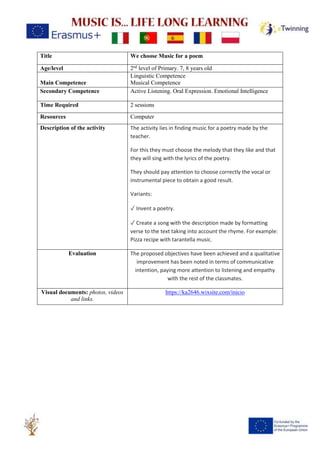
Title We choose Music for a poem
Age/level 2nd
level of Primary. 7, 8 years old
Main Competence
Linguistic Competence
Musical Competence
Secondary Competence Active Listening. Oral Expression. Emotional Intelligence
Time Required 2 sessions
Resources Computer
Description of the activity The activity lies in finding music for a poetry made by the
teacher.
For this they must choose the melody that they like and that
they will sing with the lyrics of the poetry.
They should pay attention to choose correctly the vocal or
instrumental piece to obtain a good result.
Variants:
✓ Invent a poetry.
✓ Create a song with the description made by formatting
verse to the text taking into account the rhyme. For example:
Pizza recipe with tarantella music.
Evaluation The proposed objectives have been achieved and a qualitative
improvement has been noted in terms of communicative
intention, paying more attention to listening and empathy
with the rest of the classmates.
Visual documents: photos, videos
and links.
https://ka2646.wixsite.com/inicio
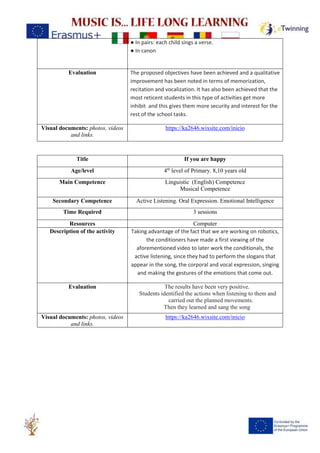
Title My aunt´s yard
Age/level 2nd
level of Primary. 7, 8 years old
Main Competence Linguistic Competence
Musical Competence
Secondary Competence Active Listening. Oral Expression. Emotional Intelligence
Time Required 4 sessions
Resources Computer
Description of the activity Number of students: 6 approx. in each group.
First, the game is contextualized. Today we visit "The yard of
my aunt" and as if by magic we become animals that wake
up, stretch and say good morning, of course, each with his
onomatopoeia.
Mime is used throughout the development of the game.
1) Let's start, first, with the farm animals.
One by one, they say the onomatopoeia of the animal
they have chosen. In the 2nd round they should
remember the onomatopoeia of the rest of their
classmates.
Variants:
● Pets, wild animals, two-legged animals, etc.
2) One emits an onomatopoeia and another identifies
what animal it is.
3) One emits an onomatopoeia and another one
identifies it with its name, example: the cat meows.
4) Song: Croak sang the frog
The children learn the song.
● We sing a verse of each verse the student that the teacher
touches on the head, as a dialogue: question- answer
● We analyze the onomatopoeia "cuckoo".
● We keep on singing Boys and girls alternate stanzas using
the boys deeper tone and the girls sharper.
5) We invented a new song with the onomatopoeias of
other animals.
6) Interpretation of the song:
Variants:
● Class group, subgroups of 5 students.
● Each table interprets a couplet
● In pairs: each child sings a verse.
● In canon
Evaluation The proposed objectives have been achieved and a qualitative
improvement has been noted in terms of memorization,
recitation and vocalization. It has also been achieved that the
most reticent students in this type of activities get more
inhibit and this gives them more security and interest for the
rest of the school tasks.
Visual documents: photos, videos
and links.
https://ka2646.wixsite.com/inicio
Title If you are happy
Age/level 4th
level of Primary. 8,10 years old
Main Competence Linguistic (English) Competence
Musical Competence
Secondary Competence Active Listening. Oral Expression. Emotional Intelligence
Time Required 3 sessions
Resources Computer
Description of the activity Taking advantage of the fact that we are working on robotics,
the conditioners have made a first viewing of the
aforementioned video to later work the conditionals, the
active listening, since they had to perform the slogans that
appear in the song, the corporal and vocal expression, singing
and making the gestures of the emotions that come out.
Evaluation The results have been very positive.
Students identified the actions when listening to them and
carried out the planned movements.
Then they learned and sang the song
Visual documents: photos, videos
and links.
https://ka2646.wixsite.com/inicio
Title Strings of Rhythms
Age/level 5th
level of primary. 10, 11 years old
Main Competence Linguistic Competence
Musical Competence
Secondary Competence Active Listening. Oral Expression. Emotional Intelligence
Time Required 1 session
Resources Students
Description of the activity Placed in a circle, different rhythmic chains are made,
associating a word with each time and body movement (in
this case each student associates a movement with the
pronunciation of his name). Placed in the same way, each
student makes a gesture associated with a feeling and others
must make the gestures of the others and then his until the
end of the chain making the last participant the gestures of all
his classmates and ending with his.
Evaluation After a first moment of lack of control, until understanding
the orders, the activity takes place with great interest and
participation.
Visual documents: photos, videos
and links.
https://ka2646.wixsite.com/inicio
Title Eco´s game
Age/level 5th
level of primary. 10, 11 years old
Main competence Linguistic Competence
Musical Competence
Secondary competence Active Listening. Oral Expression. Emotional Intelligence
Time Required 4 session
Resources Flute and score
Description of the activity Divided into two groups, the students work first the rhythmic
reading of the score to later add the melodic reading. For this
we work in the form of an echo learning to listen to ourselves
and to others; to respect the turn and keep the attention to
play on time.
Evaluation Attitude in the class has been improved; we have
achieved greater silence and attention to be
able to develop the activity properly.
Visual documents: photos, videos
and links.
https://ka2646.wixsite.com/inicio
Title From the music to the narration
Age/level 5th
level of primary. 10, 11 years old
Main Competence Linguistic Competence
Musical Competence
Secondary Competence Active Listening. Oral Expression. Emotional Intelligence
Time Required 4 sessions
Resources Tablets
Description of the activity The students were grouped four by four.
They received the music of a story in which they had their
images removed.
They downloaded the file and individually listened to the
music and noted the possible situations that suggested them.
Later they shared their impressions to try to write a story
according to the music
Evaluation The activity has been very hard.
Students have tried, without success, to adapt the text to the
given music.
They have collaborated well within the groups.
The final result has moved away from what was programmed
at the beginning but finally they have invented a story and they
have applied a musical background.
Visual documents: photos, videos
and links.
https://ka2646.wixsite.com/inicio
Title “Bartolo Bartolo”
Age/level 6th
level of primary. 11, 12 years old
Main Competence Linguistic Competence
Musical Competence
Secondary Competence Active Listening. Oral Expression. Emotional Intelligence
Time Required 3 sessions
Resources Students
Description of the activity We did two activities:
1. MUSICAL RHYTHMS with our names: in a circle you
had to follow the rhythm (slap fingers - slap on the
legs) and be attentive when they say our name.
2. BARTOLO-BARTOLO: All in a sitting circle are listed to
all participants, so that the 1st is the president the
2nd is the 2nd
president, the 3rd is the Secretary, and
the rest are listed from 1 to the end.
To the rhythm of two slaps on the knees and two
normal slaps your first number is said and then you
name the person you want.
If this person loses the rhythm or does not hear that
they have appointed him, he will be the last of the
group.
The goal is to become president. A certain time of
game is set.
Evaluation It was an activity that was fun and motivating for the
students. They found it hard to pick up the rhythm of the
game and the "song". It is necessary a concentration and
coordination that 2 students did not get.
Visual documents: photos, videos
and links.
https://ka2646.wixsite.com/inicio
Title Tell me a Fairy tale
Age/level 6th
level of primary. 11, 12 years old
Main Competence Linguistic Competence
Musical Competence
Secondary competence Active Listening. Oral Expression. Emotional Intelligence
Time Required 4 sessions
Resources Computer, Spanish song “Cuéntame un cuento” (Celtas
Cortos)
Description of the activity We will work on several objectives through this song.
Goals:
1. Recognition of emotions
2. Expression of emotions.
3. Word accents.
4. Differences between story, fable, legend and myth.
We listen to the song
https://www.youtube.com/watch?v=MM9zHF4e810
We analyze WHAT the song says and the emotions that the
author wants to transmit and we make a list of emotions.
This work has been done in small groups and then we have put
the results in common.
After this and without having said anything the teacher, one
of the students realizes that the song has no accents.
Teacher proposed to put them.
They do it in small groups and so we file the song correctly
written.
After this we consider what characteristics they think a story
should have.
We put some examples of stories to draw small conclusions.
After this they took the tablets and had to complete a
comparative table between FÁBULA, TALE, MYTH AND
LEGEND.
Evaluation It was an activity that allowed us to work on many language
contents from this song.
The students had heard it but they did not know it.
From then on they sang it very happy in the corridors.
Positive evaluation of the activity.
Visual documents: photos, videos
and links.
https://ka2646.wixsite.com/inicio
Title The clans
Age/level 6th
level of primary. 11, 12 years old
Main Competence Linguistic Competence
Musical Competence
Secondary Competence Active Listening. Oral Expression. Emotional Intelligence
Time Required 5 sessions
Resources Musical instruments, computer
Description of the activity
Goals:
• Work of the musical rhythm.
• Recognition of emotions.
• Expression of emotions.
• Linguistic contents:
• The description
• The adjectives
• The modes of verbs
• Characteristics of the TALES
• The lyric
• Types of rhyme
• Types of stanza
• Sinalefas
• Types of poems
This has been the central activity of the 6th grade class, which
has been more elaborate and longer in time.
Let's create a musical story called: LOS CLANES
There are five groups in class.
Each group in DRIVE will create the beginning of the story
(COOPERATIVE work) in which they must include the identity
of the group (name), the characteristics of each component,
description also of the place where they live and the functions
within the clan of each of them .
Here the objective to work is the adjectives and the
description.
After this beginning they will begin to create an IDENTITY
RHYMN that characterizes the group.
Then we will put a rhythm.
After successive adventures each of the Clans, for different
reasons, must leave the place where they live.
All the Clans end up meeting in the same place without
knowing each other.
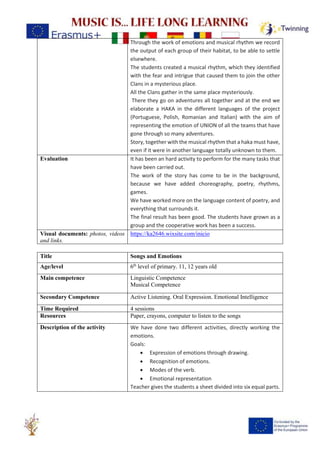
Through the work of emotions and musical rhythm we record
the output of each group of their habitat, to be able to settle
elsewhere.
The students created a musical rhythm, which they identified
with the fear and intrigue that caused them to join the other
Clans in a mysterious place.
All the Clans gather in the same place mysteriously.
There they go on adventures all together and at the end we
elaborate a HAKA in the different languages of the project
(Portuguese, Polish, Romanian and Italian) with the aim of
representing the emotion of UNION of all the teams that have
gone through so many adventures.
Story, together with the musical rhythm that a haka must have,
even if it were in another language totally unknown to them.
Evaluation It has been an hard activity to perform for the many tasks that
have been carried out.
The work of the story has come to be in the background,
because we have added choreography, poetry, rhythms,
games.
We have worked more on the language content of poetry, and
everything that surrounds it.
The final result has been good. The students have grown as a
group and the cooperative work has been a success.
Visual documents: photos, videos
and links.
https://ka2646.wixsite.com/inicio
Title Songs and Emotions
Age/level 6th
level of primary. 11, 12 years old
Main competence Linguistic Competence
Musical Competence
Secondary Competence Active Listening. Oral Expression. Emotional Intelligence
Time Required 4 sessions
Resources Paper, crayons, computer to listen to the songs
Description of the activity We have done two different activities, directly working the
emotions.
Goals:
• Expression of emotions through drawing.
• Recognition of emotions.
• Modes of the verb.
• Emotional representation
Teacher gives the students a sheet divided into six equal parts.
We will listen to six different types of music and we must draw
something that inspires us the music and write the emotion
that it transmits to us.
Reflection: What emotion do we assign to each of these songs
individually?
Does it match that of the group's classmates?
Does it match those of the rest of the class?
The second activity is to investigate how the INDICATIVE,
SUBJUNCTIVE and IMPERATIVE are different.
Then, each of the students, should take a photo in which
physically represent each of these verbal modes.
Evaluation It was difficult for the students to express their emotions. I was
more difficult in the second activity than in the first.
On a paper it is easier, corporally it has cost more.
Teacher value the activity in a positive way because it has been
more motivating for them to learn the ways of the verb.
Visual documents: photos, videos
and links.
https://ka2646.wixsite.com/inicio
Metodologia proposta pela escola:
ISTITUTO COMPRENSIVO DI ALBA ADRIATICA, ITALIA
Title “The story of Little Dart, the fish”
Age/level 1st level
Pupils from Kindergarten – 1st year of Primary school
Main
Competence
Cultural macroarea of reference
COMPETENCE IN THE MOTHER TONGUE
Secondary
Competence
Competences to be developed:
Listening and comprehension: technical and semantic competences
Time required 2 hours
Resources Scenario and images
Parachute
Little coloured balls
Orff instruments
Digital devices for photos and videos.
Description of
the activity:
methodology,
what the teacher
does, what pupils
do
Active didactic methodologies
Methodological principles inspired by the Dalcroze method.
INRODUCTION:
Immediate
involvement in the
lesson
The teachers take the pupils to the motor area or in
a part of the classroom and asks them to pretend to
be a little fish entering the sea (free movement of
the pupils):
Stimulus question:
what kind of little fish are you?
WARM-UP/
GETTING THE
GROUP TO
MOVE:
Bodily warm-up
and plays with the
voice:
experimenting body
and voice
individually and in
comparison with
others
-Free bodily exploration:
the teacher shows, one by one, some images of
some inhabitants living in the sea, s/he puts them
on the board and asks the pupils to move like the
little fish; FOR EXAMPLE: “how does the
jellyfish move?”
_Guided bodily exploration:
The teacher invites pupils to fill the space while
remaining distant and then getting closer to each
other; then only in some places of the room; etc…
- Activity proposed by one pupil and group
imitation:
the teacher observes the group and when s/he
notices a particular movement, s/he invites the
other pupils to move in the same way; for example,
“Look how Mario is moving; let’s move just like
him”; and similarly with the proposals of other
pupils
-Adding sound with the voice of the instruments:
“Let’s try to give a sound to our movement”; “Let’s
listen to the sound Mario is making!”, “Let’s try
to do just like Mario!”; proceed like this for the
other pupils’ proposals.
-Experimenting the movements of the fish with
each part of the body (torso, arms, legs, hands…):
“Let’s move our hand as if it were a seashell”;
“Let’s move our arm as if it were a seashell”; “Let’s
move our torso as if it were a seashell”, and so on…
ANIMATED
STORY:
”Little Dart, the
fish”
FIRST PART
- Presentation of the object facilitating
movement:
The teacher shows the object facilitating movement
to represent the sea: for example, ”Where do fish
live?”… “Here is our sea”…
-The story begins with the presentations of its
main character and its family, by having the little
balls roll over the cloth.
Tell the story until “he started to be happy again”
and add “he started to sing”…
SECOND PART
The characters of the story are presented through
the song intonation: the song “Little Dart” comes
before each little fish enters the story (tuned and
expressive interpretation).
The teacher has little balls moving on the cloth and
stimulates the participation of them, who can move
the cloth according to the features of the characters
repeat the song as imitation.
THIRD PART
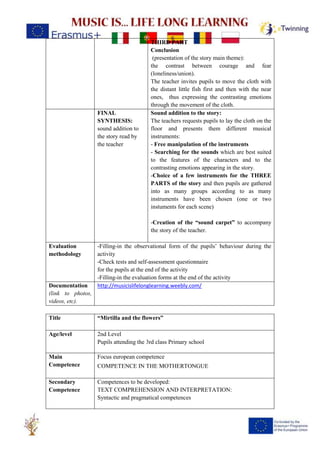
Conclusion
(presentation of the story main theme):
the contrast between courage and fear
(loneliness/union).
The teacher invites pupils to move the cloth with
the distant little fish first and then with the near
ones, thus expressing the contrasting emotions
through the movement of the cloth.
FINAL
SYNTHESIS:
sound addition to
the story read by
the teacher
Sound addition to the story:
The teachers requests pupils to lay the cloth on the
floor and presents them different musical
instruments:
- Free manipulation of the instruments
- Searching for the sounds which are best suited
to the features of the characters and to the
contrasting emotions appearing in the story.
-Choice of a few instruments for the THREE
PARTS of the story and then pupils are gathered
into as many groups according to as many
instruments have been chosen (one or two
instuments for each scene)
-Creation of the “sound carpet” to accompany
the story of the teacher.
Evaluation
methodology
-Filling-in the observational form of the pupils’ behaviour during the
activity
-Check tests and self-assessment questionnaire
for the pupils at the end of the activity
-Filling-in the evaluation forms at the end of the activity
Documentation
(link to photos,
videos, etc).
http://musicislifelonglearning.weebly.com/
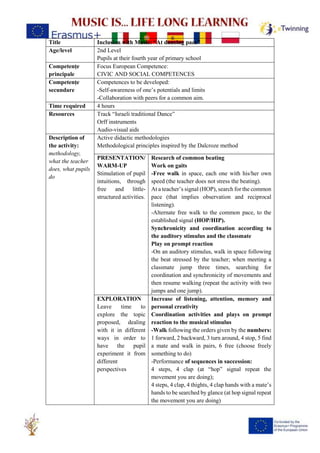
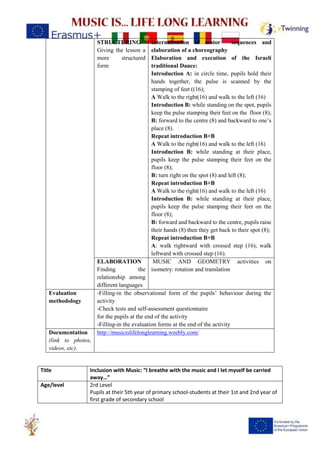
Title “Mirtilla and the flowers”
Age/level 2nd Level
Pupils attending the 3rd class Primary school
Main
Competence
Focus european competence
COMPETENCE IN THE MOTHERTONGUE
Secondary
Competence
Competences to be developed:
TEXT COMPREHENSION AND INTERPRETATION:
Syntactic and pragmatical competences
Time required 5 hours
Resources Headscarf
Track by M. Ravel “Le jardin feerique”
Description of
the activity:
methodology,
what the teacher
does, what pupils
do
Active didactic methodologies
Methodological principles inspired by the Dalcroze method.
INTRODUCTION:
immediate
involvement into the
lesson
-Symbolic play
The teacher takes the pupils to the gym and asks
them to pretend to be little butterflies flying in the
widespread field (free movement of pupils0029
WARM-UP:
getting the group to
move
-Body exploration:
the teacher asks pupils to move like those little
butterflies would do in a beautiful sunny day.
- Activity proposed by one pupil and group
imitation:
the teacher observes the group and when s/he
notices a particular movement, s/he invites the
other pupils to move in the same way; for
example, “Look how Mario is moving; let’s move
just like him”; and similarly with the proposals of
other pupils
-Vocal sound added to movement:
“Let’s try to give a sound to our movement”;
“Let’s listen to the sound Mario is making!”,
“Let’s try to do just like Mario!”; proceed like this
for the other pupils’ proposals.
-Movement experimentation withing the
group and sharing of proposals:
pupils are divided into groups of 4 each, then the
teachers invites them to make butterflies
movement in group as if they were having fun in
that beautiful sunny day.
(experimenting movements within the group and
then showing then to others)
The story “Mirtilla
and the flowers”
begins
Animated storytelling:
-FIRST PART
Presentation of the story and its environment:
The teacher starts the story “Would you like to
know what granma Francesca has told me? A long
time ago, these butterflies, lived in a field with no
flowers. The grass was green, just green”.
-Introduction of the character of the story:
“In that field a little girl, whose name was
Mirtilla, used to spend her morning running all
over the grass”.
- When starting the sentence “look at the
butterflies”, “the headscarf” - the facilitator
object - is introduced.
-Invite pupils to have the headscarf move in
space in a semicircle setting while the story
continues (until “happy”)
- The protagonist sadness:
with the sentence “when there were no
butterflies” the teacher closes the headscarf and
with this s/he invites pupils to close their own
headscarf in their hands assuming a closing
position with their body.
-The story continues until “they disappeared
silently…”:
invite pupils to put the headscarf in a particular
place of the gym and then sit down in circle. The
reading of the story continues.
SECOND PART
- Intonation of a simple song to present possible
solutions after the sentence “Mirtilla tried other
ways to make butterflies stay…”-
The song “I cannot be alone” comes before
every attempt Mirtilla tries
(tuned and expressive interpretation).
THIRD PART
-Presentation of the shape of Fairy Ghiandona
after the sentence “She fell asleep”
-At this point the teacher acts the dialogue
between Mirtilla and Fairy Ghiandona.
- At the sentence “The Fairy puffed three times”,
invite pupils to blow on the field.
FOUR PART
Conclusion:
-The story continues till the end and pupils are
shown the headscarves which by magic have
become flowers.
EXPLORATION
Facilitator object
-Pupils are invited to take the flowers by their
hands:
“Let’s take these buds in our hands” and they
simulate the slowly opening of the bud: “How can
I show these flowers opening in the field?” but
then they close again because of too much sun.
-Sound added to the opening and closing
movement.
-The teacher invites pupils in pairs to imitate
the opening and closing of the flower with their
body, thinking they have different shapes
(research within the group and sharing with the
others).
-Listening to the track by M. Ravel “Le jardin
feerique” and bodily movement according to the
suggestions of the music
FINAL SYNTESIS:
Representation of the
story read by the
teacher
- Representation of the story:
The teacher shows the pupils 4 images related to
the story.
-Pupils divided into 4 groups: represent the
story with the movement and the facilitator object
(the headscarf)
Evaluation
methodology
-Filling-in the observational form of the pupils’ behaviour during the
activity
-Check tests and self-assessment questionnaire
for the pupils at the end of the activity
-Filling-in the evaluation forms at the end of the activity
Documentation
(link to photos,
videos, etc).
http://musicislifelonglearning.weebly.com/
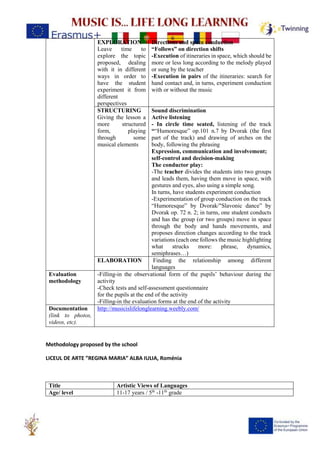
Title “DJIDI”
Age/level 3rd Level
Pupils attending 4th and 5th year of Primary school
Students attending the 1st year of Secondary school
Main
Competence
Focus european competence
COMPETENCE IN THE MOTHERTONGUE
Seconadry
competence
Competences to be developed:
TEXT COMPREHENSION AND INTERPRETATION:
Textual and extratestual competences
Time required 6 hours
Resources Images
Digital devices for pictures and videos.
Musical instruments
Interactive whiteboard
Everyday objects
Description of
the activity:
methodology,
what the teacher
Active didactic methodologies
Methodological principles inspired by the Dalcroze method.
does, what pupils
do
INTRODUCTION:
anticipation of the
atmosphere of the story
through images
-Evocative reading
- Presentation of images
-Free choice of one image and description of
the corresponding emotions aroused: personal
description and comparison with others
-Search of the body movement prompted by
the image: the teacher invites students to
explore the movement prompted by the image
through their bodies
-Vocal sound added to images and creation
of a “sound carpet” through voice: the
teacher invites students to give a sound to the
movement previously created
-Individual proposal and imitation by the
group
-Sound addition to images with
instruments: free exploration of the
instruments and creation of a “sound carpet”
(also with the voice)
PRESENTATION of
the story
-Handing of the text and silent reading.
-Evocative reading of a single sentence: the
teacher invites them to find a single sentence
linked to the chosen image and then to read it
with the sounds previously pursued (leave
time for personal research)
-Proposals to the group: the one who
proposes shares his/her own sound.
-Expressive reading by the teachers:
the teacher reads the short story “Djidi”
IDENTIFICATION of
the scenes
-Identification of the scenes: the teacher aks
students to identify the different scenes of the
story (individually or in groups), through the
delivery of five titles.
WORK in small group -Matching of the scenes to different groups:
analysis of the environment, situation and
emotions to put into sound
-Presentation of the research to the whole
class
HOMEWORK for
different groups
-Sound experimentation:
research of some materials of ordinary use,
making-up of simple musical instruments and
vocal experimentation for the sound addition
to scenes
-Expressive or animated reading of each
scene with the sound carpet.
EXPERIMENTATION
of the scens and final
reconstruction of the text
-Final revision of the text: sharing of the
different group works
RIFLESSIONE sul
lavoro e suggerimenti
dei ragazzi
-The teacher invites students to reflect on the
work done and on possible modifications or
improvement of the itinerary.
Evaluation
methodology
-Filling-in the observational form of the pupils’ behaviour during the
activity
-Check tests and self-assessment questionnaire
for the pupils at the end of the activity
-Filling-in the evaluation forms at the end of the activity
Documentation
(link to photos,
videos, etc).
http://musicislifelonglearning.weebly.com/
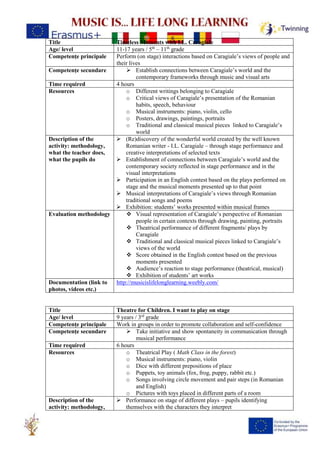
Metodologia proposta pela escola:
LICEUL DE ARTE ”REGINA MARIA” ALBA IULIA, ROMÂNIA
Title Spring is here: flowers, bees, gardens
Age/ level 8 years / 2nd
grade
Main Competence Reception of oral/written messages in familiar communicative contexts
Secondary Competence ➢ Production of oral/ written messages in various communicative
situations
Time required 6 hours
Resources o Handouts with the lyrics of songs: Spring is here, The Bee and
the flowers, The Gardens are Blooming, Flower Lady
o Musical Scores for all songs
o Antonio Vivaldi: Spring
o Pictures illustrating spring
o Piano, flute, cello
o Handouts with division of words into syllables
Description of the
activity: methodology,
what the teacher does,
what the pupils do
➢ Song interpretations (voice, piano, flute, cello, violin)
➢ Performing various songs according to the scores given
➢ Division of words into syllables using the lyrics of the songs
with piano/violin accompaniment
➢ Solving tasks having in the background A. Vivaldi: Spring
➢ Singing rhyming songs accompanied by the piano, the flute and
the violin and then solving song-related tasks
➢ Performing songs having piano and cello accompaniment
➢ Using rhythmic verses/ words by making hands percussion on
desks and body
➢ Promotion of musical words/ expressions
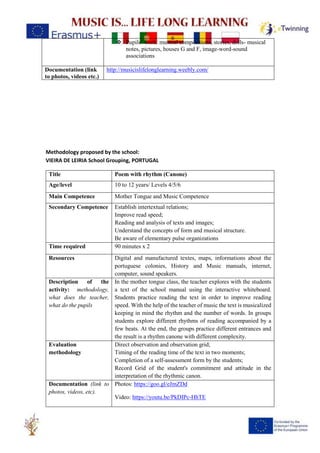
➢ Singing songs and writing specific words: for each musical
instrument, specific words and expressions were chosen to be
consolidated
Evaluation methodology ❖ Systematic observation of students
❖ Song interpretation
❖ Associations of learnt words with specific musical instruments
❖ Word meaning identification through music performed by various
instruments (memory anchorage through sounds/music)
❖ Short tasks of division of words into syllables with piano
accompaniment
❖ Dictation starting from the songs listened, while listening to the
cello
❖ Identification of the message of short texts / lyrics, while listening
to the flute
❖ Completion of evaluation worksheets while listening to Spring by
Vivaldi
Documentation (link to
photos, videos etc.)
http://musicislifelonglearning.weebly.com/
Title Lyric Poetry – traditional folkloric songs
Age/ level 12 years / 6th
grade
Main Competence Reception of written texts of various types through music
Secondary Competence ➢ Participation in communicative interactions through reception
and production of oral texts and musical compositions
➢ Expressing the linguistic identity in (inter)national context
Time required 6 hours
Resources o Musical instruments: piano, cello, clarinet, violin, triangle,
tambourine
o Handouts with the text of lyric literary compositions
o Books with folkloric literary texts
o Posters, paintings, collage on the topic of ”doina”, ”tarantella”,
”fado”, etc.
o Handouts with text related tasks
o Exhibition of traditional folkloric costumes
Description of the
activity: methodology,
what the teacher does,
what the pupils do
➢ Presentation of ‘doina’/”tarantella”/”fado” etc. using different
instruments: cello, violin, clarinet and voice
➢ Interpretation of the pieces using musical instruments
➢ Group performance accompanied by the piano
➢ Presentation of the text of the folkloric song and identification of
the theme, motifs, figures of speech, versification
➢ Analysis of the connection between the musicality of the written
text and the versification
➢ Performance of the folkloric song in groups/ with the whole
class accompanied by musical instruments
➢ Combining written notes with musical interpretations and oral
presentations
Evaluation methodology ❖ Systematic observation of students
❖ Folkloric song interpretations (voice, various instruments)
❖ Associations of musicality of the text and the versification
❖ Analysis of versification and message of the text
❖ Short tasks of definition and classification of lyric poetry
❖ Handouts with tasks related to lyric poetry
❖ Completion of evaluation worksheets
Documentation (link to
photos, videos etc.)
http://musicislifelonglearning.weebly.com/
Title Glorious Food
Age/ level 13 years / 7th
grade
Main Competence Expanding the vocabulary connected to food issues through
musical tunes
Secondary
Competence
➢ Gaining phonological awareness of certain linguistic
words/expressions through linguistic musicality
Time required 4 hours
Resources o Musical instruments: piano, blockflute, maracas,
tambourine, percussion instruments
o Handouts with snacks arranged on a musical scale for
rhythmic pronunciation
o Musical scores for the tune composed by the music
teachers for the comparative/superlative
o Pictures with snacks; food advertisements
o Handouts with text related tasks
Description of the
activity: methodology,
what the teacher does,
what the pupils do
➢ Discussion, explanation
➢ Rhythmic pronunciation of the vocabulary using a
tambourine and maracas (Rumba shakers)
➢ Singing short tunes accompanied by the blockflute and the
piano with adjectives to complete in a diagram
➢ Singing Opinion/ Fact accompanied by the piano and
bockflute so as to reflect the meaning of the two words
➢ Singing comparatives and superlatives divided into three
groups (unequal comparative, equal comparative,
superlative) having the same melody but slightly altered
so that it fits the words to be sung
Evaluation
methodology
❖ Systematic observation of students
❖ Associations of musicality of the words and their meaning
❖ Analysis of the adjectives used in the advertisements
❖ Distinguishing between facts and opinions through
singing
❖ Creating new rhythmic structures for other words
❖ Completion of comparatives/superlatives by relating to
the given musical tunes
Documentation (link to
photos, videos etc.)
http://musicislifelonglearning.weebly.com/
Title Wonderland of Musical Characters
Age/ level 8 years / 2nd
grade
Main Competence Reception of oral messages and musical terms in familiar
communicative contexts
Secondary
Competence
➢ Recognition and production of musical language in play-
related contexts
Time required 6 hours
Resources o Musical games: Listen carefully!, Guess the key!, Darts,
Hot-Cold, Little mouse steals the cheese, Champion
Squirrels, Small orchestra
o Musical notes- character-dolls, houses G and F
o Posters, pictures, stories written by pupils
o Piano, violin, cello, guitar, viola
o Cards for musical notes, for alterations
o Dice, with durations, board games, polystyrene cheese, little
magnet squirrels
Description of the
activity:
methodology, what
the teacher does,
what the pupils do
➢ Games of discovery through audition with the pupils’ eyes
covered
➢ Games of consolidating the keyboard, white and black
➢ Games for setting durations and rests: Darts, Little mouse
steals the cheese
➢ Games for setting basic piano knowledge: Hot-Cold
➢ Games for setting the alterations: Champion Squirrels
➢ Small Orchestra: a game of imitating an orchestra while a
pupil is performing a musical piece and the other children
are trying to achieve a rhythm or a melodic line using
another instrument and having a child – conductor in front
who tries to beat the measure.
Evaluation
methodology
❖ Systematic observation of pupils
❖ Musical Team competitions involving the games mentioned
and a series of musical instruments: piano, violin, cello,
viola, guitar
❖ The ‘golden coins’ collected by pupils during the games as
they reflect the number of correct answers they gave
❖ “Small Orchestra” – assesses pupils’ musical competences,
their creativity and imagination, their ability to adapt to the
group, their interactive skills in the musical field
❖ Pupils’ work: musical compositions, stories, dolls- musical
notes, pictures, houses G and F, image-word-sound
associations
Documentation (link
to photos, videos etc.)
http://musicislifelonglearning.weebly.com/
Methodology proposed by the school:
VIEIRA DE LEIRIA School Grouping, PORTUGAL
Title Poem with rhythm (Canone)
Age/level 10 to 12 years/ Levels 4/5/6
Main Competence Mother Tongue and Music Competence
Secondary Competence Establish intertextual relations;
Improve read speed;
Reading and analysis of texts and images;
Understand the concepts of form and musical structure.
Be aware of elementary pulse organizations
Time required 90 minutes x 2
Resources Digital and manufactured textes, maps, informations about the
portuguese colonies, History and Music manuals, internet,
computer, sound speakers.
Description of the
activity: methodology,
what does the teacher,
what do the pupils
In the mother tongue class, the teacher explores with the students
a text of the school manual using the interactive whiteboard.
Students practice reading the text in order to improve reading
speed. With the help of the teacher of music the text is musicalized
keeping in mind the rhythm and the number of words. In groups
students explore different rhythms of reading accompanied by a
few beats. At the end, the groups practice different entrances and
the result is a rhythm canone with different complexity.
Evaluation
methodology
Direct observation and observation grid;
Timing of the reading time of the text in two moments;
Completion of a self-assessment form by the students;
Record Grid of the student's commitment and attitude in the
interpretation of the rhythmic canon.
Documentation (link to
photos, videos, etc).
Photos: https://goo.gl/eJmZDd
Video: https://youtu.be/PkDIPc-HhTE
Title Poetic text with music
Age/level 9 to 12 years/ Levels 4/5/6
Main competence Mother Tongue and Music Competence
Secondary
competence
Understanding the poetic text;
Identify stanza, block, verse and rhymes;
Reading and declamation of the poem;
Understand the different rhythms of music;
Understand the concepts of growing and decreasing.
Understand and apply the concepts of forte and piano in the context
of analysis, creation and musical execution.
Time required 90 minutes x 3
Resources Information about different Portuguese authors and composers
(Almada Negreiros / Fausto); History and Music manuals, internet,
computer, sound speakers, drum, prongs, bells and clubs.
Description of the
activity: methodology,
what does the teacher,
what do the pupils
In the mother tongue class, the teacher explores with the students the
poetic text of the school manual with the use of the interactive
whiteboard. In a group, students read the poem. They count the
words in each verse and identify the rhymes. Each group of students
do a research to find new rhymes. In music class, students explore
different ways of reading the poem: low and high voice; slow and
fast; with suppression of words. (increasing / decreasing / strong /
piano). In a group, students explore the poetic text reading at
different rhythms accompanying with drum, bells, clubs and tools.
Evaluation
methodology
Direct observation and observation grid;
Performance of students in individual and group work; Completion
of a self-assessment form by the students;
Record Grid of the student's commitment and attitude in the
interpretation and musical execution.
Documentation (link to
photos, videos, etc).
photos: https://goo.gl/eJmZDd
Title Portuguese Language with Music
Age/level 3 to 10 years/ Levels: Kindergarten and Primary School
Main Competence Mother Tongue and Music Competence
Secondary Competence Improve oral expression;
Explore rhymes and rigmarole
Play rhymes and flicks;
Working the child's expression;
Understand the notion of syllable;
Explore the voice and the body to produce different sounds.
Time required 90 minutes x 3
Resources Syllable Games, Interative board; internet, computer, sound
speakers, drum, prongs, bells and clubs.
Description of the
activity: methodology,
what does the teacher,
what do the pupils
In the mother tongue classes, the students explore different
“rigmarole” and their rhymes. In a group, the students create
gestures and present the language to their classmates. In the
following sessions students explore the words on the interactive
whiteboard and separate the syllables from the words. Using body
beats or instruments students count the syllables of words. Then
different children's songs are explored and students use body
language and voice.
Evaluation
methodology
Direct observation and observation grid;
Performance of students in individual and group work; Completion
of a self-assessment form by the students;
Record Grid of the student's commitment and attitude in the
interpretation of children's songs and body language and voice.
Documentation (link to
photos, videos, etc).
Photos: https://goo.gl/eJmZDd
Methodology proposed by the school:
SZKOLA PODSTAWOWA NR 2 IM. JANA KOCHANOWSKIEGO, POLAND
Title Mother tongue: Collection of vocabulary around the subject: Winter. Safety during
winter holidays.
Age/level 8 years, 3rd grade
Main Competence Mother tongue
- Music influences the efficiency of the mind, concentrates, and makes the classes more
attractive.
- Music has a positive influence on learning Polish language.
- Rich vocabulary related to winter
- Shaping the habits of taking care of your own safety during winter play
Secondary
Competence
Student:
- Recognizes winter sounds - frosty wind, snow crashes, skiing, sled bells, etc.
- He knows a lot of words related to winter
- Cooperates with students group, listens when others talk
- Cares for safety during winter play
- Improves skater movements
- Sings a song about winter with a dance interpretation
Required time - 1.5 minutes - listening to sounds
- Approx. 10minutes - work in groups – writing words, control of work by reading and
hanging cards on the board
- 2 minutes - midday break
- 2 minutes - singing a song with a dance interpretation
- The whole class lasts 45 minutes.
Resources - sound effects - winter sounds- https://ucze.pl/zasob/efekty-dzwiekowe-mrozny-
wiatr-skrzypienie-sniegu-dzwonki-san-jazda-na-
nartach/?segment=163&cycle=2141
- A. Vivaldi's music CD, the Four Seasons series - „Winter” or
https://www.youtube.com/watch?v=TjhbQDfI0rg
- C. Saint-Saens's melody from the animal carnival series - "Swan”-
https://www.youtube.com/watch?v=nMGQ-EkyM9I
- A song “Zimowa wyliczanka”– CD or
https://www.youtube.com/watch?v=tG1yxLLUNBY
Description of the
activity: methodology;
What does the teacher
do? What do the
students do?
The teacher formulates and discusses the commands, helps the students and observes
them, and plays the appropriate music.
Students are able to perform the following commands:
They spell winter sounds. Students carefully listen to the sounds and correctly guess them.
In groups, they write words that they associate with winter. Together they create as much
as possible - the team that knows and writes the most "winter words" will win. They work
in groups.
Students mimic the movements of the skater, improvise dance on ice.
Students sing a song about winter sports with dance improvisation.
Evaluation
methodology
- Music has positively influenced the students.
- Students well know the winter sounds.
- By listening to Vivaldi's "Winter", they invented a lot of words related to winter. As
they worked in groups, they were focused on work.
- The music positively influenced the students and encouraged them to have fun. Very
well interpreted "ice skating". They will know how to take care of their own safety
while playing on ice.
- The students sang the winter song very beautifully and the singing is accompanying
by the movement by their own interpretation. They know how to play safely in the
winter.
Documentation (link to
photos, videos, etc).
Records of my classes:
http://www.sp2zabki.idsl.pl/filmy.html#flimy1
Pictures:
http://www.sp2zabki.idsl.pl/zdjecia.html#z1
Title Mother tongue: Onomatopoeia
Age/level Fourth-sixth grade / 10-13 years.
Main Competence Mother tongue
The ability to see the onomatopoeia in the surrounding world.
Secondary School Imitation and recognition of the sounds of the surrounding world, stimulation of
imagination, ability to cooperate in a group, enriching active vocabulary of students.
Required time 45 min.
Resources E-book for fifth grade students - “Piąta strona świata”, subject no. 87- “Do góry
nogami”.
Description of the
activity:
methodology; What
does the teacher do?
What do the
students do?
Teacher:
• explains the term "onomatopoeia";
• instructs the students to listen to the sounds of the surrounding world,
• makes students sensitive to perceiving details of everyday life,
• stimulates their imagination,
• encourages them to activity;
• evaluates student work.
Students:
• use the "onomatopoeia" term;
• see places where onomatopoeia likes to "live";
• use the sounds surrounding their everyday reality;
• guess who or what sounds like it was presented;
• they talk about the emotions that give rise to the presented sounds;
• enrich active vocabulary by recording auditory impressions;
• overcome their own shyness and embarrassment with public speeches;
• objectively evaluate their own and others work.
Evaluation
methodology
Observation of classes, evaluation of student work.
Documentation (link
to photos, videos,
etc).
Records of my classes:
http://www.sp2zabki.idsl.pl/filmy.html#flimy1
Title Mother tongue: Tongue twisters
Age/level Fourth-sixth grade / 10-13 years
Main Competence Mother tongue
Singing of the poetical piece by Małgorzata Strzałkowska, entitled “Cztery
jędze spod Swarzędza” with own melody.
Seconadry Competence Developing the efficiency of beautiful, loud, clear and expressive recitation of
phonetically difficult literary texts, the ability to express the feelings with the
help of words, the enrichment of vocabulary.
Required time 45 min.
Resources Małgorzata Strzałkowska, “Cztery jędze spod Swarzędza" Wiersze, że aż
strach!, Warsaw 2012
Description of the
activity: methodology;
What does the teacher
do? What do the students
do?
Teacher:
• gives the literary texts – poem of Małgorzata Strzałkowska entitled
“Cztery jędze spod Swarzędza”;
• orders to read the poem quietly and reflect on its content;
• suggests musical interpretation of the poem;
• evaluates student work
Students:
• get to know the texts, read the poem quietly, together with the
teacher they explain the incomprehensible words and phrases, talk in
their own words about the lyrical situation presented in the poem;
• learn to expressly read literary texts, that is, with the help of words
expressed in the line of feelings and experiences;
• practice phonetically pronunciation of difficult words;
• read the fragments of the song "Cztery jędze ze Swarzędza" in their
chosen way, e.g.: the melody of popular Polish songs, slowly, quickly,
cheerfully, sadly, grimly, sadly, etc.;
• objectively evaluate their own and colleagues works;
• stimulate the imagination
Evaluation methodology Observation of classes, evaluation of student work.
Documentation (link to
photos, videos, etc).
Records of my classes:
http://www.sp2zabki.idsl.pl/filmy.html#flimy1
10.2 PART 2: TEACHING AND LEARNING SCIENCE BY MUSIC
10.2.1. ARGUMENT
The second thematic block was devoted to the scientific expertise and was led by
Romania.
In primary school it can be applied to the natural sciences and in the secondary in
Chemistry and Physics.
The planned activities were:
• Inserting a background of classical music in the classrooms;
• The lesson begins and ends with 5 minutes played by the piano music (or other
instrument) by a larger student or a teacher;
• The algorithm of the problem of Chemistry, Physics and Sciences solution is proposed
in verse of a song (accompanied on the piano or other instrument by pupils or
teachers);
• it will be allowed to students who serve as Science, Chemistry or Physics to listen to
music with earbuds testing;
• relaxing activities with Science after school according to the principles of meloterapia.
One of the basic effects of using music in teaching sciences is that music is improving
students’ attention and motivation. They can concentrate better, the subject is more
interesting and, therefore, an extrinsic motivation for studying sciences becomes intrinsic
because students find sciences interesting and challenging.
In primary school, with the help of various types of music related to different natural
processes, teachers can help shaping and developing the abilities of exploration and
investigation of reality, as well as develop an interest regarding the living environment. An
effect of exploring and being interested in nature is the raising awareness towards the effects
of human activity in nature. An extended gain of the process of making all science classes with
music will be the knowledge of the natural world and its processes, the understanding of
changes in nature and various developmental phases (water cycle, seasons etc.), as well as the
importance of water, warmness and light for humans, animals, and plants.
For example, making associations between the verses or the rhythms of the songs and
the objects to be analyzed (parts of the body, plants, processes in nature etc.), singing rhyming
songs accompanied by piano, flute, violin or computer music creates memory connections that
will help students recognize and reproduce specific information and solving tasks.
In secondary school, music in science classes such as physics, chemistry, biology etc.,
will lead to an analytical approach to defining scientific questions and, on this ground, students
are more open to a broad-based knowledge acquisition, they are interested and motivated to
create their own scientifically testable hypotheses and then to do their own interpretation and
analysis of data.
A simple example: on a string instrument, it is possible to play harmonics (standing
waves) by creating nodes because these occur when a player touches the string at specific
points very gently with a finger while trying to make a sound normally with the bow; this effect
is only possible when the player’s finger is in exactly the right spot. Similarly, electrons can only
exist in shells. The analogy is even more appropriate when students study electrons and
quantum states in more detail.
For younger students, it is possible to explain the characteristics of sound waves by the
help of musical instruments: frequency, amplitude, length, period and speed. Various types of
sounds are made, for example, with various wind, string and percussion instruments and
intuitively even very young students can understand the characteristics of sound waves. Also,
teachers can initiate discussions on the concept of resonance and application of the concept to
the analysis of musical instruments that involve the vibration of strings and air inside a column.
Using music in classroom, using real instruments help students recognize that waves
are a way for energy to travel, as distinct from the kinetic energy carried by a moving object,
and also understand basic wave properties like amplitude, superposition, and interference, or
for periodic waves, they learn know how frequency, wavelength, and wave velocity are
related, and thus understand how physical systems can be made to vibrate in frequencies that
correspond to the notes of the musical scale.
A specific and simple application of the example above is to take primary as well as
secondary students to a concert: there is plenty of sound in a concert hall where an orchestra
is playing. Each instrument vibrates in its own way, producing the unique sound associated
with it.
Music in the classroom, during science classes is something new, something interesting and
somethings that raises concentration and willingness to know, to understand, to explore, and
to discover. This leads to the development of scientific attitude and scientific thinking, as well
as development of scientific values of inquiry, creativity, perseverance, honesty, tolerance,
accuracy, respect for natural processes and their properties.
Methodology proposed by the school:
LICEUL DE ARTE ”REGINA MARIA” ALBA IULIA, ROMÂNIA
Title Plants (Natural Sciences)
Age/ level 8 years / 2nd
grade
Competențe
principale
Shaping and developing the abilities of exploration and investigation of
reality using specific tools and procedures
Competențe
secundare
➢ Recognition of the main parts of plants and their role
➢ Development of an interest regarding a balanced living environment
➢ Raising awareness regarding the effects of human activity on nature
➢ Recording of their observations regarding some phenomena or
processes of plants
Time required 6 hours
Resources o Handouts with the lyrics of songs: The voice of flowers, Zum, zum,
zum (a song of bees)
o Handouts with drawings of the parts of plants
o Snowdrops, tulips, plants with roots
o Pictures illustrating plants
o Musical instruments: piano, flute, cello
o Science books, colouring handouts, botanical atlas
Description of the
activity:
methodology, what
the teacher does,
what the pupils do
➢ Listening to different songs related to the topic of spring flowers (The
Voice of Flowers)
➢ Selecting specific information from songs and then synthesize it in
drawings
➢ Making associations between the verses of the songs and the plants to
be analyzed
➢ Performing various songs according to the topic
➢ Singing rhyming songs accompanied by the piano, the flute and the
violin and then solving song-related tasks
➢ Using rhythmic verses/ words by making hands percussion on desks and
body
➢ Listening and singing Zum, zum, zum (a song about bees) and solve
song related tasks useful in understanding the role played by bees in the
life of plants
➢ Establishing connections between the work of bees and the growth of
plants, as well as the short-term and long-term effects
Evaluation
methodology
❖Systematic observation of pupils
❖Song interpretations
❖Associations of plants and musical instruments (the sounds they
produce)
❖Identification of similarities and differences between plants with the
help of the music listened to/ performed
❖Presentation of the process of the growth of plants in relation to the
work of bees
❖Completion of evaluation worksheets while listening to certain pieces of
music
Documentation (link
to photos, videos etc.)
http://musicislifelonglearning.weebly.com/
Title Ionic Bond (Chemistry)
Age/ level 13 years / 7th
grade
Competențe principale Analytical approach to defining scientific questions:
Why a metal and a non-metal love each other?
Competențe secundare ➢ Broad-based knowledge acquisition: students know the atomic
structure of metals and non-metals
➢ Creation of scientifically testable hypotheses: could a metal and a
non-metal love each other? Why not?
➢ Interpretation and analysis of data: how does the Ionic bond take
place: use of sweet candies!
Time required 4 hours
Resources o Musical instruments: piano, violin
o Handouts with the Ionic bonding
o Short theatre sequence with actors: story-teller, metal character
and non-metal character
o Sweet candies for electrons
Description of the
activity: methodology,
what the teacher does,
what the pupils do
➢ In front of the class, there is a story teller and 2 other characters:
a metal and a non-metal
➢ Each student has a poster on his/her T-shirt with METAL and
NON-METAL
➢ There is also a student playing the piano and a student playing
the violin
➢ While a sad song is played on the violin, the story teller says that
the metal and the non metal are very sad because they have no
stable structure of electrons on their last layer
➢ The metal gives electrons/sweet candies to the non-metal and
therefore it will have a stable structure
➢ The non-metal receives the electrons/sweet candies and will also
have a stable structure
➢ The metal becomes a positive ion and the non-metal becomes a
negative ion: together they create a Ionic bond
➢ Now, a happy play starts at the piano and the metal and the non-
metal are dancing together... happily ever after!
➢ All the students in the class eat sweet candies (not electrons) and
work in pairs to draw various Ionic bonds on their papers
➢ METAL AND NON-METAL LOVE EACH OTHER!
Evaluation methodology ❖ Performance of the short theatrical sequences
❖ Association of the formation of Ionic bonds with musical tunes
Documentation (link to
photos, videos etc.)
http://musicislifelonglearning.weebly.com/
Title Covalent Bond (Chemistry)
Age/ level 13 years / 7th
grade
Competențe principale Analytical approach to defining scientific questions: I WONDER
WHETHER NON-METALS LOVE EACH OTHER?
Competențe secundare ➢ Broad-based knowledge acquisition: students know the atomic
structure of non-metals
➢ Creation of scientifically testable hypotheses: non-metals love
each other? Of course they do!!
➢ Interpretation and analysis of data: how does the Covalent bond
take place: use of sweet candies!
Time required 4 hours
Resources o Musical instruments: piano, violin
o Handouts with the Covalent bonding
o Short theatre piece with actors: story-teller, two non-metal
characters
o Sweet candies for electrons
Description of the
activity: methodology,
what the teacher does,
what the pupils do
➢ In front of the class, there is a story teller and 2 other characters:
two non-metals (eg: 2 Oxygen atoms)
➢ Each student has a poster on his/her T-shirt with NON-METAL
➢ There is also a student playing the piano and a student playing the
violin
➢ While a sad song is played on the violin, the story teller says that
the non metals are very sad because they have no stable structure of
electrons on their last layer
➢ The non-metals put together some of their electrons/candies and
therefore they will both have a stable structure
➢ Together they form a Covalent bond
➢ Now, a happy play starts at the piano and the non-metals are
dancing together... happily ever after!
➢ All students in the class eat sweet candies (not electrons) and work
in pairs to draw various covalent bonds on their papers
➢ NON-METALS LOVE EACH OTHER!
Evaluation methodology ❖ Performance of the roles given
❖ Association of musical tunes to the formation of Covalent bond
Documentation (link to
photos, videos etc.)
http://musicislifelonglearning.weebly.com/
Title The Atom (Physics)
Age/ level 12 years / 6th
grade
Competențe principale Identification of atoms, atom structure, characteristic element, atomic
relative mass, the characteristics of periodic table, the subject matter and
description of subject matter
Competențe secundare ➢ Using proton number and the simple structure of atoms to
explain the periodic table, with special reference the elements of
proton number 1 to 20
➢ Describe the building up of electrons in “shells” and understand
the significance of valence electrons and the noble gas electronic
structures
Time required 6 hours
Resources o Musical instrument: piano
o Scores created by music teachers for the Hymn of the Atom
o Short poems written by students about the atomic structure
Description of the
activity: methodology,
what the teacher does,
what the pupils do
➢ Students work together in writing the lyrics of the hymn of the
atom
➢ The music teacher writes the score for the hymn of the atom
➢ Students learn the structure of the atom with the song, rehearsing
and singing it together, accompanied by the piano
➢ While rehearsing the hymn, the teacher gives scientific
information connected with the atomic structure: handouts with
neutrons, electrons, protons, nucleons, what orbitals mean and so
on
Chemical literature:
➢ Everybody with a common sense knows that during Chemistry
class we are struggling to calculate and understand how atoms
never lose their neutrons, nor protons, nor electrons!
➢ The orbitals s, f, p, orbitals type d, they all look like students that
study hard Chemistry, and then they look like teachers that are
trying hard to teach us all Chemistry!
Evaluation methodology ❖ Attainment of the structure of the atom through singing a song
❖ Completion of the handouts in a musical setting
Documentation (link to
photos, videos etc.)
http://musicislifelonglearning.weebly.com/
Title Atomic Structure (Chemistry)
Age/ level 13 years / 7th
grade
Competențe principale Acknowledge that atoms of different elements can bond to form new
substances that often have very different properties from the original
elements.
Competențe secundare ➢ identify elements either metals, non-metals, or metalloids, and
know where they are on the periodic table. (For example, non-
metals are to the right of the “staircase”.)
➢ identify the properties of metals, non-metals, and metalloids.
➢ Understand that non-metals tend to share valence electrons with
each other when forming compounds, and that this is known as
covalent bonding.
➢ Understand that a metal and a non-metal will typically form a
compound with the metal giving up electrons and the non-metal
taking electrons, and that this is known as ionic bonding.
Time required 6 hours
Resources o musical instrument: piano
o scores: J.S. Bach, D. Scarlatti, Fr. Chopin etc.
o periodical system of elements
o handouts with atom structure
o poems about atoms
Description of the
activity: methodology,
➢ students write poems about the structure of chemical elements:
the lyrics contain notions about the structure of the atom
what the teacher does,
what the pupils do
➢ all students in class try to write poems: atom structure, atom
properties etc. and then choose the scores (or any song they like
if they cannot read scores) that they consider suitable for their
poem (e.g. J.S. Bach, D. Scarlatti, Fr. Chopin)
➢ students work in pairs (or groups): one student plays the piano,
another student recites the poem in front of the classroom
➢ or: students work in groups of 6 and 4 of them make a quartet to
play the music of the atom, and the other 2 recite the poem like a
dialogue
Evaluation methodology ❖ Poem performance
❖ Completion of worksheets
Documentation (link to
photos, videos etc.)
http://musicislifelonglearning.weebly.com/
Title Reflection and Refraction of Light (Physics)
Age/ level 12 years / 6th
grade
Competențe principale Understanding of the process of interaction of light with various surfaces
Competențe secundare ➢ knowing that the angle at which light hits a reflecting surface is
called the angle of incidence and the angle at which light
bounces off a reflecting surface is called the angle of reflection
➢ measuring the angle of incidence and the angle of reflection
Time required 4 hours
Resources o drawings of reflection and refraction of light
o optical prism
o musical instruments: piano
o poems with optical phenomena
o scores
Description of the
activity: methodology,
what the teacher does,
what the pupils do
➢ all students in the class are drawing with coloured pencils the
reflection and the refraction of light while listening to piano
music (recommended classical music)
➢ while the class is drawing, a pair of students introduce reflection
and refraction with scientific information in poetry: a student
goes to the piano and starts a play of his/her own choice and the
other recites the poem about reflection and refraction of light
Evaluation methodology ❖ Completion of tasks required
Documentation (link to
photos, videos etc.)
http://musicislifelonglearning.weebly.com/
Title Sound Waves (Natural sciences/ Physics)
Age/ level 8 / 12 years – 2nd
/ 6th
grade
Competențe principale Recognize that waves are a way for energy to travel, as distinct from the
kinetic energy carried by a moving object
Competențe secundare ➢ Understand basic wave properties like amplitude, superposition,
and interference (constructive and destructive)
➢ For periodic waves, know how frequency, wavelength, and wave
velocity are related
➢ Understand how physical systems can be made to vibrate in
frequencies that correspond to the notes of the musical scale
Time required 4 hours
Resources o String instruments such as: violin, cello, guitar, piano
o Various percussion instruments
o Wind instruments: flute, oboe, etc.
Description of the
activity: methodology,
what the teacher does,
what the pupils do
String
➢ On a string instrument, it is possible to play harmonics (standing
waves) by creating nodes
➢ These occur when the player touches the string at specific points
very gently with a finger while trying to make a sound normally
with the bow
➢ This effect is only possible when the player’s finger is in exactly
the right spot
➢ Similarly, electrons can only exist in shells. The analogy is even
more appropriate when students study electrons and quantum
states in more detail
Wind, string, percussion
➢ For younger students, it is possible to explain the
characteristics of sound waves by the help of musical
instruments: frequency, amplitude, length, period and speed
➢ Various types of sounds are made, for example, with various
wind, string and percussion instruments and intuitively even
very young students can understand the characteristics of
sound waves
➢ Discussions on the concept of resonance and application of
the concept to the analysis of musical instruments that
involve the vibration of strings and air inside a column
Orchestra
➢ Take your students to a concert: You can hear plenty of sound in
a concert hall where an orchestra is playing.
➢ Each instrument vibrates in its own particular way, producing
the unique sound associated with it.
➢ The acoustical power coming from these instruments originates
with the musician.
➢ It is the energy of a finger thumping on a piano key and the
energy of the puff of air across the reed of the clarinet and the
energy of the slam of cymbals against each other that causes the
instrument’s vibration
➢ An orchestra with 75 performers has an acoustic power of about
67 watts!!!
Evaluation methodology ❖ Associations between wave properties, physical systems and
musical sounds
Documentation (link to
photos, videos etc.)
http://musicislifelonglearning.weebly.com/
Title Standing Waves and Music – Chladni Plates (Physics)
Age/ level 8/12 years - 2nd
/ 6th
grade
Competențe principale Understanding the various modes of vibration of a rigid surface
Competențe secundare ➢ Ability to use a cello bow to excite the edge of a thin metal or
wooden plate.
➢ Knowledge about and ability to use an oscillator, amplifier, and
an electro-mechanical oscillator. The great advantage is that we
can easily vary the frequency of excitation thereby providing a
whole vista of experimentation
Time required 6 hours
Resources o any type of sound producing device that will make standing
waves and register the frequency
o metal plate
o salt and coloured sand
o violin bow, cello bow
Description of the
activity: methodology,
what the teacher does,
what the pupils do
➢ Methods: standing waves and music Chladni Plates
➢ Technique: study the motions of vibrating plates: starting with a
metal plate whose surface had been lightly sprinkled with sand,
students can see that bowing it produces characteristic patterns
that could be related to the physical dimensions of the plate
Evaluation methodology ❖ Practical experiments and interpretation of their results
Documentation (link to
photos, videos etc.)
http://musicislifelonglearning.weebly.com/
Title Water Cycle in Nature (Physics)
Age/ level 8/12 years – 2nd
/ 6th
grade
Competențe principale Knowledge of the natural world and its processes
Competențe secundare ➢ Understand changes in nature and various developmental phases
(water cycle, seasons etc.)
➢ Understand the importance of water, warmness and light for
humans, animals, and plants
Time required 4 hours
Resources o big screen, loud speakers
o various videos with music and animations of natural processes
like water cycle in nature
o handouts with the water cycle in nature and coloured pencils /
tempera
o https://www.youtube.com/watch?v=uT3SBzmDxGk
https://www.youtube.com/watch?v=Az2xdNu0ZRk
Description of the
activity: methodology,
what the teacher does,
what the pupils do
PHASE 1: We are preparing to see a cello concert
➢ The mass of water on Earth remains fairly constant over time but
the partitioning of the water into the major reservoirs of ice, fresh
water, saline water, and atmospheric water is variable depending
on a wide range of climatic conditions
➢ The water moves from one reservoir to another, such as from
river to ocean, or from the ocean to the atmosphere, by the
physical processes of evaporation, condensation, precipitation,
infiltration, surface runoff and subsurface flow.
➢ The water goes through different forms: liquid, solid, and vapor.
PHASE 2: At the seaside, the sun is rising - evaporation
➢ Cello concert starts smoothly:
➢ The sun, which drives the water cycle, heats water in oceans and
seas. Water evaporates as water vapor into the air. Ice and snow
can sublimate directly into water vapour. Evotranspiration is
water transpired from plants and evaporated from the soil.
➢ As altitude increases, air pressure decreases and the temperature
drops down.
PHASE 3: Rain is coming - condensation, precipitation
➢ Cello concert changes into increased intensity:
➢ The lowered temperature causes water vapour to condense into a
tiny liquid water droplet which is heavier than the air, such that it
falls unless supported by an updraft. A huge concentration of
these droplets over a large space up in the atmosphere become
visible as cloud. Fog is formed if the water vapour condenses
near ground level, as a result of moist air and cool air collision or
an abrupt reduction in air pressure. Air currents move water
vapour around the globe, cloud particles collide, grow, and fall
out of the upper atmospheric layers as precipitation.
PHASE 4: Rivers are flowing...forte - infiltration, surface runoff
➢ Cello concert becomes more intense, increased in intensity and
speed, also with elements of percussion on cellos:
➢ Some precipitation falls as snow or hail, sleet, and can
accumulate as ice caps and glaciers, which can store frozen water
for thousands of years. Most water falls back into the oceans or
onto land as rain, where the water flows over the ground as
surface runoff.
➢ A portion of runoff enters rivers in valleys in the landscape, with
streamflow moving water towards the oceans. Runoff and water
emerging from the ground may be stored as fresh water in lakes.
➢ Not all runoff flows into rivers, much of it soaks into the ground
as infiltration.
PHASE 5: back to the ocean
➢ Cello music loses intensity and at the end replays the theme:
➢ Some infiltration stays close to the land surface and can seep back
into surface-water bodies (and the ocean) as groundwater
discharge. Some groundwater finds openings in the land surface
and comes out as freshwater springs. In river valleys and
floodplains, there is often continuous water exchange between
surface water and ground water in the hyporheic zone. Over time,
the water returns to the ocean, to continue the water cycle.
PHASE 6: Water cycle...cycling again
➢ Cello theme starts again, with image of the actual concert: and the
public is amazed with happiness!
Evaluation
methodology
Explaining each phase of the water cycle in nature by the help of music as
it has been learnt
Documentation (link to
photos, videos etc.)
http://musicislifelonglearning.weebly.com/
Title Exploring the Environment (Natural Sciences)
Age/ level 7 years / 1st
grade
Competențe principale Identification of certain phenomena, consequences of actions and simple
processes
Competențe secundare
➢ Accomplishment of functional and/or aesthetic creations using
diverse materials and basic techniques
➢ Finding simple explanations through the use of logical elements
➢ Problem solving starting from the observation of some common
natural features
➢ Expression of oral messages using a few scientific terms
➢ Exploration of the abilities of relating to the others
Time required 6 hours
Resources o Handouts with the lyrics of songs: The wind puts the leaves of
the trees in motion, The wind blows the windmill, All the flowers
are coloured, Shine little star
o Handouts with numbers, questions about sources of energy, topic
related images/ posters
o A castle where summer is a prisoner, windows to be opened to
free summer
o Pictures illustrating the sun, the castle, the windows, the
pinwheel, flowers
o Musical instruments: piano, violin, pipe
o National Syllabus, Textbooks, Science books, colouring
handouts, Pedagogical Books
Description of the
activity: methodology,
what the teacher does,
what the pupils do
➢ Using explanation on musical rhythms to facilitate
understanding processes, phenomena
➢ Practice a wide range of rhythmical exercises in order to revise
and consolidate specific scientific knowledge
➢ Development of simple musical conversation including scientific
elements
➢ Problem-solving tasks starting from the themes discussed and
one musical line per theme
➢ Team work, using music creatively while performing songs
➢ Working independently in order to assimilate the scientific
elements through music
Evaluation methodology ❖ Systematic observation of pupils
❖ Song interpretations
❖ Recognition of sources of energy
❖ Identification of similarities and differences between sources of
energy
❖ Managing to open the windows that allow ‘summer’ to escape
from the castle
❖ Completion of evaluation worksheets while listening to certain
pieces of music
❖ Responses given during students’ interactions on the margin of
the wind, the light, warmth, electricity, the sun etc.
Documentation (link to
photos, videos etc.)
http://musicislifelonglearning.weebly.com/
Title Dissolution of Solids and Liquids. Capillarity of Particles
Age/ level 10 years / 4th
grade
Competențe principale Observation of various natural processes and phenomena through
experiments
Competențe secundare ➢ Making associations between different stages of development in
scientific processes
➢ Dealing with a range of criteria regarding the characteristics of
particles
➢ Selection of particles according to the purposes chosen
Time required 4 hours
Resources o Pieces of classical music (Bach, H.Bertini, Mendelssohn etc.)
o Musical instruments: piano, flute, cello, violin
o Materials: salt, sugar, sand, glasses of water, oil, ink, colour
additive (blue and red), toilet paper, corrugated paper rolls etc.
o Handouts with various theme related tasks
o Process presentation in small steps on musical rhythms
Description of the
activity: methodology,
what the teacher does,
what the pupils do
➢ Performance of different classical pieces according to the topic
of the activity (dissolution of solids into liquids, dissolution of
liquids into liquids, dissolution of liquids used for food into
other liquids, capillarity of particles etc.) and using musical
instruments (piano, violin, flute, cello)
➢ Carrying out a wide range of experiments having classical music
in the background (Bach, Bertini, Mendelssohn etc.)
➢ Revising the previous knowledge by resorting to music and the
information it awakens in students’ minds: memory anchorage
with music
➢ Asking and answering questions in a musical setting
➢ Preparation of materials required on certain musical rhythms
➢ Paying attention to the sounds involved in the experiments
carried out and connecting them to the music listened to:
memory anchorage sound-experiment-phenomenon
Evaluation methodology ❖ Systematic observation of pupils
❖ Interpretations of pieces of classical music in accordance to the
experiments carried out
❖ Identification of similarities and differences between liquids,
solids and other particles
❖ Answering questions about the dissolution of liquids, solids, the
role of colour additives and the capillarity of particles
❖ Completion of experiments while listening to certain pieces of
music
Documentation (link to
photos, videos etc.)
http://musicislifelonglearning.weebly.com/
Title Characteristics and Transformations of Lifeless Particles
(Natural Sciences)
Age/ level 9 years / 3rd
grade
Competențe principale Exploration of the characteristics of particles, phenomena and processes
Competențe secundare ➢ Investigation of the environment using specific tools and
procedures
➢ Solving daily life problems
Time required 4 hours
Resources o Handouts with the lyrics of songs about the seasons
o Handouts with drawings of a tree changing according to the
season
o Pictures illustrating specific elements for the four seasons
o A. Vivaldi (fragments from the four seasons)
o The surprise basket containing cards with seasons and musical
scores as small presents
Description of the
activity: methodology,
what the teacher does,
what the pupils do
➢ Listening to different songs related to the seasons
➢ Selecting specific information from songs and then synthesizing
it in drawings
➢ Making associations between the pieces of music and the
seasons
➢ Performing small pieces of music according to each season
➢ Using the specific terms on the theme of seasons in various
contexts and with different goals
➢ Working in groups in order to achieve the expected result
➢ Encouragement of artistic expression of feelings and emotions
through music and drawing
➢ Adopting proper body posture during the activities
Evaluation methodology ❖ Observation of pupils
❖ Performance of pieces of music and interpretation of music
through drawing
❖ Associations of music with the specific notions used in
connection to seasons
❖ Degree of cooperation in the process of reaching a result
❖ Using the specific notions in other contexts
❖ Completion of evaluation worksheets while listening to music
❖ Acknowledgement of the main features of each season through
musical expression
Documentation (link to
photos, videos etc.)
http://musicislifelonglearning.weebly.com/
Title Magnetic phenomena (Physics)
Age/ level 12 years / 6th
grade
Competențe principale Structured scientific investigation through experiments
Competențe secundare ➢ Scientific explanation of some simple phenomena in Physics and
some technical applications
➢ Interpretation of data and information obtained through
experiments regarding simple phenomena in Physics
➢ Solving problems / situations through methods specific to
Physics
Time required 4 hours
Resources o Presentation of magnets – definition and properties
o School magnet kit
o Pieces of music reflecting the world of magnets (flute, guitar),
Jean Michel Jarre, Magnetic Field
o Materials: screw or iron nail, wire, battery, paper clips
o The National Syllabus for Physics
Description of the
activity: methodology,
what the teacher does,
what the pupils do
➢ Starting the lessons with a piece of music played at a musical
instrument (flute, piano)
➢ Presentations of the topic of the lessons emphasizing definitions
and characteristics
➢ Bringing practical materials in class, such as the school magnet
kit
➢ Building experiments in Physics in relation to music in different
ways according to the content of the lesson, to the knowledge to
be acquired, students’ attitudes and approaches of the process or
the laws governing the issues taught
➢ Drawing students’ attention to an increased focus on building a
magnet with the help of music
➢ Facilitating students’ understanding of various phenomena in
Physics by using music as a link between the laws governing
Physics and the way they work in the world
Evaluation methodology ❖ Systematic observation of students
❖ Associations of musical pieces and the issue explored from
Physics in order to remember better the scientific notions and
stages
❖ Students’ involvement in the accomplishment of the task (e.g.
building an electromagnet)
❖ Achievement of the final product (e.g. electromagnet) and
testing it for proper working (checking whether the
electromagnet attracts the paper clips or not)
Documentation (link to
photos, videos etc.)
http://musicislifelonglearning.weebly.com/
Title How to Make Your Own Slime and Chemical Volcano?
Age/ level 13 years / 7th
grade
Competențe principale Exploration of phenomena and properties of substances encountered in
daily activity
Competențe secundare ➢ Interpretation of data and information obtained during the
process of investigation
➢ Solving problems in concrete situations using algorithms and
tools specific to Chemistry
➢ Evaluation of the consequences of processes and effects of
chemical substances on the individual and the environment
Time required 4 hours
Resources • Materials slime: glue, colour additive, shaving foam, liquid
washing powder, glitter
• Materials volcano: modeling clay (colour additive, water,
vegetable oil, flour, salt), jars, bowls, spoons, baking soda,
vinegar
• Presentation of chemical processes
• Musical instruments: piano, flute
• Song: I’m the amateur chemist
• National Syllabus for Chemistry
Description of the
activity: methodology,
what the teacher does,
what the pupils do
➢ Presentation of the chemical process that students have to carry
out as an experiment similar to You Tube videos of How to ….?
(combining the ingredients in order to obtain the chemical
mixture for the slime, combining the ingredients in order to obtain
the molding clay used for building the volcano, combining the
ingredients that render the chemical reaction similar to the
eruption of a volcano etc.) having classical music in the
background
➢ Creating a musical atmosphere in which the experiments to take
place so that students associate the peacefulness of the pieces of
music chosen with working with chemical mixtures
➢ Offering assistance to students in the development of the
chemical experiments carried out by each one of them through
simple suggestions or observations and encouragement in
working with substances
➢ Gradual movement from one stage to another so that students
notice the changes produced by the chemical reactions, movement
facilitated by the music played (piano, flute etc.)
Evaluation methodology ❖ Systematic observation of the gradual movement from one
chemical phase to another and students’ responses across the
process
❖ Preparation of the chemical mixtures and the substances
obtained (slime, molding clay)
❖ Achievement of the chemical reactions required (e.g. eruption of
the volcano)
❖ Pursuit of the chemical phases presented leading to the
accomplishment of the chemical experiment
Documentation (link to
photos, videos etc.)
http://musicislifelonglearning.weebly.com/
Methodology proposed by the school:
ISTITUTO COMPRENSIVO DI ALBA ADRIATICA, ITALIA
Title “The Little Seed and Little Drop”
Age/level 1st Level
Pupils from kindergarten school
Pupils at their first year of primary school
Competențe
principale
Focus European Competence
BASIC COMPETENCE IN SCIENCE
Competențe
secundare
Competences to be developed:
Acquisition and interpretation of contents
Comprehension of logical nexus, links
Use of specific language
Time required 2 hours and 30 minutes
Resources Headscarf
Orff instruments
Description of the
activity:
methodology, what
the teacher does,
what pupils do
Active didactic methodologies
Methodological principles inspired by the Dalcroze method
PRESENTATION/
WARM-UP
Stimulation of pupil
intuitions, through free
and little-structured
activities. Let
spontaneity emerge
through symbolic plays
Introduction
The teacher takes the pupils to the gym and
asks them to move freely in space pretending
to be many small water drops
Exploration of the body in free space with
spontaneous sound effects, with movements
suited to the drops
Sound added to movement
Presentation of the object facilitating
movement: the headscarf (freely in space)
Imagining the sound contexts linked to words
and the movement with the object
EXPLORATION
Leave time to explore the
topic proposed, dealing
with it in different ways
in order to have the pupil
Circle-time arrangement,
Animated storytelling
“The story of Little Seed and Little Drop”
1st
step: The teacher adds sound with the Orff
musical instruments while pupils tell the
story through their bodies.
experiment it from
different perspectives
2nd
step: the teacher repeats only the sounds
of the story while pupils tell the story with
their bodies
SCIENTIFIC
EXPERIMENTATION
Sowing
STRUCTURING
Giving the lesson a more
structured form, playing
through some elements
such as:
repetition, modules
Memorization of the doggerel with the main
steps of the course in order to interiorize the
process
Evaluation
methodology
-Filling-in the observational form of the pupils’ behaviour during the
activity
-Check tests and self-assessment questionnaire for the pupils at the end
of the activity
-Filling-in the evaluation forms at the end of the activity
Documentation
(link to photos,
videos, etc).
http://musicislifelonglearning.weebly.com/
Title “Water and its states”
Age/level 2nd Level
Pupils at their third and fourth year of primary school
Competențe
principale
Focus European Competence
BASIC COMPETENCE IN SCIENCE
Competențe
secundare
Competences to be developed:
Acquisition and interpretation of contents
Comprehension of logical nexus, links
Use of specific language
Time required 2 hours
Resources Pictures
Orff instruments
Description of the
activity:
methodology, what
the teacher does,
what pupils do
Active didactic methodologies
Methodological principles inspired by the Dalcroze method
PRESENTATION/
WARM-UP
Stimulation of pupil
intuitions, through free
and little-structured
activities. Let
spontaneity emerge
through symbolic plays
Evocative introduction
Presentation of pictures related to
atmospherical phenomena in circle time
Pictures exchanging and sharing.
Evocation of the emotions aroused: personal
description within the group
Warm-up
Body exploration:
-Individual free experimentation in space of
the movements suited to the drops
(gaseous/aeriform state)
-Groups experimentation of the movements
(liquid state)
-Movement experimentation in the bigger
group (solid state)
Sound exploration:
-Sound added to the movements with the
musical instruments
EXPLORATION
Leave time to explore the
topic proposed, dealing
with it in different ways
in order to have the pupil
experiment it from
different perspectives.
Creating different paths
and being able to follow
them in the opposite way
and from different
starting points
Making up of three different groups
corresponding to the three different states of
water
- Handing out of the scientific text and
explanation of the task:
Searching for the key information and
representation of the three states
- Sharing of the group works
-in the bigger group, experimenting the three
changes of state through the body
SCIENTIFIC
EXPERIMENTATION
The changings of state
STRUCTURING
Giving the lesson a more
structured form, playing
through some elements
such as:
repetition, modules
Memorization of a rap song with the main
steps of the course in order to interiorize the
process
Evaluation
methodology
-Filling-in the observational form of the pupils’ behaviour during the
activity
-Check tests and self-assessment questionnaire for the pupils at the end
of the activity
-Filling-in the evaluation forms at the end of the activity
Documentation
(link to photos,
videos, etc).
http://musicislifelonglearning.weebly.com/
Title “The heart and the circulatory system”
Age/level 2nd Level
Students at their fifth year of primary school and first year of secondary
school
Competențe
principale
Focus European Competence
BASIC COMPETENCE IN SCIENCE
Competențe
secundare
Competences to be developed:
Acquisition and interpretation of contents
Comprehension of logical nexus, links
Use of specific language
Time required 2 hours
Resources Orff instruments
Description of
the activity:
methodology,
what the teacher
does, what pupils
do
Active didactic methodologies
Methodological principles inspired by the Dalcroze method
PRESENTATION/
WARM-UP
Stimulation of pupil
intuitions, through free
and little-structured
activities.
Circle-time arrangement,
body expansion:
mobilization, explorating different
possibilities of expansion with the different
body parts
Presentation of the object facilitating
movement: the sponge/the dodecahedron
Free position in space.
The object expands and squashes.
Some aspects can be varied: accents, rhythms,
dinamics, speed.
-The teacher moves the object and the pupils
mirror the movements through their bodies,
showing speed, accents and intensity; then the
teachers invite the pupils to add vocal sound to
the movement
-Pupils in turns try to move the object, and the
others reply with their body
-(The pupil moving the object tries to add
sound, while the group moves accordingly).
EXPLORATION
Leave time to explore the
topic proposed, dealing
with it in different ways
in order to have the pupil
experiment it from
different perspectives.
Creating different paths
and being able to follow
them in the opposite way
and from different
starting points
Different rhythmical plays with the object
facilitating movements (increase, decrease,
invertion) in order to explore pulse
(Circle-time arrangement)
Work on gait in accordance with the pulse
(Free position in space).
SCIENTIFIC
EXPERIMENTATION
-Film watching on the functioning of the
circulatory system
-Clinic conversation
-Analysis of the didactic text
-At home: study on the text, analysis of the
specific terms and map construction
-Bodily reworking of the course
STRUCTURING
Giving the lesson a more
structured form, playing
through some elements
such as:
repetition, modules
Homework:
-Group creation of a rap song with the main
steps of the course in order to interiorize the
process
-Sharing of the group works
Evaluation
methodology
-Filling-in the observational form of the pupils’ behaviour during the
activity
-Check tests and self-assessment questionnaire for the pupils at the end of
the activity
-Filling-in the evaluation forms at the end of the activity
Documentation
(link to photos,
videos, etc).
http://musicislifelonglearning.weebly.com/
Title “The water cycle”
Age/level 3rd Level
Pupils at their first and second year of secondary school
Competențe
principale
Focus European Competence
BASIC COMPETENCE IN SCIENCE
Competențe
secundare
Competences to be developed:
Acquisition and interpretation of contents
Comprehension of logical nexus, links
Use of specific language
Time required 2 hours and 30 minutes
Resources Orff instruments
Description of
the activity:
methodology,
what the teacher
does, what pupils
do
Active didactic methodologies
Methodological principles inspired by the Dalcroze method
PRESENTATION/
WARM-UP
Stimulation of pupil
intuitions, through free
and little-structured
activities.
Circle-time arrangement,
Evocative and motivating introduction
according to the topic
-Listening of the different sounds linked to
natural phenomena (water cycle)
-Sharing of the emotions felt
-Searching for the movements to be matched
to the sounds
EXPLORATION
Leave time to explore the
topic proposed, dealing
with it in different ways
in order to have the pupil
experiment it from
different perspectives.
Creating different paths
and being able to follow
them in the opposite way
and from different
starting points
Making up of different groups
- Handing out of the scientific text
- Reconstruction of the process of the different
natural phenomena through music added with
the Orff instruments
-Sharing of the group works
SCIENTIFIC
EXPERIMENTATION
The water cycle through the reconstruction of
the microclimate
STRUCTURING
Giving the lesson a more
structured form, playing
through some elements
such as:
repetition, modules
Homework:
-Group creation of a rap song with the main
steps of the course in order to interiorize the
process
-Sharing of the group works
Evaluation
methodology
-Filling-in the observational form of the pupils’ behaviour during the
activity
-Check tests and self-assessment questionnaire
for the pupils at the end of the activity
-Filling-in the evaluation forms at the end of the activity
Documentation
(link to photos,
videos, etc).
http://musicislifelonglearning.weebly.com/
Methodology proposed by the school:
CEIP GLORIA ARENILLAS, ZARAGOZA, ESPANHA
Title Timbre and Duration
Age/level Infant Students 3, 4 and 5 years old
Competențe principale Musical and science Competences
Competențe secundare Linguistic Competence
Time Required 2 sessions
Resources Percussion Instruments
Description of the activity To work the timbre we close our eyes, each one that you
touch have to say a phrase and the others guess who has
spoken. The teacher also plays an instrument without being
seen and they have to guess. After, Orff instruments are
distributed (small percussion) to touch and understand them,
depending on their material the sound will be more or less.
Before making that, they will be asked what they think.
Evaluation Very positive. Students were very motivated.
Visual documents: photos, videos
and links.
https://ka2646.wixsite.com/inicio
Title The glasses
Age/level Infant students. 3, 4 and 5 years old
Competențe principale Musical and Science Competences
Competențe secundare Linguistic Competence
Time Required 1 session
Resources Water and glasses
Description of the activity The glass of water is filled at different heights and in each
case the glass is made to sound by rubbing the edge of the
cup with the wetted finger. Depending on the water level, it
will sound one height or the other (sharper or more deep).
Evaluation Very positive. Students were very motivated and they
wanted to discover if they could do the same with plastic
glasses.
Visual documents: photos, videos
and links.
https://ka2646.wixsite.com/inicio
Title Sound Vibration
Age/level Infant students. 3,4 and 5 years old
Competențe principale Musical and Science Competence
Competențe secundare Linguistic Competence: sound height.
Time Required 1 sessions
Resources Metal plate, bicarbonate and string bow instrument.
Description of the activity We put bicarbonate on the plate we rub the frame on one edge
of the plate.
Depending on the height of the resulting sound, a figure or
another is created with the bicarbonate.
Evaluation Very motivated activity for the students.
Visual documents: photos, videos
and links.
https://ka2646.wixsite.com/inicio
Title Communicating glasses
Age/level Infant students. 3, 4 and 5 years old.
Competențe principale Musical and science Competences
Competențe secundare Linguistic Competence
Time Required 1 session
Resources Plastic glass and wool
Description of the activity In pairs, they communicate through a telephone made with
two plastic cups, placed at the end of a piece of wool.
One speaks (says a word or phrase) while the other listens to
the message, then they change.
When you touch the string when you are emitting sound you
realize that it vibrates, therefore, you understand that the
waves pass through it.
Evaluation Very motivated activity for students.
Visual documents: photos, videos
and links.
https://ka2646.wixsite.com/inicio
Title Sound Duration
Age/level 1st
and 2nd
level of primary 6, 7 and 8 years old
Competențe principale Musical and Science Competences
Competențe secundare Linguistic Competence
Time Required 2 sessions
Resources Metallic objects.
Description of the activity The duration corresponds to the time that the vibrations
produced by a sound are maintained. This parameter is
related to the rhythm. This parameter is represented in the
wave by the seconds it contains. It is one of the four essential
qualities of sound along with height, intensity and timbre.
Two metallic objects are struck and the sound is heard,
roughly calculating the duration. It is repeated but bringing
two threads that serve as a transmission of sound to the ear.
Evaluation The expected objectives are achieved and in most of the
students there is a process of reflection before starting another
activity trying to pose a hypothesis of what may happen.
Visual documents: photos, videos
and links.
https://ka2646.wixsite.com/inicio
Title Why does our voice seem to us different when we listen to it
recorded?
Age/level 1st
and 2nd
level of Primary. 6, 7 and 8 years old
Competențe principale Musical and Science Competence
Competențe secundare Linguistic Competence
Time Required 2 sessions
Resources Metal objects
Description of the activity When we speak, in addition to expelling sound out of our
body, we are also doing it inward, and this is transported
through our bone structure through the tissues of the head,
which by their characteristics, reinforce the low frequency
vibrations, which They give that deeper tone to our voice.
How is this path that predominates, we listen to the result of
this internal conduction of sound. The microphones do not
record the reverberation of the bones but the sound waves
transmitted in an aerial way, when we listen to our recorded
voice we are eliminating the most predominant and familiar
phase, that of the internal conduction. And with it, the low
frequencies. Two metal objects are struck and the sound is
heard, roughly calculating the duration. It is repeated but
bringing two threads that serve as a transmission of sound to
the ear.
Evaluation The expected objectives are achieved and in most of the
students there is a process of reflection before starting another
activity trying to pose a hypothesis of what may happen. In
addition, they come to understand how our ear is designed, the
different channels of internal communication and how we
perceive objects through sound.
Visual documents: photos, videos
and links.
https://ka2646.wixsite.com/inicio
Title Height and timbre of sound on elastic membrane
Age/level 5th
level of Primary. 10-11 years old
Competențe principale Musical and Science Competences
Competențe secundare Linguistic Competence.
Time Required 1 session
Resources Plastic can covered by an elastic membrane (latex glove or
balloon), with an opening, baking soda and cardboard tube.
Description of the activity With the mentioned resources, coupling the tube to the hole of
the boat, we emit a sound through the tube so that this makes
vibrate the membrane on which we have previously cast
bicarbonate. We verify that the bicarbonate acquires different
forms depending on the timbre and height of the emitted
sound. The more acute the sound, the more the bicarbonate
expands, and the more severe it becomes, the more it
concentrates towards the center.
Evaluation After the first failed tests, the students are able to venture the
evolution of the bicarbonate dispersion according to the
partner that emits the sound. Everyone is attentive and wants
to participate.
Visual documents: photos, videos
and links.
https://ka2646.wixsite.com/inicio
Methodology proposed by the school:
AGRUPAMENTO DE ESCOLAS DE VIEIRA DE LEIRIA, PORTUGAL
Title Reduce, recycle and reuse with Music
Age/level 10/12 years/ Levels: 4; 5 and 6
Competențe principale Science and Music Competence
Competențe secundare Understand the influence of pollution and its consequences on human health;
Fight the excess of plastic in the environment;
Promote healthy habits of life;
Educate students to the politics of the 3R: Reduce, Recycle and Reuse;
Understand the concepts of timbre and conventional and non conventional sound
source;
Interpret rhythms instrumentally with different intensities.
Time required 90 minutes x 4
Resources Empty packaging for detergents, cereals, cans, glue, wires, bottle caps, Interative
Board; internet, computer, sound speakers, drum, prongs, bells and clubs.
Description of the
activity: methodology,
what does the teacher,
what do the pupils
In science class, as a group, students discuss their daily habits related to garbage
production. The students then watch a movie about the dangers of pollution to the
planet earth - https://www.youtube.com/watch?v=wcBwFCVC1R0 In a group,
students analyse the film and draw up a poster with the main causes of pollution.
Holding a debate on the causes of pollution and presenting some measures to
solve the problem. In the Musical Education class students explore songs about
the theme and build musical instruments with recycled material. In groups they
create different rhythms with the instruments exploring the timbre notions and
sound sources.
Evaluation methodology Direct observation and observation grid;
Performance of students in individual and group work; Completion of a self-
assessment form by the students;
Record Grid of the student's commitment and attitude.
Documentation (link to
photos, videos, etc).
Photos: https://goo.gl/eJmZDd
Video:https://www.youtube.com/watch?v=AZuKql_e5UY&feature=youtu.be
Title Plants and Music
Age/level 4/5/6/7 Levels: Kindergarten and 1st and 2 grd.
Competențe principale Science and Music Competence
Competențe secundare Observe different plants in time;
Explore and identify the parts of the plants;
Make associations between the parts/roles discussed;
Explore crafts related with plants;
Experimental activities;
Develop the capacity to make forecasts;
Using rhythmic verses/ words by making hands percussion on desks and body.
Time required 90 minutes x 3
Resources Different types of seeds; Empty containers, soil, water, Interative Board;
internet, computer, sound speakers, tambourine.
Description of the
activity: methodology,
what does the teacher,
what do the pupils
The students take a short walk through the surrounding space observing the
different types of plants. With the help of the teacher the students observe the
differences: size; color, species and shape. In the classroom the students also
explore the differences of various seed species: beans, corn, cabbage, lettuce,
fava ... Students separate seeds by size; color, species and shape. The story of
the seed is explored https://www.youtube.com/watch?v=nl76rvCvscI and then
the students perform the expression game that simulates the plant to grow from
the germination to the fruit.
Evaluation methodology Direct observation and observation grid;
Performance of students in individual and group work; Completion of a self-
assessment form by the students;
Record Grid of the student's commitment and attitude.
Documentation (link to
photos, videos, etc).
Photos: https://goo.gl/eJmZDd
Video: https://www.youtube.com/watch?time_continue=2&v=Z-wh2p3GKZE
Title Plants, Animals and Music
Age/level 6 to 10 Levels: Primary School.
Competențe
principale
Science and Music Competence
Competențe
secundare
Observe different plants in time;
Explore and identify the parts of the plants;
Recognize the parts of a plant and their role;
Make associations between the parts/roles discussed;
Explore expressive and musical activities about plants and animals Explore crafts
related with plants;
Using rhythmic verses/ words by making hands percussion on desks and body.
Time required 90 minutes x 3
Resources Different types of seeds; Empty containers, soil, water, Interative Board; internet,
computer, sound speakers, tambourine.
Description of the
activity:
methodology, what
does the teacher,
what do the pupils
The students take a short walk through the surrounding space observing the different
types of plants. With the help of the teacher the students observe the differences: size;
color, species and shape. In the classroom different multimedia resources are explored
on plants and animals. Students carry out the tasks on the interactive whiteboard and
in groups prepare posters about the different parts of a plant and about wildlife and
domestic animals. Students explore the song "Gosto de Flores" -
https://www.youtube.com/watch?v=rJ356Jf71o4 and "Cuco na Floresta"
https://www.youtube.com/watch?v=8JM_nzE-ZR4, and “O Nosso Galo” exploring
rhythm and intensity. Students explore body movement as they sing songs.
Evaluation
methodology
Direct observation and observation grid;
Performance of students in individual and group work; Completion of a self-
assessment form by the students;
Record Grid of the student's commitment and attitude.
Documentation
(link to photos,
videos, etc).
Photos: https://goo.gl/eJmZDd
Video: https://www.youtube.com/watch?v=FMbL58_jtR8&feature=youtu.be
Methodology proposed by the school:
SZKOLA PODSTAWOWA NR 2 IM. JANA KOCHANOWSKIEGO, POLONIA
Title Natural science: We get to know the structure of a flower
Age / Level 7 years, 2nd
grade
Key competence Natural science
Influence of music on the memorisation of information, making the classes more
attractive.
Enrichment of the vocabulary connected with nature.
Competențe secundare The pupil
• Learns how to adapt body movements to the melody, rhythm and tempo
of a piece of music.
Time required at 2.13 - "Waltz of flowers" ["Walc kwiatów"] from the "Nutcracker" ["Dziadek do
orzechów"] ballet by P. Tchaikovsky - listening to the music and performing the
dance.
at 1.58 - "Every flower is a little world" ["Każdy kwiat to mały świat"], music: R.
Panek, lyrics: A. Markowska.
Sources Piece of classical music entitled: "Waltz of flowers" ["Walc kwiatów"] from the
"Nutcracker" ["Dziadek do orzechów"] ballet by P. Tchaikovsky
https://www.youtube.com/watch?v=QxHkLdQy5f0
Song entitled: "Every flower is a little world" ["Każdy kwiat to mały świat"], music:
R. Panek, lyrics: A. Markowska.
https://www.youtube.com/watch?v=UJ90QcB0Rkg
Description of
the exercise: methodology,
what the teacher does, what
the pupils do
The pupils create their own dancing arrangement with flowers (made by them
during art classes) for the song: "Flower Waltz" from the ballet "Nutcracker"
["Dziadek do orzechów"] by P. Tchaikovsky. Singing the song: "Every flower is a
little world" ["Każdy kwiat to mały świat"], music: R. Panek, lyrics: A. Markowska -
using their own body movements.
Evaluation of
the methodology
• The pupils got familiar with the structure of a flower.
Documentation
(link to photos, videos, etc.).
http://serwer1508943.home.pl/art,464,przyroda-klas-mlodszych
Title Science: Music with Glass Bottles
Age/level Fifth grade / 12 years
Competențe principale Science
What determines the pitch of sound?
Competențe secundare Pupil:
- knows that the pitch of the sound is the length of the air column
- knows that the pitch of the sound depends on the speed of vibration of air
- can prove it by doing simple experiments
Required time - Preparation of the experience 5 min.
- Presentation of the experience 5 min.
Resources www.fizyka.net.pl
https://www.youtube.com/watch?v=pSF-CnXl5Ow
https://www.youtube.com/watch?v=vTJmhqLhtnM
Description of the activity:
methodology; What does
the teacher do? What do
the students do?
Students under supervision of the teacher prepare the experience.
Materials: 5-6 same bottles, water.
The course of experience:
fill the bottles with water from the smallest to the largest. Then we (ascending)
blow air into them so that they sound.
Observations: Bottles emit sounds of different heights.
Conclusion: The longer the air column, the higher the sound.
Evaluation methodology The music from the bottle positively influenced the students.
- The students perfectly guessed the melody of the song
- They correctly observed and formulated the conclusion.
Documentation (link to
photos, videos, etc).
Records of my classes:
http://serwer1508943.home.pl/art,224,przyroda
Title Collection of vocabulary around the subject: Winter. Safety during winter
holidays.
Age/level 8 years, 3rd grade
Main competence - Music influences the efficiency of the mind, concentrates, and makes the
classes more attractive.
- Music has a positive influence on learning Polish language.
- Rich vocabulary related to winter
- Shaping the habits of taking care of your own safety during winter play
Other competences Student:
- Recognizes winter sounds - frosty wind, snow crashes, skiing, sled
bells, etc.
- He knows a lot of words related to winter
- Cooperates with students group, listens when others talk
- Cares for safety during winter play
- Improves skater movements
- Sings a song about winter with a dance interpretation
Required time - 1.5 minutes - listening to sounds
- Approx. 10minutes - work in groups – writing words, control of work by
reading and hanging cards on the board
- 2 minutes - midday break
- 2 minutes - singing a song with a dance interpretation
- The whole class lasts 45 minutes.
Resources - sound effects - winter sounds- https://ucze.pl/zasob/efekty-dzwiekowe-
mrozny-wiatr-skrzypienie-sniegu-dzwonki-san-jazda-na-
nartach/?segment=163&cycle=2141
- A. Vivaldi's music CD, the Four Seasons series - „Winter” or
https://www.youtube.com/watch?v=TjhbQDfI0rg
- C. Saint-Saens's melody from the animal carnival series - "Swan”-
https://www.youtube.com/watch?v=nMGQ-EkyM9I
- A song “Zimowa wyliczanka”– CD or
https://www.youtube.com/watch?v=tG1yxLLUNBY
Description of the activity:
methodology; What does
the teacher do? What do
the students do?
The teacher formulates and discusses the commands, helps the students,
observes them, and plays the appropriate music.
Students are able to perform the following commands:
They spell winter sounds. Students carefully listen to the sounds and correctly
guess them.
In groups, they write words that they associate with winter. Together they
invent and save as much as possible - the team that knows and writes the
most "winter words" will win. They work in groups.
Students mimic the movements of the skater, improvise dance on ice.
Students sing a song about winter sports with dance improvisation.
Evaluation methodology - Music has positively influenced the students.
- Students well know the winter sounds.
- By listening to Vivaldi's "Winter", they invented a lot of words related
to winter. As they worked in groups, they were focused on work.
- The music positively influenced the students and encouraged them to
have fun. Very well interpreted "ice skating". They will know how to
take care of their own safety while playing on ice.- The students sang
the winter song very beautifully and the singing is accompanying by the
movement by their own interpretation. They know how to play safely in
the winter.
Documentation (link to
photos, videos, etc).
Records of my classes:
http://www.sp2zabki.idsl.pl/filmy.html#flimy1
Pictures:
http://www.sp2zabki.idsl.pl/zdjecia.html#z1
10.3. PART 3: TEACHING AND LEARNING OF MATHEMATICS AND INFORMATION TECHNOLOGY
AND COMMUNICATION THROUGH MUSIC
10.3.1. ARGUMENT
The third block was devoted to the mathematical and digital competences and was
under the guidance of Portugal.
Using music to improve math skills is already an idea and concept comproved by many
academic investigations. If music is associated with the use of information and communication
technologies (ICT) and different musical instruments, we will certainly increase students'
motivation to learn mathematical concepts. Music is very analytical and therefore facilitates the
development of students' critical and analytical thinking. In music the accomplishment of any
task presupposes the accomplishment of more than two things at the same time. It is often
necessary to read notes, to sing words, to follow a rhythmic pattern and to observe a conductor
and everything with the maximum artistic expression of the feeling that is being transmitted.
This requirement helps to prepare students to take a more insightful look and a greater wit to
focus on the center of the problems presented to them in different mathematical situations
during their schooling.
A student who learns to read a musical score is a student who will easily understand the
fractions. The whole note is the whole, half is half, one quarter is a quarter and so on. Musical
pieces are read by students as if they were reading mathematical symbols. The pieces of music
are divided into sections called measures or bars. Each measure incorporates an equal amount
of time. These are all mathematical divisions of time. Fractions are used in music to indicate
lengths of notes.
An example of the connection of music to math is the numerical sequence of Fibonacci.
This is a sequence in music which can be found on the piano scales. Also the exploration of
patterns in mathematics and music can help to structure the thinking and to develop the
student’s ability to establish predictions. One of the main aspects that music represents in the
teaching-learning process is the stimulus of the senses by the student. Any musical experience,
regardless of the style and instruments used, promotes greater ability of observation, location,
understanding, description and representation in who touches and in whom listens. The use of
various musical instruments in the classroom can highlight unknown abilities, increase the
interaction with objects and "know-how", among other important skills in the different phases
of student development. These skills may be applied not only to the development of one's own
musical aptitudes in the future but also to learning mathematical concepts and other concepts
in other subjects.
The student with ear trained for the observation of letters, can also be a good reader
and interpreter of texts that will help a lot in understanding and solving problematic situations.
The exploitation of musical games promotes student involvement in common tasks and ICT tools
can facilitate learning and can help in consolidating learning. As an example of some ICT tools
that can help in the exploration of mathematical contents with music we suggest: incredibox;
virtualdrumming; nyphilkids; fun2think; illuminations; mathplayground; Jungle Music; DoSolFa-
Lite - learn music; Patterns; Happy Piano - Solfeggio!; FluteMaster; Rhythm Teacher: Music
beats; Pianist HD : Piano + and Math4Kids.
The planned activities were:
• Models in Music and Mathematics: solve musical and mathematical problems finding
patterns;
• Beat your feet: students do practice by following a model and becoming familiar with
the concept of beat, tempo and rhythm.
• Mathematics and Music: the Fibonacci sequence;
• Numbers and songs: create and play songs based on mathematical concepts and facts;
• Bring the music in the classroom: celebrate with music in school, multicultural
activities with different types of music;
• Making music with your computer;
• Workshop with Professor Paulo Lameiro about music for children in early childhood;
• Workshop on Music and Mathematics with Carlota Simoes professor in the
mathematics department of the University of Coimbra.
Methodology proposed by the school:
AGRUPAMENTO DE ESCOLAS DE VIEIRA DE LEIRIA, PORTUGAL
Title Patterns with Music and ICT
Age/level 6 to 12 Levels: Primary School; 5 and 6 grade
Competențe
principale
Math with ICT and Music Competence
Competențe
secundare
Read different patterns;
Identify the module of a pattern;
Determine the following figure;
Write patterns with numbers and letters;
Use body and vocal language to read patterns and express feelings and ideas;
Develop spontaneity and individual dramatic creativity;
Develop different ICT skills.
Time required 90 minutes x 3
Resources Interative Board; internet, computer, sound speakers, tambourine, castanets,
bells, drum, triangle,...
Description of
the activity:
methodology,
what does the
teacher, what
do the pupils
In the interactive whiteboard it is shown different types of patterns. Students
learn to identify the pattern module and discover the different types of
pattern. After oral exploration students read the patterns using letters and
numbers. Then they perform different beats exploring the rhythm and
intensity. Different songs are explored with musical and rhythmic patterns
https://www.youtube.com/watch?v=V7qlQwC0QdY In a following phase
students use different musical instruments and read the pattern by beating.
Students use their creativity to create the musical pattern.
Evaluation
methodology
Direct observation and observation grid;
Performance of students in individual and group work; Completion of a self-
assessment form by the students;
Record Grid of the student's commitment and attitude.
Documentatio
n (link to
photos, videos,
etc).
Photos: https://goo.gl/eJmZDd
Video: https://www.youtube.com/watch?v=FMbL58_jtR8&feature=youtu.
be
Title Patterns with Music Games
Age/level 6 to 12 Levels: Primary School; 5 and 6 grade
Competențe
principale
Math and Music Competence
Competențe
secundare
Numbers and numerical sequences;
Identify patterns in musical themes;
Read different patterns;
Identify the module of a pattern;
Write patterns with numbers and letters;
Use body and vocal language to read patterns and express feelings and ideas;
Develop spontaneity and individual dramatic creativity;
Time required 90 minutes x 3
Resources Internet, computer, sound speakers, towel and balls
Description of
the activity:
methodology,
what does the
teacher, what
do the pupils
In a room where students can move freely, the teacher presents the activity.
Students choose a behavioural pattern and assign them a numerical code.
With the music the students move around the room and when they hear the
number they have to perform the task. If they make a mistake, they leave the
game. In the next session students explore body movement and seek to
identify the pattern of music. They try to associate a movement of the towel
with the musical pattern but try to avoid that the balls fall. In the next level
the students explore the music of the wheel where they associate a movement
and a beat to the musical pattern. Students repeat actions until they achieve
a harmonious movement.
Evaluation
methodology
Direct observation and observation grid;
Performance of students in individual and group work; Completion of a self-
assessment form by the students;
Record Grid of the student's commitment and attitude.
Documentatio
n (link to
photos, videos,
etc).
Photos: https://goo.gl/eJmZDd
Video: https://www.youtube.com/watch?v=Ly6EQtzcyKA&feature=yout
u.be
Title Sequences and regularities with Music and ICT
Age/level 4 to 12 Levels: Kindergarten, Primary School, 5 and 6 grade
Competențe
principale
Math, ICT and Music Competence
Competențe
secundare
Numbers and numerical sequences;
Determine terms of a sequence;
Identify patterns in musical themes;
Read different patterns;
Identify the module of a pattern;
Write patterns with numbers and letters;
Use ICT tools to learn and explore diferent sounds;
Develop spontaneity and individual dramatic creativity;
Time required 90 minutes x 3
Resources Internet, computer, sound speakers, tablets, Interative whiteboard, ICT tools:
incredibox, virtualdruming, nyphilkids, fun2think, robots, ...
Description of
the activity:
methodology,
what does the
teacher, what
do the pupils
In the classroom and after the previous sessions the students identify the
module of the pattern and be able to identify different numerical sequences
the teacher divides the class into groups and presents the different computer
applications for the creation and exploration of patterns and sequences with
music. After the tools have been explored, the students change their activity
so that they can explore all the resources. At the end of each session each
group presents their productions to others. After these activities and while a
group presents their musical productions the students of the other groups are
invited to express with body movements a choreography for the music
listened to.
Evaluation
methodology
Direct observation and observation grid;
Performance of students in individual and group work; Completion of a self-
assessment form by the students;
Record Grid of the student's commitment and attitude.
Documentatio
n (link to
photos, videos,
etc).
Photos: https://goo.gl/eJmZDd
Video: https://www.youtube.com/watch?v=g7jckPU0xMo&feature=youtu
.be
Methodology proposed by the school:
ISTITUTO COMPRENSIVO DI ALBA ADRIATICA, ITALIA
Title “Formal patterns and musical structures”
Age/level 3rd Level
Pupils at fifth year of primary school
Pupils at first and second class of secondary school
Competențe
principale
Focus European Competence
DIGITAL AND MATHEMATICAL COMPETENCE
Competențe
secundare
Competences to be developed:
Analysis of mathematical elements through some musical experiences
Situation and problem solving through perceptive experiences and global
approach to knowledge
Time required 5 hours
Resources Objects facilitating movement:
bamboo sticks, headscarves, rope
Reworking softwares
Recorded tracks
Description of
the activity:
methodology,
what the teacher
does, what
pupils do
Active didactic methodologies
Methodological principles inspired by the Dalcroze method
PRESENTATION/
WARM-UP
Stimulation of pupil
intuitions, through
free and little-
structured activities.
-Esploration of
strucutured and
non- structured
materials, in order
to have students
actively involved in
choosing their own
personal solutions.
Discrimination of musical phrases
Presentation of the object facilitating
movement: the headscarf
-Breathing in and breathing out while moving the
headscarf up and down
- While breathing out, make a trajectory (each one
making his/her own direction) when taking the
headscarf in the room
-Form groups of two and carry the headscarf
together, like a flying carpet, on improvised
musical phrases sung or played by the teacher (the
phrases must be of different lenghts, well clear and
separated)
-Form a circle and pass the headscarf one after the
other while following the music being played, at
the end of each musical fragment (play harmonic
progressions with fixed modular structure)
-Insert longer phrases: the student has to deliver the
headscarf only at the end of the phrase.
Presentation of the objet facilitating movement:
the bamboo stick
-The teacher hands a little stick to each pupil and
invites students to explore the material while
putting it in relationship to one’s body
-In circle-time setting, one after the other students
take a static bodily shape with the stick while
listening to the musical phrase played or sung by
the teacher: if repeated, the student imitates the
shape of his/her mate, if different, the student
makes a new one.
Exploration of the object following the times of
the musical progression
(track played or sung by the teacher, based on three
harmonic progressions the third of which is the
longest. The track is characterized by the
succession of moments of suspension through
musical cadences):
The teacher divides the students in groups of three
and each group identifies itself with a number from
1 to 3.
One after the other, the students make up a shape
following the times of the musical progression by
using the stick.
EXPLORATION
Leave time to
explore the topic
proposed, dealing
with it in different
ways in order to
have the pupil
experiment it from
different
perspectives.
Active listening of the Minuetto by Haendel
”Plays on water” in order to have students
experiment the phrasing (length of the phrases)
with their body:
-In circle-time setting, during the listening the
students show the length of the phrases by drawing
arches starting from different points of their body.
Presentation of the object facilitating
movement: the rope
Activity to be done with a group of four students at
a time: three students hold the rope and one leads,
by having the others move in space, shifting
direction at every phrase change.
STRUCTURING
Giving the lesson a
more structured
form, playing
through some
elements such as:
repetition, modules
Structural analysis of the musical track
Minuetto by Haendel
A A’ B B’ A’ Structure
(A’/B’= refrains for each theme)
A= 3 phrases 6+6+12
B= 3 phrases 6+6+12
-Listening and quantification of the musical phrases
and corresponding transciption on the blackboard
-Identification of the period of the structure divided
into three phrases which are in progression, the last
one being the longest
-Association of the different musical phrases with
the colours and headscarves return.
In circle-time setting, students move the headscarf
when they listen to their own phrase of reference;
-Creation of a coreography: students divided into
colour groups create a coreography showing the
structure as a synthesis of the proposals which have
been made
ELABORATION
Finding the
relationship among
the different
languages
Transfer of the numerical data of the studied track,
into graphical, mathematical, artistical and digital
language
Evaluation
methodology
-Filling-in the observational form of the pupils’ behaviour during the
activity
-Check tests and self-assessment questionnaire for the pupils at the end of
the activity
-Filling-in the evaluation forms at the end of the activity
Documentation
(link to photos,
videos, etc).
http://musicislifelonglearning.weebly.com/
Title “Let’s create our garden”
Age/level 1st Level
Pupils from kindergarten school
Pupils at their first year of primary school
Competențe
principale
Focus European Competence
DIGITAL AND MATHEMATICAL COMPETENCE
Competențe
secundare
Competences to be developed:
Analysis and classification of elements of reality in order to catch their
relationships
Time required 3 hours
Resources Everyday objects
Orff instruments
Recorded excerpt
Description of
the activity:
methodology,
what the teacher
does, what
pupils do
Active didactic methodologies
Methodological principles inspired by the Dalcroze method
PRESENTATION/
WARM-UP
Stimulation of pupil
intuitions, through
free and little-
structured activities.
Classification based on given criteria (same and
different elements):
In circle-time setting, have pupils involved in a
round dance, by using a chosen musical track.
Each time the teacher invites to the centre of the
circle only those possessing the requisites chosen
by the teacher (elements of physical appearance
and details related to clothing).
Pupils can move freely at the centre and then go
back to their places when changing is requested.
EXPLORATION
Leave time to
explore the topic
proposed, dealing
with it in different
ways in order to
have the pupil
experiment it from
different
perspectives
Space, shapes and quantification
A “VARIED” GARDEN
-While sitting in circle-time, group discussion on
stimulus-questions in order to evoke the garden
environment and the different kinds of plants,
highlighting the features of each plant (trees,
flowers, tufts, etc).
- Invite pupils to find a way to express the different
shapes by using their body and have them choose
which plant they want to represent
-Group the pupils by three different types in
different places of the room and make numeric,
spacial, etc relationships.
Sound experimentation of variations of intensity
“THE WIND PLAY”:
-The teacher reproduces the sound of the wind with
one or more instruments/objects (rubbing a drum,
rotating the rain baton, blowing a flute,
manipulating a paper, etc), then s/he invites the
pupils to move in order to experiment the different
intensities produced.
-The teacher asks pupils to reproduce a sound
freely with their own voice to be related to the
movement and to the intensity given to one’s plant.
- Then the teacher proposes to find a common
movement and a common vocal sonority to each
group; class listening of each group and general
vocal sound adding.
Space and shapes
The gardener play
-In turns, identify a pupil who, as a good gardener,
will place the groups of plants in a way as to create
his own garden, identifying and expressing in
words the different relationships
-then, while keeping the wind effect (the teacher)
and that of the different vocal sounds of each kind
of plant, the gardener decides which plant has to
move and produce sounds, just like an orchestra
director
-Optional activity: the pupils choose three kinds of
instruments to be used when adding sound to the
different kinds of plant for the Director play
STRUCTURING
Giving the lesson a
more structured
form, playing
through some
elements such as:
repetition, modules
Structure: listening and auditive individuation
of repetition
Active listening:
-While sitting in circle-time, pupil listen to
“Rondino” by Telemann; the teacher guides them
in the finding of a sound pattern which is repeated
alternated to three different musical ideas, by
touching different parts of the body and always the
same part for the refrain.
-Creation of a choreography
Create again the previous groups and arrange them
in space. With the pupils choose a movement for
each group and in turn, point a gardener who will
interpret the refrain.
During the listening the three groups alternate their
movements to that of the gardener, following a
given numeric sequence (group 1, 2 and 3).
ELABORATION
Finding the
relationship among
different languages
Transferring the different experiences into other
languages: verbal, graphic, numeric, geometric,
digital.
Evaluation
methodology
-Filling-in the observational form of the pupils’ behaviour during the
activity
-Check tests and self-assessment questionnaire for the pupils at the end of
the activity
-Filling-in the evaluation forms at the end of the activity
Documentation
(link to photos,
videos, etc).
http://musicislifelonglearning.weebly.com/
Title “Time scanning and duration relationships” 1
Age/level 2nd Level
Pupils at fourth year of primary school
Competențe
principale
Focus European Competence
DIGITAL AND MATHEMATICAL COMPETENCE
Competențe
secundare
Competences to be developed:
Analysis of mathematical elements through some musical experiences
Situation and problem solving through perceptive experiences and global
approach to knowledge
Time required 6 hours
Resources Objects facilitating movement:
hoops
rhythmical cards
hoops, wooden sticks, headscarves
Reworking softwares
Orff instruments
Recorded tracks
Description of
the activity:
Active didactic methodologies
Methodological principles inspired by the Dalcroze method
methodology,
what the teacher
does, what
pupils do
PRESENTATION/
WARM-UP
Stimulation of pupil
intuitions, through
free and little-
structured activities.
Working on the relationships of duration
-Walking along the brazilian track “Aguas de
Marco”
-Free walk in space, following the track beat
- Walk at three different speeds: slow, medium
and fast gait
- Alternating the walk to hand clapping or to the
movement of different parts of the body
- when meeting a classmate, each couple claps
their hands together by 2, 4 or 8 times
-Presentation of rhythmical cards: show the
symbols of durations and with them create
locations in the room. The pupils will have to
walk around the rhythmical card played by the
teacher.
EXPLORATION
Leave time to
explore the topic
proposed, dealing
with it in different
ways in order to have
the pupil experiment
it from different
perspectives.
Coordination and dissociation plays
“An dan tes” nursery rhyme at three speeds
-Learn the nursery rhyme with gestures, walk on it
and represent the rhythm with hoops on the floor
(three different sizes) and then with the rhythmical
cards.
-Represent the nursery rhyme by the movement in
groups of 3: each pupil moves at his/her own
speed. Create a choreography.
“The clocks’ Song”
-Listening and memorization of the song proposed
by the teacher
-Accompanying the song with movements
invented by the pupils who are divided into three
groups according to the three different speeds
-Pupils divided into three groups: they choose the
most suited instruments to indicate the three
speeds
-MIXED PERFORMANCE:
whitin each group the pupils will be divided into
voice and instruments
“Follow” Activity on the track “Oh what a nice
Castle”
Use voice and instrument: free walk in space
following the instrument with feet and the lyric
with the hands and vice versa.
STRUCTURING
Giving the lesson a
more structured
form, playing
through the
presentation of new
PRESENTATION OF THE RHYTHMICAL
CARDS
Plays on prompt reaction:
-in circle, changing the beat by clapping the hands
according to the cards shown by the teacher
Crotchet (one beat)
materials and playing
through some
elements such as:
repetition, modules.
Quaver (two beats)
Minim (one beat with a wide circular movement)
-Hand over each pupil the rhythmical cards related
to the three gaits; the teacher keeps the beat with
an instrument on a particular speed with an
instrument and only the pupils identifying the
speed of his/her own card will move
Making-up rhythmical patterns with the cards:
-In circle sitting, each pupil at a time shows a
rhythmical pattern by walking in the hoops and
the other pupils write it on the cards, while the
teacher keeps the beat.
-Choice of two/three rhythmical patterns which
have been memorized by the pupils in order to
make up a short rhythmical sequence to be
reproduced by the musical instruments.
MEASURE
-Plays with the hoops:
The4 hoops placed one after the other represent
the measure unit (4/4)
Children have to move from one hoop to the other
by following the indication of the duration given
by the rhythmical cards (3 crotchets and 1 couple
of quavers) which are put beside the hoops. Vary
the indication of duration, by moving the quavers
card
-Active listening of the track “Danza del
Hacha”:
while listening to the track, performance of the
simple 4/4 rhythmical pattern (ta ta titi ta); each
pupil, in turn, can move the couple of quavers to
vary the pattern.
ELABORATION
Finding the
relationship among
the different
languages
Play on modular compositive structures by
inventing different sequences with these three
measures/speeds by using the following criteria:
inversion, repetition, variation, contrast/opposition
-Transfer these patterns into other languages:
graphic, numeric, geometric, computer.
-Play the invented patterns using them as
accompaniment for a song.
Evaluation
methodology
-Filling-in the observational form of the pupils’ behaviour during the
activity
-Check tests and self-assessment questionnaire for the pupils at the end of
the activity
-Filling-in the evaluation forms at the end of the activity
Documentation
(link to photos,
videos, etc).
http://musicislifelonglearning.weebly.com/
Title “Time scanning and duration relationships” 2
Age/level 2nd Level
Pupils at their second and third year of primary school
Competențe
principale
Focus European Competence
DIGITAL AND MATHEMATICAL COMPETENCE
Competențe
secundare
Competences to be developed:
Analysis of mathematical elements through some musical experiences
Situation and problem solving through perceptive experiences and global
approach to knowledge
Time required 4 hours
Resources Objects facilitating movement:
little balls
red paddle
hoops
Cardboards
Songs
Orff instruments
Recorded tracks
Reworking softwares
Description of
the activity:
methodology,
what the
teacher does,
what pupils do
Active didactic methodologies
Methodological principles inspired by the Dalcroze method
PRESENTATION/
WARM-UP
Stimulation of pupil
intuitions, through
free and little-
structured activities.
Let spontaneity
emerge through
symbolic plays
-Exploration of
structured and non-
structured materials
in order to have
pupils actively
involved in
choosing their own
personal solutions.
Slow/fast contrast
Exploration on contrast
In circle-time setting, the teacher invites the pupils
to move one part of the body at a time, first slowly
and then fast (or viceversa), while evoking images
and pupil’s proposals (let’s imagine we are in a
hurry, or we are tired; etc..)
Then, the teacher invites the pupils to give a vocal
sound to the movement.
“Follow” Activity
The teacher sings or plays a little march varying the
speed (Micky Mouse’s march, for example), while
the pupils walk or move a part of their body.
Beating
Song: “A little man in the wood”
While circle-time sitting, the teacher hands a little
ball to each pupil and then sings the song while the
pupils hit the beating on the floor and on some
parts of their body.
Then the teacher has pupils hand the ball from one
to the other by following the beat.
Optional activity:
When asking “who is it?”, the pupil who has
received the little ball chooses a mate to give it to
resume the play.
The gallery play (beating internalization)
To the established signal (a red/green paddle, for
example), pupils keep on singing the song in their
own mind; when the signal stops, they get back to
the point they have arrived
EXPLORATION
Leave time to
explore the topic
proposed, dealing
with it in different
ways in order to
have the pupil
experiment it from
different
perspectives.
Working on the two speeds
Presenting the little song “Run, run” based on a
“Polish folk tune”
Play of the little trains:
Pupils form two trains, each one with a different
speed (regular/fast). During the song, only the train
recognizing its own speed will move.
Coordination and dissociation plays:
-Playing/singing the little song “Polish folk tune”,
by inviting the pupils to walk on the quarters and
clapping their hands on the octaves.
Singing and accompanying the song with
percussions.
-Using the big and the small hoops to highlight the
rhythm of the song and have the pupils walk inside
the hoops.
(One row with the small hoops and another with
the big ones).
Repeat the song while the pupils walk inside the
hoops.
- Propose two speed patterns with the wooden
sticks or timbrels, the pupils perform the
rhythmical sequence with their body and then make
up the rhythm with the hoops. (EX: Titi-ta-ta-ta)
STRUCTURING
Giving the lesson a
more structured
form, playing
through the
presentation of new
materials and
playing through
some elements such
Song presentation “Let’s sing together” with
two different speeds
Coordination play
While singing, the pupils walk around the room
clapping their hands on the octaves and walking on
the quarters.
Find the rhythm with the hoops.
Displaying the rhythm with cut-out cardboards
Each pupil has a A4 sheet, s/he cuts it on its half
along its length, then horizontally by 4 pieces on
as: repetition,
modules.
the top, and the bottom by 8 pieces, and then makes
the sheet back again in A4.
-Sing the song again while the pupil points the
rhythmical patterns on the cardboard.
-Play with the cards by moving the couple of
quavers in a 4 quarter sequence.
-Pupils make up two different speed sequences by
using the cardboards. They find the rhythm with
the hoops and than they invent simple melodic
sequences.
ELABORATION
Finding the
relationship among
the different
languages
Playing on modular compositional structures by
using the hoops and the cut-out cardboards, thus
inventing different sequences on these two
measures/speeds using the following criteria:
inversion, repetition, variation, contrast/opposition.
Transferring these patterns into other languages:
graphic, numeric, geometric and digital.
Playing the make-up modules using them as an
arrangement for a song.
Evaluation
methodology
-Filling-in the observational form of the pupils’ behaviour during the
activity
-Check tests and self-assessment questionnaire for the pupils at the end of
the activity
-Filling-in the evaluation forms at the end of the activity
Documentation
(link to photos,
videos, etc).
http://musicislifelonglearning.weebly.com/
Methodology proposed by the school:
LICEUL DE ARTE ”REGINA MARIA” ALBA IULIA, ROMÂNIA
Title Working with natural numbers
Age/ level 9-10 years / 3rd
grade
Competențe
principale
Recognition and comparison of natural numbers (0-10000)
Competențe
secundare
➢ Approximation of natural numbers
➢ Number formation, reading and writing with Roman numerals, sums and
deductions
Time required 4 hours
Resources o Tables on cardboard
o Musical instruments: piano, violin, cello, guitar
o Computer application – Road distances
o Watches, clocks, sticks, posters
o Songs: The song of the Clock, Competition Song
o Colourful Worksheets with exercises - contest
Description of the
activity:
methodology,
what the teacher
does, what the
pupils do
➢ Presentation of natural numbers and explanation of how they are read and
written according to the table with the units class, thousands class
➢ Working on the cardboard tables while playing the piano, violin, cello
➢ Comparing numbers within musical contexts (piano, violin)
➢ Performing musical instruments (piano, violin, guitar, cello) while doing
number approximation on the computer application
➢ Singing The Song of the Clock in order to get familiar with the Roman
numerals
➢ Completion of worksheets with musical settings and transferring the
content of the worksheet in The Song Competition
➢ Conversation, learning through discovery, didactic play in musical
sequences
Evaluation
methodology
❖ Systematic observation of students
❖ Oral assessment of students’ answers
❖ Completion of specific tables through musical associations
❖ Comparison of natural numbers in musical contexts and with the help of
computer applications
❖ Performing songs related to Roman numerals, sums and deductions
❖ Written assessment of student achievement through worksheets
Documentation
(link to photos,
videos etc.)
http://musicislifelonglearning.weebly.com/
Title Discovering Computer Parts
Age/ level 9-10 years / 3rd
-4th
grade
Competențe
principale
Identification of computer hardware and software
Competențe
secundare
➢ Identification of computer input / output devices
➢ Description of how computers work
Time required 4 hours
Resources o Computer components taken separately
o Songs from youtube.com (A wonderful world)
o Piano
o Worksheets with computer hardware and software
o School computers, loudspeakers
o Computer simulation assembly (world-it.ro)
Description of the
activity:
methodology,
what the teacher
does, what the
pupils do
➢ Presentation of computer components through musical pieces, choosing
different tunes according to the selected component
➢ Performing various songs according to the components presented
➢ Solving tasks in a musical setting meant to facilitate concentration and
release of assessment stress
➢ Singing songs accompanied by the piano followed by tasks
➢ Connecting and consolidating ICT notions through musical rhythms
➢ Guided discovery of computer components through musical sequences
➢ Performing computer simulation assembly in musical settings
Evaluation
methodology
❖ Systematic observation of students
❖ Song interpretation
❖ Associations of computer components and musical pieces in order to
recognize them more easily
❖ Worksheets with basic notions and specific images
❖ Oral assessment through short presentations of different parts of the
computer
❖ Computer simulation assembly with musical background
Documentation
(link to photos,
videos etc.)
http://musicislifelonglearning.weebly.com/
Title Computer System - Efficient Use and Safety
Age/ level 11 years / 5th
grade
Competențe
principale
Efficient use of computer and information systems within safety conditions
Competențe
secundare
➢ Identification of the elements of information systems in specific contexts
Time required 4 hours
Resources o You tube songs (Crazy Frog)
o Parts of the computer taken separately
o ICT sites (world-it.ro )
o Board, chalk, internet links
o Worksheets with the structure of computer systems
o Cheerful songs (used under the form of sung dialogues) matching the
information acquired
Description of the
activity:
methodology,
what the teacher
does, what the
pupils do
➢ Presentation of the basic structure of computer systems through sung
dialogues
➢ Explanation and demonstration of the working process of computer
systems
➢ Individual and whole class conversation in musical settings
➢ Guided discovery of the structure of computer systems
➢ Acknowledgement of safety measures when working with computer and
information systems through music rhythms
➢ Performance of musical dialogues on the topic of computer components
➢ Assembly of computer parts with musical background
Evaluation
methodology
❖ Systematic observation of students
❖ Identification of computer parts through musical play
❖ Performance of musical dialogues about computer components and
structure
❖ Associations of musical rhythms and computer parts
❖ Recognition of safety measures and efficient use of computer systems
❖ Completion of evaluation worksheets
Documentation
(link to photos,
videos etc.)
http://musicislifelonglearning.weebly.com/
Title Microsoft Word Documents
Age/ level 12 years / 6th
grade
Competențe
principale
Identification of the elements of information systems in specific contexts
Competențe
secundare
➢ Knowledge of the principles of basic use of the applications for text
editing
Time required 4 hours
Resources o Microsoft Word application
o Internet; school network of computers
o You tube songs (Home - Smiley)
o Video projector, loudspeakers
o Musical instrument: piano
o Lines of various songs written in a Word document
o Worksheets with the list of the Start Menu items
Description of the
activity:
methodology,
what the teacher
does, what the
pupils do
➢ Presentation of the basic elements in a Word document through songs
➢ Demonstration of the use of text editing with musical background
➢ Individual and whole class conversation
➢ Guided discovery of the items of the Start Menu in Microsoft Word
through musical tunes
➢ Working in teams in order to make a presentation of a text edited according
to the tasks and in the musical setting provided
➢ Editing texts according to requirements within adapted musical settings
Evaluation
methodology
❖ Systematic observation of students
❖ Associations of musical pieces and word document items
❖ Oral appreciation of the results of students’ text editing
❖ Levels of achievement regarding the text editing tasks
❖ Knowledge of the options of the Start Menu
❖ Completion of worksheet with tasks related to the elements taught
Documentation
(link to photos,
videos etc.)
http://musicislifelonglearning.weebly.com/
Title Internet and Work Safety Measures
Age/ level 13 years / 7th
grade
Competențe
principale
Knowledge of specific norms of safety in the social and legislative spheres
Competențe
secundare
➢ Identification of specific elements of computer systems
➢ Efficient use of computer systems within safety conditions
Time required 2 hours
Resources o List of safety measures at work and fire prevention and extinction
norms
o Musical instruments: piano, violin, flute, guitar
o Lyrics of a rap song about safety measures
o Internet sites: flocabulary.com (Internet safety)
o School network of computers
o Video projector, loudspeakers
Description of the
activity:
methodology,
what the teacher
does, what the
pupils do
➢ Presentation of safety measures at work and fire prevention and extinction
norms within musical setting
➢ Listen to rap songs on the internet and select the safety measures
mentioned
➢ Associate safety measures with rap rhythms and lyrics
➢ Demonstration of various actions depicted on the internet using an
appropriate and suggestive musical background
➢ Take notes regarding the safety measures at work and fire prevention and
extinction norms within a piano tune background
➢ Answer and use specific gestures to present the safety measures required,
rendering the response in suggestive musical tunes
Evaluation
methodology
❖ Systematic observation of students
❖ Association of musical rhythms to safety measures presented
❖ Recognition of the positive or negative value of different actions depicted
on the internet through music correlations
❖ Acquisition of safety measures to be respected when using the internet
❖ Rendering various norms and regulations through suggestive gestures and
musical pieces
Documentation
(link to photos,
videos etc.)
http://musicislifelonglearning.weebly.com/
Methodology proposed by the school:
CEIP GLORIA ARENILLAS, ZARAGOZA, ESPANHA
Title Five little fingers
Age/level Infant Students 3 years old.
Competențe principale Musical and Maths Competences
Competențe secundare Linguistic, Artistic and Corporal Competences
Time Required 2 sessions: 45 minutes each.
Resources Crayons, paper, computer to listen to the song.
Description of the activity 1 We listened to the song and saw the video.
2 We greet hello learning number 5.
3 We draw on a big paper (wall paper) our little hands.
4 Recorded the Video.
Evaluation Mathematical competence: Children have acquired the concept
of 5, from the manipulation with objects and counting with the
fingers. They could write number 5 too on a paper.
Visual documents: photos, videos
and links.
https://ka2646.wixsite.com/inicio
Title We Dance!
Age/level Infant Students. 4 and 5 years old.
Competențe principale Digital and Maths Competences
Competențe secundare Learn to learn, Linguistic, Social and Civic Competences.
Time Required 4 sessions
Resources Tablet, Zowi app, lights, masks/ costumes and two songs:
“María” by Ricky Martin and “Mambo nº 5” of Lou Bega.
Description of the activity
The students of 2nd and 3rd of Early Childhood Education
have worked with a robot called ZOWI which works through
an APP in the tablets.
They have been given some instructions with the necessary
movements to dance some choreographies ("María" by Ricky
Martin and "Mambo Nº5" by Lou Bega).
To disguise Zowi and to become Lou Bega or María de Ricky
Martin they have designed and painted masks and prepared a
dance scene.
When they have prepared the algorithm according to the
templates indicating the speed, direction, number of steps or
facial expression, have given action to the robot while they
have launched the song on the computer.
Evaluation
They have become familiar with the Zowi APP and have a
considerable interest in programming.
They have identified directionality, speed and quantity on
almost every occasion and have represented it correctly.
Regarding the coordination of Zowi's movements with the
rhythm, they have adjusted to the rhythm of the dance and
have rarely been able to correct them although it was not a
goal either.
When they have had to imitate Zowi in the dance, they have
been successful with the movements and have enjoyed them.
Visual documents: photos, videos
and links.
https://ka2646.wixsite.com/inicio
Title Straight and curved lines
Age/level 1st
level of primary. 6-7 years old
Competențe principale Digital, Mathematical and Musical Competence.
Competențe secundare Linguistic competence.
Time Required 4 sessions
Resources Bee-bot
Description of the activity
Bee-bot: Small groups of 5 or 6 students. It is about creating a
strategy, explaining it to the group, making an assumption of
whether or not it is correct, experimenting, reflecting on the
error and correcting it. The teacher only observes the learning
process.
Dance of straight lines and curves: class group. The dance is
taught by fragments that progressively are joined until
reaching the final result. The teacher teaches the dance. The
students reflect on what they are doing.
Number of sessions: 4, both for the development of the
dance and the introduction to the bee-bot.
Keep in mind: these concepts are still working today.
Evaluation
The concept of a straight and curved line has been internalized
correctly, demonstrating it in all kinds of
paper activities carried out subsequently. Right-left
directionality has been assimilated, except in two students with
learning difficulties.
Visual documents: photos, videos
and links.
https://ka2646.wixsite.com/inicio
Title Couples and odd numbers (Imaginary square)
Age/level 3rd
level of Primary 8-9 years old.
Competențe principale Mathematical Competence, Social and Civic.
Competențe secundare Linguistic Competence. Cultural expression Competence.
Time Required 3 sessions
Resources Computer to see themselves, projector.
Description of the activity
The students are located in rows of 3 participants.
They draw an imaginary square on the ground.
At the rate of 4/4 they are placing one foot on each vertex, all
at the same time.
The activity consists of giving a slap when the "stride"
coincides with an odd or even number (depending on what we
are working on at that moment).
Other worked variants have been multiples of 2 and 4.
Evaluation
The evaluation consisted of a self-evaluation by the students
after observing the videos. They should reflect on their
progress in terms of coordination of movements skill or the
pronunciation of numbers in English.
The result in general lines has been satisfactory.
On the other hand, a written evaluation has been made in
which it has been verified if the students identify and
differentiate the odd / even numbers and know the multiples
of two and four, the result being very satisfactory.
Visual documents: photos, videos
and links.
https://ka2646.wixsite.com/inicio
Title Ordinals song (Satistaction Rolling Stones 1965)
Age/level 3rd
level of Primary 8-9 years old.
Competențe principale Linguistic, Mathematical and Musical Competences.
Competențe secundare Social and Civic Competence and Cultural expression
Competence.
Time Required 4 sessions
Resources Computer, projector and video camara.
Description of the activity
This is a version of the song Satisfaction to learn the ordinal
numbers up to 10 in English and vocabulary related to the
song.
The students read the karaoke lyrics while they listen to the
music.
They have also proposed choreography, they have drawn
numbers, they have designed some guitars and they have been
characterized as rockers for recording.
LETTER: Ordinals, what a trouble !, I can never, say the
number, and I try, and I try ...
The first is the first, the second is the second ... (so until 10)
Evaluation
The evaluation consisted in a group self-evaluation of the
whole class in assembly.
It was about reflecting and evaluating the progress from the
beginning of the activity until the final recording of the song.
The main aspects to evaluate have been the pronunciation in
English, the effort in the elaboration of materials (posters,
guitars ...) or the participation and musical interpretation.
The result in general lines has been satisfactory.
On the other hand a written evaluation has been made in
which it has been verified if the students identify the ordinal
numbers in English and some
typical phrases of the song like "what a trouble" or
"and I try", being the result very satisfactory.
Visual documents: photos, videos
and links.
https://ka2646.wixsite.com/inicio
Title Our Geometric Figures
Age/level 5th
level of primary 10-11 years old
Competențe principale Musical mathematical and Digital Competences.
Competențe secundare Linguistic Competence
Time Required 4 sessions
Resources Computer: walk band app, chalk,
Description of the activity
Each group had to draw a different geometric figure on the
ground, with chalk.
Giant size Then move freely through it: either through the
lines or inside.
We made a joint and we discussed what kind of sound would
be better for the displacement along the line (perimeter) and
inside (area).
The conclusion was: Sharp sound for the perimeter and deep
sound for the area. We put music and moved according to the
decision.
Evaluation Positive because they realized that there were two different
aspects in the same figure. AREA AND PERIMETER.
Visual documents: photos, videos
and links.
https://ka2646.wixsite.com/inicio
Title Musical figures and Combined operations
Age/level 6th
level of primary 11-12 years old
Competențe principale Musical and mathematical Competences.
Competențe secundare Linguistic and artistic Competences.
Time Required 3 sessions
Resources Photocopies
Description of the activity They are given a combined operations exercise in which the
numbers have been replaced by musical figures.
His job is to transform these figures in their values to solve
later operations.
Evaluation
The activity has been expensive to carry out.
They do not listen to the instructions and they have made
mistakes in assigning the values of the figures.
It has been repeated twice. In the final evaluation we have seen
that they have strengthened their knowledge of the figures and
their values.
Visual documents: photos, videos
and links.
https://ka2646.wixsite.com/inicio
Methodology proposed by the school:
SZKOLA PODSTAWOWA NR 2 IM. JANA KOCHANOWSKIEGO, POLONIA
Title ICT: PLAY MELODIES
Age / Level 12 years, 5th
grade
Key competence ICT
- Music affects mind efficiency and concentration,
- it activates and stimulates thinking
Competențe
secundare
The pupil
• perpetuates rhythmic values of musical notes,
• arranges musical notes on a computer,
• recognizes musical instruments
• creates buttons to play melodies,
• composes own melodies using the Melodia [Melody] module /
IMEGINE computer program
Time required • The whole class takes 45 minutes
Sources
• IMEGINE computer program - the Melodia [Melody]
module
• Manual entitled: "Computer-assisted lessons" ["Lekcje z
komputerem"] for 5th
grade pupils
Description of
the exercise:
methodology, what
the teacher does,
what the pupils do
The teacher discusses the basics how to work with the Melody
module / IMEGINE program.
The pupils - in the Melody module / IMEGINE program -:
- create their own compositions,
- create melodies based on musical notes,
- choose various instruments to play with,
- create a project - the exhibition of instruments
Evaluation of
the methodology
• Music had a positive impact on the pupils - it stimulated their
thinking and let them create their own wonderful
compositions.
Documentation
(link to photos, videos,
etc.).
Photos:
http://serwer1508943.home.pl/files/pl/t7.jpg
http://serwer1508943.home.pl/files/pl/t8.jpg
http://serwer1508943.home.pl/files/pl/t9.jpg
Videos:
We create melodies: https://youtu.be/ySI0LZIbrIE
Exhibition of instruments: https://youtu.be/LA5G2L_tC9E
10.4. PART 4: AN INCLUSIVE SCHOOL THROUGH MUSIC– CROSS-COMPREHENSIVE SKILLS
10.4.1. ARGUMENT
The fourth thematic block was inclusion and the educational needs of students with
fewer opportunities and was led by Poland.
All teachers of preschool and early education sensitize children to the beauty of music
by:
• Organizing physical activities and physical exercises with music, that works on many
senses, activates many centers in the brain and improves concentration.
• Listening and singing songs to each thematic block and playing games involving
physical movement to the songs, which improves attention span, increases creativity,
helps in remembering , focuses attention on sounds, improving the quality of
communication with the child's environment;
• Conducting vocal exercises, which in the course of the singing can be one of the factor
removing children’defects with speech disorder and speech impediments;
• Introduction to percussion instruments and the way to play them;
• Participation in eurhytmics classes, that helps children to feel a sense of beauty, not
only in music, but in general.
Movement accompanied by music is a source of joy, relaxation, discharge of energy, gives
a chance of physical development.
Music plays important role in life, shaping the children’ personality, especially in
developing their cognitive and emotional sphere.
The planned activities are:
• Participation in 'musical mornings' once a month
• Meeting with the artists and knowledge of musical instruments.
• Fun with rhythm accompaniment, singing, playing an instrument.
• Contact with different forms of musical activities: the children learn to do analysis and
synthesis
• Contact with the music for the development of speech and imagination.
• The basic needs of the mental health of the children with music: the movement, the
joy, achieving a success.
• Activities to improve coordination of listening-movement, memory and attention,
• Activities to improve concentration,
• stimulus activities or relaxation, depending on the type of music,
• Work on the sense organs, activating many centers of the brain.
Methodology proposed by the school:
SZKOLA PODSTAWOWA NR 2 IM. JANA KOCHANOWSKIEGO, POLONIA
Title Inclusion: Drawing in "autumn" colour tones
Age / Level • 10 years, 4th
grade
Key competence • Development of creative imagination
Competențe
secundare
Inclusion
The pupil
• listens to a piece of music
• is able to express emotions related to this piece of music
through drawing
• knows A. Vivaldi's 'Four seasons - Autumn [Cztery pory roku -
Jesień]
• defines the colours related to the season of the year (autumn)
• is able to present his/her work in front of the classroom
Time required • 1 lesson - 45 minutes
Sources Music CD A.Vivaldi's “Four seasons – Autumn”
or https://www.youtube.com/watch?v=H7hGiZ579cs
Description of
the exercise:
methodology, what the
teacher does, what the
pupils do
Required materials:
• white A4 sheet for each pupil
• pencils, markers
• A. Vivaldi's “Four seasons – Autumn” [Cztery pory roku -
Jesień]
Lesson course:
• Discussion on the present season - autumn - definition of
changes taking place in nature, their description. Paying
attention to colours which occur in the discussed season of
the year.
• The pupils listen to a piece by A. Vivaldi. They close their eyes.
• Their task is to imagine, while listening, which image, event
they think fits this melody.
• They get white A4 sheets and prepare drawing accessories.
• The pupils are asked by the teacher to make their drawings in
colours associated with autumn.
• After the work, any pupils (willing to do so) present their work
/ drawings, discuss their associations
Evaluation of
the methodology
• The students got familiar with the piece of classical music.
• They had a chance to activate their imagination and put their
ideas on paper.
• They were able to go to the middle of the class and present
their works.
• The pupils noticed how varied associations they had.
Documentation
(link to photos, videos,
etc.).
http://serwer1508943.home.pl/art,465,integracja
Methodology proposed by the school:
ISTITUTO COMPRENSIVO DI ALBA ADRIATICA, ITALIA
Title Inclusion with Music: “Now it’s your turn”…
Age/level 1st Level
Pupils from kindergarten school-
Pupils at their first year of primary school
Competențe
principale
Focus European Competence:
CIVIC AND SOCIAL COMPETENCES
Competențe
secundare
Competences to be developed:
Promotion of self-esteem
Interpersonal relationship
Time required 4 hours
Resources Song “One day my hand”
track Rondino “Forlane” by Francois Couperin Cardboards containing
pictures of the body parts
Audio-visual aids
Description of
the activity:
methodology,
what the teacher
does, what pupils
do
Active didactic methodologies
Methodological principles inspired by the Dalcroze method
PRESENTATION/
WARM-UP
Stimulation of pupil
intuitions, through
free and little-
structured activities.
Discrimination of the different parts of the
body and lateralization
Proposal of the song “One day my hand”
-Propose the song combining the movements
- Repeat and change part of the body also crossing
the parts (for ex., right hand and left foot),
according to the different proposals of the pupils
EXPLORATION
Leave time to
explore the topic
proposed, dealing
Discrimination of the bodily parts on oneself
and on others
Building up bonds with others, through the
body
with it in different
ways in order to
have the pupil
experiment it from
different
perspectives
Active listening of the track Rondino “Forlane” by
Francois Couperin (listening and auditory
recognition of the repetition, through the body):
-While in circle-time seated, the teacher leads the
pupils in recognizing a recurring theme which is
alternated to other musical ideas, by touching the
different parts of the body, but always using the
same part for the refrain.
AA’-B-AA’-C-AA’-D-AA’-E-AA’ Structure:
each section is associated to a different part of the
body; only section A is always repeated (twice:
piano-forte)
(for ex: massage the head during phrase A,
shoulders for B, arms for C, legs for D and feet for
E).
-In pairs, at turn one pupil massages his/her mate
in the different bodily parts previously defined.
Vary also the type of touch used in the massage.
STRUCTURING
Giving the lesson a
more structured
form
Socialization and Interaction
Elaboration of a simple choreography
Divided into groups of five, for each musical idea
the pupils invent some movements with the parts of
their body which have been involved in the
previous activities, through the suggestion of
evocative contexts (sharing of the proposals from
the groups).
ELABORATION
Finding the
relationship among
different languages
Reconstruction of a sequence of movements
-Presentation of cardboards containing pictures of
the body parts involved in the previous activities,
in order to have pupils reconstruct the sequence,
also in small groups
Evaluation
methodology
-Filling-in the observational form of the pupils’ behaviour during the
activity
-Check tests and self-assessment questionnaire
for the pupils at the end of the activity
-Filling-in the evaluation forms at the end of the activity
Documentation
(link to photos,
videos, etc).
http://musicislifelonglearning.weebly.com/
Title Inclusion with Music: “I express myself while I breathe”
Age/level 2nd Level
Pupils at their second year of primary school
Competențe
principale
Focus European Competence:
CIVIC AND SOCIAL COMPETENCES
Competențe
secundare
Competences to be developed:
Promotion of self-esteem
Interpersonal relationship
Time required 3 hours
Resources Headscarf
Song “Over here, over there”
Audio-visual aids
Description of
the activity:
methodology,
what the teacher
does, what pupils
do
Active didactic methodologies
Methodological principles inspired by the Dalcroze method
PRESENTATION/
WARM-UP
Stimulation of pupil
intuitions, through
free and little-
structured activities.
Perception of respiration
- Presentation of the object facilitating
movement: the headscarf
Hand out the headscarves making different sounds
and gestures during the distribution, in order to
involve the pupils
-Free exploration of material and sound
addition: each pupil proposes a movement (and
adds a sound to it), the group imitates his/her
proposal
-Respiration through the object and sound
addition
While on the spot, pupils move the headscarf and
give a sound to the movement when breathing out
(let the headscarf float in the air and show the
arrival point).
EXPLORATION
Leave time to
explore the topic
proposed, dealing
with it in different
ways in order to
have the pupil
experiment it from
different
perspectives
Respiration in space through the object and
sound addition
-Have the headscarf float in space individually by
following one’s breathing and give a sound to the
movement showing the arrival point (breathing
out);
- In pairs, have the headscarf float by following
the collective respiration in space and give a
common sound to the movement;
Activities with objects facilitating movement for
the expressive use of the movement and to
favour relatioships
•In pairs, pupils throw the headscarf in the air and
get it back with different parts of the body (one
tosses and the other one collects)
•In pairs, search for a contact with the hand: one
pupil acts as the headscarf and the other one leads
it with his/her hand.
STRUCTURING
Giving the lesson a
more structured
form playing
through the
presentation of new
materials
Individual creativity and sharing
Proposal of the song “Over here, over there”
During the song, the teacher moves the headscarf,
following the spacial indications of the text and
pupils imitate the different gestures.
Pupils’ proposals
Then, during the verse the teacher asks them to
change the headscarf in an object pupils choose and
have them show the sound and movement: each
pupil, in turns, shows his/her proposal and the
others imitate it: alternate the different ideas of the
pupils to the refrain
ELABORATION Finding the relationship among different languages
Evaluation
methodology
-Filling-in the observational form of the pupils’ behaviour during the
activity
-Check tests and self-assessment questionnaire
for the pupils at the end of the activity
-Filling-in the evaluation forms at the end of the activity
Documentation
(link to photos,
videos, etc).
http://musicislifelonglearning.weebly.com/
Title Inclusion with Music: “Respiration, phrasing and expression”
Age/level 2nd Level
Pupils at their third year of primary school
Competențe
principale
Focus European Competence:
CIVIC AND SOCIAL COMPETENCES
Competențe
secundare
Competences to be developed:
-Self-awareness of one’s potentials and limits
-Collaboration with peers for a common aim.
Time required 4 hours
Resources Headscarf
Cloth
Track “Morning Mood” by E. Grieg
Song “Song of faraway lands” by Ruth Moroder
Audio-visual aids
Description of
the activity:
methodology,
what the teacher
does, what pupils
do
Active didactic methodologies
Methodological principles inspired by the Dalcroze method
PRESENTATION/
WARM-UP
Stimulation of pupil
intuitions, through
free and little-
structured activities.
Perception of respiration
-Presentation of the object facilitating object:
the headscarf
Hand out the headscarves making different sounds
and gestures during the distribution, in order to
involve the pupils
-Free exploration of material and sound
addition: each pupil proposes a movement (and
adds a sound to it), the groups imitates his/her
proposal
-Respiration through the object and sound
addition
While on the spot, pupils move the headscarf and
give a sound to the movement when breathing out
(let the headscarf float in the air and show the
arrival point).
EXPLORATION
Leave time to
explore the topic
proposed, dealing
with it in different
ways in order to
have the pupil
experiment it from
different
perspectives
Respiration in space through the object and
sound addition
-Individually, pupils let the headscarf float in
space following their own breathing and they add a
sound to the movement, showing the arrival point
(breathing out);
-In pairs, have the headscarf float in space
following the collective respiration and add a
common sound to the movement;
Listening, attention and perception of the
phrasing
Play of the “Flying carpet” with the cloth, on the
track “Morning Mood” by E. Grieg
In groups, let the cloth float imaging it is a flying
carpet moving according to the music and stopping
when the musical idea gets to an end; pupils follow
the phrasing of a chosen song in an intuitive way
STRUCTURING
Giving the lesson a
more structured
form playing
through the
presentation of new
materials
Socialization and positive interaction
Elaboration of a simple choreography
-Proposal of the track “Song of faraway lands”
by Ruth Moroder: listening, memorization and first
intonation
-Divide pupils in four groups according to the
countries mentioned in the song.
-Each group searches for and shares a movement
for each verse, according to the country of
reference
-During the refrain the groups have the cloth float
in space
-Performance of the choreography
ELABORATION
Finding the
relationship among
different languages
Invention of new verses for the song to describe
the countries of the pupils in the class coming from
different cultures.
Evaluation
methodology
-Filling-in the observational form of the pupils’ behaviour during the
activity
-Check tests and self-assessment questionnaire
for the pupils at the end of the activity
-Filling-in the evaluation forms at the end of the activity
Documentation
(link to photos,
videos, etc).
http://musicislifelonglearning.weebly.com/
Title Inclusion with Music: “At dancing pace”
Age/level 2nd Level
Pupils at their fourth year of primary school
Competențe
principale
Focus European Competence:
CIVIC AND SOCIAL COMPETENCES
Competențe
secundare
Competences to be developed:
-Self-awareness of one’s potentials and limits
-Collaboration with peers for a common aim.
Time required 4 hours
Resources Track “Israeli traditional Dance”
Orff instruments
Audio-visual aids
Description of
the activity:
methodology,
what the teacher
does, what pupils
do
Active didactic methodologies
Methodological principles inspired by the Dalcroze method
PRESENTATION/
WARM-UP
Stimulation of pupil
intuitions, through
free and little-
structured activities.
Research of common beating
Work on gaits
-Free walk in space, each one with his/her own
speed (the teacher does not stress the beating).
At a teacher’s signal (HOP), search for the common
pace (that implies observation and reciprocal
listening).
-Alternate free walk to the common pace, to the
established signal (HOP/HIP).
Synchronicity and coordination according to
the auditory stimulus and the classmate
Play on prompt reaction
-On an auditory stimulus, walk in space following
the beat stressed by the teacher; when meeting a
classmate jump three times, searching for
coordination and synchronicity of movements and
then resume walking (repeat the activity with two
jumps and one jump).
EXPLORATION
Leave time to
explore the topic
proposed, dealing
with it in different
ways in order to
have the pupil
experiment it from
different
perspectives
Increase of listening, attention, memory and
personal creativity
Coordination activities and plays on prompt
reaction to the musical stimulus
-Walk following the orders given by the numbers:
1 forward, 2 backward, 3 turn around, 4 stop, 5 find
a mate and walk in pairs, 6 free (choose freely
something to do)
-Performance of sequences in succession:
4 steps, 4 clap (at “hop” signal repeat the
movement you are doing);
4 steps, 4 clap, 4 thights, 4 clap hands with a mate’s
hands to be searched by glance (at hop signal repeat
the movement you are doing)
STRUCTURING
Giving the lesson a
more structured
form
Internalization of motor sequences and
elaboration of a choreography
Elaboration and execution of the Israeli
traditional Dance:
Introduction A: in circle time, pupils hold their
hands together, the pulse is scanned by the
stamping of feet ((16);
A Walk to the right(16) and walk to the left (16)
Introduction B: while standing on the spot, pupils
keep the pulse stamping their feet on the floor (8);
B: forward to the centre (8) and backward to one’s
place (8).
Repeat introduction B+B
A Walk to the right(16) and walk to the left (16)
Introduction B: while standing at their place,
pupils keep the pulse stamping their feet on the
floor (8);
B: turn right on the spot (8) and left (8);
Repeat introduction B+B
A Walk to the right(16) and walk to the left (16)
Introduction B: while standing at their place,
pupils keep the pulse stamping their feet on the
floor (8);
B: forward and backward to the centre, pupils raise
their hands (8) then they get back to their spot (8);
Repeat introduction B+B
A: walk rightward with crossed step (16); walk
leftward with crossed step (16).
ELABORATION
Finding the
relationship among
different languages
MUSIC AND GEOMETRY activities on
isometry: rotation and translation
Evaluation
methodology
-Filling-in the observational form of the pupils’ behaviour during the
activity
-Check tests and self-assessment questionnaire
for the pupils at the end of the activity
-Filling-in the evaluation forms at the end of the activity
Documentation
(link to photos,
videos, etc).
http://musicislifelonglearning.weebly.com/
Title Inclusion with Music: “I breathe with the music and I let myself be carried
away…”
Age/level 2rd Level
Pupils at their 5th year of primary school-students at their 1st and 2nd year of
first grade of secondary school
Competențe
principale
Focus European Competence:
CIVIC AND SOCIAL COMPETENCES
Competențe
secundare
Competences to be developed:
-Promoting oneself and one’s interpersonal relationship
-Cooperative learning in the area of proximal development
-Development of self-effectiveness
Time required 3 hours
Resources Track ““Humoresque” op.101 n.7 by Dvorak
Track "Slavonic Dance” op. 72 n. 2 by Dvorak
Audio-visual aids
Description of
the activity:
methodology,
what the teacher
does, what pupils
do
Active didactic methodologies
Methodological principles inspired by the Dalcroze method
PRESENTATION/
WARM-UP
Stimulation of
student intuitions,
through free and
little-structured
activities.
Directions in space
Activities for spacial orientation and direction
- Creation of itineraries in space: draw lines moving in
space as if they were “webs” intersecting and having a
defined direction (follow one’s direction with the eyes)
-Free voice addition of the paths and active listening of
the group
EXPLORATION
Leave time to
explore the topic
proposed, dealing
with it in different
ways in order to
have the student
experiment it from
different
perspectives
Directions and space conduction
“Follows” on direction shifts
-Execution of itineraries in space, which should be more
or less long according to the melody played or sung by
the teacher
-Execution in pairs of the itineraries: search for hand
contact and, in turns, experiment conduction with or
without the music
STRUCTURING
Giving the lesson a
more structured
form, playing
through some
musical elements
Sound discrimination
Active listening
- In circle time seated, listening of the track
““Humoresque” op.101 n.7 by Dvorak (the first part of
the track) and drawing of arches on the body, following
the phrasing
Expression, communication and involvement;
self-control and decision-making
The conductor play:
-The teacher divides the students into two groups and
leads them, having them move in space, with gestures
and eyes, also using a simple song.
In turns, have students experiment conduction
-Experimentation of group conduction on the track
“Humoresque” by Dvorak/"Slavonic dance” by Dvorak
op. 72 n. 2; in turns, one student conducts and has the
group (or two groups) move in space through the body
and hands movements, and proposes direction changes
according to the track variations (each one follows the
music highlighting what strucks more: phrase, dynamics,
semiphrases…)
ELABORATION Finding the relationship among different languages
Evaluation
methodology
-Filling-in the observational form of the pupils’ behaviour during the activity
-Check tests and self-assessment questionnaire
for the pupils at the end of the activity
-Filling-in the evaluation forms at the end of the activity
Documentation
(link to photos,
videos, etc).
http://musicislifelonglearning.weebly.com/
Title Inclusion with Music: “I breathe with the music and I let myself be carried
away…”
Age/level 2rd Level
Pupils at their 5th year of primary school-students at their 1st and 2nd year of
first grade of secondary school
Competențe
principale
Focus European Competence:
CIVIC AND SOCIAL COMPETENCES
Competențe
secundare
Competences to be developed:
-Promoting oneself and one’s interpersonal relationship
-Cooperative learning in the area of proximal development
-Development of self-effectiveness
Time required 3 hours
Resources Track ““Humoresque” op.101 n.7 by Dvorak
Track "Slavonic Dance” op. 72 n. 2 by Dvorak
Audio-visual aids
Description of
the activity:
methodology,
what the teacher
does, what pupils
do
Active didactic methodologies
Methodological principles inspired by the Dalcroze method
PRESENTATION/
WARM-UP
Stimulation of
student intuitions,
through free and
little-structured
activities.
Directions in space
Activities for spacial orientation and direction
- Creation of itineraries in space: draw lines moving in
space as if they were “webs” intersecting and having a
defined direction (follow one’s direction with the eyes)
-Free voice addition of the paths and active listening of
the group
EXPLORATION
Leave time to
explore the topic
proposed, dealing
with it in different
ways in order to
have the student
experiment it from
different
perspectives
Directions and space conduction
“Follows” on direction shifts
-Execution of itineraries in space, which should be more
or less long according to the melody played or sung by
the teacher
-Execution in pairs of the itineraries: search for hand
contact and, in turns, experiment conduction with or
without the music
STRUCTURING
Giving the lesson a
more structured
form, playing
Sound discrimination
Active listening
- In circle time seated, listening of the track
““Humoresque” op.101 n.7 by Dvorak (the first part of
through some
musical elements
the track) and drawing of arches on the body, following
the phrasing
Expression, communication and involvement;
self-control and decision-making
The conductor play:
-The teacher divides the students into two groups and
leads them, having them move in space, with gestures
and eyes, also using a simple song.
In turns, have students experiment conduction
-Experimentation of group conduction on the track
“Humoresque” by Dvorak/"Slavonic dance” by Dvorak
op. 72 n. 2; in turns, one student conducts and has the
group (or two groups) move in space through the body
and hands movements, and proposes direction changes
according to the track variations (each one follows the
music highlighting what strucks more: phrase, dynamics,
semiphrases…)
ELABORATION Finding the relationship among different languages
Evaluation
methodology
-Filling-in the observational form of the pupils’ behaviour during the activity
-Check tests and self-assessment questionnaire
for the pupils at the end of the activity
-Filling-in the evaluation forms at the end of the activity
Documentation
(link to photos,
videos, etc).
http://musicislifelonglearning.weebly.com/
Title Inclusion with Music: “I breathe with the music and I let myself be
carried away…”
Age/level 2rd Level
Pupils at their 5th year of primary school-students at their 1st and 2nd year
of first grade of secondary school
Competențe
principale
Focus European Competence:
CIVIC AND SOCIAL COMPETENCES
Competențe
secundare
Competences to be developed:
-Promoting oneself and one’s interpersonal relationship
-Cooperative learning in the area of proximal development
-Development of self-effectiveness
Time required 3 hours
Resources Track ““Humoresque” op.101 n.7 by Dvorak
Track "Slavonic Dance” op. 72 n. 2 by Dvorak
Audio-visual aids
Description of
the activity:
methodology,
what the teacher
does, what pupils
do
Active didactic methodologies
Methodological principles inspired by the Dalcroze method
PRESENTATION/
WARM-UP
Stimulation of
student intuitions,
through free and
little-structured
activities.
Directions in space
Activities for spacial orientation and direction
- Creation of itineraries in space: draw lines
moving in space as if they were “webs”
intersecting and having a defined direction
(follow one’s direction with the eyes)
-Free voice addition of the paths and active
listening of the group
EXPLORATION
Leave time to
explore the topic
proposed, dealing
with it in different
ways in order to
have the student
experiment it from
different
perspectives
Directions and space conduction
“Follows” on direction shifts
-Execution of itineraries in space, which should be
more or less long according to the melody played
or sung by the teacher
-Execution in pairs of the itineraries: search for
hand contact and, in turns, experiment conduction
with or without the music
STRUCTURING
Giving the lesson a
more structured
form, playing
through some
musical elements
Sound discrimination
Active listening
- In circle time seated, listening of the track
““Humoresque” op.101 n.7 by Dvorak (the first
part of the track) and drawing of arches on the
body, following the phrasing
Expression, communication and involvement;
self-control and decision-making
The conductor play:
-The teacher divides the students into two groups
and leads them, having them move in space, with
gestures and eyes, also using a simple song.
In turns, have students experiment conduction
-Experimentation of group conduction on the track
“Humoresque” by Dvorak/"Slavonic dance” by
Dvorak op. 72 n. 2; in turns, one student conducts
and has the group (or two groups) move in space
through the body and hands movements, and
proposes direction changes according to the track
variations (each one follows the music highlighting
what strucks more: phrase, dynamics,
semiphrases…)
ELABORATION Finding the relationship among different
languages
Evaluation
methodology
-Filling-in the observational form of the pupils’ behaviour during the
activity
-Check tests and self-assessment questionnaire
for the pupils at the end of the activity
-Filling-in the evaluation forms at the end of the activity
Documentation
(link to photos,
videos, etc).
http://musicislifelonglearning.weebly.com/
Methodology proposed by the school
LICEUL DE ARTE ”REGINA MARIA” ALBA IULIA, Roménia
Title Artistic Views of Languages
Age/ level 11-17 years / 5th
-11th
grade
Competențe principale Improve the participation of students from disadvantaged groups in
exchanges of ideas regarding the study of foreign languages through
music, drawing, painting
Competențe secundare ➢ Use foreign languages as means of accessing the European
linguistic and cultural diversity
Time required 6 hours
Resources o Musical instruments: piano, violin, cello, guitar
o Coloured papers
o Songs in different languages (English, French, Italian, Spanish,
Portuguese etc.)
o List of words from different languages grouped according to
themes (flowers, colours, hobbies etc.)
o Books about the history of different countries
Description of the
activity: methodology,
what the teacher does,
what the pupils do
➢ Traditional/modern songs in English, Italian, Spanish, Polish,
Portuguese, Romanian etc. with simple choreography for
students to imitate
➢ Using specific symbols of countries in musical games
➢ Creative arrangement of words from different languages within
musical backgrounds
➢ Contest: musical performance of thematic words belonging to
different languages
➢ Exhibition: students’ works in musical settings
Evaluation methodology ❖ Observation of students
❖ Representation of words from different languages in creative
images
❖ Musical performance of songs based on thematic words from
different languages following the pronunciation of words in that
language
❖ Performance of various steps according to the traditional/modern
song listened to
❖ Exhibition of students’ art works
Documentation (link to
photos, videos etc.)
http://musicislifelonglearning.weebly.com/
Title Festive School Days
Age/ level 8-18 years / 2nd
– 12th
grade
Competențe principale Facilitate access to literary and cultural resources in order to gain
perspective on universal values reflected in the works of Queen Marie of
Romania
Competențe secundare ➢ Raise awareness regarding various types of artistic expression
Time required 6 hours
Resources o Musical instruments: piano, panpipes
o Coloured paper, frameworks, posters
o Cd player, laptop
o Queen Marie of Romania – stories and articles
o Lucian Boia’s writings about Queen Marie of Romania
o Worksheet with a story by Queen Marie of Romania
Description of the
activity: methodology,
what the teacher does,
what the pupils do
➢ Exploration of stories and articles by Queen Marie of Romania in
musical contexts
➢ Working with literary texts by Queen Marie of Romania through
creation of songs starting from key words, association of
words/expressions with certain musical tunes, performing short
musical pieces based on the themes of the text
➢ Collaborate in musical contexts in order to create musical pieces, to
recognize words/expressions from the texts
➢ Interpretation of selected quotes belonging to Queen Marie of
Romania through drawing, painting, crafts
➢ Exhibition: students’ works presented within musical frames
Evaluation methodology ❖ Observation of students
❖ Representation of selected quotes by Queen Marie of Romania
❖ Association of words/expressions with the created musical tunes
❖ Creation of short musical pieces using words/expressions from
the texts discussed
❖ Analysis and interpretation of various thoughts of Queen Marie
of Romania in musical settings
❖ Exhibition of students’ art works
Documentation (link to
photos, videos etc.)
http://musicislifelonglearning.weebly.com/
Title Christmas Time
Age/ level 9- 17 years / 3rd
– 11th
grade
Competențe principale Encourage stage performance through playful and entertaining
approaches to social situations
Competențe secundare ➢ Promote linguistic and cultural specificity through interpretation
of Christmas carols in various languages
Time required 4 hours
Resources o Musical instruments: piano, violin, cello
o Coloured paper
o Carols in different languages (English, French, Romanian) –
traditional and modern
o Christmas stories (about being grateful, about giving presents,
and the value of generosity)
o Christmas cards, posters, drawings, collage
Description of the
activity: methodology,
what the teacher does,
what the pupils do
➢ Performing various stories/ plays on stage while collaborating in
order to render it in an imaginative way
➢ Combining musical pieces with the stories told
➢ Interpretation of different carols in Romanian, English and French
➢ Designing cards, drawings, paintings, collages having music in the
background
➢ Pantomime (3rd
grade) – what’s the time?
➢ Exhibition: students’ works presented within musical frames
Evaluation methodology ❖ Observation of students
❖ Representation of Christmas thoughts through painting, drawing,
collage
❖ Musical interpretation of traditional and modern Christmas
carols
❖ Performance of stories and plays on stage
❖ Discussion of the messages contained by stories/ plays
❖ Effect of pantomime on the audience
❖ Exhibition of students’ art works
Documentation (link to
photos, videos etc.)
http://musicislifelonglearning.weebly.com/
Title Timeless Moments with I.L. Caragiale
Age/ level 11-17 years / 5th
– 11th
grade
Competențe principale Perform (on stage) interactions based on Caragiale’s views of people and
their lives
Competențe secundare ➢ Establish connections between Caragiale’s world and the
contemporary frameworks through music and visual arts
Time required 4 hours
Resources o Different writings belonging to Caragiale
o Critical views of Caragiale’s presentation of the Romanian
habits, speech, behaviour
o Musical instruments: piano, violin, cello
o Posters, drawings, paintings, portraits
o Traditional and classical musical pieces linked to Caragiale’s
world
Description of the
activity: methodology,
what the teacher does,
what the pupils do
➢ (Re)discovery of the wonderful world created by the well known
Romanian writer - I.L. Caragiale – through stage performance and
creative interpretations of selected texts
➢ Establishment of connections between Caragiale’s world and the
contemporary society reflected in stage performance and in the
visual interpretations
➢ Participation in an English contest based on the plays performed on
stage and the musical moments presented up to that point
➢ Musical interpretations of Caragiale’s views through Romanian
traditional songs and poems
➢ Exhibition: students’ works presented within musical frames
Evaluation methodology ❖ Visual representation of Caragiale’s perspective of Romanian
people in certain contexts through drawing, painting, portraits
❖ Theatrical performance of different fragments/ plays by
Caragiale
❖ Traditional and classical musical pieces linked to Caragiale’s
views of the world
❖ Score obtained in the English contest based on the previous
moments presented
❖ Audience’s reaction to stage performance (theatrical, musical)
❖ Exhibition of students’ art works
Documentation (link to
photos, videos etc.)
http://musicislifelonglearning.weebly.com/
Title Theatre for Children. I want to play on stage
Age/ level 9 years / 3rd
grade
Competențe principale Work in groups in order to promote collaboration and self-confidence
Competențe secundare ➢ Take initiative and show spontaneity in communication through
musical performance
Time required 6 hours
Resources o Theatrical Play ( Math Class in the forest)
o Musical instruments: piano, violin
o Dice with different prepositions of place
o Puppets, toy animals (fox, frog, puppy, rabbit etc.)
o Songs involving circle movement and pair steps (in Romanian
and English)
o Pictures with toys placed in different parts of a room
Description of the
activity: methodology,
➢ Performance on stage of different plays – pupils identifying
themselves with the characters they interpret
what the teacher does,
what the pupils do
➢ Involvement of parents in creating the costumes for the characters
and the scenery
➢ Combination of songs and movement in expressing the joy of
working together
➢ Collaboration in finding the most expressive mime or non-verbal
communication to be used in the plays
➢ Playing English games using specific dice, puppets, pictures
➢ Switching roles (actors, spectators) according to the activity
Evaluation methodology ❖ Observation of pupils’ involvement in the activities
❖ Interpretation of the theatrical play
❖ Analysis of pupils’ role play, mime, song interpretation
❖ Participation in the English games and songs according to the
level of pair/ group cooperation
❖ Creativity shown in play and song interpretation
❖ Presentation of pupils’ handouts
Documentation (link to
photos, videos etc.)
http://musicislifelonglearning.weebly.com/
Title Traditions. Music. Movement
Age/ level 11-16 years / 5th
, 6th
, 10th
grade
Competențe principale Encourage interaction on the topic of musical instruments and traditional
Romanian songs/ costumes / values
Competențe secundare ➢ Increase participation in musical activities through pre-taught
steps
Time required 2 hours
Resources o Traditional Romanian costume
o Musical instrument: saxophone
o Various modern songs played on laptop
o Poem about the traditional village
o Traditional Romanian songs from the Romanian folklore
o Dance steps and various sport exercises
Description of the
activity: methodology,
what the teacher does,
what the pupils do
➢ Presentation of musical instruments (the saxophone in particular) by
students from “Regina Maria” Arts High School (parts, types of
music to play – jazz, traditional Romanian music)
➢ Discussion of different aspects regarding the saxophone
➢ Presentation of Romanian traditional costume from Transylvanian
region followed by questions and discussions
➢ Performance of several Romanian traditional songs (accompanied by
the saxophone) and a poem about the traditional village– guests and
hosts’ involvement
➢ Performance of dance steps, running, jumps, stretching exercises
according to the pieces of music played
Evaluation methodology ❖ Observation of pupils’ involvement in the activities
❖ Discussion about the traditional Romanian costume, the poem
about the traditional village, the traditional songs from the
Romanian folklore
❖ Analysis of pupils’ way of carrying out the dance steps and the
sport exercises according to the music played
❖ Degree of cooperation throughout the activity
❖ Willingness to sing together (guests and hosts)
Documentation (link to
photos, videos etc.)
http://musicislifelonglearning.weebly.com/
Title Music is… telling stories over centuries
Age/ level 13-15 years / 7th
, 9th
grade
Competențe principale (Re)discover the beauty and wonder of music by analyzing the story it
tells
Competențe secundare ➢ Raise awareness regarding the role played by music in people’s
lives regardless of their education or social status
Time required 2 hours
Resources o Biography of Lady Diana
o Texts presenting the lives of Lady Diana, Marilyn Monroe
o Song: Candle in the Wind, by Elton John
o Laptop, loudspeakers
Description of the
activity: methodology,
what the teacher does,
what the pupils do
➢ Discussion regarding the role of music (more than a melodic
line, music tells a story)
➢ Finding links between three 20th
century personalities – Lady
Diana, Marilyn Monroe and Sir Elton John
➢ Finding parallels between Lady Diana’s and Marilyn Monroe’s
lives and realizing the key role played by music in shaping their
life stories
➢ Listening to and analysing Candle in the Wind, by Elton John in
order to help students realize that music may write history by
remaining in people’s collective memory
Evaluation methodology ❖ Observation of pupils’ involvement in the activities
❖ Discussion about the lives of the personalities chosen
❖ The parallels found between the life stories of Lady Diana and
Marilyn Monroe
❖ Analysis of the role played by music in shaping history
❖ Reflection on the stories told by music over centuries
Documentation (link to
photos, videos etc.)
http://musicislifelonglearning.weebly.com/
Methodology proposed by the school
CEIP GLORIA ARENILLAS, ZARAGOZA, ESPANHA
Title Musical game.“Pasemisí”
Age/level 1st
level and 2nd
level Primary.
6-7 years old/ 7-8 years old.
Competențe principale Musical Competence.
Competențe secundare Social and Physical Competence, Linguistic Competence,
Natural Competence. Mathematical competence.
Time Required Four sessions:
● In the classroom, reading the song and searching vocabulary
words. We write new rhymes.
● In the music classroom learning the melody with the rhythm
by imitation.
● In the classroom of Physical Education, learning
choreography / dance.
● Implementation of the game in the park.
Resources Photocopies, pencil and paper. Computer / music.
Description of the activity The ACNEAES students (elevii cu CES – cerințe educative
speciale) explain to the rest of the class the “Pasemisí” game
consists of the following steps:
● A couple of pupils directs the game. They stand face to face
holding hands.
● The rest of the students form a line.
● When the couple begins to sing the song, the students that
form the line begin to pass under the arms of the singing
couple pupils.
● At the end of the song, the couple catches a student and ask
a question giving two response options.
● As chosen, they will be placed behind one or the other
member of the couple.
● The song is repeated as long as there are students who can
pass.
● At the end of the musical game each pair of students will
have a row behind.
● Finally, they will throw each one in one direction to see who
is the strongest.
Evaluation The ACNEAES students have become the protagonists of the
classroom.
This has favored their inclusion in the class group, has
motivated them, they have developed their memory,
linguistic, personal development, self-esteem and
personal autonomy because they have been "helped" instead of
"being helped".
Visual documents: photos, videos
and links.
https://ka2646.wixsite.com/inicio
Title Distribution of tickets
Age/level Inter-level (all special needs students).
Competențe principale Linguistic Competence
Competențe secundare Social and Civic Competence. Digital competence. Musical
competence. Mathematical competence.
Time Required Two sessions:
● The activity is prepared in the classroom of PT and AL.
● They are distributed to the rest of the students.
● The tutors work in class different parts of the entrance to a
musical show.
Resources Computer, paper, colors and stickers.
Description of the activity The students design and make the ticket for the show "Shadow
theatre".
Evaluation
The ACNEAES students were able to design the tickets on the
computer through the publisher program.
They participated more actively than in other occasions in the
development of the class with the rest of the group
Visual documents: photos, videos
and links.
https://ka2646.wixsite.com/inicio
Title Musical game: Game of chairs
Age/level 3rd and 4th
level of Primary.
8-9 years old/ 9-10 years old
Competențe principale Musical Competence
Competențe secundare Social and Physical Competences, Mathematical Competence,
Linguistic Competence, Natural Competence.
Time Required Fours sessions:
• Explanation of the rules´ game in the classroom.
• Once in the park, the students are ready to start the
game.
• Realization of the game when the instruments
begining with a specific sound.
• Players are eliminated, game over for some students.
Resources Rings of the Physical Education classroom.
Small percussion instruments, music class.
A big place to play (a park).
Description of the activity 1. Explained the rules of the game adapted to special
needs students to be able to perform abroad.
2. The rings that we are going to use are arranged,
instead of the traditional chairs, in a circle and on the
floor.
3. The students are placed in a circle around the rings
that are already on the ground.
4. When a couple of children and the teacher begin to
play the instruments with a clear and simple rhythm,
the rest of the children begin to walk around the
hoops, to the rhythm of the music.
5. Pupils who do not stay in a hoop are eliminated when
the music stops.
6. The eliminated children joins
the group of children who play instruments to follow the
game and practice with the instruments.
Evaluation Follow the rules of the game, fair play and with
sportsmanship and fellowship.
Move to the rhythm of the music marked by the
instrumentalists.
Do not push or interfere with the game of other students.
Visual documents: photos, videos
and links.
https://ka2646.wixsite.com/inicio
Title Visit to a butchery
Age/level From 3 years to 12. All Infants and Primary education. (The
ACNEAES students)
Competențe principale Social and Civic competence
Competențe secundare Linguistic Competence. Knowledge of the environment.
Mathematical Competence.
Digital competence.
Learn to learn.
Time Required 2 sessions
Visit: 2 groups of 40 minutes each.
Resources Computer, internet and the real butcher.
Description of the activity Search for information about what a butcher is.
Preparation of a “longaniza” (saussage) recipe (ingredients,
steps to follow ..)
1st visit to the butcher shop closest to the center, requesting
permission to carry out the activity.
2nd search on the internet of the ingredients of the “longaniza”
(saussage).
Make a book with all school recipes.
Evaluation Very positive for participation and interest.
Positive recognition by their colleagues of the work done and
their subsequent explanation.
Knowledge of the elaboration of a typical product of the area.
(Country).
Visual documents: photos, videos
and links.
https://ka2646.wixsite.com/inicio
Title Musical games. Dance duels
Age/level 10 - 12 years
5th and 6th grade of Primary
Competențe principale Musical Competence
Competențe secundare Cultural and Artistic Competence
Social and Citizen Competence
Time Required 20 minutes
Resources Music player
Speakers
Microphone
Description of the activity The students were distributed in 2 rows of 20. When the music
begins one of the groups begins to dance and then the other as
an alternative.
The artistic skills were valued by a jury formed by Special
Education students who scored each of the performances.
The students participated with great motivation because they
could dance in a creative way.
The jury acquired a leading role in the evaluation of the
dancing.
Evaluation All the students, as a whole, learned the dynamics that are
established in a contest in which some win and others lose,
accepting the result.
Visual documents: photos, videos
and links.
https://ka2646.wixsite.com/inicio
Title Musical games: Music in the park
The musical caps
Age/level 10 - 12 years
5th and 6th level of Primary
Competențe principale Musical Competence
Competențe secundare Cultural and Artistic Competence
Social and Citizen Competence
Time Required 20 minutes
Resources Music player
Speakers
Microphone
Description of the activity The students are sitting in a single circle. Each is given a paper
hat, previously made in class. The music sounds and the
students must change them with the companion located to
their right, trying to follow the rhythm. When the music
stops, they change the direction of the exchange, while the
musical rhythms change.
Evaluation The students participated with great motivation having fun
for the situations that the exchange is producing: students
without hats, students with various hats, broken hats ...
Everyone welcomed this activity, favoring work in a large
group and accepting the mistakes of colleagues.
The wind affected in part the development of the activity.
Visual documents: photos, videos
and links.
List of songs
"Living life" Marc Anthony
"Satisfaction" Rolling Stones
"Two gardenias" Antonio Machín
"March Radetsky" Johan Staruss
"Paquito Chocolatero" Pasodoble
"Can not touch this" Mc Hammer
"The gorillas" Melody
"The Pink Panther" Soundtrack
https://ka2646.wixsite.com/inicio
Title Longaniza recipes
Age/level All levels Special needs students.
Competențe principale Linguistic Competence
Competențe secundare Knowledge of the Social and Cultural Environment
Math
Time Required Two weeks
Resources Photocopy of the template for the development of the
activity.
Description of the activity
Students were given a copy with the main sections for the
realization of a recipe that had as an ingredient the longaniza.
The recipes were made at home and a recipe book that was
left in the library was completed.
There has been a lot of participation. The recipe book has two
volumes.
Families have been very involved.
We have received very varied recipes
Some of us have tried them in class
Evaluation All the students were very motivated and wanted to write and
investigate about recipes.
Visual documents: photos, videos
and links.
https://ka2646.wixsite.com/inicio
Title Sociogram
Age/level 1st to 6th level. From 6 to 12 years old
Competențe principale Social and citizen Competence.
Competențe secundare Linguistic Competence.
Time Required One day
Resources Paper and pencils.
Description of the activity Find out the degree of acceptance of students with educational
needs.
Know the relationships between students of different groups.
Determine the acceptance and rejection of different aspects of
the school.
Application session of the initial questionnaire.
Application session of the final questionnaire.
Evaluation of the results.
Exhibition and sharing with the teaching team.
Evaluation Analysing of the results we could appreciate, that the project
was an important inflection point in acceptance of students
with special needs.
Visual documents: photos, videos
and links.
https://ka2646.wixsite.com/inicio
Title Shadow theather
Age/level All the students, Infants and Primary for 3 years old to 12
years.
Competențe principale Linguistic Competence.
Competențe secundare Artistic Competence.
Musical Competence.
Time Required 3 sessions for the elaboration of the materials.
4 sessions reading, memorization and expression the fairy
tale
5 sessions representing the theatre for all the school groups.
Resources Music sound system, puppets and a big sheet.
Description of the activity
Search for information on the internet.
Memorization of a script.
Attention and listen.
Eye-manual coordination.
Respect for the intervention turn.
Use microphone and speakers.
Selection of musical audios.
1. Theater of shadows based on the children's story:
"The three little pigs" related to the reason for the
celebration (the longaniza is made with pork).
2. Search and elaboration of the text and the
silhouettes.
3. Stage preparation and focus of light.
4. Distribution of tasks: narrator, characters, silhouettes,
music.
5. Carrying out the tests.
6. Representation before the students of the school.
Evaluation The choice of the shadow theater supposes to facilitate the
learning of the script given the difficulties of language that
the group of students has got in the learning process.
Participation has been adequate for the students given the
variety of activities.
The objective of representing for all school students was a
special motivation.
Visual documents: photos, videos
and links.
https://ka2646.wixsite.com/inicio
Methodology proposed by the school
AGRUPAMENTO DE ESCOLAS DE VIEIRA DE LEIRIA, PORTUGAL
Title Inclusion with Music: Sensory exploration games
Age/level 3 to 12 years/ Levels Kindergarten/Primary School/
Secondary School
Competențe principale Mother Tongue and Music Competence
Competențe secundare Develop oral communication skills; Improve relationships
with others; Create integration and acceptance situations;
Move freely and personally: alone, in pairs... Explore the
attitudes of: immobility-mobility, contraction-relaxation,
tension-relaxation; Explore thoracic and abdominal
breathing; Explore the overall movement of your body
from the smallest to the largest. Explore the segmental
movements of the body.
Time required 90 minutes x 3
Resources Internet, computer, sound speakers, other materials.
Description of the activity:
methodology, what does the
teacher, what do the pupils
Students with special educational needs are in the class
group. Students listen to the instructions transmitted
through the audio file and perform the requested tasks:
they move around imagining that they are in a garden. At
the sound of the bell they greet a colleague who is close at
the time when the bell vibrates. Then they imagine that
they are being pursued by a swarm of bees which they try
to push away with a gesture. Next they imagine that they
are going to catch a train and reproduce the sound of the
train in movement.
Evaluation methodology Direct observation and observation grid;
Timing of the reading time of the text in two moments;
Completion of a self-assessment form by the students;
Record Grid of the student's commitment and attitude.
Documentation (link to photos,
videos, etc).
Photos: https://goo.gl/eJmZDd
Video: https://youtu.be/WNmsC-IzK_8
https://youtu.be/v36ww4J5XIk
Title Inclusion with Music: Voice and Drama
Age/level 3 to 12 years/ Levels Kindergarten/Primary School/
Secondary School
Competențe principale Expression and Dramatic Education; Mother Tongue
and Music Competence
Competențe secundare Develop oral communication skills; Improve
relationships with others; Create integration and
acceptance situations; Explore the different
possibilities of the voice; Align progressively with
sound, gestures and movements; Try different ways of
producing sounds; Explore organic sounds linked to
everyday actions; try different rhythms and beats.
Time required 90 minutes x 3
Resources Internet, computer, sound speakers, other materials.
Description of the activity:
methodology, what does the teacher,
what do the pupils
Students with special educational needs are in the class
group. After listening to the song, the students in a
collaborative work will choose the gesture that best
exemplifies the lyrics of the song. They present to the
group the group their choices and then is chosen that
gesture and beat that will be done by all. Students
experience different rhythms and tonalities. In group
they construct a choreography that later is presented to
the classmates of the moment in which to combine.
Evaluation methodology Direct observation and observation grid;
Timing of the reading time of the text in two moments;
Completion of a self-assessment form by the students;
Record Grid of the student's commitment and attitude.
Documentation (link to photos,
videos, etc).
Photos: https://goo.gl/eJmZDd
Video: https://youtu.be/lcqNB-uFYJs
https://youtu.be/U1EjPaKc4JE
https://youtu.be/Bo2jMUAq99Y
Title Inclusion with Music: Dramatic games
Age/level 3 to 10 years/ Levels Kindergarten/Primary School
Competențe principale Expression and Dramatic Education; Mother Tongue
and Music Competence
Competențe secundare Develop oral communication skills; Improve
relationships with others; Create integration and
acceptance situations; Develop the ability to relate and
communicate with others; Explore the non-verbal
dimension; Develop the ability to relate and
communicate with others; Raise awareness for the use
of sounds, silences and words.
Time required 90 minutes x 3
Resources Music manuals, internet, computer, sound speakers,
cones, bows, legos, other materials.
Description of the activity:
methodology, what does the teacher,
what do the pupils
Students with special educational needs are in the class
group. Through the exploration of dramatic games,
students are encouraged to accept others and participate
in the same task in an inclusive way. They all have the
opportunity to experience the different roles in the
activity and thus gain the worked commissions. Respect
for rules and the other assume a very important role in
these tasks.
Evaluation methodology Direct observation and observation grid;
Timing of the reading time of the text in two moments;
Completion of a self-assessment form by the students;
Record Grid of the student's commitment and attitude.
Documentation (link to photos,
videos, etc).
Photos: https://goo.gl/eJmZDd
Video: https://youtu.be/tbx_57ga7pg
https://youtu.be/4ZT35JYBAIw
https://youtu.be/-vY6cdaU_0k
https://youtu.be/r7-fZN40CpY
10.5. Part 5: LEARN to LEARN - APRENDER ATRAVÉS DA MÚSICA –
COMPETÊNCIAS TRANSVERSAIS
10.5.1. ARGUMENT
The fifth block was dedicated to the competence of learning to learn and was led by Italy.
The activities carried out by the students were:
• Sound exploration games with the voice, the body, objects facilitators and educational
tools.
• Exploration and spatial orientation
• Search body of directions, in the space lines and shapes
• Breathing and use of the voice in speech and song
• Creative Activities on poetic text
• Body Interpretation of songs
• Rhythmic and body expression
• Drama
• Improvisation
• Symbolizing (conventional and not)
• approach to instrumental practice
• Dances related to cultural tradition
• Knowledge of the musical heritage.
Methodology proposed by the school:
ISTITUTO COMPRENSIVO DI ALBA ADRIATICA, ITALIA
Title Inclusion with Music: “Now it’s your turn”…
Age/level 1st Level
Pupils from kindergarten school-
Pupils at their first year of primary school
Competențe
principale
Focus European Competence:
CIVIC AND SOCIAL COMPETENCES
Competențe
secundare
Competences to be developed:
Promotion of self-esteem
Interpersonal relationship
Time required 4 hours
Resources Song “One day my hand”
track Rondino “Forlane” by Francois Couperin Cardboards containing
pictures of the body parts
Audio-visual aids
Description of
the activity:
methodology,
what the teacher
does, what pupils
do
Active didactic methodologies
Methodological principles inspired by the Dalcroze method
PRESENTATION/
WARM-UP
Stimulation of pupil
intuitions, through free
and little-structured
activities.
Discrimination of the different parts of the
body and lateralization
Proposal of the song “One day my hand”
-Propose the song combining the movements
- Repeat and change part of the body also
crossing the parts (for ex., right hand and left
foot), according to the different proposals of the
pupils
EXPLORATION
Leave time to explore
the topic proposed,
dealing with it in
different ways in order
to have the pupil
experiment it from
different perspectives
Discrimination of the bodily parts on oneself
and on others
Building up bonds with others, through the
body
Active listening of the track Rondino “Forlane”
by Francois Couperin (listening and auditory
recognition of the repetition, through the body):
-While in circle-time seated, the teacher leads
the pupils in recognizing a recurring theme
which is alternated to other musical ideas, by
touching the different parts of the body, but
always using the same part for the refrain.
AA’-B-AA’-C-AA’-D-AA’-E-AA’ Structure:
each section is associated to a different part of
the body; only section A is always repeated
(twice: piano-forte)
(for ex: massage the head during phrase A,
shoulders for B, arms for C, legs for D and feet
for E).
-In pairs, at turn one pupil massages his/her
mate in the different bodily parts previously
defined. Vary also the type of touch used in the
massage.
STRUCTURING
Giving the lesson a
more structured form
Socialization and Interaction
Elaboration of a simple choreography
Divided into groups of five, for each musical
idea the pupils invent some movements with the
parts of their body which have been involved in
the previous activities, through the suggestion of
evocative contexts (sharing of the proposals
from the groups).
ELABORATION
Finding the
relationship among
different languages
Reconstruction of a sequence of movements
-Presentation of cardboards containing
pictures of the body parts involved in the
previous activities, in order to have pupils
reconstruct the sequence, also in small groups
Evaluation
methodology
-Filling-in the observational form of the pupils’ behaviour during the
activity
-Check tests and self-assessment questionnaire
for the pupils at the end of the activity
-Filling-in the evaluation forms at the end of the activity
Documentation
(link to photos,
videos, etc).
http://musicislifelonglearning.weebly.com/
Title Inclusion with Music: “I express myself while I breathe”
Age/level 2nd Level
Pupils at their second year of primary school
Competențe
principale
Focus European Competence:
CIVIC AND SOCIAL COMPETENCES
Competențe
secundare
Competences to be developed:
Promotion of self-esteem
Interpersonal relationship
Time required 3 hours
Resources Headscarf
Song “Over here, over there”
Audio-visual aids
Description of
the activity:
methodology,
what the teacher
does, what pupils
do
Active didactic methodologies
Methodological principles inspired by the Dalcroze method
PRESENTATION/
WARM-UP
Stimulation of pupil
intuitions, through
free and little-
structured activities.
Perception of respiration
- Presentation of the object facilitating
movement: the headscarf
Hand out the headscarves making different sounds
and gestures during the distribution, in order to
involve the pupils
-Free exploration of material and sound
addition: each pupil proposes a movement (and
adds a sound to it), the group imitates his/her
proposal
-Respiration through the object and sound
addition
While on the spot, pupils move the headscarf and
give a sound to the movement when breathing out
(let the headscarf float in the air and show the
arrival point).
EXPLORATION
Leave time to
explore the topic
proposed, dealing
with it in different
ways in order to
have the pupil
experiment it from
different
perspectives
Respiration in space through the object and
sound addition
-Have the headscarf float in space individually by
following one’s breathing and give a sound to the
movement showing the arrival point (breathing
out);
- In pairs, have the headscarf float by following
the collective respiration in space and give a
common sound to the movement;
Activities with objects facilitating movement for
the expressive use of the movement and to
favour relatioships
•In pairs, pupils throw the headscarf in the air and
get it back with different parts of the body (one
tosses and the other one collects)
•In pairs, search for a contact with the hand: one
pupil acts as the headscarf and the other one leads
it with his/her hand.
STRUCTURING
Giving the lesson a
more structured
form playing
through the
presentation of new
materials
Individual creativity and sharing
Proposal of the song “Over here, over there”
During the song, the teacher moves the headscarf,
following the spacial indications of the text and
pupils imitate the different gestures.
Pupils’ proposals
Then, during the verse the teacher asks them to
change the headscarf in an object pupils choose and
have them show the sound and movement: each
pupil, in turns, shows his/her proposal and the
others imitate it: alternate the different ideas of the
pupils to the refrain
ELABORATION Finding the relationship among different languages
Evaluation
methodology
-Filling-in the observational form of the pupils’ behaviour during the
activity
-Check tests and self-assessment questionnaire
for the pupils at the end of the activity
-Filling-in the evaluation forms at the end of the activity
Documentation
(link to photos,
videos, etc).
http://musicislifelonglearning.weebly.com/
Title Inclusion with Music: “Respiration, phrasing and expression”
Age/level 2nd Level
Pupils at their third year of primary school
Competențe
principale
Focus European Competence:
CIVIC AND SOCIAL COMPETENCES
Competențe
secundare
Competences to be developed:
-Self-awareness of one’s potentials and limits
-Collaboration with peers for a common aim.
Time required 4 hours
Resources Headscarf
Cloth
Track “Morning Mood” by E. Grieg
Song “Song of faraway lands” by Ruth Moroder
Audio-visual aids
Description of
the activity:
methodology,
what the teacher
does, what pupils
do
Active didactic methodologies
Methodological principles inspired by the Dalcroze method
PRESENTATION/
WARM-UP
Stimulation of pupil
intuitions, through
free and little-
structured activities.
Perception of respiration
-Presentation of the object facilitating object:
the headscarf
Hand out the headscarves making different sounds
and gestures during the distribution, in order to
involve the pupils
-Free exploration of material and sound
addition: each pupil proposes a movement (and
adds a sound to it), the groups imitates his/her
proposal
-Respiration through the object and sound
addition
While on the spot, pupils move the headscarf and
give a sound to the movement when breathing out
(let the headscarf float in the air and show the
arrival point).
EXPLORATION
Leave time to
explore the topic
proposed, dealing
with it in different
ways in order to
have the pupil
experiment it from
different
perspectives
Respiration in space through the object and
sound addition
-Individually, pupils let the headscarf float in
space following their own breathing and they add a
sound to the movement, showing the arrival point
(breathing out);
-In pairs, have the headscarf float in space
following the collective respiration and add a
common sound to the movement;
Listening, attention and perception of the
phrasing
Play of the “Flying carpet” with the cloth, on the
track “Morning Mood” by E. Grieg
In groups, let the cloth float imaging it is a flying
carpet moving according to the music and stopping
when the musical idea gets to an end; pupils follow
the phrasing of a chosen song in an intuitive way
STRUCTURING
Giving the lesson a
more structured
form playing
through the
presentation of new
materials
Socialization and positive interaction
Elaboration of a simple choreography
-Proposal of the track “Song of faraway lands”
by Ruth Moroder: listening, memorization and first
intonation
-Divide pupils in four groups according to the
countries mentioned in the song.
-Each group searches for and shares a movement
for each verse, according to the country of
reference
-During the refrain the groups have the cloth float
in space
-Performance of the choreography
ELABORATION
Finding the
relationship among
different languages
Invention of new verses for the song to describe
the countries of the pupils in the class coming from
different cultures.
Evaluation
methodology
-Filling-in the observational form of the pupils’ behaviour during the
activity
-Check tests and self-assessment questionnaire
for the pupils at the end of the activity
-Filling-in the evaluation forms at the end of the activity
Documentation
(link to photos,
videos, etc).
http://musicislifelonglearning.weebly.com/
Title Inclusion with Music: “At dancing pace”
Age/level 2nd Level
Pupils at their fourth year of primary school
Competențe
principale
Focus European Competence:
CIVIC AND SOCIAL COMPETENCES
Competențe
secundare
Competences to be developed:
-Self-awareness of one’s potentials and limits
-Collaboration with peers for a common aim.
Time required 4 hours
Resources Track “Israeli traditional Dance”
Orff instruments
Audio-visual aids
Description of
the activity:
methodology,
what the teacher
does, what
pupils do
Active didactic methodologies
Methodological principles inspired by the Dalcroze method
PRESENTATION/
WARM-UP
Stimulation of pupil
intuitions, through
free and little-
structured activities.
Research of common beating
Work on gaits
-Free walk in space, each one with his/her own
speed (the teacher does not stress the beating).
At a teacher’s signal (HOP), search for the common
pace (that implies observation and reciprocal
listening).
-Alternate free walk to the common pace, to the
established signal (HOP/HIP).
Synchronicity and coordination according to the
auditory stimulus and the classmate
Play on prompt reaction
-On an auditory stimulus, walk in space following
the beat stressed by the teacher; when meeting a
classmate jump three times, searching for
coordination and synchronicity of movements and
then resume walking (repeat the activity with two
jumps and one jump).
EXPLORATION
Leave time to
explore the topic
proposed, dealing
with it in different
ways in order to
have the pupil
experiment it from
different
perspectives
Increase of listening, attention, memory and
personal creativity
Coordination activities and plays on prompt
reaction to the musical stimulus
-Walk following the orders given by the numbers:
1 forward, 2 backward, 3 turn around, 4 stop, 5 find
a mate and walk in pairs, 6 free (choose freely
something to do)
-Performance of sequences in succession:
4 steps, 4 clap (at “hop” signal repeat the movement
you are doing);
4 steps, 4 clap, 4 thights, 4 clap hands with a mate’s
hands to be searched by glance (at hop signal repeat
the movement you are doing)
STRUCTURING
Giving the lesson a
more structured
form
Internalization of motor sequences and
elaboration of a choreography
Elaboration and execution of the Israeli
traditional Dance:
Introduction A: in circle time, pupils hold their
hands together, the pulse is scanned by the stamping
of feet ((16);
A Walk to the right(16) and walk to the left (16)
Introduction B: while standing on the spot, pupils
keep the pulse stamping their feet on the floor (8);
B: forward to the centre (8) and backward to one’s
place (8).
Repeat introduction B+B
A Walk to the right(16) and walk to the left (16)
Introduction B: while standing at their place, pupils
keep the pulse stamping their feet on the floor (8);
B: turn right on the spot (8) and left (8);
Repeat introduction B+B
A Walk to the right(16) and walk to the left (16)
Introduction B: while standing at their place, pupils
keep the pulse stamping their feet on the floor (8);
B: forward and backward to the centre, pupils raise
their hands (8) then they get back to their spot (8);
Repeat introduction B+B
A: walk rightward with crossed step (16); walk
leftward with crossed step (16).
ELABORATION
Finding the
relationship among
different languages
MUSIC AND GEOMETRY activities on isometry:
rotation and translation
Evaluation
methodology
-Filling-in the observational form of the pupils’ behaviour during the
activity
-Check tests and self-assessment questionnaire
for the pupils at the end of the activity
-Filling-in the evaluation forms at the end of the activity
Documentation
(link to photos,
videos, etc).
http://musicislifelonglearning.weebly.com/
Title Inclusion with Music: “I breathe with the music and I let myself be
carried away…”
Age/level 2rd Level
Pupils at their 5th year of primary school-students at their 1st and 2nd year
of first grade of secondary school
Competențe
principale
Focus European Competence:
CIVIC AND SOCIAL COMPETENCES
Competențe
secundare
Competences to be developed:
-Promoting oneself and one’s interpersonal relationship
-Cooperative learning in the area of proximal development
-Development of self-effectiveness
Time required 3 hours
Resources Track ““Humoresque” op.101 n.7 by Dvorak
Track "Slavonic Dance” op. 72 n. 2 by Dvorak
Audio-visual aids
Description of
the activity:
methodology,
what the teacher
does, what
pupils do
Active didactic methodologies
Methodological principles inspired by the Dalcroze method
PRESENTATION/
WARM-UP
Stimulation of
student intuitions,
through free and
little-structured
activities.
Directions in space
Activities for spacial orientation and direction
- Creation of itineraries in space: draw lines
moving in space as if they were “webs” intersecting
and having a defined direction (follow one’s
direction with the eyes)
-Free voice addition of the paths and active
listening of the group
EXPLORATION
Leave time to
explore the topic
proposed, dealing
with it in different
ways in order to
have the student
experiment it from
different
perspectives
Directions and space conduction
“Follows” on direction shifts
-Execution of itineraries in space, which should be
more or less long according to the melody played or
sung by the teacher
-Execution in pairs of the itineraries: search for
hand contact and, in turns, experiment conduction
with or without the music
STRUCTURING
Giving the lesson a
more structured
form, playing
through some
musical elements
Sound discrimination
Active listening
- In circle time seated, listening of the track
““Humoresque” op.101 n.7 by Dvorak (the first part
of the track) and drawing of arches on the body,
following the phrasing
Expression, communication and involvement;
self-control and decision-making
The conductor play:
-The teacher divides the students into two groups
and leads them, having them move in space, with
gestures and eyes, also using a simple song.
In turns, have students experiment conduction
-Experimentation of group conduction on the track
“Humoresque” by Dvorak/"Slavonic dance” by
Dvorak op. 72 n. 2; in turns, one student conducts
and has the group (or two groups) move in space
through the body and hands movements, and
proposes direction changes according to the track
variations (each one follows the music highlighting
what strucks more: phrase, dynamics,
semiphrases…)
ELABORATION Finding the relationship among different languages
Evaluation
methodology
-Filling-in the observational form of the pupils’ behaviour during the
activity
-Check tests and self-assessment questionnaire
for the pupils at the end of the activity
-Filling-in the evaluation forms at the end of the activity
Documentation
(link to photos,
videos, etc).
http://musicislifelonglearning.weebly.com/
Title Inclusion with Music: “I breathe with the music and I let myself be carried
away…”
Age/level 2rd Level
Pupils at their 5th year of primary school-students at their 1st and 2nd year of
first grade of secondary school
Competențe
principale
Focus European Competence:
CIVIC AND SOCIAL COMPETENCES
Competențe
secundare
Competences to be developed:
-Promoting oneself and one’s interpersonal relationship
-Cooperative learning in the area of proximal development
-Development of self-effectiveness
Time required 3 hours
Resources Track ““Humoresque” op.101 n.7 by Dvorak
Track "Slavonic Dance” op. 72 n. 2 by Dvorak
Audio-visual aids
Description of
the activity:
methodology,
what the teacher
does, what pupils
do
Active didactic methodologies
Methodological principles inspired by the Dalcroze method
PRESENTATION/
WARM-UP
Stimulation of
student intuitions,
through free and
little-structured
activities.
Directions in space
Activities for spacial orientation and direction
- Creation of itineraries in space: draw lines moving in
space as if they were “webs” intersecting and having a
defined direction (follow one’s direction with the eyes)
-Free voice addition of the paths and active listening of
the group
EXPLORATION
Leave time to
explore the topic
proposed, dealing
with it in different
ways in order to
have the student
experiment it from
different
perspectives
Directions and space conduction
“Follows” on direction shifts
-Execution of itineraries in space, which should be more
or less long according to the melody played or sung by
the teacher
-Execution in pairs of the itineraries: search for hand
contact and, in turns, experiment conduction with or
without the music
STRUCTURING
Giving the lesson a
more structured
form, playing
through some
musical elements
Sound discrimination
Active listening
- In circle time seated, listening of the track
““Humoresque” op.101 n.7 by Dvorak (the first part of
the track) and drawing of arches on the body, following
the phrasing
Expression, communication and involvement;
self-control and decision-making
The conductor play:
-The teacher divides the students into two groups and
leads them, having them move in space, with gestures
and eyes, also using a simple song.
In turns, have students experiment conduction
-Experimentation of group conduction on the track
“Humoresque” by Dvorak/"Slavonic dance” by Dvorak
op. 72 n. 2; in turns, one student conducts and has the
group (or two groups) move in space through the body
and hands movements, and proposes direction changes
according to the track variations (each one follows the
music highlighting what strucks more: phrase, dynamics,
semiphrases…)
ELABORATION Finding the relationship among different languages
Evaluation
methodology
-Filling-in the observational form of the pupils’ behaviour during the activity
-Check tests and self-assessment questionnaire
for the pupils at the end of the activity
-Filling-in the evaluation forms at the end of the activity
Documentation
(link to photos,
videos, etc).
http://musicislifelonglearning.weebly.com/
Methodology proposed by the school:
LICEUL DE ARTE ”REGINA MARIA” ALBA IULIA, ROMÂNIA
Title March Celebrations
Age/ level 6 years / preparatory grade
Competențe principale Improving practical skills while working with different materials
and applying accessible techniques in musical settings
Competențe secundare ➢ Performing various songs and poems according to the
chosen theme
Time required 4 hours
Resources o Musical instruments: piano, violin, guitar
o Coloured paper, scissors, glue,
o Songs in different languages and having different themes
o Songs: Mother’s Day, Spring, The Snowdrop
o Poems about family relations, the arrival of spring, joy
and flowers
o Techniques for handicrafts
Description of the
activity: methodology,
what the teacher does,
what the pupils do
➢ Presentation of different materials to be used in creating
special cards for mother’s day
➢ Card design is carried out by pupil and mother together
➢ Listening to background music (piano, violin, guitar)
while working at the card
➢ Having students from high school as guests who perform
various songs using different musical instruments
➢ Song and poetry performance on selected themes
Evaluation
methodology
❖ Observation of pupils
❖ Cards for mother’s day – design, arrangement, message
❖ Steps followed in designing the card having musical
background
❖ Song interpretation according to the themes discussed
❖ Poetry performance in musical settings
❖ Exhibition of pupils’ works
Documentation (link to
photos, videos etc.)
http://musicislifelonglearning.weebly.com/
Title Music and Poetry
Age/ level 8 years / 2nd
grade
Competențe principale Development of reading, memorizing, understanding and learning
capacities related to poetry
Competențe secundare ➢ Association of familiar musical fragments with poetic
verses in order to broaden pupils’ knowledge on certain
topics
Time required 4 hours
Resources o Musical instruments: piano, violin, xylophone
o Coloured paper, posters, board
o Handouts with the verses of poems/ songs
o Various songs about spring and nature (The gardens are
blooming)
o Poems about spring and nature
o Drawings (vocabulary, poems, songs)
o Familiar musical fragments known by pupils
Description of the
activity: methodology,
what the teacher does,
what the pupils do
➢ Reading poems on different topics, asking and answering
questions in order to reach the message of the poems
➢ Interpreting various existent songs for the selected poems
➢ Offering guidelines for learning certain poems
➢ Musical interpretation of several missing words from
poems using different musical instruments (one pupil
performs the musical piece, the other pupils try to guess
the missing word having on a handout the verses of the
poem discussed)
➢ Word games in musical settings and selection of familiar
musical fragments to play the verses of poems
➢ Exhibition: students’ works presented within musical
frames
Evaluation
methodology
❖ Observation of pupils
❖ Pronunciation of verses while reading poems
❖ Answers given to questions related to the images and the
message of the poems
❖ Association of words with musical fragments played on
the piano, violin, xylophone (creativity, sense of rhythm/
word pronunciation)
❖ Musical interpretation of poems using familiar musical
fragments
❖ Exhibition of pupils’ works (texts of songs, poems
accompanied by drawings)
Documentation (link
to photos, videos etc.)
http://musicislifelonglearning.weebly.com/
Title Theatre and Music Advertisement
Age/ level 9-10 years / 3rd
grade
Competențe principale Detail identification, character description and role play in literary
contexts
Competențe secundare ➢ Production of functional text including visual and verbal
language
Time required 4 hours
Resources o Musical instrument: piano
o Literary texts from school library (The girl who took ‘NO’
in her arms)
o Classical music: J.S.Bach, Cantatas, Beethoven,
Moonlight Sonata, Mozart, Eine kleine nacht muzik
o Songs: Oh, poor little cuckoo offspring (sadness),
Competition Song (joyful)
o Posters representing key words, white paper, crayons,
watercolours, glue, scissors, collage
Description of the
activity: methodology,
what the teacher does,
what the pupils do
➢ Identification of various details in a literary text (real,
unusual characters) having musical pieces played on the
piano by pupils
➢ Character description with guidance in finding positive
and negative features accompanied by joyful/ sad songs
according to the features identified
➢ Role play starting from the literary text (pupils read their
roles having in the background Moonlight Sonata, by
Beethoven – piano performance)
➢ Designing an advertisement starting from the information
given about a show including theatre play and music (in
the background Mozart, Eine kleine nacht muzik)
➢ Exhibition: pupils’ works presented on the Class Creative
Panel
Evaluation
methodology
❖ Observation of pupils
❖ Classification of characters (real, unusual)
❖ Identification of positive and negative features of
characters
❖ Association of songs (joyful, sad) with the characteristics
of the characters (positive, negative)
❖ Selection of details from literary texts according to the
tasks given
❖ Role play in musical settings (pronunciation,
understanding of lines)
❖ Design of Theatre and Music Advertisement and
exhibition of pupils’ work
Documentation (link
to photos, videos etc.)
http://musicislifelonglearning.weebly.com/
Title At the market: development and growth of plants
Age/ level 9-10 years / 3rd
grade
Competențe principale Exploration of characteristics, stages identification, comparison
criteria in relation to elements from nature
Competențe secundare ➢ Presentation of conclusions regarding the investigations
carried out and the use of acquired knowledge in daily life
Time required 4 hours
Resources o Musical instrument: piano
o Flower pots with different plants / seeds
o Classical music: F. Chopin, Spring Waltz
o Songs: The Rose, The Snowdrop, The Fir Tree, Edelweiss
(Ducu Bertzi), Ana Lugojana (I. Vidu)- folkloric song
o Portfolios with various information regarding plants and
their specific elements
o Boxes with different seeds (vegetables, fruit, medical
plants, trees)
Description of the
activity: methodology,
what the teacher does,
what the pupils do
➢ Exploration of the parts of plants using posters
(vegetables, flowers, trees, medical plants)
➢ Observation of plant germination (wheat, corn, beans)
➢ Song interpretation: The Rose, The Snowdrop, The Fir
Tree, Edelweiss, traditional Romanian folk songs
➢ Description of plants’ basic needs (water, air, light,
temperature, soil) and the stage of their development
including environmental conditions
➢ Comparison of various seeds brought by pupils, writing
down observations
➢ Role play: at the market (agriculturists, farmers, buyers)
where pupils exchange/ buy seeds to improve their
agricultural crops
Evaluation
methodology
❖ Observation of pupils
❖ Identification of the parts of different plants (vegetables,
flowers, trees etc.)
❖ Song interpretations according to each activity
❖ Description of the observations made in connection to the
basic needs of plants
❖ Presentation of the information acquired in pupils’
portfolios
❖ Identification of criteria while comparing the
characteristics of seeds
❖ Participation in the role play: at the market
Documentation (link
to photos, videos etc.)
http://musicislifelonglearning.weebly.com/
Title Childhood Adventures
Age/ level 9-10 years / 3rd
grade
Competențe principale Identification of key elements in literary texts and manifestation of
curiosity towards literary messages
Competențe secundare ➢ Narration of familiar events or stories starting from the
reading of different literary texts
Time required 4 hours
Resources o The anthem of the project
o Drawings inspired by poems, stories, fairy tales
o Books from “Lucian Blaga” Alba County Library (O.
Cazimir, For you, spring!, Ana Blandiana, One day as I
was working, Mircea Santimbreanu, The little key, P.
Ispirescu, The poor man’s smart daughter)
o Reading and Borrowing Rooms from “Lucian Blaga”
Alba County Library
Description of the
activity: methodology,
what the teacher does,
what the pupils do
➢ Identification of key words, characters, main
events/messages in literary texts (poems, short stories,
fairy tales)
➢ Poem interpretations in musical settings
➢ Expressing feelings related to the texts discussed through
music
➢ Songs related to the themes of the selected literary texts
➢ Creating drawings for each text discussed having music in
the background
➢ Reading poems, fragments from stories/ fairy tales aloud
➢ Pointing out the structures of fairy tales during reading
and discussions
➢ Characterization of characters and identification of the
moral of stories
➢ Performance of project’s anthem at the Alba County
library
Evaluation
methodology
❖ Observation of pupils
❖ Identification of key words, characters, main
events/messages, lessons in literary texts (poems, short
stories, fairy tales)
❖ Observation of the structure of fairy tales
❖ Reading of poems, verses or stanzas aloud with intonation
❖ Characterization of characters in stories, fairy tales
❖ Drawings representing messages understood by pupils
from poems, stories, fairy tales
❖ Performance of the hymn of the project
Documentation (link
to photos, videos etc.)
http://musicislifelonglearning.weebly.com/
Title Practical skills: Quilling
Age/ level 9-10 years / 3rd
grade
Competențe principale Using materials according to their properties and working
techniques in various contexts
Competențe secundare ➢ Manifestation of receptivity towards visual expression
Time required 4 hours
Resources o Materials: sheets of paper of different colours, shaped
frames, different types of glue, scissors, needles, paper
bands
o Classical music: Vivaldi, Spring, Beethoven, Moonlight
Sonata, Tchaikovsky, The Waltz of the Flowers, J. Strauss,
The Blue Danube Waltz
o The project anthem: Like a little flower
o The quilling technique
Description of the
activity: methodology,
what the teacher does,
what the pupils do
➢ Pupils choose the materials they want to use (paper sheets
– different colours, different types of glue, scissors, paper
bands for rolling etc. ), the spacial frames they want to
build on, the themes they want to represent (spring,
flowers, insects, musical notes etc.)
➢ Classical music: Vivaldi, Spring, Beethoven, Moonlight
Sonata, Tchaikovsky, The Waltz of the Flowers
➢ Song performance using various musical instruments:
piano, cello, violin, guitar
➢ Pupils work individually and in groups in order to
complete the pictures using the quilling technique and
having classical music in the background
➢ Exhibition with pupils’ works in musical setting (J.
Strauss, The Blue Danube Waltz)
➢ Performing the hymn of the project Like a little flower
Evaluation
methodology
❖ Observation of pupils
❖ Combination of materials in order to create the pictures
❖ Use of materials in order to render a message through the
quilling technique
❖ Selection of themes to be represented and the arrangement
of materials in rendering the themes
❖ Involvement in the creation of the pictures and willingness
to collaborate and discover new perspectives
❖ Performance of the hymn of the project: Like a little
flower
Documentation (link
to photos, videos etc.)
http://musicislifelonglearning.weebly.com/
Title Music and Movement: Music and Body
Age/ level 9-10 years / 3rd
grade
Competențe principale Improvement of body coordination and motor skills with view to
achieving harmonious growth
Competențe secundare ➢ Development of attention and concentration capacity
Time required 4 hours
Resources o Musical instrument: piano
o Laptop. loudspeakers
o Musical pieces with various rhythms
o Selection of movements adapted to the age, abilities and
flexibility of pupils
o Rules for the musical games
o Articles on the combination of harmonic sounds and movement
Description of the
activity: methodology,
what the teacher does,
what the pupils do
➢ “In the old lady’s house” – pupils are arranged in 2 circles and
they sing and perform various movements (clapping, jumping,
turning round etc.) while a pupil plays the piano
➢ “Musical chairs” – several chairs are arranged in a circle with
space between them, but one pupil does not have a chair. A pupil
plays the piano and the others have to move around the chairs.
When the music stops they have to find a seat very quickly. The
one who misses the chair is eliminated.
➢ “Aerobics- dancing steps are combined with Tae-Bo exercises
trying to follow the musical rhythm of the melody played
➢ “Harmonic sounds and movement” – arms and legs movements
in a selected rhythm (butterflies dancing, birds chirping, bees
dancing)
Evaluation methodology ❖ Coordination of body movement with musical pieces
❖ Performance of movements according to the musical rhythms
❖ Respecting the rules of the musical games
❖ Arms and legs movements in musical settings
❖ Expressing feelings through movement performance and sound
associations
❖ Ability to focus on the movement and music and attention paid
to the rules of the games
Documentation (link to
photos, videos etc.)
http://musicislifelonglearning.weebly.com/
Title Movement dynamics through Music
Age/ level 13 years / 7th
grade
Competențe principale Harmonious physical development and acquisition of basic motor skills
Competențe secundare ➢ Improving competition efficiency and teamwork
Time required 2 hours
Resources o Rhythms created by students so that they are able to move at the
same pace
o Laptop. loudspeakers
o Musical pieces with various rhythms
o Selection of movements
o Aerobic ball, sport mattress, balloons
o Articles on the dynamics of movements and influence of music
on carrying out different exercises
Description of the
activity: methodology,
what the teacher does,
what the pupils do
➢ “Transporting a sport mattress” – students (divided into 2 teams)
have to carry a sport mattress on their heads without falling. On
their path they have to create a rhythm of moving so that they do
not lose balance and they also have to overcome some obstacles.
➢ “Don’t get caught” – students are divided on the sport field that
has been marked and they have to move according to the limits
drawn. They walk, run, jump from one line to another and if they
are caught they are eliminated
➢ “Volleyball with an aerobic ball” – students are divided into 2
teams of 6 players each. They have to play volleyball using an
aerobic ball according to the rules while music is played in the
background.
➢ “Balloons in a line” – students are divided into 2 teams. They
have to move from A to B (marked by the teacher) holding the
balloons with their bodies (use of hands is forbidden) while
music is played in the background.
Evaluation methodology ❖ Coordination of body movement with (musical) rhythms
❖ Performance of movements according to the musical rhythms
❖ Respecting the rules of the games
❖ The degree of achievement of the goals set for each game
❖ Coordination of team members in order to achieve their goal
❖ Degree of involvement in competitive activities
Documentation (link to
photos, videos etc.)
http://musicislifelonglearning.weebly.com/
Title Shakespeare Revisited
Age/ level 14 years / 8th
grade
Competențe principale Development of critical thinking skills in relation to Shakespearean plays
and sonnets through music and visual arts
Competențe secundare ➢ Drawing parallels between Shakespearean thought and
contemporary frameworks
Time required 4 hours
Resources o Musical instruments: piano, guitar
o Interdisciplinary approach: music teachers, English teacher,
philosophy and psychology teacher, drawing teacher, librarians
o Art albums, Shakespeare’s plays and sonnets
o Rhythmic structures
o Handouts with verses and vocabulary
o Materials: paper, watercolours, crayons, pencils, glue
Description of the
activity: methodology,
what the teacher does,
what the pupils do
➢ Selection of thematic Shakespearean quotations to be rendered
through visual arts (drawings, paintings)
➢ Setting a peaceful environment for students to create the artistic
works (at the library) and providing musical background (another
student playing the guitar)
➢ Combining basic rhythm with body percussion and the verses of
Sonnet 94
➢ Performing a musical song for the sonnet respecting the rhythm of
the words
➢ Discussing the ideas from the sonnet in connection to daily life
➢ Making associations between the ideas expressed in the sonnet and
students’ life experience moving beyond the verses
➢ Draw comparisons between Shakespearean thought and students’
own perspective thus emphasizing the way in which we can enrich
our life experience through literature
Evaluation methodology ❖ Song interpretation of Sonnet 94 (voice and piano)
❖ Associations of rhythmic structures with the words forming the
verses of the sonnet
❖ Coordination body percussion with musical tune and word
pronunciation
❖ Comparisons between the ideas expressed in the sonnet and
students’ life experience
❖ Exhibition of drawings, paintings reflecting Shakespearean thoughts
❖ Involvement in the discussions related to Shakespearean views
reflected in contemporary contexts
Documentation (link to
photos, videos etc.)
http://musicislifelonglearning.weebly.com/
Title Preparation and Presentation of Self-Created Products
Age/ level 16 years / 10th
grade
Competențe principale Organisation of individual learning and assimilation and analysis of data and
skills
Competențe secundare ➢ Use of prior knowledge and life experience in presenting the
products
Time required 4 hours
Resources o Cakes, jewels, building models, toys, clothing items, laptop,
loudspeakers, tablecloth
o Musical instruments: piano, violin, clarinet, pan pipes
o Music scores, fabrics, food
o Musical fragments adapted to the products presented
o Student-centred teaching methods
o Posters on different topics
Description of the
activity: methodology,
what the teacher does,
what the pupils do
➢ Presentation of working habits related to time and information
management individually and in teams
➢ Combination of non-formal learning (unplanned and spontaneous)
with team organisation
➢ Presentation accompanied by musical fragments played on the
piano, clarinet, violin, pan pipes
➢ Learning through discovery the process of data assimilation and
analysis
➢ Association of different products with specific musical pieces
➢ Presentation and Exhibition of students’ products in musical settings
Evaluation methodology ❖ Combination of working habits in teamwork
❖ Association of musical fragments with the products presented
❖ Comparison of different ways of data assimilation and analysis
❖ Presentation of products according to the stages of improved
individual learning organisation
❖ Exhibition of students’ products in musical contexts, including uses
of prior knowledge as well as personal life experience
Documentation (link to
photos, videos etc.)
http://musicislifelonglearning.weebly.com/
Methodology proposed by the school:
CEIP GLORIA ARENILLAS, ZARAGOZA, ESPANHA
Title I change the lyric!
Age/level Infant students.
3, 4 and 5 years old.
Competențe principale Linguistic Competence.
Competențe secundare Social and Civic competence.
Time Required 2 sessions. 45 minutes each.
Resources Students imagination.
Description of the activity 1. We propose to make a letter for our hymn.
2. The students propose that is hot, they can say something
about spring.
3. We listen and listen to the melody several times.
4. On it we play with the words and we will place them in
every musical note.
Evaluation It has been difficult for the students to fit the words with the
hymn. Once the letter (lyric) has been established, they have
stored and sing correctly.
Visual documents: photos, videos
and links.
https://ka2646.wixsite.com/inicio
Title We sing and dance, spring is coming!!
Age/level Infants Students.
3,4 and 5 years old
Competențe principale Musical Competence
Linguistic Competence
Competențe secundare Social and civic Competence
Cultural expressions Competence
Time Required 2 sessions. 30 minutes each.
Resources Computer to listen to the hymn
Description of the activity
1. We did a choreography among all, pretending they are
singing.
2. We sing the song and we do different gestures.
3. We will decide what gesture like more.
4. We memorize and represent.
Evaluation This task has been more simple than inventing a letter for the
hymn. Legends have begun to represent with the body or what
are they listening to.
Visual documents: photos, videos
and links.
https://ka2646.wixsite.com/inicio
Title We show you our dance for the hymn!!
Age/level Infant students.
3,4, and 5 years old.
Competențe principale Learn to learn Competence.
Competențe secundare Musical Competence.
Linguistic and Maths Competences.
Time Required 2 sessions. 45 minutes each.
Resources Tablets and computer.
Description of the activity
1. We explain that we have to be dancer teachers.
2. We distribute the tasks to each child.
3. Each student explains how to make a step of the
choreography.
4. We record the choreography with the tablet.
5. We make a video-tutorial.
Evaluation The process of explaining the step has been simple.
Recording with the video and making the video-tutorial
has been funny.
Visual documents: photos, videos
and links.
https://ka2646.wixsite.com/inicio
Title I'm also youtuber!
Age/level 1st
level of Primary/ 6 years
Competențe principale Learn to learn Competence and Musical Competence
Competențe secundare Autonomy and personal initiative
Digital Competence
Linguistic Competence
Time Required 1 session of 60 minutes
Resources Computer, digital screen and projector, tablet.
Description of the activity We reflect on how we have invented and learned song and
dance.
They explain it first in front of the class and then we record it.
Evaluation Very positive. They have had a lot of fun.
Final editing of the video is planned and they reflect on what
they have done well and what could be improved.
Visual documents: photos, videos
and links.
https://ka2646.wixsite.com/inicio
Title We discover what a hymn is
Age/level 2nd
level of Primary 7-8 years old
Competențe principale Linguistic and Musical Competences.
Competențe secundare Digital Competence.
Time Required 4 sessions: 45 minutes
Resources Computer: Youtube and noteflight.
Digital board.
Description of the activity 1.- Discover what is hymn looking in internet information and
listening a part of the 9th
Symphony of Beethoveen.
2.- Recognize the hymn of Joy, hymn of the European
countries.
3.- Listen to our own hymn: “like a little flower”.
4.- Look for the lyric for our hymn. Students wanted to named
the five countries of our Erasmus.
Evaluation Very positive. Students wanted to learn more about other
musicians and they made a small relationship between
classical music and nowerday music.
Visual documents: photos, videos
and links.
https://ka2646.wixsite.com/inicio
Title "Like a little flower" (record the video)
(with part in English, in Spanish and with gestures)
Age/level 3rd level of Primary (8 or 9 years old)
Competențe principale Awareness and cultural expressions.
Social and Civic competences.
Competențe secundare Linguistic Competence.
Sense of initiative and entrepreneurial spirit.
Mathematical competence
Time Required 2 hours and a half approx.
The volunteers in learning the gestures language (deaf) to
teach them to classmates 3 hours and a half approx.
Resources Computers, Projector, Tablet camera to record.
It has been used, youtube, Pinterest to find information about
gestures, movie maker ...
Description of the activity During several days the lyrics are tested in English and
Spanish with the demo that is posted on the "musictolearn
..." drive (usually at 9 in the morning when they enter school).
A friend of the tutor who is also PT teacher knows sign
language and has sent us two videos indicating the gestures
of the letter in Spanish that we had previously composed.
This helps us to investigate sign language. All students
participate and share their research in a large group (Who
invented it and when, what is it ...?)
Several students teach the rest of the class some gestures
they have learned and we conclude that it is a very intuitive
language.
A group of students volunteer to stay at recesses and learn
the lyrics of the song in Spanish sign language.
Later they will teach the gestures to the rest of the class in
language, maths ...
When everyone learns the gestures we rehearse, repeat, the
song two or three times every day ...
We record ourselves and we see ourselves in the projector to
correct the defects since we see that it is a very difficult
language and that you have to be "very precise" so that you
understand us.
Evaluation The result is very satisfactory. This activity has helped us to
become aware of the communication difficulties that deaf
people have. Also that in spite of the difficulties, with effort
and creativity all the obstacles can be overcome.
All the students have learned the letter and the gestures and
have researched on the subject.
In general, satisfaction is observed for having managed to
"record successfully" the song.
Visual documents: photos, videos
and links.
https://ka2646.wixsite.com/inicio
Methodology proposed by the school
AGRUPAMENTO DE ESCOLAS DE VIEIRA DE LEIRIA, PORTUGAL
Title Dramatic Games / Storytelling
Age/level Primary/2nd/3rd Cycle
Competențe principale Expression and Dramatic Education; Music Competence
Competențe secundare Explore the expressive possibilities of the body; Experience
personal ways of developing a movement: Create stories
collaboratively. Develop oral communication skills;Improve
relationships with others; Create integration and acceptance
situations;
Time required 2x90 minutes
Resources Music manuals, internet, computer, sound speakers.
Description of the activity:
methodology, what does the teacher,
what do the pupils
Students form groups of three. Each student is given a magic
word. The student who begins to tell the story goes around the
room and whenever he says one of the magic words, the students
to whom the word has been assigned must change groups. The
student who is telling the story tries to occupy one of the places
left vacant by the students who have changed groups. The student
who is without a group will have to continue the story from the
point where it was.
Evaluation methodology Direct observation and observation grid;
Student creativity to tell the story;
Completion of a self-assessment form by the students;
Record Grid of the student's commitment and attitude in the game.
Documentation (link to photos, videos,
etc).
Photos: https://goo.gl/eJmZDd
Video: https://youtu.be/coY7ka2HQ5g
Title Words with sound / Expressive Games
Age/level Kindergarten/Primary School
Competențe principale Expression and Dramatic Education; Music Competence
Competențe secundare Improve relationships with others;
Create integration and acceptance situations;
Explore the non-verbal dimension;
Understand instructions clearly;
Relate to others;
Improve listening comprehension.
Time required 2x90 minutes
Resources Music manuals, internet, computer, sound speakers.
Description of the activity: methodology,
what does the teacher, what do the pupils
Develop a natural way of expressing and communicating.
Develop musicality
Experience body percussion, beats, palms ...
Make sudden variations of tempo (fast, slow) and intensity
(strong, weak).
Relate to others;
Saying texts with different rhythms and intoations;
Explore music games;
Accompany text with rhythms and body sounds;
Improve listening comprehension.
Evaluation methodology Direct observation and observation grid;
Student creativity;
Completion of a self-assessment form by the students;
Record Grid of the student's commitment and attitude in the
game.
Documentation (link to photos, videos,
etc).
Photos: https://goo.gl/eJmZDd
Video:https://www.youtube.com/watch?v=pJpIH6C_zbU
Title Learning to Learn: Rope Skipping
Age/level 14 years/ 3th Cicle
Competențe principale Cardio and muscular resistance; Agility; Flexibility; Rhythmic
Coordination and Awareness; Balance.
Competențe secundare Creativity and awareness of sounds and rythm in body
movement; Development of self-esteem, promotion of the
process of socialization, improving relationships with others and
fighting againts social exclusion; Develop the ability to relate
and communicate with others.
Time required 2x90 minutes
Resources Music (from the computer or mobile), sound speakers, ropes of
different sizes.
Description of the activity:
methodology, what does the teacher,
what do the pupils
Individual Rope: teacher explains the basis of rope skipping;
teaches some rope skipping skills; students try and explore
different skills and possible variations; in pairs, they help each
other and try skills sharing one rope.
Double Dutch Rope: 1º - While 2 students rotate the rope the
other passes without skipping; then they pass skipping as many
times the classmate behind say; after students create variations
to this task; 2º - One by one, students enter the rope, but there
can´t be more than 2 skipping, so they have to choose a sign so
that when the 3rd enters, the 1st leaves. The sign is decided by
one student and can be a number or a sound. (this activities are
used in many school events, where this students share their
learned skills with students from other levels)
Evaluation methodology Direct observation and record grid of the student's performance,
commitment and attitude, according to the evaluation criteria.
Documentation (link to photos, videos,
etc).
Photos: https://goo.gl/eJmZDd
Video: https://youtu.be/jQ6Zfy7Stbk
Methodology proposed by the school
SZKOLA PODSTAWOWA NR 2 IM. JANA KOCHANOWSKIEGO, POLONIA
Title "At the Aladdin's Castle" - strengthening the use of number 4 through
dancing.
Age / Level 7 years, 1st
grade
Key competence • impact of music onto mind efficiency and concentration
• strengthening the use of number 4
• group integration
Competențe secundare Learning to learn
The pupil
• can concentrate
• counts up to 4
• is able to cooperate harmoniously in a group and willing to take part in a
game
Time required • 5 min - dance preparation, arrangement in a circle
• 4 min - dancing in a group
Sources • Music CD - melody Nigun Atik (instrumental)
or https://www.youtube.com/watch?v=nRCIB9xFNmA
Description of the
exercise: methodology,
what the teacher does,
what the pupils do
The teacher explains the rules of the game – dancing. The pupils get
acquainted with the melody of the song. They imitate the teacher's
movements while walking around (in a circle), tapping certain rhythm
counting to 4.
Evaluation of the
methodology
• The music had a positive impact on the pupils who cooperated
harmoniously in the group, imitating the teacher's movements. The
pupils strengthened their use of number 4 - they clapped their hands,
marched as they counted to 4.
Documentation (link to
photos, videos, etc.).
http://serwer1508943.home.pl/art,463,nauka-uczenia-sie
11. Main results and impacts
The Project Music is… Life Long Learning has as main objectives the development and
improvement of eight key competencies in the students involvement:
• Communicate in the mother tongue
• Communicate in foreign languages
• Mathematical competence and basic skills in science and technology
• Digital skills
• Learn to learn
• Social and civic competences
• Sense of initiative and entrepreneurship
• Cultural awareness and expression
Throughout the project, different strategies and instruments were used to assess the results
and impact of the project on students' learning and how families and school can profit from its
implementation.
The tools used for quality control were as follows:
a) analysis of the satisfaction of the beneficiaries (students, teachers, families) through
questionnaires, interviews, focus groups;
b) evaluation of the impact of the activities carried out on the competences (average of results
and dispersion) and motivation of the student (test before beginning and at the end of
activities, observation of teachers, etc);
c) evaluation of Joint Training Events through anonymous questionnaires to participating
teachers;
d) Student and family questionnaires on Short-term Student Exchange in other countries;
e) evaluation of the Manual and Guide to Good Practice by external teachers in the Erasmus +
working groups which contributed to the quality of the intermediate and final products
produced by evaluating their use and functionality. This verification has been carried out twice
in the projects carried out to date: at the end of the first year of operation and immediately
before the last meeting of the transnational project;
f) questionnaire at the end of the dissemination events.
This project has made Music the instrument to increase key competencies in students.
Why music? We believe that music, as a universal language, can make easier the acquisition and
improvement of students' abilities by motivating them to new learning while transforming the
classroom into a more propitiating space for the act of learning.
QUALITY ASPECT
EVALUATED
1) Quality of on-site activities carried out by participating pupils
TOOL USED a) Analysis of the beneficiaries' satisfaction (students, teachers,
families) through questionnaires, interviews, focus groups
QUALITY OF ON-SITE ACTIVITIES STUDENTS’
SATISFACTION
(on a scale from 1 –
lower to 4 – higher)
TEACHERS’
SATISFACTION
(on a scale from 1 –
lower to 4 – higher)
FAMILIES’
SATISFACTION
(on a scale from 1 –
lower to 4 – higher)
COMMUNICATION IN MOTHER LANGUAGE
Istituto Comprensivo di Alba Adriatica 3,28 2,98 3,05
Ceip Gloria Arenillas 3,50 3,40 3,59
Liceul de Arte Regina Maria Alba Iulia 3,76 4,00 3,78
Agrupamento de Escolas de Vieira de
Leiria
3,75 4,00 3,79
Szkola Podstawowa nr 2 im. Jana
Kochanowskiego
4,00 3,81 4,00
AVERAGE 3,66 3,64 3,64
BASIC COMPETENCES IN SCIENCE
Istituto Comprensivo di Alba Adriatica 3,13 2,77 3,10
Ceip Gloria Arenillas 3,50 3,63 3,50
Liceul de Arte Regina Maria Alba Iulia 3,56 4,00 3,71
Agrupamento de Escolas de Vieira de
Leiria
3,75 4,00 3,79
Szkola Podstawowa nr 2 im. Jana
Kochanowskiego – date …
4,00 3,81 4,00
AVERAGE 3,59 3,64 3,62
MATEMATICAL COMPETENCE AND BASIC COMPETENCES IN TECHNOLOGY
Istituto Comprensivo di Alba Adriatica 3,56 4,00 3,71
Ceip Gloria Arenillas – date … 3,93 3,62 3,88
Liceul de Arte Regina Maria Alba Iulia 3,74 3,77 3,73
Agrupamento de Escolas de Vieira de 3,75 4,00 3,79
Szkola Podstawowa nr 2 im. Jana
Kochanowskiego –
4,00 3,81 4,00
AVERAGE 3,8 3,84 3,82
INCLUSION
Istituto Comprensivo di Alba Adriatica 3,56 4,00 3,71
Ceip Gloria Arenillas – date 3,67 3,64 3,67
Liceul de Arte Regina Maria Alba Iulia
…
3,54 3,92 3,68
Agrupamento de Escolas de Vieira de
Leiria
3,75 4,00 3,79
Szkola Podstawowa nr 2 im. Jana
Kochanowskiego
4,00 3,81 4,00
AVERAGE 3,7 3,87 3,77
LEARNING TO LEARN
Istituto Comprensivo di Alba Adriatica 3,58 3,78 3,85
Ceip Gloria Arenillas 3,67 3,64 3,67
Liceul de Arte Regina Maria Alba Iulia 3,54 3,92 3,68
Agrupamento de Escolas de Vieira de
Leiria
3,75 3,97 3,79
Szkola Podstawowa nr 2 im. Jana
Kochanowskiego
4,00 3,43 4,00
AVERAGE 3,71 3,75 3,8
Along with the partner schools, students' apprenticeships were evaluated using a scale of 1 to
4 in two different moments: before the use of the music and after the use of the music.
From the application of this methodology the following results were obtained:
Significant improvement in learning:
Before the use of the music After the use of the music
2,84 3,67
A reduction in the dispersion of results:
Before the use of the music After the use of the music
25,3% 14%
An increase in student motivation:
Before the use of the music After the use of the music
2,35 3,48
Also for students with learning difficulties the results show us an improvement in their
learning:
Significant improvement in learning:
Before the use of the music After the use of the music
2,12 3,04
A reduction in the dispersion of results :
Before the use of the music After the use of the music
24,3% 15%
An increase in student motivation :
Before the use of the music After the use of the music
2,23 3,65
Portugues ing

Portugues ing

  • 1.
    Good Practices Manual– english version - Portugal Projetos da Ação 2 – Parcerias entre Escolas Programa ERASMUS+ Contrato Financeiro N.º 2016-1-IT02-KA219-024069_5 2016 - 2018
  • 2.
    Agrupamento de Escolasde Vieira de Leiria R.D. Luis Pereira Coutinho 2430-909 Vieira de Leiria Portugal "The European Commission support for the production of this publication does not constitute an endorsement of the contents which reflects the views only of the authors, and the Commission cannot be held responsible for any use which may be made of the information contained therein."
  • 3.
    LIST OF AUTHORS LetiziaFoschi (coordinator, Italy) Cinzia di Giorgio (supervisor, Italy) Emanuela Onofri (supervisor and lesson plans, Italy) Cristina di Brandimarte (lesson plans, Italy) Cinzia di Giorgio (lesson plans, Italy) Paola Sardella (lesson plans, Italy) Josefina Fernandez (coordinator and lesson plans, Spain) Livia Dioșan (coordinator and lesson plans, Romania) Nicoleta Apostol (supervisor and lesson plans, Romania) Monica Incze (lesson plans, Romania) Anca Rancov (lesson plans, Romania) Vasiu Diana (lesson plans, Romania) Rodica Olteanu-Moldovan (lesson plans, Romania) Celina Almășan (lesson plans, Romania) Andreea Șarlea (lesson plans, Romania) Georgeta Mărginean (lesson plans, Romania) Grosu Elena (lesson plans, Romania) Feraru Stelian (lesson plans, Romania) Boris Rancov (lesson plans, Romania) Anamaria Fiț (lesson plans, Romania) Ioana Brok (lesson plans, Romania) Păcurar Florin (lesson plans, Romania) Păcurar Alexandra (lesson plans, Romania) Jose Soares (coordinator, Portugal) Rosalia Gomes (lesson plans, Portugal) Ana Mendes (lesson plans, Portugal) Hermínia Sapateiro (lesson plans, Portugal) Katarzyna Wesierska (coordinator, Poland) Honorata Antosiewicz (lesson plans, Poland) Malgorzata Jagodzinska (lesson plans, Poland) Anna Sokolowska (lesson plans, Poland) Elzbieta Wychucka (lesson plans, Poland) Malgorzata Gozdziak (lesson plans, Poland) Malgorzata Witoslawska-Filipek (lesson plans, Poland) Jolanta Stosio (lesson plans, Poland)
  • 4.
    Índex 1. Introduction ..........................................................................................................................5 2. Partners in this project:........................................................... Erro! Marcador não definido. 2.1. Comprehensive Institute of Alba Adriatica, Alba Adriatica, Italy (coordinator).. Erro! Marcador não definido. 2.2. Ceip Gloria Arenillas, Zaragoza, Spain (partner).....................................................8 2.3. Art School"Regina Maria", Alba Iulia, Romania (partner)........... Erro! Marcador não definido. 2.4. Vieira de Leiria Grouping School , Vieira de Leiria, Portugal (partner) Erro! Marcador não definido. 2.5. Szkola Podstawowa nr. 2 im. Jana Kochanowskiego, Zabki, Poland (partner) .......11 3. General idea of the project ..................................................................................................... 12 4. Project objectives.................................................................................................................... 13 5. Expected impacts .................................................................................................................... 14 6. Educational Requirements and standarts............................................................................... 15 7. Target-groups.......................................................................................................................... 15 8. Transnational character of the project ................................................................................... 15 9. Innovation Project................................................................................................................... 16 10. Learning Methodologies ....................................................................................................... 17 10.1. Part 1: TEACHING AND LEARNING OF NATIVE AND FOREIGN LANGUAGES THROUGH MUSIC ……………………………………………………………………………………………………………………………Err o! Marcador não definido. 10.1.1. ARGUMENT ............................................................................................................. 17 10.2 PART 2: TEACHING AND LEARNING SCIENCE BY MUSIC.... Erro! Marcador não definido. 10.2.1. ARGUMENT ............................................................................................................. 48 10.3. PART 3: TEACHING AND LEARNING OF MATHEMATICS AND INFORMATION TECHNOLOGY AND COMMUNICATION THROUGH MUSIC........ Erro! Marcador não definido. 10.3.1. ARGUMENT ............................................................................................................. 78 10.4. PART 4: AN INCLUSIVE SCHOOL THROUGH MUSIC– CROSS-COMPREHENSIVE SKILLS Erro! Marcador não definido. 10.4.1. ARGUMENT ........................................................................................................... 100 10.5.PART 5: LEARN to LEARN – LEARNING THROUGH MUSIC – CROSS-COMPREHENSIVE SKILLS 127
  • 5.
    10.5.1. ARGUMENT ...........................................................................................................127 11. Main results and impacts .................................................................................................... 152 1. Introduction Music is… Life Long Learning This handbook shows different school subjects teaching-learning methodologies for native language, science, mathematics and information technology through music. Those methods were developed, applied, tested and validated over two years in five European schools in Italy, Spain, Romania, Portugal and Poland. Those methodologies were corroborated by applying them in groups of students from pre-school, elementary school, middle school and high school. The classes were prepared and taught by teachers from different levels and also from different school subjects (science, maths, I.T., history, foreign languages, native languages, physics, etc.…), from music teachers, and also psychologists and sociologists. In Vieira de Leiria grouping schools more than 80 teachers and about 600 students were involved in activities during these two years in the Music is… Life Long Learning project implementation, which final result was this handbook. Music is… Life Long Learning is a strategic partnership project between European schools which have received funding from the Erasmus + project, Key Action 2 project and with the financial contract number 2016-1-IT02-KA219-024069_5. The Erasmus + program is a European Union program for education, training, youth and sport for the period 2014-2020. In Portugal, the program is coordinated by the National Agency for Erasmus + Education and Training. Music is ... Life Long Learning is a project which goal is to achieve the key competences in the field of education established by the European Union in several fields through music. Students from the 5 countries who took part in this project, between 2016 and 2018, participated in numerous learning activities using music. The beneficiaries of this project were schools from different levels of Education (preschool to High School), students, teachers from different curricular areas, students’ families who were involved and who participated in these learning events (national and international) and local school communities that were involved in different and diverse learning moments and in the diffusion of the activities.
  • 6.
    2. Partners inthis project 2.1. Comprehensive Institute of Alba Adriatica, Alba Adriatica, Italy (coordinator) Italian school: Introduction Comprehensive Institute of Alba Adriatica The Comprehensive School of Alba Adriatica (Te) is a State school with pupils of Nursery School, Primary and Secondary of First Instance, for a total of about 1200 units (300 children, 550 primary and 350 secondary). Since 1992 the Institute is on the musical direction that gives pupils the opportunity to study different instruments: piano, violin, guitar and flute; also for over twenty years a ceramic laboratory in line with the local tradition Castellana is active. The context is characterized by an important rate of instability of the population: the area is a strong migratory process that generates continuous streams from a plurality of backgrounds, cultures and traditions; register, in fact, during the year new registrations and transfers to and from other locations. In the current year, the percentage of pupils with non- Italian citizenship is around 19,23% of the total population. (Albania, Romania, Chinese). In accordance with the musical Address, all the institute's schools have initiated projects for two decades to develop the musical sensibility of pupils through instrumental and choral practice, in continuity between the various orders, participating in various national projects ( "Music 2020 "," DM8 / 11 "," musical Scenes "," Opera Domani 2015 ") and realizing the expansion of training activities in the artistic and musical field, through interdisciplinary educational courses in music, theater, dance, as tools for ' education and pupils' well-being. The Institute also collaborates with centers, organizations and associations operating in the territory, to strengthen the school inclusion and customization of educational pathways, for which there are agreements with: local social services, rehabilitation centers and multidisciplinary Unit of the ASL . Since 2012 the Institute has initiated the revision of the educational path educational planning according to the New Directions. Through networks of schools training courses were activated for skill development that has contributed to the drafting of a vertical curriculum Institute. Different experiences of European character: Comenius Project "Unity in Diversity" 2010-2012, Etwinning with mobility "Online Friends" 2012-2013, Etwinning with mobility "Actors for a Year" 2013-2014, Etwinning no mobility "Let's be Cooks "2013-2014, Erasmus +" EU Stress Free Schools "from 2014 to 2016 is currently underway. Through them, the Institute has broadened the job prospects which have derived benefit teachers, students, families and the realities in the area. The Headmaster has a degree in Biological Sciences, was Professor of Science for 30 years in the secondary school of second degree at the Technical Institute of Nereto and high schools and Giulianova Nereto. While teaching in High School oversaw the coordination of the teaching of the Joint Educational Project - PEC - "Chemistry versus language: from laboratory
  • 7.
    experiments integration betweenpeoples", Socrates Programme, Sub-Action Language E, in collaboration with Liceo Polycladico of Edessa - Greece, built in 1998; was also Project Coordinator of the European Educational - PEE - "Living Healthly", Socrates Programme, Comenius Sub-program, led by the "Robert Haveman Ober Schule" in Berlin, from 1998 to 2001. The teacher coordinator holds the Diploma of Master diploma, the diploma of technical and commercial maturity, a Bachelor's degree in Modern Foreign Languages and Literature and the Diploma of qualification to the secondary SISS. And 'role teacher in the primary school of Alba Capital since 2006, teaches English and Mathematics. Expert in L2 English, has participated in all European projects (Comenius, Etwinning with and without mobility, Erasmus +) which took part in the school and currently coordinates the participation as a school partner Erasmus + "Stress Free Schools Eu", makes use of valuable and effective collaboration of the teachers of the Erasmus + working group, specialized in English language and in music education. Especially the music team includes: Professor Mariapaola Sardella Professor of Music Education of Secondary School of First Instance, graduated in DAMS, carrying less piano, specialized on the support and qualified teacher of music in secondary first and second able; Prof. Alessandro Ascani teacher musical instrument (violin) music address the secondary level, graduated in Violin and Viola (old system), Bienno II level to address teaching and Biennium II interpretative level and composition, of post-graduate diploma "History of music" and advanced diploma "Archives and music library science", the training course on musical "Stage" for Orchestra Professors; the teacher Cinzia Di Giorgio, teacher of primary school, graduated in violin with the old system has a degree of second level in musical disciplines "Disciplinary sector Violin"; the teacher Emanuela Onofri the kindergarten teacher has a degree in Arts, Conservatory diploma in cello, several training courses on the teaching of music, including Diambrini, Lameiro, Dalcroze. Numerous other courses attended by teachers for the teaching of music and instrumental practice. The Sardella teachers, Di Giorgio and Onofri started a training program called MusicainMovimento the Dalcroze method. Precisely for cross-fertilization and verticality of the project are active and integral part of the working group of the teachers of the various disciplines of primary school and also experience of kindergarten fields.
  • 8.
    2.2. Ceip GloriaArenillas, Zaragoza, SPAIN (partner) Spanish School : Introduction Ceip Gloria Arenillas, Zaragoça Ceip Gloria Arenillas is a small public school, kindergarten and primary, with 160 students aged 3 to 12 years, with a staff of 14 teachers, among which there are two English teachers and one music teacher. Most of the students are local, only some of them come from South America and Africa and are well integrated into the community. The Institute is located in a working-class neighborhood, the socio-economic level is not very high. In recent years learning music has reached an important role: there is a large choir of the school, some students study different instruments and a part of them attended regular classes at the local conservatory. In addition there are various projects which connect the music to other areas of learning. As mentioned earlier, a team of teachers under the direction of music teacher brought some projects forward using music to facilitate learning in other areas. The desire to deepen this aspect of teaching has become more and more insistent, and in the consolidated time gradually more profitable studies. The music teacher works at the same time as Professor of Music Education at the University of Zaragoza. He graduated in music pedagogy and music theory and a doctorate in a program of the theme of development of verbal language and music in pre-school with the Thesis: The oral language awareness process and wrote music in a class of kindergarten. The research objective was to create educational environments that facilitate the process of teaching-learning of the linguistic fact, from an approach in which the language and the music showed their complementarity and mutual enrichment, in a co-equal approach between speeches. In this process the song occupies the axis of each unit because it connects and merges both speeches naturally. It took place in early childhood education with their generalist teachers, led by the music specialist, who acted as an observer in the classroom.
  • 9.
    2.3.Art School"Regina Maria",Alba Iulia, Romania (partner) Romania School : Introduction Art School ”Regina Maria”, Alba Iulia Liceul de Arte “Regina Maria”, Alba Iulia is the only educational institution with artistic specialities from Alba County: specialized music, fine arts and architecture. The school mission is the promotion of value in the artistic field and transference of the fondness for beauty for students and community. Within this context, the student feels competent, connected to others, autonomous and prosperous. Students are the messengers of spirituality and creativity, always presenting the results of their work at musical and visual events revealing an outstanding accuracy and bringing joy and rising the cultural standards of the city and the Centre region. Art, as an endless process of creation, requires ambition, perseverance and talent. Liceul de Arte makes the most of students’ artistic potential in order to change their perception of themselves and of the world, as well as integrating them in a global and diverse society. The general fields of study are: language and communication (Romanian, English, French), mathematics and natural sciences (mathematics, physics, chemistry, biology, information technology), man and society (history, geography, religion, logic, argumentation and communication, psychology, economy, philosophy, entrepreneurial education, social education, civics), arts, technologies, sports, counseling and guidance. The structure of the specialised artistic education is different for each speciality – music, fine and decorative arts, visual arts and architecture. The subjects for the specialities studied are: 1. Music (primary, secondary and high school levels): piano, string instruments (violin, viola, cello, guitar), woodwind and brass instruments (flute, clarinet, trumpet), vocal music (classic, jazz, folkloric), theoretical subjects, history of music, theory and solfeggi, harmony, chamber music, ensembles (choir, orchestra, folkloric), rhythmics.
  • 10.
    2. Fine arts(secondary and high school levels) and architecture (high school level): drawing, painting, sculpture, ceramics, colour, modelling, history of arts, study groups according to the specialities. Liceul de Arte “Regina Maria” is one of the most valuable artistic institutions from Alba County due to the remarkable results obtained throughout the years regarding the confrontation within the specialized regional, national and international olympiads, contests and festivals, as well as the presence of our graduates at prestigious institutions of higher education from Romania and abroad, along with the integration of the students on the working market in their specialized study fields. Hundreds of prizes and awards are won annually at county, regional, national and international contests (in the school year 2017-2018 alone, students won more than 200 prizes). The school sustained the development of community relations by establishing collaborations with representative institutions of the local community (City Hall, School County Inspectorate, County Council, Police, Firefighters), with economic agents from the county in order to arrange the space necessary for the exhibition of students’ works, by carrying out common programmes with the kindergartens from the city, by signing partnerships with The Unification Museum, ASTRA Association, “Lucian Blaga” County Library, “1 Decembrie 1918” University Alba Iulia, Alba Community Foundation, as well as with various schools from Alba county and other counties too. Liceul de Arte „Regina Maria” emphasizes the importance of teamwork, self-study and collaboration took place during the music, the fine arts and the architecture courses, this being one of the main objectives of the institution. Students are integrated into the atmosphere after art school and years offer them the opportunity to become familiar with the public art and its implications for the artist's work. Every day spent in school becomes the page of a novel about the discovery of the influence of art on the personal and professional growth of the students. The school provides the following specific areas of education: instrumental music, vocal art, classical singing, folklore, jazz music. Students of Liceul de Arte Regina Maria belong to different ethnic groups (Romanians, Hungarians, Germans, Moldavians, Italians, Espanhards, Gypsies), coming from different social and economic backgrounds, from both rural and urban areas, many of them being commuters. Students also belong to different religions: Christian, orthodox, greek-Catholic, Roman Catholic, Protestant, Pentecostal, Adventist, Baptist etc. The quality management is based on the entire community of teachers working together towards achieving the institution's objectives. The school has tools for monitoring, evaluation and
  • 11.
    implementation of qualitycontrol strategies by teachers in order to improve the teaching and learning process, whose influence extends to the families and the communities from which students come. 2.4. Vieira de Leiria Grouping School , Vieira de Leiria, Portugal (partner) Portuguese School: Introduction Vieira de Leiria Grouping School The Agrupamento de Escolas de Vieira de Leiria is located in the west coast in the town of Marinha Grande. The school is situated within the great Mediterranean scrub forest consists of the Pinhal de Leiria and is very close to the banks of the River Lis and the mouth of the river on the Atlantic Ocean. This group is made up of nursery schools, 1st cycle, 2nd cycle, 3rd cycle and secondary. The students come from the town and surrounding areas, among them some migrant children from countries of Eastern Europe, China and some Portuguese-speaking countries. This group of schools is frequented by students from 3 years to 18 years of age. Schools have different classrooms, one classroom for music education, many with multimedia projector, various materials for the practice of teaching experiments, a reprographic, notebooks, a school library, a games room and playgrounds. Schools have different spaces where students can play including a small recreational park. There are teachers with various specializations. Educators in kindergarten and 1st cycle teachers are specialized in different areas of teaching such as literature, mathematics, science, sports and art, the teachers of the second cycle are experts in literature, mathematics, history, English, music , sports and art. Schools have different operating assistants and other staff that helps in the cleaning and maintenance of the garden spaces. The student population is made up of students from different social strata and the vast majority are children of workers of the glass molds and plastic industries and some services. There are several needy students and benefiting from social support of the municipality. The school program is quite varied and beyond the structural curriculum subjects, students of elementary schools have their curriculum enriched, from the age of six years, with learning music, physical education, technologies of 'information and communication technologies (ICT), dance and English. School performance in national examinations are in line with the average observed at national level, but the school is working to improve these results and to counter the downward trend of recent years and is considered very important to involve students, teachers and families in new projects that enable new approaches to the teaching of science and mathematics. The importance of education in the different types of art in the development of the curriculum the student has achieved a greater expression in schools, recognizing gradually, the value of its interrelationship with other areas of education, such as mathematics, science and literature. And 'strong awareness that early contact with the different forms of expression, with particular attention to expression and music education are fundamental contributions to the construction of active individuals in their learning, educated, a good citizen, with the knowledge and skills to take over one's life, with a critical spirit of all that surrounds them. In recent years the school has been involved in different European projects and has been able to establish partnerships with other institutions. Erasmus + projects have contributed immensely to improving student learning.
  • 12.
    2.5.Szkola Podstawowa nr.2 im. Jana Kochanowskiego, Zabki, Poland (partner) Poland School: Introduction SZKOLA PODSTAWOWA NR 2 IM. JANA KOCHANOWSKIEGO Primary School No. 2 in Ząbki (Poland) is a school that welcomes students of nursery and primary school. The school is located in the suburbs of Warsaw, the country's capital. This results in a rapid and steady influx of new students, who travel from distant lands. There is also a significant number of children of foreigners, especially from Ukraine. Since 1999, the school was the first land to have available qualified teaching staff for the integration of children with disadvantages or fewer opportunities. All children who need support, can attend the social therapy lessons for the psychological education, sensory integration and the Tomatis method. They are carried out by various specialists. Wide and broad is the range of extracurricular activities, for the development and support of the students. The children mature their interest to participate in the activities of the choir, which released a CD with songs performed in various celebrations, and is currently preparing to record a new CD with songs. The school gives students the opportunity to study different instruments: piano, violin, guitar and flute. The teachers are proud of numerous reports and awards in many editions of the Song Festival, as well as the Art of Warsaw Festival of children and youth "Asteriada". Since 2009 with the idea of teachers and in collaboration with the municipal cultural center there is a foreign traditional songs Festival aimed at students of all local schools. And 'tradition of the Institute hold a benefit concert, during which teachers play, and the money raised during the presentation is spent for a good cause. For several years they promote programs to develop the talents of students and foster their development. And 'it presents a program for children in kindergarten who spend the morning meeting of artists and familiarize themselves with musical instruments. The first class of primary students have music classes once a week, and the Class 3 another hour a week. Students in grades 4, 5 and 6 attending classes in school, at the Philharmonic, in the theater. Attending the school choir and the instrumental group. Younger children have music classes integrated into the initial training, which are taught by teachers with adequate preparation for the proper education to their age group. Music lessons for older pupils, the choir, the music ensemble were held instead by music teachers. The music teacher, who has experience working in the project, prepares students in grades 4-6, manages the activities of after-school and choir.
  • 13.
    3. General Ideaof the project The education of music and through music is a global act that engages the child in all its physical, cognitive, affective and emotional, and in which the different levels of experience, interact potenziandosi one another. The music is a privileged channel for increasing motivation, commitment, creativity, the ability to work together, as well as memory and concentration. Only through a new active pedagogy it is valued the personal contribution of each, so the music becomes an educational means of understanding and re-reading of reality. The strong idea of the project comes from the observation of the pupils during the musical workshop activities in which you take active methodologies (Dalcroze, Orff, Delfrati) and the detection of attitudes of awareness and participation in the learning process is the individual pupil that of the class. Thus grew the belief that cognitive processes thus triggered in this learning environment, can be activated in different areas to encourage the development of other skills. It should be emphasized that music is a common and unifying factor for the younger generation who can find in it the necessary motivation to learn, and whereby the more disadvantaged pupils the way to achieve essential milestones in the learning process. Finally it can be an invaluable resource for a quality education from early childhood, which in turn produces positive long-term results, especially for pupils with more difficulties. Since the 2006 Recommendation of the Parliament and the European Council, which introduced the framework of key competences for lifelong learning, the European Schools are seeking methodologies and teaching strategies that allow young people, with special attention to those in disadvantaged situations, to develop the eight key competences set out by the Union. The partner schools have identified in Music a transversal tool for developing them. 4. Project objectives • Propose, experiment and exchange best practices and musical active teaching methods, cross to other educational areas of learning; • Optimizing the achievement of key skills; • Favor in an optical of inclusion pupils with fewer opportunities; • Build a challenging and purposeful route from early childhood in an evolutionary process that respects and enhances the student's nature and involves the psycho-cognitive sphere as a whole; • Create a learning environment and research around the best practices; • Manifest gradually complementarity of practices in a global perspective and leave tangible results that can also be used by others.
  • 14.
    The partner schoolsare 5, 1400 participants were be involved, of which about 200 people with fewer opportunities, were carried out 80 student mobility (including at least 24 students with fewer opportunities), 68 mobility of teachers and headteachers. They are all public schools, four of which are generalist schools with children from kindergarden to secondary, one, the Romanian, is a lyceum with a focus on arts and music that welcomes children from 6 up to 18 years. There were 6 Transnational Project Meeting, the first in Italy (kick-off meeting) to start the project, the next 5 were held concurrently with 5 Short-term Joint Staff Training Events and 5 Short-term exchanges of groups of pupils in the following order: Spain, Romania, Portugal, Poland and Italy again. The activities are divided into five blocks, each headed by a partner with particular expertise on the subject and coordinating, from the Transnational Project Meeting that precedes, the activities that each partner will do in the next quarter and will show in the Training Events and Mobility at the end of quarter, in the country that led the issue. The first block is devoted to the competence in the mother tongue and is led by Spain. The second thematic block is devoted to the scientific competence and is led by Romania. The third block is devoted to the mathematical and digital competences and is led by Portugal. The fourth thematic block is on inclusion and the educational needs of students with fewer opportunities and is led by Poland. The fifth block is dedicated to the competence of learning to learn and is led by Italy. The project focused on the idea to develop the key competences of the European framework through the use of music, it consists in the exchange of good practices already tested by each of the partners, are studied in deep and tested in all partner schools and the impact is evaluated on the pupils' skills. It will be edite a Manual of Good Practices in order to implement the activities in different schools and defined the guidelines. 5. Expected impacts On students: improvement in the achievement of key skills, starting from early childhood, in the mother tongue, in science, math, digital competence, learning to learn, in an inclusive approach with special attention to students with fewer opportunities; increased motivation; more artistic and musical awareness; Most civic and European spirit. On teachers: increase their knowledge and teaching skills, focusing to work on skills with active teaching methods, enrichment of educational and motivational tools to use in practice.
  • 15.
    On the participatingorganizations: increasing the quality of teaching planning, improvement of the climate and the spirit of the school, acquisition and application of new methodologies that increase the educational effectiveness, improving student achievement, reducing the disparity of results, increased motivation, increase of teachers' professionalism, integration of best practices in the school curriculum, improving the image and attractiveness of the school. The potential long-term benefits could be: • Sensitize other schools to innovation of teaching and to exploit the opportunities of European projects; • Share what we expect to be a best practice; • Improve the spirit and the founding principles of the European Union in their respective countries; • Address European policies to a greater appreciation of Music; • Future more competent citizens, aware and with a greater sense of civic duty and the European spirit. 6. Educational Requirements and standarts • Know oneself, in order to meet others in real and authentic way • Develop positive behaviors, self-discipline, judgment, sense of responsibility, the ability to cooperate and communicate positively with others • Motivating commitment towards school, their classmates, the company • Strengthen interpersonal ties • Search within yourself the necessary skills to find the resolution of problems in a internal locus of control • Make positive decisions, also in terms of physical well-being • Encouraging respect for oneself and others, valuing individual differences • Develop conducted study, research logically-transferable operational processes in different contexts • Organize their knowledge in a creative, stimulating to better express their talents. 7. Target-groups • Pupils of the kindergarten, primary and secondary school level, in view of verticality. • Teachers of kindergarten, primary and secondary, with the fundamental support of music teachers and English language teachers. • The families of the students involved in the project and the international mobility, as well as the school community especially during the periods of hospitality.
  • 16.
    8. Transnational characterof the project By the recommendations of 2006 on lifelong learning and key competences, schools across Europe have had to make an effort, not yet completed, to address the historically didactic purpose of acquiring knowledge to achievement of competence. Whereas education for skills is not yet fully mature and applied uniformly in the continent, we believe that the very transnational framework is the most appropriate to develop and exchange good practices on it, with a view to greater convergence and consistency of results between countries. Furthermore, the specificities of the project that involves the use of music as a vehicle to acquire other skills narrows the field of possible partners, hardly available, with a comparable level of complementarity, in a domestic context. 9. Innovation Project The project is innovative in design, implementation and dissemination of its results.In terms of design it is innovative because it would allow the dissemination of good practices, which so far have been purely musical scope prerogative, using them as a vehicle to raise the transverse relevant pupil skills in other areas and disciplines, thus contributing to the implementation concrete of a vertical and horizontal curriculum.The student, in a context of increasing complexity pedagogical, being an active part of the learning process, acquires greater participation and motivation. The latter, as is known, is the lever that maximizes the commitment and performance of learners.Thanks to the "universal language of music" will promote more opportunities for integration in the context of multiculturalism. We also noted that the most disadvantaged pupils, especially those who have difficulty in abstraction and concentration, on the same property as that of music, are more space and opportunity to acquire skills and competences.In terms of implementation it is innovative because it involves the students since their early childhood to the end of basic education, in an educational verticality logical and comprehensive application of the disciplines, skills and competences. The assumption is that the more early and persistent is the use of good practices, inclusive and motivating, the greater the long-term benefits. Furthermore, the ability to compare, experiment and share experiences, techniques and sensitivity developed in different countries for the history, culture and tradition, can further enrich the set of effective teaching tools and successful available to individual participating schools. Verticality, transversality and the internationality of the project develops and promotes the growth of an educational community, not just limited to teachers directly involved in the project activities. In terms of dissemination of results the project is innovative because it aims to share the best results it will produce not only within the whole school community of the participating institutions, but with the help of networks of schools primarily with neighboring regions to partner schools and, via the web, social networks, national and international specialized portals for teaching, with the greatest possible number of schools, teachers and educators.
  • 17.
    10. Learning Methodologies 10.1.Part 1: TEACHING AND LEARNING OF NATIVE AND FOREIGN LANGUAGES THROUGH MUSIC 10.1.1. ARGUMENT The first block of activities was devoted to the competence in the mother tongue and was led by Spain. Alguns estudos mostram-nos que o Ensino da música promove: • Better Phonological Word Recognition (Bolduc and Montesinos-Gelet, 2005). • Faster development of metalinguistic skills (Friedman, 1959). • Greater success in reading and writing (Gombert, 1991; Lecoq, 1991). • Correlation between musical learning and linguistic learning (Gronko, 2005; Bolduc, 2006). Why teaching Mother Tongue through Music? Taking into account some Musical Pedagogues we highlight: Willems: “Musical development and the development of language acquisition follow the same steps: live, feel, raise awareness, create”; Kodaly: “The popular song is the base of the education because it picks up the linguistic and musical characteristics of the own culture. We have to educate the ear and the voice”; Orff and Wuytack: “ Music, movement and language go together. The contents that we wanted interrelate in this project have been: • Auditory development/ linguistic comprehension/ visual acuity: To improve attention, recognition, visual and auditory memory to understand, to speak, to read and write in every language. • Vocabulary: To expand vocabulary of a Semantic field. • Language Knowledge: grammar, orthography; for example: circle the adjectives of a song, looking for adverbs, interjections or articles. Write the accent on the words of this song that need it. • Reading fluence and prosodic elements: Interest to read. Students read by singing applying the intonation, accentuation and rhythm. • Written expression and creativity: To use different types of texts. Creativity working in heterogeneous working teams (team buildings) improve significant learning in a process that start with the experience through the reflection and to be aware until their own productions. The collaborative action, research between teachers favour sharing resources and teaching strategies and this always improve all educative systems: Cooperation and metacognitive development. • Structure/ Form/ Rhyme: Musicalize poems, riddles, tongue twisters, etc. • Vocal and Instrumental expression and Communicate feelings, ideas and thoughts. “Words, song and rhythm are inextricably linked in the Greek Tragedy, producing a unique feeling in the soul of listeners”. Aristoteles.
  • 18.
    The planned activitieswere: • Active listening: feelings that produces the music and lyrics of the songs and relationships between them, vocabulary and semantic field; • Relation between oral languages (music and verbal discourse): intonation, accent, syllables, syllables and musical notes, syllables and musical figures, rhymes • Relation between written languages: fluency and intonation, accent, pauses. poetic structure: verses, stanzas, rhymes, refrains. Narrative structure. • Variation between words and / or melody in the song • Development of new texts or melody of a song, processing of various types of text in relation to the musical theme of the song; • Arts: relations with the visual arts, theater, dance and movement, literature In addition, school partners have applied their own methods in the teaching and learning of other languages, mainly in English. Methodology proposed by the school: CEIP GLORIA ARENILLAS, ZARAGOZA, Spain Title The blind little hen Age/level Infant Students. 3 years old Main Competence Linguistic Competence Musical Competence Secondary Competence Active listening and Emotional Intelligence. Time Required 1 session Resources Voice and small instruments like a triangle. Description of the activity A girl with blindfolds will go in the direction of the sound which is made by a classmate. Students make a circle and in the girl is placed in the middle. Next they are blindfolded and given three turns, and one of the girls starts playing an instrument or making sounds and the girl has to go there. Evaluation They have liked the activity-game. Playing with closed eyes at first made them feel a little shy but later it was fun. They have been attentive and have made it without difficulty. Visual documents: photos, videos and links. https://ka2646.wixsite.com/inicio
  • 19.
    Title The pinkcloud 1 Age/level 1st level of primary. 6, 7 years old Main Competence Linguistic Competence Musical Competence Secondary Competence Active Listening. Oral Expression. Emotional Intelligence Time Required 6 sessions Resources Computer to listen relaxing music, paper, digital board Description of the activity To write our fairy tale: The pink Cloud, students had to choose the characters for the story. They invented the names (use of capital letters). Then they had to describe the characters: physically, phychologically and clothes. After that, students had to choose and describe the places where the story occurred: Countryside, coast-beach, magic places. One of the characters was a dog so students had to describe the main characteristics of an animal, comparing it with the description of a person. Through the music that teacher played every day, they worked in the fairy tale; students had to indentify and describe the feelings of the different characters. And finally pupils had to write the dialogues of the characters with all the orthography rules. In science class they were studying healthy food so they invented a very healthy breakfast to the end of the story. Evaluation The objectives were achieved. It was a very motivated activity and it join them a lot because they had to respect the decisions of the most classmate (Democracy). Visual documents: photos, videos and links. https://ka2646.wixsite.com/inicio
  • 20.
    Title We arestorytelling teachers Age/level 2nd level of Primary. 7, 8 years old Main Competence Linguistic Competence Musical Competence Secondary Competence Active Listening. Oral Expression. Emotional Intelligence Time Required 3 sessions Resources Computer Description of the activity Read aloud the song "The magic of telling" and understand the lyrics of the song. Learn the refrain, declaim verse by verse and sing it. Dance to tune. Variants: ✓ Sing the song in different intensities: high, low, normal volume; different speeds; new gestures, etc. ✓ Sing it expressing different feelings. ✓ Identify silence and create an expressive body posture. We dance to the rhythm of the song and: • When the refrain begins, students take a piece of paper from a tray with the name of a feeling. They read it when the song ends and nobody can say anything about it. • Each one must express himself with gestures and movement to express the feeling. • They observe each other and they are joined according to the way they have identified their feelings. ✓ Mime game. The student, chosen by lot, chooses a folded paper from a tray. Read the situation that is proposed and express your feelings about it. The rest must guess it. Evaluation The proposed objectives have been achieved and a qualitative improvement has been noted in terms of memorization, recitation and vocalization, all this has being transferred in the improvement of reading and in the oral expression. Visual documents: photos, videos and links. https://ka2646.wixsite.com/inicio
  • 21.
    Title We chooseMusic for a poem Age/level 2nd level of Primary. 7, 8 years old Main Competence Linguistic Competence Musical Competence Secondary Competence Active Listening. Oral Expression. Emotional Intelligence Time Required 2 sessions Resources Computer Description of the activity The activity lies in finding music for a poetry made by the teacher. For this they must choose the melody that they like and that they will sing with the lyrics of the poetry. They should pay attention to choose correctly the vocal or instrumental piece to obtain a good result. Variants: ✓ Invent a poetry. ✓ Create a song with the description made by formatting verse to the text taking into account the rhyme. For example: Pizza recipe with tarantella music. Evaluation The proposed objectives have been achieved and a qualitative improvement has been noted in terms of communicative intention, paying more attention to listening and empathy with the rest of the classmates. Visual documents: photos, videos and links. https://ka2646.wixsite.com/inicio
  • 22.
    Title My aunt´syard Age/level 2nd level of Primary. 7, 8 years old Main Competence Linguistic Competence Musical Competence Secondary Competence Active Listening. Oral Expression. Emotional Intelligence Time Required 4 sessions Resources Computer Description of the activity Number of students: 6 approx. in each group. First, the game is contextualized. Today we visit "The yard of my aunt" and as if by magic we become animals that wake up, stretch and say good morning, of course, each with his onomatopoeia. Mime is used throughout the development of the game. 1) Let's start, first, with the farm animals. One by one, they say the onomatopoeia of the animal they have chosen. In the 2nd round they should remember the onomatopoeia of the rest of their classmates. Variants: ● Pets, wild animals, two-legged animals, etc. 2) One emits an onomatopoeia and another identifies what animal it is. 3) One emits an onomatopoeia and another one identifies it with its name, example: the cat meows. 4) Song: Croak sang the frog The children learn the song. ● We sing a verse of each verse the student that the teacher touches on the head, as a dialogue: question- answer ● We analyze the onomatopoeia "cuckoo". ● We keep on singing Boys and girls alternate stanzas using the boys deeper tone and the girls sharper. 5) We invented a new song with the onomatopoeias of other animals. 6) Interpretation of the song: Variants: ● Class group, subgroups of 5 students. ● Each table interprets a couplet
  • 23.
    ● In pairs:each child sings a verse. ● In canon Evaluation The proposed objectives have been achieved and a qualitative improvement has been noted in terms of memorization, recitation and vocalization. It has also been achieved that the most reticent students in this type of activities get more inhibit and this gives them more security and interest for the rest of the school tasks. Visual documents: photos, videos and links. https://ka2646.wixsite.com/inicio Title If you are happy Age/level 4th level of Primary. 8,10 years old Main Competence Linguistic (English) Competence Musical Competence Secondary Competence Active Listening. Oral Expression. Emotional Intelligence Time Required 3 sessions Resources Computer Description of the activity Taking advantage of the fact that we are working on robotics, the conditioners have made a first viewing of the aforementioned video to later work the conditionals, the active listening, since they had to perform the slogans that appear in the song, the corporal and vocal expression, singing and making the gestures of the emotions that come out. Evaluation The results have been very positive. Students identified the actions when listening to them and carried out the planned movements. Then they learned and sang the song Visual documents: photos, videos and links. https://ka2646.wixsite.com/inicio
  • 24.
    Title Strings ofRhythms Age/level 5th level of primary. 10, 11 years old Main Competence Linguistic Competence Musical Competence Secondary Competence Active Listening. Oral Expression. Emotional Intelligence Time Required 1 session Resources Students Description of the activity Placed in a circle, different rhythmic chains are made, associating a word with each time and body movement (in this case each student associates a movement with the pronunciation of his name). Placed in the same way, each student makes a gesture associated with a feeling and others must make the gestures of the others and then his until the end of the chain making the last participant the gestures of all his classmates and ending with his. Evaluation After a first moment of lack of control, until understanding the orders, the activity takes place with great interest and participation. Visual documents: photos, videos and links. https://ka2646.wixsite.com/inicio
  • 25.
    Title Eco´s game Age/level5th level of primary. 10, 11 years old Main competence Linguistic Competence Musical Competence Secondary competence Active Listening. Oral Expression. Emotional Intelligence Time Required 4 session Resources Flute and score Description of the activity Divided into two groups, the students work first the rhythmic reading of the score to later add the melodic reading. For this we work in the form of an echo learning to listen to ourselves and to others; to respect the turn and keep the attention to play on time. Evaluation Attitude in the class has been improved; we have achieved greater silence and attention to be able to develop the activity properly. Visual documents: photos, videos and links. https://ka2646.wixsite.com/inicio
  • 26.
    Title From themusic to the narration Age/level 5th level of primary. 10, 11 years old Main Competence Linguistic Competence Musical Competence Secondary Competence Active Listening. Oral Expression. Emotional Intelligence Time Required 4 sessions Resources Tablets Description of the activity The students were grouped four by four. They received the music of a story in which they had their images removed. They downloaded the file and individually listened to the music and noted the possible situations that suggested them. Later they shared their impressions to try to write a story according to the music Evaluation The activity has been very hard. Students have tried, without success, to adapt the text to the given music. They have collaborated well within the groups. The final result has moved away from what was programmed at the beginning but finally they have invented a story and they have applied a musical background. Visual documents: photos, videos and links. https://ka2646.wixsite.com/inicio
  • 27.
    Title “Bartolo Bartolo” Age/level6th level of primary. 11, 12 years old Main Competence Linguistic Competence Musical Competence Secondary Competence Active Listening. Oral Expression. Emotional Intelligence Time Required 3 sessions Resources Students Description of the activity We did two activities: 1. MUSICAL RHYTHMS with our names: in a circle you had to follow the rhythm (slap fingers - slap on the legs) and be attentive when they say our name. 2. BARTOLO-BARTOLO: All in a sitting circle are listed to all participants, so that the 1st is the president the 2nd is the 2nd president, the 3rd is the Secretary, and the rest are listed from 1 to the end. To the rhythm of two slaps on the knees and two normal slaps your first number is said and then you name the person you want. If this person loses the rhythm or does not hear that they have appointed him, he will be the last of the group. The goal is to become president. A certain time of game is set. Evaluation It was an activity that was fun and motivating for the students. They found it hard to pick up the rhythm of the game and the "song". It is necessary a concentration and coordination that 2 students did not get. Visual documents: photos, videos and links. https://ka2646.wixsite.com/inicio
  • 28.
    Title Tell mea Fairy tale Age/level 6th level of primary. 11, 12 years old Main Competence Linguistic Competence Musical Competence Secondary competence Active Listening. Oral Expression. Emotional Intelligence Time Required 4 sessions Resources Computer, Spanish song “Cuéntame un cuento” (Celtas Cortos) Description of the activity We will work on several objectives through this song. Goals: 1. Recognition of emotions 2. Expression of emotions. 3. Word accents. 4. Differences between story, fable, legend and myth. We listen to the song https://www.youtube.com/watch?v=MM9zHF4e810 We analyze WHAT the song says and the emotions that the author wants to transmit and we make a list of emotions. This work has been done in small groups and then we have put the results in common. After this and without having said anything the teacher, one of the students realizes that the song has no accents. Teacher proposed to put them. They do it in small groups and so we file the song correctly written. After this we consider what characteristics they think a story should have. We put some examples of stories to draw small conclusions. After this they took the tablets and had to complete a comparative table between FÁBULA, TALE, MYTH AND LEGEND. Evaluation It was an activity that allowed us to work on many language contents from this song. The students had heard it but they did not know it. From then on they sang it very happy in the corridors. Positive evaluation of the activity. Visual documents: photos, videos and links. https://ka2646.wixsite.com/inicio
  • 29.
    Title The clans Age/level6th level of primary. 11, 12 years old Main Competence Linguistic Competence Musical Competence Secondary Competence Active Listening. Oral Expression. Emotional Intelligence Time Required 5 sessions Resources Musical instruments, computer Description of the activity Goals: • Work of the musical rhythm. • Recognition of emotions. • Expression of emotions. • Linguistic contents: • The description • The adjectives • The modes of verbs • Characteristics of the TALES • The lyric • Types of rhyme • Types of stanza • Sinalefas • Types of poems This has been the central activity of the 6th grade class, which has been more elaborate and longer in time. Let's create a musical story called: LOS CLANES There are five groups in class. Each group in DRIVE will create the beginning of the story (COOPERATIVE work) in which they must include the identity of the group (name), the characteristics of each component, description also of the place where they live and the functions within the clan of each of them . Here the objective to work is the adjectives and the description. After this beginning they will begin to create an IDENTITY RHYMN that characterizes the group. Then we will put a rhythm. After successive adventures each of the Clans, for different reasons, must leave the place where they live. All the Clans end up meeting in the same place without knowing each other.
  • 30.
    Through the workof emotions and musical rhythm we record the output of each group of their habitat, to be able to settle elsewhere. The students created a musical rhythm, which they identified with the fear and intrigue that caused them to join the other Clans in a mysterious place. All the Clans gather in the same place mysteriously. There they go on adventures all together and at the end we elaborate a HAKA in the different languages of the project (Portuguese, Polish, Romanian and Italian) with the aim of representing the emotion of UNION of all the teams that have gone through so many adventures. Story, together with the musical rhythm that a haka must have, even if it were in another language totally unknown to them. Evaluation It has been an hard activity to perform for the many tasks that have been carried out. The work of the story has come to be in the background, because we have added choreography, poetry, rhythms, games. We have worked more on the language content of poetry, and everything that surrounds it. The final result has been good. The students have grown as a group and the cooperative work has been a success. Visual documents: photos, videos and links. https://ka2646.wixsite.com/inicio Title Songs and Emotions Age/level 6th level of primary. 11, 12 years old Main competence Linguistic Competence Musical Competence Secondary Competence Active Listening. Oral Expression. Emotional Intelligence Time Required 4 sessions Resources Paper, crayons, computer to listen to the songs Description of the activity We have done two different activities, directly working the emotions. Goals: • Expression of emotions through drawing. • Recognition of emotions. • Modes of the verb. • Emotional representation Teacher gives the students a sheet divided into six equal parts.
  • 31.
    We will listento six different types of music and we must draw something that inspires us the music and write the emotion that it transmits to us. Reflection: What emotion do we assign to each of these songs individually? Does it match that of the group's classmates? Does it match those of the rest of the class? The second activity is to investigate how the INDICATIVE, SUBJUNCTIVE and IMPERATIVE are different. Then, each of the students, should take a photo in which physically represent each of these verbal modes. Evaluation It was difficult for the students to express their emotions. I was more difficult in the second activity than in the first. On a paper it is easier, corporally it has cost more. Teacher value the activity in a positive way because it has been more motivating for them to learn the ways of the verb. Visual documents: photos, videos and links. https://ka2646.wixsite.com/inicio Metodologia proposta pela escola: ISTITUTO COMPRENSIVO DI ALBA ADRIATICA, ITALIA Title “The story of Little Dart, the fish” Age/level 1st level Pupils from Kindergarten – 1st year of Primary school Main Competence Cultural macroarea of reference COMPETENCE IN THE MOTHER TONGUE Secondary Competence Competences to be developed: Listening and comprehension: technical and semantic competences Time required 2 hours Resources Scenario and images Parachute Little coloured balls Orff instruments Digital devices for photos and videos. Description of the activity: methodology, what the teacher does, what pupils do Active didactic methodologies Methodological principles inspired by the Dalcroze method. INRODUCTION: Immediate involvement in the lesson The teachers take the pupils to the motor area or in a part of the classroom and asks them to pretend to be a little fish entering the sea (free movement of the pupils): Stimulus question: what kind of little fish are you?
  • 32.
    WARM-UP/ GETTING THE GROUP TO MOVE: Bodilywarm-up and plays with the voice: experimenting body and voice individually and in comparison with others -Free bodily exploration: the teacher shows, one by one, some images of some inhabitants living in the sea, s/he puts them on the board and asks the pupils to move like the little fish; FOR EXAMPLE: “how does the jellyfish move?” _Guided bodily exploration: The teacher invites pupils to fill the space while remaining distant and then getting closer to each other; then only in some places of the room; etc… - Activity proposed by one pupil and group imitation: the teacher observes the group and when s/he notices a particular movement, s/he invites the other pupils to move in the same way; for example, “Look how Mario is moving; let’s move just like him”; and similarly with the proposals of other pupils -Adding sound with the voice of the instruments: “Let’s try to give a sound to our movement”; “Let’s listen to the sound Mario is making!”, “Let’s try to do just like Mario!”; proceed like this for the other pupils’ proposals. -Experimenting the movements of the fish with each part of the body (torso, arms, legs, hands…): “Let’s move our hand as if it were a seashell”; “Let’s move our arm as if it were a seashell”; “Let’s move our torso as if it were a seashell”, and so on… ANIMATED STORY: ”Little Dart, the fish” FIRST PART - Presentation of the object facilitating movement: The teacher shows the object facilitating movement to represent the sea: for example, ”Where do fish live?”… “Here is our sea”… -The story begins with the presentations of its main character and its family, by having the little balls roll over the cloth. Tell the story until “he started to be happy again” and add “he started to sing”… SECOND PART The characters of the story are presented through the song intonation: the song “Little Dart” comes before each little fish enters the story (tuned and expressive interpretation). The teacher has little balls moving on the cloth and stimulates the participation of them, who can move the cloth according to the features of the characters repeat the song as imitation.
  • 33.
    THIRD PART Conclusion (presentation ofthe story main theme): the contrast between courage and fear (loneliness/union). The teacher invites pupils to move the cloth with the distant little fish first and then with the near ones, thus expressing the contrasting emotions through the movement of the cloth. FINAL SYNTHESIS: sound addition to the story read by the teacher Sound addition to the story: The teachers requests pupils to lay the cloth on the floor and presents them different musical instruments: - Free manipulation of the instruments - Searching for the sounds which are best suited to the features of the characters and to the contrasting emotions appearing in the story. -Choice of a few instruments for the THREE PARTS of the story and then pupils are gathered into as many groups according to as many instruments have been chosen (one or two instuments for each scene) -Creation of the “sound carpet” to accompany the story of the teacher. Evaluation methodology -Filling-in the observational form of the pupils’ behaviour during the activity -Check tests and self-assessment questionnaire for the pupils at the end of the activity -Filling-in the evaluation forms at the end of the activity Documentation (link to photos, videos, etc). http://musicislifelonglearning.weebly.com/ Title “Mirtilla and the flowers” Age/level 2nd Level Pupils attending the 3rd class Primary school Main Competence Focus european competence COMPETENCE IN THE MOTHERTONGUE Secondary Competence Competences to be developed: TEXT COMPREHENSION AND INTERPRETATION: Syntactic and pragmatical competences
  • 34.
    Time required 5hours Resources Headscarf Track by M. Ravel “Le jardin feerique” Description of the activity: methodology, what the teacher does, what pupils do Active didactic methodologies Methodological principles inspired by the Dalcroze method. INTRODUCTION: immediate involvement into the lesson -Symbolic play The teacher takes the pupils to the gym and asks them to pretend to be little butterflies flying in the widespread field (free movement of pupils0029 WARM-UP: getting the group to move -Body exploration: the teacher asks pupils to move like those little butterflies would do in a beautiful sunny day. - Activity proposed by one pupil and group imitation: the teacher observes the group and when s/he notices a particular movement, s/he invites the other pupils to move in the same way; for example, “Look how Mario is moving; let’s move just like him”; and similarly with the proposals of other pupils -Vocal sound added to movement: “Let’s try to give a sound to our movement”; “Let’s listen to the sound Mario is making!”, “Let’s try to do just like Mario!”; proceed like this for the other pupils’ proposals. -Movement experimentation withing the group and sharing of proposals: pupils are divided into groups of 4 each, then the teachers invites them to make butterflies movement in group as if they were having fun in that beautiful sunny day. (experimenting movements within the group and then showing then to others) The story “Mirtilla and the flowers” begins Animated storytelling: -FIRST PART Presentation of the story and its environment: The teacher starts the story “Would you like to know what granma Francesca has told me? A long time ago, these butterflies, lived in a field with no flowers. The grass was green, just green”. -Introduction of the character of the story:
  • 35.
    “In that fielda little girl, whose name was Mirtilla, used to spend her morning running all over the grass”. - When starting the sentence “look at the butterflies”, “the headscarf” - the facilitator object - is introduced. -Invite pupils to have the headscarf move in space in a semicircle setting while the story continues (until “happy”) - The protagonist sadness: with the sentence “when there were no butterflies” the teacher closes the headscarf and with this s/he invites pupils to close their own headscarf in their hands assuming a closing position with their body. -The story continues until “they disappeared silently…”: invite pupils to put the headscarf in a particular place of the gym and then sit down in circle. The reading of the story continues. SECOND PART - Intonation of a simple song to present possible solutions after the sentence “Mirtilla tried other ways to make butterflies stay…”- The song “I cannot be alone” comes before every attempt Mirtilla tries (tuned and expressive interpretation). THIRD PART -Presentation of the shape of Fairy Ghiandona after the sentence “She fell asleep” -At this point the teacher acts the dialogue between Mirtilla and Fairy Ghiandona. - At the sentence “The Fairy puffed three times”, invite pupils to blow on the field. FOUR PART Conclusion: -The story continues till the end and pupils are shown the headscarves which by magic have become flowers. EXPLORATION Facilitator object -Pupils are invited to take the flowers by their hands: “Let’s take these buds in our hands” and they simulate the slowly opening of the bud: “How can I show these flowers opening in the field?” but then they close again because of too much sun. -Sound added to the opening and closing movement.
  • 36.
    -The teacher invitespupils in pairs to imitate the opening and closing of the flower with their body, thinking they have different shapes (research within the group and sharing with the others). -Listening to the track by M. Ravel “Le jardin feerique” and bodily movement according to the suggestions of the music FINAL SYNTESIS: Representation of the story read by the teacher - Representation of the story: The teacher shows the pupils 4 images related to the story. -Pupils divided into 4 groups: represent the story with the movement and the facilitator object (the headscarf) Evaluation methodology -Filling-in the observational form of the pupils’ behaviour during the activity -Check tests and self-assessment questionnaire for the pupils at the end of the activity -Filling-in the evaluation forms at the end of the activity Documentation (link to photos, videos, etc). http://musicislifelonglearning.weebly.com/ Title “DJIDI” Age/level 3rd Level Pupils attending 4th and 5th year of Primary school Students attending the 1st year of Secondary school Main Competence Focus european competence COMPETENCE IN THE MOTHERTONGUE Seconadry competence Competences to be developed: TEXT COMPREHENSION AND INTERPRETATION: Textual and extratestual competences Time required 6 hours Resources Images Digital devices for pictures and videos. Musical instruments Interactive whiteboard Everyday objects Description of the activity: methodology, what the teacher Active didactic methodologies Methodological principles inspired by the Dalcroze method.
  • 37.
    does, what pupils do INTRODUCTION: anticipationof the atmosphere of the story through images -Evocative reading - Presentation of images -Free choice of one image and description of the corresponding emotions aroused: personal description and comparison with others -Search of the body movement prompted by the image: the teacher invites students to explore the movement prompted by the image through their bodies -Vocal sound added to images and creation of a “sound carpet” through voice: the teacher invites students to give a sound to the movement previously created -Individual proposal and imitation by the group -Sound addition to images with instruments: free exploration of the instruments and creation of a “sound carpet” (also with the voice) PRESENTATION of the story -Handing of the text and silent reading. -Evocative reading of a single sentence: the teacher invites them to find a single sentence linked to the chosen image and then to read it with the sounds previously pursued (leave time for personal research) -Proposals to the group: the one who proposes shares his/her own sound. -Expressive reading by the teachers: the teacher reads the short story “Djidi” IDENTIFICATION of the scenes -Identification of the scenes: the teacher aks students to identify the different scenes of the story (individually or in groups), through the delivery of five titles. WORK in small group -Matching of the scenes to different groups: analysis of the environment, situation and emotions to put into sound -Presentation of the research to the whole class HOMEWORK for different groups -Sound experimentation: research of some materials of ordinary use, making-up of simple musical instruments and vocal experimentation for the sound addition to scenes -Expressive or animated reading of each scene with the sound carpet.
  • 38.
    EXPERIMENTATION of the scensand final reconstruction of the text -Final revision of the text: sharing of the different group works RIFLESSIONE sul lavoro e suggerimenti dei ragazzi -The teacher invites students to reflect on the work done and on possible modifications or improvement of the itinerary. Evaluation methodology -Filling-in the observational form of the pupils’ behaviour during the activity -Check tests and self-assessment questionnaire for the pupils at the end of the activity -Filling-in the evaluation forms at the end of the activity Documentation (link to photos, videos, etc). http://musicislifelonglearning.weebly.com/ Metodologia proposta pela escola: LICEUL DE ARTE ”REGINA MARIA” ALBA IULIA, ROMÂNIA Title Spring is here: flowers, bees, gardens Age/ level 8 years / 2nd grade Main Competence Reception of oral/written messages in familiar communicative contexts Secondary Competence ➢ Production of oral/ written messages in various communicative situations Time required 6 hours Resources o Handouts with the lyrics of songs: Spring is here, The Bee and the flowers, The Gardens are Blooming, Flower Lady o Musical Scores for all songs o Antonio Vivaldi: Spring o Pictures illustrating spring o Piano, flute, cello o Handouts with division of words into syllables Description of the activity: methodology, what the teacher does, what the pupils do ➢ Song interpretations (voice, piano, flute, cello, violin) ➢ Performing various songs according to the scores given ➢ Division of words into syllables using the lyrics of the songs with piano/violin accompaniment ➢ Solving tasks having in the background A. Vivaldi: Spring ➢ Singing rhyming songs accompanied by the piano, the flute and the violin and then solving song-related tasks ➢ Performing songs having piano and cello accompaniment ➢ Using rhythmic verses/ words by making hands percussion on desks and body ➢ Promotion of musical words/ expressions
  • 39.
    ➢ Singing songsand writing specific words: for each musical instrument, specific words and expressions were chosen to be consolidated Evaluation methodology ❖ Systematic observation of students ❖ Song interpretation ❖ Associations of learnt words with specific musical instruments ❖ Word meaning identification through music performed by various instruments (memory anchorage through sounds/music) ❖ Short tasks of division of words into syllables with piano accompaniment ❖ Dictation starting from the songs listened, while listening to the cello ❖ Identification of the message of short texts / lyrics, while listening to the flute ❖ Completion of evaluation worksheets while listening to Spring by Vivaldi Documentation (link to photos, videos etc.) http://musicislifelonglearning.weebly.com/ Title Lyric Poetry – traditional folkloric songs Age/ level 12 years / 6th grade Main Competence Reception of written texts of various types through music Secondary Competence ➢ Participation in communicative interactions through reception and production of oral texts and musical compositions ➢ Expressing the linguistic identity in (inter)national context Time required 6 hours Resources o Musical instruments: piano, cello, clarinet, violin, triangle, tambourine o Handouts with the text of lyric literary compositions o Books with folkloric literary texts o Posters, paintings, collage on the topic of ”doina”, ”tarantella”, ”fado”, etc. o Handouts with text related tasks o Exhibition of traditional folkloric costumes Description of the activity: methodology, what the teacher does, what the pupils do ➢ Presentation of ‘doina’/”tarantella”/”fado” etc. using different instruments: cello, violin, clarinet and voice ➢ Interpretation of the pieces using musical instruments ➢ Group performance accompanied by the piano ➢ Presentation of the text of the folkloric song and identification of the theme, motifs, figures of speech, versification ➢ Analysis of the connection between the musicality of the written text and the versification ➢ Performance of the folkloric song in groups/ with the whole class accompanied by musical instruments
  • 40.
    ➢ Combining writtennotes with musical interpretations and oral presentations Evaluation methodology ❖ Systematic observation of students ❖ Folkloric song interpretations (voice, various instruments) ❖ Associations of musicality of the text and the versification ❖ Analysis of versification and message of the text ❖ Short tasks of definition and classification of lyric poetry ❖ Handouts with tasks related to lyric poetry ❖ Completion of evaluation worksheets Documentation (link to photos, videos etc.) http://musicislifelonglearning.weebly.com/ Title Glorious Food Age/ level 13 years / 7th grade Main Competence Expanding the vocabulary connected to food issues through musical tunes Secondary Competence ➢ Gaining phonological awareness of certain linguistic words/expressions through linguistic musicality Time required 4 hours Resources o Musical instruments: piano, blockflute, maracas, tambourine, percussion instruments o Handouts with snacks arranged on a musical scale for rhythmic pronunciation o Musical scores for the tune composed by the music teachers for the comparative/superlative o Pictures with snacks; food advertisements o Handouts with text related tasks Description of the activity: methodology, what the teacher does, what the pupils do ➢ Discussion, explanation ➢ Rhythmic pronunciation of the vocabulary using a tambourine and maracas (Rumba shakers) ➢ Singing short tunes accompanied by the blockflute and the piano with adjectives to complete in a diagram ➢ Singing Opinion/ Fact accompanied by the piano and bockflute so as to reflect the meaning of the two words ➢ Singing comparatives and superlatives divided into three groups (unequal comparative, equal comparative, superlative) having the same melody but slightly altered so that it fits the words to be sung Evaluation methodology ❖ Systematic observation of students ❖ Associations of musicality of the words and their meaning ❖ Analysis of the adjectives used in the advertisements ❖ Distinguishing between facts and opinions through singing
  • 41.
    ❖ Creating newrhythmic structures for other words ❖ Completion of comparatives/superlatives by relating to the given musical tunes Documentation (link to photos, videos etc.) http://musicislifelonglearning.weebly.com/ Title Wonderland of Musical Characters Age/ level 8 years / 2nd grade Main Competence Reception of oral messages and musical terms in familiar communicative contexts Secondary Competence ➢ Recognition and production of musical language in play- related contexts Time required 6 hours Resources o Musical games: Listen carefully!, Guess the key!, Darts, Hot-Cold, Little mouse steals the cheese, Champion Squirrels, Small orchestra o Musical notes- character-dolls, houses G and F o Posters, pictures, stories written by pupils o Piano, violin, cello, guitar, viola o Cards for musical notes, for alterations o Dice, with durations, board games, polystyrene cheese, little magnet squirrels Description of the activity: methodology, what the teacher does, what the pupils do ➢ Games of discovery through audition with the pupils’ eyes covered ➢ Games of consolidating the keyboard, white and black ➢ Games for setting durations and rests: Darts, Little mouse steals the cheese ➢ Games for setting basic piano knowledge: Hot-Cold ➢ Games for setting the alterations: Champion Squirrels ➢ Small Orchestra: a game of imitating an orchestra while a pupil is performing a musical piece and the other children are trying to achieve a rhythm or a melodic line using another instrument and having a child – conductor in front who tries to beat the measure. Evaluation methodology ❖ Systematic observation of pupils ❖ Musical Team competitions involving the games mentioned and a series of musical instruments: piano, violin, cello, viola, guitar ❖ The ‘golden coins’ collected by pupils during the games as they reflect the number of correct answers they gave ❖ “Small Orchestra” – assesses pupils’ musical competences, their creativity and imagination, their ability to adapt to the group, their interactive skills in the musical field
  • 42.
    ❖ Pupils’ work:musical compositions, stories, dolls- musical notes, pictures, houses G and F, image-word-sound associations Documentation (link to photos, videos etc.) http://musicislifelonglearning.weebly.com/ Methodology proposed by the school: VIEIRA DE LEIRIA School Grouping, PORTUGAL Title Poem with rhythm (Canone) Age/level 10 to 12 years/ Levels 4/5/6 Main Competence Mother Tongue and Music Competence Secondary Competence Establish intertextual relations; Improve read speed; Reading and analysis of texts and images; Understand the concepts of form and musical structure. Be aware of elementary pulse organizations Time required 90 minutes x 2 Resources Digital and manufactured textes, maps, informations about the portuguese colonies, History and Music manuals, internet, computer, sound speakers. Description of the activity: methodology, what does the teacher, what do the pupils In the mother tongue class, the teacher explores with the students a text of the school manual using the interactive whiteboard. Students practice reading the text in order to improve reading speed. With the help of the teacher of music the text is musicalized keeping in mind the rhythm and the number of words. In groups students explore different rhythms of reading accompanied by a few beats. At the end, the groups practice different entrances and the result is a rhythm canone with different complexity. Evaluation methodology Direct observation and observation grid; Timing of the reading time of the text in two moments; Completion of a self-assessment form by the students; Record Grid of the student's commitment and attitude in the interpretation of the rhythmic canon. Documentation (link to photos, videos, etc). Photos: https://goo.gl/eJmZDd Video: https://youtu.be/PkDIPc-HhTE
  • 43.
    Title Poetic textwith music Age/level 9 to 12 years/ Levels 4/5/6 Main competence Mother Tongue and Music Competence Secondary competence Understanding the poetic text; Identify stanza, block, verse and rhymes; Reading and declamation of the poem; Understand the different rhythms of music; Understand the concepts of growing and decreasing. Understand and apply the concepts of forte and piano in the context of analysis, creation and musical execution. Time required 90 minutes x 3 Resources Information about different Portuguese authors and composers (Almada Negreiros / Fausto); History and Music manuals, internet, computer, sound speakers, drum, prongs, bells and clubs. Description of the activity: methodology, what does the teacher, what do the pupils In the mother tongue class, the teacher explores with the students the poetic text of the school manual with the use of the interactive whiteboard. In a group, students read the poem. They count the words in each verse and identify the rhymes. Each group of students do a research to find new rhymes. In music class, students explore different ways of reading the poem: low and high voice; slow and fast; with suppression of words. (increasing / decreasing / strong / piano). In a group, students explore the poetic text reading at different rhythms accompanying with drum, bells, clubs and tools. Evaluation methodology Direct observation and observation grid; Performance of students in individual and group work; Completion of a self-assessment form by the students; Record Grid of the student's commitment and attitude in the interpretation and musical execution. Documentation (link to photos, videos, etc). photos: https://goo.gl/eJmZDd
  • 44.
    Title Portuguese Languagewith Music Age/level 3 to 10 years/ Levels: Kindergarten and Primary School Main Competence Mother Tongue and Music Competence Secondary Competence Improve oral expression; Explore rhymes and rigmarole Play rhymes and flicks; Working the child's expression; Understand the notion of syllable; Explore the voice and the body to produce different sounds. Time required 90 minutes x 3 Resources Syllable Games, Interative board; internet, computer, sound speakers, drum, prongs, bells and clubs. Description of the activity: methodology, what does the teacher, what do the pupils In the mother tongue classes, the students explore different “rigmarole” and their rhymes. In a group, the students create gestures and present the language to their classmates. In the following sessions students explore the words on the interactive whiteboard and separate the syllables from the words. Using body beats or instruments students count the syllables of words. Then different children's songs are explored and students use body language and voice. Evaluation methodology Direct observation and observation grid; Performance of students in individual and group work; Completion of a self-assessment form by the students; Record Grid of the student's commitment and attitude in the interpretation of children's songs and body language and voice. Documentation (link to photos, videos, etc). Photos: https://goo.gl/eJmZDd
  • 45.
    Methodology proposed bythe school: SZKOLA PODSTAWOWA NR 2 IM. JANA KOCHANOWSKIEGO, POLAND Title Mother tongue: Collection of vocabulary around the subject: Winter. Safety during winter holidays. Age/level 8 years, 3rd grade Main Competence Mother tongue - Music influences the efficiency of the mind, concentrates, and makes the classes more attractive. - Music has a positive influence on learning Polish language. - Rich vocabulary related to winter - Shaping the habits of taking care of your own safety during winter play Secondary Competence Student: - Recognizes winter sounds - frosty wind, snow crashes, skiing, sled bells, etc. - He knows a lot of words related to winter - Cooperates with students group, listens when others talk - Cares for safety during winter play - Improves skater movements - Sings a song about winter with a dance interpretation Required time - 1.5 minutes - listening to sounds - Approx. 10minutes - work in groups – writing words, control of work by reading and hanging cards on the board - 2 minutes - midday break - 2 minutes - singing a song with a dance interpretation - The whole class lasts 45 minutes. Resources - sound effects - winter sounds- https://ucze.pl/zasob/efekty-dzwiekowe-mrozny- wiatr-skrzypienie-sniegu-dzwonki-san-jazda-na- nartach/?segment=163&cycle=2141 - A. Vivaldi's music CD, the Four Seasons series - „Winter” or https://www.youtube.com/watch?v=TjhbQDfI0rg - C. Saint-Saens's melody from the animal carnival series - "Swan”- https://www.youtube.com/watch?v=nMGQ-EkyM9I - A song “Zimowa wyliczanka”– CD or https://www.youtube.com/watch?v=tG1yxLLUNBY
  • 46.
    Description of the activity:methodology; What does the teacher do? What do the students do? The teacher formulates and discusses the commands, helps the students and observes them, and plays the appropriate music. Students are able to perform the following commands: They spell winter sounds. Students carefully listen to the sounds and correctly guess them. In groups, they write words that they associate with winter. Together they create as much as possible - the team that knows and writes the most "winter words" will win. They work in groups. Students mimic the movements of the skater, improvise dance on ice. Students sing a song about winter sports with dance improvisation. Evaluation methodology - Music has positively influenced the students. - Students well know the winter sounds. - By listening to Vivaldi's "Winter", they invented a lot of words related to winter. As they worked in groups, they were focused on work. - The music positively influenced the students and encouraged them to have fun. Very well interpreted "ice skating". They will know how to take care of their own safety while playing on ice. - The students sang the winter song very beautifully and the singing is accompanying by the movement by their own interpretation. They know how to play safely in the winter. Documentation (link to photos, videos, etc). Records of my classes: http://www.sp2zabki.idsl.pl/filmy.html#flimy1 Pictures: http://www.sp2zabki.idsl.pl/zdjecia.html#z1 Title Mother tongue: Onomatopoeia Age/level Fourth-sixth grade / 10-13 years. Main Competence Mother tongue The ability to see the onomatopoeia in the surrounding world. Secondary School Imitation and recognition of the sounds of the surrounding world, stimulation of imagination, ability to cooperate in a group, enriching active vocabulary of students. Required time 45 min. Resources E-book for fifth grade students - “Piąta strona świata”, subject no. 87- “Do góry nogami”. Description of the activity: methodology; What does the teacher do? What do the students do? Teacher: • explains the term "onomatopoeia"; • instructs the students to listen to the sounds of the surrounding world, • makes students sensitive to perceiving details of everyday life, • stimulates their imagination, • encourages them to activity; • evaluates student work. Students: • use the "onomatopoeia" term; • see places where onomatopoeia likes to "live"; • use the sounds surrounding their everyday reality;
  • 47.
    • guess whoor what sounds like it was presented; • they talk about the emotions that give rise to the presented sounds; • enrich active vocabulary by recording auditory impressions; • overcome their own shyness and embarrassment with public speeches; • objectively evaluate their own and others work. Evaluation methodology Observation of classes, evaluation of student work. Documentation (link to photos, videos, etc). Records of my classes: http://www.sp2zabki.idsl.pl/filmy.html#flimy1 Title Mother tongue: Tongue twisters Age/level Fourth-sixth grade / 10-13 years Main Competence Mother tongue Singing of the poetical piece by Małgorzata Strzałkowska, entitled “Cztery jędze spod Swarzędza” with own melody. Seconadry Competence Developing the efficiency of beautiful, loud, clear and expressive recitation of phonetically difficult literary texts, the ability to express the feelings with the help of words, the enrichment of vocabulary. Required time 45 min. Resources Małgorzata Strzałkowska, “Cztery jędze spod Swarzędza" Wiersze, że aż strach!, Warsaw 2012 Description of the activity: methodology; What does the teacher do? What do the students do? Teacher: • gives the literary texts – poem of Małgorzata Strzałkowska entitled “Cztery jędze spod Swarzędza”; • orders to read the poem quietly and reflect on its content; • suggests musical interpretation of the poem; • evaluates student work Students: • get to know the texts, read the poem quietly, together with the teacher they explain the incomprehensible words and phrases, talk in their own words about the lyrical situation presented in the poem; • learn to expressly read literary texts, that is, with the help of words expressed in the line of feelings and experiences; • practice phonetically pronunciation of difficult words; • read the fragments of the song "Cztery jędze ze Swarzędza" in their chosen way, e.g.: the melody of popular Polish songs, slowly, quickly, cheerfully, sadly, grimly, sadly, etc.; • objectively evaluate their own and colleagues works; • stimulate the imagination Evaluation methodology Observation of classes, evaluation of student work. Documentation (link to photos, videos, etc). Records of my classes: http://www.sp2zabki.idsl.pl/filmy.html#flimy1
  • 48.
    10.2 PART 2:TEACHING AND LEARNING SCIENCE BY MUSIC 10.2.1. ARGUMENT The second thematic block was devoted to the scientific expertise and was led by Romania. In primary school it can be applied to the natural sciences and in the secondary in Chemistry and Physics. The planned activities were: • Inserting a background of classical music in the classrooms; • The lesson begins and ends with 5 minutes played by the piano music (or other instrument) by a larger student or a teacher; • The algorithm of the problem of Chemistry, Physics and Sciences solution is proposed in verse of a song (accompanied on the piano or other instrument by pupils or teachers); • it will be allowed to students who serve as Science, Chemistry or Physics to listen to music with earbuds testing; • relaxing activities with Science after school according to the principles of meloterapia. One of the basic effects of using music in teaching sciences is that music is improving students’ attention and motivation. They can concentrate better, the subject is more interesting and, therefore, an extrinsic motivation for studying sciences becomes intrinsic because students find sciences interesting and challenging. In primary school, with the help of various types of music related to different natural processes, teachers can help shaping and developing the abilities of exploration and investigation of reality, as well as develop an interest regarding the living environment. An effect of exploring and being interested in nature is the raising awareness towards the effects of human activity in nature. An extended gain of the process of making all science classes with music will be the knowledge of the natural world and its processes, the understanding of changes in nature and various developmental phases (water cycle, seasons etc.), as well as the importance of water, warmness and light for humans, animals, and plants. For example, making associations between the verses or the rhythms of the songs and the objects to be analyzed (parts of the body, plants, processes in nature etc.), singing rhyming
  • 49.
    songs accompanied bypiano, flute, violin or computer music creates memory connections that will help students recognize and reproduce specific information and solving tasks. In secondary school, music in science classes such as physics, chemistry, biology etc., will lead to an analytical approach to defining scientific questions and, on this ground, students are more open to a broad-based knowledge acquisition, they are interested and motivated to create their own scientifically testable hypotheses and then to do their own interpretation and analysis of data. A simple example: on a string instrument, it is possible to play harmonics (standing waves) by creating nodes because these occur when a player touches the string at specific points very gently with a finger while trying to make a sound normally with the bow; this effect is only possible when the player’s finger is in exactly the right spot. Similarly, electrons can only exist in shells. The analogy is even more appropriate when students study electrons and quantum states in more detail. For younger students, it is possible to explain the characteristics of sound waves by the help of musical instruments: frequency, amplitude, length, period and speed. Various types of sounds are made, for example, with various wind, string and percussion instruments and intuitively even very young students can understand the characteristics of sound waves. Also, teachers can initiate discussions on the concept of resonance and application of the concept to the analysis of musical instruments that involve the vibration of strings and air inside a column. Using music in classroom, using real instruments help students recognize that waves are a way for energy to travel, as distinct from the kinetic energy carried by a moving object, and also understand basic wave properties like amplitude, superposition, and interference, or for periodic waves, they learn know how frequency, wavelength, and wave velocity are related, and thus understand how physical systems can be made to vibrate in frequencies that correspond to the notes of the musical scale. A specific and simple application of the example above is to take primary as well as secondary students to a concert: there is plenty of sound in a concert hall where an orchestra is playing. Each instrument vibrates in its own way, producing the unique sound associated with it. Music in the classroom, during science classes is something new, something interesting and somethings that raises concentration and willingness to know, to understand, to explore, and to discover. This leads to the development of scientific attitude and scientific thinking, as well as development of scientific values of inquiry, creativity, perseverance, honesty, tolerance, accuracy, respect for natural processes and their properties. Methodology proposed by the school: LICEUL DE ARTE ”REGINA MARIA” ALBA IULIA, ROMÂNIA Title Plants (Natural Sciences) Age/ level 8 years / 2nd grade
  • 50.
    Competențe principale Shaping and developingthe abilities of exploration and investigation of reality using specific tools and procedures Competențe secundare ➢ Recognition of the main parts of plants and their role ➢ Development of an interest regarding a balanced living environment ➢ Raising awareness regarding the effects of human activity on nature ➢ Recording of their observations regarding some phenomena or processes of plants Time required 6 hours Resources o Handouts with the lyrics of songs: The voice of flowers, Zum, zum, zum (a song of bees) o Handouts with drawings of the parts of plants o Snowdrops, tulips, plants with roots o Pictures illustrating plants o Musical instruments: piano, flute, cello o Science books, colouring handouts, botanical atlas Description of the activity: methodology, what the teacher does, what the pupils do ➢ Listening to different songs related to the topic of spring flowers (The Voice of Flowers) ➢ Selecting specific information from songs and then synthesize it in drawings ➢ Making associations between the verses of the songs and the plants to be analyzed ➢ Performing various songs according to the topic ➢ Singing rhyming songs accompanied by the piano, the flute and the violin and then solving song-related tasks ➢ Using rhythmic verses/ words by making hands percussion on desks and body ➢ Listening and singing Zum, zum, zum (a song about bees) and solve song related tasks useful in understanding the role played by bees in the life of plants ➢ Establishing connections between the work of bees and the growth of plants, as well as the short-term and long-term effects Evaluation methodology ❖Systematic observation of pupils ❖Song interpretations ❖Associations of plants and musical instruments (the sounds they produce) ❖Identification of similarities and differences between plants with the help of the music listened to/ performed ❖Presentation of the process of the growth of plants in relation to the work of bees ❖Completion of evaluation worksheets while listening to certain pieces of music Documentation (link to photos, videos etc.) http://musicislifelonglearning.weebly.com/ Title Ionic Bond (Chemistry) Age/ level 13 years / 7th grade
  • 51.
    Competențe principale Analyticalapproach to defining scientific questions: Why a metal and a non-metal love each other? Competențe secundare ➢ Broad-based knowledge acquisition: students know the atomic structure of metals and non-metals ➢ Creation of scientifically testable hypotheses: could a metal and a non-metal love each other? Why not? ➢ Interpretation and analysis of data: how does the Ionic bond take place: use of sweet candies! Time required 4 hours Resources o Musical instruments: piano, violin o Handouts with the Ionic bonding o Short theatre sequence with actors: story-teller, metal character and non-metal character o Sweet candies for electrons Description of the activity: methodology, what the teacher does, what the pupils do ➢ In front of the class, there is a story teller and 2 other characters: a metal and a non-metal ➢ Each student has a poster on his/her T-shirt with METAL and NON-METAL ➢ There is also a student playing the piano and a student playing the violin ➢ While a sad song is played on the violin, the story teller says that the metal and the non metal are very sad because they have no stable structure of electrons on their last layer ➢ The metal gives electrons/sweet candies to the non-metal and therefore it will have a stable structure ➢ The non-metal receives the electrons/sweet candies and will also have a stable structure ➢ The metal becomes a positive ion and the non-metal becomes a negative ion: together they create a Ionic bond ➢ Now, a happy play starts at the piano and the metal and the non- metal are dancing together... happily ever after! ➢ All the students in the class eat sweet candies (not electrons) and work in pairs to draw various Ionic bonds on their papers ➢ METAL AND NON-METAL LOVE EACH OTHER! Evaluation methodology ❖ Performance of the short theatrical sequences ❖ Association of the formation of Ionic bonds with musical tunes Documentation (link to photos, videos etc.) http://musicislifelonglearning.weebly.com/ Title Covalent Bond (Chemistry) Age/ level 13 years / 7th grade Competențe principale Analytical approach to defining scientific questions: I WONDER WHETHER NON-METALS LOVE EACH OTHER? Competențe secundare ➢ Broad-based knowledge acquisition: students know the atomic structure of non-metals
  • 52.
    ➢ Creation ofscientifically testable hypotheses: non-metals love each other? Of course they do!! ➢ Interpretation and analysis of data: how does the Covalent bond take place: use of sweet candies! Time required 4 hours Resources o Musical instruments: piano, violin o Handouts with the Covalent bonding o Short theatre piece with actors: story-teller, two non-metal characters o Sweet candies for electrons Description of the activity: methodology, what the teacher does, what the pupils do ➢ In front of the class, there is a story teller and 2 other characters: two non-metals (eg: 2 Oxygen atoms) ➢ Each student has a poster on his/her T-shirt with NON-METAL ➢ There is also a student playing the piano and a student playing the violin ➢ While a sad song is played on the violin, the story teller says that the non metals are very sad because they have no stable structure of electrons on their last layer ➢ The non-metals put together some of their electrons/candies and therefore they will both have a stable structure ➢ Together they form a Covalent bond ➢ Now, a happy play starts at the piano and the non-metals are dancing together... happily ever after! ➢ All students in the class eat sweet candies (not electrons) and work in pairs to draw various covalent bonds on their papers ➢ NON-METALS LOVE EACH OTHER! Evaluation methodology ❖ Performance of the roles given ❖ Association of musical tunes to the formation of Covalent bond Documentation (link to photos, videos etc.) http://musicislifelonglearning.weebly.com/ Title The Atom (Physics) Age/ level 12 years / 6th grade Competențe principale Identification of atoms, atom structure, characteristic element, atomic relative mass, the characteristics of periodic table, the subject matter and description of subject matter Competențe secundare ➢ Using proton number and the simple structure of atoms to explain the periodic table, with special reference the elements of proton number 1 to 20 ➢ Describe the building up of electrons in “shells” and understand the significance of valence electrons and the noble gas electronic structures Time required 6 hours Resources o Musical instrument: piano o Scores created by music teachers for the Hymn of the Atom o Short poems written by students about the atomic structure
  • 53.
    Description of the activity:methodology, what the teacher does, what the pupils do ➢ Students work together in writing the lyrics of the hymn of the atom ➢ The music teacher writes the score for the hymn of the atom ➢ Students learn the structure of the atom with the song, rehearsing and singing it together, accompanied by the piano ➢ While rehearsing the hymn, the teacher gives scientific information connected with the atomic structure: handouts with neutrons, electrons, protons, nucleons, what orbitals mean and so on Chemical literature: ➢ Everybody with a common sense knows that during Chemistry class we are struggling to calculate and understand how atoms never lose their neutrons, nor protons, nor electrons! ➢ The orbitals s, f, p, orbitals type d, they all look like students that study hard Chemistry, and then they look like teachers that are trying hard to teach us all Chemistry! Evaluation methodology ❖ Attainment of the structure of the atom through singing a song ❖ Completion of the handouts in a musical setting Documentation (link to photos, videos etc.) http://musicislifelonglearning.weebly.com/ Title Atomic Structure (Chemistry) Age/ level 13 years / 7th grade Competențe principale Acknowledge that atoms of different elements can bond to form new substances that often have very different properties from the original elements. Competențe secundare ➢ identify elements either metals, non-metals, or metalloids, and know where they are on the periodic table. (For example, non- metals are to the right of the “staircase”.) ➢ identify the properties of metals, non-metals, and metalloids. ➢ Understand that non-metals tend to share valence electrons with each other when forming compounds, and that this is known as covalent bonding. ➢ Understand that a metal and a non-metal will typically form a compound with the metal giving up electrons and the non-metal taking electrons, and that this is known as ionic bonding. Time required 6 hours Resources o musical instrument: piano o scores: J.S. Bach, D. Scarlatti, Fr. Chopin etc. o periodical system of elements o handouts with atom structure o poems about atoms Description of the activity: methodology, ➢ students write poems about the structure of chemical elements: the lyrics contain notions about the structure of the atom
  • 54.
    what the teacherdoes, what the pupils do ➢ all students in class try to write poems: atom structure, atom properties etc. and then choose the scores (or any song they like if they cannot read scores) that they consider suitable for their poem (e.g. J.S. Bach, D. Scarlatti, Fr. Chopin) ➢ students work in pairs (or groups): one student plays the piano, another student recites the poem in front of the classroom ➢ or: students work in groups of 6 and 4 of them make a quartet to play the music of the atom, and the other 2 recite the poem like a dialogue Evaluation methodology ❖ Poem performance ❖ Completion of worksheets Documentation (link to photos, videos etc.) http://musicislifelonglearning.weebly.com/ Title Reflection and Refraction of Light (Physics) Age/ level 12 years / 6th grade Competențe principale Understanding of the process of interaction of light with various surfaces Competențe secundare ➢ knowing that the angle at which light hits a reflecting surface is called the angle of incidence and the angle at which light bounces off a reflecting surface is called the angle of reflection ➢ measuring the angle of incidence and the angle of reflection Time required 4 hours Resources o drawings of reflection and refraction of light o optical prism o musical instruments: piano o poems with optical phenomena o scores Description of the activity: methodology, what the teacher does, what the pupils do ➢ all students in the class are drawing with coloured pencils the reflection and the refraction of light while listening to piano music (recommended classical music) ➢ while the class is drawing, a pair of students introduce reflection and refraction with scientific information in poetry: a student goes to the piano and starts a play of his/her own choice and the other recites the poem about reflection and refraction of light Evaluation methodology ❖ Completion of tasks required Documentation (link to photos, videos etc.) http://musicislifelonglearning.weebly.com/ Title Sound Waves (Natural sciences/ Physics) Age/ level 8 / 12 years – 2nd / 6th grade Competențe principale Recognize that waves are a way for energy to travel, as distinct from the kinetic energy carried by a moving object Competențe secundare ➢ Understand basic wave properties like amplitude, superposition, and interference (constructive and destructive)
  • 55.
    ➢ For periodicwaves, know how frequency, wavelength, and wave velocity are related ➢ Understand how physical systems can be made to vibrate in frequencies that correspond to the notes of the musical scale Time required 4 hours Resources o String instruments such as: violin, cello, guitar, piano o Various percussion instruments o Wind instruments: flute, oboe, etc. Description of the activity: methodology, what the teacher does, what the pupils do String ➢ On a string instrument, it is possible to play harmonics (standing waves) by creating nodes ➢ These occur when the player touches the string at specific points very gently with a finger while trying to make a sound normally with the bow ➢ This effect is only possible when the player’s finger is in exactly the right spot ➢ Similarly, electrons can only exist in shells. The analogy is even more appropriate when students study electrons and quantum states in more detail Wind, string, percussion ➢ For younger students, it is possible to explain the characteristics of sound waves by the help of musical instruments: frequency, amplitude, length, period and speed ➢ Various types of sounds are made, for example, with various wind, string and percussion instruments and intuitively even very young students can understand the characteristics of sound waves ➢ Discussions on the concept of resonance and application of the concept to the analysis of musical instruments that involve the vibration of strings and air inside a column Orchestra ➢ Take your students to a concert: You can hear plenty of sound in a concert hall where an orchestra is playing. ➢ Each instrument vibrates in its own particular way, producing the unique sound associated with it. ➢ The acoustical power coming from these instruments originates with the musician. ➢ It is the energy of a finger thumping on a piano key and the energy of the puff of air across the reed of the clarinet and the energy of the slam of cymbals against each other that causes the instrument’s vibration ➢ An orchestra with 75 performers has an acoustic power of about 67 watts!!! Evaluation methodology ❖ Associations between wave properties, physical systems and musical sounds Documentation (link to photos, videos etc.) http://musicislifelonglearning.weebly.com/
  • 56.
    Title Standing Wavesand Music – Chladni Plates (Physics) Age/ level 8/12 years - 2nd / 6th grade Competențe principale Understanding the various modes of vibration of a rigid surface Competențe secundare ➢ Ability to use a cello bow to excite the edge of a thin metal or wooden plate. ➢ Knowledge about and ability to use an oscillator, amplifier, and an electro-mechanical oscillator. The great advantage is that we can easily vary the frequency of excitation thereby providing a whole vista of experimentation Time required 6 hours Resources o any type of sound producing device that will make standing waves and register the frequency o metal plate o salt and coloured sand o violin bow, cello bow Description of the activity: methodology, what the teacher does, what the pupils do ➢ Methods: standing waves and music Chladni Plates ➢ Technique: study the motions of vibrating plates: starting with a metal plate whose surface had been lightly sprinkled with sand, students can see that bowing it produces characteristic patterns that could be related to the physical dimensions of the plate Evaluation methodology ❖ Practical experiments and interpretation of their results Documentation (link to photos, videos etc.) http://musicislifelonglearning.weebly.com/ Title Water Cycle in Nature (Physics) Age/ level 8/12 years – 2nd / 6th grade Competențe principale Knowledge of the natural world and its processes Competențe secundare ➢ Understand changes in nature and various developmental phases (water cycle, seasons etc.) ➢ Understand the importance of water, warmness and light for humans, animals, and plants Time required 4 hours Resources o big screen, loud speakers o various videos with music and animations of natural processes like water cycle in nature o handouts with the water cycle in nature and coloured pencils / tempera o https://www.youtube.com/watch?v=uT3SBzmDxGk https://www.youtube.com/watch?v=Az2xdNu0ZRk Description of the activity: methodology, what the teacher does, what the pupils do PHASE 1: We are preparing to see a cello concert ➢ The mass of water on Earth remains fairly constant over time but the partitioning of the water into the major reservoirs of ice, fresh water, saline water, and atmospheric water is variable depending on a wide range of climatic conditions
  • 57.
    ➢ The watermoves from one reservoir to another, such as from river to ocean, or from the ocean to the atmosphere, by the physical processes of evaporation, condensation, precipitation, infiltration, surface runoff and subsurface flow. ➢ The water goes through different forms: liquid, solid, and vapor. PHASE 2: At the seaside, the sun is rising - evaporation ➢ Cello concert starts smoothly: ➢ The sun, which drives the water cycle, heats water in oceans and seas. Water evaporates as water vapor into the air. Ice and snow can sublimate directly into water vapour. Evotranspiration is water transpired from plants and evaporated from the soil. ➢ As altitude increases, air pressure decreases and the temperature drops down. PHASE 3: Rain is coming - condensation, precipitation ➢ Cello concert changes into increased intensity: ➢ The lowered temperature causes water vapour to condense into a tiny liquid water droplet which is heavier than the air, such that it falls unless supported by an updraft. A huge concentration of these droplets over a large space up in the atmosphere become visible as cloud. Fog is formed if the water vapour condenses near ground level, as a result of moist air and cool air collision or an abrupt reduction in air pressure. Air currents move water vapour around the globe, cloud particles collide, grow, and fall out of the upper atmospheric layers as precipitation. PHASE 4: Rivers are flowing...forte - infiltration, surface runoff ➢ Cello concert becomes more intense, increased in intensity and speed, also with elements of percussion on cellos: ➢ Some precipitation falls as snow or hail, sleet, and can accumulate as ice caps and glaciers, which can store frozen water for thousands of years. Most water falls back into the oceans or onto land as rain, where the water flows over the ground as surface runoff. ➢ A portion of runoff enters rivers in valleys in the landscape, with streamflow moving water towards the oceans. Runoff and water emerging from the ground may be stored as fresh water in lakes. ➢ Not all runoff flows into rivers, much of it soaks into the ground as infiltration. PHASE 5: back to the ocean ➢ Cello music loses intensity and at the end replays the theme: ➢ Some infiltration stays close to the land surface and can seep back into surface-water bodies (and the ocean) as groundwater discharge. Some groundwater finds openings in the land surface and comes out as freshwater springs. In river valleys and floodplains, there is often continuous water exchange between surface water and ground water in the hyporheic zone. Over time, the water returns to the ocean, to continue the water cycle. PHASE 6: Water cycle...cycling again
  • 58.
    ➢ Cello themestarts again, with image of the actual concert: and the public is amazed with happiness! Evaluation methodology Explaining each phase of the water cycle in nature by the help of music as it has been learnt Documentation (link to photos, videos etc.) http://musicislifelonglearning.weebly.com/ Title Exploring the Environment (Natural Sciences) Age/ level 7 years / 1st grade Competențe principale Identification of certain phenomena, consequences of actions and simple processes Competențe secundare ➢ Accomplishment of functional and/or aesthetic creations using diverse materials and basic techniques ➢ Finding simple explanations through the use of logical elements ➢ Problem solving starting from the observation of some common natural features ➢ Expression of oral messages using a few scientific terms ➢ Exploration of the abilities of relating to the others Time required 6 hours Resources o Handouts with the lyrics of songs: The wind puts the leaves of the trees in motion, The wind blows the windmill, All the flowers are coloured, Shine little star o Handouts with numbers, questions about sources of energy, topic related images/ posters o A castle where summer is a prisoner, windows to be opened to free summer o Pictures illustrating the sun, the castle, the windows, the pinwheel, flowers o Musical instruments: piano, violin, pipe o National Syllabus, Textbooks, Science books, colouring handouts, Pedagogical Books Description of the activity: methodology, what the teacher does, what the pupils do ➢ Using explanation on musical rhythms to facilitate understanding processes, phenomena ➢ Practice a wide range of rhythmical exercises in order to revise and consolidate specific scientific knowledge ➢ Development of simple musical conversation including scientific elements ➢ Problem-solving tasks starting from the themes discussed and one musical line per theme ➢ Team work, using music creatively while performing songs ➢ Working independently in order to assimilate the scientific elements through music Evaluation methodology ❖ Systematic observation of pupils ❖ Song interpretations
  • 59.
    ❖ Recognition ofsources of energy ❖ Identification of similarities and differences between sources of energy ❖ Managing to open the windows that allow ‘summer’ to escape from the castle ❖ Completion of evaluation worksheets while listening to certain pieces of music ❖ Responses given during students’ interactions on the margin of the wind, the light, warmth, electricity, the sun etc. Documentation (link to photos, videos etc.) http://musicislifelonglearning.weebly.com/ Title Dissolution of Solids and Liquids. Capillarity of Particles Age/ level 10 years / 4th grade Competențe principale Observation of various natural processes and phenomena through experiments Competențe secundare ➢ Making associations between different stages of development in scientific processes ➢ Dealing with a range of criteria regarding the characteristics of particles ➢ Selection of particles according to the purposes chosen Time required 4 hours Resources o Pieces of classical music (Bach, H.Bertini, Mendelssohn etc.) o Musical instruments: piano, flute, cello, violin o Materials: salt, sugar, sand, glasses of water, oil, ink, colour additive (blue and red), toilet paper, corrugated paper rolls etc. o Handouts with various theme related tasks o Process presentation in small steps on musical rhythms Description of the activity: methodology, what the teacher does, what the pupils do ➢ Performance of different classical pieces according to the topic of the activity (dissolution of solids into liquids, dissolution of liquids into liquids, dissolution of liquids used for food into other liquids, capillarity of particles etc.) and using musical instruments (piano, violin, flute, cello) ➢ Carrying out a wide range of experiments having classical music in the background (Bach, Bertini, Mendelssohn etc.) ➢ Revising the previous knowledge by resorting to music and the information it awakens in students’ minds: memory anchorage with music ➢ Asking and answering questions in a musical setting ➢ Preparation of materials required on certain musical rhythms ➢ Paying attention to the sounds involved in the experiments carried out and connecting them to the music listened to: memory anchorage sound-experiment-phenomenon Evaluation methodology ❖ Systematic observation of pupils
  • 60.
    ❖ Interpretations ofpieces of classical music in accordance to the experiments carried out ❖ Identification of similarities and differences between liquids, solids and other particles ❖ Answering questions about the dissolution of liquids, solids, the role of colour additives and the capillarity of particles ❖ Completion of experiments while listening to certain pieces of music Documentation (link to photos, videos etc.) http://musicislifelonglearning.weebly.com/ Title Characteristics and Transformations of Lifeless Particles (Natural Sciences) Age/ level 9 years / 3rd grade Competențe principale Exploration of the characteristics of particles, phenomena and processes Competențe secundare ➢ Investigation of the environment using specific tools and procedures ➢ Solving daily life problems Time required 4 hours Resources o Handouts with the lyrics of songs about the seasons o Handouts with drawings of a tree changing according to the season o Pictures illustrating specific elements for the four seasons o A. Vivaldi (fragments from the four seasons) o The surprise basket containing cards with seasons and musical scores as small presents Description of the activity: methodology, what the teacher does, what the pupils do ➢ Listening to different songs related to the seasons ➢ Selecting specific information from songs and then synthesizing it in drawings ➢ Making associations between the pieces of music and the seasons ➢ Performing small pieces of music according to each season ➢ Using the specific terms on the theme of seasons in various contexts and with different goals ➢ Working in groups in order to achieve the expected result ➢ Encouragement of artistic expression of feelings and emotions through music and drawing ➢ Adopting proper body posture during the activities Evaluation methodology ❖ Observation of pupils ❖ Performance of pieces of music and interpretation of music through drawing ❖ Associations of music with the specific notions used in connection to seasons ❖ Degree of cooperation in the process of reaching a result ❖ Using the specific notions in other contexts
  • 61.
    ❖ Completion ofevaluation worksheets while listening to music ❖ Acknowledgement of the main features of each season through musical expression Documentation (link to photos, videos etc.) http://musicislifelonglearning.weebly.com/ Title Magnetic phenomena (Physics) Age/ level 12 years / 6th grade Competențe principale Structured scientific investigation through experiments Competențe secundare ➢ Scientific explanation of some simple phenomena in Physics and some technical applications ➢ Interpretation of data and information obtained through experiments regarding simple phenomena in Physics ➢ Solving problems / situations through methods specific to Physics Time required 4 hours Resources o Presentation of magnets – definition and properties o School magnet kit o Pieces of music reflecting the world of magnets (flute, guitar), Jean Michel Jarre, Magnetic Field o Materials: screw or iron nail, wire, battery, paper clips o The National Syllabus for Physics Description of the activity: methodology, what the teacher does, what the pupils do ➢ Starting the lessons with a piece of music played at a musical instrument (flute, piano) ➢ Presentations of the topic of the lessons emphasizing definitions and characteristics ➢ Bringing practical materials in class, such as the school magnet kit ➢ Building experiments in Physics in relation to music in different ways according to the content of the lesson, to the knowledge to be acquired, students’ attitudes and approaches of the process or the laws governing the issues taught ➢ Drawing students’ attention to an increased focus on building a magnet with the help of music ➢ Facilitating students’ understanding of various phenomena in Physics by using music as a link between the laws governing Physics and the way they work in the world Evaluation methodology ❖ Systematic observation of students ❖ Associations of musical pieces and the issue explored from Physics in order to remember better the scientific notions and stages ❖ Students’ involvement in the accomplishment of the task (e.g. building an electromagnet) ❖ Achievement of the final product (e.g. electromagnet) and testing it for proper working (checking whether the electromagnet attracts the paper clips or not)
  • 62.
    Documentation (link to photos,videos etc.) http://musicislifelonglearning.weebly.com/ Title How to Make Your Own Slime and Chemical Volcano? Age/ level 13 years / 7th grade Competențe principale Exploration of phenomena and properties of substances encountered in daily activity Competențe secundare ➢ Interpretation of data and information obtained during the process of investigation ➢ Solving problems in concrete situations using algorithms and tools specific to Chemistry ➢ Evaluation of the consequences of processes and effects of chemical substances on the individual and the environment Time required 4 hours Resources • Materials slime: glue, colour additive, shaving foam, liquid washing powder, glitter • Materials volcano: modeling clay (colour additive, water, vegetable oil, flour, salt), jars, bowls, spoons, baking soda, vinegar • Presentation of chemical processes • Musical instruments: piano, flute • Song: I’m the amateur chemist • National Syllabus for Chemistry Description of the activity: methodology, what the teacher does, what the pupils do ➢ Presentation of the chemical process that students have to carry out as an experiment similar to You Tube videos of How to ….? (combining the ingredients in order to obtain the chemical mixture for the slime, combining the ingredients in order to obtain the molding clay used for building the volcano, combining the ingredients that render the chemical reaction similar to the eruption of a volcano etc.) having classical music in the background ➢ Creating a musical atmosphere in which the experiments to take place so that students associate the peacefulness of the pieces of music chosen with working with chemical mixtures ➢ Offering assistance to students in the development of the chemical experiments carried out by each one of them through simple suggestions or observations and encouragement in working with substances ➢ Gradual movement from one stage to another so that students notice the changes produced by the chemical reactions, movement facilitated by the music played (piano, flute etc.) Evaluation methodology ❖ Systematic observation of the gradual movement from one chemical phase to another and students’ responses across the process ❖ Preparation of the chemical mixtures and the substances obtained (slime, molding clay)
  • 63.
    ❖ Achievement ofthe chemical reactions required (e.g. eruption of the volcano) ❖ Pursuit of the chemical phases presented leading to the accomplishment of the chemical experiment Documentation (link to photos, videos etc.) http://musicislifelonglearning.weebly.com/ Methodology proposed by the school: ISTITUTO COMPRENSIVO DI ALBA ADRIATICA, ITALIA Title “The Little Seed and Little Drop” Age/level 1st Level Pupils from kindergarten school Pupils at their first year of primary school Competențe principale Focus European Competence BASIC COMPETENCE IN SCIENCE Competențe secundare Competences to be developed: Acquisition and interpretation of contents Comprehension of logical nexus, links Use of specific language Time required 2 hours and 30 minutes Resources Headscarf Orff instruments Description of the activity: methodology, what the teacher does, what pupils do Active didactic methodologies Methodological principles inspired by the Dalcroze method PRESENTATION/ WARM-UP Stimulation of pupil intuitions, through free and little-structured activities. Let spontaneity emerge through symbolic plays Introduction The teacher takes the pupils to the gym and asks them to move freely in space pretending to be many small water drops Exploration of the body in free space with spontaneous sound effects, with movements suited to the drops Sound added to movement Presentation of the object facilitating movement: the headscarf (freely in space) Imagining the sound contexts linked to words and the movement with the object EXPLORATION Leave time to explore the topic proposed, dealing with it in different ways in order to have the pupil Circle-time arrangement, Animated storytelling “The story of Little Seed and Little Drop” 1st step: The teacher adds sound with the Orff musical instruments while pupils tell the story through their bodies.
  • 64.
    experiment it from differentperspectives 2nd step: the teacher repeats only the sounds of the story while pupils tell the story with their bodies SCIENTIFIC EXPERIMENTATION Sowing STRUCTURING Giving the lesson a more structured form, playing through some elements such as: repetition, modules Memorization of the doggerel with the main steps of the course in order to interiorize the process Evaluation methodology -Filling-in the observational form of the pupils’ behaviour during the activity -Check tests and self-assessment questionnaire for the pupils at the end of the activity -Filling-in the evaluation forms at the end of the activity Documentation (link to photos, videos, etc). http://musicislifelonglearning.weebly.com/ Title “Water and its states” Age/level 2nd Level Pupils at their third and fourth year of primary school Competențe principale Focus European Competence BASIC COMPETENCE IN SCIENCE Competențe secundare Competences to be developed: Acquisition and interpretation of contents Comprehension of logical nexus, links Use of specific language Time required 2 hours Resources Pictures Orff instruments Description of the activity: methodology, what the teacher does, what pupils do Active didactic methodologies Methodological principles inspired by the Dalcroze method PRESENTATION/ WARM-UP Stimulation of pupil intuitions, through free and little-structured activities. Let spontaneity emerge through symbolic plays Evocative introduction Presentation of pictures related to atmospherical phenomena in circle time Pictures exchanging and sharing. Evocation of the emotions aroused: personal description within the group Warm-up Body exploration:
  • 65.
    -Individual free experimentationin space of the movements suited to the drops (gaseous/aeriform state) -Groups experimentation of the movements (liquid state) -Movement experimentation in the bigger group (solid state) Sound exploration: -Sound added to the movements with the musical instruments EXPLORATION Leave time to explore the topic proposed, dealing with it in different ways in order to have the pupil experiment it from different perspectives. Creating different paths and being able to follow them in the opposite way and from different starting points Making up of three different groups corresponding to the three different states of water - Handing out of the scientific text and explanation of the task: Searching for the key information and representation of the three states - Sharing of the group works -in the bigger group, experimenting the three changes of state through the body SCIENTIFIC EXPERIMENTATION The changings of state STRUCTURING Giving the lesson a more structured form, playing through some elements such as: repetition, modules Memorization of a rap song with the main steps of the course in order to interiorize the process Evaluation methodology -Filling-in the observational form of the pupils’ behaviour during the activity -Check tests and self-assessment questionnaire for the pupils at the end of the activity -Filling-in the evaluation forms at the end of the activity Documentation (link to photos, videos, etc). http://musicislifelonglearning.weebly.com/ Title “The heart and the circulatory system” Age/level 2nd Level Students at their fifth year of primary school and first year of secondary school
  • 66.
    Competențe principale Focus European Competence BASICCOMPETENCE IN SCIENCE Competențe secundare Competences to be developed: Acquisition and interpretation of contents Comprehension of logical nexus, links Use of specific language Time required 2 hours Resources Orff instruments Description of the activity: methodology, what the teacher does, what pupils do Active didactic methodologies Methodological principles inspired by the Dalcroze method PRESENTATION/ WARM-UP Stimulation of pupil intuitions, through free and little-structured activities. Circle-time arrangement, body expansion: mobilization, explorating different possibilities of expansion with the different body parts Presentation of the object facilitating movement: the sponge/the dodecahedron Free position in space. The object expands and squashes. Some aspects can be varied: accents, rhythms, dinamics, speed. -The teacher moves the object and the pupils mirror the movements through their bodies, showing speed, accents and intensity; then the teachers invite the pupils to add vocal sound to the movement -Pupils in turns try to move the object, and the others reply with their body -(The pupil moving the object tries to add sound, while the group moves accordingly). EXPLORATION Leave time to explore the topic proposed, dealing with it in different ways in order to have the pupil experiment it from different perspectives. Creating different paths and being able to follow them in the opposite way and from different starting points Different rhythmical plays with the object facilitating movements (increase, decrease, invertion) in order to explore pulse (Circle-time arrangement) Work on gait in accordance with the pulse (Free position in space). SCIENTIFIC EXPERIMENTATION -Film watching on the functioning of the circulatory system
  • 67.
    -Clinic conversation -Analysis ofthe didactic text -At home: study on the text, analysis of the specific terms and map construction -Bodily reworking of the course STRUCTURING Giving the lesson a more structured form, playing through some elements such as: repetition, modules Homework: -Group creation of a rap song with the main steps of the course in order to interiorize the process -Sharing of the group works Evaluation methodology -Filling-in the observational form of the pupils’ behaviour during the activity -Check tests and self-assessment questionnaire for the pupils at the end of the activity -Filling-in the evaluation forms at the end of the activity Documentation (link to photos, videos, etc). http://musicislifelonglearning.weebly.com/ Title “The water cycle” Age/level 3rd Level Pupils at their first and second year of secondary school Competențe principale Focus European Competence BASIC COMPETENCE IN SCIENCE Competențe secundare Competences to be developed: Acquisition and interpretation of contents Comprehension of logical nexus, links Use of specific language Time required 2 hours and 30 minutes Resources Orff instruments Description of the activity: methodology, what the teacher does, what pupils do Active didactic methodologies Methodological principles inspired by the Dalcroze method PRESENTATION/ WARM-UP Stimulation of pupil intuitions, through free and little-structured activities. Circle-time arrangement, Evocative and motivating introduction according to the topic -Listening of the different sounds linked to natural phenomena (water cycle) -Sharing of the emotions felt -Searching for the movements to be matched to the sounds
  • 68.
    EXPLORATION Leave time toexplore the topic proposed, dealing with it in different ways in order to have the pupil experiment it from different perspectives. Creating different paths and being able to follow them in the opposite way and from different starting points Making up of different groups - Handing out of the scientific text - Reconstruction of the process of the different natural phenomena through music added with the Orff instruments -Sharing of the group works SCIENTIFIC EXPERIMENTATION The water cycle through the reconstruction of the microclimate STRUCTURING Giving the lesson a more structured form, playing through some elements such as: repetition, modules Homework: -Group creation of a rap song with the main steps of the course in order to interiorize the process -Sharing of the group works Evaluation methodology -Filling-in the observational form of the pupils’ behaviour during the activity -Check tests and self-assessment questionnaire for the pupils at the end of the activity -Filling-in the evaluation forms at the end of the activity Documentation (link to photos, videos, etc). http://musicislifelonglearning.weebly.com/ Methodology proposed by the school: CEIP GLORIA ARENILLAS, ZARAGOZA, ESPANHA Title Timbre and Duration Age/level Infant Students 3, 4 and 5 years old Competențe principale Musical and science Competences Competențe secundare Linguistic Competence Time Required 2 sessions Resources Percussion Instruments
  • 69.
    Description of theactivity To work the timbre we close our eyes, each one that you touch have to say a phrase and the others guess who has spoken. The teacher also plays an instrument without being seen and they have to guess. After, Orff instruments are distributed (small percussion) to touch and understand them, depending on their material the sound will be more or less. Before making that, they will be asked what they think. Evaluation Very positive. Students were very motivated. Visual documents: photos, videos and links. https://ka2646.wixsite.com/inicio Title The glasses Age/level Infant students. 3, 4 and 5 years old Competențe principale Musical and Science Competences Competențe secundare Linguistic Competence Time Required 1 session Resources Water and glasses Description of the activity The glass of water is filled at different heights and in each case the glass is made to sound by rubbing the edge of the cup with the wetted finger. Depending on the water level, it will sound one height or the other (sharper or more deep). Evaluation Very positive. Students were very motivated and they wanted to discover if they could do the same with plastic glasses. Visual documents: photos, videos and links. https://ka2646.wixsite.com/inicio Title Sound Vibration Age/level Infant students. 3,4 and 5 years old Competențe principale Musical and Science Competence Competențe secundare Linguistic Competence: sound height. Time Required 1 sessions Resources Metal plate, bicarbonate and string bow instrument. Description of the activity We put bicarbonate on the plate we rub the frame on one edge of the plate.
  • 70.
    Depending on theheight of the resulting sound, a figure or another is created with the bicarbonate. Evaluation Very motivated activity for the students. Visual documents: photos, videos and links. https://ka2646.wixsite.com/inicio Title Communicating glasses Age/level Infant students. 3, 4 and 5 years old. Competențe principale Musical and science Competences Competențe secundare Linguistic Competence Time Required 1 session Resources Plastic glass and wool Description of the activity In pairs, they communicate through a telephone made with two plastic cups, placed at the end of a piece of wool. One speaks (says a word or phrase) while the other listens to the message, then they change. When you touch the string when you are emitting sound you realize that it vibrates, therefore, you understand that the waves pass through it. Evaluation Very motivated activity for students. Visual documents: photos, videos and links. https://ka2646.wixsite.com/inicio Title Sound Duration Age/level 1st and 2nd level of primary 6, 7 and 8 years old Competențe principale Musical and Science Competences Competențe secundare Linguistic Competence Time Required 2 sessions Resources Metallic objects. Description of the activity The duration corresponds to the time that the vibrations produced by a sound are maintained. This parameter is related to the rhythm. This parameter is represented in the wave by the seconds it contains. It is one of the four essential qualities of sound along with height, intensity and timbre. Two metallic objects are struck and the sound is heard,
  • 71.
    roughly calculating theduration. It is repeated but bringing two threads that serve as a transmission of sound to the ear. Evaluation The expected objectives are achieved and in most of the students there is a process of reflection before starting another activity trying to pose a hypothesis of what may happen. Visual documents: photos, videos and links. https://ka2646.wixsite.com/inicio Title Why does our voice seem to us different when we listen to it recorded? Age/level 1st and 2nd level of Primary. 6, 7 and 8 years old Competențe principale Musical and Science Competence Competențe secundare Linguistic Competence Time Required 2 sessions Resources Metal objects Description of the activity When we speak, in addition to expelling sound out of our body, we are also doing it inward, and this is transported through our bone structure through the tissues of the head, which by their characteristics, reinforce the low frequency vibrations, which They give that deeper tone to our voice. How is this path that predominates, we listen to the result of this internal conduction of sound. The microphones do not record the reverberation of the bones but the sound waves transmitted in an aerial way, when we listen to our recorded voice we are eliminating the most predominant and familiar phase, that of the internal conduction. And with it, the low frequencies. Two metal objects are struck and the sound is heard, roughly calculating the duration. It is repeated but bringing two threads that serve as a transmission of sound to the ear. Evaluation The expected objectives are achieved and in most of the students there is a process of reflection before starting another activity trying to pose a hypothesis of what may happen. In addition, they come to understand how our ear is designed, the different channels of internal communication and how we perceive objects through sound. Visual documents: photos, videos and links. https://ka2646.wixsite.com/inicio
  • 72.
    Title Height andtimbre of sound on elastic membrane Age/level 5th level of Primary. 10-11 years old Competențe principale Musical and Science Competences Competențe secundare Linguistic Competence. Time Required 1 session Resources Plastic can covered by an elastic membrane (latex glove or balloon), with an opening, baking soda and cardboard tube. Description of the activity With the mentioned resources, coupling the tube to the hole of the boat, we emit a sound through the tube so that this makes vibrate the membrane on which we have previously cast bicarbonate. We verify that the bicarbonate acquires different forms depending on the timbre and height of the emitted sound. The more acute the sound, the more the bicarbonate expands, and the more severe it becomes, the more it concentrates towards the center. Evaluation After the first failed tests, the students are able to venture the evolution of the bicarbonate dispersion according to the partner that emits the sound. Everyone is attentive and wants to participate. Visual documents: photos, videos and links. https://ka2646.wixsite.com/inicio Methodology proposed by the school: AGRUPAMENTO DE ESCOLAS DE VIEIRA DE LEIRIA, PORTUGAL Title Reduce, recycle and reuse with Music Age/level 10/12 years/ Levels: 4; 5 and 6 Competențe principale Science and Music Competence Competențe secundare Understand the influence of pollution and its consequences on human health; Fight the excess of plastic in the environment; Promote healthy habits of life; Educate students to the politics of the 3R: Reduce, Recycle and Reuse; Understand the concepts of timbre and conventional and non conventional sound source; Interpret rhythms instrumentally with different intensities. Time required 90 minutes x 4 Resources Empty packaging for detergents, cereals, cans, glue, wires, bottle caps, Interative Board; internet, computer, sound speakers, drum, prongs, bells and clubs.
  • 73.
    Description of the activity:methodology, what does the teacher, what do the pupils In science class, as a group, students discuss their daily habits related to garbage production. The students then watch a movie about the dangers of pollution to the planet earth - https://www.youtube.com/watch?v=wcBwFCVC1R0 In a group, students analyse the film and draw up a poster with the main causes of pollution. Holding a debate on the causes of pollution and presenting some measures to solve the problem. In the Musical Education class students explore songs about the theme and build musical instruments with recycled material. In groups they create different rhythms with the instruments exploring the timbre notions and sound sources. Evaluation methodology Direct observation and observation grid; Performance of students in individual and group work; Completion of a self- assessment form by the students; Record Grid of the student's commitment and attitude. Documentation (link to photos, videos, etc). Photos: https://goo.gl/eJmZDd Video:https://www.youtube.com/watch?v=AZuKql_e5UY&feature=youtu.be Title Plants and Music Age/level 4/5/6/7 Levels: Kindergarten and 1st and 2 grd. Competențe principale Science and Music Competence Competențe secundare Observe different plants in time; Explore and identify the parts of the plants; Make associations between the parts/roles discussed; Explore crafts related with plants; Experimental activities; Develop the capacity to make forecasts; Using rhythmic verses/ words by making hands percussion on desks and body. Time required 90 minutes x 3 Resources Different types of seeds; Empty containers, soil, water, Interative Board; internet, computer, sound speakers, tambourine. Description of the activity: methodology, what does the teacher, what do the pupils The students take a short walk through the surrounding space observing the different types of plants. With the help of the teacher the students observe the differences: size; color, species and shape. In the classroom the students also explore the differences of various seed species: beans, corn, cabbage, lettuce, fava ... Students separate seeds by size; color, species and shape. The story of the seed is explored https://www.youtube.com/watch?v=nl76rvCvscI and then the students perform the expression game that simulates the plant to grow from the germination to the fruit. Evaluation methodology Direct observation and observation grid; Performance of students in individual and group work; Completion of a self- assessment form by the students; Record Grid of the student's commitment and attitude.
  • 74.
    Documentation (link to photos,videos, etc). Photos: https://goo.gl/eJmZDd Video: https://www.youtube.com/watch?time_continue=2&v=Z-wh2p3GKZE Title Plants, Animals and Music Age/level 6 to 10 Levels: Primary School. Competențe principale Science and Music Competence Competențe secundare Observe different plants in time; Explore and identify the parts of the plants; Recognize the parts of a plant and their role; Make associations between the parts/roles discussed; Explore expressive and musical activities about plants and animals Explore crafts related with plants; Using rhythmic verses/ words by making hands percussion on desks and body. Time required 90 minutes x 3 Resources Different types of seeds; Empty containers, soil, water, Interative Board; internet, computer, sound speakers, tambourine. Description of the activity: methodology, what does the teacher, what do the pupils The students take a short walk through the surrounding space observing the different types of plants. With the help of the teacher the students observe the differences: size; color, species and shape. In the classroom different multimedia resources are explored on plants and animals. Students carry out the tasks on the interactive whiteboard and in groups prepare posters about the different parts of a plant and about wildlife and domestic animals. Students explore the song "Gosto de Flores" - https://www.youtube.com/watch?v=rJ356Jf71o4 and "Cuco na Floresta" https://www.youtube.com/watch?v=8JM_nzE-ZR4, and “O Nosso Galo” exploring rhythm and intensity. Students explore body movement as they sing songs. Evaluation methodology Direct observation and observation grid; Performance of students in individual and group work; Completion of a self- assessment form by the students; Record Grid of the student's commitment and attitude. Documentation (link to photos, videos, etc). Photos: https://goo.gl/eJmZDd Video: https://www.youtube.com/watch?v=FMbL58_jtR8&feature=youtu.be Methodology proposed by the school: SZKOLA PODSTAWOWA NR 2 IM. JANA KOCHANOWSKIEGO, POLONIA Title Natural science: We get to know the structure of a flower
  • 75.
    Age / Level7 years, 2nd grade Key competence Natural science Influence of music on the memorisation of information, making the classes more attractive. Enrichment of the vocabulary connected with nature. Competențe secundare The pupil • Learns how to adapt body movements to the melody, rhythm and tempo of a piece of music. Time required at 2.13 - "Waltz of flowers" ["Walc kwiatów"] from the "Nutcracker" ["Dziadek do orzechów"] ballet by P. Tchaikovsky - listening to the music and performing the dance. at 1.58 - "Every flower is a little world" ["Każdy kwiat to mały świat"], music: R. Panek, lyrics: A. Markowska. Sources Piece of classical music entitled: "Waltz of flowers" ["Walc kwiatów"] from the "Nutcracker" ["Dziadek do orzechów"] ballet by P. Tchaikovsky https://www.youtube.com/watch?v=QxHkLdQy5f0 Song entitled: "Every flower is a little world" ["Każdy kwiat to mały świat"], music: R. Panek, lyrics: A. Markowska. https://www.youtube.com/watch?v=UJ90QcB0Rkg Description of the exercise: methodology, what the teacher does, what the pupils do The pupils create their own dancing arrangement with flowers (made by them during art classes) for the song: "Flower Waltz" from the ballet "Nutcracker" ["Dziadek do orzechów"] by P. Tchaikovsky. Singing the song: "Every flower is a little world" ["Każdy kwiat to mały świat"], music: R. Panek, lyrics: A. Markowska - using their own body movements. Evaluation of the methodology • The pupils got familiar with the structure of a flower. Documentation (link to photos, videos, etc.). http://serwer1508943.home.pl/art,464,przyroda-klas-mlodszych Title Science: Music with Glass Bottles Age/level Fifth grade / 12 years Competențe principale Science What determines the pitch of sound? Competențe secundare Pupil: - knows that the pitch of the sound is the length of the air column - knows that the pitch of the sound depends on the speed of vibration of air - can prove it by doing simple experiments Required time - Preparation of the experience 5 min. - Presentation of the experience 5 min. Resources www.fizyka.net.pl https://www.youtube.com/watch?v=pSF-CnXl5Ow https://www.youtube.com/watch?v=vTJmhqLhtnM
  • 76.
    Description of theactivity: methodology; What does the teacher do? What do the students do? Students under supervision of the teacher prepare the experience. Materials: 5-6 same bottles, water. The course of experience: fill the bottles with water from the smallest to the largest. Then we (ascending) blow air into them so that they sound. Observations: Bottles emit sounds of different heights. Conclusion: The longer the air column, the higher the sound. Evaluation methodology The music from the bottle positively influenced the students. - The students perfectly guessed the melody of the song - They correctly observed and formulated the conclusion. Documentation (link to photos, videos, etc). Records of my classes: http://serwer1508943.home.pl/art,224,przyroda Title Collection of vocabulary around the subject: Winter. Safety during winter holidays. Age/level 8 years, 3rd grade Main competence - Music influences the efficiency of the mind, concentrates, and makes the classes more attractive. - Music has a positive influence on learning Polish language. - Rich vocabulary related to winter - Shaping the habits of taking care of your own safety during winter play Other competences Student: - Recognizes winter sounds - frosty wind, snow crashes, skiing, sled bells, etc. - He knows a lot of words related to winter - Cooperates with students group, listens when others talk - Cares for safety during winter play - Improves skater movements - Sings a song about winter with a dance interpretation Required time - 1.5 minutes - listening to sounds - Approx. 10minutes - work in groups – writing words, control of work by reading and hanging cards on the board - 2 minutes - midday break - 2 minutes - singing a song with a dance interpretation - The whole class lasts 45 minutes. Resources - sound effects - winter sounds- https://ucze.pl/zasob/efekty-dzwiekowe- mrozny-wiatr-skrzypienie-sniegu-dzwonki-san-jazda-na- nartach/?segment=163&cycle=2141 - A. Vivaldi's music CD, the Four Seasons series - „Winter” or https://www.youtube.com/watch?v=TjhbQDfI0rg - C. Saint-Saens's melody from the animal carnival series - "Swan”- https://www.youtube.com/watch?v=nMGQ-EkyM9I
  • 77.
    - A song“Zimowa wyliczanka”– CD or https://www.youtube.com/watch?v=tG1yxLLUNBY Description of the activity: methodology; What does the teacher do? What do the students do? The teacher formulates and discusses the commands, helps the students, observes them, and plays the appropriate music. Students are able to perform the following commands: They spell winter sounds. Students carefully listen to the sounds and correctly guess them. In groups, they write words that they associate with winter. Together they invent and save as much as possible - the team that knows and writes the most "winter words" will win. They work in groups. Students mimic the movements of the skater, improvise dance on ice. Students sing a song about winter sports with dance improvisation. Evaluation methodology - Music has positively influenced the students. - Students well know the winter sounds. - By listening to Vivaldi's "Winter", they invented a lot of words related to winter. As they worked in groups, they were focused on work. - The music positively influenced the students and encouraged them to have fun. Very well interpreted "ice skating". They will know how to take care of their own safety while playing on ice.- The students sang the winter song very beautifully and the singing is accompanying by the movement by their own interpretation. They know how to play safely in the winter. Documentation (link to photos, videos, etc). Records of my classes: http://www.sp2zabki.idsl.pl/filmy.html#flimy1 Pictures: http://www.sp2zabki.idsl.pl/zdjecia.html#z1
  • 78.
    10.3. PART 3:TEACHING AND LEARNING OF MATHEMATICS AND INFORMATION TECHNOLOGY AND COMMUNICATION THROUGH MUSIC 10.3.1. ARGUMENT The third block was devoted to the mathematical and digital competences and was under the guidance of Portugal. Using music to improve math skills is already an idea and concept comproved by many academic investigations. If music is associated with the use of information and communication technologies (ICT) and different musical instruments, we will certainly increase students' motivation to learn mathematical concepts. Music is very analytical and therefore facilitates the development of students' critical and analytical thinking. In music the accomplishment of any task presupposes the accomplishment of more than two things at the same time. It is often necessary to read notes, to sing words, to follow a rhythmic pattern and to observe a conductor and everything with the maximum artistic expression of the feeling that is being transmitted. This requirement helps to prepare students to take a more insightful look and a greater wit to focus on the center of the problems presented to them in different mathematical situations during their schooling. A student who learns to read a musical score is a student who will easily understand the fractions. The whole note is the whole, half is half, one quarter is a quarter and so on. Musical pieces are read by students as if they were reading mathematical symbols. The pieces of music are divided into sections called measures or bars. Each measure incorporates an equal amount of time. These are all mathematical divisions of time. Fractions are used in music to indicate lengths of notes. An example of the connection of music to math is the numerical sequence of Fibonacci. This is a sequence in music which can be found on the piano scales. Also the exploration of patterns in mathematics and music can help to structure the thinking and to develop the student’s ability to establish predictions. One of the main aspects that music represents in the teaching-learning process is the stimulus of the senses by the student. Any musical experience, regardless of the style and instruments used, promotes greater ability of observation, location, understanding, description and representation in who touches and in whom listens. The use of various musical instruments in the classroom can highlight unknown abilities, increase the interaction with objects and "know-how", among other important skills in the different phases of student development. These skills may be applied not only to the development of one's own musical aptitudes in the future but also to learning mathematical concepts and other concepts in other subjects. The student with ear trained for the observation of letters, can also be a good reader and interpreter of texts that will help a lot in understanding and solving problematic situations. The exploitation of musical games promotes student involvement in common tasks and ICT tools can facilitate learning and can help in consolidating learning. As an example of some ICT tools
  • 79.
    that can helpin the exploration of mathematical contents with music we suggest: incredibox; virtualdrumming; nyphilkids; fun2think; illuminations; mathplayground; Jungle Music; DoSolFa- Lite - learn music; Patterns; Happy Piano - Solfeggio!; FluteMaster; Rhythm Teacher: Music beats; Pianist HD : Piano + and Math4Kids. The planned activities were: • Models in Music and Mathematics: solve musical and mathematical problems finding patterns; • Beat your feet: students do practice by following a model and becoming familiar with the concept of beat, tempo and rhythm. • Mathematics and Music: the Fibonacci sequence; • Numbers and songs: create and play songs based on mathematical concepts and facts; • Bring the music in the classroom: celebrate with music in school, multicultural activities with different types of music; • Making music with your computer; • Workshop with Professor Paulo Lameiro about music for children in early childhood; • Workshop on Music and Mathematics with Carlota Simoes professor in the mathematics department of the University of Coimbra. Methodology proposed by the school: AGRUPAMENTO DE ESCOLAS DE VIEIRA DE LEIRIA, PORTUGAL Title Patterns with Music and ICT Age/level 6 to 12 Levels: Primary School; 5 and 6 grade Competențe principale Math with ICT and Music Competence Competențe secundare Read different patterns; Identify the module of a pattern; Determine the following figure; Write patterns with numbers and letters; Use body and vocal language to read patterns and express feelings and ideas; Develop spontaneity and individual dramatic creativity; Develop different ICT skills. Time required 90 minutes x 3 Resources Interative Board; internet, computer, sound speakers, tambourine, castanets, bells, drum, triangle,... Description of the activity: methodology, what does the teacher, what do the pupils In the interactive whiteboard it is shown different types of patterns. Students learn to identify the pattern module and discover the different types of pattern. After oral exploration students read the patterns using letters and numbers. Then they perform different beats exploring the rhythm and intensity. Different songs are explored with musical and rhythmic patterns https://www.youtube.com/watch?v=V7qlQwC0QdY In a following phase
  • 80.
    students use differentmusical instruments and read the pattern by beating. Students use their creativity to create the musical pattern. Evaluation methodology Direct observation and observation grid; Performance of students in individual and group work; Completion of a self- assessment form by the students; Record Grid of the student's commitment and attitude. Documentatio n (link to photos, videos, etc). Photos: https://goo.gl/eJmZDd Video: https://www.youtube.com/watch?v=FMbL58_jtR8&feature=youtu. be Title Patterns with Music Games Age/level 6 to 12 Levels: Primary School; 5 and 6 grade Competențe principale Math and Music Competence Competențe secundare Numbers and numerical sequences; Identify patterns in musical themes; Read different patterns; Identify the module of a pattern; Write patterns with numbers and letters; Use body and vocal language to read patterns and express feelings and ideas; Develop spontaneity and individual dramatic creativity; Time required 90 minutes x 3 Resources Internet, computer, sound speakers, towel and balls Description of the activity: methodology, what does the teacher, what do the pupils In a room where students can move freely, the teacher presents the activity. Students choose a behavioural pattern and assign them a numerical code. With the music the students move around the room and when they hear the number they have to perform the task. If they make a mistake, they leave the game. In the next session students explore body movement and seek to identify the pattern of music. They try to associate a movement of the towel with the musical pattern but try to avoid that the balls fall. In the next level the students explore the music of the wheel where they associate a movement and a beat to the musical pattern. Students repeat actions until they achieve a harmonious movement. Evaluation methodology Direct observation and observation grid; Performance of students in individual and group work; Completion of a self- assessment form by the students; Record Grid of the student's commitment and attitude. Documentatio n (link to photos, videos, etc). Photos: https://goo.gl/eJmZDd Video: https://www.youtube.com/watch?v=Ly6EQtzcyKA&feature=yout u.be
  • 81.
    Title Sequences andregularities with Music and ICT Age/level 4 to 12 Levels: Kindergarten, Primary School, 5 and 6 grade Competențe principale Math, ICT and Music Competence Competențe secundare Numbers and numerical sequences; Determine terms of a sequence; Identify patterns in musical themes; Read different patterns; Identify the module of a pattern; Write patterns with numbers and letters; Use ICT tools to learn and explore diferent sounds; Develop spontaneity and individual dramatic creativity; Time required 90 minutes x 3 Resources Internet, computer, sound speakers, tablets, Interative whiteboard, ICT tools: incredibox, virtualdruming, nyphilkids, fun2think, robots, ... Description of the activity: methodology, what does the teacher, what do the pupils In the classroom and after the previous sessions the students identify the module of the pattern and be able to identify different numerical sequences the teacher divides the class into groups and presents the different computer applications for the creation and exploration of patterns and sequences with music. After the tools have been explored, the students change their activity so that they can explore all the resources. At the end of each session each group presents their productions to others. After these activities and while a group presents their musical productions the students of the other groups are invited to express with body movements a choreography for the music listened to. Evaluation methodology Direct observation and observation grid; Performance of students in individual and group work; Completion of a self- assessment form by the students; Record Grid of the student's commitment and attitude. Documentatio n (link to photos, videos, etc). Photos: https://goo.gl/eJmZDd Video: https://www.youtube.com/watch?v=g7jckPU0xMo&feature=youtu .be Methodology proposed by the school: ISTITUTO COMPRENSIVO DI ALBA ADRIATICA, ITALIA Title “Formal patterns and musical structures” Age/level 3rd Level Pupils at fifth year of primary school Pupils at first and second class of secondary school Competențe principale Focus European Competence DIGITAL AND MATHEMATICAL COMPETENCE
  • 82.
    Competențe secundare Competences to bedeveloped: Analysis of mathematical elements through some musical experiences Situation and problem solving through perceptive experiences and global approach to knowledge Time required 5 hours Resources Objects facilitating movement: bamboo sticks, headscarves, rope Reworking softwares Recorded tracks Description of the activity: methodology, what the teacher does, what pupils do Active didactic methodologies Methodological principles inspired by the Dalcroze method PRESENTATION/ WARM-UP Stimulation of pupil intuitions, through free and little- structured activities. -Esploration of strucutured and non- structured materials, in order to have students actively involved in choosing their own personal solutions. Discrimination of musical phrases Presentation of the object facilitating movement: the headscarf -Breathing in and breathing out while moving the headscarf up and down - While breathing out, make a trajectory (each one making his/her own direction) when taking the headscarf in the room -Form groups of two and carry the headscarf together, like a flying carpet, on improvised musical phrases sung or played by the teacher (the phrases must be of different lenghts, well clear and separated) -Form a circle and pass the headscarf one after the other while following the music being played, at the end of each musical fragment (play harmonic progressions with fixed modular structure) -Insert longer phrases: the student has to deliver the headscarf only at the end of the phrase. Presentation of the objet facilitating movement: the bamboo stick -The teacher hands a little stick to each pupil and invites students to explore the material while putting it in relationship to one’s body -In circle-time setting, one after the other students take a static bodily shape with the stick while listening to the musical phrase played or sung by the teacher: if repeated, the student imitates the shape of his/her mate, if different, the student makes a new one. Exploration of the object following the times of the musical progression (track played or sung by the teacher, based on three harmonic progressions the third of which is the
  • 83.
    longest. The trackis characterized by the succession of moments of suspension through musical cadences): The teacher divides the students in groups of three and each group identifies itself with a number from 1 to 3. One after the other, the students make up a shape following the times of the musical progression by using the stick. EXPLORATION Leave time to explore the topic proposed, dealing with it in different ways in order to have the pupil experiment it from different perspectives. Active listening of the Minuetto by Haendel ”Plays on water” in order to have students experiment the phrasing (length of the phrases) with their body: -In circle-time setting, during the listening the students show the length of the phrases by drawing arches starting from different points of their body. Presentation of the object facilitating movement: the rope Activity to be done with a group of four students at a time: three students hold the rope and one leads, by having the others move in space, shifting direction at every phrase change. STRUCTURING Giving the lesson a more structured form, playing through some elements such as: repetition, modules Structural analysis of the musical track Minuetto by Haendel A A’ B B’ A’ Structure (A’/B’= refrains for each theme) A= 3 phrases 6+6+12 B= 3 phrases 6+6+12 -Listening and quantification of the musical phrases and corresponding transciption on the blackboard -Identification of the period of the structure divided into three phrases which are in progression, the last one being the longest -Association of the different musical phrases with the colours and headscarves return. In circle-time setting, students move the headscarf when they listen to their own phrase of reference; -Creation of a coreography: students divided into colour groups create a coreography showing the structure as a synthesis of the proposals which have been made ELABORATION Finding the relationship among the different languages Transfer of the numerical data of the studied track, into graphical, mathematical, artistical and digital language
  • 84.
    Evaluation methodology -Filling-in the observationalform of the pupils’ behaviour during the activity -Check tests and self-assessment questionnaire for the pupils at the end of the activity -Filling-in the evaluation forms at the end of the activity Documentation (link to photos, videos, etc). http://musicislifelonglearning.weebly.com/ Title “Let’s create our garden” Age/level 1st Level Pupils from kindergarten school Pupils at their first year of primary school Competențe principale Focus European Competence DIGITAL AND MATHEMATICAL COMPETENCE Competențe secundare Competences to be developed: Analysis and classification of elements of reality in order to catch their relationships Time required 3 hours Resources Everyday objects Orff instruments Recorded excerpt Description of the activity: methodology, what the teacher does, what pupils do Active didactic methodologies Methodological principles inspired by the Dalcroze method PRESENTATION/ WARM-UP Stimulation of pupil intuitions, through free and little- structured activities. Classification based on given criteria (same and different elements): In circle-time setting, have pupils involved in a round dance, by using a chosen musical track. Each time the teacher invites to the centre of the circle only those possessing the requisites chosen by the teacher (elements of physical appearance and details related to clothing). Pupils can move freely at the centre and then go back to their places when changing is requested. EXPLORATION Leave time to explore the topic proposed, dealing with it in different ways in order to have the pupil experiment it from different perspectives Space, shapes and quantification A “VARIED” GARDEN -While sitting in circle-time, group discussion on stimulus-questions in order to evoke the garden environment and the different kinds of plants, highlighting the features of each plant (trees, flowers, tufts, etc). - Invite pupils to find a way to express the different shapes by using their body and have them choose which plant they want to represent
  • 85.
    -Group the pupilsby three different types in different places of the room and make numeric, spacial, etc relationships. Sound experimentation of variations of intensity “THE WIND PLAY”: -The teacher reproduces the sound of the wind with one or more instruments/objects (rubbing a drum, rotating the rain baton, blowing a flute, manipulating a paper, etc), then s/he invites the pupils to move in order to experiment the different intensities produced. -The teacher asks pupils to reproduce a sound freely with their own voice to be related to the movement and to the intensity given to one’s plant. - Then the teacher proposes to find a common movement and a common vocal sonority to each group; class listening of each group and general vocal sound adding. Space and shapes The gardener play -In turns, identify a pupil who, as a good gardener, will place the groups of plants in a way as to create his own garden, identifying and expressing in words the different relationships -then, while keeping the wind effect (the teacher) and that of the different vocal sounds of each kind of plant, the gardener decides which plant has to move and produce sounds, just like an orchestra director -Optional activity: the pupils choose three kinds of instruments to be used when adding sound to the different kinds of plant for the Director play STRUCTURING Giving the lesson a more structured form, playing through some elements such as: repetition, modules Structure: listening and auditive individuation of repetition Active listening: -While sitting in circle-time, pupil listen to “Rondino” by Telemann; the teacher guides them in the finding of a sound pattern which is repeated alternated to three different musical ideas, by touching different parts of the body and always the same part for the refrain. -Creation of a choreography Create again the previous groups and arrange them in space. With the pupils choose a movement for each group and in turn, point a gardener who will interpret the refrain.
  • 86.
    During the listeningthe three groups alternate their movements to that of the gardener, following a given numeric sequence (group 1, 2 and 3). ELABORATION Finding the relationship among different languages Transferring the different experiences into other languages: verbal, graphic, numeric, geometric, digital. Evaluation methodology -Filling-in the observational form of the pupils’ behaviour during the activity -Check tests and self-assessment questionnaire for the pupils at the end of the activity -Filling-in the evaluation forms at the end of the activity Documentation (link to photos, videos, etc). http://musicislifelonglearning.weebly.com/ Title “Time scanning and duration relationships” 1 Age/level 2nd Level Pupils at fourth year of primary school Competențe principale Focus European Competence DIGITAL AND MATHEMATICAL COMPETENCE Competențe secundare Competences to be developed: Analysis of mathematical elements through some musical experiences Situation and problem solving through perceptive experiences and global approach to knowledge Time required 6 hours Resources Objects facilitating movement: hoops rhythmical cards hoops, wooden sticks, headscarves Reworking softwares Orff instruments Recorded tracks Description of the activity: Active didactic methodologies Methodological principles inspired by the Dalcroze method
  • 87.
    methodology, what the teacher does,what pupils do PRESENTATION/ WARM-UP Stimulation of pupil intuitions, through free and little- structured activities. Working on the relationships of duration -Walking along the brazilian track “Aguas de Marco” -Free walk in space, following the track beat - Walk at three different speeds: slow, medium and fast gait - Alternating the walk to hand clapping or to the movement of different parts of the body - when meeting a classmate, each couple claps their hands together by 2, 4 or 8 times -Presentation of rhythmical cards: show the symbols of durations and with them create locations in the room. The pupils will have to walk around the rhythmical card played by the teacher. EXPLORATION Leave time to explore the topic proposed, dealing with it in different ways in order to have the pupil experiment it from different perspectives. Coordination and dissociation plays “An dan tes” nursery rhyme at three speeds -Learn the nursery rhyme with gestures, walk on it and represent the rhythm with hoops on the floor (three different sizes) and then with the rhythmical cards. -Represent the nursery rhyme by the movement in groups of 3: each pupil moves at his/her own speed. Create a choreography. “The clocks’ Song” -Listening and memorization of the song proposed by the teacher -Accompanying the song with movements invented by the pupils who are divided into three groups according to the three different speeds -Pupils divided into three groups: they choose the most suited instruments to indicate the three speeds -MIXED PERFORMANCE: whitin each group the pupils will be divided into voice and instruments “Follow” Activity on the track “Oh what a nice Castle” Use voice and instrument: free walk in space following the instrument with feet and the lyric with the hands and vice versa. STRUCTURING Giving the lesson a more structured form, playing through the presentation of new PRESENTATION OF THE RHYTHMICAL CARDS Plays on prompt reaction: -in circle, changing the beat by clapping the hands according to the cards shown by the teacher Crotchet (one beat)
  • 88.
    materials and playing throughsome elements such as: repetition, modules. Quaver (two beats) Minim (one beat with a wide circular movement) -Hand over each pupil the rhythmical cards related to the three gaits; the teacher keeps the beat with an instrument on a particular speed with an instrument and only the pupils identifying the speed of his/her own card will move Making-up rhythmical patterns with the cards: -In circle sitting, each pupil at a time shows a rhythmical pattern by walking in the hoops and the other pupils write it on the cards, while the teacher keeps the beat. -Choice of two/three rhythmical patterns which have been memorized by the pupils in order to make up a short rhythmical sequence to be reproduced by the musical instruments. MEASURE -Plays with the hoops: The4 hoops placed one after the other represent the measure unit (4/4) Children have to move from one hoop to the other by following the indication of the duration given by the rhythmical cards (3 crotchets and 1 couple of quavers) which are put beside the hoops. Vary the indication of duration, by moving the quavers card -Active listening of the track “Danza del Hacha”: while listening to the track, performance of the simple 4/4 rhythmical pattern (ta ta titi ta); each pupil, in turn, can move the couple of quavers to vary the pattern. ELABORATION Finding the relationship among the different languages Play on modular compositive structures by inventing different sequences with these three measures/speeds by using the following criteria: inversion, repetition, variation, contrast/opposition -Transfer these patterns into other languages: graphic, numeric, geometric, computer. -Play the invented patterns using them as accompaniment for a song. Evaluation methodology -Filling-in the observational form of the pupils’ behaviour during the activity -Check tests and self-assessment questionnaire for the pupils at the end of the activity -Filling-in the evaluation forms at the end of the activity
  • 89.
    Documentation (link to photos, videos,etc). http://musicislifelonglearning.weebly.com/ Title “Time scanning and duration relationships” 2 Age/level 2nd Level Pupils at their second and third year of primary school Competențe principale Focus European Competence DIGITAL AND MATHEMATICAL COMPETENCE Competențe secundare Competences to be developed: Analysis of mathematical elements through some musical experiences Situation and problem solving through perceptive experiences and global approach to knowledge Time required 4 hours Resources Objects facilitating movement: little balls red paddle hoops Cardboards Songs Orff instruments Recorded tracks Reworking softwares Description of the activity: methodology, what the teacher does, what pupils do Active didactic methodologies Methodological principles inspired by the Dalcroze method PRESENTATION/ WARM-UP Stimulation of pupil intuitions, through free and little- structured activities. Let spontaneity emerge through symbolic plays -Exploration of structured and non- structured materials in order to have pupils actively involved in choosing their own personal solutions. Slow/fast contrast Exploration on contrast In circle-time setting, the teacher invites the pupils to move one part of the body at a time, first slowly and then fast (or viceversa), while evoking images and pupil’s proposals (let’s imagine we are in a hurry, or we are tired; etc..) Then, the teacher invites the pupils to give a vocal sound to the movement. “Follow” Activity The teacher sings or plays a little march varying the speed (Micky Mouse’s march, for example), while the pupils walk or move a part of their body. Beating Song: “A little man in the wood” While circle-time sitting, the teacher hands a little ball to each pupil and then sings the song while the
  • 90.
    pupils hit thebeating on the floor and on some parts of their body. Then the teacher has pupils hand the ball from one to the other by following the beat. Optional activity: When asking “who is it?”, the pupil who has received the little ball chooses a mate to give it to resume the play. The gallery play (beating internalization) To the established signal (a red/green paddle, for example), pupils keep on singing the song in their own mind; when the signal stops, they get back to the point they have arrived EXPLORATION Leave time to explore the topic proposed, dealing with it in different ways in order to have the pupil experiment it from different perspectives. Working on the two speeds Presenting the little song “Run, run” based on a “Polish folk tune” Play of the little trains: Pupils form two trains, each one with a different speed (regular/fast). During the song, only the train recognizing its own speed will move. Coordination and dissociation plays: -Playing/singing the little song “Polish folk tune”, by inviting the pupils to walk on the quarters and clapping their hands on the octaves. Singing and accompanying the song with percussions. -Using the big and the small hoops to highlight the rhythm of the song and have the pupils walk inside the hoops. (One row with the small hoops and another with the big ones). Repeat the song while the pupils walk inside the hoops. - Propose two speed patterns with the wooden sticks or timbrels, the pupils perform the rhythmical sequence with their body and then make up the rhythm with the hoops. (EX: Titi-ta-ta-ta) STRUCTURING Giving the lesson a more structured form, playing through the presentation of new materials and playing through some elements such Song presentation “Let’s sing together” with two different speeds Coordination play While singing, the pupils walk around the room clapping their hands on the octaves and walking on the quarters. Find the rhythm with the hoops. Displaying the rhythm with cut-out cardboards Each pupil has a A4 sheet, s/he cuts it on its half along its length, then horizontally by 4 pieces on
  • 91.
    as: repetition, modules. the top,and the bottom by 8 pieces, and then makes the sheet back again in A4. -Sing the song again while the pupil points the rhythmical patterns on the cardboard. -Play with the cards by moving the couple of quavers in a 4 quarter sequence. -Pupils make up two different speed sequences by using the cardboards. They find the rhythm with the hoops and than they invent simple melodic sequences. ELABORATION Finding the relationship among the different languages Playing on modular compositional structures by using the hoops and the cut-out cardboards, thus inventing different sequences on these two measures/speeds using the following criteria: inversion, repetition, variation, contrast/opposition. Transferring these patterns into other languages: graphic, numeric, geometric and digital. Playing the make-up modules using them as an arrangement for a song. Evaluation methodology -Filling-in the observational form of the pupils’ behaviour during the activity -Check tests and self-assessment questionnaire for the pupils at the end of the activity -Filling-in the evaluation forms at the end of the activity Documentation (link to photos, videos, etc). http://musicislifelonglearning.weebly.com/ Methodology proposed by the school: LICEUL DE ARTE ”REGINA MARIA” ALBA IULIA, ROMÂNIA Title Working with natural numbers Age/ level 9-10 years / 3rd grade Competențe principale Recognition and comparison of natural numbers (0-10000) Competențe secundare ➢ Approximation of natural numbers ➢ Number formation, reading and writing with Roman numerals, sums and deductions Time required 4 hours Resources o Tables on cardboard o Musical instruments: piano, violin, cello, guitar o Computer application – Road distances o Watches, clocks, sticks, posters o Songs: The song of the Clock, Competition Song o Colourful Worksheets with exercises - contest
  • 92.
    Description of the activity: methodology, whatthe teacher does, what the pupils do ➢ Presentation of natural numbers and explanation of how they are read and written according to the table with the units class, thousands class ➢ Working on the cardboard tables while playing the piano, violin, cello ➢ Comparing numbers within musical contexts (piano, violin) ➢ Performing musical instruments (piano, violin, guitar, cello) while doing number approximation on the computer application ➢ Singing The Song of the Clock in order to get familiar with the Roman numerals ➢ Completion of worksheets with musical settings and transferring the content of the worksheet in The Song Competition ➢ Conversation, learning through discovery, didactic play in musical sequences Evaluation methodology ❖ Systematic observation of students ❖ Oral assessment of students’ answers ❖ Completion of specific tables through musical associations ❖ Comparison of natural numbers in musical contexts and with the help of computer applications ❖ Performing songs related to Roman numerals, sums and deductions ❖ Written assessment of student achievement through worksheets Documentation (link to photos, videos etc.) http://musicislifelonglearning.weebly.com/ Title Discovering Computer Parts Age/ level 9-10 years / 3rd -4th grade Competențe principale Identification of computer hardware and software Competențe secundare ➢ Identification of computer input / output devices ➢ Description of how computers work Time required 4 hours Resources o Computer components taken separately o Songs from youtube.com (A wonderful world) o Piano o Worksheets with computer hardware and software o School computers, loudspeakers o Computer simulation assembly (world-it.ro) Description of the activity: methodology, what the teacher does, what the pupils do ➢ Presentation of computer components through musical pieces, choosing different tunes according to the selected component ➢ Performing various songs according to the components presented ➢ Solving tasks in a musical setting meant to facilitate concentration and release of assessment stress ➢ Singing songs accompanied by the piano followed by tasks ➢ Connecting and consolidating ICT notions through musical rhythms ➢ Guided discovery of computer components through musical sequences ➢ Performing computer simulation assembly in musical settings
  • 93.
    Evaluation methodology ❖ Systematic observationof students ❖ Song interpretation ❖ Associations of computer components and musical pieces in order to recognize them more easily ❖ Worksheets with basic notions and specific images ❖ Oral assessment through short presentations of different parts of the computer ❖ Computer simulation assembly with musical background Documentation (link to photos, videos etc.) http://musicislifelonglearning.weebly.com/ Title Computer System - Efficient Use and Safety Age/ level 11 years / 5th grade Competențe principale Efficient use of computer and information systems within safety conditions Competențe secundare ➢ Identification of the elements of information systems in specific contexts Time required 4 hours Resources o You tube songs (Crazy Frog) o Parts of the computer taken separately o ICT sites (world-it.ro ) o Board, chalk, internet links o Worksheets with the structure of computer systems o Cheerful songs (used under the form of sung dialogues) matching the information acquired Description of the activity: methodology, what the teacher does, what the pupils do ➢ Presentation of the basic structure of computer systems through sung dialogues ➢ Explanation and demonstration of the working process of computer systems ➢ Individual and whole class conversation in musical settings ➢ Guided discovery of the structure of computer systems ➢ Acknowledgement of safety measures when working with computer and information systems through music rhythms ➢ Performance of musical dialogues on the topic of computer components ➢ Assembly of computer parts with musical background Evaluation methodology ❖ Systematic observation of students ❖ Identification of computer parts through musical play ❖ Performance of musical dialogues about computer components and structure ❖ Associations of musical rhythms and computer parts ❖ Recognition of safety measures and efficient use of computer systems ❖ Completion of evaluation worksheets Documentation (link to photos, videos etc.) http://musicislifelonglearning.weebly.com/
  • 94.
    Title Microsoft WordDocuments Age/ level 12 years / 6th grade Competențe principale Identification of the elements of information systems in specific contexts Competențe secundare ➢ Knowledge of the principles of basic use of the applications for text editing Time required 4 hours Resources o Microsoft Word application o Internet; school network of computers o You tube songs (Home - Smiley) o Video projector, loudspeakers o Musical instrument: piano o Lines of various songs written in a Word document o Worksheets with the list of the Start Menu items Description of the activity: methodology, what the teacher does, what the pupils do ➢ Presentation of the basic elements in a Word document through songs ➢ Demonstration of the use of text editing with musical background ➢ Individual and whole class conversation ➢ Guided discovery of the items of the Start Menu in Microsoft Word through musical tunes ➢ Working in teams in order to make a presentation of a text edited according to the tasks and in the musical setting provided ➢ Editing texts according to requirements within adapted musical settings Evaluation methodology ❖ Systematic observation of students ❖ Associations of musical pieces and word document items ❖ Oral appreciation of the results of students’ text editing ❖ Levels of achievement regarding the text editing tasks ❖ Knowledge of the options of the Start Menu ❖ Completion of worksheet with tasks related to the elements taught Documentation (link to photos, videos etc.) http://musicislifelonglearning.weebly.com/ Title Internet and Work Safety Measures Age/ level 13 years / 7th grade Competențe principale Knowledge of specific norms of safety in the social and legislative spheres Competențe secundare ➢ Identification of specific elements of computer systems ➢ Efficient use of computer systems within safety conditions Time required 2 hours Resources o List of safety measures at work and fire prevention and extinction norms o Musical instruments: piano, violin, flute, guitar o Lyrics of a rap song about safety measures o Internet sites: flocabulary.com (Internet safety) o School network of computers o Video projector, loudspeakers
  • 95.
    Description of the activity: methodology, whatthe teacher does, what the pupils do ➢ Presentation of safety measures at work and fire prevention and extinction norms within musical setting ➢ Listen to rap songs on the internet and select the safety measures mentioned ➢ Associate safety measures with rap rhythms and lyrics ➢ Demonstration of various actions depicted on the internet using an appropriate and suggestive musical background ➢ Take notes regarding the safety measures at work and fire prevention and extinction norms within a piano tune background ➢ Answer and use specific gestures to present the safety measures required, rendering the response in suggestive musical tunes Evaluation methodology ❖ Systematic observation of students ❖ Association of musical rhythms to safety measures presented ❖ Recognition of the positive or negative value of different actions depicted on the internet through music correlations ❖ Acquisition of safety measures to be respected when using the internet ❖ Rendering various norms and regulations through suggestive gestures and musical pieces Documentation (link to photos, videos etc.) http://musicislifelonglearning.weebly.com/ Methodology proposed by the school: CEIP GLORIA ARENILLAS, ZARAGOZA, ESPANHA Title Five little fingers Age/level Infant Students 3 years old. Competențe principale Musical and Maths Competences Competențe secundare Linguistic, Artistic and Corporal Competences Time Required 2 sessions: 45 minutes each. Resources Crayons, paper, computer to listen to the song. Description of the activity 1 We listened to the song and saw the video. 2 We greet hello learning number 5. 3 We draw on a big paper (wall paper) our little hands. 4 Recorded the Video. Evaluation Mathematical competence: Children have acquired the concept of 5, from the manipulation with objects and counting with the fingers. They could write number 5 too on a paper. Visual documents: photos, videos and links. https://ka2646.wixsite.com/inicio Title We Dance!
  • 96.
    Age/level Infant Students.4 and 5 years old. Competențe principale Digital and Maths Competences Competențe secundare Learn to learn, Linguistic, Social and Civic Competences. Time Required 4 sessions Resources Tablet, Zowi app, lights, masks/ costumes and two songs: “María” by Ricky Martin and “Mambo nº 5” of Lou Bega. Description of the activity The students of 2nd and 3rd of Early Childhood Education have worked with a robot called ZOWI which works through an APP in the tablets. They have been given some instructions with the necessary movements to dance some choreographies ("María" by Ricky Martin and "Mambo Nº5" by Lou Bega). To disguise Zowi and to become Lou Bega or María de Ricky Martin they have designed and painted masks and prepared a dance scene. When they have prepared the algorithm according to the templates indicating the speed, direction, number of steps or facial expression, have given action to the robot while they have launched the song on the computer. Evaluation They have become familiar with the Zowi APP and have a considerable interest in programming. They have identified directionality, speed and quantity on almost every occasion and have represented it correctly. Regarding the coordination of Zowi's movements with the rhythm, they have adjusted to the rhythm of the dance and have rarely been able to correct them although it was not a goal either. When they have had to imitate Zowi in the dance, they have been successful with the movements and have enjoyed them. Visual documents: photos, videos and links. https://ka2646.wixsite.com/inicio Title Straight and curved lines Age/level 1st level of primary. 6-7 years old Competențe principale Digital, Mathematical and Musical Competence. Competențe secundare Linguistic competence. Time Required 4 sessions Resources Bee-bot Description of the activity Bee-bot: Small groups of 5 or 6 students. It is about creating a strategy, explaining it to the group, making an assumption of whether or not it is correct, experimenting, reflecting on the
  • 97.
    error and correctingit. The teacher only observes the learning process. Dance of straight lines and curves: class group. The dance is taught by fragments that progressively are joined until reaching the final result. The teacher teaches the dance. The students reflect on what they are doing. Number of sessions: 4, both for the development of the dance and the introduction to the bee-bot. Keep in mind: these concepts are still working today. Evaluation The concept of a straight and curved line has been internalized correctly, demonstrating it in all kinds of paper activities carried out subsequently. Right-left directionality has been assimilated, except in two students with learning difficulties. Visual documents: photos, videos and links. https://ka2646.wixsite.com/inicio Title Couples and odd numbers (Imaginary square) Age/level 3rd level of Primary 8-9 years old. Competențe principale Mathematical Competence, Social and Civic. Competențe secundare Linguistic Competence. Cultural expression Competence. Time Required 3 sessions Resources Computer to see themselves, projector. Description of the activity The students are located in rows of 3 participants. They draw an imaginary square on the ground. At the rate of 4/4 they are placing one foot on each vertex, all at the same time. The activity consists of giving a slap when the "stride" coincides with an odd or even number (depending on what we are working on at that moment). Other worked variants have been multiples of 2 and 4. Evaluation The evaluation consisted of a self-evaluation by the students after observing the videos. They should reflect on their progress in terms of coordination of movements skill or the pronunciation of numbers in English. The result in general lines has been satisfactory. On the other hand, a written evaluation has been made in which it has been verified if the students identify and differentiate the odd / even numbers and know the multiples of two and four, the result being very satisfactory. Visual documents: photos, videos and links. https://ka2646.wixsite.com/inicio Title Ordinals song (Satistaction Rolling Stones 1965)
  • 98.
    Age/level 3rd level ofPrimary 8-9 years old. Competențe principale Linguistic, Mathematical and Musical Competences. Competențe secundare Social and Civic Competence and Cultural expression Competence. Time Required 4 sessions Resources Computer, projector and video camara. Description of the activity This is a version of the song Satisfaction to learn the ordinal numbers up to 10 in English and vocabulary related to the song. The students read the karaoke lyrics while they listen to the music. They have also proposed choreography, they have drawn numbers, they have designed some guitars and they have been characterized as rockers for recording. LETTER: Ordinals, what a trouble !, I can never, say the number, and I try, and I try ... The first is the first, the second is the second ... (so until 10) Evaluation The evaluation consisted in a group self-evaluation of the whole class in assembly. It was about reflecting and evaluating the progress from the beginning of the activity until the final recording of the song. The main aspects to evaluate have been the pronunciation in English, the effort in the elaboration of materials (posters, guitars ...) or the participation and musical interpretation. The result in general lines has been satisfactory. On the other hand a written evaluation has been made in which it has been verified if the students identify the ordinal numbers in English and some typical phrases of the song like "what a trouble" or "and I try", being the result very satisfactory. Visual documents: photos, videos and links. https://ka2646.wixsite.com/inicio Title Our Geometric Figures Age/level 5th level of primary 10-11 years old Competențe principale Musical mathematical and Digital Competences. Competențe secundare Linguistic Competence Time Required 4 sessions Resources Computer: walk band app, chalk, Description of the activity Each group had to draw a different geometric figure on the ground, with chalk. Giant size Then move freely through it: either through the lines or inside.
  • 99.
    We made ajoint and we discussed what kind of sound would be better for the displacement along the line (perimeter) and inside (area). The conclusion was: Sharp sound for the perimeter and deep sound for the area. We put music and moved according to the decision. Evaluation Positive because they realized that there were two different aspects in the same figure. AREA AND PERIMETER. Visual documents: photos, videos and links. https://ka2646.wixsite.com/inicio Title Musical figures and Combined operations Age/level 6th level of primary 11-12 years old Competențe principale Musical and mathematical Competences. Competențe secundare Linguistic and artistic Competences. Time Required 3 sessions Resources Photocopies Description of the activity They are given a combined operations exercise in which the numbers have been replaced by musical figures. His job is to transform these figures in their values to solve later operations. Evaluation The activity has been expensive to carry out. They do not listen to the instructions and they have made mistakes in assigning the values of the figures. It has been repeated twice. In the final evaluation we have seen that they have strengthened their knowledge of the figures and their values. Visual documents: photos, videos and links. https://ka2646.wixsite.com/inicio Methodology proposed by the school: SZKOLA PODSTAWOWA NR 2 IM. JANA KOCHANOWSKIEGO, POLONIA Title ICT: PLAY MELODIES Age / Level 12 years, 5th grade Key competence ICT - Music affects mind efficiency and concentration, - it activates and stimulates thinking Competențe secundare The pupil • perpetuates rhythmic values of musical notes, • arranges musical notes on a computer, • recognizes musical instruments
  • 100.
    • creates buttonsto play melodies, • composes own melodies using the Melodia [Melody] module / IMEGINE computer program Time required • The whole class takes 45 minutes Sources • IMEGINE computer program - the Melodia [Melody] module • Manual entitled: "Computer-assisted lessons" ["Lekcje z komputerem"] for 5th grade pupils Description of the exercise: methodology, what the teacher does, what the pupils do The teacher discusses the basics how to work with the Melody module / IMEGINE program. The pupils - in the Melody module / IMEGINE program -: - create their own compositions, - create melodies based on musical notes, - choose various instruments to play with, - create a project - the exhibition of instruments Evaluation of the methodology • Music had a positive impact on the pupils - it stimulated their thinking and let them create their own wonderful compositions. Documentation (link to photos, videos, etc.). Photos: http://serwer1508943.home.pl/files/pl/t7.jpg http://serwer1508943.home.pl/files/pl/t8.jpg http://serwer1508943.home.pl/files/pl/t9.jpg Videos: We create melodies: https://youtu.be/ySI0LZIbrIE Exhibition of instruments: https://youtu.be/LA5G2L_tC9E 10.4. PART 4: AN INCLUSIVE SCHOOL THROUGH MUSIC– CROSS-COMPREHENSIVE SKILLS 10.4.1. ARGUMENT The fourth thematic block was inclusion and the educational needs of students with fewer opportunities and was led by Poland. All teachers of preschool and early education sensitize children to the beauty of music by: • Organizing physical activities and physical exercises with music, that works on many senses, activates many centers in the brain and improves concentration. • Listening and singing songs to each thematic block and playing games involving physical movement to the songs, which improves attention span, increases creativity, helps in remembering , focuses attention on sounds, improving the quality of communication with the child's environment; • Conducting vocal exercises, which in the course of the singing can be one of the factor removing children’defects with speech disorder and speech impediments; • Introduction to percussion instruments and the way to play them;
  • 101.
    • Participation ineurhytmics classes, that helps children to feel a sense of beauty, not only in music, but in general. Movement accompanied by music is a source of joy, relaxation, discharge of energy, gives a chance of physical development. Music plays important role in life, shaping the children’ personality, especially in developing their cognitive and emotional sphere. The planned activities are: • Participation in 'musical mornings' once a month • Meeting with the artists and knowledge of musical instruments. • Fun with rhythm accompaniment, singing, playing an instrument. • Contact with different forms of musical activities: the children learn to do analysis and synthesis • Contact with the music for the development of speech and imagination. • The basic needs of the mental health of the children with music: the movement, the joy, achieving a success. • Activities to improve coordination of listening-movement, memory and attention, • Activities to improve concentration, • stimulus activities or relaxation, depending on the type of music, • Work on the sense organs, activating many centers of the brain. Methodology proposed by the school: SZKOLA PODSTAWOWA NR 2 IM. JANA KOCHANOWSKIEGO, POLONIA Title Inclusion: Drawing in "autumn" colour tones Age / Level • 10 years, 4th grade Key competence • Development of creative imagination Competențe secundare Inclusion The pupil • listens to a piece of music • is able to express emotions related to this piece of music through drawing • knows A. Vivaldi's 'Four seasons - Autumn [Cztery pory roku - Jesień] • defines the colours related to the season of the year (autumn) • is able to present his/her work in front of the classroom Time required • 1 lesson - 45 minutes Sources Music CD A.Vivaldi's “Four seasons – Autumn” or https://www.youtube.com/watch?v=H7hGiZ579cs Description of the exercise: methodology, what the teacher does, what the pupils do Required materials: • white A4 sheet for each pupil • pencils, markers • A. Vivaldi's “Four seasons – Autumn” [Cztery pory roku - Jesień] Lesson course: • Discussion on the present season - autumn - definition of changes taking place in nature, their description. Paying
  • 102.
    attention to colourswhich occur in the discussed season of the year. • The pupils listen to a piece by A. Vivaldi. They close their eyes. • Their task is to imagine, while listening, which image, event they think fits this melody. • They get white A4 sheets and prepare drawing accessories. • The pupils are asked by the teacher to make their drawings in colours associated with autumn. • After the work, any pupils (willing to do so) present their work / drawings, discuss their associations Evaluation of the methodology • The students got familiar with the piece of classical music. • They had a chance to activate their imagination and put their ideas on paper. • They were able to go to the middle of the class and present their works. • The pupils noticed how varied associations they had. Documentation (link to photos, videos, etc.). http://serwer1508943.home.pl/art,465,integracja Methodology proposed by the school: ISTITUTO COMPRENSIVO DI ALBA ADRIATICA, ITALIA Title Inclusion with Music: “Now it’s your turn”… Age/level 1st Level Pupils from kindergarten school- Pupils at their first year of primary school Competențe principale Focus European Competence: CIVIC AND SOCIAL COMPETENCES Competențe secundare Competences to be developed: Promotion of self-esteem Interpersonal relationship Time required 4 hours Resources Song “One day my hand” track Rondino “Forlane” by Francois Couperin Cardboards containing pictures of the body parts Audio-visual aids Description of the activity: methodology, what the teacher does, what pupils do Active didactic methodologies Methodological principles inspired by the Dalcroze method PRESENTATION/ WARM-UP Stimulation of pupil intuitions, through free and little- structured activities. Discrimination of the different parts of the body and lateralization Proposal of the song “One day my hand” -Propose the song combining the movements - Repeat and change part of the body also crossing the parts (for ex., right hand and left foot), according to the different proposals of the pupils EXPLORATION Leave time to explore the topic proposed, dealing Discrimination of the bodily parts on oneself and on others Building up bonds with others, through the body
  • 103.
    with it indifferent ways in order to have the pupil experiment it from different perspectives Active listening of the track Rondino “Forlane” by Francois Couperin (listening and auditory recognition of the repetition, through the body): -While in circle-time seated, the teacher leads the pupils in recognizing a recurring theme which is alternated to other musical ideas, by touching the different parts of the body, but always using the same part for the refrain. AA’-B-AA’-C-AA’-D-AA’-E-AA’ Structure: each section is associated to a different part of the body; only section A is always repeated (twice: piano-forte) (for ex: massage the head during phrase A, shoulders for B, arms for C, legs for D and feet for E). -In pairs, at turn one pupil massages his/her mate in the different bodily parts previously defined. Vary also the type of touch used in the massage. STRUCTURING Giving the lesson a more structured form Socialization and Interaction Elaboration of a simple choreography Divided into groups of five, for each musical idea the pupils invent some movements with the parts of their body which have been involved in the previous activities, through the suggestion of evocative contexts (sharing of the proposals from the groups). ELABORATION Finding the relationship among different languages Reconstruction of a sequence of movements -Presentation of cardboards containing pictures of the body parts involved in the previous activities, in order to have pupils reconstruct the sequence, also in small groups Evaluation methodology -Filling-in the observational form of the pupils’ behaviour during the activity -Check tests and self-assessment questionnaire for the pupils at the end of the activity -Filling-in the evaluation forms at the end of the activity Documentation (link to photos, videos, etc). http://musicislifelonglearning.weebly.com/ Title Inclusion with Music: “I express myself while I breathe” Age/level 2nd Level Pupils at their second year of primary school Competențe principale Focus European Competence: CIVIC AND SOCIAL COMPETENCES Competențe secundare Competences to be developed: Promotion of self-esteem Interpersonal relationship Time required 3 hours Resources Headscarf Song “Over here, over there”
  • 104.
    Audio-visual aids Description of theactivity: methodology, what the teacher does, what pupils do Active didactic methodologies Methodological principles inspired by the Dalcroze method PRESENTATION/ WARM-UP Stimulation of pupil intuitions, through free and little- structured activities. Perception of respiration - Presentation of the object facilitating movement: the headscarf Hand out the headscarves making different sounds and gestures during the distribution, in order to involve the pupils -Free exploration of material and sound addition: each pupil proposes a movement (and adds a sound to it), the group imitates his/her proposal -Respiration through the object and sound addition While on the spot, pupils move the headscarf and give a sound to the movement when breathing out (let the headscarf float in the air and show the arrival point). EXPLORATION Leave time to explore the topic proposed, dealing with it in different ways in order to have the pupil experiment it from different perspectives Respiration in space through the object and sound addition -Have the headscarf float in space individually by following one’s breathing and give a sound to the movement showing the arrival point (breathing out); - In pairs, have the headscarf float by following the collective respiration in space and give a common sound to the movement; Activities with objects facilitating movement for the expressive use of the movement and to favour relatioships •In pairs, pupils throw the headscarf in the air and get it back with different parts of the body (one tosses and the other one collects) •In pairs, search for a contact with the hand: one pupil acts as the headscarf and the other one leads it with his/her hand. STRUCTURING Giving the lesson a more structured form playing through the presentation of new materials Individual creativity and sharing Proposal of the song “Over here, over there” During the song, the teacher moves the headscarf, following the spacial indications of the text and pupils imitate the different gestures. Pupils’ proposals Then, during the verse the teacher asks them to change the headscarf in an object pupils choose and have them show the sound and movement: each
  • 105.
    pupil, in turns,shows his/her proposal and the others imitate it: alternate the different ideas of the pupils to the refrain ELABORATION Finding the relationship among different languages Evaluation methodology -Filling-in the observational form of the pupils’ behaviour during the activity -Check tests and self-assessment questionnaire for the pupils at the end of the activity -Filling-in the evaluation forms at the end of the activity Documentation (link to photos, videos, etc). http://musicislifelonglearning.weebly.com/ Title Inclusion with Music: “Respiration, phrasing and expression” Age/level 2nd Level Pupils at their third year of primary school Competențe principale Focus European Competence: CIVIC AND SOCIAL COMPETENCES Competențe secundare Competences to be developed: -Self-awareness of one’s potentials and limits -Collaboration with peers for a common aim. Time required 4 hours Resources Headscarf Cloth Track “Morning Mood” by E. Grieg Song “Song of faraway lands” by Ruth Moroder Audio-visual aids Description of the activity: methodology, what the teacher does, what pupils do Active didactic methodologies Methodological principles inspired by the Dalcroze method PRESENTATION/ WARM-UP Stimulation of pupil intuitions, through free and little- structured activities. Perception of respiration -Presentation of the object facilitating object: the headscarf Hand out the headscarves making different sounds and gestures during the distribution, in order to involve the pupils -Free exploration of material and sound addition: each pupil proposes a movement (and adds a sound to it), the groups imitates his/her proposal -Respiration through the object and sound addition While on the spot, pupils move the headscarf and give a sound to the movement when breathing out
  • 106.
    (let the headscarffloat in the air and show the arrival point). EXPLORATION Leave time to explore the topic proposed, dealing with it in different ways in order to have the pupil experiment it from different perspectives Respiration in space through the object and sound addition -Individually, pupils let the headscarf float in space following their own breathing and they add a sound to the movement, showing the arrival point (breathing out); -In pairs, have the headscarf float in space following the collective respiration and add a common sound to the movement; Listening, attention and perception of the phrasing Play of the “Flying carpet” with the cloth, on the track “Morning Mood” by E. Grieg In groups, let the cloth float imaging it is a flying carpet moving according to the music and stopping when the musical idea gets to an end; pupils follow the phrasing of a chosen song in an intuitive way STRUCTURING Giving the lesson a more structured form playing through the presentation of new materials Socialization and positive interaction Elaboration of a simple choreography -Proposal of the track “Song of faraway lands” by Ruth Moroder: listening, memorization and first intonation -Divide pupils in four groups according to the countries mentioned in the song. -Each group searches for and shares a movement for each verse, according to the country of reference -During the refrain the groups have the cloth float in space -Performance of the choreography ELABORATION Finding the relationship among different languages Invention of new verses for the song to describe the countries of the pupils in the class coming from different cultures. Evaluation methodology -Filling-in the observational form of the pupils’ behaviour during the activity -Check tests and self-assessment questionnaire for the pupils at the end of the activity -Filling-in the evaluation forms at the end of the activity Documentation (link to photos, videos, etc). http://musicislifelonglearning.weebly.com/
  • 107.
    Title Inclusion withMusic: “At dancing pace” Age/level 2nd Level Pupils at their fourth year of primary school Competențe principale Focus European Competence: CIVIC AND SOCIAL COMPETENCES Competențe secundare Competences to be developed: -Self-awareness of one’s potentials and limits -Collaboration with peers for a common aim. Time required 4 hours Resources Track “Israeli traditional Dance” Orff instruments Audio-visual aids Description of the activity: methodology, what the teacher does, what pupils do Active didactic methodologies Methodological principles inspired by the Dalcroze method PRESENTATION/ WARM-UP Stimulation of pupil intuitions, through free and little- structured activities. Research of common beating Work on gaits -Free walk in space, each one with his/her own speed (the teacher does not stress the beating). At a teacher’s signal (HOP), search for the common pace (that implies observation and reciprocal listening). -Alternate free walk to the common pace, to the established signal (HOP/HIP). Synchronicity and coordination according to the auditory stimulus and the classmate Play on prompt reaction -On an auditory stimulus, walk in space following the beat stressed by the teacher; when meeting a classmate jump three times, searching for coordination and synchronicity of movements and then resume walking (repeat the activity with two jumps and one jump). EXPLORATION Leave time to explore the topic proposed, dealing with it in different ways in order to have the pupil experiment it from different perspectives Increase of listening, attention, memory and personal creativity Coordination activities and plays on prompt reaction to the musical stimulus -Walk following the orders given by the numbers: 1 forward, 2 backward, 3 turn around, 4 stop, 5 find a mate and walk in pairs, 6 free (choose freely something to do) -Performance of sequences in succession: 4 steps, 4 clap (at “hop” signal repeat the movement you are doing); 4 steps, 4 clap, 4 thights, 4 clap hands with a mate’s hands to be searched by glance (at hop signal repeat the movement you are doing)
  • 108.
    STRUCTURING Giving the lessona more structured form Internalization of motor sequences and elaboration of a choreography Elaboration and execution of the Israeli traditional Dance: Introduction A: in circle time, pupils hold their hands together, the pulse is scanned by the stamping of feet ((16); A Walk to the right(16) and walk to the left (16) Introduction B: while standing on the spot, pupils keep the pulse stamping their feet on the floor (8); B: forward to the centre (8) and backward to one’s place (8). Repeat introduction B+B A Walk to the right(16) and walk to the left (16) Introduction B: while standing at their place, pupils keep the pulse stamping their feet on the floor (8); B: turn right on the spot (8) and left (8); Repeat introduction B+B A Walk to the right(16) and walk to the left (16) Introduction B: while standing at their place, pupils keep the pulse stamping their feet on the floor (8); B: forward and backward to the centre, pupils raise their hands (8) then they get back to their spot (8); Repeat introduction B+B A: walk rightward with crossed step (16); walk leftward with crossed step (16). ELABORATION Finding the relationship among different languages MUSIC AND GEOMETRY activities on isometry: rotation and translation Evaluation methodology -Filling-in the observational form of the pupils’ behaviour during the activity -Check tests and self-assessment questionnaire for the pupils at the end of the activity -Filling-in the evaluation forms at the end of the activity Documentation (link to photos, videos, etc). http://musicislifelonglearning.weebly.com/ Title Inclusion with Music: “I breathe with the music and I let myself be carried away…” Age/level 2rd Level Pupils at their 5th year of primary school-students at their 1st and 2nd year of first grade of secondary school
  • 109.
    Competențe principale Focus European Competence: CIVICAND SOCIAL COMPETENCES Competențe secundare Competences to be developed: -Promoting oneself and one’s interpersonal relationship -Cooperative learning in the area of proximal development -Development of self-effectiveness Time required 3 hours Resources Track ““Humoresque” op.101 n.7 by Dvorak Track "Slavonic Dance” op. 72 n. 2 by Dvorak Audio-visual aids Description of the activity: methodology, what the teacher does, what pupils do Active didactic methodologies Methodological principles inspired by the Dalcroze method PRESENTATION/ WARM-UP Stimulation of student intuitions, through free and little-structured activities. Directions in space Activities for spacial orientation and direction - Creation of itineraries in space: draw lines moving in space as if they were “webs” intersecting and having a defined direction (follow one’s direction with the eyes) -Free voice addition of the paths and active listening of the group EXPLORATION Leave time to explore the topic proposed, dealing with it in different ways in order to have the student experiment it from different perspectives Directions and space conduction “Follows” on direction shifts -Execution of itineraries in space, which should be more or less long according to the melody played or sung by the teacher -Execution in pairs of the itineraries: search for hand contact and, in turns, experiment conduction with or without the music STRUCTURING Giving the lesson a more structured form, playing through some musical elements Sound discrimination Active listening - In circle time seated, listening of the track ““Humoresque” op.101 n.7 by Dvorak (the first part of the track) and drawing of arches on the body, following the phrasing Expression, communication and involvement; self-control and decision-making The conductor play: -The teacher divides the students into two groups and leads them, having them move in space, with gestures and eyes, also using a simple song. In turns, have students experiment conduction -Experimentation of group conduction on the track “Humoresque” by Dvorak/"Slavonic dance” by Dvorak op. 72 n. 2; in turns, one student conducts and has the group (or two groups) move in space through the body and hands movements, and proposes direction changes according to the track variations (each one follows the music highlighting what strucks more: phrase, dynamics, semiphrases…)
  • 110.
    ELABORATION Finding therelationship among different languages Evaluation methodology -Filling-in the observational form of the pupils’ behaviour during the activity -Check tests and self-assessment questionnaire for the pupils at the end of the activity -Filling-in the evaluation forms at the end of the activity Documentation (link to photos, videos, etc). http://musicislifelonglearning.weebly.com/ Title Inclusion with Music: “I breathe with the music and I let myself be carried away…” Age/level 2rd Level Pupils at their 5th year of primary school-students at their 1st and 2nd year of first grade of secondary school Competențe principale Focus European Competence: CIVIC AND SOCIAL COMPETENCES Competențe secundare Competences to be developed: -Promoting oneself and one’s interpersonal relationship -Cooperative learning in the area of proximal development -Development of self-effectiveness Time required 3 hours Resources Track ““Humoresque” op.101 n.7 by Dvorak Track "Slavonic Dance” op. 72 n. 2 by Dvorak Audio-visual aids Description of the activity: methodology, what the teacher does, what pupils do Active didactic methodologies Methodological principles inspired by the Dalcroze method PRESENTATION/ WARM-UP Stimulation of student intuitions, through free and little-structured activities. Directions in space Activities for spacial orientation and direction - Creation of itineraries in space: draw lines moving in space as if they were “webs” intersecting and having a defined direction (follow one’s direction with the eyes) -Free voice addition of the paths and active listening of the group EXPLORATION Leave time to explore the topic proposed, dealing with it in different ways in order to have the student experiment it from different perspectives Directions and space conduction “Follows” on direction shifts -Execution of itineraries in space, which should be more or less long according to the melody played or sung by the teacher -Execution in pairs of the itineraries: search for hand contact and, in turns, experiment conduction with or without the music STRUCTURING Giving the lesson a more structured form, playing Sound discrimination Active listening - In circle time seated, listening of the track ““Humoresque” op.101 n.7 by Dvorak (the first part of
  • 111.
    through some musical elements thetrack) and drawing of arches on the body, following the phrasing Expression, communication and involvement; self-control and decision-making The conductor play: -The teacher divides the students into two groups and leads them, having them move in space, with gestures and eyes, also using a simple song. In turns, have students experiment conduction -Experimentation of group conduction on the track “Humoresque” by Dvorak/"Slavonic dance” by Dvorak op. 72 n. 2; in turns, one student conducts and has the group (or two groups) move in space through the body and hands movements, and proposes direction changes according to the track variations (each one follows the music highlighting what strucks more: phrase, dynamics, semiphrases…) ELABORATION Finding the relationship among different languages Evaluation methodology -Filling-in the observational form of the pupils’ behaviour during the activity -Check tests and self-assessment questionnaire for the pupils at the end of the activity -Filling-in the evaluation forms at the end of the activity Documentation (link to photos, videos, etc). http://musicislifelonglearning.weebly.com/ Title Inclusion with Music: “I breathe with the music and I let myself be carried away…” Age/level 2rd Level Pupils at their 5th year of primary school-students at their 1st and 2nd year of first grade of secondary school Competențe principale Focus European Competence: CIVIC AND SOCIAL COMPETENCES Competențe secundare Competences to be developed: -Promoting oneself and one’s interpersonal relationship -Cooperative learning in the area of proximal development -Development of self-effectiveness Time required 3 hours Resources Track ““Humoresque” op.101 n.7 by Dvorak Track "Slavonic Dance” op. 72 n. 2 by Dvorak Audio-visual aids Description of the activity: methodology, what the teacher does, what pupils do Active didactic methodologies Methodological principles inspired by the Dalcroze method PRESENTATION/ WARM-UP Stimulation of student intuitions, through free and little-structured activities. Directions in space Activities for spacial orientation and direction - Creation of itineraries in space: draw lines moving in space as if they were “webs” intersecting and having a defined direction (follow one’s direction with the eyes) -Free voice addition of the paths and active listening of the group
  • 112.
    EXPLORATION Leave time to explorethe topic proposed, dealing with it in different ways in order to have the student experiment it from different perspectives Directions and space conduction “Follows” on direction shifts -Execution of itineraries in space, which should be more or less long according to the melody played or sung by the teacher -Execution in pairs of the itineraries: search for hand contact and, in turns, experiment conduction with or without the music STRUCTURING Giving the lesson a more structured form, playing through some musical elements Sound discrimination Active listening - In circle time seated, listening of the track ““Humoresque” op.101 n.7 by Dvorak (the first part of the track) and drawing of arches on the body, following the phrasing Expression, communication and involvement; self-control and decision-making The conductor play: -The teacher divides the students into two groups and leads them, having them move in space, with gestures and eyes, also using a simple song. In turns, have students experiment conduction -Experimentation of group conduction on the track “Humoresque” by Dvorak/"Slavonic dance” by Dvorak op. 72 n. 2; in turns, one student conducts and has the group (or two groups) move in space through the body and hands movements, and proposes direction changes according to the track variations (each one follows the music highlighting what strucks more: phrase, dynamics, semiphrases…) ELABORATION Finding the relationship among different languages Evaluation methodology -Filling-in the observational form of the pupils’ behaviour during the activity -Check tests and self-assessment questionnaire for the pupils at the end of the activity -Filling-in the evaluation forms at the end of the activity Documentation (link to photos, videos, etc). http://musicislifelonglearning.weebly.com/ Methodology proposed by the school LICEUL DE ARTE ”REGINA MARIA” ALBA IULIA, Roménia Title Artistic Views of Languages Age/ level 11-17 years / 5th -11th grade
  • 113.
    Competențe principale Improvethe participation of students from disadvantaged groups in exchanges of ideas regarding the study of foreign languages through music, drawing, painting Competențe secundare ➢ Use foreign languages as means of accessing the European linguistic and cultural diversity Time required 6 hours Resources o Musical instruments: piano, violin, cello, guitar o Coloured papers o Songs in different languages (English, French, Italian, Spanish, Portuguese etc.) o List of words from different languages grouped according to themes (flowers, colours, hobbies etc.) o Books about the history of different countries Description of the activity: methodology, what the teacher does, what the pupils do ➢ Traditional/modern songs in English, Italian, Spanish, Polish, Portuguese, Romanian etc. with simple choreography for students to imitate ➢ Using specific symbols of countries in musical games ➢ Creative arrangement of words from different languages within musical backgrounds ➢ Contest: musical performance of thematic words belonging to different languages ➢ Exhibition: students’ works in musical settings Evaluation methodology ❖ Observation of students ❖ Representation of words from different languages in creative images ❖ Musical performance of songs based on thematic words from different languages following the pronunciation of words in that language ❖ Performance of various steps according to the traditional/modern song listened to ❖ Exhibition of students’ art works Documentation (link to photos, videos etc.) http://musicislifelonglearning.weebly.com/ Title Festive School Days Age/ level 8-18 years / 2nd – 12th grade Competențe principale Facilitate access to literary and cultural resources in order to gain perspective on universal values reflected in the works of Queen Marie of Romania Competențe secundare ➢ Raise awareness regarding various types of artistic expression Time required 6 hours Resources o Musical instruments: piano, panpipes o Coloured paper, frameworks, posters o Cd player, laptop o Queen Marie of Romania – stories and articles o Lucian Boia’s writings about Queen Marie of Romania o Worksheet with a story by Queen Marie of Romania Description of the activity: methodology, what the teacher does, what the pupils do ➢ Exploration of stories and articles by Queen Marie of Romania in musical contexts ➢ Working with literary texts by Queen Marie of Romania through creation of songs starting from key words, association of
  • 114.
    words/expressions with certainmusical tunes, performing short musical pieces based on the themes of the text ➢ Collaborate in musical contexts in order to create musical pieces, to recognize words/expressions from the texts ➢ Interpretation of selected quotes belonging to Queen Marie of Romania through drawing, painting, crafts ➢ Exhibition: students’ works presented within musical frames Evaluation methodology ❖ Observation of students ❖ Representation of selected quotes by Queen Marie of Romania ❖ Association of words/expressions with the created musical tunes ❖ Creation of short musical pieces using words/expressions from the texts discussed ❖ Analysis and interpretation of various thoughts of Queen Marie of Romania in musical settings ❖ Exhibition of students’ art works Documentation (link to photos, videos etc.) http://musicislifelonglearning.weebly.com/ Title Christmas Time Age/ level 9- 17 years / 3rd – 11th grade Competențe principale Encourage stage performance through playful and entertaining approaches to social situations Competențe secundare ➢ Promote linguistic and cultural specificity through interpretation of Christmas carols in various languages Time required 4 hours Resources o Musical instruments: piano, violin, cello o Coloured paper o Carols in different languages (English, French, Romanian) – traditional and modern o Christmas stories (about being grateful, about giving presents, and the value of generosity) o Christmas cards, posters, drawings, collage Description of the activity: methodology, what the teacher does, what the pupils do ➢ Performing various stories/ plays on stage while collaborating in order to render it in an imaginative way ➢ Combining musical pieces with the stories told ➢ Interpretation of different carols in Romanian, English and French ➢ Designing cards, drawings, paintings, collages having music in the background ➢ Pantomime (3rd grade) – what’s the time? ➢ Exhibition: students’ works presented within musical frames Evaluation methodology ❖ Observation of students ❖ Representation of Christmas thoughts through painting, drawing, collage ❖ Musical interpretation of traditional and modern Christmas carols ❖ Performance of stories and plays on stage ❖ Discussion of the messages contained by stories/ plays ❖ Effect of pantomime on the audience ❖ Exhibition of students’ art works Documentation (link to photos, videos etc.) http://musicislifelonglearning.weebly.com/
  • 115.
    Title Timeless Momentswith I.L. Caragiale Age/ level 11-17 years / 5th – 11th grade Competențe principale Perform (on stage) interactions based on Caragiale’s views of people and their lives Competențe secundare ➢ Establish connections between Caragiale’s world and the contemporary frameworks through music and visual arts Time required 4 hours Resources o Different writings belonging to Caragiale o Critical views of Caragiale’s presentation of the Romanian habits, speech, behaviour o Musical instruments: piano, violin, cello o Posters, drawings, paintings, portraits o Traditional and classical musical pieces linked to Caragiale’s world Description of the activity: methodology, what the teacher does, what the pupils do ➢ (Re)discovery of the wonderful world created by the well known Romanian writer - I.L. Caragiale – through stage performance and creative interpretations of selected texts ➢ Establishment of connections between Caragiale’s world and the contemporary society reflected in stage performance and in the visual interpretations ➢ Participation in an English contest based on the plays performed on stage and the musical moments presented up to that point ➢ Musical interpretations of Caragiale’s views through Romanian traditional songs and poems ➢ Exhibition: students’ works presented within musical frames Evaluation methodology ❖ Visual representation of Caragiale’s perspective of Romanian people in certain contexts through drawing, painting, portraits ❖ Theatrical performance of different fragments/ plays by Caragiale ❖ Traditional and classical musical pieces linked to Caragiale’s views of the world ❖ Score obtained in the English contest based on the previous moments presented ❖ Audience’s reaction to stage performance (theatrical, musical) ❖ Exhibition of students’ art works Documentation (link to photos, videos etc.) http://musicislifelonglearning.weebly.com/ Title Theatre for Children. I want to play on stage Age/ level 9 years / 3rd grade Competențe principale Work in groups in order to promote collaboration and self-confidence Competențe secundare ➢ Take initiative and show spontaneity in communication through musical performance Time required 6 hours Resources o Theatrical Play ( Math Class in the forest) o Musical instruments: piano, violin o Dice with different prepositions of place o Puppets, toy animals (fox, frog, puppy, rabbit etc.) o Songs involving circle movement and pair steps (in Romanian and English) o Pictures with toys placed in different parts of a room Description of the activity: methodology, ➢ Performance on stage of different plays – pupils identifying themselves with the characters they interpret
  • 116.
    what the teacherdoes, what the pupils do ➢ Involvement of parents in creating the costumes for the characters and the scenery ➢ Combination of songs and movement in expressing the joy of working together ➢ Collaboration in finding the most expressive mime or non-verbal communication to be used in the plays ➢ Playing English games using specific dice, puppets, pictures ➢ Switching roles (actors, spectators) according to the activity Evaluation methodology ❖ Observation of pupils’ involvement in the activities ❖ Interpretation of the theatrical play ❖ Analysis of pupils’ role play, mime, song interpretation ❖ Participation in the English games and songs according to the level of pair/ group cooperation ❖ Creativity shown in play and song interpretation ❖ Presentation of pupils’ handouts Documentation (link to photos, videos etc.) http://musicislifelonglearning.weebly.com/ Title Traditions. Music. Movement Age/ level 11-16 years / 5th , 6th , 10th grade Competențe principale Encourage interaction on the topic of musical instruments and traditional Romanian songs/ costumes / values Competențe secundare ➢ Increase participation in musical activities through pre-taught steps Time required 2 hours Resources o Traditional Romanian costume o Musical instrument: saxophone o Various modern songs played on laptop o Poem about the traditional village o Traditional Romanian songs from the Romanian folklore o Dance steps and various sport exercises Description of the activity: methodology, what the teacher does, what the pupils do ➢ Presentation of musical instruments (the saxophone in particular) by students from “Regina Maria” Arts High School (parts, types of music to play – jazz, traditional Romanian music) ➢ Discussion of different aspects regarding the saxophone ➢ Presentation of Romanian traditional costume from Transylvanian region followed by questions and discussions ➢ Performance of several Romanian traditional songs (accompanied by the saxophone) and a poem about the traditional village– guests and hosts’ involvement ➢ Performance of dance steps, running, jumps, stretching exercises according to the pieces of music played Evaluation methodology ❖ Observation of pupils’ involvement in the activities ❖ Discussion about the traditional Romanian costume, the poem about the traditional village, the traditional songs from the Romanian folklore ❖ Analysis of pupils’ way of carrying out the dance steps and the sport exercises according to the music played ❖ Degree of cooperation throughout the activity ❖ Willingness to sing together (guests and hosts) Documentation (link to photos, videos etc.) http://musicislifelonglearning.weebly.com/
  • 117.
    Title Music is…telling stories over centuries Age/ level 13-15 years / 7th , 9th grade Competențe principale (Re)discover the beauty and wonder of music by analyzing the story it tells Competențe secundare ➢ Raise awareness regarding the role played by music in people’s lives regardless of their education or social status Time required 2 hours Resources o Biography of Lady Diana o Texts presenting the lives of Lady Diana, Marilyn Monroe o Song: Candle in the Wind, by Elton John o Laptop, loudspeakers Description of the activity: methodology, what the teacher does, what the pupils do ➢ Discussion regarding the role of music (more than a melodic line, music tells a story) ➢ Finding links between three 20th century personalities – Lady Diana, Marilyn Monroe and Sir Elton John ➢ Finding parallels between Lady Diana’s and Marilyn Monroe’s lives and realizing the key role played by music in shaping their life stories ➢ Listening to and analysing Candle in the Wind, by Elton John in order to help students realize that music may write history by remaining in people’s collective memory Evaluation methodology ❖ Observation of pupils’ involvement in the activities ❖ Discussion about the lives of the personalities chosen ❖ The parallels found between the life stories of Lady Diana and Marilyn Monroe ❖ Analysis of the role played by music in shaping history ❖ Reflection on the stories told by music over centuries Documentation (link to photos, videos etc.) http://musicislifelonglearning.weebly.com/ Methodology proposed by the school CEIP GLORIA ARENILLAS, ZARAGOZA, ESPANHA Title Musical game.“Pasemisí” Age/level 1st level and 2nd level Primary. 6-7 years old/ 7-8 years old. Competențe principale Musical Competence. Competențe secundare Social and Physical Competence, Linguistic Competence, Natural Competence. Mathematical competence. Time Required Four sessions: ● In the classroom, reading the song and searching vocabulary words. We write new rhymes. ● In the music classroom learning the melody with the rhythm by imitation. ● In the classroom of Physical Education, learning choreography / dance. ● Implementation of the game in the park. Resources Photocopies, pencil and paper. Computer / music.
  • 118.
    Description of theactivity The ACNEAES students (elevii cu CES – cerințe educative speciale) explain to the rest of the class the “Pasemisí” game consists of the following steps: ● A couple of pupils directs the game. They stand face to face holding hands. ● The rest of the students form a line. ● When the couple begins to sing the song, the students that form the line begin to pass under the arms of the singing couple pupils. ● At the end of the song, the couple catches a student and ask a question giving two response options. ● As chosen, they will be placed behind one or the other member of the couple. ● The song is repeated as long as there are students who can pass. ● At the end of the musical game each pair of students will have a row behind. ● Finally, they will throw each one in one direction to see who is the strongest. Evaluation The ACNEAES students have become the protagonists of the classroom. This has favored their inclusion in the class group, has motivated them, they have developed their memory, linguistic, personal development, self-esteem and personal autonomy because they have been "helped" instead of "being helped". Visual documents: photos, videos and links. https://ka2646.wixsite.com/inicio Title Distribution of tickets Age/level Inter-level (all special needs students). Competențe principale Linguistic Competence Competențe secundare Social and Civic Competence. Digital competence. Musical competence. Mathematical competence. Time Required Two sessions: ● The activity is prepared in the classroom of PT and AL. ● They are distributed to the rest of the students. ● The tutors work in class different parts of the entrance to a musical show. Resources Computer, paper, colors and stickers. Description of the activity The students design and make the ticket for the show "Shadow theatre". Evaluation The ACNEAES students were able to design the tickets on the computer through the publisher program. They participated more actively than in other occasions in the development of the class with the rest of the group Visual documents: photos, videos and links. https://ka2646.wixsite.com/inicio
  • 119.
    Title Musical game:Game of chairs Age/level 3rd and 4th level of Primary. 8-9 years old/ 9-10 years old Competențe principale Musical Competence Competențe secundare Social and Physical Competences, Mathematical Competence, Linguistic Competence, Natural Competence. Time Required Fours sessions: • Explanation of the rules´ game in the classroom. • Once in the park, the students are ready to start the game. • Realization of the game when the instruments begining with a specific sound. • Players are eliminated, game over for some students. Resources Rings of the Physical Education classroom. Small percussion instruments, music class. A big place to play (a park). Description of the activity 1. Explained the rules of the game adapted to special needs students to be able to perform abroad. 2. The rings that we are going to use are arranged, instead of the traditional chairs, in a circle and on the floor. 3. The students are placed in a circle around the rings that are already on the ground. 4. When a couple of children and the teacher begin to play the instruments with a clear and simple rhythm, the rest of the children begin to walk around the hoops, to the rhythm of the music. 5. Pupils who do not stay in a hoop are eliminated when the music stops. 6. The eliminated children joins the group of children who play instruments to follow the game and practice with the instruments. Evaluation Follow the rules of the game, fair play and with sportsmanship and fellowship. Move to the rhythm of the music marked by the instrumentalists. Do not push or interfere with the game of other students. Visual documents: photos, videos and links. https://ka2646.wixsite.com/inicio Title Visit to a butchery Age/level From 3 years to 12. All Infants and Primary education. (The ACNEAES students) Competențe principale Social and Civic competence
  • 120.
    Competențe secundare LinguisticCompetence. Knowledge of the environment. Mathematical Competence. Digital competence. Learn to learn. Time Required 2 sessions Visit: 2 groups of 40 minutes each. Resources Computer, internet and the real butcher. Description of the activity Search for information about what a butcher is. Preparation of a “longaniza” (saussage) recipe (ingredients, steps to follow ..) 1st visit to the butcher shop closest to the center, requesting permission to carry out the activity. 2nd search on the internet of the ingredients of the “longaniza” (saussage). Make a book with all school recipes. Evaluation Very positive for participation and interest. Positive recognition by their colleagues of the work done and their subsequent explanation. Knowledge of the elaboration of a typical product of the area. (Country). Visual documents: photos, videos and links. https://ka2646.wixsite.com/inicio Title Musical games. Dance duels Age/level 10 - 12 years 5th and 6th grade of Primary Competențe principale Musical Competence Competențe secundare Cultural and Artistic Competence Social and Citizen Competence Time Required 20 minutes Resources Music player Speakers Microphone Description of the activity The students were distributed in 2 rows of 20. When the music begins one of the groups begins to dance and then the other as an alternative. The artistic skills were valued by a jury formed by Special Education students who scored each of the performances. The students participated with great motivation because they could dance in a creative way. The jury acquired a leading role in the evaluation of the dancing.
  • 121.
    Evaluation All thestudents, as a whole, learned the dynamics that are established in a contest in which some win and others lose, accepting the result. Visual documents: photos, videos and links. https://ka2646.wixsite.com/inicio Title Musical games: Music in the park The musical caps Age/level 10 - 12 years 5th and 6th level of Primary Competențe principale Musical Competence Competențe secundare Cultural and Artistic Competence Social and Citizen Competence Time Required 20 minutes Resources Music player Speakers Microphone Description of the activity The students are sitting in a single circle. Each is given a paper hat, previously made in class. The music sounds and the students must change them with the companion located to their right, trying to follow the rhythm. When the music stops, they change the direction of the exchange, while the musical rhythms change. Evaluation The students participated with great motivation having fun for the situations that the exchange is producing: students without hats, students with various hats, broken hats ... Everyone welcomed this activity, favoring work in a large group and accepting the mistakes of colleagues. The wind affected in part the development of the activity. Visual documents: photos, videos and links. List of songs "Living life" Marc Anthony "Satisfaction" Rolling Stones "Two gardenias" Antonio Machín "March Radetsky" Johan Staruss "Paquito Chocolatero" Pasodoble "Can not touch this" Mc Hammer "The gorillas" Melody "The Pink Panther" Soundtrack https://ka2646.wixsite.com/inicio Title Longaniza recipes Age/level All levels Special needs students.
  • 122.
    Competențe principale LinguisticCompetence Competențe secundare Knowledge of the Social and Cultural Environment Math Time Required Two weeks Resources Photocopy of the template for the development of the activity. Description of the activity Students were given a copy with the main sections for the realization of a recipe that had as an ingredient the longaniza. The recipes were made at home and a recipe book that was left in the library was completed. There has been a lot of participation. The recipe book has two volumes. Families have been very involved. We have received very varied recipes Some of us have tried them in class Evaluation All the students were very motivated and wanted to write and investigate about recipes. Visual documents: photos, videos and links. https://ka2646.wixsite.com/inicio Title Sociogram Age/level 1st to 6th level. From 6 to 12 years old Competențe principale Social and citizen Competence. Competențe secundare Linguistic Competence. Time Required One day Resources Paper and pencils. Description of the activity Find out the degree of acceptance of students with educational needs. Know the relationships between students of different groups. Determine the acceptance and rejection of different aspects of the school. Application session of the initial questionnaire. Application session of the final questionnaire. Evaluation of the results. Exhibition and sharing with the teaching team. Evaluation Analysing of the results we could appreciate, that the project was an important inflection point in acceptance of students with special needs. Visual documents: photos, videos and links. https://ka2646.wixsite.com/inicio Title Shadow theather
  • 123.
    Age/level All thestudents, Infants and Primary for 3 years old to 12 years. Competențe principale Linguistic Competence. Competențe secundare Artistic Competence. Musical Competence. Time Required 3 sessions for the elaboration of the materials. 4 sessions reading, memorization and expression the fairy tale 5 sessions representing the theatre for all the school groups. Resources Music sound system, puppets and a big sheet. Description of the activity Search for information on the internet. Memorization of a script. Attention and listen. Eye-manual coordination. Respect for the intervention turn. Use microphone and speakers. Selection of musical audios. 1. Theater of shadows based on the children's story: "The three little pigs" related to the reason for the celebration (the longaniza is made with pork). 2. Search and elaboration of the text and the silhouettes. 3. Stage preparation and focus of light. 4. Distribution of tasks: narrator, characters, silhouettes, music. 5. Carrying out the tests. 6. Representation before the students of the school. Evaluation The choice of the shadow theater supposes to facilitate the learning of the script given the difficulties of language that the group of students has got in the learning process. Participation has been adequate for the students given the variety of activities. The objective of representing for all school students was a special motivation. Visual documents: photos, videos and links. https://ka2646.wixsite.com/inicio Methodology proposed by the school AGRUPAMENTO DE ESCOLAS DE VIEIRA DE LEIRIA, PORTUGAL Title Inclusion with Music: Sensory exploration games
  • 124.
    Age/level 3 to12 years/ Levels Kindergarten/Primary School/ Secondary School Competențe principale Mother Tongue and Music Competence Competențe secundare Develop oral communication skills; Improve relationships with others; Create integration and acceptance situations; Move freely and personally: alone, in pairs... Explore the attitudes of: immobility-mobility, contraction-relaxation, tension-relaxation; Explore thoracic and abdominal breathing; Explore the overall movement of your body from the smallest to the largest. Explore the segmental movements of the body. Time required 90 minutes x 3 Resources Internet, computer, sound speakers, other materials. Description of the activity: methodology, what does the teacher, what do the pupils Students with special educational needs are in the class group. Students listen to the instructions transmitted through the audio file and perform the requested tasks: they move around imagining that they are in a garden. At the sound of the bell they greet a colleague who is close at the time when the bell vibrates. Then they imagine that they are being pursued by a swarm of bees which they try to push away with a gesture. Next they imagine that they are going to catch a train and reproduce the sound of the train in movement. Evaluation methodology Direct observation and observation grid; Timing of the reading time of the text in two moments; Completion of a self-assessment form by the students; Record Grid of the student's commitment and attitude. Documentation (link to photos, videos, etc). Photos: https://goo.gl/eJmZDd Video: https://youtu.be/WNmsC-IzK_8 https://youtu.be/v36ww4J5XIk Title Inclusion with Music: Voice and Drama Age/level 3 to 12 years/ Levels Kindergarten/Primary School/ Secondary School Competențe principale Expression and Dramatic Education; Mother Tongue and Music Competence Competențe secundare Develop oral communication skills; Improve relationships with others; Create integration and acceptance situations; Explore the different possibilities of the voice; Align progressively with sound, gestures and movements; Try different ways of
  • 125.
    producing sounds; Exploreorganic sounds linked to everyday actions; try different rhythms and beats. Time required 90 minutes x 3 Resources Internet, computer, sound speakers, other materials. Description of the activity: methodology, what does the teacher, what do the pupils Students with special educational needs are in the class group. After listening to the song, the students in a collaborative work will choose the gesture that best exemplifies the lyrics of the song. They present to the group the group their choices and then is chosen that gesture and beat that will be done by all. Students experience different rhythms and tonalities. In group they construct a choreography that later is presented to the classmates of the moment in which to combine. Evaluation methodology Direct observation and observation grid; Timing of the reading time of the text in two moments; Completion of a self-assessment form by the students; Record Grid of the student's commitment and attitude. Documentation (link to photos, videos, etc). Photos: https://goo.gl/eJmZDd Video: https://youtu.be/lcqNB-uFYJs https://youtu.be/U1EjPaKc4JE https://youtu.be/Bo2jMUAq99Y Title Inclusion with Music: Dramatic games Age/level 3 to 10 years/ Levels Kindergarten/Primary School Competențe principale Expression and Dramatic Education; Mother Tongue and Music Competence Competențe secundare Develop oral communication skills; Improve relationships with others; Create integration and acceptance situations; Develop the ability to relate and communicate with others; Explore the non-verbal dimension; Develop the ability to relate and communicate with others; Raise awareness for the use of sounds, silences and words. Time required 90 minutes x 3 Resources Music manuals, internet, computer, sound speakers, cones, bows, legos, other materials. Description of the activity: methodology, what does the teacher, what do the pupils Students with special educational needs are in the class group. Through the exploration of dramatic games, students are encouraged to accept others and participate in the same task in an inclusive way. They all have the opportunity to experience the different roles in the activity and thus gain the worked commissions. Respect
  • 126.
    for rules andthe other assume a very important role in these tasks. Evaluation methodology Direct observation and observation grid; Timing of the reading time of the text in two moments; Completion of a self-assessment form by the students; Record Grid of the student's commitment and attitude. Documentation (link to photos, videos, etc). Photos: https://goo.gl/eJmZDd Video: https://youtu.be/tbx_57ga7pg https://youtu.be/4ZT35JYBAIw https://youtu.be/-vY6cdaU_0k https://youtu.be/r7-fZN40CpY
  • 127.
    10.5. Part 5:LEARN to LEARN - APRENDER ATRAVÉS DA MÚSICA – COMPETÊNCIAS TRANSVERSAIS 10.5.1. ARGUMENT The fifth block was dedicated to the competence of learning to learn and was led by Italy. The activities carried out by the students were: • Sound exploration games with the voice, the body, objects facilitators and educational tools. • Exploration and spatial orientation • Search body of directions, in the space lines and shapes • Breathing and use of the voice in speech and song • Creative Activities on poetic text • Body Interpretation of songs • Rhythmic and body expression • Drama • Improvisation • Symbolizing (conventional and not) • approach to instrumental practice • Dances related to cultural tradition • Knowledge of the musical heritage. Methodology proposed by the school: ISTITUTO COMPRENSIVO DI ALBA ADRIATICA, ITALIA Title Inclusion with Music: “Now it’s your turn”… Age/level 1st Level Pupils from kindergarten school- Pupils at their first year of primary school Competențe principale Focus European Competence: CIVIC AND SOCIAL COMPETENCES Competențe secundare Competences to be developed: Promotion of self-esteem Interpersonal relationship Time required 4 hours Resources Song “One day my hand” track Rondino “Forlane” by Francois Couperin Cardboards containing pictures of the body parts Audio-visual aids
  • 128.
    Description of the activity: methodology, whatthe teacher does, what pupils do Active didactic methodologies Methodological principles inspired by the Dalcroze method PRESENTATION/ WARM-UP Stimulation of pupil intuitions, through free and little-structured activities. Discrimination of the different parts of the body and lateralization Proposal of the song “One day my hand” -Propose the song combining the movements - Repeat and change part of the body also crossing the parts (for ex., right hand and left foot), according to the different proposals of the pupils EXPLORATION Leave time to explore the topic proposed, dealing with it in different ways in order to have the pupil experiment it from different perspectives Discrimination of the bodily parts on oneself and on others Building up bonds with others, through the body Active listening of the track Rondino “Forlane” by Francois Couperin (listening and auditory recognition of the repetition, through the body): -While in circle-time seated, the teacher leads the pupils in recognizing a recurring theme which is alternated to other musical ideas, by touching the different parts of the body, but always using the same part for the refrain. AA’-B-AA’-C-AA’-D-AA’-E-AA’ Structure: each section is associated to a different part of the body; only section A is always repeated (twice: piano-forte) (for ex: massage the head during phrase A, shoulders for B, arms for C, legs for D and feet for E). -In pairs, at turn one pupil massages his/her mate in the different bodily parts previously defined. Vary also the type of touch used in the massage. STRUCTURING Giving the lesson a more structured form Socialization and Interaction Elaboration of a simple choreography Divided into groups of five, for each musical idea the pupils invent some movements with the parts of their body which have been involved in the previous activities, through the suggestion of evocative contexts (sharing of the proposals from the groups). ELABORATION Finding the relationship among different languages Reconstruction of a sequence of movements -Presentation of cardboards containing pictures of the body parts involved in the previous activities, in order to have pupils reconstruct the sequence, also in small groups Evaluation methodology -Filling-in the observational form of the pupils’ behaviour during the activity -Check tests and self-assessment questionnaire for the pupils at the end of the activity -Filling-in the evaluation forms at the end of the activity
  • 129.
    Documentation (link to photos, videos,etc). http://musicislifelonglearning.weebly.com/ Title Inclusion with Music: “I express myself while I breathe” Age/level 2nd Level Pupils at their second year of primary school Competențe principale Focus European Competence: CIVIC AND SOCIAL COMPETENCES Competențe secundare Competences to be developed: Promotion of self-esteem Interpersonal relationship Time required 3 hours Resources Headscarf Song “Over here, over there” Audio-visual aids Description of the activity: methodology, what the teacher does, what pupils do Active didactic methodologies Methodological principles inspired by the Dalcroze method PRESENTATION/ WARM-UP Stimulation of pupil intuitions, through free and little- structured activities. Perception of respiration - Presentation of the object facilitating movement: the headscarf Hand out the headscarves making different sounds and gestures during the distribution, in order to involve the pupils -Free exploration of material and sound addition: each pupil proposes a movement (and adds a sound to it), the group imitates his/her proposal -Respiration through the object and sound addition While on the spot, pupils move the headscarf and give a sound to the movement when breathing out (let the headscarf float in the air and show the arrival point). EXPLORATION Leave time to explore the topic proposed, dealing with it in different ways in order to have the pupil experiment it from different perspectives Respiration in space through the object and sound addition -Have the headscarf float in space individually by following one’s breathing and give a sound to the movement showing the arrival point (breathing out); - In pairs, have the headscarf float by following the collective respiration in space and give a common sound to the movement; Activities with objects facilitating movement for the expressive use of the movement and to favour relatioships •In pairs, pupils throw the headscarf in the air and get it back with different parts of the body (one tosses and the other one collects) •In pairs, search for a contact with the hand: one pupil acts as the headscarf and the other one leads it with his/her hand.
  • 130.
    STRUCTURING Giving the lessona more structured form playing through the presentation of new materials Individual creativity and sharing Proposal of the song “Over here, over there” During the song, the teacher moves the headscarf, following the spacial indications of the text and pupils imitate the different gestures. Pupils’ proposals Then, during the verse the teacher asks them to change the headscarf in an object pupils choose and have them show the sound and movement: each pupil, in turns, shows his/her proposal and the others imitate it: alternate the different ideas of the pupils to the refrain ELABORATION Finding the relationship among different languages Evaluation methodology -Filling-in the observational form of the pupils’ behaviour during the activity -Check tests and self-assessment questionnaire for the pupils at the end of the activity -Filling-in the evaluation forms at the end of the activity Documentation (link to photos, videos, etc). http://musicislifelonglearning.weebly.com/ Title Inclusion with Music: “Respiration, phrasing and expression” Age/level 2nd Level Pupils at their third year of primary school Competențe principale Focus European Competence: CIVIC AND SOCIAL COMPETENCES Competențe secundare Competences to be developed: -Self-awareness of one’s potentials and limits -Collaboration with peers for a common aim. Time required 4 hours Resources Headscarf Cloth Track “Morning Mood” by E. Grieg Song “Song of faraway lands” by Ruth Moroder Audio-visual aids Description of the activity: methodology, what the teacher does, what pupils do Active didactic methodologies Methodological principles inspired by the Dalcroze method PRESENTATION/ WARM-UP Stimulation of pupil intuitions, through free and little- structured activities. Perception of respiration -Presentation of the object facilitating object: the headscarf Hand out the headscarves making different sounds and gestures during the distribution, in order to involve the pupils -Free exploration of material and sound addition: each pupil proposes a movement (and adds a sound to it), the groups imitates his/her proposal -Respiration through the object and sound addition
  • 131.
    While on thespot, pupils move the headscarf and give a sound to the movement when breathing out (let the headscarf float in the air and show the arrival point). EXPLORATION Leave time to explore the topic proposed, dealing with it in different ways in order to have the pupil experiment it from different perspectives Respiration in space through the object and sound addition -Individually, pupils let the headscarf float in space following their own breathing and they add a sound to the movement, showing the arrival point (breathing out); -In pairs, have the headscarf float in space following the collective respiration and add a common sound to the movement; Listening, attention and perception of the phrasing Play of the “Flying carpet” with the cloth, on the track “Morning Mood” by E. Grieg In groups, let the cloth float imaging it is a flying carpet moving according to the music and stopping when the musical idea gets to an end; pupils follow the phrasing of a chosen song in an intuitive way STRUCTURING Giving the lesson a more structured form playing through the presentation of new materials Socialization and positive interaction Elaboration of a simple choreography -Proposal of the track “Song of faraway lands” by Ruth Moroder: listening, memorization and first intonation -Divide pupils in four groups according to the countries mentioned in the song. -Each group searches for and shares a movement for each verse, according to the country of reference -During the refrain the groups have the cloth float in space -Performance of the choreography ELABORATION Finding the relationship among different languages Invention of new verses for the song to describe the countries of the pupils in the class coming from different cultures. Evaluation methodology -Filling-in the observational form of the pupils’ behaviour during the activity -Check tests and self-assessment questionnaire for the pupils at the end of the activity -Filling-in the evaluation forms at the end of the activity Documentation (link to photos, videos, etc). http://musicislifelonglearning.weebly.com/ Title Inclusion with Music: “At dancing pace” Age/level 2nd Level Pupils at their fourth year of primary school Competențe principale Focus European Competence: CIVIC AND SOCIAL COMPETENCES
  • 132.
    Competențe secundare Competences to bedeveloped: -Self-awareness of one’s potentials and limits -Collaboration with peers for a common aim. Time required 4 hours Resources Track “Israeli traditional Dance” Orff instruments Audio-visual aids Description of the activity: methodology, what the teacher does, what pupils do Active didactic methodologies Methodological principles inspired by the Dalcroze method PRESENTATION/ WARM-UP Stimulation of pupil intuitions, through free and little- structured activities. Research of common beating Work on gaits -Free walk in space, each one with his/her own speed (the teacher does not stress the beating). At a teacher’s signal (HOP), search for the common pace (that implies observation and reciprocal listening). -Alternate free walk to the common pace, to the established signal (HOP/HIP). Synchronicity and coordination according to the auditory stimulus and the classmate Play on prompt reaction -On an auditory stimulus, walk in space following the beat stressed by the teacher; when meeting a classmate jump three times, searching for coordination and synchronicity of movements and then resume walking (repeat the activity with two jumps and one jump). EXPLORATION Leave time to explore the topic proposed, dealing with it in different ways in order to have the pupil experiment it from different perspectives Increase of listening, attention, memory and personal creativity Coordination activities and plays on prompt reaction to the musical stimulus -Walk following the orders given by the numbers: 1 forward, 2 backward, 3 turn around, 4 stop, 5 find a mate and walk in pairs, 6 free (choose freely something to do) -Performance of sequences in succession: 4 steps, 4 clap (at “hop” signal repeat the movement you are doing); 4 steps, 4 clap, 4 thights, 4 clap hands with a mate’s hands to be searched by glance (at hop signal repeat the movement you are doing) STRUCTURING Giving the lesson a more structured form Internalization of motor sequences and elaboration of a choreography Elaboration and execution of the Israeli traditional Dance: Introduction A: in circle time, pupils hold their hands together, the pulse is scanned by the stamping of feet ((16); A Walk to the right(16) and walk to the left (16) Introduction B: while standing on the spot, pupils keep the pulse stamping their feet on the floor (8); B: forward to the centre (8) and backward to one’s place (8). Repeat introduction B+B
  • 133.
    A Walk tothe right(16) and walk to the left (16) Introduction B: while standing at their place, pupils keep the pulse stamping their feet on the floor (8); B: turn right on the spot (8) and left (8); Repeat introduction B+B A Walk to the right(16) and walk to the left (16) Introduction B: while standing at their place, pupils keep the pulse stamping their feet on the floor (8); B: forward and backward to the centre, pupils raise their hands (8) then they get back to their spot (8); Repeat introduction B+B A: walk rightward with crossed step (16); walk leftward with crossed step (16). ELABORATION Finding the relationship among different languages MUSIC AND GEOMETRY activities on isometry: rotation and translation Evaluation methodology -Filling-in the observational form of the pupils’ behaviour during the activity -Check tests and self-assessment questionnaire for the pupils at the end of the activity -Filling-in the evaluation forms at the end of the activity Documentation (link to photos, videos, etc). http://musicislifelonglearning.weebly.com/ Title Inclusion with Music: “I breathe with the music and I let myself be carried away…” Age/level 2rd Level Pupils at their 5th year of primary school-students at their 1st and 2nd year of first grade of secondary school Competențe principale Focus European Competence: CIVIC AND SOCIAL COMPETENCES Competențe secundare Competences to be developed: -Promoting oneself and one’s interpersonal relationship -Cooperative learning in the area of proximal development -Development of self-effectiveness Time required 3 hours Resources Track ““Humoresque” op.101 n.7 by Dvorak Track "Slavonic Dance” op. 72 n. 2 by Dvorak Audio-visual aids Description of the activity: methodology, what the teacher does, what pupils do Active didactic methodologies Methodological principles inspired by the Dalcroze method PRESENTATION/ WARM-UP Stimulation of student intuitions, through free and little-structured activities. Directions in space Activities for spacial orientation and direction - Creation of itineraries in space: draw lines moving in space as if they were “webs” intersecting and having a defined direction (follow one’s direction with the eyes) -Free voice addition of the paths and active listening of the group
  • 134.
    EXPLORATION Leave time to explorethe topic proposed, dealing with it in different ways in order to have the student experiment it from different perspectives Directions and space conduction “Follows” on direction shifts -Execution of itineraries in space, which should be more or less long according to the melody played or sung by the teacher -Execution in pairs of the itineraries: search for hand contact and, in turns, experiment conduction with or without the music STRUCTURING Giving the lesson a more structured form, playing through some musical elements Sound discrimination Active listening - In circle time seated, listening of the track ““Humoresque” op.101 n.7 by Dvorak (the first part of the track) and drawing of arches on the body, following the phrasing Expression, communication and involvement; self-control and decision-making The conductor play: -The teacher divides the students into two groups and leads them, having them move in space, with gestures and eyes, also using a simple song. In turns, have students experiment conduction -Experimentation of group conduction on the track “Humoresque” by Dvorak/"Slavonic dance” by Dvorak op. 72 n. 2; in turns, one student conducts and has the group (or two groups) move in space through the body and hands movements, and proposes direction changes according to the track variations (each one follows the music highlighting what strucks more: phrase, dynamics, semiphrases…) ELABORATION Finding the relationship among different languages Evaluation methodology -Filling-in the observational form of the pupils’ behaviour during the activity -Check tests and self-assessment questionnaire for the pupils at the end of the activity -Filling-in the evaluation forms at the end of the activity Documentation (link to photos, videos, etc). http://musicislifelonglearning.weebly.com/ Title Inclusion with Music: “I breathe with the music and I let myself be carried away…” Age/level 2rd Level Pupils at their 5th year of primary school-students at their 1st and 2nd year of first grade of secondary school Competențe principale Focus European Competence: CIVIC AND SOCIAL COMPETENCES
  • 135.
    Competențe secundare Competences to bedeveloped: -Promoting oneself and one’s interpersonal relationship -Cooperative learning in the area of proximal development -Development of self-effectiveness Time required 3 hours Resources Track ““Humoresque” op.101 n.7 by Dvorak Track "Slavonic Dance” op. 72 n. 2 by Dvorak Audio-visual aids Description of the activity: methodology, what the teacher does, what pupils do Active didactic methodologies Methodological principles inspired by the Dalcroze method PRESENTATION/ WARM-UP Stimulation of student intuitions, through free and little-structured activities. Directions in space Activities for spacial orientation and direction - Creation of itineraries in space: draw lines moving in space as if they were “webs” intersecting and having a defined direction (follow one’s direction with the eyes) -Free voice addition of the paths and active listening of the group EXPLORATION Leave time to explore the topic proposed, dealing with it in different ways in order to have the student experiment it from different perspectives Directions and space conduction “Follows” on direction shifts -Execution of itineraries in space, which should be more or less long according to the melody played or sung by the teacher -Execution in pairs of the itineraries: search for hand contact and, in turns, experiment conduction with or without the music STRUCTURING Giving the lesson a more structured form, playing through some musical elements Sound discrimination Active listening - In circle time seated, listening of the track ““Humoresque” op.101 n.7 by Dvorak (the first part of the track) and drawing of arches on the body, following the phrasing Expression, communication and involvement; self-control and decision-making The conductor play: -The teacher divides the students into two groups and leads them, having them move in space, with gestures and eyes, also using a simple song. In turns, have students experiment conduction -Experimentation of group conduction on the track “Humoresque” by Dvorak/"Slavonic dance” by Dvorak op. 72 n. 2; in turns, one student conducts and has the group (or two groups) move in space through the body and hands movements, and proposes direction changes according to the track variations (each one follows the music highlighting what strucks more: phrase, dynamics, semiphrases…)
  • 136.
    ELABORATION Finding therelationship among different languages Evaluation methodology -Filling-in the observational form of the pupils’ behaviour during the activity -Check tests and self-assessment questionnaire for the pupils at the end of the activity -Filling-in the evaluation forms at the end of the activity Documentation (link to photos, videos, etc). http://musicislifelonglearning.weebly.com/ Methodology proposed by the school: LICEUL DE ARTE ”REGINA MARIA” ALBA IULIA, ROMÂNIA Title March Celebrations Age/ level 6 years / preparatory grade Competențe principale Improving practical skills while working with different materials and applying accessible techniques in musical settings Competențe secundare ➢ Performing various songs and poems according to the chosen theme Time required 4 hours Resources o Musical instruments: piano, violin, guitar o Coloured paper, scissors, glue, o Songs in different languages and having different themes o Songs: Mother’s Day, Spring, The Snowdrop o Poems about family relations, the arrival of spring, joy and flowers o Techniques for handicrafts Description of the activity: methodology, what the teacher does, what the pupils do ➢ Presentation of different materials to be used in creating special cards for mother’s day ➢ Card design is carried out by pupil and mother together ➢ Listening to background music (piano, violin, guitar) while working at the card ➢ Having students from high school as guests who perform various songs using different musical instruments ➢ Song and poetry performance on selected themes Evaluation methodology ❖ Observation of pupils ❖ Cards for mother’s day – design, arrangement, message ❖ Steps followed in designing the card having musical background ❖ Song interpretation according to the themes discussed ❖ Poetry performance in musical settings ❖ Exhibition of pupils’ works Documentation (link to photos, videos etc.) http://musicislifelonglearning.weebly.com/
  • 137.
    Title Music andPoetry Age/ level 8 years / 2nd grade Competențe principale Development of reading, memorizing, understanding and learning capacities related to poetry Competențe secundare ➢ Association of familiar musical fragments with poetic verses in order to broaden pupils’ knowledge on certain topics Time required 4 hours Resources o Musical instruments: piano, violin, xylophone o Coloured paper, posters, board o Handouts with the verses of poems/ songs o Various songs about spring and nature (The gardens are blooming) o Poems about spring and nature o Drawings (vocabulary, poems, songs) o Familiar musical fragments known by pupils Description of the activity: methodology, what the teacher does, what the pupils do ➢ Reading poems on different topics, asking and answering questions in order to reach the message of the poems ➢ Interpreting various existent songs for the selected poems ➢ Offering guidelines for learning certain poems ➢ Musical interpretation of several missing words from poems using different musical instruments (one pupil performs the musical piece, the other pupils try to guess the missing word having on a handout the verses of the poem discussed) ➢ Word games in musical settings and selection of familiar musical fragments to play the verses of poems ➢ Exhibition: students’ works presented within musical frames Evaluation methodology ❖ Observation of pupils ❖ Pronunciation of verses while reading poems ❖ Answers given to questions related to the images and the message of the poems ❖ Association of words with musical fragments played on the piano, violin, xylophone (creativity, sense of rhythm/ word pronunciation) ❖ Musical interpretation of poems using familiar musical fragments ❖ Exhibition of pupils’ works (texts of songs, poems accompanied by drawings) Documentation (link to photos, videos etc.) http://musicislifelonglearning.weebly.com/ Title Theatre and Music Advertisement Age/ level 9-10 years / 3rd grade Competențe principale Detail identification, character description and role play in literary contexts
  • 138.
    Competențe secundare ➢Production of functional text including visual and verbal language Time required 4 hours Resources o Musical instrument: piano o Literary texts from school library (The girl who took ‘NO’ in her arms) o Classical music: J.S.Bach, Cantatas, Beethoven, Moonlight Sonata, Mozart, Eine kleine nacht muzik o Songs: Oh, poor little cuckoo offspring (sadness), Competition Song (joyful) o Posters representing key words, white paper, crayons, watercolours, glue, scissors, collage Description of the activity: methodology, what the teacher does, what the pupils do ➢ Identification of various details in a literary text (real, unusual characters) having musical pieces played on the piano by pupils ➢ Character description with guidance in finding positive and negative features accompanied by joyful/ sad songs according to the features identified ➢ Role play starting from the literary text (pupils read their roles having in the background Moonlight Sonata, by Beethoven – piano performance) ➢ Designing an advertisement starting from the information given about a show including theatre play and music (in the background Mozart, Eine kleine nacht muzik) ➢ Exhibition: pupils’ works presented on the Class Creative Panel Evaluation methodology ❖ Observation of pupils ❖ Classification of characters (real, unusual) ❖ Identification of positive and negative features of characters ❖ Association of songs (joyful, sad) with the characteristics of the characters (positive, negative) ❖ Selection of details from literary texts according to the tasks given ❖ Role play in musical settings (pronunciation, understanding of lines) ❖ Design of Theatre and Music Advertisement and exhibition of pupils’ work Documentation (link to photos, videos etc.) http://musicislifelonglearning.weebly.com/ Title At the market: development and growth of plants Age/ level 9-10 years / 3rd grade Competențe principale Exploration of characteristics, stages identification, comparison criteria in relation to elements from nature
  • 139.
    Competențe secundare ➢Presentation of conclusions regarding the investigations carried out and the use of acquired knowledge in daily life Time required 4 hours Resources o Musical instrument: piano o Flower pots with different plants / seeds o Classical music: F. Chopin, Spring Waltz o Songs: The Rose, The Snowdrop, The Fir Tree, Edelweiss (Ducu Bertzi), Ana Lugojana (I. Vidu)- folkloric song o Portfolios with various information regarding plants and their specific elements o Boxes with different seeds (vegetables, fruit, medical plants, trees) Description of the activity: methodology, what the teacher does, what the pupils do ➢ Exploration of the parts of plants using posters (vegetables, flowers, trees, medical plants) ➢ Observation of plant germination (wheat, corn, beans) ➢ Song interpretation: The Rose, The Snowdrop, The Fir Tree, Edelweiss, traditional Romanian folk songs ➢ Description of plants’ basic needs (water, air, light, temperature, soil) and the stage of their development including environmental conditions ➢ Comparison of various seeds brought by pupils, writing down observations ➢ Role play: at the market (agriculturists, farmers, buyers) where pupils exchange/ buy seeds to improve their agricultural crops Evaluation methodology ❖ Observation of pupils ❖ Identification of the parts of different plants (vegetables, flowers, trees etc.) ❖ Song interpretations according to each activity ❖ Description of the observations made in connection to the basic needs of plants ❖ Presentation of the information acquired in pupils’ portfolios ❖ Identification of criteria while comparing the characteristics of seeds ❖ Participation in the role play: at the market Documentation (link to photos, videos etc.) http://musicislifelonglearning.weebly.com/ Title Childhood Adventures Age/ level 9-10 years / 3rd grade Competențe principale Identification of key elements in literary texts and manifestation of curiosity towards literary messages Competențe secundare ➢ Narration of familiar events or stories starting from the reading of different literary texts Time required 4 hours Resources o The anthem of the project
  • 140.
    o Drawings inspiredby poems, stories, fairy tales o Books from “Lucian Blaga” Alba County Library (O. Cazimir, For you, spring!, Ana Blandiana, One day as I was working, Mircea Santimbreanu, The little key, P. Ispirescu, The poor man’s smart daughter) o Reading and Borrowing Rooms from “Lucian Blaga” Alba County Library Description of the activity: methodology, what the teacher does, what the pupils do ➢ Identification of key words, characters, main events/messages in literary texts (poems, short stories, fairy tales) ➢ Poem interpretations in musical settings ➢ Expressing feelings related to the texts discussed through music ➢ Songs related to the themes of the selected literary texts ➢ Creating drawings for each text discussed having music in the background ➢ Reading poems, fragments from stories/ fairy tales aloud ➢ Pointing out the structures of fairy tales during reading and discussions ➢ Characterization of characters and identification of the moral of stories ➢ Performance of project’s anthem at the Alba County library Evaluation methodology ❖ Observation of pupils ❖ Identification of key words, characters, main events/messages, lessons in literary texts (poems, short stories, fairy tales) ❖ Observation of the structure of fairy tales ❖ Reading of poems, verses or stanzas aloud with intonation ❖ Characterization of characters in stories, fairy tales ❖ Drawings representing messages understood by pupils from poems, stories, fairy tales ❖ Performance of the hymn of the project Documentation (link to photos, videos etc.) http://musicislifelonglearning.weebly.com/ Title Practical skills: Quilling Age/ level 9-10 years / 3rd grade Competențe principale Using materials according to their properties and working techniques in various contexts Competențe secundare ➢ Manifestation of receptivity towards visual expression Time required 4 hours Resources o Materials: sheets of paper of different colours, shaped frames, different types of glue, scissors, needles, paper bands o Classical music: Vivaldi, Spring, Beethoven, Moonlight Sonata, Tchaikovsky, The Waltz of the Flowers, J. Strauss, The Blue Danube Waltz o The project anthem: Like a little flower
  • 141.
    o The quillingtechnique Description of the activity: methodology, what the teacher does, what the pupils do ➢ Pupils choose the materials they want to use (paper sheets – different colours, different types of glue, scissors, paper bands for rolling etc. ), the spacial frames they want to build on, the themes they want to represent (spring, flowers, insects, musical notes etc.) ➢ Classical music: Vivaldi, Spring, Beethoven, Moonlight Sonata, Tchaikovsky, The Waltz of the Flowers ➢ Song performance using various musical instruments: piano, cello, violin, guitar ➢ Pupils work individually and in groups in order to complete the pictures using the quilling technique and having classical music in the background ➢ Exhibition with pupils’ works in musical setting (J. Strauss, The Blue Danube Waltz) ➢ Performing the hymn of the project Like a little flower Evaluation methodology ❖ Observation of pupils ❖ Combination of materials in order to create the pictures ❖ Use of materials in order to render a message through the quilling technique ❖ Selection of themes to be represented and the arrangement of materials in rendering the themes ❖ Involvement in the creation of the pictures and willingness to collaborate and discover new perspectives ❖ Performance of the hymn of the project: Like a little flower Documentation (link to photos, videos etc.) http://musicislifelonglearning.weebly.com/ Title Music and Movement: Music and Body Age/ level 9-10 years / 3rd grade Competențe principale Improvement of body coordination and motor skills with view to achieving harmonious growth Competențe secundare ➢ Development of attention and concentration capacity Time required 4 hours Resources o Musical instrument: piano o Laptop. loudspeakers o Musical pieces with various rhythms o Selection of movements adapted to the age, abilities and flexibility of pupils o Rules for the musical games o Articles on the combination of harmonic sounds and movement
  • 142.
    Description of the activity:methodology, what the teacher does, what the pupils do ➢ “In the old lady’s house” – pupils are arranged in 2 circles and they sing and perform various movements (clapping, jumping, turning round etc.) while a pupil plays the piano ➢ “Musical chairs” – several chairs are arranged in a circle with space between them, but one pupil does not have a chair. A pupil plays the piano and the others have to move around the chairs. When the music stops they have to find a seat very quickly. The one who misses the chair is eliminated. ➢ “Aerobics- dancing steps are combined with Tae-Bo exercises trying to follow the musical rhythm of the melody played ➢ “Harmonic sounds and movement” – arms and legs movements in a selected rhythm (butterflies dancing, birds chirping, bees dancing) Evaluation methodology ❖ Coordination of body movement with musical pieces ❖ Performance of movements according to the musical rhythms ❖ Respecting the rules of the musical games ❖ Arms and legs movements in musical settings ❖ Expressing feelings through movement performance and sound associations ❖ Ability to focus on the movement and music and attention paid to the rules of the games Documentation (link to photos, videos etc.) http://musicislifelonglearning.weebly.com/ Title Movement dynamics through Music Age/ level 13 years / 7th grade Competențe principale Harmonious physical development and acquisition of basic motor skills Competențe secundare ➢ Improving competition efficiency and teamwork Time required 2 hours Resources o Rhythms created by students so that they are able to move at the same pace o Laptop. loudspeakers o Musical pieces with various rhythms o Selection of movements o Aerobic ball, sport mattress, balloons o Articles on the dynamics of movements and influence of music on carrying out different exercises Description of the activity: methodology, what the teacher does, what the pupils do ➢ “Transporting a sport mattress” – students (divided into 2 teams) have to carry a sport mattress on their heads without falling. On their path they have to create a rhythm of moving so that they do not lose balance and they also have to overcome some obstacles. ➢ “Don’t get caught” – students are divided on the sport field that has been marked and they have to move according to the limits drawn. They walk, run, jump from one line to another and if they are caught they are eliminated
  • 143.
    ➢ “Volleyball withan aerobic ball” – students are divided into 2 teams of 6 players each. They have to play volleyball using an aerobic ball according to the rules while music is played in the background. ➢ “Balloons in a line” – students are divided into 2 teams. They have to move from A to B (marked by the teacher) holding the balloons with their bodies (use of hands is forbidden) while music is played in the background. Evaluation methodology ❖ Coordination of body movement with (musical) rhythms ❖ Performance of movements according to the musical rhythms ❖ Respecting the rules of the games ❖ The degree of achievement of the goals set for each game ❖ Coordination of team members in order to achieve their goal ❖ Degree of involvement in competitive activities Documentation (link to photos, videos etc.) http://musicislifelonglearning.weebly.com/ Title Shakespeare Revisited Age/ level 14 years / 8th grade Competențe principale Development of critical thinking skills in relation to Shakespearean plays and sonnets through music and visual arts Competențe secundare ➢ Drawing parallels between Shakespearean thought and contemporary frameworks Time required 4 hours Resources o Musical instruments: piano, guitar o Interdisciplinary approach: music teachers, English teacher, philosophy and psychology teacher, drawing teacher, librarians o Art albums, Shakespeare’s plays and sonnets o Rhythmic structures o Handouts with verses and vocabulary o Materials: paper, watercolours, crayons, pencils, glue Description of the activity: methodology, what the teacher does, what the pupils do ➢ Selection of thematic Shakespearean quotations to be rendered through visual arts (drawings, paintings) ➢ Setting a peaceful environment for students to create the artistic works (at the library) and providing musical background (another student playing the guitar) ➢ Combining basic rhythm with body percussion and the verses of Sonnet 94 ➢ Performing a musical song for the sonnet respecting the rhythm of the words ➢ Discussing the ideas from the sonnet in connection to daily life ➢ Making associations between the ideas expressed in the sonnet and students’ life experience moving beyond the verses ➢ Draw comparisons between Shakespearean thought and students’ own perspective thus emphasizing the way in which we can enrich our life experience through literature Evaluation methodology ❖ Song interpretation of Sonnet 94 (voice and piano)
  • 144.
    ❖ Associations ofrhythmic structures with the words forming the verses of the sonnet ❖ Coordination body percussion with musical tune and word pronunciation ❖ Comparisons between the ideas expressed in the sonnet and students’ life experience ❖ Exhibition of drawings, paintings reflecting Shakespearean thoughts ❖ Involvement in the discussions related to Shakespearean views reflected in contemporary contexts Documentation (link to photos, videos etc.) http://musicislifelonglearning.weebly.com/ Title Preparation and Presentation of Self-Created Products Age/ level 16 years / 10th grade Competențe principale Organisation of individual learning and assimilation and analysis of data and skills Competențe secundare ➢ Use of prior knowledge and life experience in presenting the products Time required 4 hours Resources o Cakes, jewels, building models, toys, clothing items, laptop, loudspeakers, tablecloth o Musical instruments: piano, violin, clarinet, pan pipes o Music scores, fabrics, food o Musical fragments adapted to the products presented o Student-centred teaching methods o Posters on different topics Description of the activity: methodology, what the teacher does, what the pupils do ➢ Presentation of working habits related to time and information management individually and in teams ➢ Combination of non-formal learning (unplanned and spontaneous) with team organisation ➢ Presentation accompanied by musical fragments played on the piano, clarinet, violin, pan pipes ➢ Learning through discovery the process of data assimilation and analysis ➢ Association of different products with specific musical pieces ➢ Presentation and Exhibition of students’ products in musical settings Evaluation methodology ❖ Combination of working habits in teamwork ❖ Association of musical fragments with the products presented ❖ Comparison of different ways of data assimilation and analysis ❖ Presentation of products according to the stages of improved individual learning organisation ❖ Exhibition of students’ products in musical contexts, including uses of prior knowledge as well as personal life experience Documentation (link to photos, videos etc.) http://musicislifelonglearning.weebly.com/
  • 145.
    Methodology proposed bythe school: CEIP GLORIA ARENILLAS, ZARAGOZA, ESPANHA Title I change the lyric! Age/level Infant students. 3, 4 and 5 years old. Competențe principale Linguistic Competence. Competențe secundare Social and Civic competence. Time Required 2 sessions. 45 minutes each. Resources Students imagination. Description of the activity 1. We propose to make a letter for our hymn. 2. The students propose that is hot, they can say something about spring. 3. We listen and listen to the melody several times. 4. On it we play with the words and we will place them in every musical note. Evaluation It has been difficult for the students to fit the words with the hymn. Once the letter (lyric) has been established, they have stored and sing correctly. Visual documents: photos, videos and links. https://ka2646.wixsite.com/inicio Title We sing and dance, spring is coming!! Age/level Infants Students. 3,4 and 5 years old Competențe principale Musical Competence Linguistic Competence Competențe secundare Social and civic Competence Cultural expressions Competence Time Required 2 sessions. 30 minutes each. Resources Computer to listen to the hymn Description of the activity 1. We did a choreography among all, pretending they are singing. 2. We sing the song and we do different gestures. 3. We will decide what gesture like more. 4. We memorize and represent.
  • 146.
    Evaluation This taskhas been more simple than inventing a letter for the hymn. Legends have begun to represent with the body or what are they listening to. Visual documents: photos, videos and links. https://ka2646.wixsite.com/inicio Title We show you our dance for the hymn!! Age/level Infant students. 3,4, and 5 years old. Competențe principale Learn to learn Competence. Competențe secundare Musical Competence. Linguistic and Maths Competences. Time Required 2 sessions. 45 minutes each. Resources Tablets and computer. Description of the activity 1. We explain that we have to be dancer teachers. 2. We distribute the tasks to each child. 3. Each student explains how to make a step of the choreography. 4. We record the choreography with the tablet. 5. We make a video-tutorial. Evaluation The process of explaining the step has been simple. Recording with the video and making the video-tutorial has been funny. Visual documents: photos, videos and links. https://ka2646.wixsite.com/inicio Title I'm also youtuber! Age/level 1st level of Primary/ 6 years Competențe principale Learn to learn Competence and Musical Competence Competențe secundare Autonomy and personal initiative Digital Competence Linguistic Competence Time Required 1 session of 60 minutes Resources Computer, digital screen and projector, tablet. Description of the activity We reflect on how we have invented and learned song and dance. They explain it first in front of the class and then we record it.
  • 147.
    Evaluation Very positive.They have had a lot of fun. Final editing of the video is planned and they reflect on what they have done well and what could be improved. Visual documents: photos, videos and links. https://ka2646.wixsite.com/inicio Title We discover what a hymn is Age/level 2nd level of Primary 7-8 years old Competențe principale Linguistic and Musical Competences. Competențe secundare Digital Competence. Time Required 4 sessions: 45 minutes Resources Computer: Youtube and noteflight. Digital board. Description of the activity 1.- Discover what is hymn looking in internet information and listening a part of the 9th Symphony of Beethoveen. 2.- Recognize the hymn of Joy, hymn of the European countries. 3.- Listen to our own hymn: “like a little flower”. 4.- Look for the lyric for our hymn. Students wanted to named the five countries of our Erasmus. Evaluation Very positive. Students wanted to learn more about other musicians and they made a small relationship between classical music and nowerday music. Visual documents: photos, videos and links. https://ka2646.wixsite.com/inicio Title "Like a little flower" (record the video) (with part in English, in Spanish and with gestures) Age/level 3rd level of Primary (8 or 9 years old) Competențe principale Awareness and cultural expressions. Social and Civic competences. Competențe secundare Linguistic Competence. Sense of initiative and entrepreneurial spirit. Mathematical competence Time Required 2 hours and a half approx. The volunteers in learning the gestures language (deaf) to teach them to classmates 3 hours and a half approx. Resources Computers, Projector, Tablet camera to record. It has been used, youtube, Pinterest to find information about gestures, movie maker ...
  • 148.
    Description of theactivity During several days the lyrics are tested in English and Spanish with the demo that is posted on the "musictolearn ..." drive (usually at 9 in the morning when they enter school). A friend of the tutor who is also PT teacher knows sign language and has sent us two videos indicating the gestures of the letter in Spanish that we had previously composed. This helps us to investigate sign language. All students participate and share their research in a large group (Who invented it and when, what is it ...?) Several students teach the rest of the class some gestures they have learned and we conclude that it is a very intuitive language. A group of students volunteer to stay at recesses and learn the lyrics of the song in Spanish sign language. Later they will teach the gestures to the rest of the class in language, maths ... When everyone learns the gestures we rehearse, repeat, the song two or three times every day ... We record ourselves and we see ourselves in the projector to correct the defects since we see that it is a very difficult language and that you have to be "very precise" so that you understand us. Evaluation The result is very satisfactory. This activity has helped us to become aware of the communication difficulties that deaf people have. Also that in spite of the difficulties, with effort and creativity all the obstacles can be overcome. All the students have learned the letter and the gestures and have researched on the subject. In general, satisfaction is observed for having managed to "record successfully" the song. Visual documents: photos, videos and links. https://ka2646.wixsite.com/inicio Methodology proposed by the school AGRUPAMENTO DE ESCOLAS DE VIEIRA DE LEIRIA, PORTUGAL Title Dramatic Games / Storytelling Age/level Primary/2nd/3rd Cycle Competențe principale Expression and Dramatic Education; Music Competence Competențe secundare Explore the expressive possibilities of the body; Experience personal ways of developing a movement: Create stories collaboratively. Develop oral communication skills;Improve
  • 149.
    relationships with others;Create integration and acceptance situations; Time required 2x90 minutes Resources Music manuals, internet, computer, sound speakers. Description of the activity: methodology, what does the teacher, what do the pupils Students form groups of three. Each student is given a magic word. The student who begins to tell the story goes around the room and whenever he says one of the magic words, the students to whom the word has been assigned must change groups. The student who is telling the story tries to occupy one of the places left vacant by the students who have changed groups. The student who is without a group will have to continue the story from the point where it was. Evaluation methodology Direct observation and observation grid; Student creativity to tell the story; Completion of a self-assessment form by the students; Record Grid of the student's commitment and attitude in the game. Documentation (link to photos, videos, etc). Photos: https://goo.gl/eJmZDd Video: https://youtu.be/coY7ka2HQ5g Title Words with sound / Expressive Games Age/level Kindergarten/Primary School Competențe principale Expression and Dramatic Education; Music Competence Competențe secundare Improve relationships with others; Create integration and acceptance situations; Explore the non-verbal dimension; Understand instructions clearly; Relate to others; Improve listening comprehension. Time required 2x90 minutes Resources Music manuals, internet, computer, sound speakers. Description of the activity: methodology, what does the teacher, what do the pupils Develop a natural way of expressing and communicating. Develop musicality Experience body percussion, beats, palms ... Make sudden variations of tempo (fast, slow) and intensity (strong, weak). Relate to others; Saying texts with different rhythms and intoations; Explore music games; Accompany text with rhythms and body sounds; Improve listening comprehension.
  • 150.
    Evaluation methodology Directobservation and observation grid; Student creativity; Completion of a self-assessment form by the students; Record Grid of the student's commitment and attitude in the game. Documentation (link to photos, videos, etc). Photos: https://goo.gl/eJmZDd Video:https://www.youtube.com/watch?v=pJpIH6C_zbU Title Learning to Learn: Rope Skipping Age/level 14 years/ 3th Cicle Competențe principale Cardio and muscular resistance; Agility; Flexibility; Rhythmic Coordination and Awareness; Balance. Competențe secundare Creativity and awareness of sounds and rythm in body movement; Development of self-esteem, promotion of the process of socialization, improving relationships with others and fighting againts social exclusion; Develop the ability to relate and communicate with others. Time required 2x90 minutes Resources Music (from the computer or mobile), sound speakers, ropes of different sizes. Description of the activity: methodology, what does the teacher, what do the pupils Individual Rope: teacher explains the basis of rope skipping; teaches some rope skipping skills; students try and explore different skills and possible variations; in pairs, they help each other and try skills sharing one rope. Double Dutch Rope: 1º - While 2 students rotate the rope the other passes without skipping; then they pass skipping as many times the classmate behind say; after students create variations to this task; 2º - One by one, students enter the rope, but there can´t be more than 2 skipping, so they have to choose a sign so that when the 3rd enters, the 1st leaves. The sign is decided by one student and can be a number or a sound. (this activities are used in many school events, where this students share their learned skills with students from other levels) Evaluation methodology Direct observation and record grid of the student's performance, commitment and attitude, according to the evaluation criteria. Documentation (link to photos, videos, etc). Photos: https://goo.gl/eJmZDd Video: https://youtu.be/jQ6Zfy7Stbk Methodology proposed by the school SZKOLA PODSTAWOWA NR 2 IM. JANA KOCHANOWSKIEGO, POLONIA
  • 151.
    Title "At theAladdin's Castle" - strengthening the use of number 4 through dancing. Age / Level 7 years, 1st grade Key competence • impact of music onto mind efficiency and concentration • strengthening the use of number 4 • group integration Competențe secundare Learning to learn The pupil • can concentrate • counts up to 4 • is able to cooperate harmoniously in a group and willing to take part in a game Time required • 5 min - dance preparation, arrangement in a circle • 4 min - dancing in a group Sources • Music CD - melody Nigun Atik (instrumental) or https://www.youtube.com/watch?v=nRCIB9xFNmA Description of the exercise: methodology, what the teacher does, what the pupils do The teacher explains the rules of the game – dancing. The pupils get acquainted with the melody of the song. They imitate the teacher's movements while walking around (in a circle), tapping certain rhythm counting to 4. Evaluation of the methodology • The music had a positive impact on the pupils who cooperated harmoniously in the group, imitating the teacher's movements. The pupils strengthened their use of number 4 - they clapped their hands, marched as they counted to 4. Documentation (link to photos, videos, etc.). http://serwer1508943.home.pl/art,463,nauka-uczenia-sie
  • 152.
    11. Main resultsand impacts The Project Music is… Life Long Learning has as main objectives the development and improvement of eight key competencies in the students involvement: • Communicate in the mother tongue • Communicate in foreign languages • Mathematical competence and basic skills in science and technology • Digital skills • Learn to learn • Social and civic competences • Sense of initiative and entrepreneurship • Cultural awareness and expression Throughout the project, different strategies and instruments were used to assess the results and impact of the project on students' learning and how families and school can profit from its implementation. The tools used for quality control were as follows: a) analysis of the satisfaction of the beneficiaries (students, teachers, families) through questionnaires, interviews, focus groups; b) evaluation of the impact of the activities carried out on the competences (average of results and dispersion) and motivation of the student (test before beginning and at the end of activities, observation of teachers, etc); c) evaluation of Joint Training Events through anonymous questionnaires to participating teachers; d) Student and family questionnaires on Short-term Student Exchange in other countries; e) evaluation of the Manual and Guide to Good Practice by external teachers in the Erasmus + working groups which contributed to the quality of the intermediate and final products produced by evaluating their use and functionality. This verification has been carried out twice in the projects carried out to date: at the end of the first year of operation and immediately before the last meeting of the transnational project; f) questionnaire at the end of the dissemination events. This project has made Music the instrument to increase key competencies in students. Why music? We believe that music, as a universal language, can make easier the acquisition and improvement of students' abilities by motivating them to new learning while transforming the classroom into a more propitiating space for the act of learning.
  • 153.
    QUALITY ASPECT EVALUATED 1) Qualityof on-site activities carried out by participating pupils TOOL USED a) Analysis of the beneficiaries' satisfaction (students, teachers, families) through questionnaires, interviews, focus groups QUALITY OF ON-SITE ACTIVITIES STUDENTS’ SATISFACTION (on a scale from 1 – lower to 4 – higher) TEACHERS’ SATISFACTION (on a scale from 1 – lower to 4 – higher) FAMILIES’ SATISFACTION (on a scale from 1 – lower to 4 – higher) COMMUNICATION IN MOTHER LANGUAGE Istituto Comprensivo di Alba Adriatica 3,28 2,98 3,05 Ceip Gloria Arenillas 3,50 3,40 3,59 Liceul de Arte Regina Maria Alba Iulia 3,76 4,00 3,78 Agrupamento de Escolas de Vieira de Leiria 3,75 4,00 3,79 Szkola Podstawowa nr 2 im. Jana Kochanowskiego 4,00 3,81 4,00 AVERAGE 3,66 3,64 3,64 BASIC COMPETENCES IN SCIENCE Istituto Comprensivo di Alba Adriatica 3,13 2,77 3,10 Ceip Gloria Arenillas 3,50 3,63 3,50 Liceul de Arte Regina Maria Alba Iulia 3,56 4,00 3,71 Agrupamento de Escolas de Vieira de Leiria 3,75 4,00 3,79 Szkola Podstawowa nr 2 im. Jana Kochanowskiego – date … 4,00 3,81 4,00 AVERAGE 3,59 3,64 3,62 MATEMATICAL COMPETENCE AND BASIC COMPETENCES IN TECHNOLOGY Istituto Comprensivo di Alba Adriatica 3,56 4,00 3,71 Ceip Gloria Arenillas – date … 3,93 3,62 3,88 Liceul de Arte Regina Maria Alba Iulia 3,74 3,77 3,73 Agrupamento de Escolas de Vieira de 3,75 4,00 3,79 Szkola Podstawowa nr 2 im. Jana Kochanowskiego – 4,00 3,81 4,00 AVERAGE 3,8 3,84 3,82 INCLUSION Istituto Comprensivo di Alba Adriatica 3,56 4,00 3,71 Ceip Gloria Arenillas – date 3,67 3,64 3,67 Liceul de Arte Regina Maria Alba Iulia … 3,54 3,92 3,68 Agrupamento de Escolas de Vieira de Leiria 3,75 4,00 3,79 Szkola Podstawowa nr 2 im. Jana Kochanowskiego 4,00 3,81 4,00 AVERAGE 3,7 3,87 3,77 LEARNING TO LEARN Istituto Comprensivo di Alba Adriatica 3,58 3,78 3,85
  • 154.
    Ceip Gloria Arenillas3,67 3,64 3,67 Liceul de Arte Regina Maria Alba Iulia 3,54 3,92 3,68 Agrupamento de Escolas de Vieira de Leiria 3,75 3,97 3,79 Szkola Podstawowa nr 2 im. Jana Kochanowskiego 4,00 3,43 4,00 AVERAGE 3,71 3,75 3,8 Along with the partner schools, students' apprenticeships were evaluated using a scale of 1 to 4 in two different moments: before the use of the music and after the use of the music. From the application of this methodology the following results were obtained: Significant improvement in learning: Before the use of the music After the use of the music 2,84 3,67 A reduction in the dispersion of results: Before the use of the music After the use of the music 25,3% 14% An increase in student motivation: Before the use of the music After the use of the music 2,35 3,48 Also for students with learning difficulties the results show us an improvement in their learning: Significant improvement in learning: Before the use of the music After the use of the music 2,12 3,04 A reduction in the dispersion of results : Before the use of the music After the use of the music 24,3% 15% An increase in student motivation : Before the use of the music After the use of the music 2,23 3,65