News from Italy The Education System  Visite di studio 2008
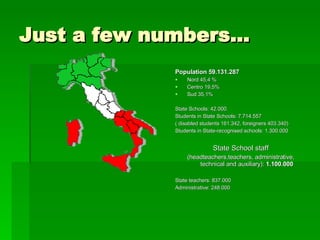
Just a few numbers… Population 59.131.287 Nord 45,4 % Centro 19,5% Sud 35,1% State Schools: 42.000. Students in State Schools: 7.714.557  ( disabled students 161.342, foreigners 403.340) Students in State-recognised schools: 1.300.000 State School  staff (headteachers,teachers, administrative, technical and auxiliary):  1.100.000 State teachers: 837.000 Administrative: 248.000
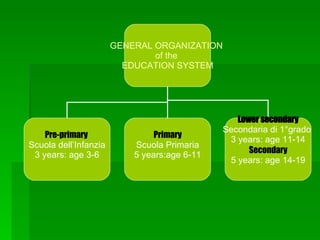
GENERAL ORGANIZATION  of the  EDUCATION SYSTEM Pre-primary  Scuola dell’Infanzia 3 years: age 3-6 Primary Scuola Primaria 5 years:age 6-11 Lower secondary Secondaria di 1°grado  3 years: age 11-14 Secondary 5 years: age 14-19
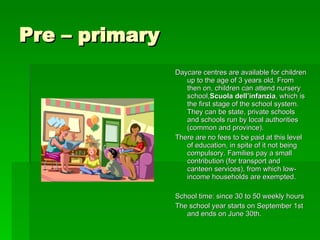
Pre – primary  Daycare centres are available for children up to the age of 3 years old. From then on, children can attend nursery school, Scuola dell’infanzia , which is the first stage of the school system. They   can be state, private schools and schools run by local authorities (common and province). There are no fees to be paid at this level of education, in spite of it not being compulsory. Families pay a small contribution (for transport and canteen services), from which low-income households are exempted. School time: since 30 to 50 weekly hours The school year starts on September 1st and ends on June 30th.
Compulsory  education In addition to compulsory schooling, the so-called diritto-dovere offer education and training to all within the education system for at least 10 years  (16 age ) or up to the attainment of a qualification within the vocational education and training system
Primary  Organization of the timetable is arranged into modules: 27 weekly teaching hours, which become 30 including the teaching of foreign language Full time (tempo pieno): 40 weekly teaching hours with two teachers per class The basis of school autonomy, schools have been able to adopt more flexible solutions according to the families requirements, their available teaching staff, their structures and functioning services.
Secondary Secondary education has been divided into two stages up to school:  1° stage, corrisponding  Scuola Secondaria di Primo grado   (lower secondary school). On completion of the compulsory first school cycle, students take a state examination to be admitted to the upper secondary education level.
Organization secondary education (lower secondary school). Weekly and daily timetable :  The lesson hours is divided into five or six days a week . It can vary according to the direction which has been chosen (27 or 33 hours by week). Subjects : italian, history, geography,mathematics, science,technical education, information and communication technology, English language, 2°Community language,  art and drawing, music,  sport and motorysciences,  catholic religion(no compulsory)
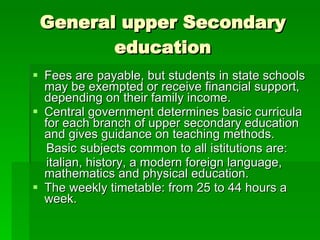
General upper Secondary education Fees are payable, but students in state schools may be exempted or receive financial support, depending on their family income. Central government determines basic curricula for each branch of upper secondary education and gives guidance on teaching methods.  Basic subjects common to all istitutions are:  italian, history, a modern foreign language, mathematics and physical education. The weekly timetable: from 25 to 44 hours a week.
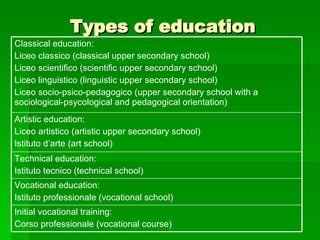
Types of education Initial vocational training: Corso professionale (vocational course) Vocational education: Istituto professionale (vocational school) Technical education: Istituto tecnico (technical school) Artistic education: Liceo artistico (artistic upper secondary school) Istituto d’arte (art school) Classical education: Liceo classico (classical upper secondary school) Liceo scientifico (scientific upper secondary school) Liceo linguistico (linguistic upper secondary school) Liceo socio-psico-pedagogico (upper secondary school with a sociological-psycological and pedagogical orientation)
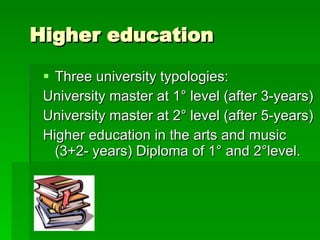
Higher education Three university typologies: University master at 1° level (after 3-years) University master at 2° level (after 5-years) Higher education in the arts and music (3+2- years) Diploma of 1° and 2°level.
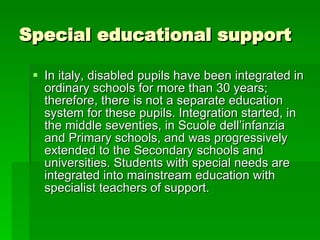
Special educational support In italy, disabled pupils have been integrated in ordinary schools for more than 30 years; therefore, there is not a separate education system for these pupils. Integration started, in the middle seventies, in Scuole dell’infanzia and Primary schools, and was progressively extended to the Secondary schools and universities. Students with special needs are integrated into mainstream education with specialist teachers of support.
About our school Scuola Secondaria di Primo grado  Della Torre/Garibaldi   di  Chiavari (provincia di Genova)
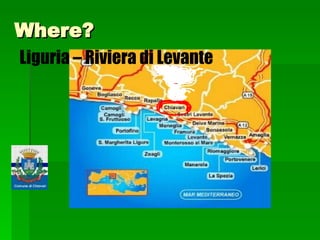
Where? Liguria – Riviera di Levante
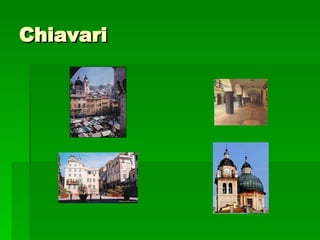
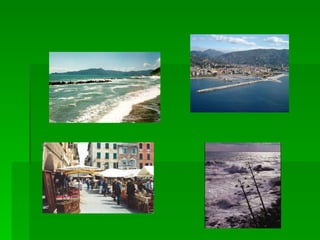
Chiavari
 
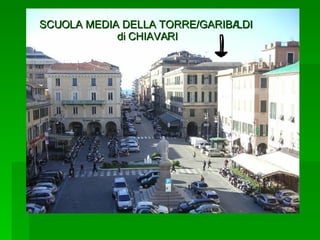
SCUOLA MEDIA  DELLA TORRE/GARIBALDI  di CHIAVARI " Scuola Media di Chiavari " is a  Scuola Secondaria di Primo grado   (lower secondary school). established on 1st September 2000 two different schools previously existing in Chiavari came together.  The school is in the heart of the town, in a convenient and easily reachable area, a few minutes from the Chiavari railway station.  The four-storey building, called  Palazzo della Torre , dates back to the 18th century and since 1750 it has been a municipal property.  The school occupies three floors: the Principal’s office, the Teachers’ Room and the Secretary’s office are on the second floor while the classrooms are on all the three floors.  The  school  is in an area living on tourism, commerce and services.  The social context, generally uniform, is of a medium-high economical level and recently there has been immigration from non-European countries, mainly from South America.
SCUOLA MEDIA DELLA TORRE/GARIBALDI  di CHIAVARI
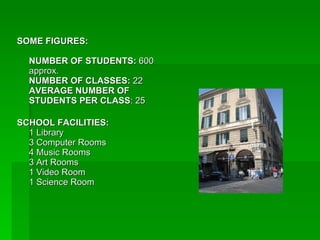
SOME FIGURES:   NUMBER OF STUDENTS:  600 approx.  NUMBER OF CLASSES:  22  AVERAGE NUMBER OF STUDENTS PER CLASS : 25  SCHOOL FACILITIES:  1 Library  3 Computer Rooms  4 Music Rooms  3 Art Rooms  1 Video Room  1 Science Room
THE SCHOOL ORGANIZATION The school has successfully kept pace with rapid changes in education and is therefore based on a new flexible teaching model.  The weekly school time is 30 units of 50 minutes each, Monday to Friday.  The daily school time is 6 units for five mornings plus one afternoon with 3 units.  29 units involve the fundamental subjects while the remaining one is a flexible unit organized in a different way and dedicated to small groups activities.
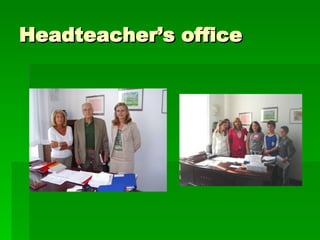
Headteacher’s office
FUNDAMENTAL SCHOOL SUBJECTS   Italian - 7 units  History - 2 units  Geography - 2 units  Mathematics - 4 units  Science - 2 units  Technical education - 2 units  Information and communication technology English language - 3 units  2nd Community Language – (French or Spanish) 2 units  Art  and drawing - 2 units  Music - 2 units  Sport and motorysciences - 2 units  Catholic religion (no compulsory)
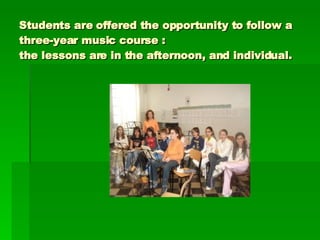
Students are offered the opportunity to follow a three-year music course :  the lessons are in the afternoon, and individual.
PROJECTS Students take part in exciting projects such as :  The school at the cinema  The school at the theatre  The school trips Making up/Development laboratories  Primary School-Secondary School continuity  Perseus  Comenius – European project  Swimming/Baseball/Tennis/Sailing
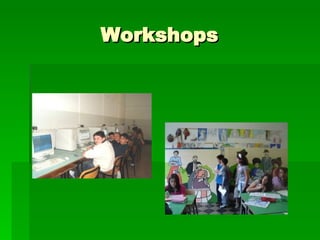
Workshops
HIGHPOINTS OF OUR SCHOOL WELCOME : our school provides a welcoming and caring environment . On the 1st School day parents will be welcomed and teachers will explain  and show both pupils and their parents the school activities.  During the first month a monitoring action will follow the pupils’  integration in the new school.  CARE : our school works hard to provide a lively and caring atmosphere.  Children are encouraged to develop socially, emotionally and  academically.  COLLABORATION : School-Family cooperation is essential to stimulate an  adequate and complete development.  DISCIPLINE : we aim to create a well disciplined environment where all pupils can realize their potential.
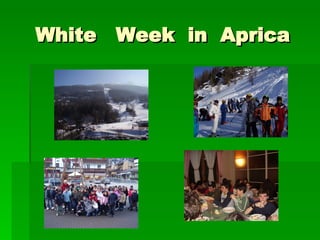
White  Week  in  Aprica
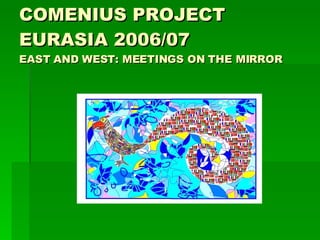
COMENIUS PROJECT EURASIA 2006/07 EAST AND WEST: MEETINGS ON THE MIRROR
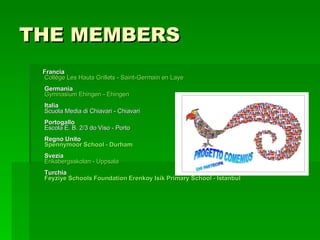
THE MEMBERS Francia   Collège  Les   Hauts   Grillets  -  Saint-Germain  en  Laye   Germania   Gymnasium   Ehingen  -  Ehingen   Italia  Scuola Media di Chiavari - Chiavari  Portogallo   Escola E. B. 2/3 do Viso - Porto  Regno Unito  Spennymoor   School  -  Durham   Svezia   Eriksbergsskolan  -  Uppsala   Turchia  Feyziye   Schools   Foundation   Erenkoy   Isik   Primary   School  - Istanbul
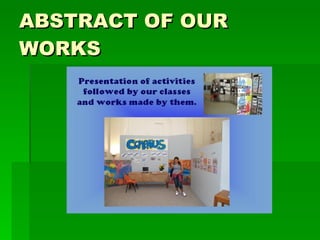
ABSTRACT OF OUR WORKS


Italian educational system I

  • 1.
    News from ItalyThe Education System Visite di studio 2008
  • 2.
    Just a fewnumbers… Population 59.131.287 Nord 45,4 % Centro 19,5% Sud 35,1% State Schools: 42.000. Students in State Schools: 7.714.557 ( disabled students 161.342, foreigners 403.340) Students in State-recognised schools: 1.300.000 State School staff (headteachers,teachers, administrative, technical and auxiliary): 1.100.000 State teachers: 837.000 Administrative: 248.000
  • 3.
    GENERAL ORGANIZATION of the EDUCATION SYSTEM Pre-primary Scuola dell’Infanzia 3 years: age 3-6 Primary Scuola Primaria 5 years:age 6-11 Lower secondary Secondaria di 1°grado 3 years: age 11-14 Secondary 5 years: age 14-19
  • 4.
    Pre – primary Daycare centres are available for children up to the age of 3 years old. From then on, children can attend nursery school, Scuola dell’infanzia , which is the first stage of the school system. They can be state, private schools and schools run by local authorities (common and province). There are no fees to be paid at this level of education, in spite of it not being compulsory. Families pay a small contribution (for transport and canteen services), from which low-income households are exempted. School time: since 30 to 50 weekly hours The school year starts on September 1st and ends on June 30th.
  • 5.
    Compulsory educationIn addition to compulsory schooling, the so-called diritto-dovere offer education and training to all within the education system for at least 10 years (16 age ) or up to the attainment of a qualification within the vocational education and training system
  • 6.
    Primary Organizationof the timetable is arranged into modules: 27 weekly teaching hours, which become 30 including the teaching of foreign language Full time (tempo pieno): 40 weekly teaching hours with two teachers per class The basis of school autonomy, schools have been able to adopt more flexible solutions according to the families requirements, their available teaching staff, their structures and functioning services.
  • 7.
    Secondary Secondary educationhas been divided into two stages up to school: 1° stage, corrisponding Scuola Secondaria di Primo grado (lower secondary school). On completion of the compulsory first school cycle, students take a state examination to be admitted to the upper secondary education level.
  • 8.
    Organization secondary education(lower secondary school). Weekly and daily timetable : The lesson hours is divided into five or six days a week . It can vary according to the direction which has been chosen (27 or 33 hours by week). Subjects : italian, history, geography,mathematics, science,technical education, information and communication technology, English language, 2°Community language, art and drawing, music, sport and motorysciences, catholic religion(no compulsory)
  • 9.
    General upper Secondaryeducation Fees are payable, but students in state schools may be exempted or receive financial support, depending on their family income. Central government determines basic curricula for each branch of upper secondary education and gives guidance on teaching methods. Basic subjects common to all istitutions are: italian, history, a modern foreign language, mathematics and physical education. The weekly timetable: from 25 to 44 hours a week.
  • 10.
    Types of educationInitial vocational training: Corso professionale (vocational course) Vocational education: Istituto professionale (vocational school) Technical education: Istituto tecnico (technical school) Artistic education: Liceo artistico (artistic upper secondary school) Istituto d’arte (art school) Classical education: Liceo classico (classical upper secondary school) Liceo scientifico (scientific upper secondary school) Liceo linguistico (linguistic upper secondary school) Liceo socio-psico-pedagogico (upper secondary school with a sociological-psycological and pedagogical orientation)
  • 11.
    Higher education Threeuniversity typologies: University master at 1° level (after 3-years) University master at 2° level (after 5-years) Higher education in the arts and music (3+2- years) Diploma of 1° and 2°level.
  • 12.
    Special educational supportIn italy, disabled pupils have been integrated in ordinary schools for more than 30 years; therefore, there is not a separate education system for these pupils. Integration started, in the middle seventies, in Scuole dell’infanzia and Primary schools, and was progressively extended to the Secondary schools and universities. Students with special needs are integrated into mainstream education with specialist teachers of support.
  • 13.
    About our schoolScuola Secondaria di Primo grado Della Torre/Garibaldi di Chiavari (provincia di Genova)
  • 14.
    Where? Liguria –Riviera di Levante
  • 15.
  • 16.
  • 17.
    SCUOLA MEDIA DELLA TORRE/GARIBALDI di CHIAVARI " Scuola Media di Chiavari " is a Scuola Secondaria di Primo grado (lower secondary school). established on 1st September 2000 two different schools previously existing in Chiavari came together. The school is in the heart of the town, in a convenient and easily reachable area, a few minutes from the Chiavari railway station. The four-storey building, called Palazzo della Torre , dates back to the 18th century and since 1750 it has been a municipal property. The school occupies three floors: the Principal’s office, the Teachers’ Room and the Secretary’s office are on the second floor while the classrooms are on all the three floors. The school is in an area living on tourism, commerce and services. The social context, generally uniform, is of a medium-high economical level and recently there has been immigration from non-European countries, mainly from South America.
  • 18.
    SCUOLA MEDIA DELLATORRE/GARIBALDI di CHIAVARI
  • 19.
    SOME FIGURES: NUMBER OF STUDENTS: 600 approx. NUMBER OF CLASSES: 22 AVERAGE NUMBER OF STUDENTS PER CLASS : 25 SCHOOL FACILITIES: 1 Library 3 Computer Rooms 4 Music Rooms 3 Art Rooms 1 Video Room 1 Science Room
  • 20.
    THE SCHOOL ORGANIZATIONThe school has successfully kept pace with rapid changes in education and is therefore based on a new flexible teaching model. The weekly school time is 30 units of 50 minutes each, Monday to Friday. The daily school time is 6 units for five mornings plus one afternoon with 3 units. 29 units involve the fundamental subjects while the remaining one is a flexible unit organized in a different way and dedicated to small groups activities.
  • 21.
  • 22.
    FUNDAMENTAL SCHOOL SUBJECTS Italian - 7 units History - 2 units Geography - 2 units Mathematics - 4 units Science - 2 units Technical education - 2 units Information and communication technology English language - 3 units 2nd Community Language – (French or Spanish) 2 units Art and drawing - 2 units Music - 2 units Sport and motorysciences - 2 units Catholic religion (no compulsory)
  • 23.
    Students are offeredthe opportunity to follow a three-year music course : the lessons are in the afternoon, and individual.
  • 24.
    PROJECTS Students takepart in exciting projects such as : The school at the cinema The school at the theatre The school trips Making up/Development laboratories Primary School-Secondary School continuity Perseus Comenius – European project Swimming/Baseball/Tennis/Sailing
  • 25.
  • 26.
    HIGHPOINTS OF OURSCHOOL WELCOME : our school provides a welcoming and caring environment . On the 1st School day parents will be welcomed and teachers will explain and show both pupils and their parents the school activities. During the first month a monitoring action will follow the pupils’ integration in the new school. CARE : our school works hard to provide a lively and caring atmosphere. Children are encouraged to develop socially, emotionally and academically. COLLABORATION : School-Family cooperation is essential to stimulate an adequate and complete development. DISCIPLINE : we aim to create a well disciplined environment where all pupils can realize their potential.
  • 27.
    White Week in Aprica
  • 28.
    COMENIUS PROJECT EURASIA2006/07 EAST AND WEST: MEETINGS ON THE MIRROR
  • 29.
    THE MEMBERS Francia Collège Les Hauts Grillets - Saint-Germain en Laye Germania Gymnasium Ehingen - Ehingen Italia Scuola Media di Chiavari - Chiavari Portogallo Escola E. B. 2/3 do Viso - Porto Regno Unito Spennymoor School - Durham Svezia Eriksbergsskolan - Uppsala Turchia Feyziye Schools Foundation Erenkoy Isik Primary School - Istanbul
  • 30.
  • 31.
  • 32.
  • 33.
  • 34.
  • 35.
  • 36.
  • 37.