GOOD, FAST, or CHEAP?
Or,
How to Use the Triple Constraints
to Define and Manage Project
Parameters
Michael Dobson, PMP
Principal
Dobson Solutions
michael@dobsonsolutions.com
Overview
• What are project constraints and why do they
matter?
• What is the Hierarchy of Constraints and how
does that help you make project decisions?
• How do you make the right tradeoffs among
project constraints?
Constraints Limit Your Project Choices
• My project has a deadline
• My project has a budget.
• My project has requirements.
• My team members have certain skills.
• I must follow policies, regulations, and laws.
• I must make my customer happy.
Some Constraints Only Apply to
Certain Projects
• My project must meet building codes.
• My project has to beat the competition to
market.
• My project must work across international
borders.
• My project must not generate publicity.
Some Constraints are Hidden,
Unknown, or Assumed
• The deadline depends on outside events we
can’t predict or control
• One of the key stakeholders refuses to say
exactly what he or she wants
• We’re assuming that everybody’s on board
with this project
Some Constraints Aren’t Even Real!
• We can’t try a particular technique; we tried
once before and it didn’t work
• Everybody likes blue. It has to be blue.
• If we don’t submit the weekly reports on time,
the project will be judged a failure.
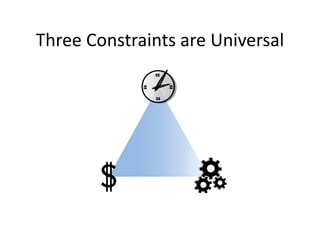
Three Constraints are Universal
The TIME Constraint
“How long have I got?”
• Specific Deadline
• Triggered by an
Event
• Degree of Urgency
The COST Constraint
“How much (of what) can I spend?”
• Cash
• Person-Hours
• Equipment
• Supplies
• Overhead
• Intangibles
The SCOPE Constraint
“What Do I Have to Produce?”
• Functional/Technical
Requirements
• Purpose/Desired End
State
• Evaluation Criteria
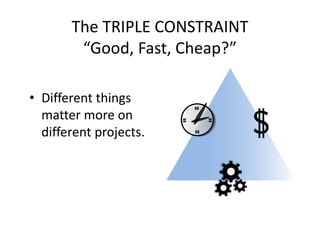
The TRIPLE CONSTRAINT
“Good, Fast, Cheap?”
• Different things
matter more on
different projects.
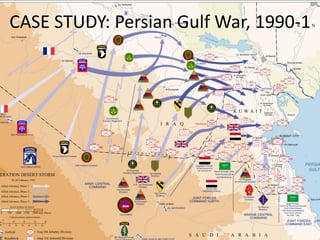
CASE STUDY: Persian Gulf War, 1990-1
Types of Failure
• “What if it takes longer than we would
like?”
• “What if it costs more than we want to
pay?”
• “What if we lose?”
Hierarchy of Failure
• If we lose, nobody will care how
quickly or cheaply.
• If we take too long, our allies and
homefront support may weaken.
• If we spend too much, some people
may complain.
The DRIVER
• The DRIVER usually has the least
flexibility of the constraints.
• If you fail to achieve the DRIVER, you
have failed.
The WEAK Constraint
• The WEAK Constraint has the most
flexibility of the constraints (but
not unlimited).
• Exploit the WEAK Constraint’s
flexibility to achieve your goals!
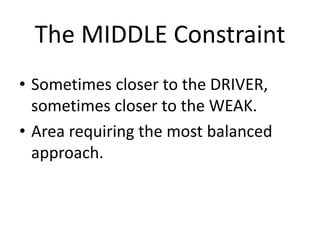
The MIDDLE Constraint
• Sometimes closer to the DRIVER,
sometimes closer to the WEAK.
• Area requiring the most balanced
approach.
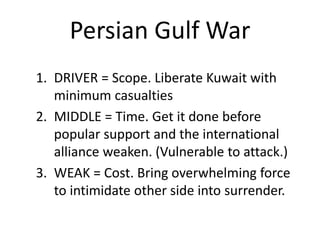
Persian Gulf War
1. DRIVER = Scope. Liberate Kuwait with
minimum casualties
2. MIDDLE = Time. Get it done before
popular support and the international
alliance weaken. (Vulnerable to attack.)
3. WEAK = Cost. Bring overwhelming force
to intimidate other side into surrender.
Case Study:
Apollo 13
1970
Unfortunately, Failure
Is An Option
• Develop a power-up sequence that uses
fewer than 20 amps
• Calculate a burn rate to get the reentry
angle within tolerance
• Fit the square command module CO2
scrubber filter into the round LEM filter
socket
Apollo 13
1. DRIVER = Time. Before the CO2 level
impairs the astronauts too much.
2. MIDDLE = Cost. Use only the
resources available on the spacecraft.
3. WEAK = Scope. Even an inadequate
result may give us extra time.
Case Study: NASA to the Moon
“We commit this nation…”
1. …to put an man on the Moon and
bring him safely back to earth
2. …before this decade is out!”
3. Budget? What budget?
Define the Constraints
Before Ranking Them!
• “End of the Decade” — 1969 or 1970?
• What’s the financing source and how
flexible is it?
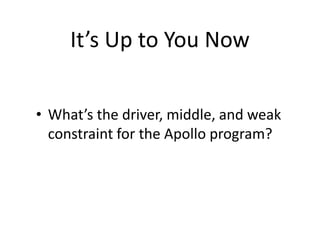
It’s Up to You Now
• What’s the driver, middle, and weak
constraint for the Apollo program?
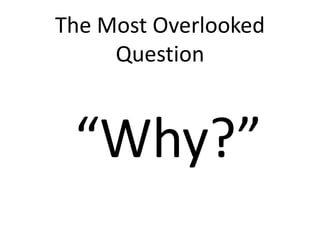
The Most Overlooked
Question
“Why?”
The SPACE RACE
1. DRIVER = Time. Before the Soviets, or
the end of the decade, whichever
comes first!
2. MIDDLE = Scope. Do your best to
keep the astronauts safe.
3. WEAK = Cost. Don’t waste money, but
spend what you need to win.
What about QUALITY and RISK?
QUALITY is not just SCOPE
“How good is ‘Good Enough’?”
• The Triple
Constraints are
minimum standards
• Quality is the
pressure to go
beyond the
minimums
How Good is “Good Enough”?
• Fitness for use
• Benchmarking
• Meaningful
improvement
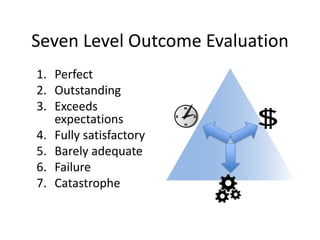
Seven Level Outcome Evaluation
1. Perfect
2. Outstanding
3. Exceeds
expectations
4. Fully satisfactory
5. Barely adequate
6. Failure
7. Catastrophe
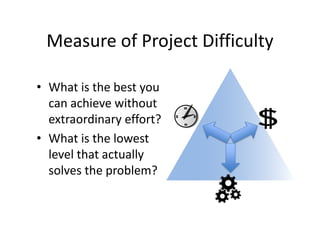
Measure of Project Difficulty
• What is the best you
can achieve without
extraordinary effort?
• What is the lowest
level that actually
solves the problem?
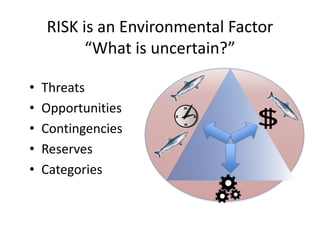
RISK is an Environmental Factor
“What is uncertain?”
• Threats
• Opportunities
• Contingencies
• Reserves
• Categories
Types of RISKS
“How much (and what kind) of risk can
I accept?”
• Financial
• Legal
• Safety
• Reputational
• Competitive
Key Advice
1. Defining the constraints is essential to
defining the project.
2. There are many constraints, but the
Triple Constraint of Time, Cost, and
Scope is universal.
3. Constraints can be hidden, assumed,
or unknown
Key Advice
4. You must achieve the Driver.
5. The Weak and Middle Constraints
have exploitable flexibility. Exploit it
creatively.
6. Watch out for assumed constraints.
7. The most overlooked question in
project management is “Why?”
Key Advice
8. There are seven possible project
outcomes.
9. Defining exceeds expectations,
outstanding, and perfect helps set
quality goals.
10. Defining failure and catastrophe
identifies risks.
11. Quality and risk affect all three legs of
the Triple Constraint
Thank you very much.
Questions?
Good, Fast, or Cheap.

Good, Fast, or Cheap.

  • 1.
  • 2.
    Or, How to Usethe Triple Constraints to Define and Manage Project Parameters Michael Dobson, PMP Principal Dobson Solutions michael@dobsonsolutions.com
  • 3.
    Overview • What areproject constraints and why do they matter? • What is the Hierarchy of Constraints and how does that help you make project decisions? • How do you make the right tradeoffs among project constraints?
  • 4.
    Constraints Limit YourProject Choices • My project has a deadline • My project has a budget. • My project has requirements. • My team members have certain skills. • I must follow policies, regulations, and laws. • I must make my customer happy.
  • 5.
    Some Constraints OnlyApply to Certain Projects • My project must meet building codes. • My project has to beat the competition to market. • My project must work across international borders. • My project must not generate publicity.
  • 6.
    Some Constraints areHidden, Unknown, or Assumed • The deadline depends on outside events we can’t predict or control • One of the key stakeholders refuses to say exactly what he or she wants • We’re assuming that everybody’s on board with this project
  • 7.
    Some Constraints Aren’tEven Real! • We can’t try a particular technique; we tried once before and it didn’t work • Everybody likes blue. It has to be blue. • If we don’t submit the weekly reports on time, the project will be judged a failure.
  • 8.
  • 9.
    The TIME Constraint “Howlong have I got?” • Specific Deadline • Triggered by an Event • Degree of Urgency
  • 10.
    The COST Constraint “Howmuch (of what) can I spend?” • Cash • Person-Hours • Equipment • Supplies • Overhead • Intangibles
  • 11.
    The SCOPE Constraint “WhatDo I Have to Produce?” • Functional/Technical Requirements • Purpose/Desired End State • Evaluation Criteria
  • 12.
    The TRIPLE CONSTRAINT “Good,Fast, Cheap?” • Different things matter more on different projects.
  • 13.
    CASE STUDY: PersianGulf War, 1990-1
  • 14.
    Types of Failure •“What if it takes longer than we would like?” • “What if it costs more than we want to pay?” • “What if we lose?”
  • 15.
    Hierarchy of Failure •If we lose, nobody will care how quickly or cheaply. • If we take too long, our allies and homefront support may weaken. • If we spend too much, some people may complain.
  • 16.
    The DRIVER • TheDRIVER usually has the least flexibility of the constraints. • If you fail to achieve the DRIVER, you have failed.
  • 17.
    The WEAK Constraint •The WEAK Constraint has the most flexibility of the constraints (but not unlimited). • Exploit the WEAK Constraint’s flexibility to achieve your goals!
  • 18.
    The MIDDLE Constraint •Sometimes closer to the DRIVER, sometimes closer to the WEAK. • Area requiring the most balanced approach.
  • 19.
    Persian Gulf War 1.DRIVER = Scope. Liberate Kuwait with minimum casualties 2. MIDDLE = Time. Get it done before popular support and the international alliance weaken. (Vulnerable to attack.) 3. WEAK = Cost. Bring overwhelming force to intimidate other side into surrender.
  • 20.
  • 21.
    Unfortunately, Failure Is AnOption • Develop a power-up sequence that uses fewer than 20 amps • Calculate a burn rate to get the reentry angle within tolerance • Fit the square command module CO2 scrubber filter into the round LEM filter socket
  • 22.
    Apollo 13 1. DRIVER= Time. Before the CO2 level impairs the astronauts too much. 2. MIDDLE = Cost. Use only the resources available on the spacecraft. 3. WEAK = Scope. Even an inadequate result may give us extra time.
  • 23.
    Case Study: NASAto the Moon
  • 24.
    “We commit thisnation…” 1. …to put an man on the Moon and bring him safely back to earth 2. …before this decade is out!” 3. Budget? What budget?
  • 25.
    Define the Constraints BeforeRanking Them! • “End of the Decade” — 1969 or 1970? • What’s the financing source and how flexible is it?
  • 26.
    It’s Up toYou Now • What’s the driver, middle, and weak constraint for the Apollo program?
  • 27.
  • 28.
    The SPACE RACE 1.DRIVER = Time. Before the Soviets, or the end of the decade, whichever comes first! 2. MIDDLE = Scope. Do your best to keep the astronauts safe. 3. WEAK = Cost. Don’t waste money, but spend what you need to win.
  • 29.
  • 30.
    QUALITY is notjust SCOPE “How good is ‘Good Enough’?” • The Triple Constraints are minimum standards • Quality is the pressure to go beyond the minimums
  • 31.
    How Good is“Good Enough”? • Fitness for use • Benchmarking • Meaningful improvement
  • 32.
    Seven Level OutcomeEvaluation 1. Perfect 2. Outstanding 3. Exceeds expectations 4. Fully satisfactory 5. Barely adequate 6. Failure 7. Catastrophe
  • 33.
    Measure of ProjectDifficulty • What is the best you can achieve without extraordinary effort? • What is the lowest level that actually solves the problem?
  • 34.
    RISK is anEnvironmental Factor “What is uncertain?” • Threats • Opportunities • Contingencies • Reserves • Categories
  • 35.
    Types of RISKS “Howmuch (and what kind) of risk can I accept?” • Financial • Legal • Safety • Reputational • Competitive
  • 36.
    Key Advice 1. Definingthe constraints is essential to defining the project. 2. There are many constraints, but the Triple Constraint of Time, Cost, and Scope is universal. 3. Constraints can be hidden, assumed, or unknown
  • 37.
    Key Advice 4. Youmust achieve the Driver. 5. The Weak and Middle Constraints have exploitable flexibility. Exploit it creatively. 6. Watch out for assumed constraints. 7. The most overlooked question in project management is “Why?”
  • 38.
    Key Advice 8. Thereare seven possible project outcomes. 9. Defining exceeds expectations, outstanding, and perfect helps set quality goals. 10. Defining failure and catastrophe identifies risks. 11. Quality and risk affect all three legs of the Triple Constraint
  • 39.
    Thank you verymuch. Questions?