

1.7 Growth and
                        Evolution

By Alex Arancibia, for Nuevo Mundo High School
Sources:
Business and Management for IB, Paul Hoang, 2007
Business and Management for IB, Peter Stimpson, 2011
Business and Management for IB, Paul Clark, 2009
Business and Management for the IB Diploma, Lloyd Gutteridge, 2009
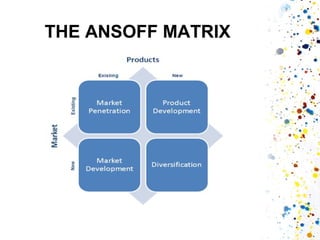
THE ANSOFF MATRIX
Market Penetration
The business focuses on selling existing products into existing
markets.

Market penetration seeks to achieve four main objectives:

• Maintain or increase the market share of current products – this
can be achieved by a combination of competitive pricing strategies,
advertising, sales promotion and perhaps more resources dedicated
to personal selling

• Secure dominance of growth markets

• Restructure a mature market by driving out competitors; this
would require a much more aggressive promotional campaign,
supported by a pricing strategy designed to make the market
unattractive for competitors

• Increase usage by existing customers – for example by
introducing loyalty schemes
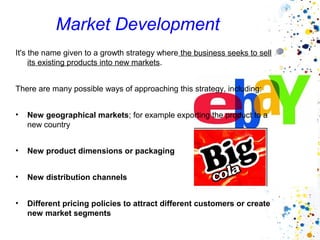
Market Development
It's the name given to a growth strategy where the business seeks to sell
     its existing products into new markets.


There are many possible ways of approaching this strategy, including:


•   New geographical markets; for example exporting the product to a
    new country


•   New product dimensions or packaging


•   New distribution channels


•   Different pricing policies to attract different customers or create
    new market segments
Product development

It's the name given to a growth
   strategy where a business aims to
   introduce new products into
   existing markets.
• This strategy may require the
   development of new competencies
   and requires the business to
   develop modified products which
   can appeal to existing markets.
Diversification
•   It's the name given to the growth strategy
    where a business markets new products in new
    markets.


• This is an inherently more risk strategy
  because the business is moving into markets in
  which it has little or no experience.


• For a business to adopt a diversification
  strategy, therefore, it must have a clear idea
  about what it expects to gain from the strategy
  and an honest assessment of the risks.
Strategic Alliance
Starbucks
According to Rebecca Larson, assistant Professor of Business
  at Liberty University, Starbucks partnered with Barnes and
  Nobles bookstores in 1993 to provide in-house coffee shops,
  benefiting both retailers. In 1996, Starbucks partnered with
  Pepsico to bottle, distribute and sell the popular coffee-
  based drink, Frappacino. A Starbucks-United Airlines
  alliance has resulted in their coffee being offered on flights
  with the Starbucks logo on the cups and a partnership with
  Kraft foods has resulted in Starbucks coffee being marketed
  in grocery stores. In 2006, Starbucks formed an alliance with
  the NAACP, the sole purpose of which was to advance the
  company's and the NAACP's goals of social and economic
  justice.
Strategic Alliance
In R&D: Microsoft and Nokia- a
  software partnership forNokia’s
  Windows Phones.

WATCH VIDEO
Porter's Generic Strategies

     1. Cost Leadership

      2. Differentiation

          3. Focus
Cost Leadership
Being the lowest-cost producer in the
 industry for a certain level of product
 quality will allow the firm to make higher
 profits than rivals or, if it lowers its prices
 below the average of competitors, to
 increase market share.
Cost Leadership
Cost leadership often stems from the following
  internal strengths:
● high levels of investment in advanced
  production methods, requiring access to much
  capital
● efficient production methods, e.g. low stock
  levels and low numbers of components used to
  shorten the production process
● efficient distribution channels, e.g. Ryanair only
  uses the internet for selling tickets and
  communicating with customers.
Differentiation
This strategy involves developing a product
 or service that offers unique features
 valued by customers. The value added to
 the product or service by these features
 may allow the firm to charge a premium
 price for it.
Differentiation
Apple’s constant research into innovative products
  allows it to charge high prices for its
  differentiated products. A differentiation strategy
  often results from the following internal
  strengths:
● excellent research and development facilities
  and a track record in developing unique
  products
● corporate reputation for innovation and quality
● strong sales team able to promote the perceived
  strengths of the brand and the products.
Focus (a.k.a Niche)
This concentrates on a narrow market
 segment, aiming to achieve either a cost
 advantage or differentiation. This can lead
 to a high degree of customer loyalty within
 the market segment.
Focus (a.k.a Niche)
This concentrates on a narrow market
 segment, aiming to achieve either a cost
 advantage or differentiation. This can lead
 to a high degree of customer loyalty within
 the market segment.
Economies of Scale
Economies of Scale
Operating at full capacity Ben Rishi is operations manager for a factory
  making saucepans. The weekly maximum capacity of the factory is
  3000 units. The main limit on capacity is the old-fashioned machine
  for stamping out the metal pans from sheet metal. Purchasing
  another machine would be expensive – and would require an
  extension to the building. Workers are working very long shifts. Ben
  has also been working long days to ensure that all the factory works
  at full capacity. For the last three months, demand has been high and
  last week there were orders for 3100 pots. Ben is under pressure
  from his managing director to see that this number is produced. Ben
  is unsure whether to recommend purchasing the new machine or to
  buy in components from another fi rm in the city that has spare
  capacity.

Growth and Evolution

  • 1.
    1.7 Growth and Evolution By Alex Arancibia, for Nuevo Mundo High School Sources: Business and Management for IB, Paul Hoang, 2007 Business and Management for IB, Peter Stimpson, 2011 Business and Management for IB, Paul Clark, 2009 Business and Management for the IB Diploma, Lloyd Gutteridge, 2009
  • 2.
  • 3.
    Market Penetration The businessfocuses on selling existing products into existing markets. Market penetration seeks to achieve four main objectives: • Maintain or increase the market share of current products – this can be achieved by a combination of competitive pricing strategies, advertising, sales promotion and perhaps more resources dedicated to personal selling • Secure dominance of growth markets • Restructure a mature market by driving out competitors; this would require a much more aggressive promotional campaign, supported by a pricing strategy designed to make the market unattractive for competitors • Increase usage by existing customers – for example by introducing loyalty schemes
  • 4.
    Market Development It's thename given to a growth strategy where the business seeks to sell its existing products into new markets. There are many possible ways of approaching this strategy, including: • New geographical markets; for example exporting the product to a new country • New product dimensions or packaging • New distribution channels • Different pricing policies to attract different customers or create new market segments
  • 5.
    Product development It's thename given to a growth strategy where a business aims to introduce new products into existing markets. • This strategy may require the development of new competencies and requires the business to develop modified products which can appeal to existing markets.
  • 6.
    Diversification • It's the name given to the growth strategy where a business markets new products in new markets. • This is an inherently more risk strategy because the business is moving into markets in which it has little or no experience. • For a business to adopt a diversification strategy, therefore, it must have a clear idea about what it expects to gain from the strategy and an honest assessment of the risks.
  • 7.
    Strategic Alliance Starbucks According toRebecca Larson, assistant Professor of Business at Liberty University, Starbucks partnered with Barnes and Nobles bookstores in 1993 to provide in-house coffee shops, benefiting both retailers. In 1996, Starbucks partnered with Pepsico to bottle, distribute and sell the popular coffee- based drink, Frappacino. A Starbucks-United Airlines alliance has resulted in their coffee being offered on flights with the Starbucks logo on the cups and a partnership with Kraft foods has resulted in Starbucks coffee being marketed in grocery stores. In 2006, Starbucks formed an alliance with the NAACP, the sole purpose of which was to advance the company's and the NAACP's goals of social and economic justice.
  • 8.
    Strategic Alliance In R&D:Microsoft and Nokia- a software partnership forNokia’s Windows Phones. WATCH VIDEO
  • 9.
    Porter's Generic Strategies 1. Cost Leadership 2. Differentiation 3. Focus
  • 10.
    Cost Leadership Being thelowest-cost producer in the industry for a certain level of product quality will allow the firm to make higher profits than rivals or, if it lowers its prices below the average of competitors, to increase market share.
  • 11.
    Cost Leadership Cost leadershipoften stems from the following internal strengths: ● high levels of investment in advanced production methods, requiring access to much capital ● efficient production methods, e.g. low stock levels and low numbers of components used to shorten the production process ● efficient distribution channels, e.g. Ryanair only uses the internet for selling tickets and communicating with customers.
  • 12.
    Differentiation This strategy involvesdeveloping a product or service that offers unique features valued by customers. The value added to the product or service by these features may allow the firm to charge a premium price for it.
  • 13.
    Differentiation Apple’s constant researchinto innovative products allows it to charge high prices for its differentiated products. A differentiation strategy often results from the following internal strengths: ● excellent research and development facilities and a track record in developing unique products ● corporate reputation for innovation and quality ● strong sales team able to promote the perceived strengths of the brand and the products.
  • 14.
    Focus (a.k.a Niche) Thisconcentrates on a narrow market segment, aiming to achieve either a cost advantage or differentiation. This can lead to a high degree of customer loyalty within the market segment.
  • 15.
    Focus (a.k.a Niche) Thisconcentrates on a narrow market segment, aiming to achieve either a cost advantage or differentiation. This can lead to a high degree of customer loyalty within the market segment.
  • 16.
  • 17.
    Economies of Scale Operatingat full capacity Ben Rishi is operations manager for a factory making saucepans. The weekly maximum capacity of the factory is 3000 units. The main limit on capacity is the old-fashioned machine for stamping out the metal pans from sheet metal. Purchasing another machine would be expensive – and would require an extension to the building. Workers are working very long shifts. Ben has also been working long days to ensure that all the factory works at full capacity. For the last three months, demand has been high and last week there were orders for 3100 pots. Ben is under pressure from his managing director to see that this number is produced. Ben is unsure whether to recommend purchasing the new machine or to buy in components from another fi rm in the city that has spare capacity.