Porphyry Deposits
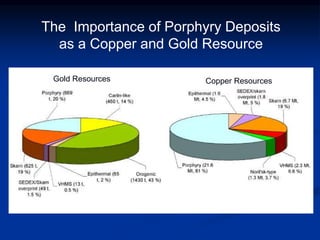
The Importance of Porphyry Deposits
as a Copper and Gold Resource
Gold Resources Copper Resources
A Geological Cross Section through the Batu
Hijau Porphyry Deposit, Indonesia
(920 million tons of ore grading 0.55 wt.% Cu, 0.42 g/t Au)
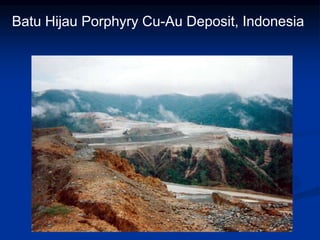
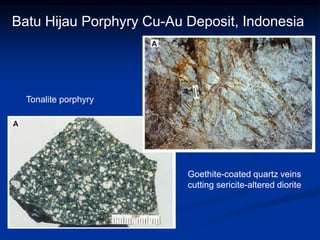
Batu Hijau Porphyry Cu-Au Deposit, Indonesia
Goethite-coated quartz veins
cutting sericite-altered diorite
Tonalite porphyry
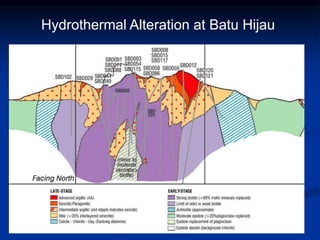
Hydrothermal Alteration at Batu Hijau
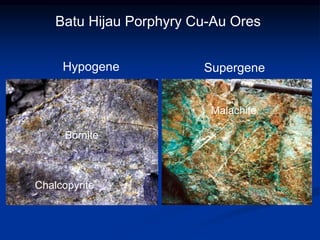
Batu Hijau Porphyry Cu-Au Ores
Supergene
Hypogene
Chalcopyrite
Bornite
Malachite
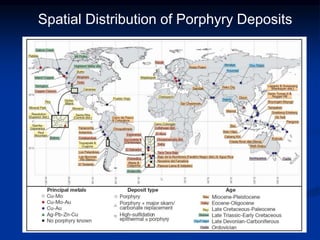
Spatial Distribution of Porphyry Deposits
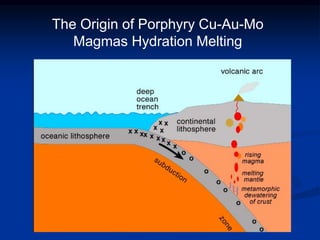
The Origin of Porphyry Cu-Au-Mo
Magmas Hydration Melting
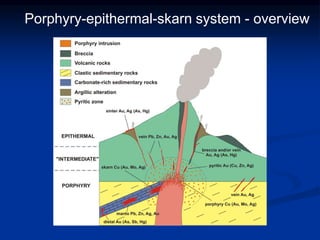
Porphyry-epithermal-skarn system - overview
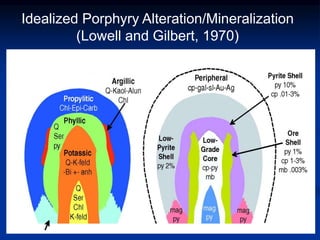
Idealized Porphyry Alteration/Mineralization
(Lowell and Gilbert, 1970)
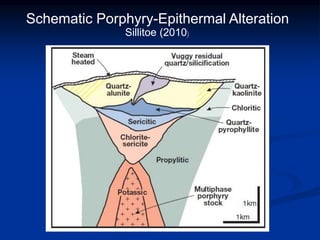
Schematic Porphyry-Epithermal Alteration
Sillitoe (2010)
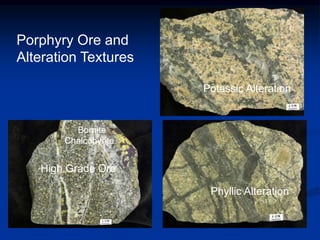
Potassic Alteration
High Grade Ore
Bornite
Chalcopyrite
Porphyry Ore and
Alteration Textures
Phyllic Alteration
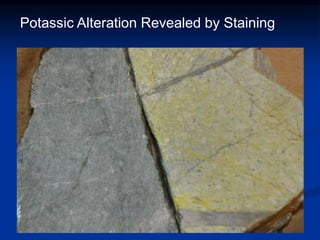
Potassic Alteration Revealed by Staining
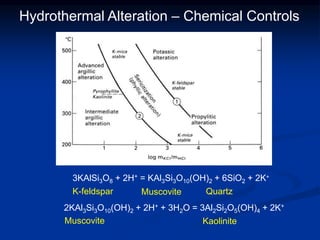
3KAlSi3O8 + 2H+ = KAl3Si3O10(OH)2 + 6SiO2 + 2K+
K-feldspar Muscovite Quartz
Hydrothermal Alteration – Chemical Controls
2KAl3Si3O10(OH)2 + 2H+ + 3H2O = 3Al2Si2O5(OH)4 + 2K+
Muscovite Kaolinite
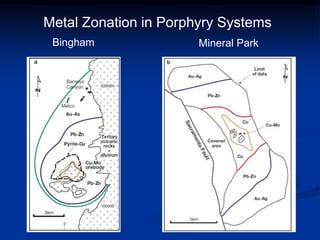
Metal Zonation in Porphyry Systems
Bingham Mineral Park
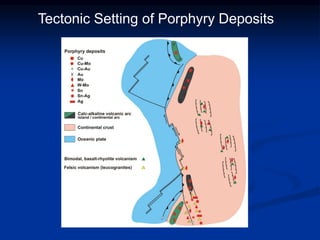
Tectonic Setting of Porphyry Deposits
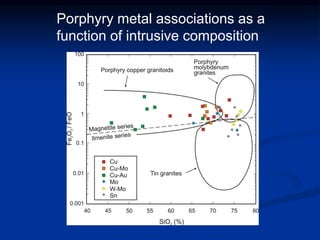
Porphyry metal associations as a
function of intrusive composition
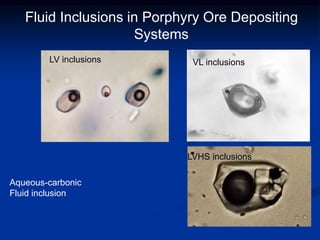
LV inclusions VL inclusions
LVHS inclusions
Fluid Inclusions in Porphyry Ore Depositing
Systems
Aqueous-carbonic
Fluid inclusion
100 mm
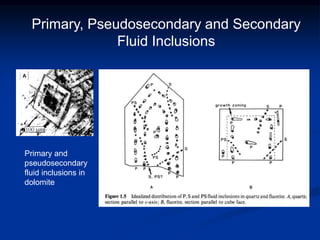
Primary, Pseudosecondary and Secondary
Fluid Inclusions
Primary and
pseudosecondary
fluid inclusions in
dolomite
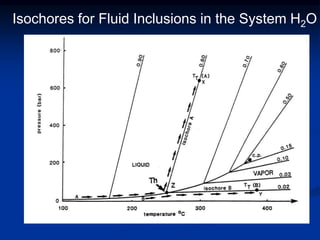
Isochores for Fluid Inclusions in the System H2O
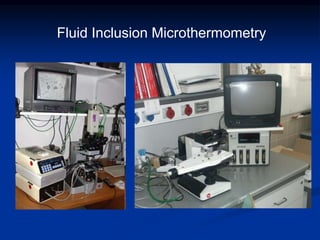
Fluid Inclusion Microthermometry
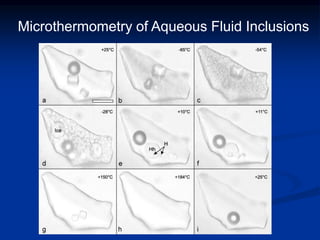
Microthermometry of Aqueous Fluid Inclusions
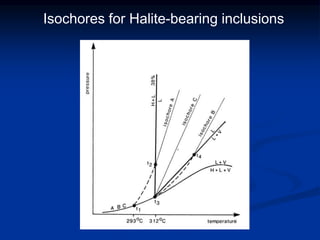
Isochores for Halite-bearing inclusions
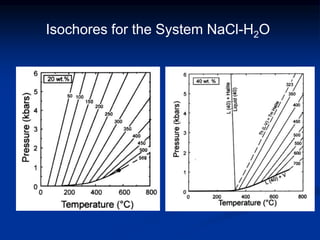
Isochores for the System NaCl-H2O
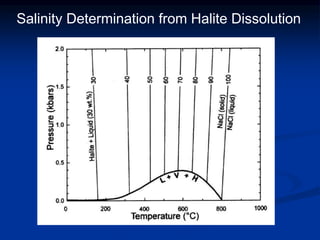
Salinity Determination from Halite Dissolution
Salinity Determination from Ice Melting
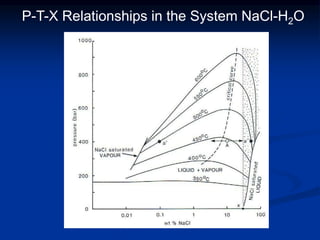
P-T-X Relationships in the System NaCl-H2O
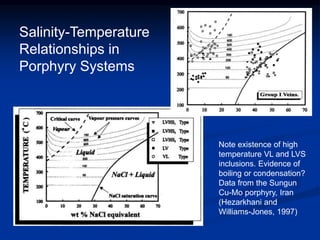
Salinity-Temperature
Relationships in
Porphyry Systems
Note existence of high
temperature VL and LVS
inclusions. Evidence of
boiling or condensation?
Data from the Sungun
Cu-Mo porphyry, Iran
(Hezarkhani and
Williams-Jones, 1997)
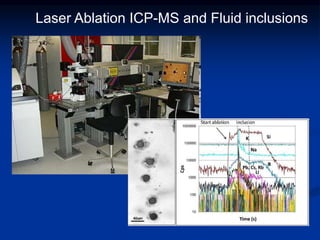
Laser Ablation ICP-MS and Fluid inclusions
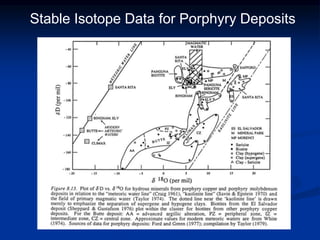
Stable Isotope Data for Porphyry Deposits
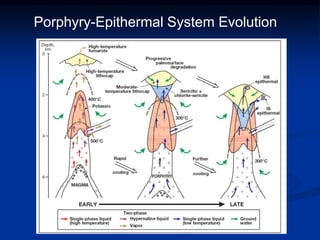
Porphyry-Epithermal System Evolution
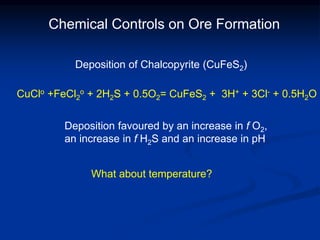
Chemical Controls on Ore Formation
CuClo +FeCl2
o + 2H2S + 0.5O2= CuFeS2 + 3H+ + 3Cl- + 0.5H2O
Deposition of Chalcopyrite (CuFeS2)
Deposition favoured by an increase in f O2,
an increase in f H2S and an increase in pH
What about temperature?
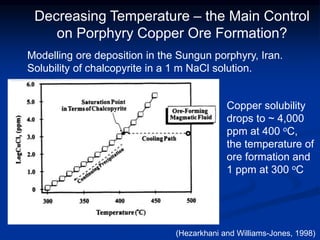
Decreasing Temperature – the Main Control
on Porphyry Copper Ore Formation?
(Hezarkhani and Williams-Jones, 1998)
Modelling ore deposition in the Sungun porphyry, Iran.
Solubility of chalcopyrite in a 1 m NaCl solution.
Copper solubility
drops to ~ 4,000
ppm at 400 oC,
the temperature of
ore formation and
1 ppm at 300 oC
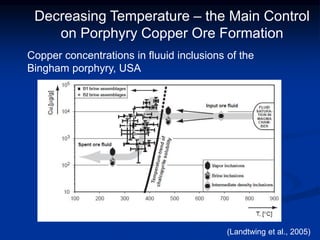
Decreasing Temperature – the Main Control
on Porphyry Copper Ore Formation
(Landtwing et al., 2005)
Copper concentrations in fluuid inclusions of the
Bingham porphyry, USA
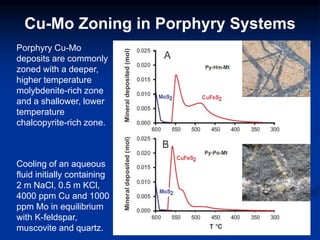
Cu-Mo Zoning in Porphyry Systems
Porphyry Cu-Mo
deposits are commonly
zoned with a deeper,
higher temperature
molybdenite-rich zone
and a shallower, lower
temperature
chalcopyrite-rich zone.
Cooling of an aqueous
fluid initially containing
2 m NaCl, 0.5 m KCl,
4000 ppm Cu and 1000
ppm Mo in equilibrium
with K-feldspar,
muscovite and quartz.
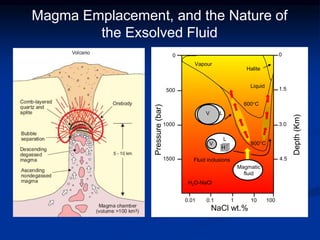
Magma Emplacement, and the Nature of
the Exsolved Fluid
0.01 0.1 1 10 100
0
500
1000
1500
0
1.5
3.0
4.5
Vapour
Liquid
600C
800C
Halite
H2O-NaCl
V
V L
L
H
Magmatic
fluid
Pressure
(bar)
Depth
(Km)
Fluid inclusions
NaCl wt.%
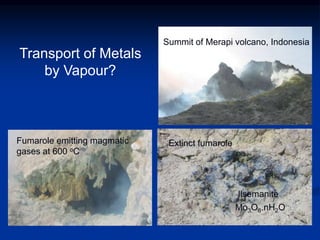
Transport of Metals
by Vapour?
Extinct fumarole
Summit of Merapi volcano, Indonesia
Fumarole emitting magmatic
gases at 600 oC
Mo3O8.nH2O
Ilsemanite
Quartz
monz
onite
porphyry
E
quigranular
monz
onite
>
0
.
7
%
C
u
>
0
.
7
%
C
u
>
0
.
3
5
%
C
u
>
0
.
3
5
%
Cu
>
0
.
3
5
%
C
u
< 0.35% Cu
S
edimentary
R
ocks
upper lim it of
critical-type
inclus
ions
1
-
5
v
o
l
.
%
q
u
a
r
t
z
v
e
i
n
s
1
-
5
v
o
l.
%
q
u
a
rt
z
v
e
i
n
s
< 1 vol %
quartz veins
5-10 vol. %
quartz veins
brine inclusions
critical-type inclusions
vapor-rich inclusions
2.5
3.0
3.5
2.0
P
aleo-depth
(k
m)
NNW
halite
opaq ue
va por
va por
va por
va por
sylvite
liq uid
liq uid
liq uid
chalc opyrite
10 mm
10 mm
10 mm
hema tite
1997 Pit
SS
E
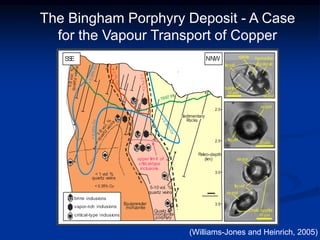
The Bingham Porphyry Deposit - A Case
for the Vapour Transport of Copper
(Williams-Jones and Heinrich, 2005)
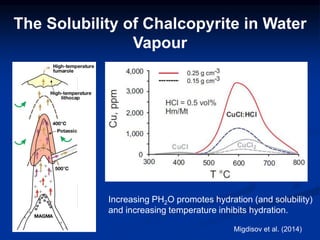
The Solubility of Chalcopyrite in Water
Vapour
Increasing PH2O promotes hydration (and solubility)
and increasing temperature inhibits hydration.
Migdisov et al. (2014)
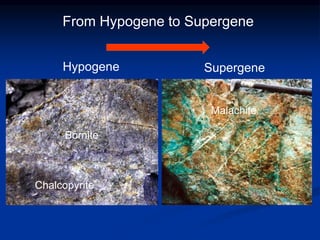
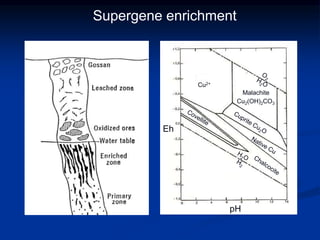
From Hypogene to Supergene
Supergene
Hypogene
Chalcopyrite
Bornite
Malachite
Oxidised zone
Primary zone
Enriched zone
Leached zone
Mineralized gravel
Mineralized bedrock
Barren gravel
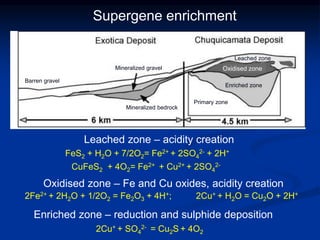
Supergene enrichment
FeS2 + H2O + 7/2O2= Fe2+ + 2SO4
2- + 2H+
2Fe2+ + 2H2O + 1/2O2 = Fe2O3 + 4H+; 2Cu+ + H2O = Cu2O + 2H+
2Cu+ + SO4
2- = Cu2S + 4O2
Leached zone – acidity creation
CuFeS2 + 4O2= Fe2+ + Cu2+ + 2SO4
2-
Oxidised zone – Fe and Cu oxides, acidity creation
Enriched zone – reduction and sulphide deposition
Cu2+
Malachite
Cu2(OH)2CO3
Eh
pH
Supergene enrichment
References
Seedorff, E., Dilles, J.H., Proffett Jr, J.M., Einaudi, M.T., Zurcher, L., Stavast,
W.J.A, 2006, Porphyry Deposits: Characteristics and origin of
hypogene features in Hedenquist et Al. (eds) Economic Geology
One Hundreth Anniversary Volume, p.251-298.
Williams-Jones, A.E. and Heinrich, C.H., 2005, Vapor transport of metals and
the formation of magmatic-hydrothermal ore deposits: Econ. Geol.,
100, p.1287-1312.
Evans, A.M., 1993, Ore geology and industrial minerals, an introduction:
Blackwell Science, Chapter 14.
Pirajno, F. 2009, Hydrothermal processes and mineral systems, Springer,
Chapter 5.
Sillitoe, R.H., 2010, Porphyry copper systems: Econ. Geol., 195, 3-41.

Porphyry deposits.ppt