Igneous Rocks
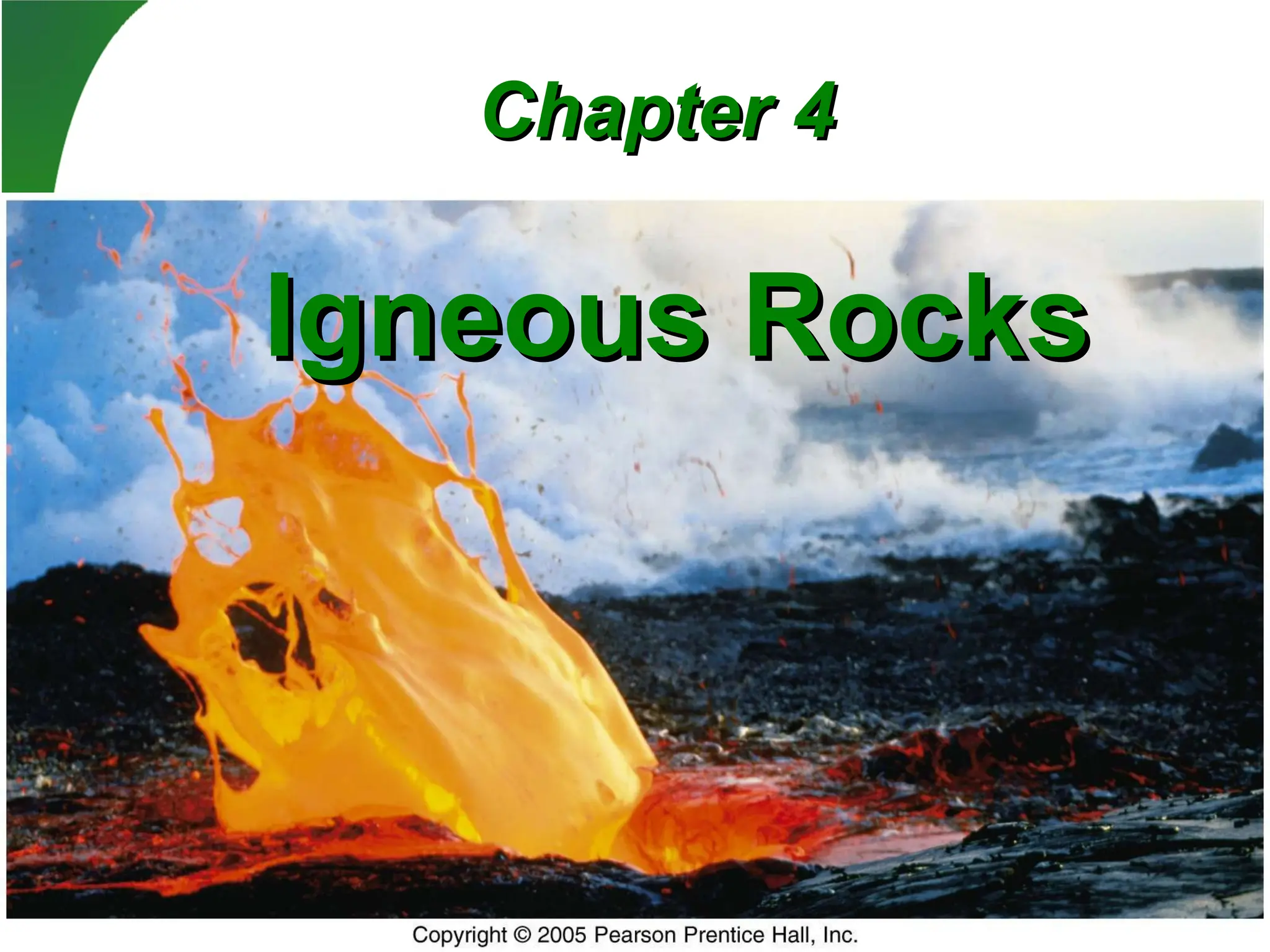
Igneous Rocks
Chapter 4
Chapter 4
General characteristics
of magma
of magma
• Igneous rocks form as molten rock
Igneous rocks form as molten rock
cools and solidifies
• General characteristics of
General characteristics of magma:
magma:
• Parent material of igneous rocks
Parent material of igneous rocks
• Forms from partial melting of rocks
Forms from partial melting of rocks
• Magma at surface is called
Magma at surface is called lava
lava
General characteristics
of magma
of magma
• General characteristic of magma
General characteristic of magma
• Rocks formed from lava =
Rocks formed from lava = extrusive
extrusive, or
, or
volcanic rocks
volcanic rocks
• Rocks formed from magma at depth =
Rocks formed from magma at depth =
intrusive
intrusive, or
, or plutonic rocks
plutonic rocks
General characteristics
of magma
of magma
• The nature of magma
The nature of magma
• Consists of three components:
Consists of three components:
– Liquid portion
Liquid portion =
= melt
melt
– Solids
Solids, if any, are silicate minerals
, if any, are silicate minerals
– Volatiles
Volatiles = dissolved gases in the melt,
= dissolved gases in the melt,
including water vapor (H
including water vapor (H2
2O), carbon dioxide
O), carbon dioxide
(CO
(CO2
2), and sulfur dioxide (SO
), and sulfur dioxide (SO2
2)
)
General characteristics
of magma
of magma
• Crystallization of magma
Crystallization of magma
• Cooling of magma results in the
Cooling of magma results in the
systematic arrangement of ions into
orderly patterns
orderly patterns
• The silicate minerals resulting from
The silicate minerals resulting from
crystallization form in a predictable
order
order
• Texture - size and arrangement of
Texture - size and arrangement of
mineral grains
mineral grains
Igneous textures
Igneous textures
• Texture
Texture is used to describe the
is used to describe the
overall appearance of a rock based
on the size, shape, and arrangement
of interlocking minerals
• Factors affecting crystal size
Factors affecting crystal size
• Rate of cooling
Rate of cooling
– Slow rate = fewer but larger crystals
Slow rate = fewer but larger crystals
– Fast rate = many small crystals
Fast rate = many small crystals
– Very fast rate forms glass
Very fast rate forms glass
Igneous textures
Igneous textures
• Factors affecting crystal size
Factors affecting crystal size
• % of
% of silica
silica (SiO
(SiO2
2) present
) present
• Dissolved gases
Dissolved gases
Igneous textures
Igneous textures
• Types of igneous textures
Types of igneous textures
• Aphanitic
Aphanitic (fine-grained) texture
(fine-grained) texture
– Rapid rate of cooling
Rapid rate of cooling
– Microscopic crystals
Microscopic crystals
– May contain
May contain vesicles
vesicles (holes from gas
(holes from gas
bubbles)
bubbles)
• Phaneritic
Phaneritic (coarse-grained) texture
(coarse-grained) texture
– Slow cooling
Slow cooling
– Large, visible crystals
Large, visible crystals
Aphanitic texture
Aphanitic texture
Phaneritic texture
Phaneritic texture
Igneous textures
Igneous textures
• Types of igneous textures
Types of igneous textures
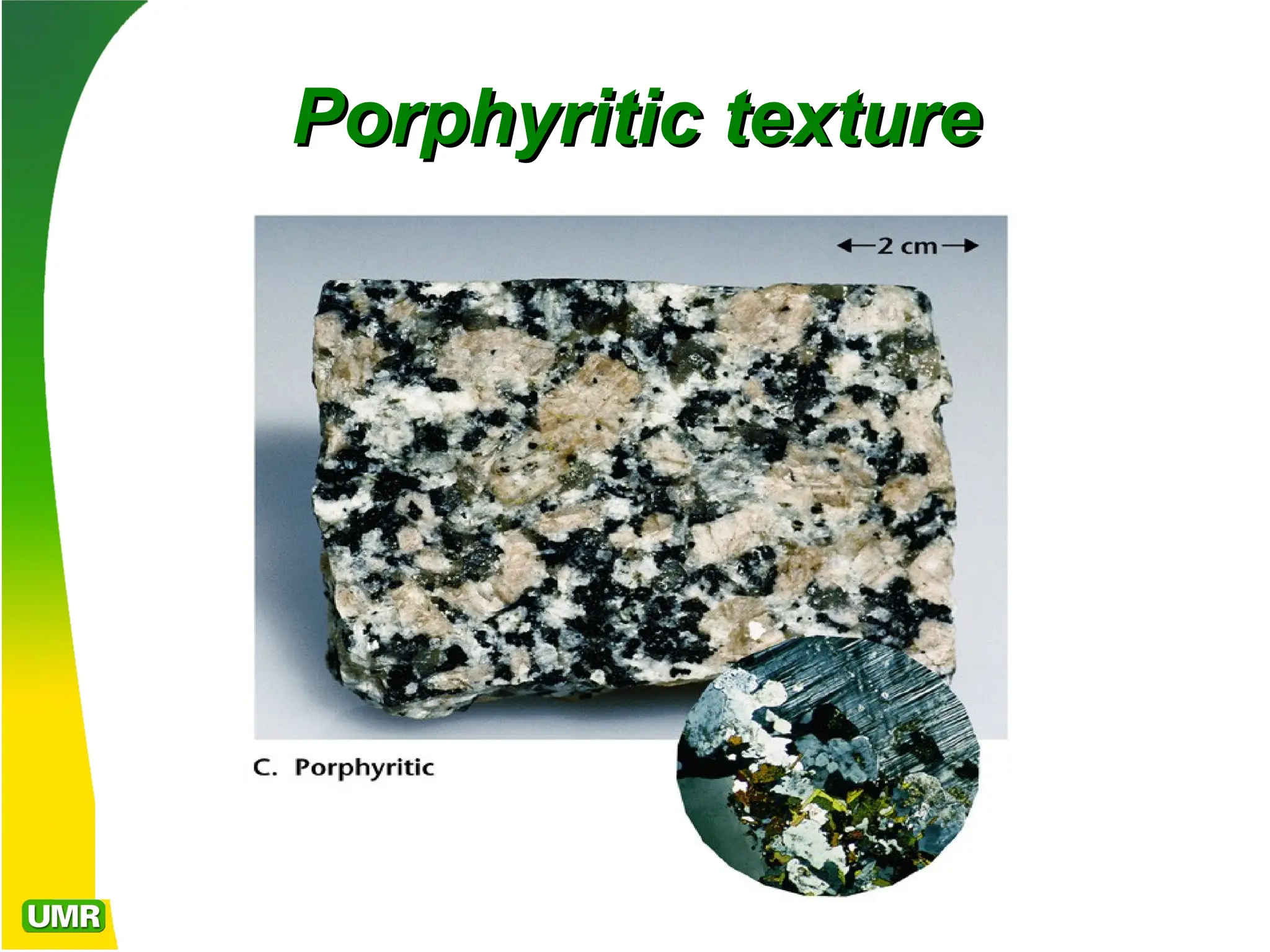
• Porphyritic
Porphyritic texture
texture
– Minerals form at different temperatures
Minerals form at different temperatures
– Large crystals (
Large crystals (phenocrysts
phenocrysts) are embedded
) are embedded
in a matrix of smaller crystals (
in a matrix of smaller crystals (groundmass
groundmass)
)
• Glassy
Glassy texture
texture
– Very rapid cooling of lava
Very rapid cooling of lava
– Resulting rock is called
Resulting rock is called obsidian
obsidian
Igneous textures
Igneous textures
• Types of igneous textures
Types of igneous textures
• Pyroclastic
Pyroclastic texture
texture
– Fragmental appearance produced by violent
Fragmental appearance produced by violent
volcanic eruptions
volcanic eruptions
– Often appear more similar to sedimentary
Often appear more similar to sedimentary
rocks
rocks
• Pegmatitic
Pegmatitic texture
texture
– Exceptionally coarse grained
Exceptionally coarse grained
– Form in late stages of crystallization of
Form in late stages of crystallization of
granitic magmas
granitic magmas
Porphyritic texture
Porphyritic texture
Glassy texture
Glassy texture
Igneous compositions
• Igneous rocks are composed primarily
Igneous rocks are composed primarily
of silicate minerals
• Dark (or
Dark (or ferromagnesian
ferromagnesian) silicates
) silicates
– Olivine, pyroxene, amphibole, and biotite
Olivine, pyroxene, amphibole, and biotite
mica
mica
• Light (or nonferromagnesian) silicates
Light (or nonferromagnesian) silicates
– Quartz, muscovite mica, and feldspars
Quartz, muscovite mica, and feldspars
Igneous compositions
• Granitic
Granitic versus
versus basaltic
basaltic compositions
compositions
• Granitic
Granitic composition
composition
– Light-colored silicates
Light-colored silicates
– Termed
Termed felsic
felsic (
(fe
feldspar and
ldspar and si
silica) in
lica) in
composition
composition
– High amounts of silica (SiO
High amounts of silica (SiO2
2)
)
– Major constituent of continental crust
Major constituent of continental crust
Igneous compositions
• Granitic
Granitic versus basaltic compositions
versus basaltic compositions
• Basaltic composition
Basaltic composition
– Dark silicates and calcium-rich feldspar
Dark silicates and calcium-rich feldspar
– Termed
Termed mafic
mafic (
(ma
magnesium and
gnesium and fe
ferrum, for
rrum, for
iron) in composition
– Higher dense than granitic rocks
Higher dense than granitic rocks
– Comprise the ocean floor and many
Comprise the ocean floor and many
volcanic islands
volcanic islands
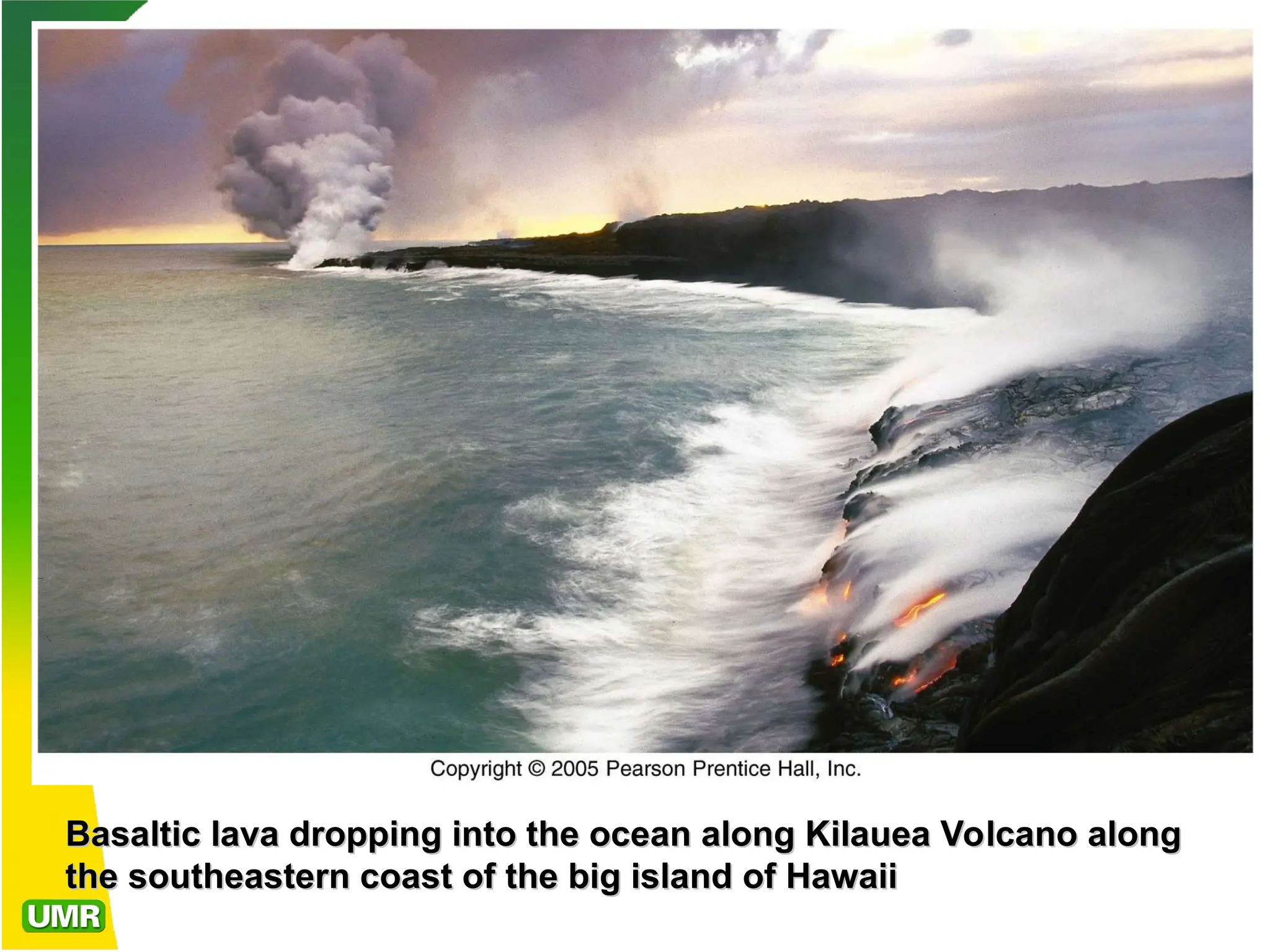
Basaltic lava dropping into the ocean along Kilauea Volcano along
the southeastern coast of the big island of Hawaii
Igneous compositions
• Other compositional groups
Other compositional groups
• Intermediate
Intermediate (or
(or andesitic
andesitic) composition
) composition
– Contain 25% or more dark silicate minerals
Contain 25% or more dark silicate minerals
– Associated with explosive volcanic activity
Associated with explosive volcanic activity
• Ultramafic
Ultramafic composition
composition
– Rare composition that is high in magnesium
Rare composition that is high in magnesium
and iron
and iron
– Composed entirely of ferromagnesian
Composed entirely of ferromagnesian
silicates
silicates
Igneous compositions
• Silica content
Silica content as an indicator of
as an indicator of
composition
composition
• Exhibits a considerable range in the crust
Exhibits a considerable range in the crust
– 45% to 70%
45% to 70%
• Silica content
Silica content influences magma
influences magma
behavior
behavior
• Granitic magmas = high silica content
Granitic magmas = high silica content
and viscous
and viscous
• Basaltic magmas = much lower silica
Basaltic magmas = much lower silica
content and more fluid-like behavior
Igneous compositions
• Naming igneous rocks – granitic rocks
Naming igneous rocks – granitic rocks
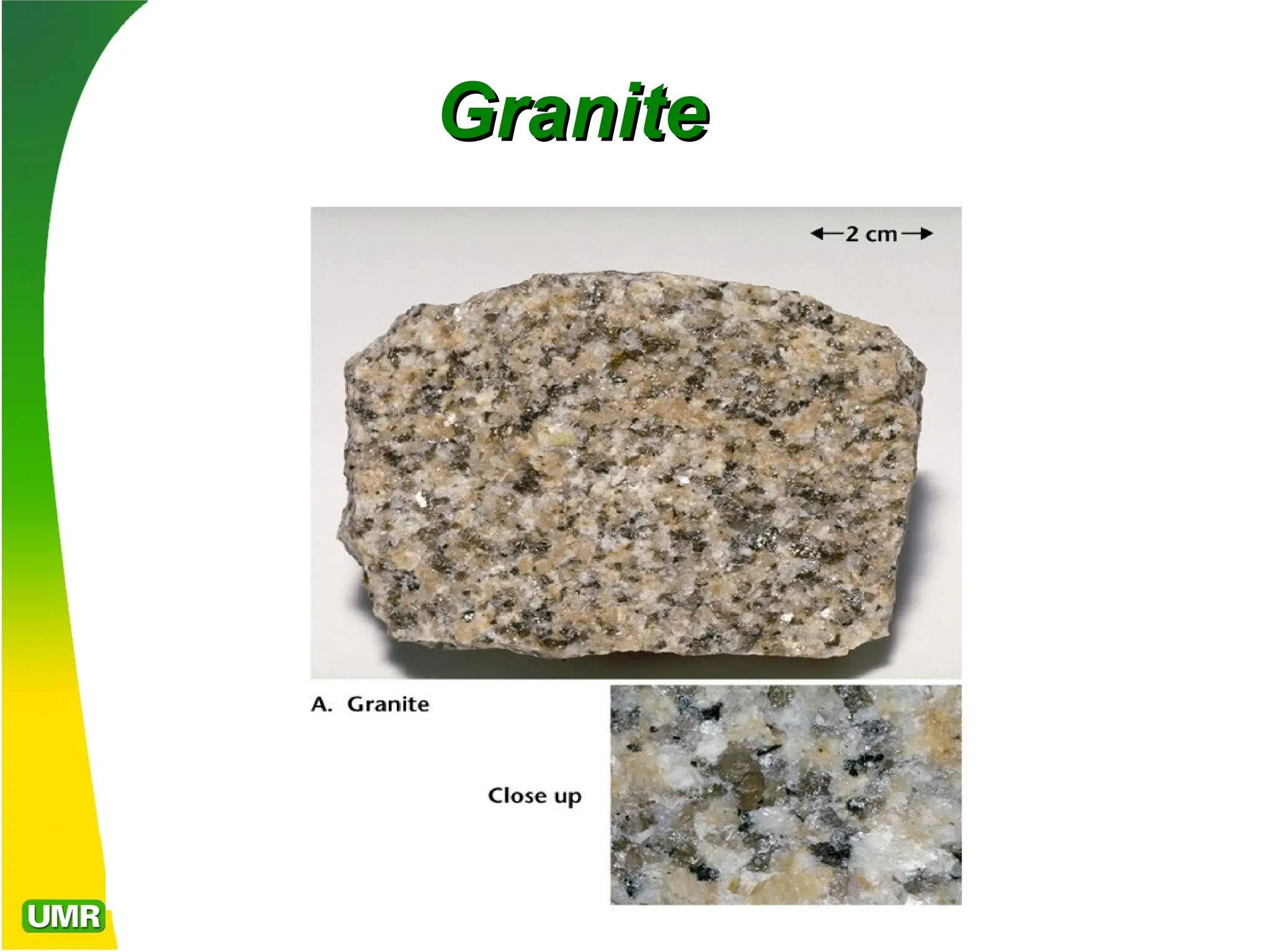
• Granite
Granite
– Phaneritic
Phaneritic
– Over 25% quartz, about 65% or more
Over 25% quartz, about 65% or more
feldspar
feldspar
– Very abundant - often associated with
Very abundant - often associated with
mountain building
mountain building
– The term granite includes a wide range of
The term granite includes a wide range of
mineral compositions
Granite
Granite
Igneous compositions
• Naming igneous rocks – granitic rocks
Naming igneous rocks – granitic rocks
• Rhyolite
Rhyolite
– Extrusive equivalent of granite
Extrusive equivalent of granite
– May contain glass fragments and vesicles
May contain glass fragments and vesicles
– Aphanitic texture
Aphanitic texture
– Less common and less voluminous than
Less common and less voluminous than
granite
granite
Rhyolite
Rhyolite
Igneous compositions
• Naming igneous rocks – granitic rocks
Naming igneous rocks – granitic rocks
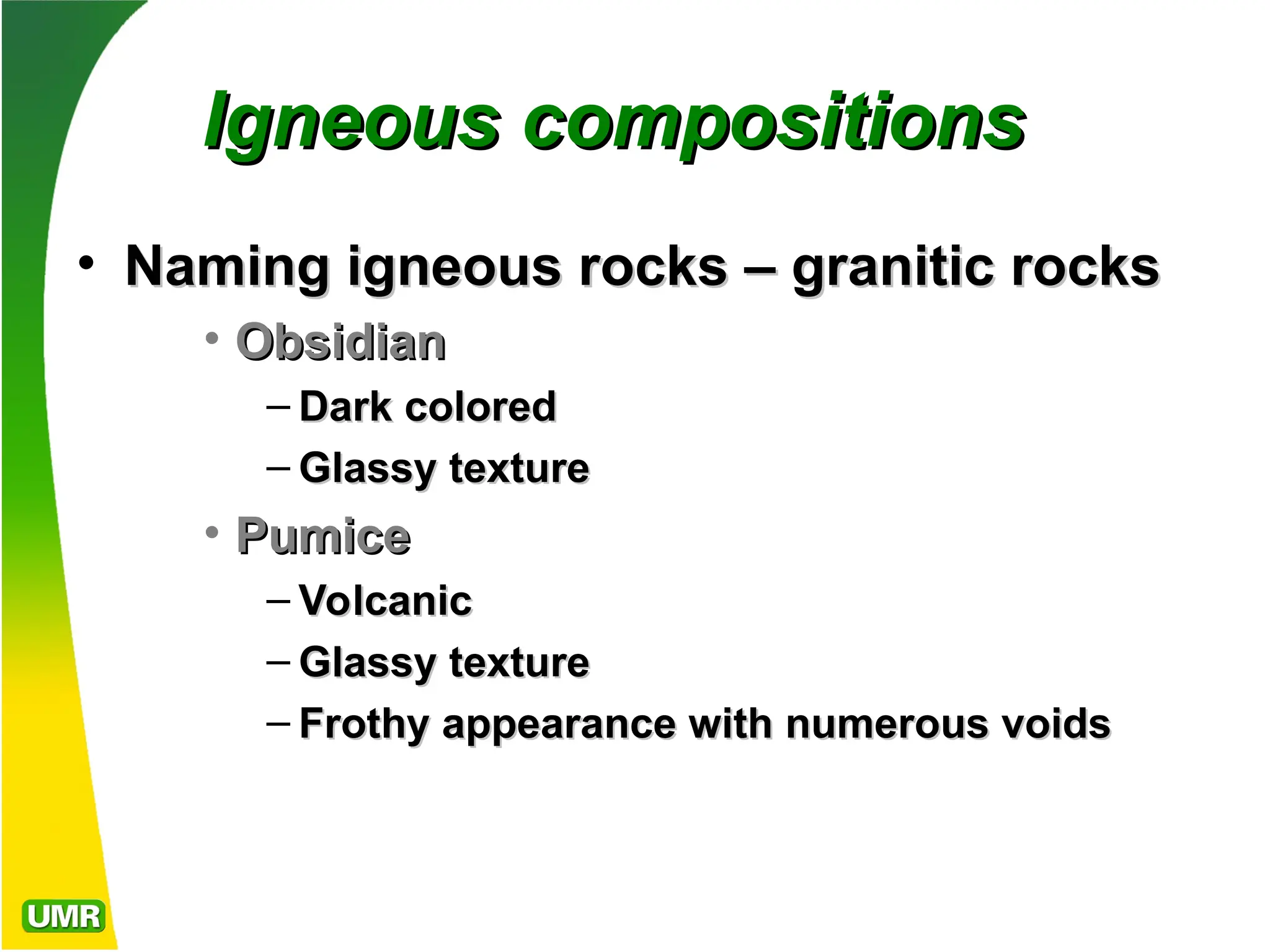
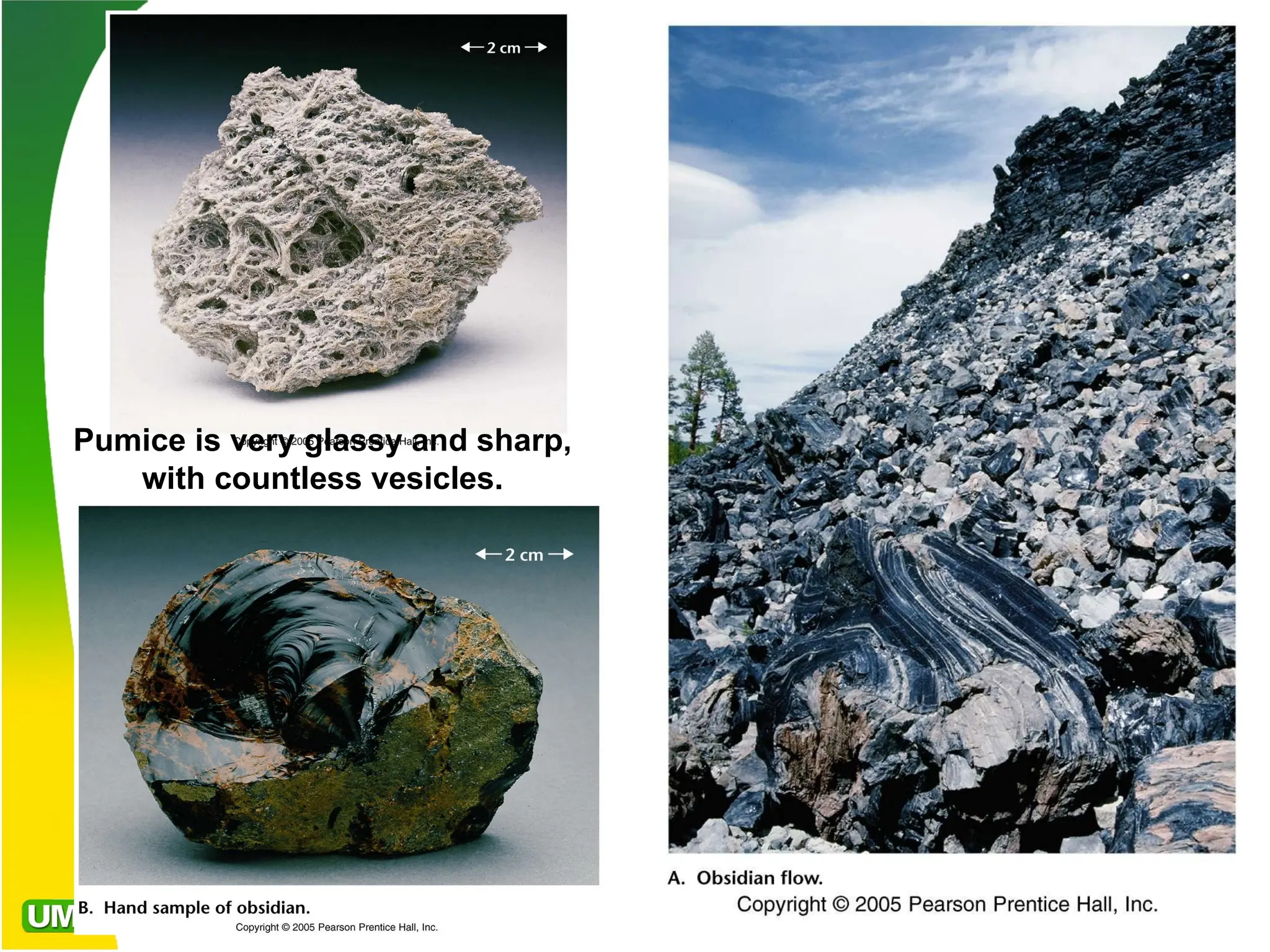
• Obsidian
Obsidian
– Dark colored
Dark colored
– Glassy texture
Glassy texture
• Pumice
Pumice
– Volcanic
Volcanic
– Glassy texture
Glassy texture
– Frothy appearance with numerous voids
Frothy appearance with numerous voids
Pumice is very glassy and sharp,
with countless vesicles.
Igneous compositions
• Naming igneous rocks – intermediate
Naming igneous rocks – intermediate
rocks
rocks
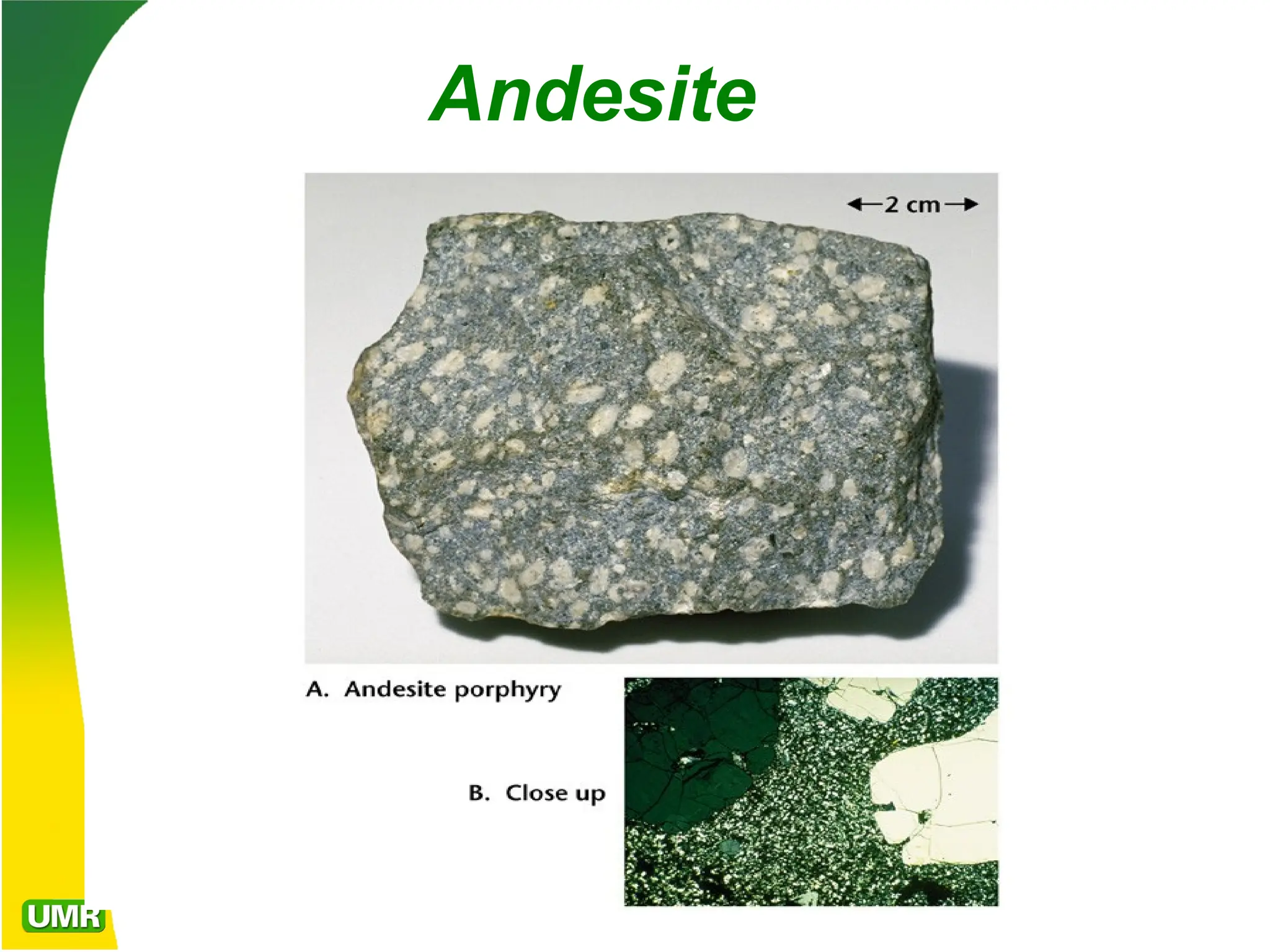
• Andesite
Andesite
– Volcanic origin
Volcanic origin
– Aphanitic texture
Aphanitic texture
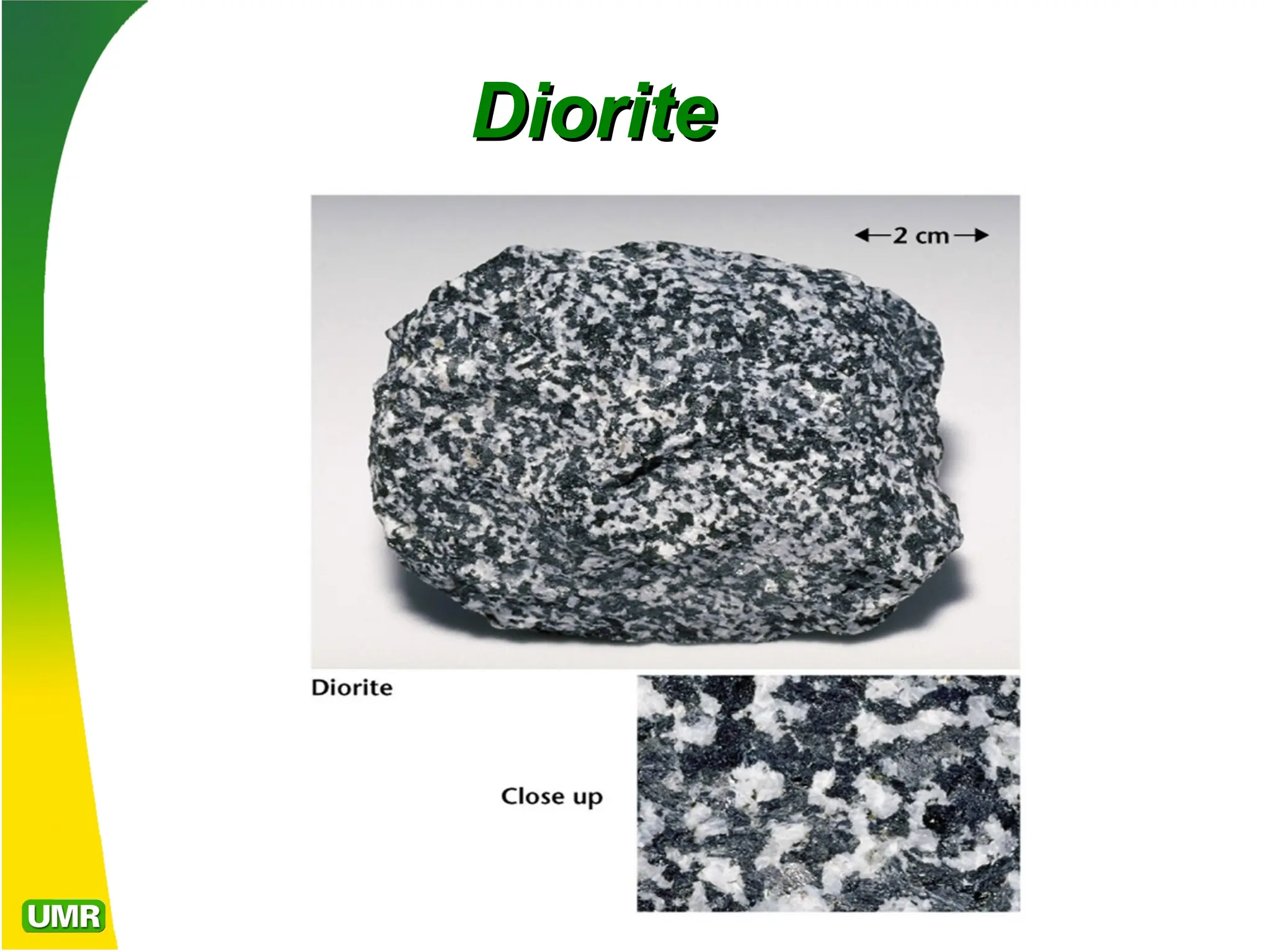
• Diorite
Diorite
– Plutonic equivalent of andesite
Plutonic equivalent of andesite
– Coarse grained
Coarse grained
Andesite
Diorite
Diorite
Igneous compositions
• Naming igneous rocks – basaltic rocks
Naming igneous rocks – basaltic rocks
• Basalt
Basalt
– Volcanic origin
Volcanic origin
– Aphanitic texture
Aphanitic texture
– Composed mainly of pyroxene and calcium-
Composed mainly of pyroxene and calcium-
rich plagioclase feldspar
– Most common extrusive igneous rock
Most common extrusive igneous rock
Basalt
Basalt
Igneous compositions
• Naming igneous rocks – mafic rocks
Naming igneous rocks – mafic rocks
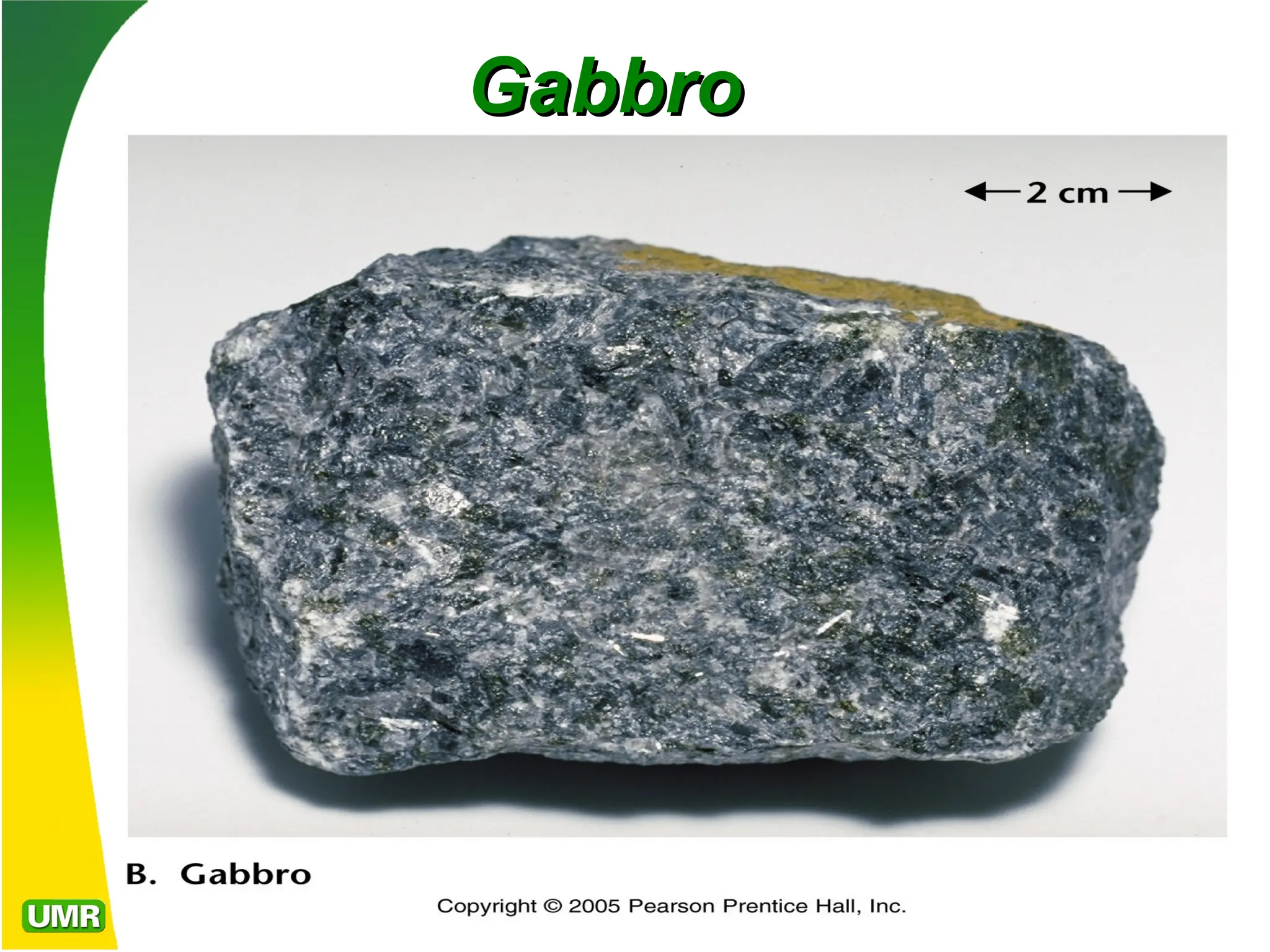
• Gabbro
Gabbro
– Intrusive equivalent of basalt
Intrusive equivalent of basalt
– Phaneritic texture consisting of pyroxene
Phaneritic texture consisting of pyroxene
and calcium-rich plagioclase
– Significant % of the oceanic crust
Significant % of the oceanic crust
Gabbro
Gabbro
Igneous compositions
• Naming igneous rocks –
Naming igneous rocks – pyroclastic
pyroclastic
rocks
rocks
• Composed of fragments ejected during
Composed of fragments ejected during
a volcanic eruption
a volcanic eruption
• Varieties
Varieties
– Tuff
Tuff = ash-sized fragments
= ash-sized fragments
– Volcanic breccia
Volcanic breccia = particles larger than ash
= particles larger than ash
Origin of magma
Origin of magma
• Highly debated topic
Highly debated topic
• Generating magma from solid rock
Generating magma from solid rock
• Role of heat
Role of heat
– Temperature increases in the upper crust
Temperature increases in the upper crust
(
(geothermal gradient
geothermal gradient) average between
) average between 20
20o
o
C
C
to 30
to 30o
o
C per kilometer
C per kilometer of depth
of depth
– Rocks in the lower crust and upper mantle
Rocks in the lower crust and upper mantle
are near their melting points
– Any additional heat may induce melting
Any additional heat may induce melting
Origin of magma
Origin of magma
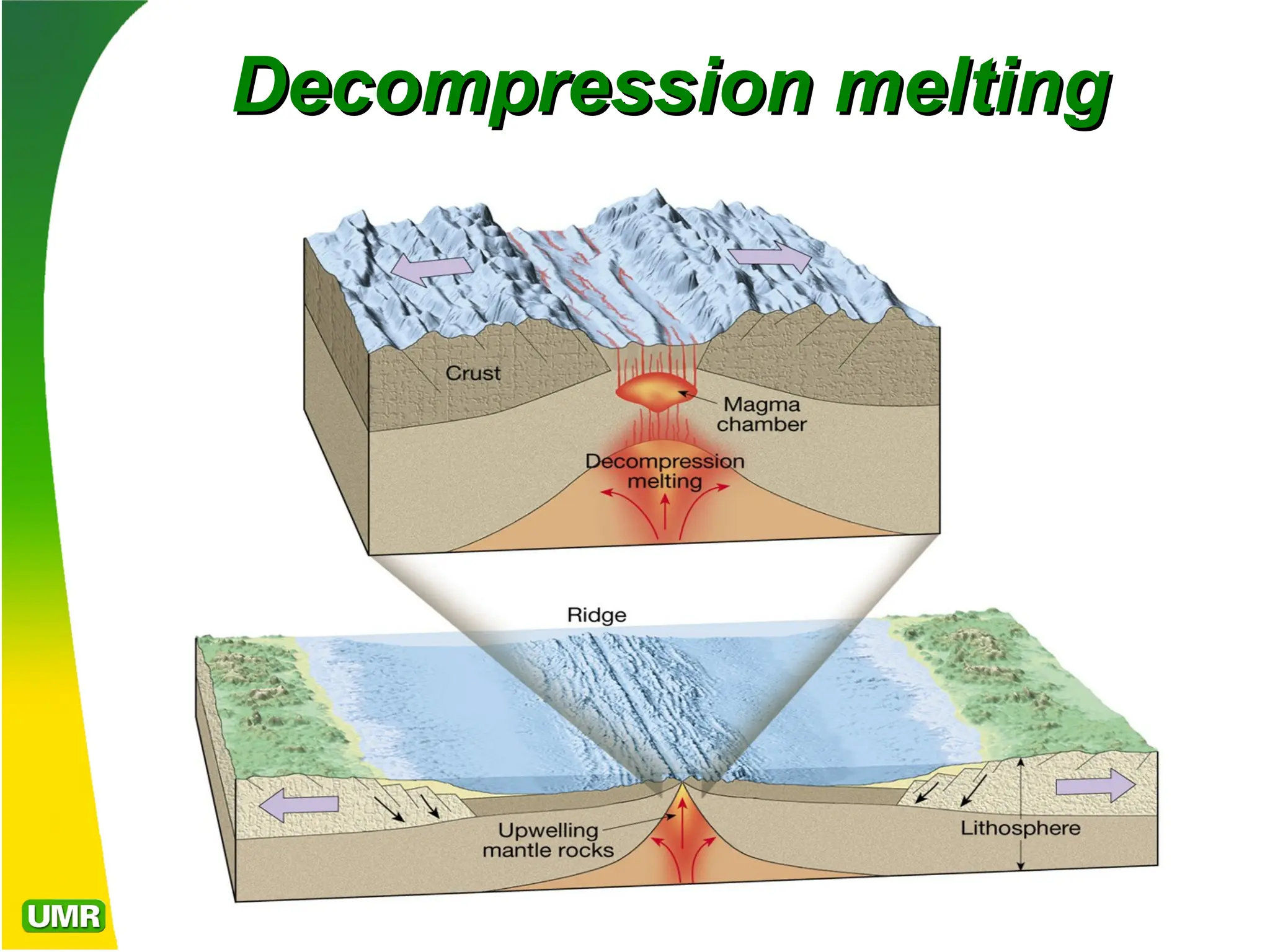
• Role of pressure
Role of pressure
– Increases in confining pressure cause an
Increases in confining pressure cause an
increase in a rock’s melting temperature
– When confining pressures drop,
When confining pressures drop,
decompression melting occurs
• Role of volatiles
Role of volatiles
– Volatiles (primarily
Volatiles (primarily water
water) cause rocks to
) cause rocks to
melt at lower temperatures
– Important factor where oceanic lithosphere
Important factor where oceanic lithosphere
descends into the mantle
Decompression melting
Evolution of magmas
Evolution of magmas
• A single volcano may extrude lavas exhibiting
A single volcano may extrude lavas exhibiting
very different compositions
• Each volcanic eruption tends to exhibit a
Each volcanic eruption tends to exhibit a
unique geochemical fingerprint, defined by
trace element percentages
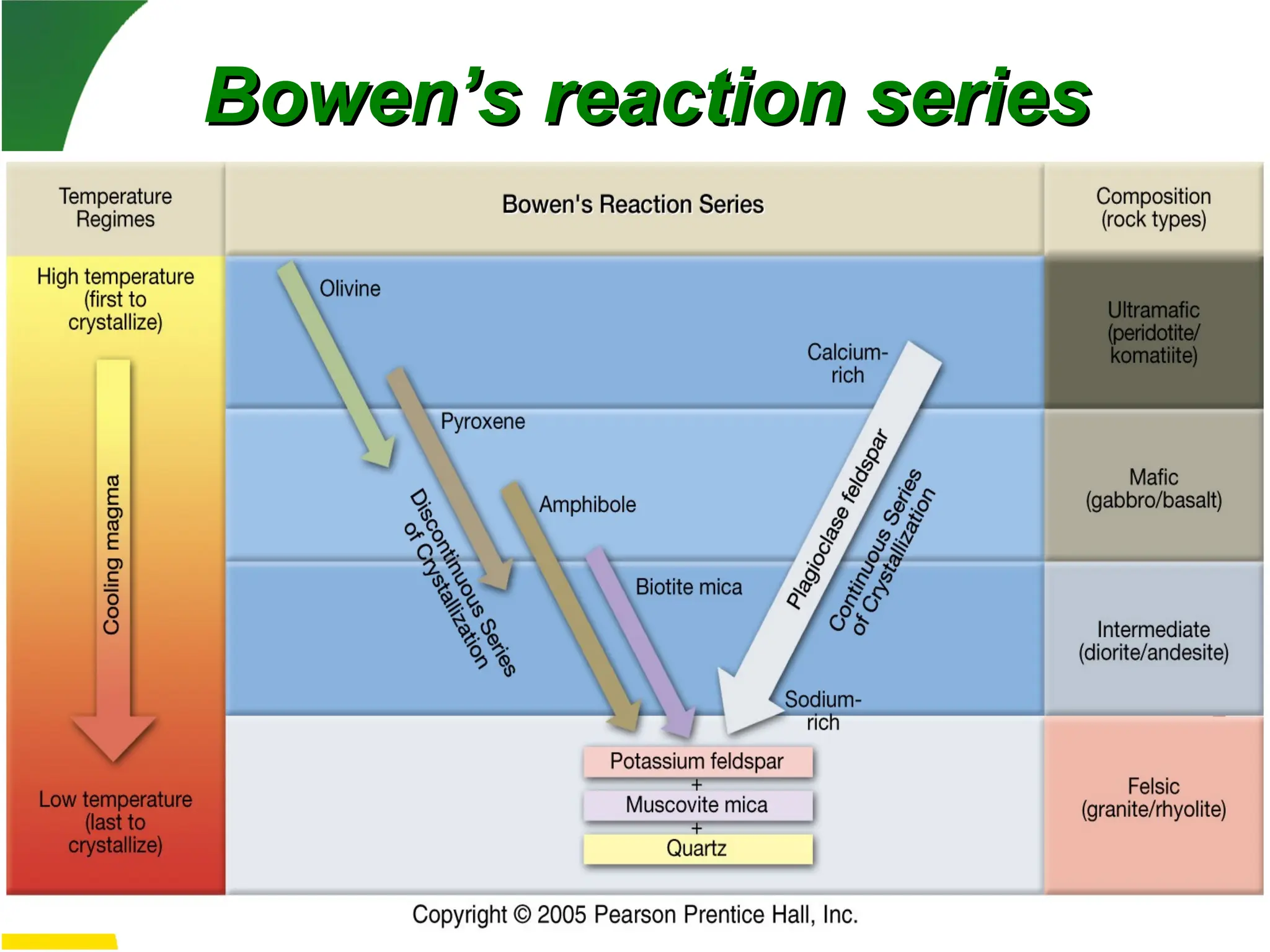
• Bowen’s reaction series
Bowen’s reaction series
• Minerals crystallize in a systematic fashion
Minerals crystallize in a systematic fashion
based on their melting points
• During crystallization, the composition of the
During crystallization, the composition of the
liquid portion of the magma continually changes
Bowen’s reaction series
Evolution of magmas
Evolution of magmas
• Processes responsible for changing a
Processes responsible for changing a
magma’s composition
magma’s composition
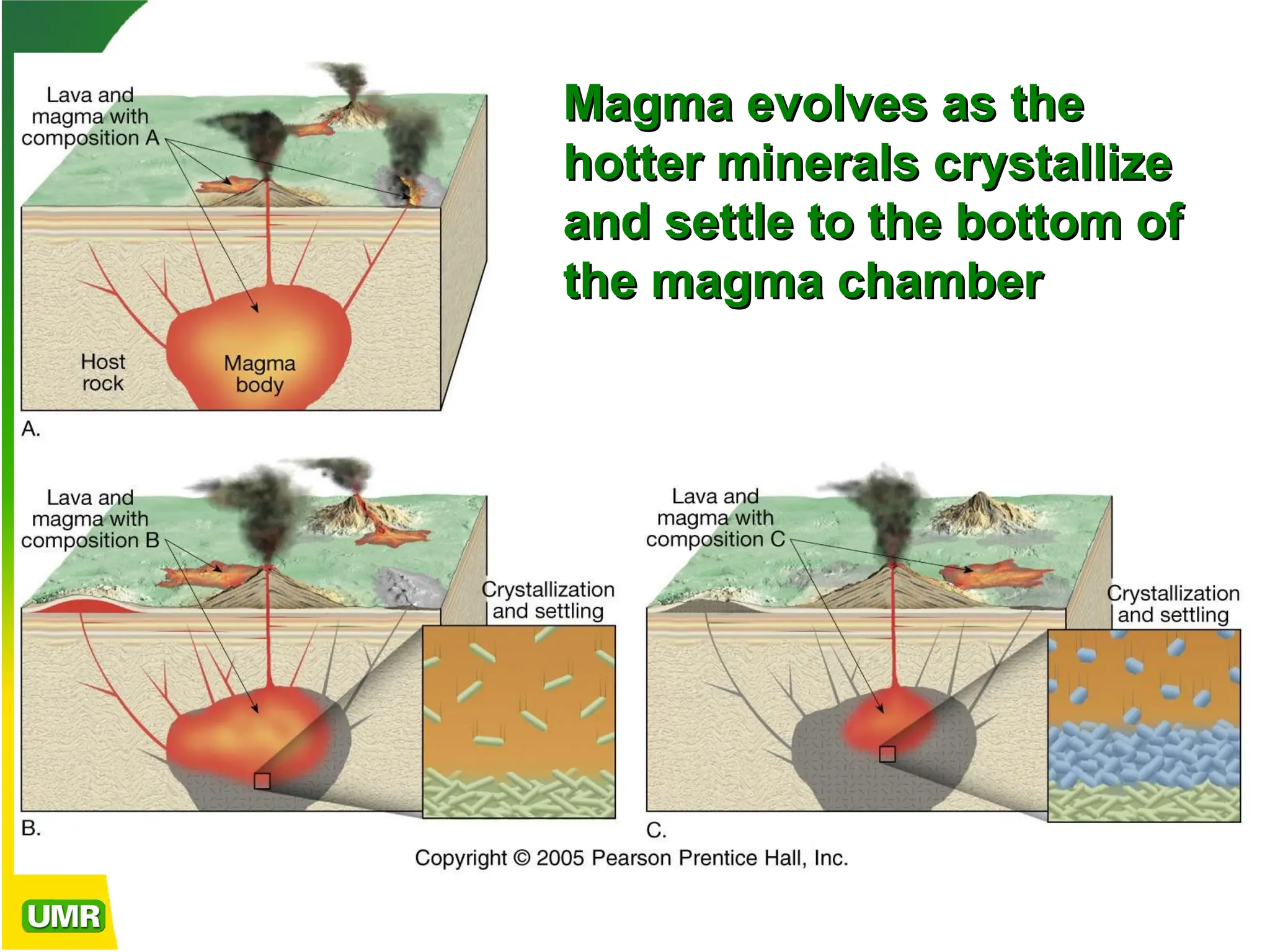
• Magmatic differentiation
Magmatic differentiation
– Separation of a melt from earlier formed
Separation of a melt from earlier formed
crystals
crystals
• Assimilation
Assimilation
– Changing a magma’s composition by the
Changing a magma’s composition by the
incorporation of surrounding rock bodies
into a magma
into a magma
Magma evolves as the
hotter minerals crystallize
and settle to the bottom of
the magma chamber
the magma chamber
Evolution of magmas
Evolution of magmas
• Processes responsible for changing a
Processes responsible for changing a
magma’s composition
magma’s composition
• Magma mixing
Magma mixing
– Two chemically distinct magmas may
Two chemically distinct magmas may
produce a composition quite different from
either original magma
Assimilation, magma mixing,
and magmatic differentiation
Evolution of magmas
Evolution of magmas
• Partial melting and magma formation
Partial melting and magma formation
• Incomplete melting of rocks is known as
Incomplete melting of rocks is known as
partial melting
partial melting
• Formation of basaltic magmas
Formation of basaltic magmas
– Most originate from partial melting of
Most originate from partial melting of
ultramafic rock in the mantle at oceanic
ridges
ridges
– Large outpourings of basaltic magma are
Large outpourings of basaltic magma are
common at Earth’s surface
Evolution of magmas
Evolution of magmas
• Partial melting and magma formation
Partial melting and magma formation
• Formation of andesitic magmas
Formation of andesitic magmas
– Produced by interaction of basaltic magmas
Produced by interaction of basaltic magmas
and more silica-rich rocks in the crust
– May also evolve by magmatic differentiation
May also evolve by magmatic differentiation
Evolution of magmas
Evolution of magmas
• Partial melting and magma formation
Partial melting and magma formation
• Formation of granitic magmas
Formation of granitic magmas
– Most likely form as the end product of
Most likely form as the end product of
crystallization of andesitic magma
– Granitic magmas are more viscous than
Granitic magmas are more viscous than
other magmas so they tend to lose their
mobility before reaching the surface
– Tend to produce large plutonic structures
Tend to produce large plutonic structures

Ch 4-Igneous Rocks.pptBBBBBBBBBBBBBBBBBB

  • 1.
  • 2.
    General characteristics General characteristics ofmagma of magma • Igneous rocks form as molten rock Igneous rocks form as molten rock cools and solidifies cools and solidifies • General characteristics of General characteristics of magma: magma: • Parent material of igneous rocks Parent material of igneous rocks • Forms from partial melting of rocks Forms from partial melting of rocks • Magma at surface is called Magma at surface is called lava lava
  • 3.
    General characteristics General characteristics ofmagma of magma • General characteristic of magma General characteristic of magma • Rocks formed from lava = Rocks formed from lava = extrusive extrusive, or , or volcanic rocks volcanic rocks • Rocks formed from magma at depth = Rocks formed from magma at depth = intrusive intrusive, or , or plutonic rocks plutonic rocks
  • 4.
    General characteristics General characteristics ofmagma of magma • The nature of magma The nature of magma • Consists of three components: Consists of three components: – Liquid portion Liquid portion = = melt melt – Solids Solids, if any, are silicate minerals , if any, are silicate minerals – Volatiles Volatiles = dissolved gases in the melt, = dissolved gases in the melt, including water vapor (H including water vapor (H2 2O), carbon dioxide O), carbon dioxide (CO (CO2 2), and sulfur dioxide (SO ), and sulfur dioxide (SO2 2) )
  • 5.
    General characteristics General characteristics ofmagma of magma • Crystallization of magma Crystallization of magma • Cooling of magma results in the Cooling of magma results in the systematic arrangement of ions into systematic arrangement of ions into orderly patterns orderly patterns • The silicate minerals resulting from The silicate minerals resulting from crystallization form in a predictable crystallization form in a predictable order order • Texture - size and arrangement of Texture - size and arrangement of mineral grains mineral grains
  • 6.
    Igneous textures Igneous textures •Texture Texture is used to describe the is used to describe the overall appearance of a rock based overall appearance of a rock based on the size, shape, and arrangement on the size, shape, and arrangement of interlocking minerals of interlocking minerals • Factors affecting crystal size Factors affecting crystal size • Rate of cooling Rate of cooling – Slow rate = fewer but larger crystals Slow rate = fewer but larger crystals – Fast rate = many small crystals Fast rate = many small crystals – Very fast rate forms glass Very fast rate forms glass
  • 7.
    Igneous textures Igneous textures •Factors affecting crystal size Factors affecting crystal size • % of % of silica silica (SiO (SiO2 2) present ) present • Dissolved gases Dissolved gases
  • 8.
    Igneous textures Igneous textures •Types of igneous textures Types of igneous textures • Aphanitic Aphanitic (fine-grained) texture (fine-grained) texture – Rapid rate of cooling Rapid rate of cooling – Microscopic crystals Microscopic crystals – May contain May contain vesicles vesicles (holes from gas (holes from gas bubbles) bubbles) • Phaneritic Phaneritic (coarse-grained) texture (coarse-grained) texture – Slow cooling Slow cooling – Large, visible crystals Large, visible crystals
  • 9.
  • 10.
  • 11.
    Igneous textures Igneous textures •Types of igneous textures Types of igneous textures • Porphyritic Porphyritic texture texture – Minerals form at different temperatures Minerals form at different temperatures – Large crystals ( Large crystals (phenocrysts phenocrysts) are embedded ) are embedded in a matrix of smaller crystals ( in a matrix of smaller crystals (groundmass groundmass) ) • Glassy Glassy texture texture – Very rapid cooling of lava Very rapid cooling of lava – Resulting rock is called Resulting rock is called obsidian obsidian
  • 12.
    Igneous textures Igneous textures •Types of igneous textures Types of igneous textures • Pyroclastic Pyroclastic texture texture – Fragmental appearance produced by violent Fragmental appearance produced by violent volcanic eruptions volcanic eruptions – Often appear more similar to sedimentary Often appear more similar to sedimentary rocks rocks • Pegmatitic Pegmatitic texture texture – Exceptionally coarse grained Exceptionally coarse grained – Form in late stages of crystallization of Form in late stages of crystallization of granitic magmas granitic magmas
  • 13.
  • 14.
  • 15.
    Igneous compositions Igneous compositions •Igneous rocks are composed primarily Igneous rocks are composed primarily of silicate minerals of silicate minerals • Dark (or Dark (or ferromagnesian ferromagnesian) silicates ) silicates – Olivine, pyroxene, amphibole, and biotite Olivine, pyroxene, amphibole, and biotite mica mica • Light (or nonferromagnesian) silicates Light (or nonferromagnesian) silicates – Quartz, muscovite mica, and feldspars Quartz, muscovite mica, and feldspars
  • 17.
    Igneous compositions Igneous compositions •Granitic Granitic versus versus basaltic basaltic compositions compositions • Granitic Granitic composition composition – Light-colored silicates Light-colored silicates – Termed Termed felsic felsic ( (fe feldspar and ldspar and si silica) in lica) in composition composition – High amounts of silica (SiO High amounts of silica (SiO2 2) ) – Major constituent of continental crust Major constituent of continental crust
  • 18.
    Igneous compositions Igneous compositions •Granitic Granitic versus basaltic compositions versus basaltic compositions • Basaltic composition Basaltic composition – Dark silicates and calcium-rich feldspar Dark silicates and calcium-rich feldspar – Termed Termed mafic mafic ( (ma magnesium and gnesium and fe ferrum, for rrum, for iron) in composition iron) in composition – Higher dense than granitic rocks Higher dense than granitic rocks – Comprise the ocean floor and many Comprise the ocean floor and many volcanic islands volcanic islands
  • 19.
    Basaltic lava droppinginto the ocean along Kilauea Volcano along Basaltic lava dropping into the ocean along Kilauea Volcano along the southeastern coast of the big island of Hawaii the southeastern coast of the big island of Hawaii
  • 20.
    Igneous compositions Igneous compositions •Other compositional groups Other compositional groups • Intermediate Intermediate (or (or andesitic andesitic) composition ) composition – Contain 25% or more dark silicate minerals Contain 25% or more dark silicate minerals – Associated with explosive volcanic activity Associated with explosive volcanic activity • Ultramafic Ultramafic composition composition – Rare composition that is high in magnesium Rare composition that is high in magnesium and iron and iron – Composed entirely of ferromagnesian Composed entirely of ferromagnesian silicates silicates
  • 21.
    Igneous compositions Igneous compositions •Silica content Silica content as an indicator of as an indicator of composition composition • Exhibits a considerable range in the crust Exhibits a considerable range in the crust – 45% to 70% 45% to 70% • Silica content Silica content influences magma influences magma behavior behavior • Granitic magmas = high silica content Granitic magmas = high silica content and viscous and viscous • Basaltic magmas = much lower silica Basaltic magmas = much lower silica content and more fluid-like behavior content and more fluid-like behavior
  • 23.
    Igneous compositions Igneous compositions •Naming igneous rocks – granitic rocks Naming igneous rocks – granitic rocks • Granite Granite – Phaneritic Phaneritic – Over 25% quartz, about 65% or more Over 25% quartz, about 65% or more feldspar feldspar – Very abundant - often associated with Very abundant - often associated with mountain building mountain building – The term granite includes a wide range of The term granite includes a wide range of mineral compositions mineral compositions
  • 24.
  • 25.
    Igneous compositions Igneous compositions •Naming igneous rocks – granitic rocks Naming igneous rocks – granitic rocks • Rhyolite Rhyolite – Extrusive equivalent of granite Extrusive equivalent of granite – May contain glass fragments and vesicles May contain glass fragments and vesicles – Aphanitic texture Aphanitic texture – Less common and less voluminous than Less common and less voluminous than granite granite
  • 26.
  • 27.
    Igneous compositions Igneous compositions •Naming igneous rocks – granitic rocks Naming igneous rocks – granitic rocks • Obsidian Obsidian – Dark colored Dark colored – Glassy texture Glassy texture • Pumice Pumice – Volcanic Volcanic – Glassy texture Glassy texture – Frothy appearance with numerous voids Frothy appearance with numerous voids
  • 28.
    Pumice is veryglassy and sharp, with countless vesicles.
  • 29.
    Igneous compositions Igneous compositions •Naming igneous rocks – intermediate Naming igneous rocks – intermediate rocks rocks • Andesite Andesite – Volcanic origin Volcanic origin – Aphanitic texture Aphanitic texture • Diorite Diorite – Plutonic equivalent of andesite Plutonic equivalent of andesite – Coarse grained Coarse grained
  • 30.
  • 31.
  • 32.
    Igneous compositions Igneous compositions •Naming igneous rocks – basaltic rocks Naming igneous rocks – basaltic rocks • Basalt Basalt – Volcanic origin Volcanic origin – Aphanitic texture Aphanitic texture – Composed mainly of pyroxene and calcium- Composed mainly of pyroxene and calcium- rich plagioclase feldspar rich plagioclase feldspar – Most common extrusive igneous rock Most common extrusive igneous rock
  • 33.
  • 34.
    Igneous compositions Igneous compositions •Naming igneous rocks – mafic rocks Naming igneous rocks – mafic rocks • Gabbro Gabbro – Intrusive equivalent of basalt Intrusive equivalent of basalt – Phaneritic texture consisting of pyroxene Phaneritic texture consisting of pyroxene and calcium-rich plagioclase and calcium-rich plagioclase – Significant % of the oceanic crust Significant % of the oceanic crust
  • 35.
  • 36.
    Igneous compositions Igneous compositions •Naming igneous rocks – Naming igneous rocks – pyroclastic pyroclastic rocks rocks • Composed of fragments ejected during Composed of fragments ejected during a volcanic eruption a volcanic eruption • Varieties Varieties – Tuff Tuff = ash-sized fragments = ash-sized fragments – Volcanic breccia Volcanic breccia = particles larger than ash = particles larger than ash
  • 38.
    Origin of magma Originof magma • Highly debated topic Highly debated topic • Generating magma from solid rock Generating magma from solid rock • Role of heat Role of heat – Temperature increases in the upper crust Temperature increases in the upper crust ( (geothermal gradient geothermal gradient) average between ) average between 20 20o o C C to 30 to 30o o C per kilometer C per kilometer of depth of depth – Rocks in the lower crust and upper mantle Rocks in the lower crust and upper mantle are near their melting points are near their melting points – Any additional heat may induce melting Any additional heat may induce melting
  • 39.
    Origin of magma Originof magma • Role of pressure Role of pressure – Increases in confining pressure cause an Increases in confining pressure cause an increase in a rock’s melting temperature increase in a rock’s melting temperature – When confining pressures drop, When confining pressures drop, decompression melting occurs decompression melting occurs • Role of volatiles Role of volatiles – Volatiles (primarily Volatiles (primarily water water) cause rocks to ) cause rocks to melt at lower temperatures melt at lower temperatures – Important factor where oceanic lithosphere Important factor where oceanic lithosphere descends into the mantle descends into the mantle
  • 40.
  • 41.
    Evolution of magmas Evolutionof magmas • A single volcano may extrude lavas exhibiting A single volcano may extrude lavas exhibiting very different compositions very different compositions • Each volcanic eruption tends to exhibit a Each volcanic eruption tends to exhibit a unique geochemical fingerprint, defined by unique geochemical fingerprint, defined by trace element percentages trace element percentages • Bowen’s reaction series Bowen’s reaction series • Minerals crystallize in a systematic fashion Minerals crystallize in a systematic fashion based on their melting points based on their melting points • During crystallization, the composition of the During crystallization, the composition of the liquid portion of the magma continually changes liquid portion of the magma continually changes
  • 42.
  • 43.
    Evolution of magmas Evolutionof magmas • Processes responsible for changing a Processes responsible for changing a magma’s composition magma’s composition • Magmatic differentiation Magmatic differentiation – Separation of a melt from earlier formed Separation of a melt from earlier formed crystals crystals • Assimilation Assimilation – Changing a magma’s composition by the Changing a magma’s composition by the incorporation of surrounding rock bodies incorporation of surrounding rock bodies into a magma into a magma
  • 44.
    Magma evolves asthe Magma evolves as the hotter minerals crystallize hotter minerals crystallize and settle to the bottom of and settle to the bottom of the magma chamber the magma chamber
  • 45.
    Evolution of magmas Evolutionof magmas • Processes responsible for changing a Processes responsible for changing a magma’s composition magma’s composition • Magma mixing Magma mixing – Two chemically distinct magmas may Two chemically distinct magmas may produce a composition quite different from produce a composition quite different from either original magma either original magma
  • 46.
    Assimilation, magma mixing, Assimilation,magma mixing, and magmatic differentiation and magmatic differentiation
  • 47.
    Evolution of magmas Evolutionof magmas • Partial melting and magma formation Partial melting and magma formation • Incomplete melting of rocks is known as Incomplete melting of rocks is known as partial melting partial melting • Formation of basaltic magmas Formation of basaltic magmas – Most originate from partial melting of Most originate from partial melting of ultramafic rock in the mantle at oceanic ultramafic rock in the mantle at oceanic ridges ridges – Large outpourings of basaltic magma are Large outpourings of basaltic magma are common at Earth’s surface common at Earth’s surface
  • 48.
    Evolution of magmas Evolutionof magmas • Partial melting and magma formation Partial melting and magma formation • Formation of andesitic magmas Formation of andesitic magmas – Produced by interaction of basaltic magmas Produced by interaction of basaltic magmas and more silica-rich rocks in the crust and more silica-rich rocks in the crust – May also evolve by magmatic differentiation May also evolve by magmatic differentiation
  • 49.
    Evolution of magmas Evolutionof magmas • Partial melting and magma formation Partial melting and magma formation • Formation of granitic magmas Formation of granitic magmas – Most likely form as the end product of Most likely form as the end product of crystallization of andesitic magma crystallization of andesitic magma – Granitic magmas are more viscous than Granitic magmas are more viscous than other magmas so they tend to lose their other magmas so they tend to lose their mobility before reaching the surface mobility before reaching the surface – Tend to produce large plutonic structures Tend to produce large plutonic structures