The Rare Earth Elements
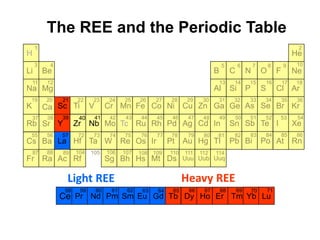
The REE and the Periodic Table
Li
3
H
1
Na
K
Rb
Cs
Fr
Be
Mg
Ca
Sr
Ba
Ra
Sc
Y
La
Ac
Ti
Zr
Hf
Rf
V
Nb
Ta
Cr
Mo
W
Sg
Mn
Tc
Re
Bh
Fe
Ru
Os
Co
Rh
Ir
Ni
Pd
Pt
Ag
Au
Cd
Hg
B
Al
Ga
In
Tl
C
Si
Ge
Sn
Pb
N
P
As
Sb
Bi
O
S
Se
Te
Po
F
Cl
Br
I
At
He
Ne
Ar
Kr
Xe
Rn
11
19
37
55
87
4
12
20
38
56
88
21 22 23 24 25 26 27 28
Cu Zn
29 30 31 32
39 40 41 42 43 44 45 46 47 48 49 50 51 52 53 54
36
18
10
2
5 6 7 8 9
17
16
15
14
13
33 34 35
57 72 73 74 75 76 77 78 79 80 81 82 83 84 85 86
89 104 105 106 107
Hs Mt Ds Uuu Uub Uuq
108 109 110 111 112 114
Ce Pr Nd Pm Sm Eu Gd Tb Dy Ho Er Tm Yb Lu
58 59 60 61 62 63 64 65 66 67 68 69 70 71
Light REE Heavy REE
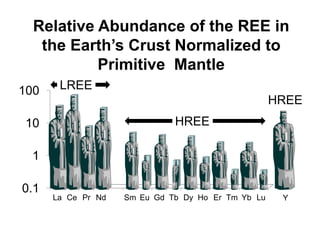
Relative Abundance of the REE in
the Earth’s Crust Normalized to
Primitive Mantle
0.1
1
10
100
La Ce Pr Nd Sm Eu Gd Tb Dy Ho Er Tm Yb Lu Y
LREE
HREE
HREE
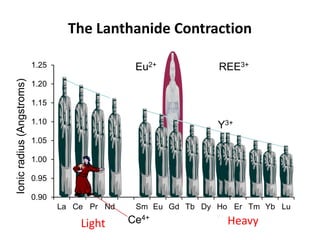
The Lanthanide Contraction
0.90
0.95
1.00
1.05
1.10
1.15
1.20
1.25
La Ce Pr Nd Sm Eu Gd Tb Dy Ho Er Tm Yb Lu
Ce4+
Eu2+ REE3+
Ionic
radius
(Angstroms)
Y3+
Heavy
Light
Y3+
The Oddo-Harkins Rule
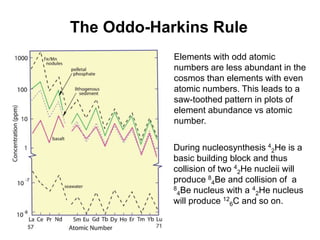
Elements with odd atomic
numbers are less abundant in the
cosmos than elements with even
atomic numbers. This leads to a
saw-toothed pattern in plots of
element abundance vs atomic
number.
During nucleosynthesis 4
2He is a
basic building block and thus
collision of two 4
2He nucleii will
produce 8
4Be and collision of a
8
4Be nucleus with a 4
2He nucleus
will produce 12
6C and so on.
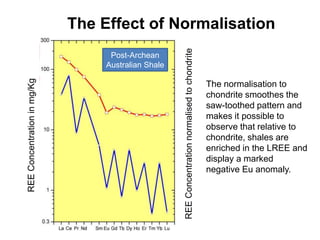
Post-Archean
Australian Shale
REE
Concentration
in
mg/Kg
REE
Concentration
normalised
to
chondrite
The Effect of Normalisation
The normalisation to
chondrite smoothes the
saw-toothed pattern and
makes it possible to
observe that relative to
chondrite, shales are
enriched in the LREE and
display a marked
negative Eu anomaly.
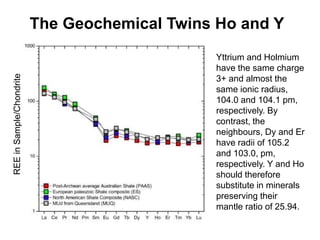
The Geochemical Twins Ho and Y
REE
in
Sample/Chondrite
Yttrium and Holmium
have the same charge
3+ and almost the
same ionic radius,
104.0 and 104.1 pm,
respectively. By
contrast, the
neighbours, Dy and Er
have radii of 105.2
and 103.0, pm,
respectively. Y and Ho
should therefore
substitute in minerals
preserving their
mantle ratio of 25.94.
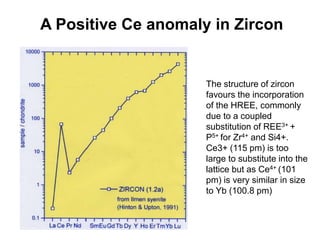
A Positive Ce anomaly in Zircon
The structure of zircon
favours the incorporation
of the HREE, commonly
due to a coupled
substitution of REE3+ +
P5+ for Zr4+ and Si4+.
Ce3+ (115 pm) is too
large to substitute into the
lattice but as Ce4+ (101
pm) is very similar in size
to Yb (100.8 pm)
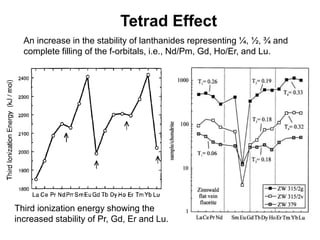
Tetrad Effect
An increase in the stability of lanthanides representing ¼, ½, ¾ and
complete filling of the f-orbitals, i.e., Nd/Pm, Gd, Ho/Er, and Lu.
Third ionization energy showing the
increased stability of Pr, Gd, Er and Lu.
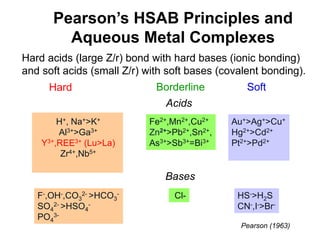
Pearson’s HSAB Principles and
Aqueous Metal Complexes
Hard acids (large Z/r) bond with hard bases (ionic bonding)
and soft acids (small Z/r) with soft bases (covalent bonding).
Hard Borderline Soft
Acids
Fe2+,Mn2+,Cu2+
Zn2+>Pb2+,Sn2+,
As3+>Sb3+=Bi3+
H+, Na+>K+
Al3+>Ga3+
Y3+,REE3+ (Lu>La)
Zr4+,Nb5+
Bases
F-,OH-,CO3
2- >HCO3
-
SO4
2- >HSO4
-
PO4
3-
Cl-
Au+>Ag+>Cu+
Hg2+>Cd2+
Pt2+>Pd2+
HS->H2S
CN-,I->Br-
Pearson (1963)
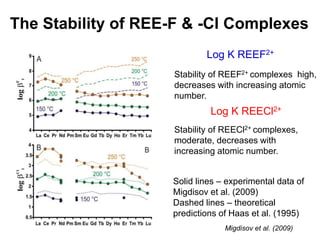
Log K REEF2+
Log K REECl2+
Solid lines – experimental data of
Migdisov et al. (2009)
Dashed lines – theoretical
predictions of Haas et al. (1995)
The Stability of REE-F & -Cl Complexes
Stability of REEF2+ complexes high,
decreases with increasing atomic
number.
Stability of REECl2+ complexes,
moderate, decreases with
increasing atomic number.
Migdisov et al. (2009))
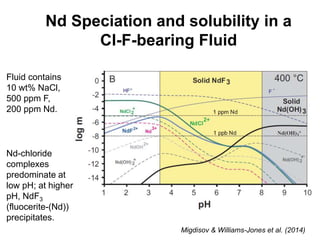
Nd Speciation and solubility in a
Cl-F-bearing Fluid
Fluid contains
10 wt% NaCl,
500 ppm F,
200 ppm Nd.
Migdisov & Williams-Jones et al. (2014)
Nd-chloride
complexes
predominate at
low pH; at higher
pH, NdF3
(fluocerite-(Nd))
precipitates.
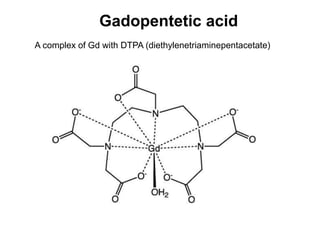
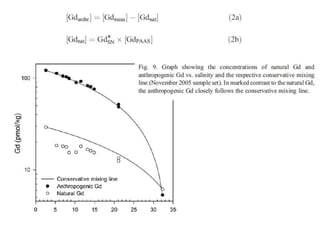
Gadopentetic acid
A complex of Gd with DTPA (diethylenetriaminepentacetate)
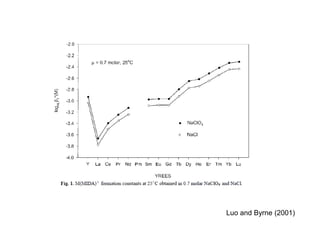
Luo and Byrne (2001)
Rare Earth Elements.pptx

Rare Earth Elements.pptx

  • 1.
  • 2.
    The REE andthe Periodic Table Li 3 H 1 Na K Rb Cs Fr Be Mg Ca Sr Ba Ra Sc Y La Ac Ti Zr Hf Rf V Nb Ta Cr Mo W Sg Mn Tc Re Bh Fe Ru Os Co Rh Ir Ni Pd Pt Ag Au Cd Hg B Al Ga In Tl C Si Ge Sn Pb N P As Sb Bi O S Se Te Po F Cl Br I At He Ne Ar Kr Xe Rn 11 19 37 55 87 4 12 20 38 56 88 21 22 23 24 25 26 27 28 Cu Zn 29 30 31 32 39 40 41 42 43 44 45 46 47 48 49 50 51 52 53 54 36 18 10 2 5 6 7 8 9 17 16 15 14 13 33 34 35 57 72 73 74 75 76 77 78 79 80 81 82 83 84 85 86 89 104 105 106 107 Hs Mt Ds Uuu Uub Uuq 108 109 110 111 112 114 Ce Pr Nd Pm Sm Eu Gd Tb Dy Ho Er Tm Yb Lu 58 59 60 61 62 63 64 65 66 67 68 69 70 71 Light REE Heavy REE
  • 3.
    Relative Abundance ofthe REE in the Earth’s Crust Normalized to Primitive Mantle 0.1 1 10 100 La Ce Pr Nd Sm Eu Gd Tb Dy Ho Er Tm Yb Lu Y LREE HREE HREE
  • 4.
    The Lanthanide Contraction 0.90 0.95 1.00 1.05 1.10 1.15 1.20 1.25 LaCe Pr Nd Sm Eu Gd Tb Dy Ho Er Tm Yb Lu Ce4+ Eu2+ REE3+ Ionic radius (Angstroms) Y3+ Heavy Light Y3+
  • 5.
    The Oddo-Harkins Rule Elementswith odd atomic numbers are less abundant in the cosmos than elements with even atomic numbers. This leads to a saw-toothed pattern in plots of element abundance vs atomic number. During nucleosynthesis 4 2He is a basic building block and thus collision of two 4 2He nucleii will produce 8 4Be and collision of a 8 4Be nucleus with a 4 2He nucleus will produce 12 6C and so on.
  • 6.
    Post-Archean Australian Shale REE Concentration in mg/Kg REE Concentration normalised to chondrite The Effectof Normalisation The normalisation to chondrite smoothes the saw-toothed pattern and makes it possible to observe that relative to chondrite, shales are enriched in the LREE and display a marked negative Eu anomaly.
  • 7.
    The Geochemical TwinsHo and Y REE in Sample/Chondrite Yttrium and Holmium have the same charge 3+ and almost the same ionic radius, 104.0 and 104.1 pm, respectively. By contrast, the neighbours, Dy and Er have radii of 105.2 and 103.0, pm, respectively. Y and Ho should therefore substitute in minerals preserving their mantle ratio of 25.94.
  • 8.
    A Positive Ceanomaly in Zircon The structure of zircon favours the incorporation of the HREE, commonly due to a coupled substitution of REE3+ + P5+ for Zr4+ and Si4+. Ce3+ (115 pm) is too large to substitute into the lattice but as Ce4+ (101 pm) is very similar in size to Yb (100.8 pm)
  • 9.
    Tetrad Effect An increasein the stability of lanthanides representing ¼, ½, ¾ and complete filling of the f-orbitals, i.e., Nd/Pm, Gd, Ho/Er, and Lu. Third ionization energy showing the increased stability of Pr, Gd, Er and Lu.
  • 10.
    Pearson’s HSAB Principlesand Aqueous Metal Complexes Hard acids (large Z/r) bond with hard bases (ionic bonding) and soft acids (small Z/r) with soft bases (covalent bonding). Hard Borderline Soft Acids Fe2+,Mn2+,Cu2+ Zn2+>Pb2+,Sn2+, As3+>Sb3+=Bi3+ H+, Na+>K+ Al3+>Ga3+ Y3+,REE3+ (Lu>La) Zr4+,Nb5+ Bases F-,OH-,CO3 2- >HCO3 - SO4 2- >HSO4 - PO4 3- Cl- Au+>Ag+>Cu+ Hg2+>Cd2+ Pt2+>Pd2+ HS->H2S CN-,I->Br- Pearson (1963)
  • 11.
    Log K REEF2+ LogK REECl2+ Solid lines – experimental data of Migdisov et al. (2009) Dashed lines – theoretical predictions of Haas et al. (1995) The Stability of REE-F & -Cl Complexes Stability of REEF2+ complexes high, decreases with increasing atomic number. Stability of REECl2+ complexes, moderate, decreases with increasing atomic number. Migdisov et al. (2009))
  • 12.
    Nd Speciation andsolubility in a Cl-F-bearing Fluid Fluid contains 10 wt% NaCl, 500 ppm F, 200 ppm Nd. Migdisov & Williams-Jones et al. (2014) Nd-chloride complexes predominate at low pH; at higher pH, NdF3 (fluocerite-(Nd)) precipitates.
  • 13.
    Gadopentetic acid A complexof Gd with DTPA (diethylenetriaminepentacetate)
  • 18.