Population-Based DNA
Variant Analysis
with Golden Helix SVS
Jan 21, 2015
Bryce Christensen, PhD
Statistical Geneticist / Director of Services
Use the Questions pane in
your GoToWebinar window
Questions during
the presentation
Golden Helix
Leaders in Genetic Analytics
 Founded in 1998
 Multi-disciplinary: computer science,
bioinformatics, statistics, genetics
 Software and analytic services
About Golden Helix
Core
Features
Packages
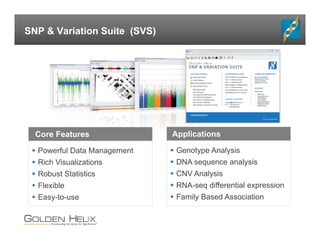
Core Features
 Powerful Data Management
 Rich Visualizations
 Robust Statistics
 Flexible
 Easy-to-use
Applications
 Genotype Analysis
 DNA sequence analysis
 CNV Analysis
 RNA-seq differential expression
 Family Based Association
SNP & Variation Suite (SVS)
Agenda
Overview of RV analysis methods
Method Comparisons
2
3
4
NGS workflow design in SVS
Define the problem: What is rare variant (RV) analysis?1
Upstream analysis and QC considerations5
Q&A6
The Problem
 Array-based GWAS has been the primary technology for gene-
finding research for the past decade
 NGS technology, particularly whole-exome sequencing, makes it
possible to include rare variants (RVs) in the analysis
 Individual RVs lack statistical power for standard GWAS
approaches
- How do we utilize that information?
 Proposed solution: combine RVs into logical groups and analyze
them as a single unit
- AKA “Collapsing” or “Burden” tests.
Two Primary Approaches
 Direct search for susceptibility variants
- Assume highly penetrant variant and/or Mendelian disease
- Extensive reliance on bioinformatics for variant annotation and filtering
- Sample sizes usually small
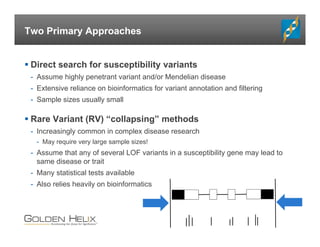
 Rare Variant (RV) “collapsing” methods
- Increasingly common in complex disease research
- May require very large sample sizes!
- Assume that any of several LOF variants in a susceptibility gene may lead to
same disease or trait
- Many statistical tests available
- Also relies heavily on bioinformatics
Families of Collapsing Tests
 Burden Tests
- Combine minor alleles across multiple variant sites…
- Without weighting (CMC, CAST, CMAT)
- With fixed weights based on allele frequency (WSS, RWAS)
- With data-adaptive weights (Lin/Tang, KBAC)
- With data-adaptive thresholds (Step-Up, VT)
- With extensions to allow for effects in either direction (Ionita-Laza/Lange, C-alpha)
 Kernel Tests
- Allow for individual variant effects in either direction and permit covariate
adjustment based on kernel regression
- Kwee et al., AJHG, 2008
- SKAT
- SKAT-O
Credit: Schaid et al., Genet Epi, 2013
Burden Test Methods in SVS
 CMC: Combined Multivariate and Collapsing test
- Multivariate test: simultaneous test for association of common
and rare variants in gene
- Testing methods include Hotelling T2 and Regression
- Li and Leal, AJHG, 2008
 KBAC: Kernel-Based Adaptive Clustering
- Test models the risk associated with multi-locus genotypes in gene regions
- Adaptive weighting procedure that gives higher weights to genotypes with higher
sample risks
- Permutation testing, regression or mixed-model significance testing options
- Liu and Leal, PLoS Genetics, 2010
KBAC: Kernel Based Adaptive Clustering
 Test models the risk associated with multi-locus genotypes at a
per-gene level
 Adaptive weighting procedure that gives higher weights to
genotypes with higher sample risks
 SVS implementation includes option for 1- or 2-tailed test
- But most powerful when all variants in gene have unidirectional effect
 Permutation testing, regression or mixed-model significance
testing options
 Liu and Leal, PLoS Genetics, 2010
SKAT: Sequence Kernel Association Test
 Utilizes kernel machine methods
 Aggregates test statistics of variants over gene region to compute
region level p-values
 Many extensions of the method
 “This method can be more powerful when causal variants have
bidirectional effects and/or a large proportion of the variants within
gene region are non-causal.”
 “SKAT is less powerful than burden tests when causal variant
effects are unidirectional.”
- Liu and Leal, PLoS Genetics, 2012
SKAT-O: Optimized SKAT approach
 Combines a burden test with SKAT test in unified approach
 Burden tests are more powerful when most variants in a region are
causal
 SKAT test is more powerful when variants have effects in different
directions or some variants have no effect
 SKAT-O optimizes power by adaptively weighting the SKAT and
burden results in a combined test
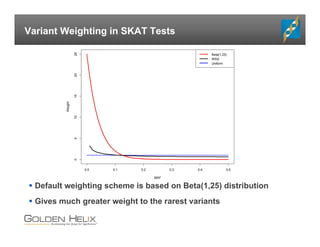
Variant Weighting in SKAT Tests
 Default weighting scheme is based on Beta(1,25) distribution
 Gives much greater weight to the rarest variants
0.0 0.1 0.2 0.3 0.4 0.5
0510152025
MAF
Weight
Beta(1,25)
WSS
Uniform
Bioinformatic Filtering and Annotation
 The genomics community has spent years producing vast
resources of data about DNA sequence variants
- Some data is observational, like variant frequencies from the 1000 genomes
project or the NHLBI Exome Sequencing Project
- Other data is based on predictive algorithms, like PolyPhen or SIFT.
- Even “simple” annotations, like mapping data for genes, segmental duplications
and other sequence features are extremely valuable for analytic workflows.
 These data sources can be used to annotate variants identified in
an NGS experiment
- Annotations may be used for both QC and analysis purposes.
 Once annotated, variants may be filtered, sorted, and prioritized to
help us identify disease-causing mutations
Interactive Demonstration
 SVS 8.3
 Exploratory analysis workflow
- Simulate the development of a burden test
 Formal RV association test workflows
- SKAT and SKAT-O
- KBAC and MM-KBAC
- CMC
NGS Analysis Workflow Development in SVS
 SVS is very flexible in workflow design.
 SVS includes a broad range of tools for data manipulation and
variant annotation and visualization that can be used together to
guide us on an interactive exploration of the data.
 We begin by defining the final goal and the steps needed to help us
reach that goal:
- Are we looking for a very rare, non-synonymous variant that causes a dominant
Mendelian trait?
- Are we looking for a gene with excess rare variation in cases vs controls?
 Once we know what we are looking for, we can identify the
available annotation sources that will help us answer the question.
Data Simulation Process
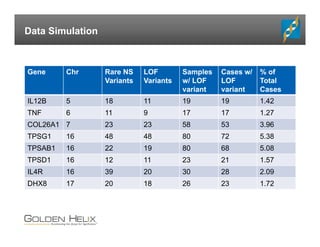
 Begin with 2504 samples from 1000 Genomes Phase 3 data.
 Define LOF variants as:
- MAF<0.01 in NHLBI/ESP 6500 Exomes data
- MAF<0.01 according to dbSNP
- Predicted damaging by at least one of 5 prediction methods in dbNSFP
- (Automatically excludes synonymous, non-coding, and InDel variants)
- Results in 395k variant sites
 Create random binary phenotype
 Adjust phenotypes based on carrying LOF variants in any of eight
genes previously implicated in asthma
 Final: 1338 cases, 1166 controls
 About 18k genes in tests
Data Simulation
Gene Chr Rare NS
Variants
LOF
Variants
Samples
w/ LOF
variant
Cases w/
LOF
variant
% of
Total
Cases
IL12B 5 18 11 19 19 1.42
TNF 6 11 9 17 17 1.27
COL26A1 7 23 23 58 53 3.96
TPSG1 16 48 48 80 72 5.38
TPSAB1 16 22 19 80 68 5.08
TPSD1 16 12 11 23 21 1.57
IL4R 16 39 20 30 28 2.09
DHX8 17 20 18 26 23 1.72
Demonstration
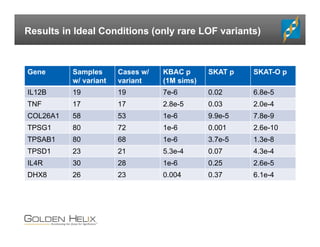
Results in Ideal Conditions (only rare LOF variants)
Gene Samples
w/ variant
Cases w/
variant
KBAC p
(1M sims)
SKAT p SKAT-O p
IL12B 19 19 7e-6 0.02 6.8e-5
TNF 17 17 2.8e-5 0.03 2.0e-4
COL26A1 58 53 1e-6 9.9e-5 7.8e-9
TPSG1 80 72 1e-6 0.001 2.6e-10
TPSAB1 80 68 1e-6 3.7e-5 1.3e-8
TPSD1 23 21 5.3e-4 0.07 4.3e-4
IL4R 30 28 1e-6 0.25 2.6e-5
DHX8 26 23 0.004 0.37 6.1e-4
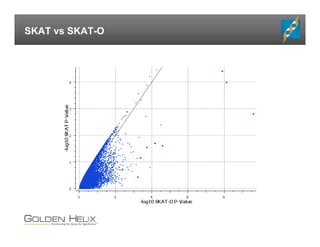
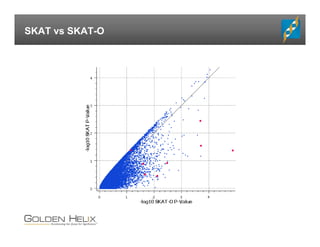
SKAT vs SKAT-O
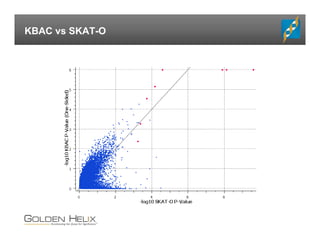
KBAC vs SKAT-O
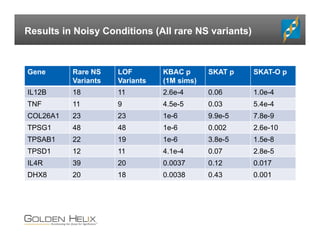
Results in Noisy Conditions (All rare NS variants)
Gene Rare NS
Variants
LOF
Variants
KBAC p
(1M sims)
SKAT p SKAT-O p
IL12B 18 11 2.6e-4 0.06 1.0e-4
TNF 11 9 4.5e-5 0.03 5.4e-4
COL26A1 23 23 1e-6 9.9e-5 7.8e-9
TPSG1 48 48 1e-6 0.002 2.6e-10
TPSAB1 22 19 1e-6 3.8e-5 1.5e-8
TPSD1 12 11 4.1e-4 0.07 2.8e-5
IL4R 39 20 0.0037 0.12 0.017
DHX8 20 18 0.0038 0.43 0.001
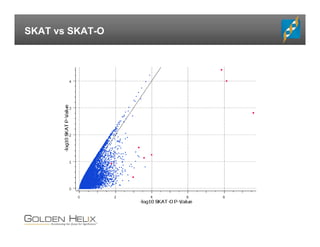
SKAT vs SKAT-O
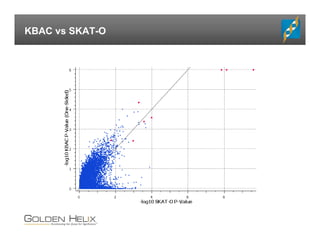
KBAC vs SKAT-O
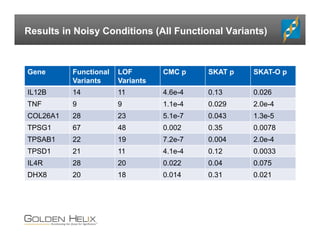
Results in Noisy Conditions (All Functional Variants)
Gene Functional
Variants
LOF
Variants
CMC p SKAT p SKAT-O p
IL12B 14 11 4.6e-4 0.13 0.026
TNF 9 9 1.1e-4 0.029 2.0e-4
COL26A1 28 23 5.1e-7 0.043 1.3e-5
TPSG1 67 48 0.002 0.35 0.0078
TPSAB1 22 19 7.2e-7 0.004 2.0e-4
TPSD1 21 11 4.1e-4 0.12 0.0033
IL4R 28 20 0.022 0.04 0.075
DHX8 20 18 0.014 0.31 0.021
SKAT vs SKAT-O
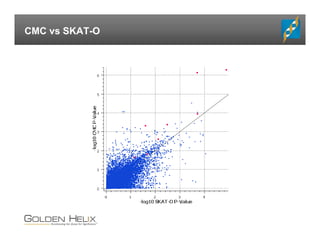
CMC vs SKAT-O
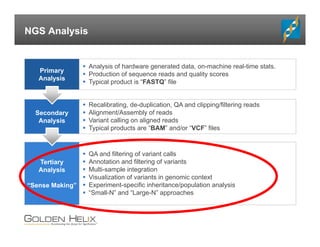
NGS Analysis
Primary
Analysis
Secondary
Analysis
Tertiary
Analysis
“Sense Making”
 Analysis of hardware generated data, on-machine real-time stats.
 Production of sequence reads and quality scores
 Typical product is “FASTQ” file
 Recalibrating, de-duplication, QA and clipping/filtering reads
 Alignment/Assembly of reads
 Variant calling on aligned reads
 Typical products are “BAM” and/or “VCF” files
 QA and filtering of variant calls
 Annotation and filtering of variants
 Multi-sample integration
 Visualization of variants in genomic context
 Experiment-specific inheritance/population analysis
 “Small-N” and “Large-N” approaches
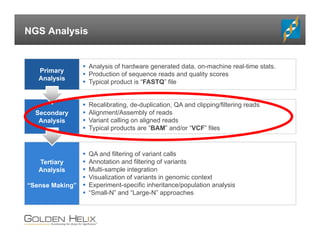
NGS Analysis
Primary
Analysis
Secondary
Analysis
Tertiary
Analysis
“Sense Making”
 Analysis of hardware generated data, on-machine real-time stats.
 Production of sequence reads and quality scores
 Typical product is “FASTQ” file
 Recalibrating, de-duplication, QA and clipping/filtering reads
 Alignment/Assembly of reads
 Variant calling on aligned reads
 Typical products are “BAM” and/or “VCF” files
 QA and filtering of variant calls
 Annotation and filtering of variants
 Multi-sample integration
 Visualization of variants in genomic context
 Experiment-specific inheritance/population analysis
 “Small-N” and “Large-N” approaches
Secondary Analysis and QC Considerations
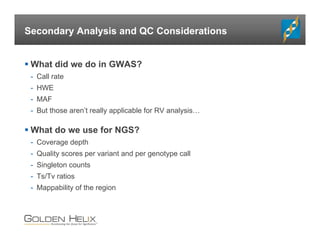
 What did we do in GWAS?
- Call rate
- HWE
- MAF
- But those aren’t really applicable for RV analysis…
 What do we use for NGS?
- Coverage depth
- Quality scores per variant and per genotype call
- Singleton counts
- Ts/Tv ratios
- Mappability of the region
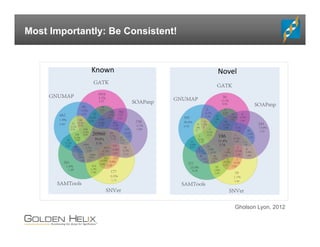
Most Importantly: Be Consistent!
Gholson Lyon, 2012
What about common variants?
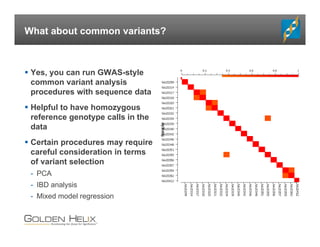
 Yes, you can run GWAS-style
common variant analysis
procedures with sequence data
 Helpful to have homozygous
reference genotype calls in the
data
 Certain procedures may require
careful consideration in terms
of variant selection
- PCA
- IBD analysis
- Mixed model regression
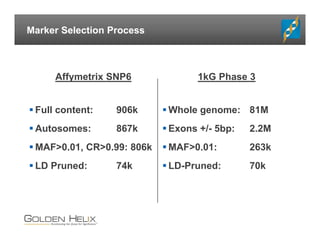
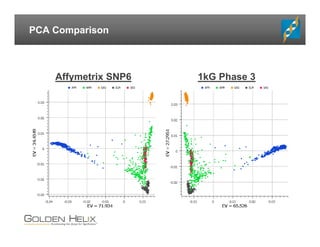
Marker Selection Process
Affymetrix SNP6
 Full content: 906k
 Autosomes: 867k
 MAF>0.01, CR>0.99: 806k
 LD Pruned: 74k
1kG Phase 3
 Whole genome: 81M
 Exons +/- 5bp: 2.2M
 MAF>0.01: 263k
 LD-Pruned: 70k
PCA Comparison
Affymetrix SNP6 1kG Phase 3
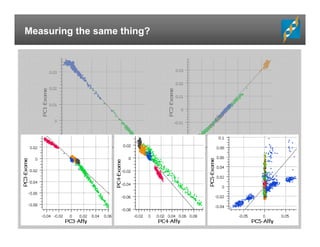
Measuring the same thing?
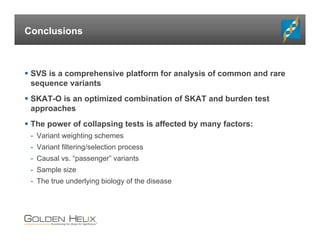
Conclusions
 SVS is a comprehensive platform for analysis of common and rare
sequence variants
 SKAT-O is an optimized combination of SKAT and burden test
approaches
 The power of collapsing tests is affected by many factors:
- Variant weighting schemes
- Variant filtering/selection process
- Causal vs. “passenger” variants
- Sample size
- The true underlying biology of the disease
Questions or
more info:
 info@goldenhelix.com
 Request a copy of SVS at
www.goldenhelix.com
 Download GenomeBrowse
for free at
www.GenomeBrowse.com
Use the Questions pane in
your GoToWebinar window
Any Questions?

Population-Based DNA Variant Analysis

  • 1.
    Population-Based DNA Variant Analysis withGolden Helix SVS Jan 21, 2015 Bryce Christensen, PhD Statistical Geneticist / Director of Services
  • 2.
    Use the Questionspane in your GoToWebinar window Questions during the presentation
  • 3.
    Golden Helix Leaders inGenetic Analytics  Founded in 1998  Multi-disciplinary: computer science, bioinformatics, statistics, genetics  Software and analytic services About Golden Helix
  • 4.
    Core Features Packages Core Features  PowerfulData Management  Rich Visualizations  Robust Statistics  Flexible  Easy-to-use Applications  Genotype Analysis  DNA sequence analysis  CNV Analysis  RNA-seq differential expression  Family Based Association SNP & Variation Suite (SVS)
  • 5.
    Agenda Overview of RVanalysis methods Method Comparisons 2 3 4 NGS workflow design in SVS Define the problem: What is rare variant (RV) analysis?1 Upstream analysis and QC considerations5 Q&A6
  • 6.
    The Problem  Array-basedGWAS has been the primary technology for gene- finding research for the past decade  NGS technology, particularly whole-exome sequencing, makes it possible to include rare variants (RVs) in the analysis  Individual RVs lack statistical power for standard GWAS approaches - How do we utilize that information?  Proposed solution: combine RVs into logical groups and analyze them as a single unit - AKA “Collapsing” or “Burden” tests.
  • 7.
    Two Primary Approaches Direct search for susceptibility variants - Assume highly penetrant variant and/or Mendelian disease - Extensive reliance on bioinformatics for variant annotation and filtering - Sample sizes usually small  Rare Variant (RV) “collapsing” methods - Increasingly common in complex disease research - May require very large sample sizes! - Assume that any of several LOF variants in a susceptibility gene may lead to same disease or trait - Many statistical tests available - Also relies heavily on bioinformatics
  • 8.
    Families of CollapsingTests  Burden Tests - Combine minor alleles across multiple variant sites… - Without weighting (CMC, CAST, CMAT) - With fixed weights based on allele frequency (WSS, RWAS) - With data-adaptive weights (Lin/Tang, KBAC) - With data-adaptive thresholds (Step-Up, VT) - With extensions to allow for effects in either direction (Ionita-Laza/Lange, C-alpha)  Kernel Tests - Allow for individual variant effects in either direction and permit covariate adjustment based on kernel regression - Kwee et al., AJHG, 2008 - SKAT - SKAT-O Credit: Schaid et al., Genet Epi, 2013
  • 9.
    Burden Test Methodsin SVS  CMC: Combined Multivariate and Collapsing test - Multivariate test: simultaneous test for association of common and rare variants in gene - Testing methods include Hotelling T2 and Regression - Li and Leal, AJHG, 2008  KBAC: Kernel-Based Adaptive Clustering - Test models the risk associated with multi-locus genotypes in gene regions - Adaptive weighting procedure that gives higher weights to genotypes with higher sample risks - Permutation testing, regression or mixed-model significance testing options - Liu and Leal, PLoS Genetics, 2010
  • 10.
    KBAC: Kernel BasedAdaptive Clustering  Test models the risk associated with multi-locus genotypes at a per-gene level  Adaptive weighting procedure that gives higher weights to genotypes with higher sample risks  SVS implementation includes option for 1- or 2-tailed test - But most powerful when all variants in gene have unidirectional effect  Permutation testing, regression or mixed-model significance testing options  Liu and Leal, PLoS Genetics, 2010
  • 11.
    SKAT: Sequence KernelAssociation Test  Utilizes kernel machine methods  Aggregates test statistics of variants over gene region to compute region level p-values  Many extensions of the method  “This method can be more powerful when causal variants have bidirectional effects and/or a large proportion of the variants within gene region are non-causal.”  “SKAT is less powerful than burden tests when causal variant effects are unidirectional.” - Liu and Leal, PLoS Genetics, 2012
  • 12.
    SKAT-O: Optimized SKATapproach  Combines a burden test with SKAT test in unified approach  Burden tests are more powerful when most variants in a region are causal  SKAT test is more powerful when variants have effects in different directions or some variants have no effect  SKAT-O optimizes power by adaptively weighting the SKAT and burden results in a combined test
  • 13.
    Variant Weighting inSKAT Tests  Default weighting scheme is based on Beta(1,25) distribution  Gives much greater weight to the rarest variants 0.0 0.1 0.2 0.3 0.4 0.5 0510152025 MAF Weight Beta(1,25) WSS Uniform
  • 14.
    Bioinformatic Filtering andAnnotation  The genomics community has spent years producing vast resources of data about DNA sequence variants - Some data is observational, like variant frequencies from the 1000 genomes project or the NHLBI Exome Sequencing Project - Other data is based on predictive algorithms, like PolyPhen or SIFT. - Even “simple” annotations, like mapping data for genes, segmental duplications and other sequence features are extremely valuable for analytic workflows.  These data sources can be used to annotate variants identified in an NGS experiment - Annotations may be used for both QC and analysis purposes.  Once annotated, variants may be filtered, sorted, and prioritized to help us identify disease-causing mutations
  • 15.
    Interactive Demonstration  SVS8.3  Exploratory analysis workflow - Simulate the development of a burden test  Formal RV association test workflows - SKAT and SKAT-O - KBAC and MM-KBAC - CMC
  • 16.
    NGS Analysis WorkflowDevelopment in SVS  SVS is very flexible in workflow design.  SVS includes a broad range of tools for data manipulation and variant annotation and visualization that can be used together to guide us on an interactive exploration of the data.  We begin by defining the final goal and the steps needed to help us reach that goal: - Are we looking for a very rare, non-synonymous variant that causes a dominant Mendelian trait? - Are we looking for a gene with excess rare variation in cases vs controls?  Once we know what we are looking for, we can identify the available annotation sources that will help us answer the question.
  • 17.
    Data Simulation Process Begin with 2504 samples from 1000 Genomes Phase 3 data.  Define LOF variants as: - MAF<0.01 in NHLBI/ESP 6500 Exomes data - MAF<0.01 according to dbSNP - Predicted damaging by at least one of 5 prediction methods in dbNSFP - (Automatically excludes synonymous, non-coding, and InDel variants) - Results in 395k variant sites  Create random binary phenotype  Adjust phenotypes based on carrying LOF variants in any of eight genes previously implicated in asthma  Final: 1338 cases, 1166 controls  About 18k genes in tests
  • 18.
    Data Simulation Gene ChrRare NS Variants LOF Variants Samples w/ LOF variant Cases w/ LOF variant % of Total Cases IL12B 5 18 11 19 19 1.42 TNF 6 11 9 17 17 1.27 COL26A1 7 23 23 58 53 3.96 TPSG1 16 48 48 80 72 5.38 TPSAB1 16 22 19 80 68 5.08 TPSD1 16 12 11 23 21 1.57 IL4R 16 39 20 30 28 2.09 DHX8 17 20 18 26 23 1.72
  • 19.
  • 20.
    Results in IdealConditions (only rare LOF variants) Gene Samples w/ variant Cases w/ variant KBAC p (1M sims) SKAT p SKAT-O p IL12B 19 19 7e-6 0.02 6.8e-5 TNF 17 17 2.8e-5 0.03 2.0e-4 COL26A1 58 53 1e-6 9.9e-5 7.8e-9 TPSG1 80 72 1e-6 0.001 2.6e-10 TPSAB1 80 68 1e-6 3.7e-5 1.3e-8 TPSD1 23 21 5.3e-4 0.07 4.3e-4 IL4R 30 28 1e-6 0.25 2.6e-5 DHX8 26 23 0.004 0.37 6.1e-4
  • 21.
  • 22.
  • 23.
    Results in NoisyConditions (All rare NS variants) Gene Rare NS Variants LOF Variants KBAC p (1M sims) SKAT p SKAT-O p IL12B 18 11 2.6e-4 0.06 1.0e-4 TNF 11 9 4.5e-5 0.03 5.4e-4 COL26A1 23 23 1e-6 9.9e-5 7.8e-9 TPSG1 48 48 1e-6 0.002 2.6e-10 TPSAB1 22 19 1e-6 3.8e-5 1.5e-8 TPSD1 12 11 4.1e-4 0.07 2.8e-5 IL4R 39 20 0.0037 0.12 0.017 DHX8 20 18 0.0038 0.43 0.001
  • 24.
  • 25.
  • 26.
    Results in NoisyConditions (All Functional Variants) Gene Functional Variants LOF Variants CMC p SKAT p SKAT-O p IL12B 14 11 4.6e-4 0.13 0.026 TNF 9 9 1.1e-4 0.029 2.0e-4 COL26A1 28 23 5.1e-7 0.043 1.3e-5 TPSG1 67 48 0.002 0.35 0.0078 TPSAB1 22 19 7.2e-7 0.004 2.0e-4 TPSD1 21 11 4.1e-4 0.12 0.0033 IL4R 28 20 0.022 0.04 0.075 DHX8 20 18 0.014 0.31 0.021
  • 27.
  • 28.
  • 29.
    NGS Analysis Primary Analysis Secondary Analysis Tertiary Analysis “Sense Making” Analysis of hardware generated data, on-machine real-time stats.  Production of sequence reads and quality scores  Typical product is “FASTQ” file  Recalibrating, de-duplication, QA and clipping/filtering reads  Alignment/Assembly of reads  Variant calling on aligned reads  Typical products are “BAM” and/or “VCF” files  QA and filtering of variant calls  Annotation and filtering of variants  Multi-sample integration  Visualization of variants in genomic context  Experiment-specific inheritance/population analysis  “Small-N” and “Large-N” approaches
  • 30.
    NGS Analysis Primary Analysis Secondary Analysis Tertiary Analysis “Sense Making” Analysis of hardware generated data, on-machine real-time stats.  Production of sequence reads and quality scores  Typical product is “FASTQ” file  Recalibrating, de-duplication, QA and clipping/filtering reads  Alignment/Assembly of reads  Variant calling on aligned reads  Typical products are “BAM” and/or “VCF” files  QA and filtering of variant calls  Annotation and filtering of variants  Multi-sample integration  Visualization of variants in genomic context  Experiment-specific inheritance/population analysis  “Small-N” and “Large-N” approaches
  • 31.
    Secondary Analysis andQC Considerations  What did we do in GWAS? - Call rate - HWE - MAF - But those aren’t really applicable for RV analysis…  What do we use for NGS? - Coverage depth - Quality scores per variant and per genotype call - Singleton counts - Ts/Tv ratios - Mappability of the region
  • 32.
    Most Importantly: BeConsistent! Gholson Lyon, 2012
  • 33.
    What about commonvariants?  Yes, you can run GWAS-style common variant analysis procedures with sequence data  Helpful to have homozygous reference genotype calls in the data  Certain procedures may require careful consideration in terms of variant selection - PCA - IBD analysis - Mixed model regression
  • 34.
    Marker Selection Process AffymetrixSNP6  Full content: 906k  Autosomes: 867k  MAF>0.01, CR>0.99: 806k  LD Pruned: 74k 1kG Phase 3  Whole genome: 81M  Exons +/- 5bp: 2.2M  MAF>0.01: 263k  LD-Pruned: 70k
  • 35.
  • 36.
  • 37.
    Conclusions  SVS isa comprehensive platform for analysis of common and rare sequence variants  SKAT-O is an optimized combination of SKAT and burden test approaches  The power of collapsing tests is affected by many factors: - Variant weighting schemes - Variant filtering/selection process - Causal vs. “passenger” variants - Sample size - The true underlying biology of the disease
  • 38.
    Questions or more info: info@goldenhelix.com  Request a copy of SVS at www.goldenhelix.com  Download GenomeBrowse for free at www.GenomeBrowse.com
  • 39.
    Use the Questionspane in your GoToWebinar window Any Questions?