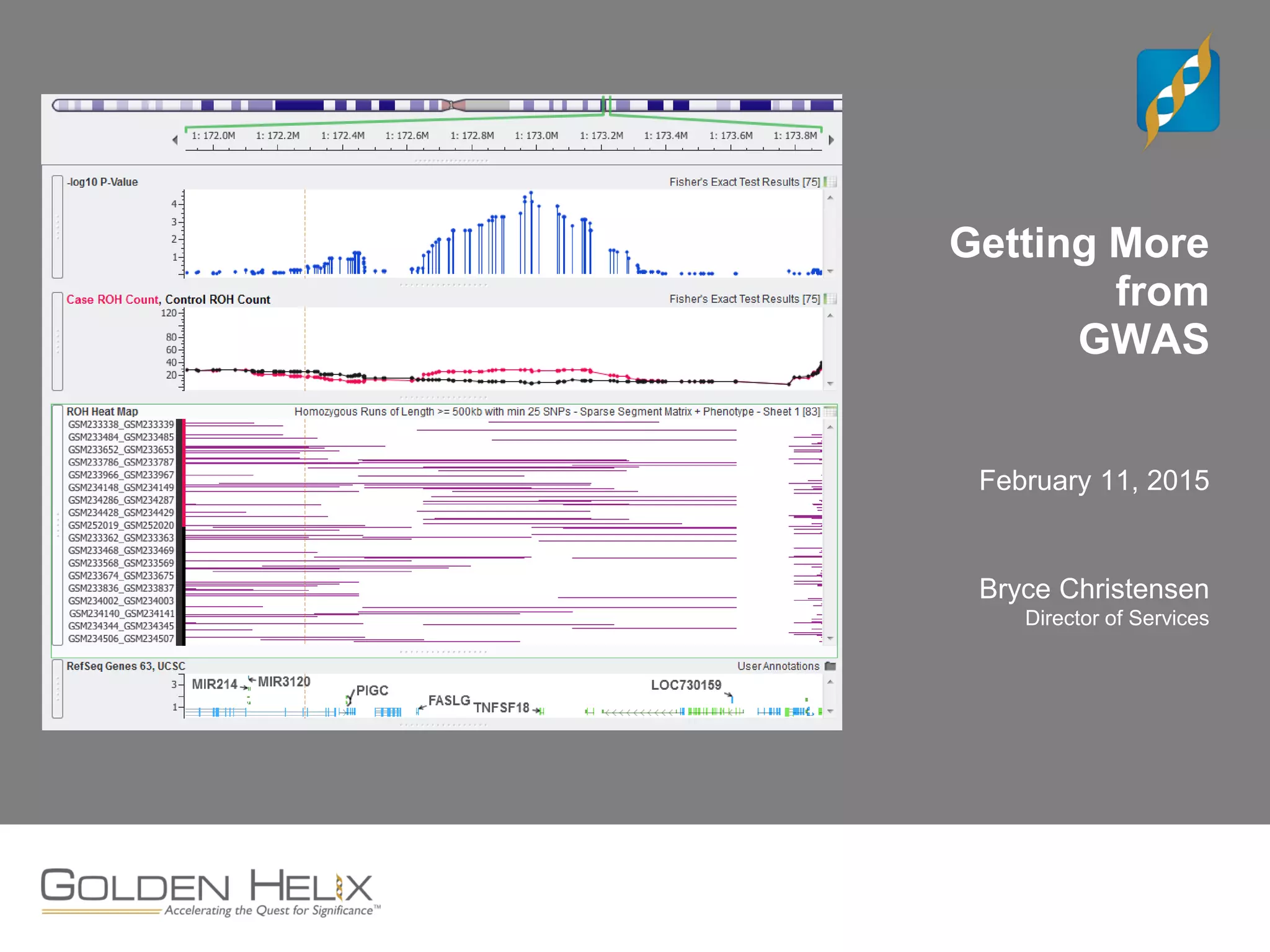
Getting More
from
GWAS
February 11, 2015
Bryce Christensen
Director of Services
Use the Questions pane in
your GoToWebinar window
Questions during
the presentation
Golden Helix
Leaders in Genetic Analytics
 Founded in 1998
 Multi-disciplinary: computer science,
bioinformatics, statistics, genetics
 Software and analytic services
 Hundreds of literature citations
About Golden Helix
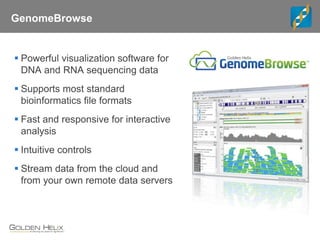
GenomeBrowse
 Powerful visualization software for
DNA and RNA sequencing data
 Supports most standard
bioinformatics file formats
 Fast and responsive for interactive
analysis
 Intuitive controls
 Stream data from the cloud and
from your own remote data servers
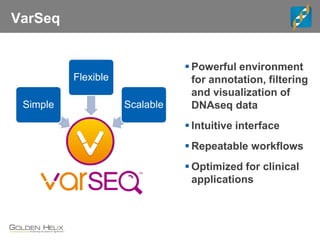
VarSeq
VarSeq
Simple
Flexible
Scalable
 Powerful environment
for annotation, filtering
and visualization of
DNAseq data
 Intuitive interface
 Repeatable workflows
 Optimized for clinical
applications
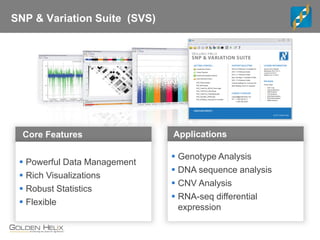
Core
Features
Packages
Core Features
 Powerful Data Management
 Rich Visualizations
 Robust Statistics
 Flexible
Applications
 Genotype Analysis
 DNA sequence analysis
 CNV Analysis
 RNA-seq differential
expression
SNP & Variation Suite (SVS)
Approximate Agenda
Haplotypes and Haplotype Testing
Q&A
2
3
4
Runs of Homozygosity
GWAS Background1
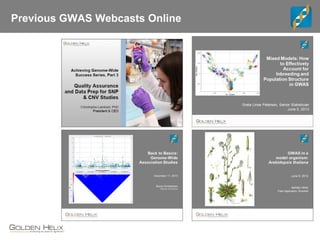
Previous GWAS Webcasts Online
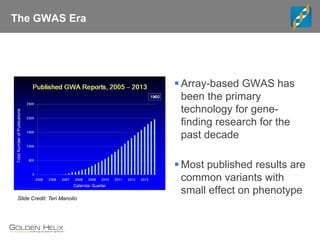
The GWAS Era
 Array-based GWAS has
been the primary
technology for gene-
finding research for the
past decade
 Most published results are
common variants with
small effect on phenotype
Slide Credit: Teri Manolio
GWAS is based on tag-SNPs
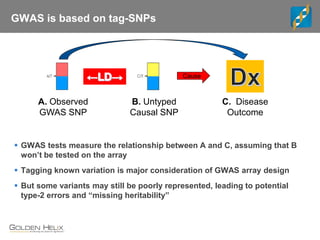
 GWAS tests measure the relationship between A and C, assuming that B
won’t be tested on the array
 Tagging known variation is major consideration of GWAS array design
 But some variants may still be poorly represented, leading to potential
type-2 errors and “missing heritability”
A. Observed
GWAS SNP
B. Untyped
Causal SNP
C. Disease
Outcome
Cause
How to get more from GWAS
 Can we learn more from existing
data?
 Collecting more samples or investing
in NGS isn’t always possible.
 Combinations of neighboring
markers may give a better
representation of some un-
genotyped SNPs.
 Haplotypes capture greater allelic
diversity than individual SNPs.
 Runs of homozygosity (ROH) can
capture trait associations that aren’t
specific to a particular allele.
From tag-SNPs to Haplotypes
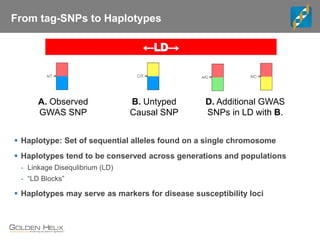
A. Observed
GWAS SNP
B. Untyped
Causal SNP
D. Additional GWAS
SNPs in LD with B.
 Haplotype: Set of sequential alleles found on a single chromosome
 Haplotypes tend to be conserved across generations and populations
- Linkage Disequlibrium (LD)
- “LD Blocks”
 Haplotypes may serve as markers for disease susceptibility loci
Inference from Haplotypes
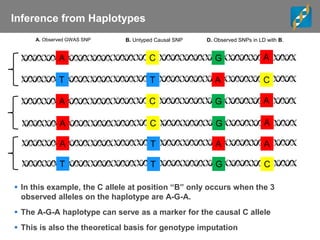
 In this example, the C allele at position “B” only occurs when the 3
observed alleles on the haplotype are A-G-A.
 The A-G-A haplotype can serve as a marker for the causal C allele
 This is also the theoretical basis for genotype imputation
A. Observed GWAS SNP B. Untyped Causal SNP D. Observed SNPs in LD with B.
A
A
AG
T
C
T C
A AGC
A AGC
GT T C
AA T A
Demonstration
Haplotype Estimation
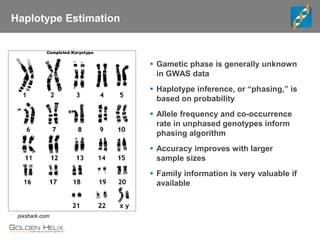
 Gametic phase is generally unknown
in GWAS data
 Haplotype inference, or “phasing,” is
based on probability
 Allele frequency and co-occurrence
rate in unphased genotypes inform
phasing algorithm
 Accuracy improves with larger
sample sizes
 Family information is very valuable if
available
pixshark.com
Haplotype Estimation in SVS
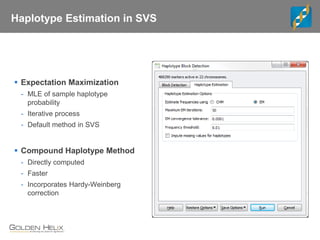
 Expectation Maximization
- MLE of sample haplotype
probability
- Iterative process
- Default method in SVS
 Compound Haplotype Method
- Directly computed
- Faster
- Incorporates Hardy-Weinberg
correction
Options to Identify Haplotypes in SVS
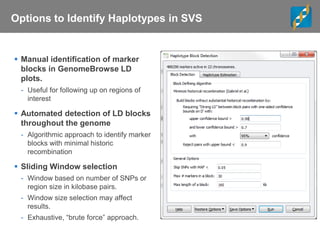
 Manual identification of marker
blocks in GenomeBrowse LD
plots.
- Useful for following up on regions of
interest
 Automated detection of LD blocks
throughout the genome
- Algorithmic approach to identify marker
blocks with minimal historic
recombination
 Sliding Window selection
- Window based on number of SNPs or
region size in kilobase pairs.
- Window size selection may affect
results.
- Exhaustive, “brute force” approach.
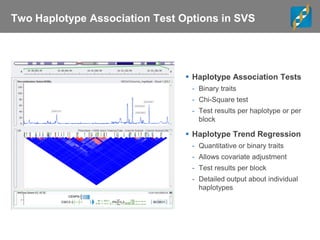
Two Haplotype Association Test Options in SVS
 Haplotype Association Tests
- Binary traits
- Chi-Square test
- Test results per haplotype or per
block
 Haplotype Trend Regression
- Quantitative or binary traits
- Allows covariate adjustment
- Test results per block
- Detailed output about individual
haplotypes
Demonstration
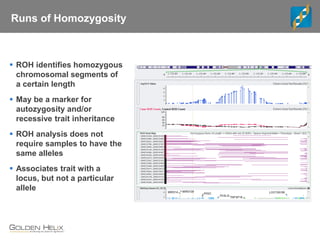
Runs of Homozygosity
 ROH identifies homozygous
chromosomal segments of
a certain length
 May be a marker for
autozygosity and/or
recessive trait inheritance
 ROH analysis does not
require samples to have the
same alleles
 Associates trait with a
locus, but not a particular
allele
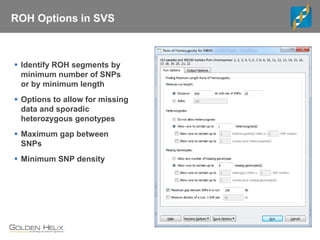
ROH Options in SVS
 Identify ROH segments by
minimum number of SNPs
or by minimum length
 Options to allow for missing
data and sporadic
heterozygous genotypes
 Maximum gap between
SNPs
 Minimum SNP density
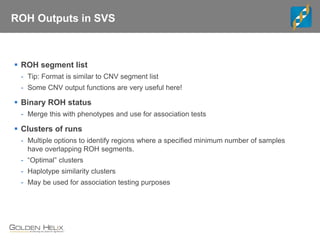
ROH Outputs in SVS
 ROH segment list
- Tip: Format is similar to CNV segment list
- Some CNV output functions are very useful here!
 Binary ROH status
- Merge this with phenotypes and use for association tests
 Clusters of runs
- Multiple options to identify regions where a specified minimum number of samples
have overlapping ROH segments.
- “Optimal” clusters
- Haplotype similarity clusters
- May be used for association testing purposes
Demonstration
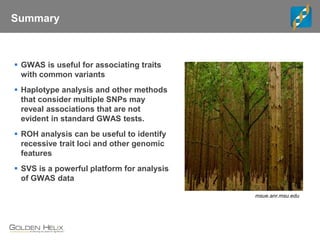
Summary
 GWAS is useful for associating traits
with common variants
 Haplotype analysis and other methods
that consider multiple SNPs may
reveal associations that are not
evident in standard GWAS tests.
 ROH analysis can be useful to identify
recessive trait loci and other genomic
features
 SVS is a powerful platform for analysis
of GWAS data
msue.anr.msu.edu
Questions or
more info:
 Email
info@goldenhelix.com
 Request an evaluation of
the software at
www.goldenhelix.com
 Check out our abstract
competition!
Questions?
Use the Questions pane in
your GoToWebinar window

Getting More from GWAS

  • 1.
    Getting More from GWAS February 11,2015 Bryce Christensen Director of Services
  • 2.
    Use the Questionspane in your GoToWebinar window Questions during the presentation
  • 3.
    Golden Helix Leaders inGenetic Analytics  Founded in 1998  Multi-disciplinary: computer science, bioinformatics, statistics, genetics  Software and analytic services  Hundreds of literature citations About Golden Helix
  • 4.
    GenomeBrowse  Powerful visualizationsoftware for DNA and RNA sequencing data  Supports most standard bioinformatics file formats  Fast and responsive for interactive analysis  Intuitive controls  Stream data from the cloud and from your own remote data servers
  • 5.
    VarSeq VarSeq Simple Flexible Scalable  Powerful environment forannotation, filtering and visualization of DNAseq data  Intuitive interface  Repeatable workflows  Optimized for clinical applications
  • 6.
    Core Features Packages Core Features  PowerfulData Management  Rich Visualizations  Robust Statistics  Flexible Applications  Genotype Analysis  DNA sequence analysis  CNV Analysis  RNA-seq differential expression SNP & Variation Suite (SVS)
  • 7.
    Approximate Agenda Haplotypes andHaplotype Testing Q&A 2 3 4 Runs of Homozygosity GWAS Background1
  • 8.
  • 9.
    The GWAS Era Array-based GWAS has been the primary technology for gene- finding research for the past decade  Most published results are common variants with small effect on phenotype Slide Credit: Teri Manolio
  • 10.
    GWAS is basedon tag-SNPs  GWAS tests measure the relationship between A and C, assuming that B won’t be tested on the array  Tagging known variation is major consideration of GWAS array design  But some variants may still be poorly represented, leading to potential type-2 errors and “missing heritability” A. Observed GWAS SNP B. Untyped Causal SNP C. Disease Outcome Cause
  • 11.
    How to getmore from GWAS  Can we learn more from existing data?  Collecting more samples or investing in NGS isn’t always possible.  Combinations of neighboring markers may give a better representation of some un- genotyped SNPs.  Haplotypes capture greater allelic diversity than individual SNPs.  Runs of homozygosity (ROH) can capture trait associations that aren’t specific to a particular allele.
  • 12.
    From tag-SNPs toHaplotypes A. Observed GWAS SNP B. Untyped Causal SNP D. Additional GWAS SNPs in LD with B.  Haplotype: Set of sequential alleles found on a single chromosome  Haplotypes tend to be conserved across generations and populations - Linkage Disequlibrium (LD) - “LD Blocks”  Haplotypes may serve as markers for disease susceptibility loci
  • 13.
    Inference from Haplotypes In this example, the C allele at position “B” only occurs when the 3 observed alleles on the haplotype are A-G-A.  The A-G-A haplotype can serve as a marker for the causal C allele  This is also the theoretical basis for genotype imputation A. Observed GWAS SNP B. Untyped Causal SNP D. Observed SNPs in LD with B. A A AG T C T C A AGC A AGC GT T C AA T A
  • 14.
  • 15.
    Haplotype Estimation  Gameticphase is generally unknown in GWAS data  Haplotype inference, or “phasing,” is based on probability  Allele frequency and co-occurrence rate in unphased genotypes inform phasing algorithm  Accuracy improves with larger sample sizes  Family information is very valuable if available pixshark.com
  • 16.
    Haplotype Estimation inSVS  Expectation Maximization - MLE of sample haplotype probability - Iterative process - Default method in SVS  Compound Haplotype Method - Directly computed - Faster - Incorporates Hardy-Weinberg correction
  • 17.
    Options to IdentifyHaplotypes in SVS  Manual identification of marker blocks in GenomeBrowse LD plots. - Useful for following up on regions of interest  Automated detection of LD blocks throughout the genome - Algorithmic approach to identify marker blocks with minimal historic recombination  Sliding Window selection - Window based on number of SNPs or region size in kilobase pairs. - Window size selection may affect results. - Exhaustive, “brute force” approach.
  • 18.
    Two Haplotype AssociationTest Options in SVS  Haplotype Association Tests - Binary traits - Chi-Square test - Test results per haplotype or per block  Haplotype Trend Regression - Quantitative or binary traits - Allows covariate adjustment - Test results per block - Detailed output about individual haplotypes
  • 19.
  • 20.
    Runs of Homozygosity ROH identifies homozygous chromosomal segments of a certain length  May be a marker for autozygosity and/or recessive trait inheritance  ROH analysis does not require samples to have the same alleles  Associates trait with a locus, but not a particular allele
  • 21.
    ROH Options inSVS  Identify ROH segments by minimum number of SNPs or by minimum length  Options to allow for missing data and sporadic heterozygous genotypes  Maximum gap between SNPs  Minimum SNP density
  • 22.
    ROH Outputs inSVS  ROH segment list - Tip: Format is similar to CNV segment list - Some CNV output functions are very useful here!  Binary ROH status - Merge this with phenotypes and use for association tests  Clusters of runs - Multiple options to identify regions where a specified minimum number of samples have overlapping ROH segments. - “Optimal” clusters - Haplotype similarity clusters - May be used for association testing purposes
  • 23.
  • 24.
    Summary  GWAS isuseful for associating traits with common variants  Haplotype analysis and other methods that consider multiple SNPs may reveal associations that are not evident in standard GWAS tests.  ROH analysis can be useful to identify recessive trait loci and other genomic features  SVS is a powerful platform for analysis of GWAS data msue.anr.msu.edu
  • 25.
    Questions or more info: Email info@goldenhelix.com  Request an evaluation of the software at www.goldenhelix.com  Check out our abstract competition!
  • 26.
    Questions? Use the Questionspane in your GoToWebinar window