Download to read offline


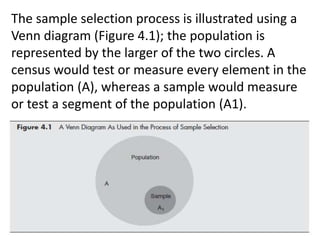



This document discusses population and sampling methods used in research. It defines a population as the entire group being studied, while a sample is a subset of the population that is representative of it. There are two main types of sampling: probability sampling, which allows researchers to calculate sampling error, and nonprobability sampling, which does not. Some examples of nonprobability sampling methods provided are convenience sampling, volunteer sampling, purposive sampling, and snowball sampling. Probability sampling methods discussed include simple random sampling, systematic random sampling, stratified sampling, and cluster sampling.


![BS M2U2 [Autosaved].pptx biostatistics module](https://cdn.slidesharecdn.com/ss_thumbnails/bsm2u2autosaved-250815133911-fdd8cc10-thumbnail.jpg?width=640&height=640&fit=bounds)


