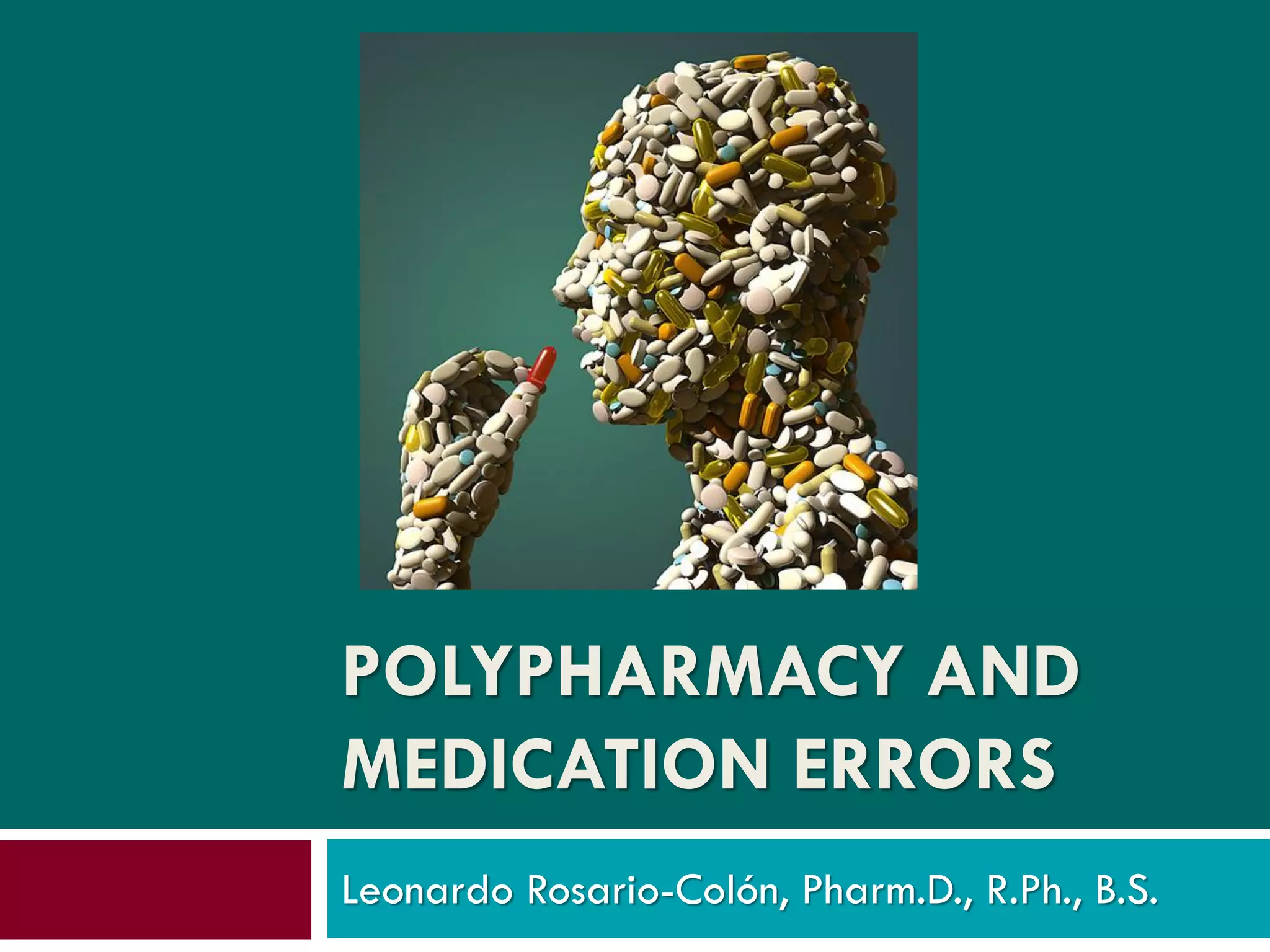
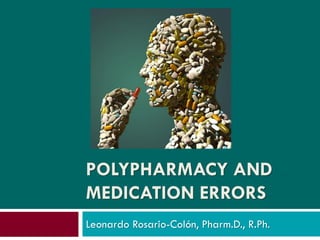
POLYPHARMACY AND
MEDICATION ERRORS
Leonardo Rosario-Colón, Pharm.D., R.Ph., B.S.
Objectives
 Goals and Objectives: The goal of this activity is to help providers in
all settings develop a better knowledge base from which they can
prevent polypharmacy and medication errors.
 Upon completion of this activity, the learner will be able to:
 Discuss the impact of polypharmacy and medication errors.
 List different types and/or risk factors of polypharmacy and medication
errors.
 Describe potential problems with using medical abbreviations.
 Identify the different problems that can be caused by drug names.
 Define at-risk behaviors as they relate to polypharmacy and medication
errors.
 Discuss different ways individuals and organizations can reduce the risk
of medication errors.
 Explain what should be done if a medication error has occurred.
2
POLYPHARMACY
What is Polypharmacy?
 Use of multiple medications for the treatment of a
patient's medical conditions
 More medication is being used than is clinically
indicated
 Inappropriate polypharmacy imposes a substantial
burden of adverse drug events, ill health, disability,
hospitalization, and even death
Hajjar ER, Cafiero AC, Hanlon JT. Polypharmacy in elderly patients. Am J Geriatr Pharmacother. 2007;5(4):345-351.
4
Polypharmacy Risk Factors
 Elderly
 Multiple comorbid conditions
 Recent hospitalization
 Multiple physicians
 Multiple pharmacies
 Inappropriate medication
 Poor documentation
5
Healthcare Provider’s Factors
 No patient’s medication review on regular basis
 Provides unclear, complex or incomplete instructions
 No effort to simplify medication regimen
 Ordering automatic refills
 Lack of knowledge
6
Patient’s Factors
 Multiple providers and/or pharmacies
 Insisting on taking inappropriate drugs
 Inaccurately report meds taken or symptoms
 Assumption that all medications needs to be
continued once started
 Changes in lifestyle activities
7
Negative Outcomes
 Polypharmacy has been shown to increase:
 Unnecessary / inappropriate medication prescribing
 Risk of drug interactions / adverse drug reactions
 Medication nonadherence
 Overall drug expenditures
8
Example
 85 y/o woman with a prescription of Amitriptyline
50mg at bedtime for insomnia.
 Side effects:
 Constipation
 Urinary Incontinence
 Dizziness
 Dry mouth
 Dry eyes
 Possible new medications:
 Docusate with senna
 Oxybutinin
 Eye drops
9
Management of Polypharmacy
 Obtain an accurate medication and medical history
 Link each prescribed medication to a disease state
 Identify medications that are treating side effects
 Initiate interventions to ensure adherence
 Reconcile medications upon any discharge from
hospital or skilled nursing facility
 Prevention
10
“Deprescribing”
 Process of tapering or stopping drugs, aimed at
minimizing polypharmacy and improving patient
outcomes
 Ascertain all drugs patient is currently taking and why
 Consider overall risk of drug-induced harm
 Assess each drug for its eligibility to be discontinued
 Prioritize drugs for discontinuation
 Implement and monitor drug discontinuation regimen
Scott IA, Hilmer SN, Reeve E, et al. Reducing inappropriate polypharmacy: the process of deprescribing. JAMA Intern Med 2015;175:827-34.
11
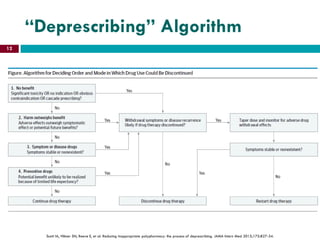
“Deprescribing” Algorithm
Scott IA, Hilmer SN, Reeve E, et al. Reducing inappropriate polypharmacy: the process of deprescribing. JAMA Intern Med 2015;175:827-34.
12
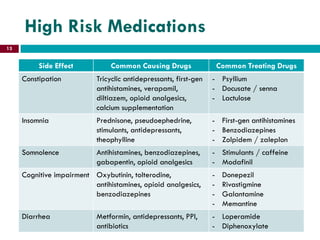
High Risk Medications
Side Effect Common Causing Drugs Common Treating Drugs
Constipation Tricyclic antidepressants, first-gen
antihistamines, verapamil,
diltiazem, opioid analgesics,
calcium supplementation
- Psyllium
- Docusate / senna
- Lactulose
Insomnia Prednisone, pseudoephedrine,
stimulants, antidepressants,
theophylline
- First-gen antihistamines
- Benzodiazepines
- Zolpidem / zaleplon
Somnolence Antihistamines, benzodiazepines,
gabapentin, opioid analgesics
- Stimulants / caffeine
- Modafinil
Cognitive impairment Oxybutinin, tolterodine,
antihistamines, opioid analgesics,
benzodiazepines
- Donepezil
- Rivastigmine
- Galantamine
- Memantine
Diarrhea Metformin, antidepressants, PPI,
antibiotics
- Loperamide
- Diphenoxylate
13
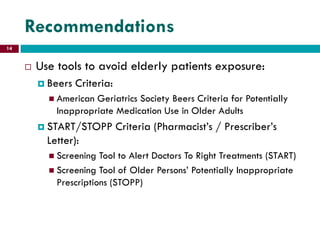
Recommendations
 Use tools to avoid elderly patients exposure:
 Beers Criteria:
 American Geriatrics Society Beers Criteria for Potentially
Inappropriate Medication Use in Older Adults
 START/STOPP Criteria (Pharmacist’s / Prescriber’s
Letter):
 Screening Tool to Alert Doctors To Right Treatments (START)
 Screening Tool of Older Persons’ Potentially Inappropriate
Prescriptions (STOPP)
14
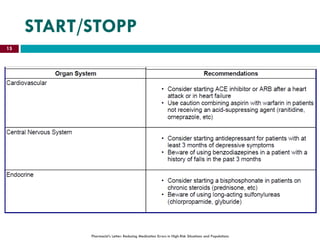
START/STOPP
Pharmacist’s Letter: Reducing Medication Errors in High-Risk Situations and Populations
15
MEDICATION ERRORS
Definitions
 In healthcare, an error has been defined by the
IOM as:
 the failure of a planned action to be completed as
intended (error of execution) or the use of a wrong
plan to achieve an aim (error of planning)
 An error may be an act of commission or an act of
omission
 A medication error has been defined as:
 any error occurring in the medication use process
Institute of Medicine. Patient Safety: Achieving a New Standard for Care. Washington, DC: National Academies Press; 2004.
Bates DW, Boyle DL, Vander Vliet MB, Schneider J, Leape L. Relationship between medication errors and adverse drug events. J Gen Intern Med. 1995;10(4):199-205.
17
Examples
 Medication errors can include:
 giving a medication to the wrong patient
 giving the wrong dose of a medication
 not prescribing a medication that was indicated
 entering an order for the wrong patient
 forgetting to give a medication that was due
Wittich CM, Burkle CM, Lanier WL. Medication errors: An overview for clinicians. Mayo Clin Proc. 2014;89:1116–25
18
Pharmacovigilance
 Drug Safety (IOM):
 science and activities relating to the detection, assessment,
understanding, and prevention of adverse effects or any
other medicine-related problem
 Adverse Drug Event:
 is an adverse outcome that can be attributed, with some
degree of probability, to an action of a drug
 May or may not be due to a medication error
 Adverse drug effects and reactions:
 nonpreventable adverse drug events
World Health Organization. Pharmacovigilance: Ensuring the Safe Use of Medicines. Geneva, Switzerland: World Health Organization; 2004:6. WHO Policy Perspectives on Medicines 9.
Aronson JK, Ferner RE. Clarification of terminology in drug safety. Drug Saf. 2005;28(10):851-870.
19
ASHP Categories
 American Society of Health-System Pharmacists
categorizes medication errors based on:
 prescribing
 omission
 timing
 use of an unauthorized drug
 improper dosing
 wrong dosage form
 wrong drug preparation
 wrong administration technique
 deteriorated drug
 monitoring
 compliance
ASHP guidelines on preventing medication errors in hospitals. Am J Hosp Pharm. 1993;50(2):305-314.
20
Other Categories
 The National Coordinating Council for Medication
Error Reporting and Prevention categorizes the
relationship between error and harm as:
 no error (circumstances have the capacity to cause error)
 error but no harm
 error and harm
 error and patient death
National Coordinating Council for Medication Error Reporting and Prevention. NCC MERP Index for Categorizing Medication Errors. www.nccmerp.org/medErrorCatIndex.html.
21
Incidence
 Medication errors are the most common type of medical
error.
 The Institute of Medicine (IOM) estimates 1.5 million
preventable medication errors happen in the United States
each year
 Medication errors cause 1 of 131 outpatient and 1 of
854 inpatient deaths
 Some medication errors cause harm to the patient, most
do not
 < 1% of medication errors resulted in an adverse drug
event
Kohn LT, Corrigan J, Donaldson Molla S; Institute of Medicine Committee on Quality of HealthCare in America. To Err is Human: Building a Safer Health System. National Academy Press; 2000.
Bates DW, Boyle DL, Vander Vliet MB, Schneider J, Leape L. Relationship between medication errors and adverse drug events. J Gen Intern Med. 1995;10(4):199-205.
22
Reporting
 Voluntary reporting systems used to track medication
errors:
 US Food and Drug Administration (FDA) MedWatch:
 http://www.fda.gov/Safety/MedWatch/
 United States Pharmacopeia (USP) and Institute for Safe
Medication Practices (ISMP) - Medication Error Reporting
Program (MERP):
 https://www.ismp.org/errorReporting/reportErrortoISMP.aspx
 Quantros, Inc MEDMARX (software)
 https://www.medmarx.com/
23
Top Drugs
 Top 10 drugs most commonly implicated in drug
errors:
 insulins, albuterol, morphine, potassium chloride,
heparin, cefazolin, furosemide, levofloxacin, and
vancomycin
 The 5 most commonly implicated drug classes
(27.7%):
 insulins, opioid-containing analgesics, anticoagulants,
amoxicillin-containing agents, and antihistamines/cold
remedies.
Vecchione A. USP Drug Safety Review: Top 10 drugs involved in medication errors. Drug Topics website. http://drugtopics.modernmedicine.com. Published December 8, 2003
Budnitz DS, Pollock DA, Weidenbach KN, Mendelsohn AB, Schroeder TJ, Annest JL. National surveillance of emergency department visits for outpatient adverse drug events. JAMA.
2006;296(15):1858-1866.
24
Risk Factors
 Unapproved abbreviations and illegible handwriting
 Look-alike and sound-alike products
 Patient risk factors such as age, comorbidities, and
polypharmacy
 Decline in renal or hepatic function
 Cognitive biases and lack of situational awareness by
health care professionals
25
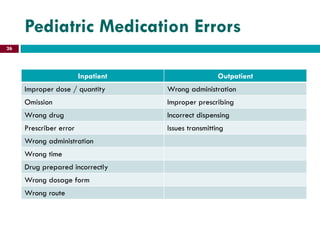
Pediatric Medication Errors
Inpatient Outpatient
Improper dose / quantity Wrong administration
Omission Improper prescribing
Wrong drug Incorrect dispensing
Prescriber error Issues transmitting
Wrong administration
Wrong time
Drug prepared incorrectly
Wrong dosage form
Wrong route
26
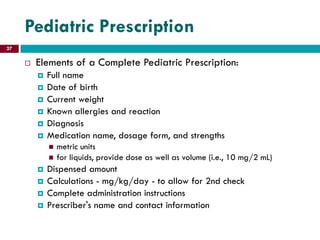
Pediatric Prescription
 Elements of a Complete Pediatric Prescription:
 Full name
 Date of birth
 Current weight
 Known allergies and reaction
 Diagnosis
 Medication name, dosage form, and strengths
 metric units
 for liquids, provide dose as well as volume (i.e., 10 mg/2 mL)
 Dispensed amount
 Calculations - mg/kg/day - to allow for 2nd check
 Complete administration instructions
 Prescriber's name and contact information
27
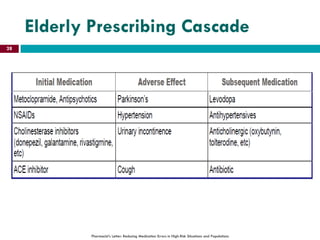
Elderly Prescribing Cascade
Pharmacist’s Letter: Reducing Medication Errors in High-Risk Situations and Populations
28
Avoiding Errors
 The FDA has worked to review confusing drug
names, improve packaging, require identification
bar codes, and educate patients
 Campaigns such as the “5 Rights of Medication
Administration”
 right drug, right patient, right dose, right route, right
time
 Medication reconciliation
 Computerized systems
 Interdisciplinary approach
Wittich CM, Burkle CM, Lanier WL. Medication errors: An overview for clinicians. Mayo Clin Proc. 2014;89:1116–25
29
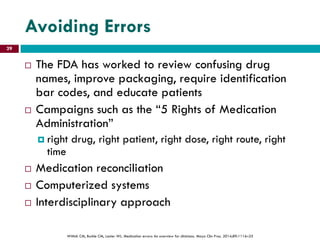
Be Careful…
Institute for Safe Medication Practices. http://www.ismp.org/
30
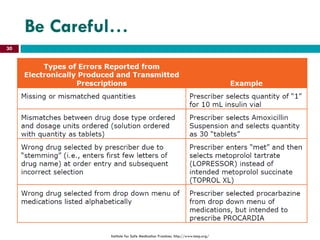
Avoid Error-Prone Abbreviations
Institute for Safe Medication Practices. http://www.ismp.org/
31
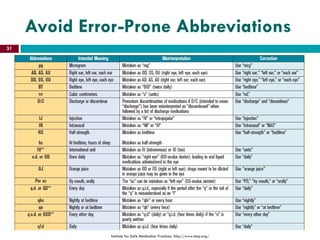
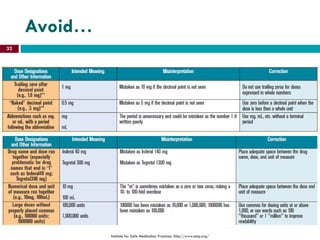
Avoid…
Institute for Safe Medication Practices. http://www.ismp.org/
32
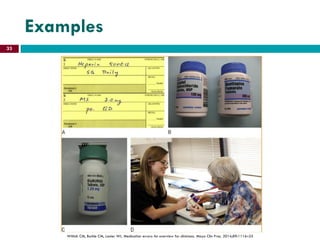
Examples
Wittich CM, Burkle CM, Lanier WL. Medication errors: An overview for clinicians. Mayo Clin Proc. 2014;89:1116–25
33
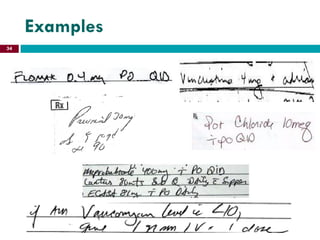
Examples
34
Disclosure and Legal Consequences
 Disclosure of medication errors:
 for the benefit of an individual patient
 to provide data for broader, systemic insights into any
recurring patterns of errors
 Legal consequences:
 can include civil actions, criminal charges, and board
discipline
35
QUESTIONS?
POLYPHARMACY AND
MEDICATION ERRORS
Leonardo Rosario-Colón, Pharm.D., R.Ph.

Polypharmacy and medication errors

  • 1.
    POLYPHARMACY AND MEDICATION ERRORS LeonardoRosario-Colón, Pharm.D., R.Ph., B.S.
  • 2.
    Objectives  Goals andObjectives: The goal of this activity is to help providers in all settings develop a better knowledge base from which they can prevent polypharmacy and medication errors.  Upon completion of this activity, the learner will be able to:  Discuss the impact of polypharmacy and medication errors.  List different types and/or risk factors of polypharmacy and medication errors.  Describe potential problems with using medical abbreviations.  Identify the different problems that can be caused by drug names.  Define at-risk behaviors as they relate to polypharmacy and medication errors.  Discuss different ways individuals and organizations can reduce the risk of medication errors.  Explain what should be done if a medication error has occurred. 2
  • 3.
  • 4.
    What is Polypharmacy? Use of multiple medications for the treatment of a patient's medical conditions  More medication is being used than is clinically indicated  Inappropriate polypharmacy imposes a substantial burden of adverse drug events, ill health, disability, hospitalization, and even death Hajjar ER, Cafiero AC, Hanlon JT. Polypharmacy in elderly patients. Am J Geriatr Pharmacother. 2007;5(4):345-351. 4
  • 5.
    Polypharmacy Risk Factors Elderly  Multiple comorbid conditions  Recent hospitalization  Multiple physicians  Multiple pharmacies  Inappropriate medication  Poor documentation 5
  • 6.
    Healthcare Provider’s Factors No patient’s medication review on regular basis  Provides unclear, complex or incomplete instructions  No effort to simplify medication regimen  Ordering automatic refills  Lack of knowledge 6
  • 7.
    Patient’s Factors  Multipleproviders and/or pharmacies  Insisting on taking inappropriate drugs  Inaccurately report meds taken or symptoms  Assumption that all medications needs to be continued once started  Changes in lifestyle activities 7
  • 8.
    Negative Outcomes  Polypharmacyhas been shown to increase:  Unnecessary / inappropriate medication prescribing  Risk of drug interactions / adverse drug reactions  Medication nonadherence  Overall drug expenditures 8
  • 9.
    Example  85 y/owoman with a prescription of Amitriptyline 50mg at bedtime for insomnia.  Side effects:  Constipation  Urinary Incontinence  Dizziness  Dry mouth  Dry eyes  Possible new medications:  Docusate with senna  Oxybutinin  Eye drops 9
  • 10.
    Management of Polypharmacy Obtain an accurate medication and medical history  Link each prescribed medication to a disease state  Identify medications that are treating side effects  Initiate interventions to ensure adherence  Reconcile medications upon any discharge from hospital or skilled nursing facility  Prevention 10
  • 11.
    “Deprescribing”  Process oftapering or stopping drugs, aimed at minimizing polypharmacy and improving patient outcomes  Ascertain all drugs patient is currently taking and why  Consider overall risk of drug-induced harm  Assess each drug for its eligibility to be discontinued  Prioritize drugs for discontinuation  Implement and monitor drug discontinuation regimen Scott IA, Hilmer SN, Reeve E, et al. Reducing inappropriate polypharmacy: the process of deprescribing. JAMA Intern Med 2015;175:827-34. 11
  • 12.
    “Deprescribing” Algorithm Scott IA,Hilmer SN, Reeve E, et al. Reducing inappropriate polypharmacy: the process of deprescribing. JAMA Intern Med 2015;175:827-34. 12
  • 13.
    High Risk Medications SideEffect Common Causing Drugs Common Treating Drugs Constipation Tricyclic antidepressants, first-gen antihistamines, verapamil, diltiazem, opioid analgesics, calcium supplementation - Psyllium - Docusate / senna - Lactulose Insomnia Prednisone, pseudoephedrine, stimulants, antidepressants, theophylline - First-gen antihistamines - Benzodiazepines - Zolpidem / zaleplon Somnolence Antihistamines, benzodiazepines, gabapentin, opioid analgesics - Stimulants / caffeine - Modafinil Cognitive impairment Oxybutinin, tolterodine, antihistamines, opioid analgesics, benzodiazepines - Donepezil - Rivastigmine - Galantamine - Memantine Diarrhea Metformin, antidepressants, PPI, antibiotics - Loperamide - Diphenoxylate 13
  • 14.
    Recommendations  Use toolsto avoid elderly patients exposure:  Beers Criteria:  American Geriatrics Society Beers Criteria for Potentially Inappropriate Medication Use in Older Adults  START/STOPP Criteria (Pharmacist’s / Prescriber’s Letter):  Screening Tool to Alert Doctors To Right Treatments (START)  Screening Tool of Older Persons’ Potentially Inappropriate Prescriptions (STOPP) 14
  • 15.
    START/STOPP Pharmacist’s Letter: ReducingMedication Errors in High-Risk Situations and Populations 15
  • 16.
  • 17.
    Definitions  In healthcare,an error has been defined by the IOM as:  the failure of a planned action to be completed as intended (error of execution) or the use of a wrong plan to achieve an aim (error of planning)  An error may be an act of commission or an act of omission  A medication error has been defined as:  any error occurring in the medication use process Institute of Medicine. Patient Safety: Achieving a New Standard for Care. Washington, DC: National Academies Press; 2004. Bates DW, Boyle DL, Vander Vliet MB, Schneider J, Leape L. Relationship between medication errors and adverse drug events. J Gen Intern Med. 1995;10(4):199-205. 17
  • 18.
    Examples  Medication errorscan include:  giving a medication to the wrong patient  giving the wrong dose of a medication  not prescribing a medication that was indicated  entering an order for the wrong patient  forgetting to give a medication that was due Wittich CM, Burkle CM, Lanier WL. Medication errors: An overview for clinicians. Mayo Clin Proc. 2014;89:1116–25 18
  • 19.
    Pharmacovigilance  Drug Safety(IOM):  science and activities relating to the detection, assessment, understanding, and prevention of adverse effects or any other medicine-related problem  Adverse Drug Event:  is an adverse outcome that can be attributed, with some degree of probability, to an action of a drug  May or may not be due to a medication error  Adverse drug effects and reactions:  nonpreventable adverse drug events World Health Organization. Pharmacovigilance: Ensuring the Safe Use of Medicines. Geneva, Switzerland: World Health Organization; 2004:6. WHO Policy Perspectives on Medicines 9. Aronson JK, Ferner RE. Clarification of terminology in drug safety. Drug Saf. 2005;28(10):851-870. 19
  • 20.
    ASHP Categories  AmericanSociety of Health-System Pharmacists categorizes medication errors based on:  prescribing  omission  timing  use of an unauthorized drug  improper dosing  wrong dosage form  wrong drug preparation  wrong administration technique  deteriorated drug  monitoring  compliance ASHP guidelines on preventing medication errors in hospitals. Am J Hosp Pharm. 1993;50(2):305-314. 20
  • 21.
    Other Categories  TheNational Coordinating Council for Medication Error Reporting and Prevention categorizes the relationship between error and harm as:  no error (circumstances have the capacity to cause error)  error but no harm  error and harm  error and patient death National Coordinating Council for Medication Error Reporting and Prevention. NCC MERP Index for Categorizing Medication Errors. www.nccmerp.org/medErrorCatIndex.html. 21
  • 22.
    Incidence  Medication errorsare the most common type of medical error.  The Institute of Medicine (IOM) estimates 1.5 million preventable medication errors happen in the United States each year  Medication errors cause 1 of 131 outpatient and 1 of 854 inpatient deaths  Some medication errors cause harm to the patient, most do not  < 1% of medication errors resulted in an adverse drug event Kohn LT, Corrigan J, Donaldson Molla S; Institute of Medicine Committee on Quality of HealthCare in America. To Err is Human: Building a Safer Health System. National Academy Press; 2000. Bates DW, Boyle DL, Vander Vliet MB, Schneider J, Leape L. Relationship between medication errors and adverse drug events. J Gen Intern Med. 1995;10(4):199-205. 22
  • 23.
    Reporting  Voluntary reportingsystems used to track medication errors:  US Food and Drug Administration (FDA) MedWatch:  http://www.fda.gov/Safety/MedWatch/  United States Pharmacopeia (USP) and Institute for Safe Medication Practices (ISMP) - Medication Error Reporting Program (MERP):  https://www.ismp.org/errorReporting/reportErrortoISMP.aspx  Quantros, Inc MEDMARX (software)  https://www.medmarx.com/ 23
  • 24.
    Top Drugs  Top10 drugs most commonly implicated in drug errors:  insulins, albuterol, morphine, potassium chloride, heparin, cefazolin, furosemide, levofloxacin, and vancomycin  The 5 most commonly implicated drug classes (27.7%):  insulins, opioid-containing analgesics, anticoagulants, amoxicillin-containing agents, and antihistamines/cold remedies. Vecchione A. USP Drug Safety Review: Top 10 drugs involved in medication errors. Drug Topics website. http://drugtopics.modernmedicine.com. Published December 8, 2003 Budnitz DS, Pollock DA, Weidenbach KN, Mendelsohn AB, Schroeder TJ, Annest JL. National surveillance of emergency department visits for outpatient adverse drug events. JAMA. 2006;296(15):1858-1866. 24
  • 25.
    Risk Factors  Unapprovedabbreviations and illegible handwriting  Look-alike and sound-alike products  Patient risk factors such as age, comorbidities, and polypharmacy  Decline in renal or hepatic function  Cognitive biases and lack of situational awareness by health care professionals 25
  • 26.
    Pediatric Medication Errors InpatientOutpatient Improper dose / quantity Wrong administration Omission Improper prescribing Wrong drug Incorrect dispensing Prescriber error Issues transmitting Wrong administration Wrong time Drug prepared incorrectly Wrong dosage form Wrong route 26
  • 27.
    Pediatric Prescription  Elementsof a Complete Pediatric Prescription:  Full name  Date of birth  Current weight  Known allergies and reaction  Diagnosis  Medication name, dosage form, and strengths  metric units  for liquids, provide dose as well as volume (i.e., 10 mg/2 mL)  Dispensed amount  Calculations - mg/kg/day - to allow for 2nd check  Complete administration instructions  Prescriber's name and contact information 27
  • 28.
    Elderly Prescribing Cascade Pharmacist’sLetter: Reducing Medication Errors in High-Risk Situations and Populations 28
  • 29.
    Avoiding Errors  TheFDA has worked to review confusing drug names, improve packaging, require identification bar codes, and educate patients  Campaigns such as the “5 Rights of Medication Administration”  right drug, right patient, right dose, right route, right time  Medication reconciliation  Computerized systems  Interdisciplinary approach Wittich CM, Burkle CM, Lanier WL. Medication errors: An overview for clinicians. Mayo Clin Proc. 2014;89:1116–25 29
  • 30.
    Be Careful… Institute forSafe Medication Practices. http://www.ismp.org/ 30
  • 31.
    Avoid Error-Prone Abbreviations Institutefor Safe Medication Practices. http://www.ismp.org/ 31
  • 32.
    Avoid… Institute for SafeMedication Practices. http://www.ismp.org/ 32
  • 33.
    Examples Wittich CM, BurkleCM, Lanier WL. Medication errors: An overview for clinicians. Mayo Clin Proc. 2014;89:1116–25 33
  • 34.
  • 35.
    Disclosure and LegalConsequences  Disclosure of medication errors:  for the benefit of an individual patient  to provide data for broader, systemic insights into any recurring patterns of errors  Legal consequences:  can include civil actions, criminal charges, and board discipline 35
  • 36.
  • 37.
    POLYPHARMACY AND MEDICATION ERRORS LeonardoRosario-Colón, Pharm.D., R.Ph.