Medication Errors:
Focus on Prevention Tactics
Gary Brodskiy
PharmD/MBA Candidate, Anticipated 2017
Fairleigh Dickinson University School of Pharmacy and Health Sciences
August 24, 2016
Objectives
• Differentiate between a medication error, adverse
drug event, and adverse drug reaction
• Identify common causes of medication errors and
approaches to prevent them
• Assess novel modification to the five “rights”
required for safe medication ordering
2
Background
• 700,000 emergency department visits and 120,000
hospitalizations are due to ADEs annually
• $3.5 billion is paid out on extra medical costs of
ADEs annually
• At least 1.5 million preventable ADEs occur in the
United States each year
• At least 40% of costs of ambulatory ADEs are
estimated to be preventable
3
Definitions
• Medication error
– Error at any step along the pathway that begins when
a clinician prescribes a medication and ends when the
patient receives the medication
• Preventable ADE
– Medication error that reaches the patient and causes
any degree of harm
• ADR (side effect or non-preventable ADE)
– ADE that is experienced when a medication is
prescribed and administered appropriately
4
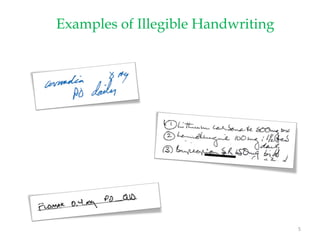
Examples of Illegible Handwriting
5
Common Causes of Medication Errors
• Drug product
nomenclature
(i.e. LASA names)
• Equipment failure or
malfunction
• Illegible handwriting
• Improper transcription
• Inaccurate dosage
calculation
• Inadequately trained
personnel
• Inappropriate
abbreviations
• Labeling errors
• Excessive workload
6
Does It Stop There?
• Even though many medication errors are
preventable, they will never be eliminated
• The number of ADEs will likely grow due to:
– Aging population
– Increase in use of medication for disease prevention
– Discover new uses for existing medication
– Development of new medications
7
Technical Approaches to Preventing Errors
• Prescribing errors
– Computerized physician order entry system (CPOE)
– Clinical decision support system (CDSS)
– E-scribing
• Preparation errors
– Pill counters
– Unit-dose packagers
– IV compounding robots
• Dispensing errors
– Carousels
– Automated dispensing cabinets (ADCs)
• Administration errors
– Electronic medication administration record (eMAR)
– Bar code medication administration system (BCMA)
8
CPOE
• Computer system that replaces traditional methods
of placing orders (i.e. written and verbal) and
ensures legible orders
• Functionality of CPOE is increased by adding CDSS
– Provides clinicians decision support in real-time as they
enter electronic orders
– Examples: drug interactions, patient allergies,
medication contraindications, renal- and weight-based
dosing, etc.
• CPOE is one of CMS’s criteria for electronic medical
record’s “meaningful use”
– Meant to ensure active incorporation into patient care
9
Advantages of CPOE with CDSS
• Free of handwriting identification problems
• Easily linked to drug-drug interactions
• Link to ADE reporting systems
• Avoid specification errors (i.e. trailing zeros)
• Emphasize cost-effective medications
• Reduce incorrect drug choices
10
Impact of CPOE on Pharmacists
• Clinical Informatics
– Manage medication related information while
promoting integration, interoperability, and information
exchange
– Cataloging and embedding knowledge into the
workflow
– Develop analytic solutions for improving decision-
making
– Apply user experience for optimizing clinical practice
and usability
• Efficiency in workflow
– Spend less time per day clarifying medication orders
– Concentrate on clinical aspects of the medication
ordering process
11
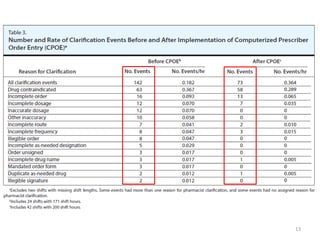
McMullen et al. (2015)
• Purpose: investigate pharmacists’ satisfaction with
CPOE system and the impact of CPOE on pharmacy
workflow in three hospitals of a large Michigan-
based health system
• Methods: Evaluate how CPOE implementation
affects pharmacists through:
– Self-reported perceptions of CPOE implementation
– Description of experiences through interviews and focus
groups
– Frequency and duration of pharmacists’ work clarifying
orders before and after implementation
12
13
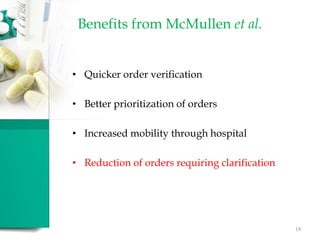
• Quicker order verification
• Better prioritization of orders
• Increased mobility through hospital
• Reduction of orders requiring clarification
Benefits from McMullen et al.
14
• Short follow-up period demonstrates CPOE
benefits only over a short term
• Studied only one hospital system and one
EHR vendor, making it difficult to generalize
• CPOE’s impact on workflow limited by only
observing medication clarification events
Limitations of McMullen et al. Study
15
Conclusion from McMullen et al.
“Pharmacists noted that order ambiguity still
existed and that the system needed to be
optimized to gain efficiencies and increase
clarity.”
16
Is CPOE a Solution?
• Success of CPOE
– Processing drugs via CPOE decreases likelihood of error
drug order by 48%
– In 2008, estimate of 12.5% reduction in medication errors
or ~17.4 million errors averted in USA
• Downfall of CPOE
– NOT a solution for medication errors
– Personalized order sets which may deviate from
protocols
– Ambiguity still exists
17
Joyce Oyler Case (2013)
• The 66 year-old female was treated for CHF at Heartland
Regional Medical Center in St. Joseph, Missouri
• Hospital nurse telephones eight new prescriptions to local
pharmacy
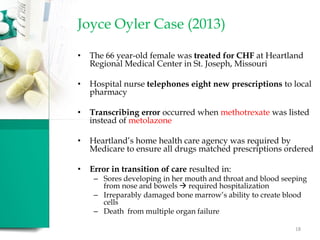
• Transcribing error occurred when methotrexate was listed
instead of metolazone
• Heartland’s home health care agency was required by
Medicare to ensure all drugs matched prescriptions ordered
• Error in transition of care resulted in:
– Sores developing in her mouth and throat and blood seeping
from nose and bowels  required hospitalization
– Irreparably damaged bone marrow’s ability to create blood
cells
– Death from multiple organ failure
18
Reduce Errors Associated with Verbal Orders
• Do NOT permit verbal
orders for antineoplastic
agents due to narrow margin
of safety
• Clear communication of
content
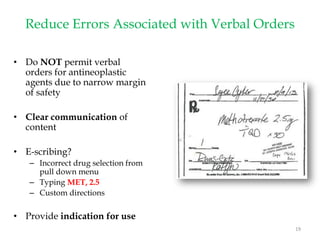
• E-scribing?
– Incorrect drug selection from
pull down menu
– Typing MET, 2.5
– Custom directions
• Provide indication for use
19
The Five “Rights”
Right Patient
Right Drug
Right Dose
Right Route
Right Time
20
Schiff et al. (2016)
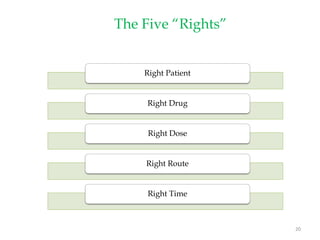
• Add a sixth element to the five “rights”
required for safe medication ordering  right
indication
• Propose to shift medication ordering workflow
to indications-based prescribing where
medication choices are narrowed to indications
21
Potential Benefits of “Sixth” Right
• Improve medication safety
– Identify and intervene wrong-drug errors
– Ensure proper dosing regimen
• Better educate and empower patients
– Facilitate patient adherence due to better understanding
– Enhance shared decision making and encourage
questions
• Streamline reimbursement coding
• Improve health care team communication
– Aid care transitions by providing reasons for
medications
– Provide information to help counsel patients
22
Potential Benefits of “Sixth” Right
• Facilitate medication reconciliation
– Organize list by indication
– Knowing reason of why started helps decide whether to
discontinue
• Increase efficiency of prescribing by showing drug
regimen choices for indication
• Improve documentation of medical history
• Improve appropriate use of medication by prescribers
– Reduce “never-indicated” drugs
– Support selection of targeted drug choices
• Accurately measure a drug’s long-term effectiveness
23
Potential Challenges of “Sixth” Right
• Extra prescriber time and effort
• Privacy concerns
• No randomized trials showing use of indications is
beneficial
• Defining and creating indications is complex
– Terminology (ICD-10, diagnosis, symptom, etc.)
– Drugs given for multiple indications
– Empirical treatment that lacks definite diagnosis
24
Potential Challenges of “Sixth” Right
• Creating “smart” drug recommendations based on
indications
– Need to incorporate allergies, contraindicated diseases,
etc.
– Ensure that choices do not include previous drugs that
have failed
– Inclusion of insurance and formulary requirements
• Transmission of indication information from
CPOE to pharmacy to patient
– Interoperability between EHR and pharmacy system
– Limited real estate on prescription labels
25
Conclusion and Future Research of “Sixth” Right
• Knowledge of indications is key to getting prescribers,
pharmacists, nurses, and patients on the same page
regarding what is being treated and outcomes desired
• Agency for Healthcare Research and Quality (AHRQ)
funded a 3-year project with key stakeholders for seven
international Web conferences
– Clarify rationale behind “sixth” right model
– Challenges to implementation of model
– Find ways to move the model forward
• Researchers are currently working with engineers, IT design
specialists, and policy leaders to build a prototype
– Objective: system will result in a safer and more efficient way
of ordering medications
26
Capital Health CPOE & “Sixth” Right
• Benefit to attendings and residents
– Eliminates time spent researching recommended drug
choice and proper dosing regimen
• Benefit to pharmacy
– Decreases time spent clarifying orders, thus increasing
availability for other tasks
– Optimize medication reconciliation by eliminating the
need to guess indication and ensuring reason for
discontinuation
• Increase probability of cost savings for both
hospitals through clinical utilization
– HCPs doing the right things in the right way
27
Future of Medication Error Prevention
• Patient care is shifting to a team-based approach so
a collaborative work environment combined with
safety-focused leadership is a key element of
providing quality care
• Implementation of information technology systems
are vital components of strategies to prevent
medication errors so there is a need for continuous
improvement
• No solution, but combining team-based patient care
with continuous technical improvements can have
the potential to significantly minimize errors
28
29
References
• https://psnet.ahrq.gov/primers/primer/23/medication-errors
• Slone Epidemiology Center at Boston University. Patterns of
medication use in the United States, 2006.
• Budnitz DS, Pollock DA, Weidenbach KN, Mendelsohn AB,
Schroeder TJ, Annest JL. National surveillance of emergency
department visits for outpatient adverse drug events .External
Web Site Icon JAMA 2006;296:1858-66.
• Institute of Medicine. Committee on Identifying and Preventing
Medication Errors. Preventing Medication Errors, Washington,
DC: The National Academies Press 2006
• Aspden P, Wolcott JA, Bootman JL, Cronenwett LR, eds.
Preventing medication errors. Committee on
• Identifying and Preventing Medication Errors, Institute of
Medicine. Washington, DC: National Academies Press, 2006.
• https://healthit.ahrq.gov/sites/default/files/docs/page/09-
0031-EF_cpoe.pdf
• http://www.ncbi.nlm.nih.gov/pmc/articles/PMC3869307/
• https://www.ashp.org/DocLibrary/BestPractices/AutoITStInf
ormatics.aspx
30

German Brodskiy_Medication Errors

  • 1.
    Medication Errors: Focus onPrevention Tactics Gary Brodskiy PharmD/MBA Candidate, Anticipated 2017 Fairleigh Dickinson University School of Pharmacy and Health Sciences August 24, 2016
  • 2.
    Objectives • Differentiate betweena medication error, adverse drug event, and adverse drug reaction • Identify common causes of medication errors and approaches to prevent them • Assess novel modification to the five “rights” required for safe medication ordering 2
  • 3.
    Background • 700,000 emergencydepartment visits and 120,000 hospitalizations are due to ADEs annually • $3.5 billion is paid out on extra medical costs of ADEs annually • At least 1.5 million preventable ADEs occur in the United States each year • At least 40% of costs of ambulatory ADEs are estimated to be preventable 3
  • 4.
    Definitions • Medication error –Error at any step along the pathway that begins when a clinician prescribes a medication and ends when the patient receives the medication • Preventable ADE – Medication error that reaches the patient and causes any degree of harm • ADR (side effect or non-preventable ADE) – ADE that is experienced when a medication is prescribed and administered appropriately 4
  • 5.
    Examples of IllegibleHandwriting 5
  • 6.
    Common Causes ofMedication Errors • Drug product nomenclature (i.e. LASA names) • Equipment failure or malfunction • Illegible handwriting • Improper transcription • Inaccurate dosage calculation • Inadequately trained personnel • Inappropriate abbreviations • Labeling errors • Excessive workload 6
  • 7.
    Does It StopThere? • Even though many medication errors are preventable, they will never be eliminated • The number of ADEs will likely grow due to: – Aging population – Increase in use of medication for disease prevention – Discover new uses for existing medication – Development of new medications 7
  • 8.
    Technical Approaches toPreventing Errors • Prescribing errors – Computerized physician order entry system (CPOE) – Clinical decision support system (CDSS) – E-scribing • Preparation errors – Pill counters – Unit-dose packagers – IV compounding robots • Dispensing errors – Carousels – Automated dispensing cabinets (ADCs) • Administration errors – Electronic medication administration record (eMAR) – Bar code medication administration system (BCMA) 8
  • 9.
    CPOE • Computer systemthat replaces traditional methods of placing orders (i.e. written and verbal) and ensures legible orders • Functionality of CPOE is increased by adding CDSS – Provides clinicians decision support in real-time as they enter electronic orders – Examples: drug interactions, patient allergies, medication contraindications, renal- and weight-based dosing, etc. • CPOE is one of CMS’s criteria for electronic medical record’s “meaningful use” – Meant to ensure active incorporation into patient care 9
  • 10.
    Advantages of CPOEwith CDSS • Free of handwriting identification problems • Easily linked to drug-drug interactions • Link to ADE reporting systems • Avoid specification errors (i.e. trailing zeros) • Emphasize cost-effective medications • Reduce incorrect drug choices 10
  • 11.
    Impact of CPOEon Pharmacists • Clinical Informatics – Manage medication related information while promoting integration, interoperability, and information exchange – Cataloging and embedding knowledge into the workflow – Develop analytic solutions for improving decision- making – Apply user experience for optimizing clinical practice and usability • Efficiency in workflow – Spend less time per day clarifying medication orders – Concentrate on clinical aspects of the medication ordering process 11
  • 12.
    McMullen et al.(2015) • Purpose: investigate pharmacists’ satisfaction with CPOE system and the impact of CPOE on pharmacy workflow in three hospitals of a large Michigan- based health system • Methods: Evaluate how CPOE implementation affects pharmacists through: – Self-reported perceptions of CPOE implementation – Description of experiences through interviews and focus groups – Frequency and duration of pharmacists’ work clarifying orders before and after implementation 12
  • 13.
  • 14.
    • Quicker orderverification • Better prioritization of orders • Increased mobility through hospital • Reduction of orders requiring clarification Benefits from McMullen et al. 14
  • 15.
    • Short follow-upperiod demonstrates CPOE benefits only over a short term • Studied only one hospital system and one EHR vendor, making it difficult to generalize • CPOE’s impact on workflow limited by only observing medication clarification events Limitations of McMullen et al. Study 15
  • 16.
    Conclusion from McMullenet al. “Pharmacists noted that order ambiguity still existed and that the system needed to be optimized to gain efficiencies and increase clarity.” 16
  • 17.
    Is CPOE aSolution? • Success of CPOE – Processing drugs via CPOE decreases likelihood of error drug order by 48% – In 2008, estimate of 12.5% reduction in medication errors or ~17.4 million errors averted in USA • Downfall of CPOE – NOT a solution for medication errors – Personalized order sets which may deviate from protocols – Ambiguity still exists 17
  • 18.
    Joyce Oyler Case(2013) • The 66 year-old female was treated for CHF at Heartland Regional Medical Center in St. Joseph, Missouri • Hospital nurse telephones eight new prescriptions to local pharmacy • Transcribing error occurred when methotrexate was listed instead of metolazone • Heartland’s home health care agency was required by Medicare to ensure all drugs matched prescriptions ordered • Error in transition of care resulted in: – Sores developing in her mouth and throat and blood seeping from nose and bowels  required hospitalization – Irreparably damaged bone marrow’s ability to create blood cells – Death from multiple organ failure 18
  • 19.
    Reduce Errors Associatedwith Verbal Orders • Do NOT permit verbal orders for antineoplastic agents due to narrow margin of safety • Clear communication of content • E-scribing? – Incorrect drug selection from pull down menu – Typing MET, 2.5 – Custom directions • Provide indication for use 19
  • 20.
    The Five “Rights” RightPatient Right Drug Right Dose Right Route Right Time 20
  • 21.
    Schiff et al.(2016) • Add a sixth element to the five “rights” required for safe medication ordering  right indication • Propose to shift medication ordering workflow to indications-based prescribing where medication choices are narrowed to indications 21
  • 22.
    Potential Benefits of“Sixth” Right • Improve medication safety – Identify and intervene wrong-drug errors – Ensure proper dosing regimen • Better educate and empower patients – Facilitate patient adherence due to better understanding – Enhance shared decision making and encourage questions • Streamline reimbursement coding • Improve health care team communication – Aid care transitions by providing reasons for medications – Provide information to help counsel patients 22
  • 23.
    Potential Benefits of“Sixth” Right • Facilitate medication reconciliation – Organize list by indication – Knowing reason of why started helps decide whether to discontinue • Increase efficiency of prescribing by showing drug regimen choices for indication • Improve documentation of medical history • Improve appropriate use of medication by prescribers – Reduce “never-indicated” drugs – Support selection of targeted drug choices • Accurately measure a drug’s long-term effectiveness 23
  • 24.
    Potential Challenges of“Sixth” Right • Extra prescriber time and effort • Privacy concerns • No randomized trials showing use of indications is beneficial • Defining and creating indications is complex – Terminology (ICD-10, diagnosis, symptom, etc.) – Drugs given for multiple indications – Empirical treatment that lacks definite diagnosis 24
  • 25.
    Potential Challenges of“Sixth” Right • Creating “smart” drug recommendations based on indications – Need to incorporate allergies, contraindicated diseases, etc. – Ensure that choices do not include previous drugs that have failed – Inclusion of insurance and formulary requirements • Transmission of indication information from CPOE to pharmacy to patient – Interoperability between EHR and pharmacy system – Limited real estate on prescription labels 25
  • 26.
    Conclusion and FutureResearch of “Sixth” Right • Knowledge of indications is key to getting prescribers, pharmacists, nurses, and patients on the same page regarding what is being treated and outcomes desired • Agency for Healthcare Research and Quality (AHRQ) funded a 3-year project with key stakeholders for seven international Web conferences – Clarify rationale behind “sixth” right model – Challenges to implementation of model – Find ways to move the model forward • Researchers are currently working with engineers, IT design specialists, and policy leaders to build a prototype – Objective: system will result in a safer and more efficient way of ordering medications 26
  • 27.
    Capital Health CPOE& “Sixth” Right • Benefit to attendings and residents – Eliminates time spent researching recommended drug choice and proper dosing regimen • Benefit to pharmacy – Decreases time spent clarifying orders, thus increasing availability for other tasks – Optimize medication reconciliation by eliminating the need to guess indication and ensuring reason for discontinuation • Increase probability of cost savings for both hospitals through clinical utilization – HCPs doing the right things in the right way 27
  • 28.
    Future of MedicationError Prevention • Patient care is shifting to a team-based approach so a collaborative work environment combined with safety-focused leadership is a key element of providing quality care • Implementation of information technology systems are vital components of strategies to prevent medication errors so there is a need for continuous improvement • No solution, but combining team-based patient care with continuous technical improvements can have the potential to significantly minimize errors 28
  • 29.
  • 30.
    References • https://psnet.ahrq.gov/primers/primer/23/medication-errors • SloneEpidemiology Center at Boston University. Patterns of medication use in the United States, 2006. • Budnitz DS, Pollock DA, Weidenbach KN, Mendelsohn AB, Schroeder TJ, Annest JL. National surveillance of emergency department visits for outpatient adverse drug events .External Web Site Icon JAMA 2006;296:1858-66. • Institute of Medicine. Committee on Identifying and Preventing Medication Errors. Preventing Medication Errors, Washington, DC: The National Academies Press 2006 • Aspden P, Wolcott JA, Bootman JL, Cronenwett LR, eds. Preventing medication errors. Committee on • Identifying and Preventing Medication Errors, Institute of Medicine. Washington, DC: National Academies Press, 2006. • https://healthit.ahrq.gov/sites/default/files/docs/page/09- 0031-EF_cpoe.pdf • http://www.ncbi.nlm.nih.gov/pmc/articles/PMC3869307/ • https://www.ashp.org/DocLibrary/BestPractices/AutoITStInf ormatics.aspx 30