JOURNAL CLUB
The Prevalence Of Polypharmacy In
South Indian Patients:
A Pharmacoepidemiological Approach
Mohammed S.S* et.al
By,
Dr.N.Pratyusha
10B0501
Introduction
Polypharmacy:
Defined as a condition in which a patient
receives too many drugs for too long time,
or drug in exceedingly high doses often
result in polypharmacy.
Potential risks of polypharmacy:
 Drug- Drug interactions
 Drug- Food interactions
 Adverse drug reactions
 Increased hospitalisation
 Medication errors
Eventually leading to increased pateint costs
and non-compliance to treatment.
Purpose of the study:
To develop a prescription database and to
compare different methods of identifying
drug users exposed to polypharmacy.
Methodology:
Study site: Govt Dist HQ hospital, Ooty
Study period : 9 months
Type of study: prospectively and retrospectively
Inclusion criteria: prescriptions containing more
than 1 drug and of age 2-70 yrs
Exclusion criteria: age less than 2 yrs,
psychiatric and cancer disorders
Classification:
According to BNF:
Minor Polypharmacy :
Concurrent use of 2 to 4 drugs
Major Polypharmacy :
Use of 5 or more drugs
Results:
Total number of prescriptions- 1003
Major polypharmacy- 600
Minor polypharmacy- 403
Total number of males- 670
Total number of females- 330
Fig1: Age vs total number of
prescriptions
Quantitative estimation of
polypharmacy:
1.Polypharmacy Vs Gender
Number of
drugs
Male Female Total Percentage
2-4 227 176 403 40.18%
Greater than
or equalto 5
443 157 600 59.82%
2.Polypharmacy Vs Age
Both minor and major polypharmacy is
seen high in the age group of 19-60 yrs
that is 78.41% and 87.33% respectively.
3.Polypharmacy Vs Hospital stays
Hospital stay was found to be more for
major polypharmacy that is 45.50% (one
to two weeks of stay)
Quantitative estimation of therapeutic
categories of prescriptions:
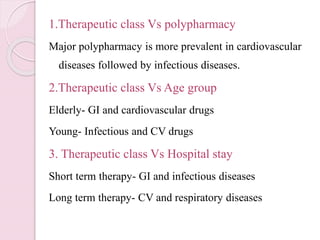
1.Therapeutic class Vs polypharmacy
Major polypharmacy is more prevalent in cardiovascular
diseases followed by infectious diseases.
2.Therapeutic class Vs Age group
Elderly- GI and cardiovascular drugs
Young- Infectious and CV drugs
3. Therapeutic class Vs Hospital stay
Short term therapy- GI and infectious diseases
Long term therapy- CV and respiratory diseases
Discussion
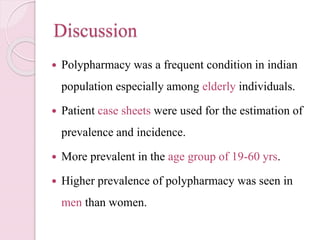
 Polypharmacy was a frequent condition in indian
population especially among elderly individuals.
 Patient case sheets were used for the estimation of
prevalence and incidence.
 More prevalent in the age group of 19-60 yrs.
 Higher prevalence of polypharmacy was seen in
men than women.
Discussion cntd..
 Length of hospital stay is found to be more in
major polypharmacy compared to minor.
 Prevalence of cardiovascular drugs and GI drugs
were more often involved in polypharmacy
among the elderly and infectious, cardiovascular
drugs were prominent among young individuals
exposed to polypharmacy.
Suggestions to reduce the problems
associated with polypharmacy, based on the
study:
 Ask patients to bring all medicines to the counseling
center (the brown bag approach)
 Restrict pro re nata prescribing
 Encourage physicians to prescribe using evidence-based
medicine
 Select a drug that may treat more than one condition
 Check for contraindications and potential drug
interactions before prescribing a drug
 Start with low doses and titrate dose according to effect
 Monitor for adverse reactions and check potential drug
interactions
 Educate the patient about the drug therapy and teach the
patient to prioritize the currently used drugs
 Routinely check and encourage compliance
 Periodically simplify the therapeutic regimen and stop
drugs if possible
 Place limits on the duration of drug prescribing
Conclusion:
The use of medication to disease condition is necessary, but unnecessary
load of drugs to patient will increase the safety problems.
Polypharmacy can be avoided by sharing the decisions for making
treatment goals and plans.
The medication regimen can be simplified by eliminating
pharmacological duplication, decreasing dosing frequency and regular
review of drug regimen.
The goal should be to prescribe the least complex drug regimen for the
patient as possible while considering the medication problems,
symptoms and ofcourse the cost of therapy.
Thank you

Polypharmacy

  • 1.
  • 2.
    The Prevalence OfPolypharmacy In South Indian Patients: A Pharmacoepidemiological Approach Mohammed S.S* et.al By, Dr.N.Pratyusha 10B0501
  • 3.
    Introduction Polypharmacy: Defined as acondition in which a patient receives too many drugs for too long time, or drug in exceedingly high doses often result in polypharmacy.
  • 4.
    Potential risks ofpolypharmacy:  Drug- Drug interactions  Drug- Food interactions  Adverse drug reactions  Increased hospitalisation  Medication errors Eventually leading to increased pateint costs and non-compliance to treatment.
  • 5.
    Purpose of thestudy: To develop a prescription database and to compare different methods of identifying drug users exposed to polypharmacy.
  • 6.
    Methodology: Study site: GovtDist HQ hospital, Ooty Study period : 9 months Type of study: prospectively and retrospectively Inclusion criteria: prescriptions containing more than 1 drug and of age 2-70 yrs Exclusion criteria: age less than 2 yrs, psychiatric and cancer disorders
  • 7.
    Classification: According to BNF: MinorPolypharmacy : Concurrent use of 2 to 4 drugs Major Polypharmacy : Use of 5 or more drugs
  • 8.
    Results: Total number ofprescriptions- 1003 Major polypharmacy- 600 Minor polypharmacy- 403 Total number of males- 670 Total number of females- 330
  • 9.
    Fig1: Age vstotal number of prescriptions
  • 10.
    Quantitative estimation of polypharmacy: 1.PolypharmacyVs Gender Number of drugs Male Female Total Percentage 2-4 227 176 403 40.18% Greater than or equalto 5 443 157 600 59.82%
  • 11.
    2.Polypharmacy Vs Age Bothminor and major polypharmacy is seen high in the age group of 19-60 yrs that is 78.41% and 87.33% respectively. 3.Polypharmacy Vs Hospital stays Hospital stay was found to be more for major polypharmacy that is 45.50% (one to two weeks of stay)
  • 12.
    Quantitative estimation oftherapeutic categories of prescriptions:
  • 13.
    1.Therapeutic class Vspolypharmacy Major polypharmacy is more prevalent in cardiovascular diseases followed by infectious diseases. 2.Therapeutic class Vs Age group Elderly- GI and cardiovascular drugs Young- Infectious and CV drugs 3. Therapeutic class Vs Hospital stay Short term therapy- GI and infectious diseases Long term therapy- CV and respiratory diseases
  • 14.
    Discussion  Polypharmacy wasa frequent condition in indian population especially among elderly individuals.  Patient case sheets were used for the estimation of prevalence and incidence.  More prevalent in the age group of 19-60 yrs.  Higher prevalence of polypharmacy was seen in men than women.
  • 15.
    Discussion cntd..  Lengthof hospital stay is found to be more in major polypharmacy compared to minor.  Prevalence of cardiovascular drugs and GI drugs were more often involved in polypharmacy among the elderly and infectious, cardiovascular drugs were prominent among young individuals exposed to polypharmacy.
  • 16.
    Suggestions to reducethe problems associated with polypharmacy, based on the study:  Ask patients to bring all medicines to the counseling center (the brown bag approach)  Restrict pro re nata prescribing  Encourage physicians to prescribe using evidence-based medicine  Select a drug that may treat more than one condition  Check for contraindications and potential drug interactions before prescribing a drug
  • 17.
     Start withlow doses and titrate dose according to effect  Monitor for adverse reactions and check potential drug interactions  Educate the patient about the drug therapy and teach the patient to prioritize the currently used drugs  Routinely check and encourage compliance  Periodically simplify the therapeutic regimen and stop drugs if possible  Place limits on the duration of drug prescribing
  • 18.
    Conclusion: The use ofmedication to disease condition is necessary, but unnecessary load of drugs to patient will increase the safety problems. Polypharmacy can be avoided by sharing the decisions for making treatment goals and plans. The medication regimen can be simplified by eliminating pharmacological duplication, decreasing dosing frequency and regular review of drug regimen. The goal should be to prescribe the least complex drug regimen for the patient as possible while considering the medication problems, symptoms and ofcourse the cost of therapy.
  • 19.