In the name of Allah, Most
Gracious, Most
Merciful.
STRATEGIC PLAN TO
MINIMIZE MEDICATION
ERROR
By
Mr.Jawed Ali Quazi
 Define medication errors and classify their
significance
 Understand the extent of medication errors
and their impact on patient care
 Discuss the many factors that contribute to
errors and the impulse to “place blame” on
healthcare workers
 Examine approaches to minimize the risk of
medication errors
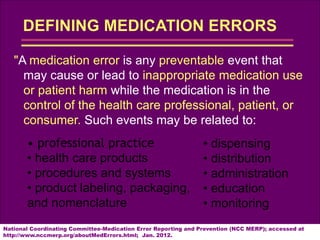
"A medication error is any preventable event that
may cause or lead to inappropriate medication use
or patient harm while the medication is in the
control of the health care professional, patient, or
consumer. Such events may be related to:
National Coordinating Committee-Medication Error Reporting and Prevention (NCC MERP); accessed at
http://www.nccmerp.org/aboutMedErrors.html; Jan. 2012.
• professional practice
• health care products
• procedures and systems
• product labeling, packaging,
and nomenclature
• dispensing
• distribution
• administration
• education
• monitoring
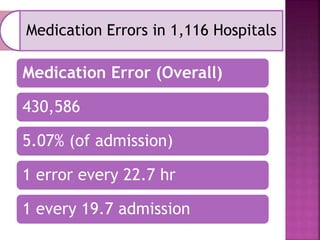
Medication Errors in 1,116 Hospitals
Medication Error (Overall)
430,586
5.07% (of admission)
1 error every 22.7 hr
1 every 19.7 admission
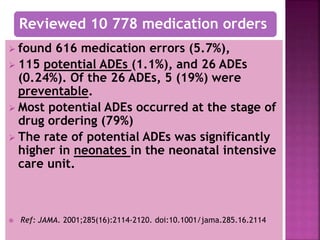
 found 616 medication errors (5.7%),
 115 potential ADEs (1.1%), and 26 ADEs
(0.24%). Of the 26 ADEs, 5 (19%) were
preventable.
 Most potential ADEs occurred at the stage of
drug ordering (79%)
 The rate of potential ADEs was significantly
higher in neonates in the neonatal intensive
care unit.
 Ref: JAMA. 2001;285(16):2114-2120. doi:10.1001/jama.285.16.2114
Reviewed 10 778 medication orders
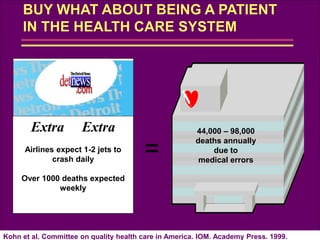
Extra Extra
Airlines expect 1-2
jets to crash daily
Over 1000 deaths expected weekly
Kohn et al. Committee on quality health care in America. IOM. Academy Press. 1999.
Extra Extra
Airlines expect 1-2 jets to
crash daily
Over 1000 deaths expected
weekly
=
44,000 – 98,000
deaths annually
due to
medical errors
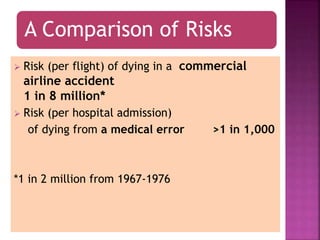
A Comparison of Risks
 Risk (per flight) of dying in a commercial
airline accident
1 in 8 million*
 Risk (per hospital admission)
of dying from a medical error >1 in 1,000
*1 in 2 million from 1967-1976
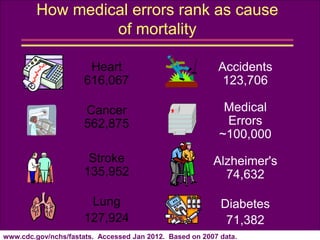
Accidents
123,706
Medical
Errors
~100,000
Alzheimer's
74,632
Diabetes
71,382
www.cdc.gov/nchs/fastats. Accessed Jan 2012. Based on 2007 data.
How medical errors rank as cause
of mortality
Heart
616,067
Cancer
562,875
Stroke
135,952
Lung
127,924
NCC MERP. accessed Jan 2012. www.nccmerp.org
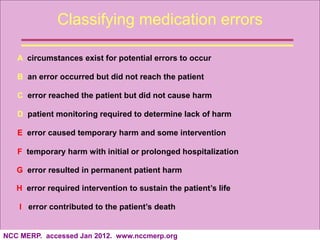
Classifying medication errors
A circumstances exist for potential errors to occur
B an error occurred but did not reach the patient
C error reached the patient but did not cause harm
D patient monitoring required to determine lack of harm
E error caused temporary harm and some intervention
F temporary harm with initial or prolonged hospitalization
G error resulted in permanent patient harm
H error required intervention to sustain the patient’s life
I error contributed to the patient’s death
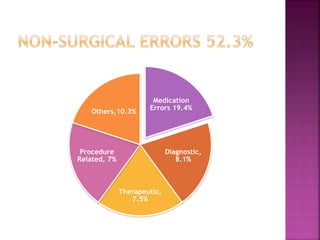
Medication
Errors 19.4%
Diagnostic,
8.1%
Therapeutic,
7.5%
Procedure
Related, 7%
Others,10.3%
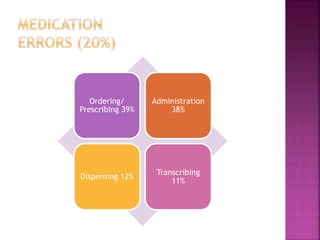
Ordering/
Prescribing 39%
Administration
38%
Dispensing 12%
Transcribing
11%
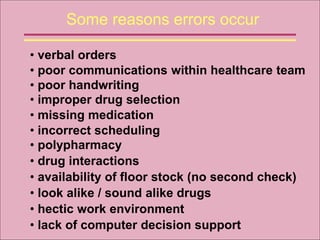
Some reasons errors occur
• poor communications within healthcare team
• verbal orders
• poor handwriting
• improper drug selection
• missing medication
• incorrect scheduling
• look alike / sound alike drugs
• polypharmacy
• availability of floor stock (no second check)
• drug interactions
• hectic work environment
• lack of computer decision support
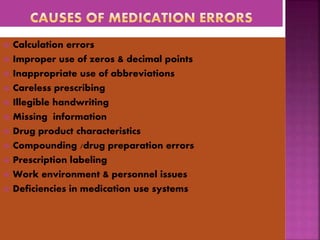
 Calculation errors
 Improper use of zeros & decimal points
 Inappropriate use of abbreviations
 Careless prescribing
 Illegible handwriting
 Missing information
 Drug product characteristics
 Compounding /drug preparation errors
 Prescription labeling
 Work environment & personnel issues
 Deficiencies in medication use systems
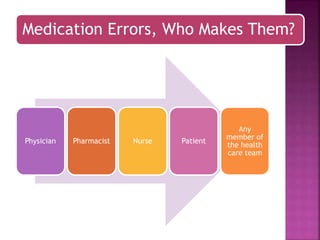
Medication Errors, Who Makes Them?
Physician Pharmacist Nurse Patient
Any
member of
the health
care team
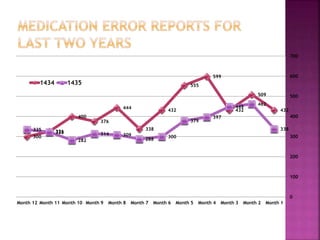
432
509
432
599
555
432
338
444
376
400
326
300
338
462
449
397
379
300
288
309314
282
322
335
0
100
200
300
400
500
600
700
Month 1Month 2Month 3Month 4Month 5Month 6Month 7Month 8Month 9Month 10Month 11Month 12
1434 1435
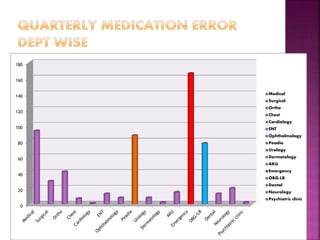
0
20
40
60
80
100
120
140
160
180
Medical
Surgical
Ortho
Chest
Cardiology
ENT
Ophthalmology
Peadia
Urology
Dermatology
AKU
Emergency
OBG/LR
Dental
Neurology
Psychiatric clinic
0
20
40
60
80
100
120
140
160
180
No Diagnosis Prohibited
Abbr
No Gen Name Prescription
Previlage
No.file No. weak
strenght
No Diagnosis
Prohibited Abbr
No Gen Name
Prescription Previlage
No.file No.
weak strenght
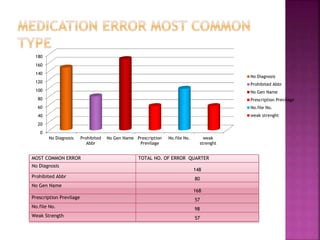
MOST COMMON ERROR TOTAL NO. OF ERROR QUARTER
No Diagnosis
148
Prohibited Abbr 80
No Gen Name
168
Prescription Previlage 57
No.file No. 98
Weak Strength 57
An anticonvulsant
approved in Canada and the US
since2005 to treat neuropathic pain
approved by the European
Commission in 2006 to treat
generalized anxiety disorder.
 The maximum dose of pregabalin
depends on its indication but should
not exceed 600 mg/day.
Clinical studies including 5500 patients
showed that euphoric effects were reported
more frequently in pregabalin groups versus
placebo (4% vs. 1%, respectively).
A clinical abuse liability study found that
pregabalin had a potential for euphorigenic
activity in susceptible populations.
Therefore scheduled by the US Drug
Enforcement Administration under the
Controlled Substances Act as a Schedule V
drug, indicating that
it had abuse potential.
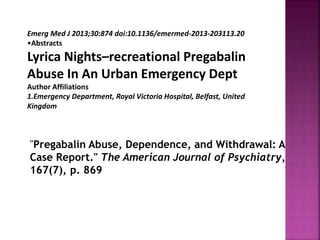
Emerg Med J 2013;30:874 doi:10.1136/emermed-2013-203113.20
•Abstracts
Lyrica Nights–recreational Pregabalin
Abuse In An Urban Emergency Dept
Author Affiliations
1.Emergency Department, Royal Victoria Hospital, Belfast, United
Kingdom
"Pregabalin Abuse, Dependence, and Withdrawal: A
Case Report." The American Journal of Psychiatry,
167(7), p. 869
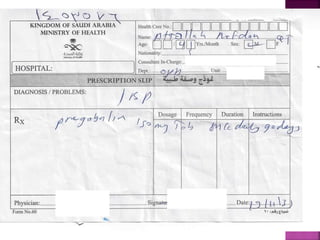
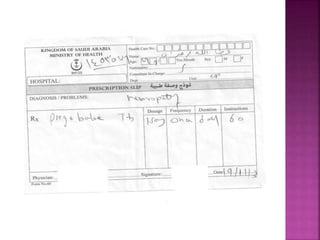
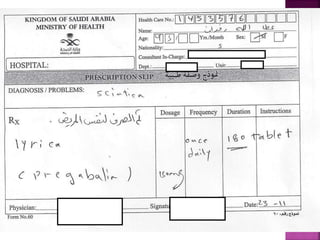
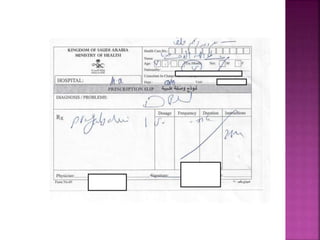
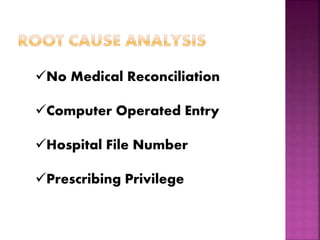
No Medical Reconciliation
Computer Operated Entry
Hospital File Number
Prescribing Privilege
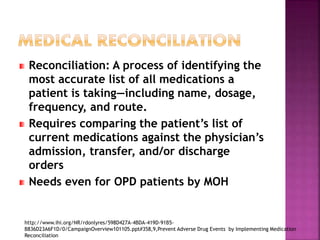
Reconciliation: A process of identifying the
most accurate list of all medications a
patient is taking—including name, dosage,
frequency, and route.
Requires comparing the patient’s list of
current medications against the physician’s
admission, transfer, and/or discharge
orders
Needs even for OPD patients by MOH
http://www.ihi.org/NR/rdonlyres/598D427A-4BDA-419D-91B5-
B836D23A6F1D/0/CampaignOverview101105.ppt#358,9,Prevent Adverse Drug Events by Implementing Medication
Reconciliation
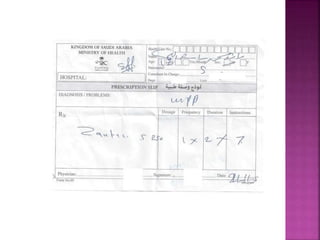
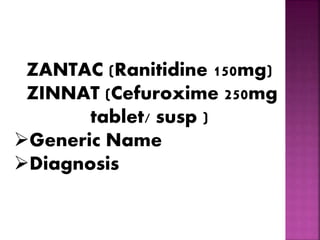
ZANTAC (Ranitidine 150mg)
ZINNAT (Cefuroxime 250mg
tablet/ susp )
Generic Name
Diagnosis
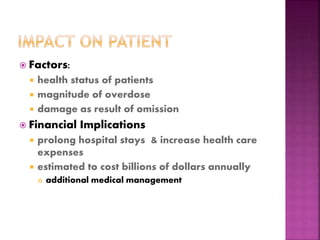
 Factors:
 health status of patients
 magnitude of overdose
 damage as result of omission
 Financial Implications
 prolong hospital stays & increase health care
expenses
 estimated to cost billions of dollars annually
 additional medical management
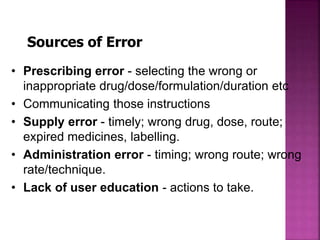
Sources of Error
• Prescribing error - selecting the wrong or
inappropriate drug/dose/formulation/duration etc
• Communicating those instructions
• Supply error - timely; wrong drug, dose, route;
expired medicines, labelling.
• Administration error - timing; wrong route; wrong
rate/technique.
• Lack of user education - actions to take.
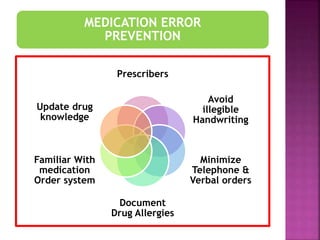
MEDICATION ERROR
PREVENTION
Prescribers
Avoid
illegible
Handwriting
Minimize
Telephone &
Verbal orders
Document
Drug Allergies
Familiar With
medication
Order system
Update drug
knowledge
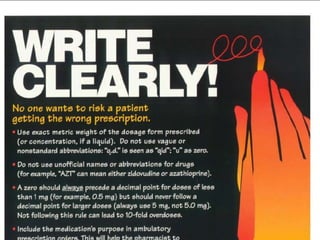
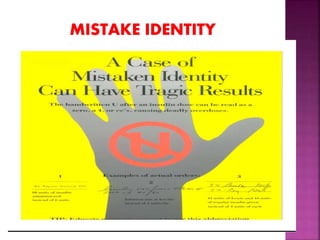
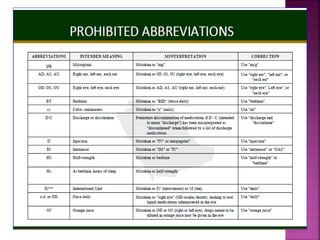
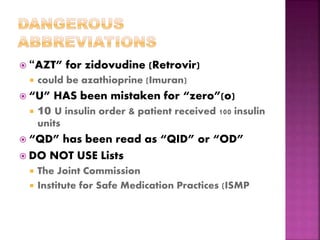
 “AZT” for zidovudine (Retrovir)
 could be azathioprine (Imuran)
 “U” HAS been mistaken for “zero”(o)
 10 U insulin order & patient received 100 insulin
units
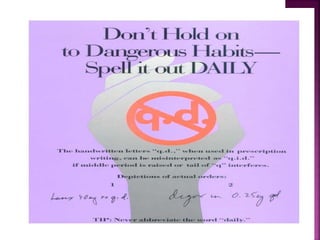
 “QD” has been read as “QID” or “OD”
 DO NOT USE Lists
 The Joint Commission
 Institute for Safe Medication Practices (ISMP
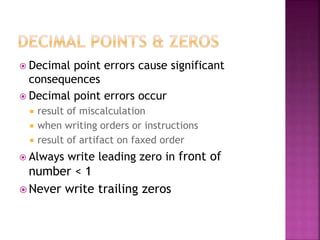
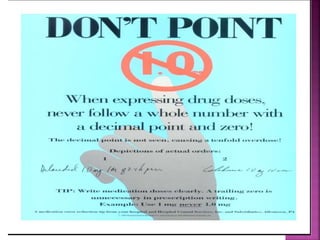
 Decimal point errors cause significant
consequences
 Decimal point errors occur
 result of miscalculation
 when writing orders or instructions
 result of artifact on faxed order
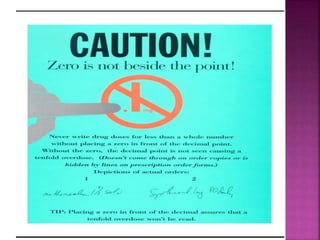
 Always write leading zero in front of
number < 1
 Never write trailing zeros
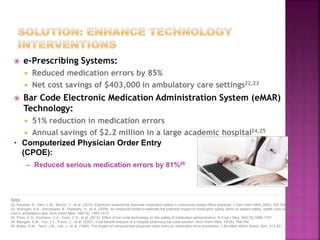
 e-Prescribing Systems:
 Reduced medication errors by 85%
 Net cost savings of $403,000 in ambulatory care settings22,23
 Bar Code Electronic Medication Administration System (eMAR)
Technology:
 51% reduction in medication errors
 Annual savings of $2.2 million in a large academic hospital24,25
• Computerized Physician Order Entry
(CPOE):
– Reduced serious medication errors by 81%26
Notes
22. Kaushal, R., Kern, L.M., Barrón, Y., et al. (2010). Electronic prescribing improves medication safety in community-based office practices. J Gen Intern Med, 25(6), 530-536.
23. Weingart, S.N., Simchowitz, B., Padolsky, H., et al. (2009). An empirical model to estimate the potential impact of medication safety alerts on patient safety, health care utilization, and
cost in ambulatory care. Arch Intern Med, 169(16), 1465-1473.
24. Poon, E.G., Keohane, C.A., Yoon, C.S., et al. (2010). Effect of bar-code technology on the safety of medication administration. N Engl J Med, 362(18),1698-1707.
25. Maviglia, S.M., Yoo, J.Y., Franz, C., et al. (2007). Cost-benefit analysis of a hospital pharmacy bar code solution. Arch Intern Med, 167(8), 788-794.
26. Bates, D.W., Teich, J.M., Lee, J., et al. (1999). The impact of computerized physician order entry on medication error prevention. J Am Med Inform Assoc, 6(4), 313-321.
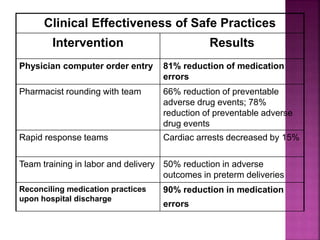
Clinical Effectiveness of Safe Practices
Intervention Results
Physician computer order entry 81% reduction of medication
errors
Pharmacist rounding with team 66% reduction of preventable
adverse drug events; 78%
reduction of preventable adverse
drug events
Rapid response teams Cardiac arrests decreased by 15%
Team training in labor and delivery 50% reduction in adverse
outcomes in preterm deliveries
Reconciling medication practices
upon hospital discharge
90% reduction in medication
errors
 Failure to include concentration in
prescription can result in wrong dose being
dispensed
 amoxicillin suspension 1/2 tsp (2.5 mL) TID
 Concentration?
 “1 amp,” “1 vial,” “1 cap” unclear
 multiple strengths, doses, or vial sizes
 Order for one “vial” of magnesium sulfate?
 2 mL vial (8 mEq)
 20 mL vial (16 mEq)
 10 mL vial of 50% concentration (40 mEq)
 Handwriting of physicians is subject of jokes
 no laughing matter
 Unclear orders should be clarified
 Use standardized, preprinted order forms
 Computer generated & typewritten labels
 Use of upper- and lowercase lettering
(TALLman)
 Lack of medical information about patient
may cause error
 age
 weight
 allergies
 diagnosis
 indication & severity of condition
 Error is inevitable due to “our” limitations:
- limited memory capacity
- limited mental processing capacity
- negative effects of fatigue other stressors
 We all make errors all the time
 Patients suffer adverse events much more
often than previously realised
 Errors often NOT immediately observed
Human beings will always make
errors
Errors are common in medicine,
killing tens of thousands
Naming, blaming and shaming
have no remedial value
THANK YOU

HOW TO MINIMIZE MEDICATION ERROR

  • 1.
    In the nameof Allah, Most Gracious, Most Merciful.
  • 2.
    STRATEGIC PLAN TO MINIMIZEMEDICATION ERROR By Mr.Jawed Ali Quazi
  • 3.
     Define medicationerrors and classify their significance  Understand the extent of medication errors and their impact on patient care  Discuss the many factors that contribute to errors and the impulse to “place blame” on healthcare workers  Examine approaches to minimize the risk of medication errors
  • 4.
    "A medication erroris any preventable event that may cause or lead to inappropriate medication use or patient harm while the medication is in the control of the health care professional, patient, or consumer. Such events may be related to: National Coordinating Committee-Medication Error Reporting and Prevention (NCC MERP); accessed at http://www.nccmerp.org/aboutMedErrors.html; Jan. 2012. • professional practice • health care products • procedures and systems • product labeling, packaging, and nomenclature • dispensing • distribution • administration • education • monitoring
  • 5.
    Medication Errors in1,116 Hospitals Medication Error (Overall) 430,586 5.07% (of admission) 1 error every 22.7 hr 1 every 19.7 admission
  • 6.
     found 616medication errors (5.7%),  115 potential ADEs (1.1%), and 26 ADEs (0.24%). Of the 26 ADEs, 5 (19%) were preventable.  Most potential ADEs occurred at the stage of drug ordering (79%)  The rate of potential ADEs was significantly higher in neonates in the neonatal intensive care unit.  Ref: JAMA. 2001;285(16):2114-2120. doi:10.1001/jama.285.16.2114 Reviewed 10 778 medication orders
  • 7.
    Extra Extra Airlines expect1-2 jets to crash daily Over 1000 deaths expected weekly
  • 8.
    Kohn et al.Committee on quality health care in America. IOM. Academy Press. 1999. Extra Extra Airlines expect 1-2 jets to crash daily Over 1000 deaths expected weekly = 44,000 – 98,000 deaths annually due to medical errors
  • 9.
    A Comparison ofRisks  Risk (per flight) of dying in a commercial airline accident 1 in 8 million*  Risk (per hospital admission) of dying from a medical error >1 in 1,000 *1 in 2 million from 1967-1976
  • 10.
    Accidents 123,706 Medical Errors ~100,000 Alzheimer's 74,632 Diabetes 71,382 www.cdc.gov/nchs/fastats. Accessed Jan2012. Based on 2007 data. How medical errors rank as cause of mortality Heart 616,067 Cancer 562,875 Stroke 135,952 Lung 127,924
  • 11.
    NCC MERP. accessedJan 2012. www.nccmerp.org Classifying medication errors A circumstances exist for potential errors to occur B an error occurred but did not reach the patient C error reached the patient but did not cause harm D patient monitoring required to determine lack of harm E error caused temporary harm and some intervention F temporary harm with initial or prolonged hospitalization G error resulted in permanent patient harm H error required intervention to sustain the patient’s life I error contributed to the patient’s death
  • 13.
  • 14.
  • 15.
    Some reasons errorsoccur • poor communications within healthcare team • verbal orders • poor handwriting • improper drug selection • missing medication • incorrect scheduling • look alike / sound alike drugs • polypharmacy • availability of floor stock (no second check) • drug interactions • hectic work environment • lack of computer decision support
  • 16.
     Calculation errors Improper use of zeros & decimal points  Inappropriate use of abbreviations  Careless prescribing  Illegible handwriting  Missing information  Drug product characteristics  Compounding /drug preparation errors  Prescription labeling  Work environment & personnel issues  Deficiencies in medication use systems
  • 17.
    Medication Errors, WhoMakes Them? Physician Pharmacist Nurse Patient Any member of the health care team
  • 18.
  • 19.
  • 20.
    0 20 40 60 80 100 120 140 160 180 No Diagnosis Prohibited Abbr NoGen Name Prescription Previlage No.file No. weak strenght No Diagnosis Prohibited Abbr No Gen Name Prescription Previlage No.file No. weak strenght MOST COMMON ERROR TOTAL NO. OF ERROR QUARTER No Diagnosis 148 Prohibited Abbr 80 No Gen Name 168 Prescription Previlage 57 No.file No. 98 Weak Strength 57
  • 25.
    An anticonvulsant approved inCanada and the US since2005 to treat neuropathic pain approved by the European Commission in 2006 to treat generalized anxiety disorder.  The maximum dose of pregabalin depends on its indication but should not exceed 600 mg/day.
  • 26.
    Clinical studies including5500 patients showed that euphoric effects were reported more frequently in pregabalin groups versus placebo (4% vs. 1%, respectively). A clinical abuse liability study found that pregabalin had a potential for euphorigenic activity in susceptible populations. Therefore scheduled by the US Drug Enforcement Administration under the Controlled Substances Act as a Schedule V drug, indicating that it had abuse potential.
  • 27.
    Emerg Med J2013;30:874 doi:10.1136/emermed-2013-203113.20 •Abstracts Lyrica Nights–recreational Pregabalin Abuse In An Urban Emergency Dept Author Affiliations 1.Emergency Department, Royal Victoria Hospital, Belfast, United Kingdom "Pregabalin Abuse, Dependence, and Withdrawal: A Case Report." The American Journal of Psychiatry, 167(7), p. 869
  • 28.
    No Medical Reconciliation ComputerOperated Entry Hospital File Number Prescribing Privilege
  • 29.
    Reconciliation: A processof identifying the most accurate list of all medications a patient is taking—including name, dosage, frequency, and route. Requires comparing the patient’s list of current medications against the physician’s admission, transfer, and/or discharge orders Needs even for OPD patients by MOH http://www.ihi.org/NR/rdonlyres/598D427A-4BDA-419D-91B5- B836D23A6F1D/0/CampaignOverview101105.ppt#358,9,Prevent Adverse Drug Events by Implementing Medication Reconciliation
  • 31.
    ZANTAC (Ranitidine 150mg) ZINNAT(Cefuroxime 250mg tablet/ susp ) Generic Name Diagnosis
  • 32.
     Factors:  healthstatus of patients  magnitude of overdose  damage as result of omission  Financial Implications  prolong hospital stays & increase health care expenses  estimated to cost billions of dollars annually  additional medical management
  • 33.
    Sources of Error •Prescribing error - selecting the wrong or inappropriate drug/dose/formulation/duration etc • Communicating those instructions • Supply error - timely; wrong drug, dose, route; expired medicines, labelling. • Administration error - timing; wrong route; wrong rate/technique. • Lack of user education - actions to take.
  • 34.
    MEDICATION ERROR PREVENTION Prescribers Avoid illegible Handwriting Minimize Telephone & Verbalorders Document Drug Allergies Familiar With medication Order system Update drug knowledge
  • 37.
     “AZT” forzidovudine (Retrovir)  could be azathioprine (Imuran)  “U” HAS been mistaken for “zero”(o)  10 U insulin order & patient received 100 insulin units  “QD” has been read as “QID” or “OD”  DO NOT USE Lists  The Joint Commission  Institute for Safe Medication Practices (ISMP
  • 40.
     Decimal pointerrors cause significant consequences  Decimal point errors occur  result of miscalculation  when writing orders or instructions  result of artifact on faxed order  Always write leading zero in front of number < 1  Never write trailing zeros
  • 43.
     e-Prescribing Systems: Reduced medication errors by 85%  Net cost savings of $403,000 in ambulatory care settings22,23  Bar Code Electronic Medication Administration System (eMAR) Technology:  51% reduction in medication errors  Annual savings of $2.2 million in a large academic hospital24,25 • Computerized Physician Order Entry (CPOE): – Reduced serious medication errors by 81%26 Notes 22. Kaushal, R., Kern, L.M., Barrón, Y., et al. (2010). Electronic prescribing improves medication safety in community-based office practices. J Gen Intern Med, 25(6), 530-536. 23. Weingart, S.N., Simchowitz, B., Padolsky, H., et al. (2009). An empirical model to estimate the potential impact of medication safety alerts on patient safety, health care utilization, and cost in ambulatory care. Arch Intern Med, 169(16), 1465-1473. 24. Poon, E.G., Keohane, C.A., Yoon, C.S., et al. (2010). Effect of bar-code technology on the safety of medication administration. N Engl J Med, 362(18),1698-1707. 25. Maviglia, S.M., Yoo, J.Y., Franz, C., et al. (2007). Cost-benefit analysis of a hospital pharmacy bar code solution. Arch Intern Med, 167(8), 788-794. 26. Bates, D.W., Teich, J.M., Lee, J., et al. (1999). The impact of computerized physician order entry on medication error prevention. J Am Med Inform Assoc, 6(4), 313-321.
  • 44.
    Clinical Effectiveness ofSafe Practices Intervention Results Physician computer order entry 81% reduction of medication errors Pharmacist rounding with team 66% reduction of preventable adverse drug events; 78% reduction of preventable adverse drug events Rapid response teams Cardiac arrests decreased by 15% Team training in labor and delivery 50% reduction in adverse outcomes in preterm deliveries Reconciling medication practices upon hospital discharge 90% reduction in medication errors
  • 45.
     Failure toinclude concentration in prescription can result in wrong dose being dispensed  amoxicillin suspension 1/2 tsp (2.5 mL) TID  Concentration?  “1 amp,” “1 vial,” “1 cap” unclear  multiple strengths, doses, or vial sizes  Order for one “vial” of magnesium sulfate?  2 mL vial (8 mEq)  20 mL vial (16 mEq)  10 mL vial of 50% concentration (40 mEq)
  • 46.
     Handwriting ofphysicians is subject of jokes  no laughing matter  Unclear orders should be clarified  Use standardized, preprinted order forms  Computer generated & typewritten labels  Use of upper- and lowercase lettering (TALLman)
  • 47.
     Lack ofmedical information about patient may cause error  age  weight  allergies  diagnosis  indication & severity of condition
  • 48.
     Error isinevitable due to “our” limitations: - limited memory capacity - limited mental processing capacity - negative effects of fatigue other stressors  We all make errors all the time  Patients suffer adverse events much more often than previously realised  Errors often NOT immediately observed
  • 49.
    Human beings willalways make errors Errors are common in medicine, killing tens of thousands Naming, blaming and shaming have no remedial value
  • 50.