GENERAL FOEM OF THE EXCESS FREE CASH FLOW MODEL
EXCESS OPERATING CASH FLOW MODEL
THE EXCESS (OR RESIDUAL ) EARNINGS MODEL
5
6
7
7.2
The concept of excess earnings is not new.
5 Introduction
As early as 1890, an economist named Alfred Marshell defined profits in terms of
excess earnings.
Edwards and Bell explicitly discussed measuring residual earnings using financial
statements.
Sten Stewart & Company, the sonsulting company, also popularized an adjusted
excess earnings valuation method, (EVA).
Ohlson(1989, 1995) provided a rigorous development of these model and popularized
this valuation method as a research topic and its use in the investment community.
If implemented consistently, the various excess earnings valuation methods result in
the same valuation as the DCF model.
5
How can the excess earnings and DCF valuation methods result in the same valuation?
We discount excess accounting earnings ( residual earnings or residual income)
instead of excess free cash flows. We use accounting earnings and total invested
capital based on financial statements.
Excess free cash flow model
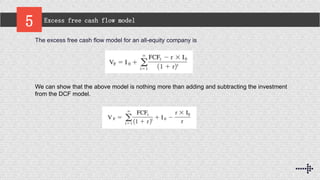
The excess free cash flow model for an all-equity company is
5 Excess free cash flow model
We can show that the above model is nothing more than adding and subtracting the investment
from the DCF model.
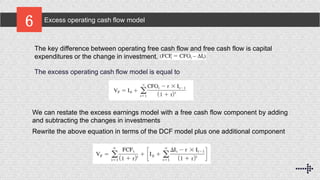
The excess operating cash flow model is equal to
6 Excess operating cash flow model
We can restate the excess earnings model with a free cash flow component by adding
and subtracting the changes in investments
Rewrite the above equation in terms of the DCF model plus one additional component
The key difference between operating free cash flow and free cash flow is capital
expenditures or the change in investment.
7 Excess earnings model
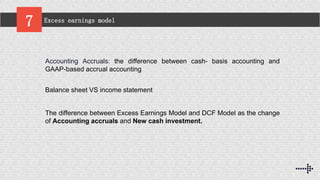
Accounting Accruals: the difference between cash- basis accounting and
GAAP-based accrual accounting
Balance sheet VS income statement
The difference between Excess Earnings Model and DCF Model as the change
of Accounting accruals and New cash investment.
Basic free cash flow formula:
7
FCF = EBIT - TAX + NCX - NCR - △RC - △NWC - CAPEX
E = EBIT - TAX
△I = △RC + CAPEX
△A = △NWC + NCR - NCX
FCF = E - △A - △I
BVE = I + A
Excess earnings model
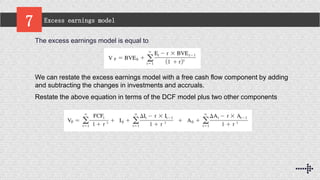
The excess earnings model is equal to
7
We can restate the excess earnings model with a free cash flow component by adding
and subtracting the changes in investments and accruals.
Restate the above equation in terms of the DCF model plus two other components
Excess earnings model
Use the information from Review Exercise 7.1 and assume that in addition to the initial $10 million invest-
ment in the company, the company also recorded a $1 million intangible asset, which has a perpetual life.
Also assume that the company’s free cash flow is equal to its accounting earnings
7 Exercise 7.2
THANKS

Cash flow model

  • 1.
    GENERAL FOEM OFTHE EXCESS FREE CASH FLOW MODEL EXCESS OPERATING CASH FLOW MODEL THE EXCESS (OR RESIDUAL ) EARNINGS MODEL 5 6 7 7.2
  • 2.
    The concept ofexcess earnings is not new. 5 Introduction As early as 1890, an economist named Alfred Marshell defined profits in terms of excess earnings. Edwards and Bell explicitly discussed measuring residual earnings using financial statements. Sten Stewart & Company, the sonsulting company, also popularized an adjusted excess earnings valuation method, (EVA). Ohlson(1989, 1995) provided a rigorous development of these model and popularized this valuation method as a research topic and its use in the investment community.
  • 3.
    If implemented consistently,the various excess earnings valuation methods result in the same valuation as the DCF model. 5 How can the excess earnings and DCF valuation methods result in the same valuation? We discount excess accounting earnings ( residual earnings or residual income) instead of excess free cash flows. We use accounting earnings and total invested capital based on financial statements. Excess free cash flow model
  • 4.
    The excess freecash flow model for an all-equity company is 5 Excess free cash flow model We can show that the above model is nothing more than adding and subtracting the investment from the DCF model.
  • 5.
    The excess operatingcash flow model is equal to 6 Excess operating cash flow model We can restate the excess earnings model with a free cash flow component by adding and subtracting the changes in investments Rewrite the above equation in terms of the DCF model plus one additional component The key difference between operating free cash flow and free cash flow is capital expenditures or the change in investment.
  • 6.
    7 Excess earningsmodel Accounting Accruals: the difference between cash- basis accounting and GAAP-based accrual accounting Balance sheet VS income statement The difference between Excess Earnings Model and DCF Model as the change of Accounting accruals and New cash investment.
  • 7.
    Basic free cashflow formula: 7 FCF = EBIT - TAX + NCX - NCR - △RC - △NWC - CAPEX E = EBIT - TAX △I = △RC + CAPEX △A = △NWC + NCR - NCX FCF = E - △A - △I BVE = I + A Excess earnings model
  • 8.
    The excess earningsmodel is equal to 7 We can restate the excess earnings model with a free cash flow component by adding and subtracting the changes in investments and accruals. Restate the above equation in terms of the DCF model plus two other components Excess earnings model
  • 9.
    Use the informationfrom Review Exercise 7.1 and assume that in addition to the initial $10 million invest- ment in the company, the company also recorded a $1 million intangible asset, which has a perpetual life. Also assume that the company’s free cash flow is equal to its accounting earnings 7 Exercise 7.2
  • 10.