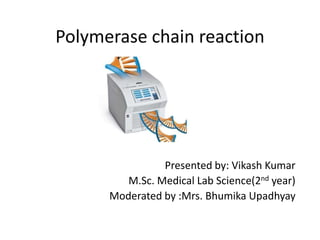
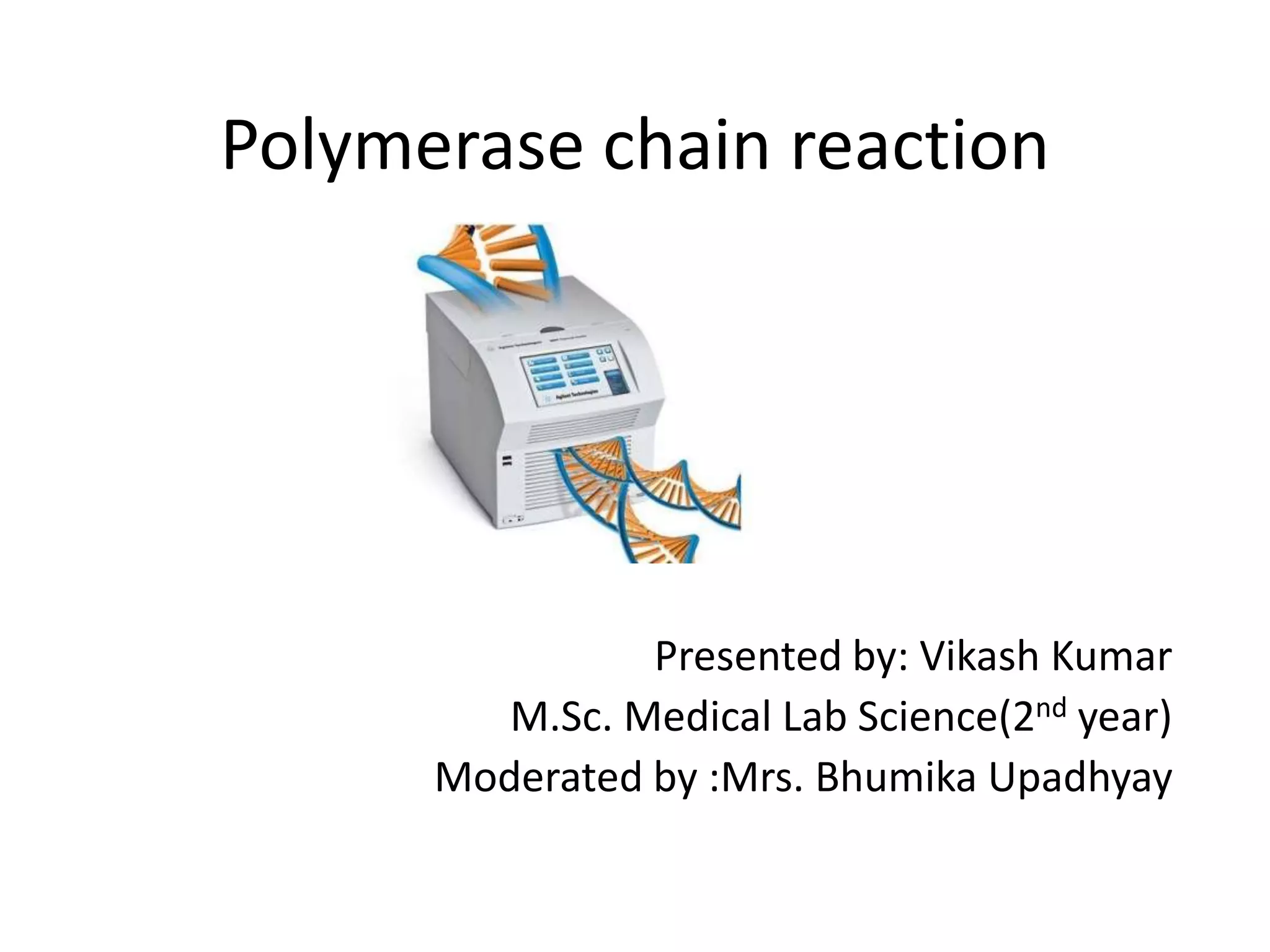
Polymerase chain reaction
Presented by: Vikash Kumar
M.Sc. Medical Lab Science(2nd year)
Moderated by :Mrs. Bhumika Upadhyay
content
• Introduction
• Short History of PCR
• Principle of PCR
• Working of PCR
• Types of PCR
• Application
History
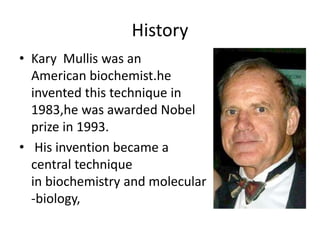
• Kary Mullis was an
American biochemist.he
invented this technique in
1983,he was awarded Nobel
prize in 1993.
• His invention became a
central technique
in biochemistry and molecular
-biology,
Introduction
• The polymerase chain reaction or PCR is an in
vitro technique.
• It is like xerox machine for gene copying.
• PCR is a method of amplifying specific DNA
sequences & RNA sequences.
• It can be used to very quickly & efficiently
produce millions copies of a single DNA
segment.
Working principle of PCR
• One DNA molecule is used to produce
two copies, then four, then eight and so
on.
• This continuous doubling is accomplished
by specific proteins known as polymerase
enzyme that are able to string together
individual DNA building blocks to form
long molecular strands.
Reagents Needed
• Target DNA molecule (DNA sample which you want to
amplify)
• A pair of DNA primer
• Forward primer (One primer binds to the 5’ end of one
of the DNA strands)
• Reverse primer (The other primer binds to the 3’ end of
the anti-parallel DNA strand)
• Heat resistance DNA polymerase(Taq polymerase) Works at
high temperature
• All types of deoxynucleotide triphosphates (dNTPs)
adenine, cytosine, guanine and thymine.
• PCR buffer
• Divalent cations (MgCl2)
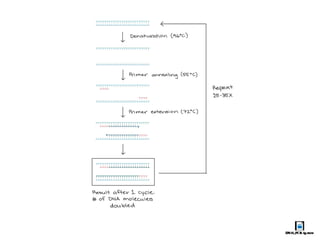
The basic steps are:
• Denaturation (95 °C)Heat the reaction strongly to
separate, or denature, the DNA strands. This
provides single-stranded template for the next
step.
• Annealing (55° C): Cool the reaction so the
primers can bind to their complementary
sequences on the single-stranded template DNA.
• Extension (72 °C): Raise the reaction
temperatures so Taq polymerase extends the
primers, synthesizing new strands of DNA.
How PCR Works• Protocol
– Put all reagents into a PCR tube
Melting or heat denaturation
Break the DNA ladder down the middle to create two
strands, a 5’ to 3’ strand and a 3’ to 5’ strand
Annealing
Bind each primer to its appropriate strand
• 5’ primer to the 5’ to 3’ strand
• 3’ primer to the 3’ to 5’ strand
Extending
Copy each strand
• DNA polymerase
How PCR Works
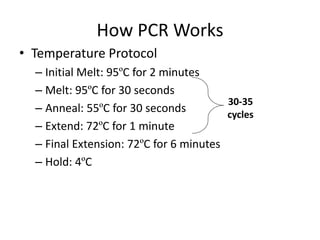
• Temperature Protocol
– Initial Melt: 95ºC for 2 minutes
– Melt: 95ºC for 30 seconds
– Anneal: 55ºC for 30 seconds
– Extend: 72ºC for 1 minute
– Final Extension: 72ºC for 6 minutes
– Hold: 4ºC
30-35
cycles
Why electrophoresis?
• To separate DNA
fragments from each
other
• To determine the sizes
of DNA fragments
• To determine the
presence or amount of
DNA
• To analyze restriction
digestion products
Introduction Of Agarose Gel
Electrophoresis
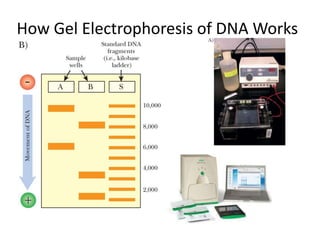
• Agarose gel electrophorresis is a method
to separate DNA or RNA molecules by size &
charge.
• This is achieved by moving negatively charged
nucleic acid molecules through an agarose
matrix with an electric field (electrophoresis).
• Shorter molecules move faster and migrate
faster than longer ones .
Principle of electrophoresis
• separates molecules from each other on the basis of
– size
– charge
– shape
• basis of separation depends on how the sample and gel
are prepared
• employs electromotive force to move molecules
through a porous gel
Material required for agarose gel
electrophoresis
 Electrophoresis chamber
 Agarose gel
 Gel casting tray
 Buffer
 Staining agent (dye)
 A comb
 DNA ladder
 Sample to be separate
 ETBR (ethidium bromide)
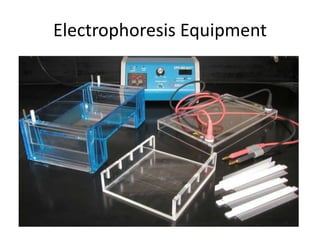
Electrophoresis Equipment
How Gel Electrophoresis of DNA Works
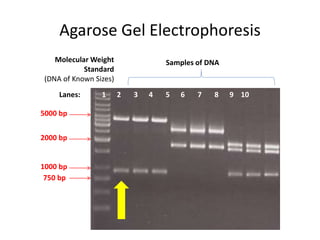
Agarose Gel Electrophoresis
Molecular Weight
Standard
(DNA of Known Sizes)
1 2 3 4 5 6 7 8 9 10
Samples of DNA
2000 bp
1000 bp
750 bp
Lanes:
5000 bp
There are many types of PCR
 Real-Time PCR (quantitative PCR or
qPCR)
 Reverse-Transcriptase (RT-PCR)
 Multiplex PCR
 Nested PCR
 High Fidelity PCR
 Fast PCR
 Hot Start PCR
 GC-Rich PCR
 Long-range PCR.
 Quantitative PCR
 Semi quantitative PCR
 Methylation specific PCR
 In situ PCR
 Long PCR
 Colony PCR
 Touch down PCR
 Band stab PCR Allele specific PCR
 Digital PCR
 Overlap Extension PCR
 Solid phase
 Inverse PCR
 Hot start PCR
 Differential display
 Ligation mediated PCR
 Methylation specific PCR
Real-Time PCR
• Real time PCR also k/a kinetic PCR, qPCR, qRT PCR
and RT-PCR, is a quantitative PCR method for the
determination of copy number of PCR templates
such as DNA or CDNA in a PCR reaction.
• Real-time PCR monitors the fluorescence emitted
during the reaction as an indicator of amplicon
production at each PCR cycle.
• Thus in Real-time PCR one can visually see the
progress of the reaction in "real time“
Reverse-Transcriptase (RT-PCR)
It is employed for amplification of RNA
molecules .
 RT-PCR is widely used in expression profiling,
to determine the expression of a gene or to
identify the sequence of an RNA transcript.
Multiplex PCR
• Multiplex PCR is a widespread molecular biology
technique for amplification of multiple targets in
a single PCR experiment.
• In a multiplexing assay, more than one target
sequence can be amplified by using multiple
primer pairs in a reaction mixture.
• Generally up to eight primer pairs c/b used in a
standard multiplex reaction, otherwise the yield
of some amplicons is reduced and not visible on
agarose gel.
Nested PCR
• Two pairs instead of one pair of PCR primers
are used to amplify a fragment.
• First pair amplifies a fragment similar to
standard PCR
• Second pairs bind inside the 1st PCR product
fragment allow amplification of 2d PCR
product which is shorter than the 1st one
Application of PCR
• Diagnosis of infectious disease
 Tuberculosis
 Hiv
• Detection of variation & mutations in gene
• DNA finger printing can multiply
Thank you

Polymerase chain reaction

  • 1.
    Polymerase chain reaction Presentedby: Vikash Kumar M.Sc. Medical Lab Science(2nd year) Moderated by :Mrs. Bhumika Upadhyay
  • 2.
    content • Introduction • ShortHistory of PCR • Principle of PCR • Working of PCR • Types of PCR • Application
  • 3.
    History • Kary Mulliswas an American biochemist.he invented this technique in 1983,he was awarded Nobel prize in 1993. • His invention became a central technique in biochemistry and molecular -biology,
  • 4.
    Introduction • The polymerasechain reaction or PCR is an in vitro technique. • It is like xerox machine for gene copying. • PCR is a method of amplifying specific DNA sequences & RNA sequences. • It can be used to very quickly & efficiently produce millions copies of a single DNA segment.
  • 5.
    Working principle ofPCR • One DNA molecule is used to produce two copies, then four, then eight and so on. • This continuous doubling is accomplished by specific proteins known as polymerase enzyme that are able to string together individual DNA building blocks to form long molecular strands.
  • 6.
    Reagents Needed • TargetDNA molecule (DNA sample which you want to amplify) • A pair of DNA primer • Forward primer (One primer binds to the 5’ end of one of the DNA strands) • Reverse primer (The other primer binds to the 3’ end of the anti-parallel DNA strand) • Heat resistance DNA polymerase(Taq polymerase) Works at high temperature • All types of deoxynucleotide triphosphates (dNTPs) adenine, cytosine, guanine and thymine. • PCR buffer • Divalent cations (MgCl2)
  • 8.
    The basic stepsare: • Denaturation (95 °C)Heat the reaction strongly to separate, or denature, the DNA strands. This provides single-stranded template for the next step. • Annealing (55° C): Cool the reaction so the primers can bind to their complementary sequences on the single-stranded template DNA. • Extension (72 °C): Raise the reaction temperatures so Taq polymerase extends the primers, synthesizing new strands of DNA.
  • 9.
    How PCR Works•Protocol – Put all reagents into a PCR tube Melting or heat denaturation Break the DNA ladder down the middle to create two strands, a 5’ to 3’ strand and a 3’ to 5’ strand Annealing Bind each primer to its appropriate strand • 5’ primer to the 5’ to 3’ strand • 3’ primer to the 3’ to 5’ strand Extending Copy each strand • DNA polymerase
  • 10.
    How PCR Works •Temperature Protocol – Initial Melt: 95ºC for 2 minutes – Melt: 95ºC for 30 seconds – Anneal: 55ºC for 30 seconds – Extend: 72ºC for 1 minute – Final Extension: 72ºC for 6 minutes – Hold: 4ºC 30-35 cycles
  • 11.
    Why electrophoresis? • Toseparate DNA fragments from each other • To determine the sizes of DNA fragments • To determine the presence or amount of DNA • To analyze restriction digestion products
  • 12.
    Introduction Of AgaroseGel Electrophoresis • Agarose gel electrophorresis is a method to separate DNA or RNA molecules by size & charge. • This is achieved by moving negatively charged nucleic acid molecules through an agarose matrix with an electric field (electrophoresis). • Shorter molecules move faster and migrate faster than longer ones .
  • 13.
    Principle of electrophoresis •separates molecules from each other on the basis of – size – charge – shape • basis of separation depends on how the sample and gel are prepared • employs electromotive force to move molecules through a porous gel
  • 14.
    Material required foragarose gel electrophoresis  Electrophoresis chamber  Agarose gel  Gel casting tray  Buffer  Staining agent (dye)  A comb  DNA ladder  Sample to be separate  ETBR (ethidium bromide)
  • 15.
  • 16.
  • 17.
    Agarose Gel Electrophoresis MolecularWeight Standard (DNA of Known Sizes) 1 2 3 4 5 6 7 8 9 10 Samples of DNA 2000 bp 1000 bp 750 bp Lanes: 5000 bp
  • 18.
    There are manytypes of PCR  Real-Time PCR (quantitative PCR or qPCR)  Reverse-Transcriptase (RT-PCR)  Multiplex PCR  Nested PCR  High Fidelity PCR  Fast PCR  Hot Start PCR  GC-Rich PCR  Long-range PCR.  Quantitative PCR  Semi quantitative PCR  Methylation specific PCR  In situ PCR  Long PCR  Colony PCR  Touch down PCR  Band stab PCR Allele specific PCR  Digital PCR  Overlap Extension PCR  Solid phase  Inverse PCR  Hot start PCR  Differential display  Ligation mediated PCR  Methylation specific PCR
  • 19.
    Real-Time PCR • Realtime PCR also k/a kinetic PCR, qPCR, qRT PCR and RT-PCR, is a quantitative PCR method for the determination of copy number of PCR templates such as DNA or CDNA in a PCR reaction. • Real-time PCR monitors the fluorescence emitted during the reaction as an indicator of amplicon production at each PCR cycle. • Thus in Real-time PCR one can visually see the progress of the reaction in "real time“
  • 20.
    Reverse-Transcriptase (RT-PCR) It isemployed for amplification of RNA molecules .  RT-PCR is widely used in expression profiling, to determine the expression of a gene or to identify the sequence of an RNA transcript.
  • 21.
    Multiplex PCR • MultiplexPCR is a widespread molecular biology technique for amplification of multiple targets in a single PCR experiment. • In a multiplexing assay, more than one target sequence can be amplified by using multiple primer pairs in a reaction mixture. • Generally up to eight primer pairs c/b used in a standard multiplex reaction, otherwise the yield of some amplicons is reduced and not visible on agarose gel.
  • 22.
    Nested PCR • Twopairs instead of one pair of PCR primers are used to amplify a fragment. • First pair amplifies a fragment similar to standard PCR • Second pairs bind inside the 1st PCR product fragment allow amplification of 2d PCR product which is shorter than the 1st one
  • 23.
    Application of PCR •Diagnosis of infectious disease  Tuberculosis  Hiv • Detection of variation & mutations in gene • DNA finger printing can multiply
  • 24.