
ANTISENSE OLIGONUCLEOTIDES
AYANA R KUMAR
M Pharm, Pharmacology
DEPARTMENT OF PHARMACOLOGY 1
ANTISENSE OLIGONUCLEOTIDE
 Antisense RNA (as RNA)
 Antisense transcript
 Natural Antisense Transcript (NAT)
 Single stranded RNA
DEPARTMENT OF PHARMACOLOGY 2
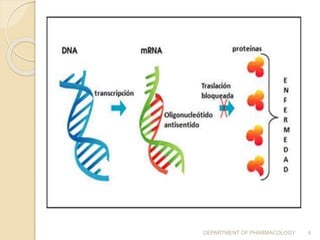
ANTISENSE TECHNOLOGY
 Antisense therapy
 Regulate gene expression
 Gene knock down
Fomivirsen - Cytomegalovirus retinitis
Mipomersen - Hypercholesterolemia
Eteplirsen – Muscular dystrophy
Nusinersen - Spinal muscular atrophy.
DEPARTMENT OF PHARMACOLOGY 3
DEPARTMENT OF PHARMACOLOGY 4
CLASSIFICATION
• Cis – acting oligonucleotide
• Trans – acting oligonucleotide
DEPARTMENT OF PHARMACOLOGY 5
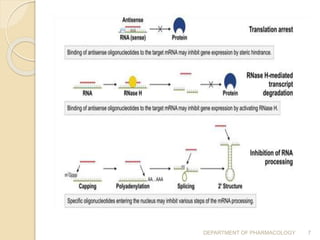
MECHANISM OF ACTION
(a)The RNAse H-dependent oligonucleotides - Degradation of
mRNA.
(b) The steric blocker oligonucleotides - Physically prevent or inhibit
the progression of splicing or the translational.
DEPARTMENT OF PHARMACOLOGY 6
DEPARTMENT OF PHARMACOLOGY 7
DELIVERY OF OLIGONUCLEOTIDES TO CELL
 Uptake occurs through active transport
 Temperature
 The structure
 Concentration of the oligonucleotide
• Adsorptive endocytosis
• Fluid phase pinocytosis
DEPARTMENT OF PHARMACOLOGY 8
FUNCTIONS
 Epigenetic regulation
 DNA methylation
 Histone modification
 Co-transcriptional regulation
 Post-transcriptional regulation
DEPARTMENT OF PHARMACOLOGY 9
ANTISENSE OLIGONUCLEOTIDE
TECHNOLOGIES IN DRUG DISCOVERY
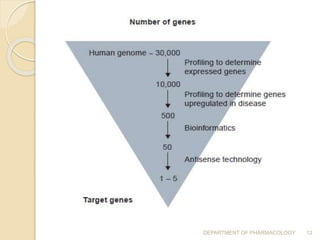
 New genomic knowledge.
 Simple and Efficient.
 Specific manipulation of gene expression at the
DNA or RNA stage of protein synthesis.
 Gene-function analysis and for the development
of therapeutics.
 Target-gene function.
 Identification of novel drug targets.
 Function of any newly discovered genes.
DEPARTMENT OF PHARMACOLOGY 10
 Discover novel pathways
 Design new, gene-specific drug targets.
 Reduce the cost of drug discovery
DEPARTMENT OF PHARMACOLOGY 11
DEPARTMENT OF PHARMACOLOGY 12
REFERENCES
1. Expert opin. Drug Discov. (2006), 1 (4): 285 – 288.
2. Antisense Oligonucleotides: Basic Concepts and Mechanisms
.Dol Nathalie Dias Published March 2002.
3. Agrawal s, kandimalla .Antisense therapeutics: is it as simple
as complementary base recognition. Mol. Med. Today (2000)
6:72-81.
4. hopkins al groom cr. The druggable genome. Nat. Rev. Drug
Discov. (2002) 1:727-730.
DEPARTMENT OF PHARMACOLOGY 13
THANK YOU
DEPARTMENT OF PHARMACOLOGY 14

ANTISENSE OLIGONUCLEOTIDES

  • 1.
    ANTISENSE OLIGONUCLEOTIDES AYANA RKUMAR M Pharm, Pharmacology DEPARTMENT OF PHARMACOLOGY 1
  • 2.
    ANTISENSE OLIGONUCLEOTIDE  AntisenseRNA (as RNA)  Antisense transcript  Natural Antisense Transcript (NAT)  Single stranded RNA DEPARTMENT OF PHARMACOLOGY 2
  • 3.
    ANTISENSE TECHNOLOGY  Antisensetherapy  Regulate gene expression  Gene knock down Fomivirsen - Cytomegalovirus retinitis Mipomersen - Hypercholesterolemia Eteplirsen – Muscular dystrophy Nusinersen - Spinal muscular atrophy. DEPARTMENT OF PHARMACOLOGY 3
  • 4.
  • 5.
    CLASSIFICATION • Cis –acting oligonucleotide • Trans – acting oligonucleotide DEPARTMENT OF PHARMACOLOGY 5
  • 6.
    MECHANISM OF ACTION (a)TheRNAse H-dependent oligonucleotides - Degradation of mRNA. (b) The steric blocker oligonucleotides - Physically prevent or inhibit the progression of splicing or the translational. DEPARTMENT OF PHARMACOLOGY 6
  • 7.
  • 8.
    DELIVERY OF OLIGONUCLEOTIDESTO CELL  Uptake occurs through active transport  Temperature  The structure  Concentration of the oligonucleotide • Adsorptive endocytosis • Fluid phase pinocytosis DEPARTMENT OF PHARMACOLOGY 8
  • 9.
    FUNCTIONS  Epigenetic regulation DNA methylation  Histone modification  Co-transcriptional regulation  Post-transcriptional regulation DEPARTMENT OF PHARMACOLOGY 9
  • 10.
    ANTISENSE OLIGONUCLEOTIDE TECHNOLOGIES INDRUG DISCOVERY  New genomic knowledge.  Simple and Efficient.  Specific manipulation of gene expression at the DNA or RNA stage of protein synthesis.  Gene-function analysis and for the development of therapeutics.  Target-gene function.  Identification of novel drug targets.  Function of any newly discovered genes. DEPARTMENT OF PHARMACOLOGY 10
  • 11.
     Discover novelpathways  Design new, gene-specific drug targets.  Reduce the cost of drug discovery DEPARTMENT OF PHARMACOLOGY 11
  • 12.
  • 13.
    REFERENCES 1. Expert opin.Drug Discov. (2006), 1 (4): 285 – 288. 2. Antisense Oligonucleotides: Basic Concepts and Mechanisms .Dol Nathalie Dias Published March 2002. 3. Agrawal s, kandimalla .Antisense therapeutics: is it as simple as complementary base recognition. Mol. Med. Today (2000) 6:72-81. 4. hopkins al groom cr. The druggable genome. Nat. Rev. Drug Discov. (2002) 1:727-730. DEPARTMENT OF PHARMACOLOGY 13
  • 14.
    THANK YOU DEPARTMENT OFPHARMACOLOGY 14