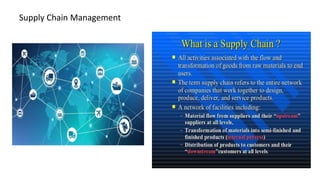
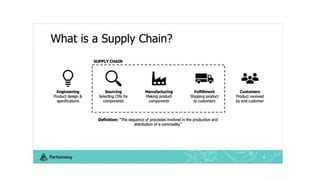
Supply Chain Management
In commerce, supply chain management, the management of the flow of
goods and services, involves the movement and storage of raw materials, of
work-in-process inventory, and of finished goods from point of origin to point
of consumption.
Supply Chain Management
Definition
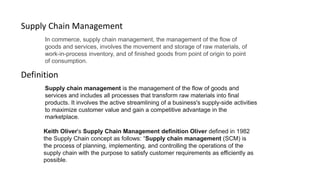
Supply chain management is the management of the flow of goods and
services and includes all processes that transform raw materials into final
products. It involves the active streamlining of a business's supply-side activities
to maximize customer value and gain a competitive advantage in the
marketplace.
Keith Oliver's Supply Chain Management definition Oliver defined in 1982
the Supply Chain concept as follows: “Supply chain management (SCM) is
the process of planning, implementing, and controlling the operations of the
supply chain with the purpose to satisfy customer requirements as efficiently as
possible.
Evolution of supply chain management
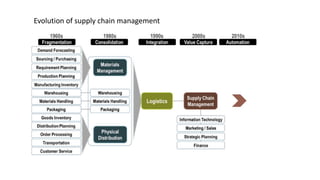
 The evolution of supply chain management has been characterized by an increasing
degree of integration of separate tasks;
 a trend underlined in the 1960s as a key area for future productivity improvements since
the system was highly fragmented. Although the logistics tasks have remained relatively
similar,
 they initially consolidated into two distinct functions related to materials
management and physical distribution during the 1970s and 1980s.
 This process moved further in the 1990s as globalization incited a functional integration
and the emergence of logistics in a true sense; all the elements of the supply chain
became part of a single management perspective.
Evolution of supply chain management
Material (Product) Flow
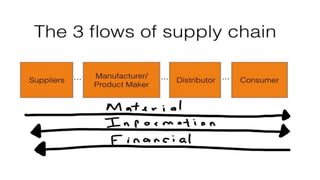
 This is the flow of the physical product from supplier all the way down to the customer.
 This flow is usually uni-directional, that is, it only flows one direction from supplier to customer;
however, in certain instances, when the customer returns the product, the flow occasionally goes in
the other direction.
 A typical flow of materials usually begins with the raw materials suppliers to manufacturers to
warehouses and distribution to the final customer.
Information Flow
 Information flow is the flow of information from supplier to customer and from customer back to supplier.
 This flow is bi-directional, that is, it goes both direction in the supply chain. The type of information that
flows between customers and suppliers include quotations, purchase orders, delivery status, invoices,
customer complaints and so on.
 For supply chain to be successful there has to be constant interaction between supplier and
Customer. In many cases, other partners like distributors, dealers, retailers, logistic service providers
are involved in the information network.
 kpakpakpa.com is an information network for product makers, suppliers and consumers of goods made
in Nigeria.
Supply Chain Flow:
Financial Flow
 Lastly, financial flow involves the movement of money from the customer to the
supplier. Usually, when the customer receives the product and verifies it, the customer
pays and the money travels back to the supplier.
 For an efficient and effective supply chain, it is important that all three flows are
managed properly with minimal effort.
 By understanding your supply chain and how products, information and money flows
through it, you will be in a good position to find several inefficiencies and figure out
how to significantly improve your business.
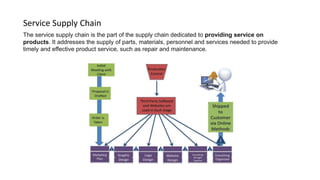
Service Supply Chain
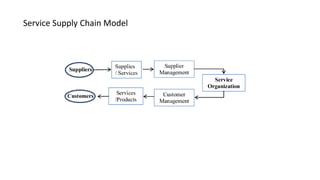
The service supply chain is the part of the supply chain dedicated to providing service on
products. It addresses the supply of parts, materials, personnel and services needed to provide
timely and effective product service, such as repair and maintenance.
Service Supply Chain Model
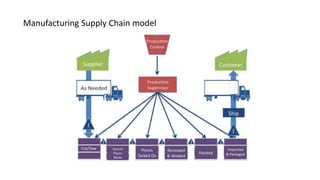
Manufacturing Supply Chain model
Supply chain performance measure can be defined as an approach to judge the performance of supply
chain system. Supply chain performance measures can broadly be classified into two categories −
•Qualitative measures − For example, customer satisfaction and product quality.
•Quantitative measures − For example, order-to-delivery lead time, supply chain response time,
flexibility, resource utilization, delivery performance.
Here, we will be considering the quantitative performance measures only. The performance of a supply
chain can be improvised by using a multi-dimensional strategy, which addresses how the company
needs to provide services to diverse customer demands.
Supply Chain Performance Measures
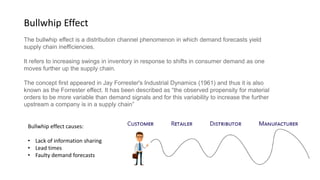
Bullwhip effect causes:
• Lack of information sharing
• Lead times
• Faulty demand forecasts
The bullwhip effect is a distribution channel phenomenon in which demand forecasts yield
supply chain inefficiencies.
It refers to increasing swings in inventory in response to shifts in consumer demand as one
moves further up the supply chain.
The concept first appeared in Jay Forrester's Industrial Dynamics (1961) and thus it is also
known as the Forrester effect. It has been described as “the observed propensity for material
orders to be more variable than demand signals and for this variability to increase the further
upstream a company is in a supply chain”
Bullwhip Effect

Supply chain concepts and planning.pptx

  • 1.
  • 3.
    In commerce, supplychain management, the management of the flow of goods and services, involves the movement and storage of raw materials, of work-in-process inventory, and of finished goods from point of origin to point of consumption. Supply Chain Management Definition Supply chain management is the management of the flow of goods and services and includes all processes that transform raw materials into final products. It involves the active streamlining of a business's supply-side activities to maximize customer value and gain a competitive advantage in the marketplace. Keith Oliver's Supply Chain Management definition Oliver defined in 1982 the Supply Chain concept as follows: “Supply chain management (SCM) is the process of planning, implementing, and controlling the operations of the supply chain with the purpose to satisfy customer requirements as efficiently as possible.
  • 4.
    Evolution of supplychain management
  • 5.
     The evolutionof supply chain management has been characterized by an increasing degree of integration of separate tasks;  a trend underlined in the 1960s as a key area for future productivity improvements since the system was highly fragmented. Although the logistics tasks have remained relatively similar,  they initially consolidated into two distinct functions related to materials management and physical distribution during the 1970s and 1980s.  This process moved further in the 1990s as globalization incited a functional integration and the emergence of logistics in a true sense; all the elements of the supply chain became part of a single management perspective. Evolution of supply chain management
  • 7.
    Material (Product) Flow This is the flow of the physical product from supplier all the way down to the customer.  This flow is usually uni-directional, that is, it only flows one direction from supplier to customer; however, in certain instances, when the customer returns the product, the flow occasionally goes in the other direction.  A typical flow of materials usually begins with the raw materials suppliers to manufacturers to warehouses and distribution to the final customer. Information Flow  Information flow is the flow of information from supplier to customer and from customer back to supplier.  This flow is bi-directional, that is, it goes both direction in the supply chain. The type of information that flows between customers and suppliers include quotations, purchase orders, delivery status, invoices, customer complaints and so on.  For supply chain to be successful there has to be constant interaction between supplier and Customer. In many cases, other partners like distributors, dealers, retailers, logistic service providers are involved in the information network.  kpakpakpa.com is an information network for product makers, suppliers and consumers of goods made in Nigeria. Supply Chain Flow:
  • 8.
    Financial Flow  Lastly,financial flow involves the movement of money from the customer to the supplier. Usually, when the customer receives the product and verifies it, the customer pays and the money travels back to the supplier.  For an efficient and effective supply chain, it is important that all three flows are managed properly with minimal effort.  By understanding your supply chain and how products, information and money flows through it, you will be in a good position to find several inefficiencies and figure out how to significantly improve your business.
  • 9.
    Service Supply Chain Theservice supply chain is the part of the supply chain dedicated to providing service on products. It addresses the supply of parts, materials, personnel and services needed to provide timely and effective product service, such as repair and maintenance.
  • 10.
  • 11.
  • 12.
    Supply chain performancemeasure can be defined as an approach to judge the performance of supply chain system. Supply chain performance measures can broadly be classified into two categories − •Qualitative measures − For example, customer satisfaction and product quality. •Quantitative measures − For example, order-to-delivery lead time, supply chain response time, flexibility, resource utilization, delivery performance. Here, we will be considering the quantitative performance measures only. The performance of a supply chain can be improvised by using a multi-dimensional strategy, which addresses how the company needs to provide services to diverse customer demands. Supply Chain Performance Measures
  • 13.
    Bullwhip effect causes: •Lack of information sharing • Lead times • Faulty demand forecasts The bullwhip effect is a distribution channel phenomenon in which demand forecasts yield supply chain inefficiencies. It refers to increasing swings in inventory in response to shifts in consumer demand as one moves further up the supply chain. The concept first appeared in Jay Forrester's Industrial Dynamics (1961) and thus it is also known as the Forrester effect. It has been described as “the observed propensity for material orders to be more variable than demand signals and for this variability to increase the further upstream a company is in a supply chain” Bullwhip Effect