Image by : Anniespratt
Power Sharing
Political Science
Class X
Synopsis
1. Basic Terms
2. Belgium and Sri Lanka
3. Majoritarianism in Sri Lanka
4. Accommodation in Belgium
5. Why Power Sharing is desirable?
6. Forms of Power Sharing in modern democracies
Image by: Pinterest.com
BasicTerms
1. Ethnic: It means relating to a population subgroup with a common national or cultural
tradition.
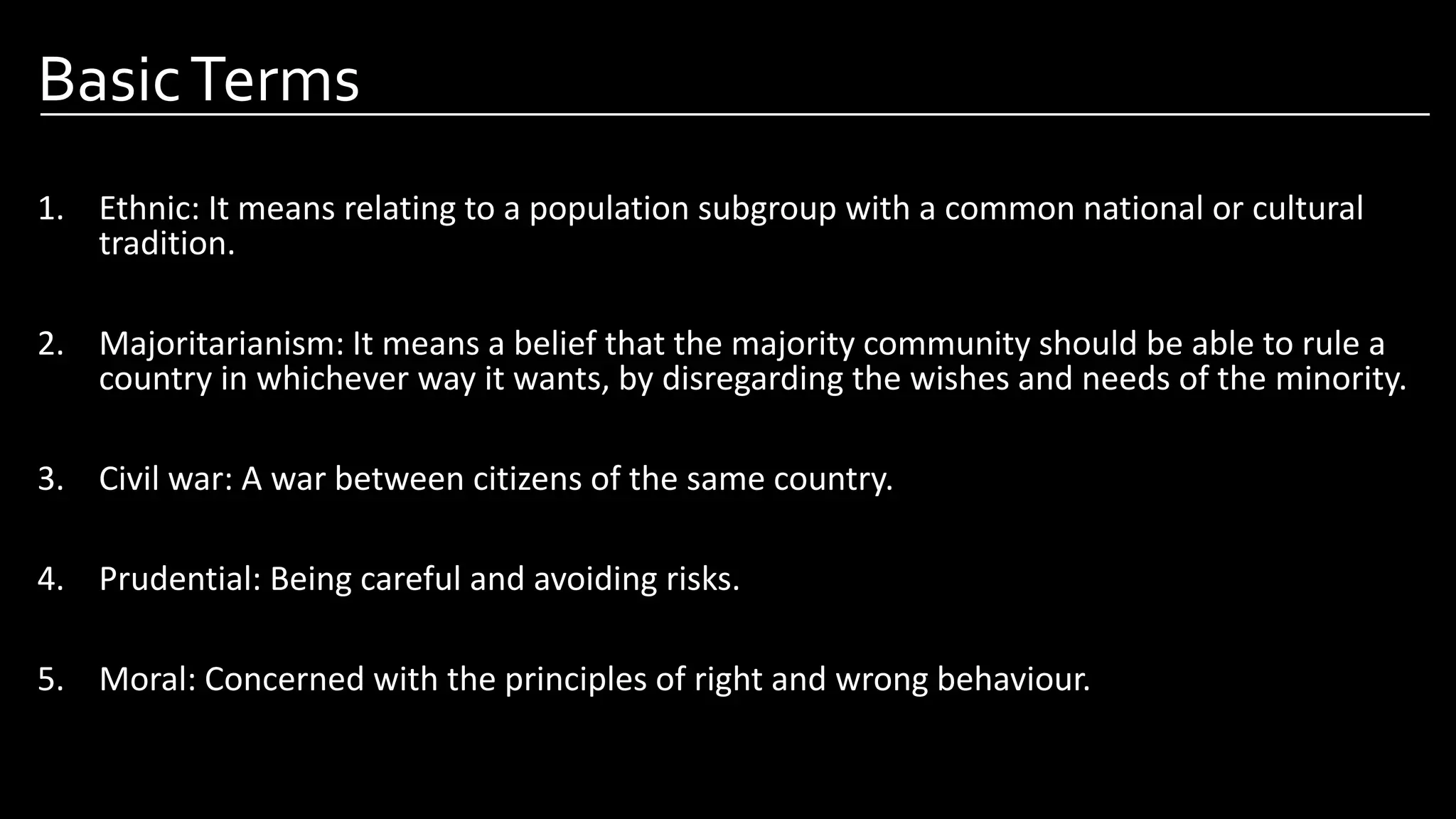
2. Majoritarianism: It means a belief that the majority community should be able to rule a
country in whichever way it wants, by disregarding the wishes and needs of the minority.
3. Civil war: A war between citizens of the same country.
4. Prudential: Being careful and avoiding risks.
5. Moral: Concerned with the principles of right and wrong behaviour.
Image by: Pinterest.com
Belgium and Sri Lanka
Image by: Pinterest.com
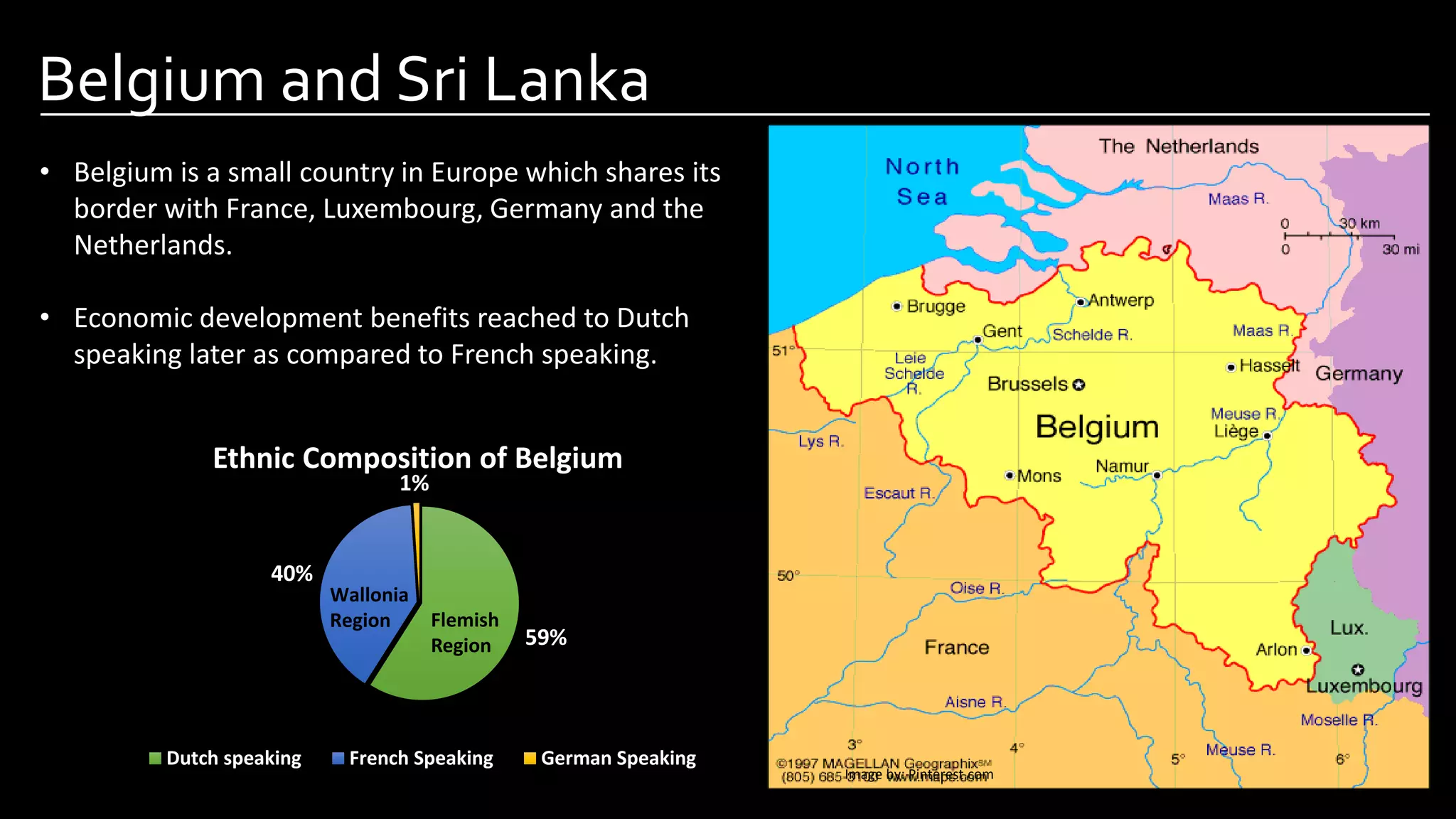
• Belgium is a small country in Europe which shares its
border with France, Luxembourg, Germany and the
Netherlands.
• Economic development benefits reached to Dutch
speaking later as compared to French speaking.
59%
40%
1%
Ethnic Composition of Belgium
Dutch speaking French Speaking German Speaking
Wallonia
Region Flemish
Region
Belgium and Sri Lanka
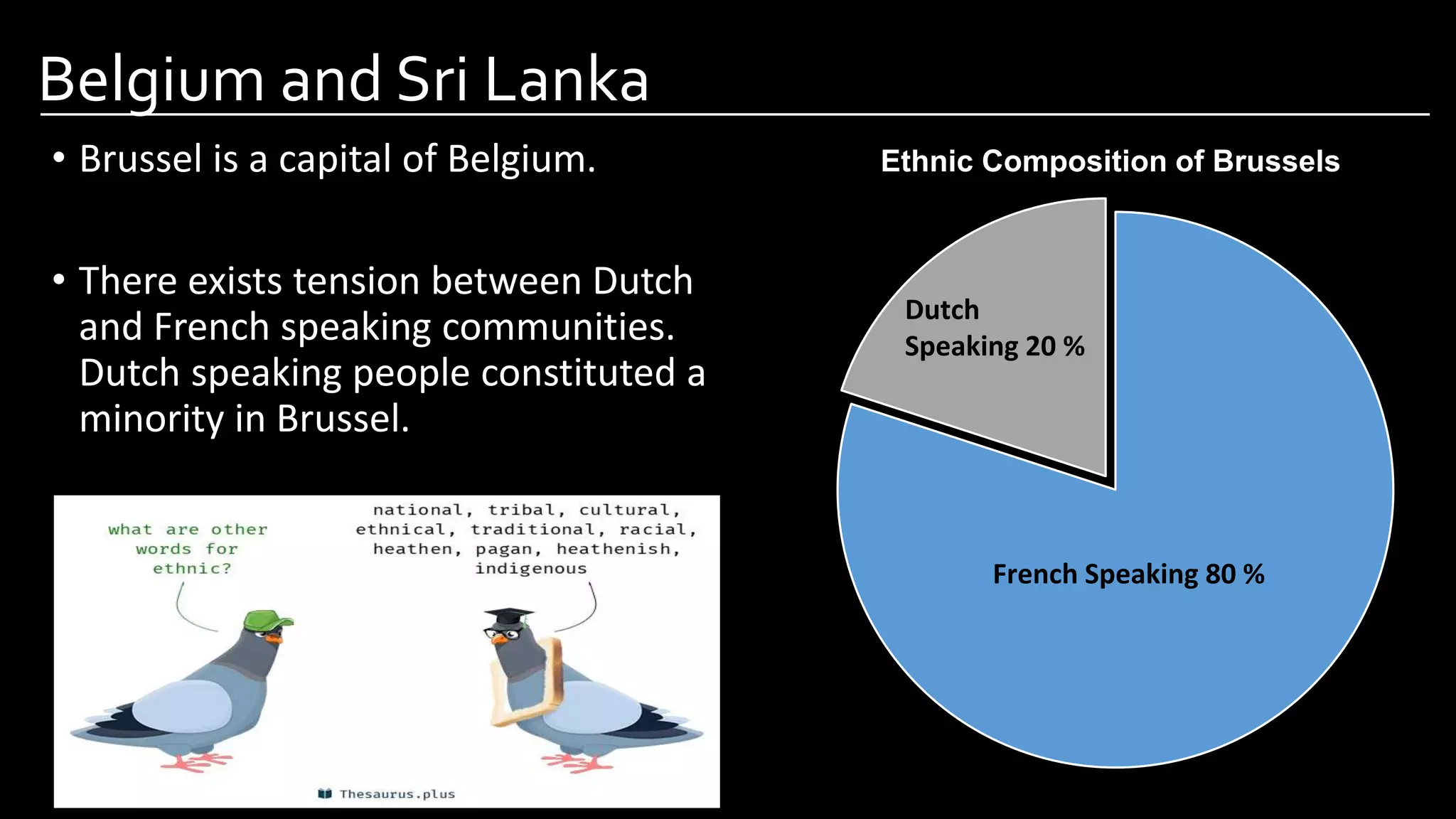
• Brussel is a capital of Belgium.
• There exists tension between Dutch
and French speaking communities.
Dutch speaking people constituted a
minority in Brussel.
Image by: kailashafoundation.orgImage by: Chethan M
Ethnic Composition of Brussels
French Speaking 80 %
Dutch
Speaking 20 %
Belgium and Sri Lanka
• Sri Lanka is an island nation, few
kilometres off the southern coast of
Tamil Nadu.
• Tamil Speakers are sub groups into:
• Sri Lankans Tamils: They are the Tamil
natives of the Sri Lanka.
• Indians Tamils: Whose forefathers
came from India as plantation workers
during colonial period.
Image by: kailashafoundation.org
Image By: toppr.com
ETHNIC COMPOSITION OF SRI LANKA
74% Sinhala
Speakers(Buddhist)
18% Tamil
Speakers
(Hindus/Muslims)
13% Sri Lankans
Tamils in North
and east
5%
Indian
Tamils
Other 7% Both
Sinhala & Tamil
(Christian)
Majoritarianism in Sri Lanka
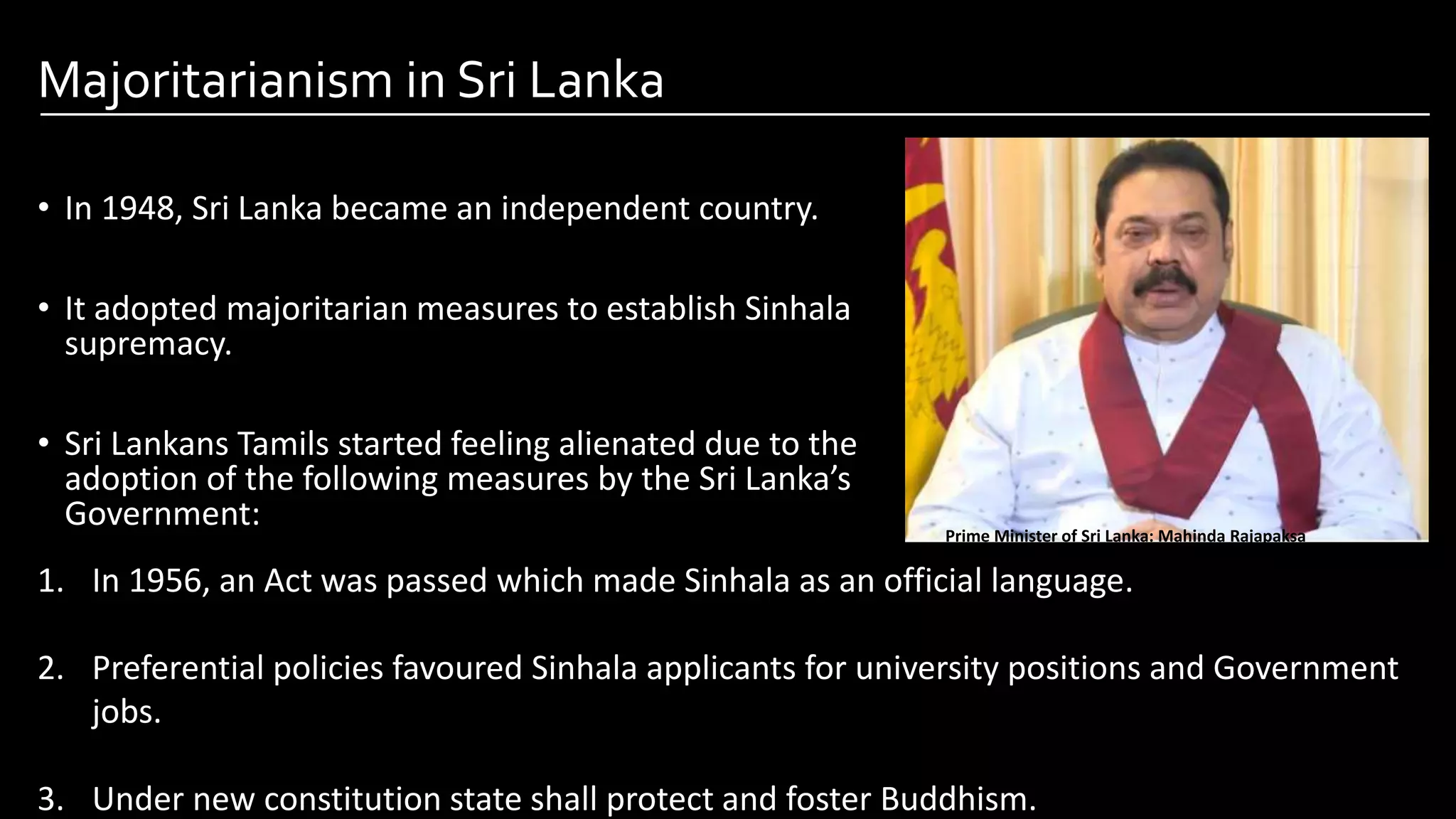
• In 1948, Sri Lanka became an independent country.
• It adopted majoritarian measures to establish Sinhala
supremacy.
• Sri Lankans Tamils started feeling alienated due to the
adoption of the following measures by the Sri Lanka’s
Government:
Image by: kailashafoundation.org
Image By: toppr.com
Prime Minister of Sri Lanka: Mahinda Rajapaksa
1. In 1956, an Act was passed which made Sinhala as an official language.
2. Preferential policies favoured Sinhala applicants for university positions and Government
jobs.
3. Under new constitution state shall protect and foster Buddhism.
Majoritarianism in Sri Lanka
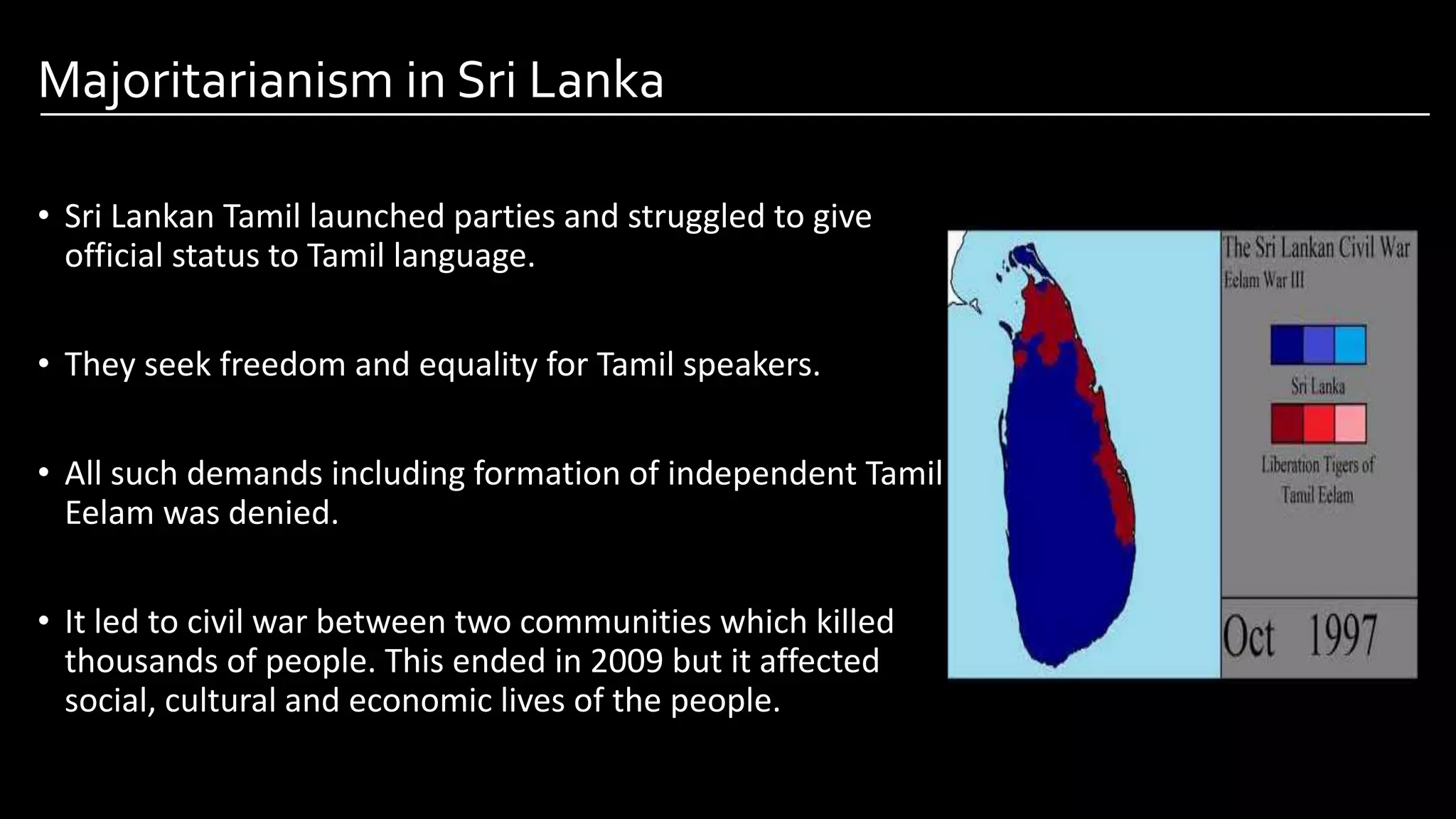
• Sri Lankan Tamil launched parties and struggled to give
official status to Tamil language.
• They seek freedom and equality for Tamil speakers.
• All such demands including formation of independent Tamil
Eelam was denied.
• It led to civil war between two communities which killed
thousands of people. This ended in 2009 but it affected
social, cultural and economic lives of the people.
Image by: kailashafoundation.org
Image By: toppr.com
Accommodation in Belgium
• Between 1970 and 1993, Belgian leaders amended their constitution 4 times.
• The elements of the Belgian model:
1. Number of Dutch and French- speaking ministers shall be equal in the Central Government. Thus,
no single community can make decisions unilaterally.
2. The state governments are not subordinate to the Central Government.
3. Brussels has a separate government in which both the communities have equal representation.
4. There also existed community government which is elected by people belonging to one language
community.
Image by: kailashafoundation.org
Image By: toppr.com
Accommodation in Belgium
Image by: kailashafoundation.org
Image By: toppr.com
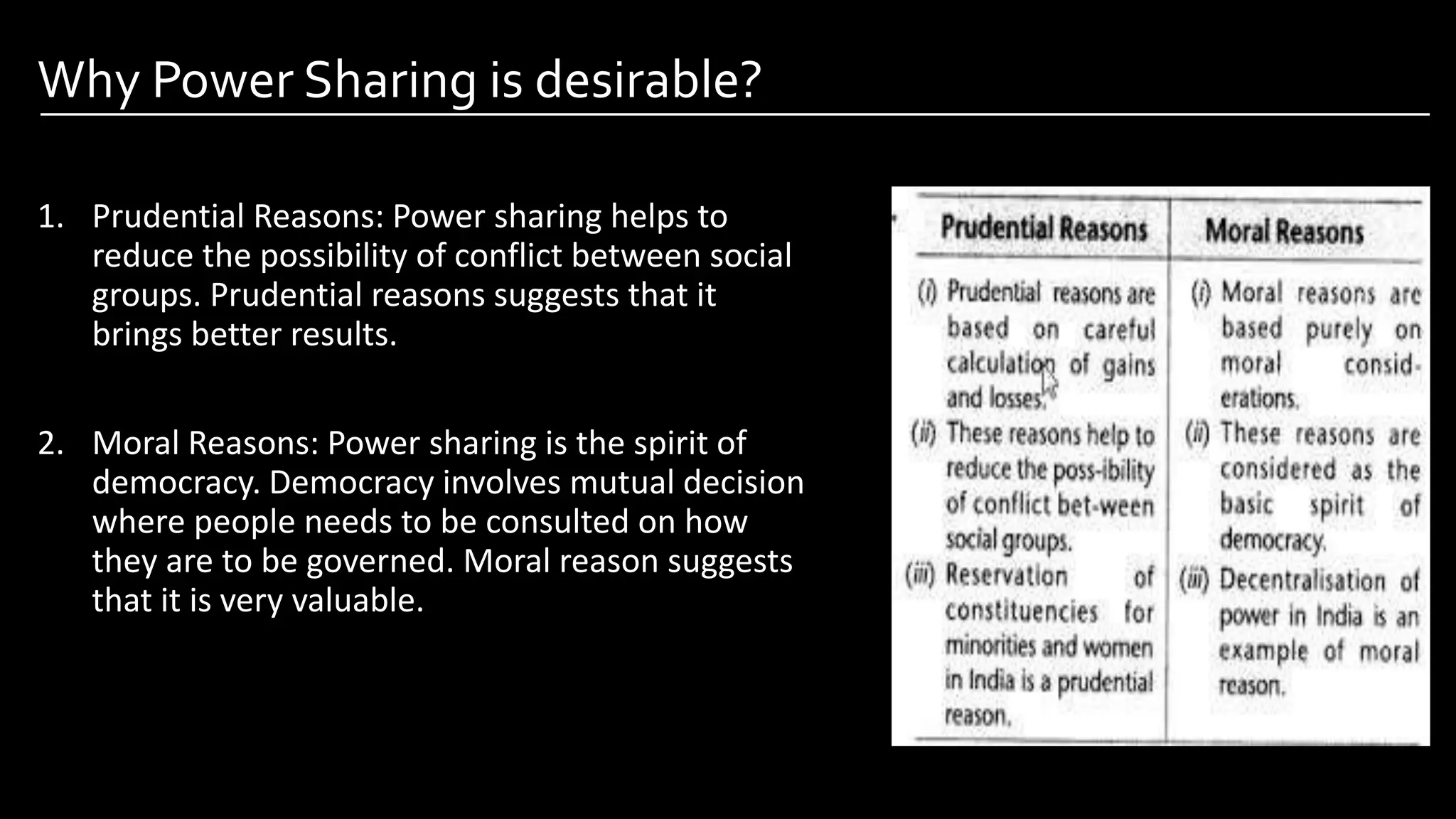
Why Power Sharing is desirable?
1. Prudential Reasons: Power sharing helps to
reduce the possibility of conflict between social
groups. Prudential reasons suggests that it
brings better results.
2. Moral Reasons: Power sharing is the spirit of
democracy. Democracy involves mutual decision
where people needs to be consulted on how
they are to be governed. Moral reason suggests
that it is very valuable.
Image by: kailashafoundation.org
Image By: toppr.com
Forms of Power Sharing in modern democracies
Image by: kailashafoundation.org
Image By: toppr.com
Forms of Power Sharing in modern democracies
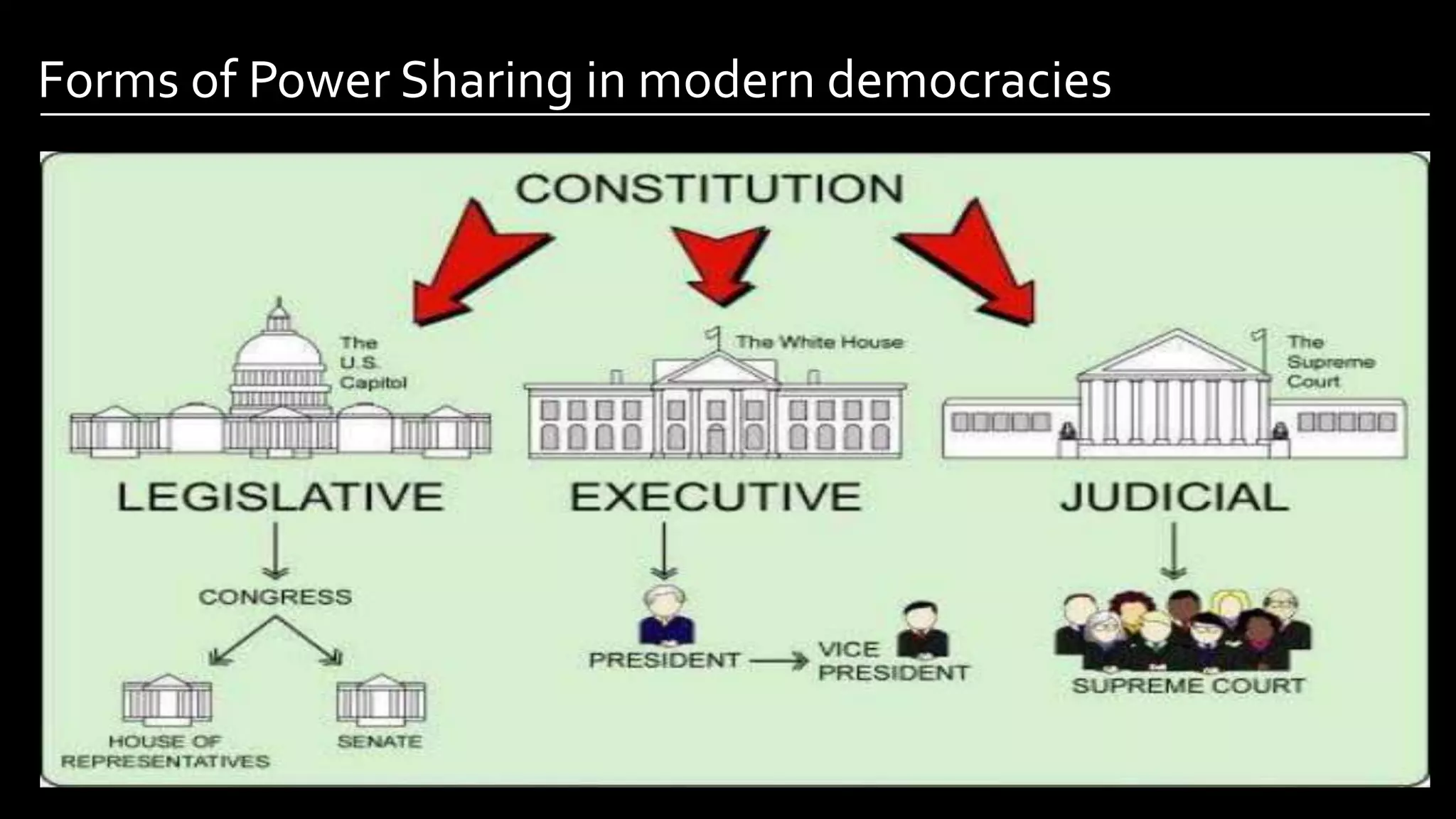
• Different organs of government: Under this power is shared between legislature, executive and
judiciary. This is called horizontal distribution of power because these organs are at the same level.
When one organ keeps a check on the other this is called a system of checks and balances.
• Governments at different levels: Constitution clearly defines power of different levels of
government for those countries which have different levels of government. For example, in Belgium.
This distribution is called federal division of power.
• Social groups: It includes religious and linguistic groups. For example, Community Government. In
some countries there are constitutional and legal arrangements whereby socially weaker sections
and women are represented in the legislatures and administration.
• Political parties, pressure groups and movements: This kind of power sharing can be direct, when
two or more parties form an alliance to contest elections. If elected, they form a coalition
government
Image by: kailashafoundation.org
Image By: toppr.com
LearnWithAnjali.com | contact@LearnWithAnjali.com | linkedin.com/in/anjali-kaur

Political Science, Power Sharing, Class - 10

  • 1.
    Image by :Anniespratt Power Sharing Political Science Class X
  • 2.
    Synopsis 1. Basic Terms 2.Belgium and Sri Lanka 3. Majoritarianism in Sri Lanka 4. Accommodation in Belgium 5. Why Power Sharing is desirable? 6. Forms of Power Sharing in modern democracies Image by: Pinterest.com
  • 3.
    BasicTerms 1. Ethnic: Itmeans relating to a population subgroup with a common national or cultural tradition. 2. Majoritarianism: It means a belief that the majority community should be able to rule a country in whichever way it wants, by disregarding the wishes and needs of the minority. 3. Civil war: A war between citizens of the same country. 4. Prudential: Being careful and avoiding risks. 5. Moral: Concerned with the principles of right and wrong behaviour. Image by: Pinterest.com
  • 4.
    Belgium and SriLanka Image by: Pinterest.com • Belgium is a small country in Europe which shares its border with France, Luxembourg, Germany and the Netherlands. • Economic development benefits reached to Dutch speaking later as compared to French speaking. 59% 40% 1% Ethnic Composition of Belgium Dutch speaking French Speaking German Speaking Wallonia Region Flemish Region
  • 5.
    Belgium and SriLanka • Brussel is a capital of Belgium. • There exists tension between Dutch and French speaking communities. Dutch speaking people constituted a minority in Brussel. Image by: kailashafoundation.orgImage by: Chethan M Ethnic Composition of Brussels French Speaking 80 % Dutch Speaking 20 %
  • 6.
    Belgium and SriLanka • Sri Lanka is an island nation, few kilometres off the southern coast of Tamil Nadu. • Tamil Speakers are sub groups into: • Sri Lankans Tamils: They are the Tamil natives of the Sri Lanka. • Indians Tamils: Whose forefathers came from India as plantation workers during colonial period. Image by: kailashafoundation.org Image By: toppr.com ETHNIC COMPOSITION OF SRI LANKA 74% Sinhala Speakers(Buddhist) 18% Tamil Speakers (Hindus/Muslims) 13% Sri Lankans Tamils in North and east 5% Indian Tamils Other 7% Both Sinhala & Tamil (Christian)
  • 7.
    Majoritarianism in SriLanka • In 1948, Sri Lanka became an independent country. • It adopted majoritarian measures to establish Sinhala supremacy. • Sri Lankans Tamils started feeling alienated due to the adoption of the following measures by the Sri Lanka’s Government: Image by: kailashafoundation.org Image By: toppr.com Prime Minister of Sri Lanka: Mahinda Rajapaksa 1. In 1956, an Act was passed which made Sinhala as an official language. 2. Preferential policies favoured Sinhala applicants for university positions and Government jobs. 3. Under new constitution state shall protect and foster Buddhism.
  • 8.
    Majoritarianism in SriLanka • Sri Lankan Tamil launched parties and struggled to give official status to Tamil language. • They seek freedom and equality for Tamil speakers. • All such demands including formation of independent Tamil Eelam was denied. • It led to civil war between two communities which killed thousands of people. This ended in 2009 but it affected social, cultural and economic lives of the people. Image by: kailashafoundation.org Image By: toppr.com
  • 9.
    Accommodation in Belgium •Between 1970 and 1993, Belgian leaders amended their constitution 4 times. • The elements of the Belgian model: 1. Number of Dutch and French- speaking ministers shall be equal in the Central Government. Thus, no single community can make decisions unilaterally. 2. The state governments are not subordinate to the Central Government. 3. Brussels has a separate government in which both the communities have equal representation. 4. There also existed community government which is elected by people belonging to one language community. Image by: kailashafoundation.org Image By: toppr.com
  • 10.
    Accommodation in Belgium Imageby: kailashafoundation.org Image By: toppr.com
  • 11.
    Why Power Sharingis desirable? 1. Prudential Reasons: Power sharing helps to reduce the possibility of conflict between social groups. Prudential reasons suggests that it brings better results. 2. Moral Reasons: Power sharing is the spirit of democracy. Democracy involves mutual decision where people needs to be consulted on how they are to be governed. Moral reason suggests that it is very valuable. Image by: kailashafoundation.org Image By: toppr.com
  • 12.
    Forms of PowerSharing in modern democracies Image by: kailashafoundation.org Image By: toppr.com
  • 13.
    Forms of PowerSharing in modern democracies • Different organs of government: Under this power is shared between legislature, executive and judiciary. This is called horizontal distribution of power because these organs are at the same level. When one organ keeps a check on the other this is called a system of checks and balances. • Governments at different levels: Constitution clearly defines power of different levels of government for those countries which have different levels of government. For example, in Belgium. This distribution is called federal division of power. • Social groups: It includes religious and linguistic groups. For example, Community Government. In some countries there are constitutional and legal arrangements whereby socially weaker sections and women are represented in the legislatures and administration. • Political parties, pressure groups and movements: This kind of power sharing can be direct, when two or more parties form an alliance to contest elections. If elected, they form a coalition government Image by: kailashafoundation.org Image By: toppr.com
  • 14.