TOPIC
POLITICAL SCIENCE:
AS AN ACADEMIC DISCIPLINE:
RATIONALITY AND EFFECTIVENESS
TO STUDY
Political science is the field of
the social sciences concerning
the theory and practice of
politics and the description and
analysis of political systems
and political behaviour.
Political Science is also known by:
Politics
Science of State
 Science of Government
Science of Politics etc.
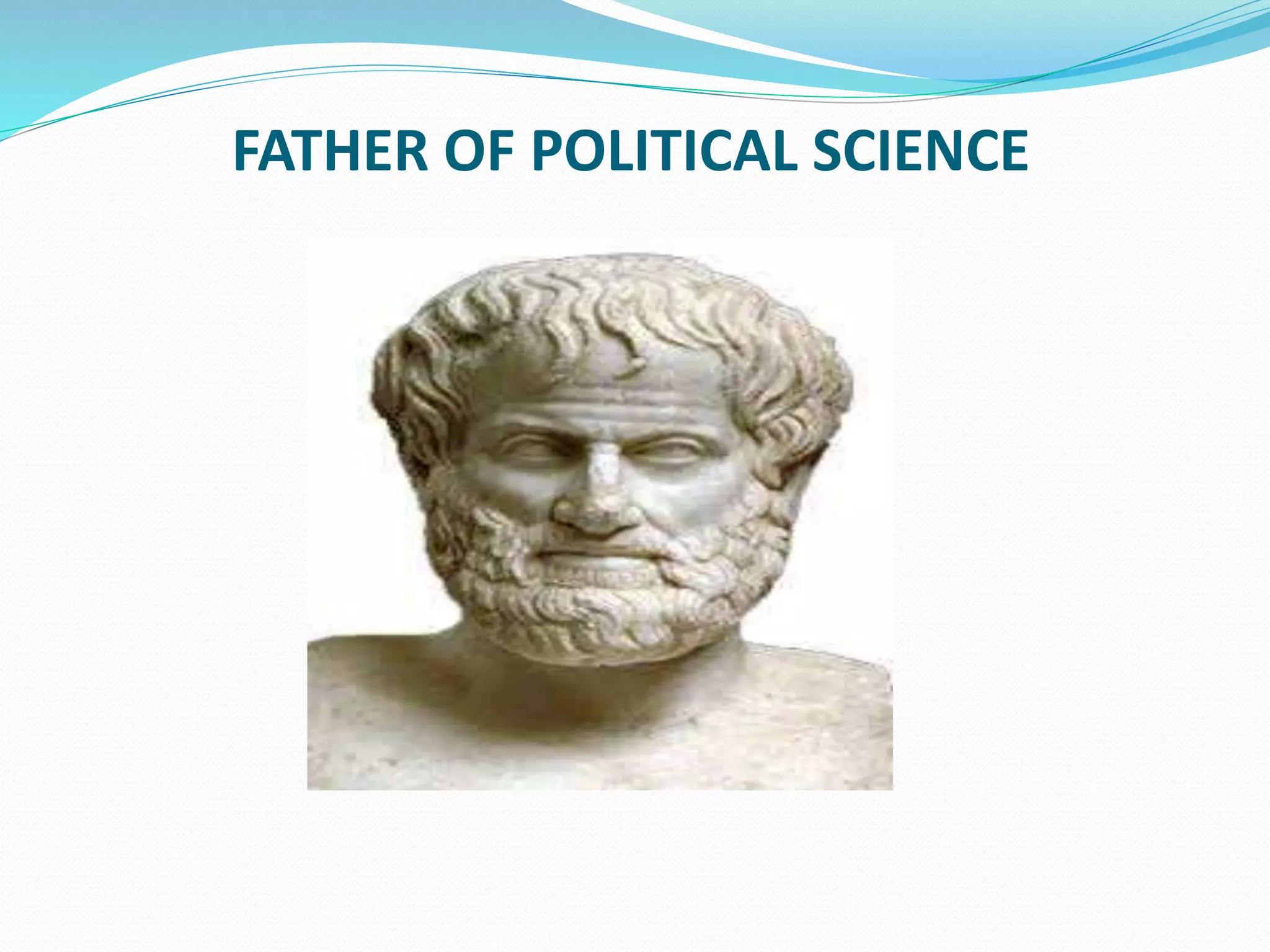
FATHER OF POLITICAL SCIENCE
The word Politics has its origins in
Ancient Greece.
It comes from 3 Greek words:
Polis- City State
Polity- Government
Politeia- Constitition
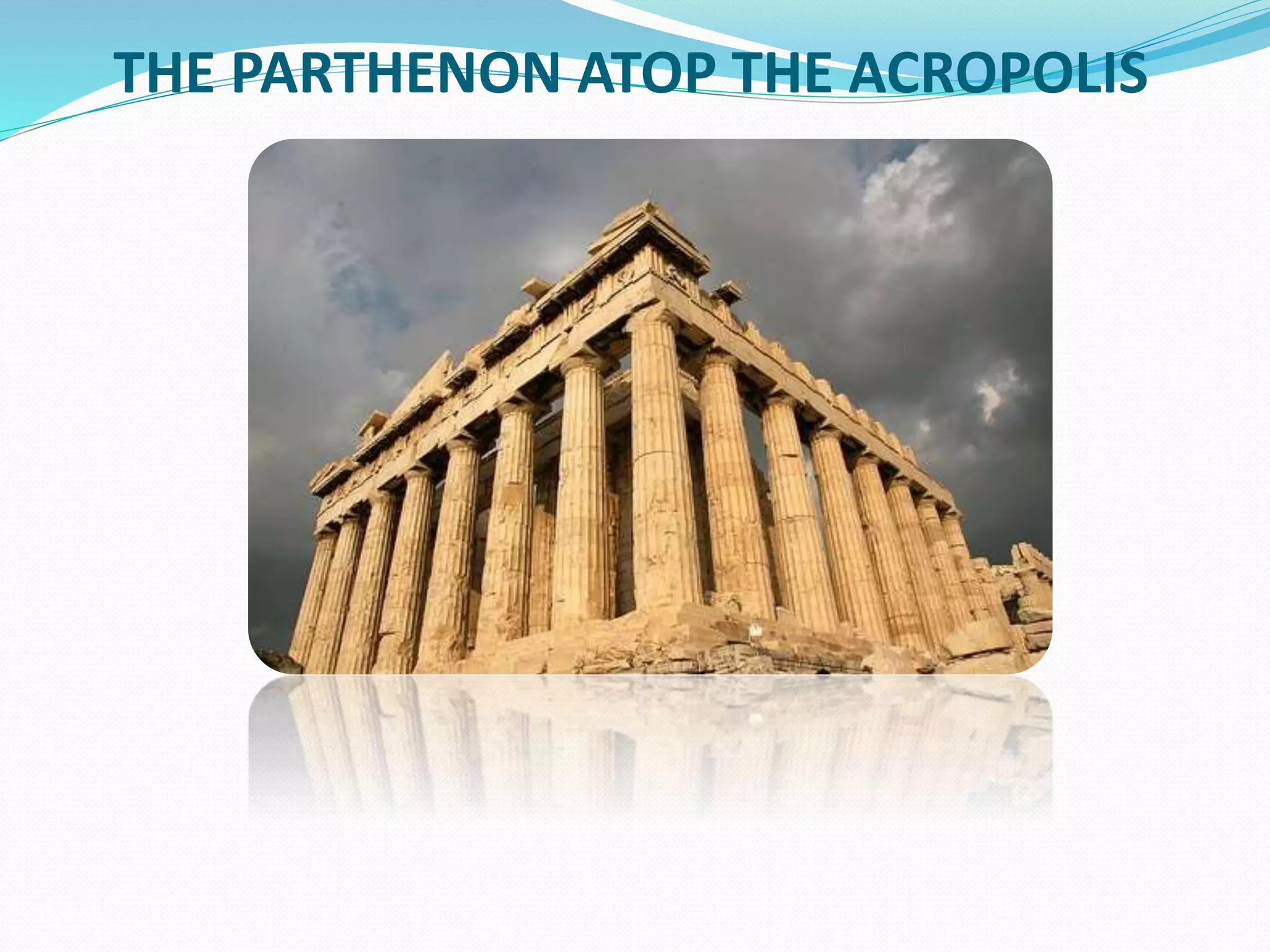
THE PARTHENON ATOP THE ACROPOLIS
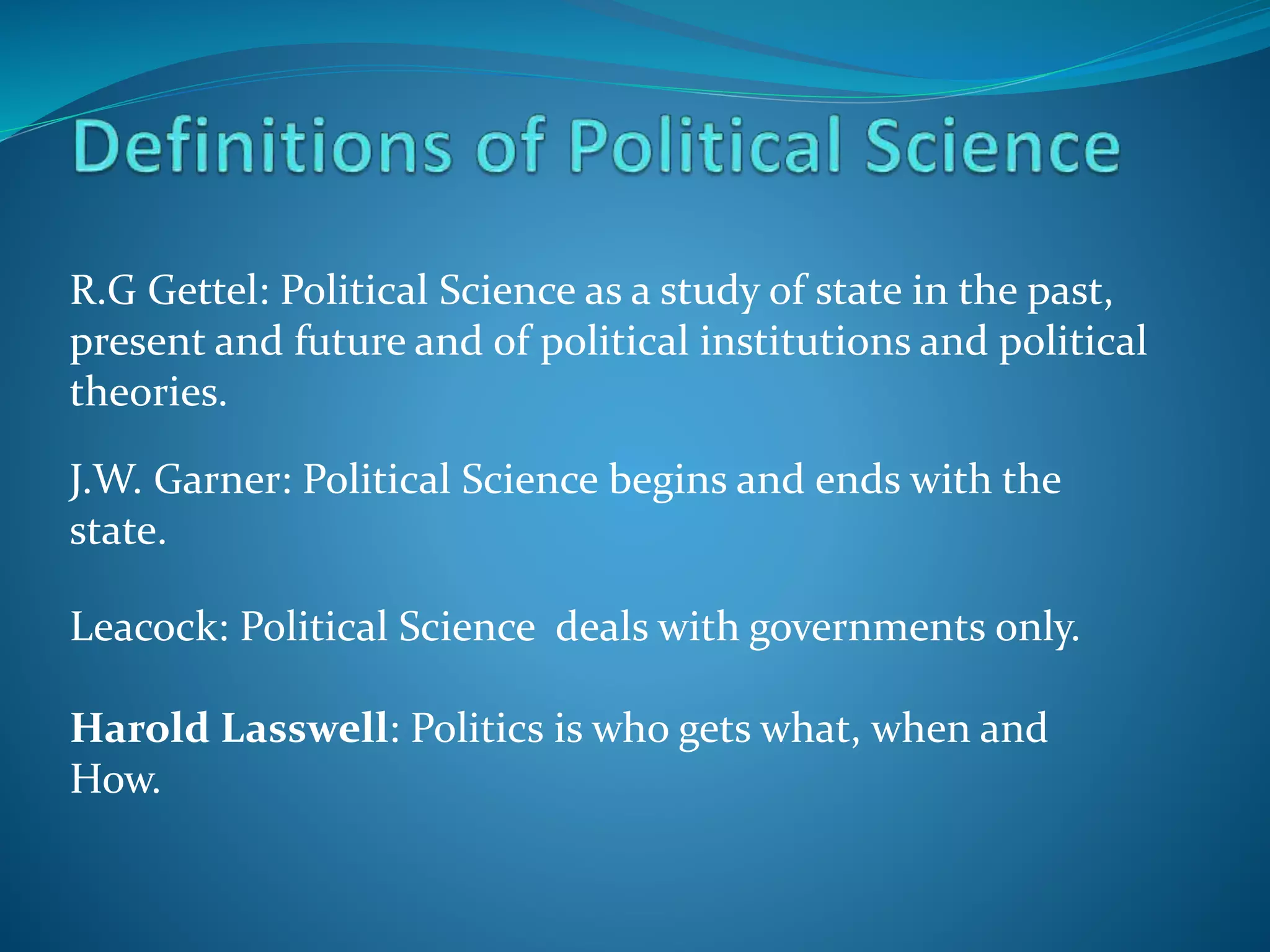
R.G Gettel: Political Science as a study of state in the past,
present and future and of political institutions and political
theories.
J.W. Garner: Political Science begins and ends with the
state.
Leacock: Political Science deals with governments only.
Harold Lasswell: Politics is who gets what, when and
How.
The State is the central theme of
political science.
It is the systemic study of the state, it’s
origin, it’s nature, it’s structure,
government, power, authority and so on.
Approaches mean the different angles
and ways from which the study of
political phenomena may be
undertaken. Approaches is an outlook.
It is also known as method.
In the study of political science a variety of
approaches are applied by the political scientists.
The key approaches of political science can be
divided into two:
Traditional Approach Modern Approach
Traditional Approach
Traditional
approach is
known as
normative
approach.
It emphasizes on
the study of
government.
It made very little
attempt to relate
theory and
research.
• Philosophical
• Historical
• Institutional
• Legal
• Observational
• Experimental
• Comparative
• Biological
• Sociological
• Psychological
• Empirical
Various Forms of Traditional Approaches
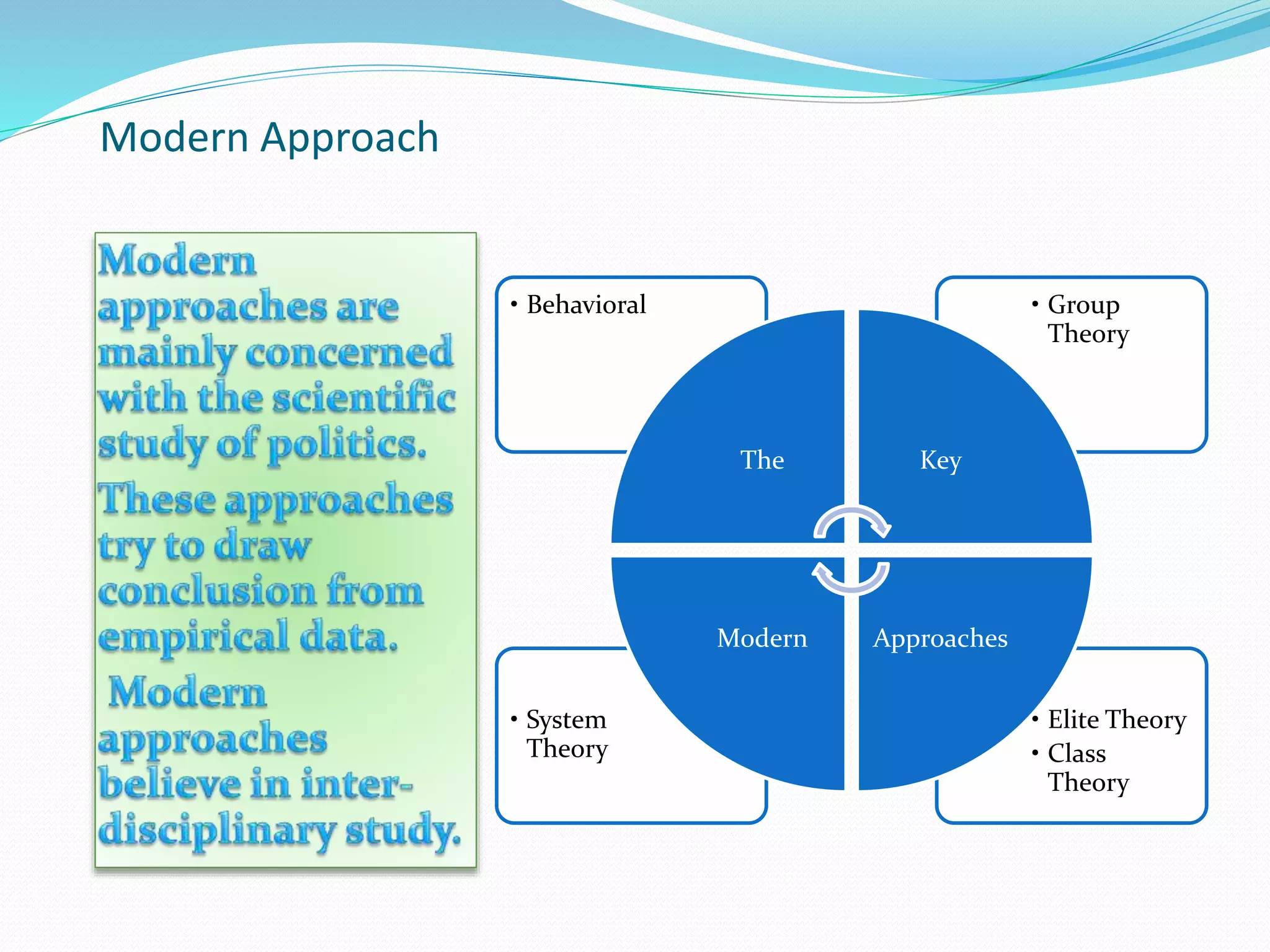
Modern Approach
• Elite Theory
• Class
Theory
• System
Theory
• Group
Theory
• Behavioral
The Key
ApproachesModern
An academic discipline is a branch of
knowledge
that is taught and researched as a part of
higher education
The Academic Discipline of Political Science concerned
with the empirical study of government and politics.
It deals extensively with the theory and practice of politics
which is commonly thought of as the determining of the
distribution of power and resources.
Although it was codified in the 19th century, when all the
social sciences were established, the study of political
science has ancient roots that can be traced back to the
works of Plato and Aristotle which were written nearly
2,500 years ago.
The first institution of Political Science was founded in
Paris in 1871.
Political Science as an Academic
Discipline
Political science draws upon the fields
of economics, law, sociology, history,
anthropology, public administration,
public policy, national politics,
international relations, comparative
politics, psychology, political
organization, and political theory.
Rationality is the quality or state of
being reasonable, based on facts or
reason.
Rationality implies the conformity of
one's beliefs with one's reasons to
believe, or of one's actions with one's
reasons for action.
Political Science is a state and government related
science. It deals with the nature and formation of the
state and tries to understand various forms and functions
of the government.
It deals with the people and their order.
To understand behaviour, structure and existence of
politics we need to study it.
To analyse the purpose of the state- of what it had been,
what it is and what it ought to be.
To rule over society.
To know about Bureaucracy, Legislative and Judiciary
System we need to study it.
To understand
International Politics
Diplomacy Laws
Problems
Organizations
Political Science keeps a great impact in our practical
lives.
In fact it deals with almost all the necessary things
which are related to our day to day life.
Family is the smallest institution of the society where
Politics starts and then it just spread its branches.
What we discuss with our family members in one
sense that may be treated as political conversation.
Preservation of State
Safety Peace Prosperity
Preservation of Citizens
Rights
Liberty
Property
Defense of
state and its
existence
International
Relations
Past, Present
and Future
Development
T H A N K Y O U

Political science: As an Academic Discipline

  • 2.
    TOPIC POLITICAL SCIENCE: AS ANACADEMIC DISCIPLINE: RATIONALITY AND EFFECTIVENESS TO STUDY
  • 3.
    Political science isthe field of the social sciences concerning the theory and practice of politics and the description and analysis of political systems and political behaviour.
  • 4.
    Political Science isalso known by: Politics Science of State  Science of Government Science of Politics etc.
  • 5.
  • 6.
    The word Politicshas its origins in Ancient Greece. It comes from 3 Greek words: Polis- City State Polity- Government Politeia- Constitition
  • 7.
    THE PARTHENON ATOPTHE ACROPOLIS
  • 8.
    R.G Gettel: PoliticalScience as a study of state in the past, present and future and of political institutions and political theories. J.W. Garner: Political Science begins and ends with the state. Leacock: Political Science deals with governments only. Harold Lasswell: Politics is who gets what, when and How.
  • 9.
    The State isthe central theme of political science. It is the systemic study of the state, it’s origin, it’s nature, it’s structure, government, power, authority and so on.
  • 10.
    Approaches mean thedifferent angles and ways from which the study of political phenomena may be undertaken. Approaches is an outlook. It is also known as method.
  • 11.
    In the studyof political science a variety of approaches are applied by the political scientists. The key approaches of political science can be divided into two: Traditional Approach Modern Approach
  • 12.
    Traditional Approach Traditional approach is knownas normative approach. It emphasizes on the study of government. It made very little attempt to relate theory and research. • Philosophical • Historical • Institutional • Legal • Observational • Experimental • Comparative • Biological • Sociological • Psychological • Empirical Various Forms of Traditional Approaches
  • 13.
    Modern Approach • EliteTheory • Class Theory • System Theory • Group Theory • Behavioral The Key ApproachesModern
  • 14.
    An academic disciplineis a branch of knowledge that is taught and researched as a part of higher education
  • 15.
    The Academic Disciplineof Political Science concerned with the empirical study of government and politics. It deals extensively with the theory and practice of politics which is commonly thought of as the determining of the distribution of power and resources. Although it was codified in the 19th century, when all the social sciences were established, the study of political science has ancient roots that can be traced back to the works of Plato and Aristotle which were written nearly 2,500 years ago. The first institution of Political Science was founded in Paris in 1871.
  • 16.
    Political Science asan Academic Discipline Political science draws upon the fields of economics, law, sociology, history, anthropology, public administration, public policy, national politics, international relations, comparative politics, psychology, political organization, and political theory.
  • 17.
    Rationality is thequality or state of being reasonable, based on facts or reason. Rationality implies the conformity of one's beliefs with one's reasons to believe, or of one's actions with one's reasons for action.
  • 18.
    Political Science isa state and government related science. It deals with the nature and formation of the state and tries to understand various forms and functions of the government. It deals with the people and their order. To understand behaviour, structure and existence of politics we need to study it. To analyse the purpose of the state- of what it had been, what it is and what it ought to be. To rule over society. To know about Bureaucracy, Legislative and Judiciary System we need to study it.
  • 19.
  • 20.
    Political Science keepsa great impact in our practical lives. In fact it deals with almost all the necessary things which are related to our day to day life. Family is the smallest institution of the society where Politics starts and then it just spread its branches. What we discuss with our family members in one sense that may be treated as political conversation.
  • 21.
  • 22.
  • 23.
    Defense of state andits existence International Relations Past, Present and Future Development
  • 24.
    T H AN K Y O U