Introduction to
Public Policy
 Policy Science is a comparatively recent
discipline.
 It primarily emerged in North America and
Europe in the post-World War II era.
 It is a outcome of the search for new
understandings of the relationship between
governments and citizens.
 Prior to that studies of political life tended to
focus on the normative or moral dimensions
of government or on the minutiae of the
operation of the operation of specific political
institutions.
 Recognition of the increasing gap between
prescriptive political theory and the political
practice of modern state led many to search
for another method of examining politics.
 Similarly, scholars interested in the institutions
of government had been conducting empirical
examination of legislature, courts and
bureaucracies while generally ignoring the
normative aspects of these institutions. –
failed to the basis for evaluation
 In the post world war era due to
decolonization, the reconstruction of war-torn
states and eth establishment of new
institutions of international governance –
students of politics sought new approach
The desire was for a new approach that would
blend their studies with question of
 justice,
 Equity
 Pursuit of social, economic and political
development
 Harold Lasswell and others expected Policy
Sciences to replace traditional political studies,
integrating the study of political theory and
political practices without falling into the sterility
of formal legal studies.
 Lasswell proposed that the policy science had
three distinct characteristics :
 Multi-disciplinary
 Problem Solving
 Explicitly Normative – not cloaked in the guise
of scientific objectivity
 However, the passage of time has led to some
changes in the three specific components of the
policy orientation
 First - While emphasis on multi-disciplinary
approach remains, policy science is much more
a discipline by itself with a unique set of
concepts, concerns, and a vocabulary and
terminology all of its own.
 Second the virtually exclusive concern of many
policy makers with concrete problem solving
has waned as government often proved
intractable and resistant to expert advice.
 The call for policy sciences to remain explicitly
normative also changed over time. Yet, most
policy scholars have refused to exclude values
from their analysis and have insisted upon
evaluating both the goals and the means of
policy. More emphasis of late on efficiency or
effectiveness in achieving stated goals.
 Question of associating policy sciences with an
era of unrealised hopes and expectations for
social engineering and government planning.
 This criticism is to some extent justified and
should serve as a warning against premature or
ill founded prescriptions or excessive
conceptual sophistry.
 However, this should not be taken as a
rejection of the need to undertake systematic
study of government actions.
Definition of Public
Policy
Thomas Dye defines public policy as “Anything a
Government chooses to do or not to do”.
 This formulation is perhaps too simple and fails to
provide the means for conceptualising public policy.
 It would include as public policy every aspect of
governmental behaviour from purchasing or failing
to purchase paper clips to waging or failing to wage
nuclear war.
 Further there might be a divergence between what
governments decide to do and what they actually
do.
Contributions of Dye’s definition
 First, Dye specifies clearly that the agent of
public policy making is a government.
 Second, Dye highlights the that public policies
involve a fundamental choice on the part of
governments to do something or to do nothing.
This includes ‘non-decision’.
 Carl Friedrich defines public policy as “ … a
proposed course of action of a person,
group, or government within a given
environment providing obstacles and
opportunities which the policy was proposed
to utilize and overcome in an effort to reach a
goal or realise an objective or a purpose.”
 Friedrich adds the requirement that policy is
directed toward the accomplishment of some
purpose or goal. Goal and purpose may not
always be easy to discern.
 William Jenkins defines public policy as “ a
set of interrelated decisions taken by a
political actor or group of actors concerning
the selection of goals and the means of
achieving them within a specified situation
where those decisions should, in principle, be
within the power of those actors to achieve.”
 Jenkins views public policy as a process
unlike Dye who defines it as a choice (which
presumes the existence of an underlying
process but does not state that explicitly.
 Jenkins also explicitly acknowledges that
public policy is a ‘set of interrelated
decisions”.
 Jenkins also improves upon Dye by
suggesting that the question of a
government’s capacity to implement its
decisions is also significant. Internal and
external constraints on government make
public policy difficult.
 Jenkins also introduced the idea of public policy
making as goal-oriented behaviour on the part of
the Government, an idea which provides a standard
by which to evaluate public policies.
 This says nothing about the nature of the goals or
the means to achieve it provides several avenues
for evaluating policies which are missing from Dye’s
definition.
 These include the relevance of the goal, the
congruence of the goals and means and the degree
to which means succeed in reaching the goals.
 James Anderson defines public policy as “a
purposive course of action followed by an actor or a
set of actors in dealing with a problem or matter of
concern”.
 Two important additions namely :
 it notes that policy decisions are often taken by sets
of actors rather than a sole set or actor within a
government. Policies are often the result of not only
multiple decisions but of multiple decisions taken by
multiple decision makers
 Anderson’s definition highlights the link
between government action and the
perception, real or otherwise, of the
existence of a problem or concern requiring
action.
 All illustrate that studying public policy is a
complex task because
 Mere description is not sufficient.
 Dependence on government record does not
provide information about potential choices or
choices not made.
 Records of decisions do not reflect the
unencumbered will of government decision
makers.
 It would be well to spell out some of the
implications of our concept of public policy.
 These are purposive and goal oriented rather than
random or chance behaviour.
 Policy consists of courses or pattern of action by
governmental officials rather than their separate
discrete decisions.
 Policy is what governments actually do in
regulating trade, controlling inflation, or promoting
public housing not what they intend to do or say
they are going to do.
 Public Policy may be either positive or negative.
 Positive may involve some form of overt
government action to affect a particular problem,
 Negatively, it involves a decision by government
officials not to take action or to do nothing.
 Public policy, at least in its positive form, is based
on law and is authoritative. Members accept it as
legitimate.
 The special characteristics of public policies
stem from the fact that they are formulated by
what David Easton has called the ‘authorities’
in a political system namely elders,
 paramount chiefs,
 executives,
 legislators,
 judges,
 administrators,
 councillors,
 monarchs and the like.
Nature of Public
Policy
Very Complex
 policy making involves many components which
are interconnected by communication and
feedback loops and which interact in different
ways.
 Some parts of the process are explicit and directly
observable, but many others proceed by hidden
channels and even actors themselves are often
partly aware of.
 Series of single decisions that result in a policy
without any one of the decision makers being
aware of that process.
Dynamic Process
Policy making is a process, that is, a continuous
activity taking place within a structure.
To be sustained it requires a continuing input of
resources and motivation.
It is a dynamic process, which change with time.
The sequence of its sub processes and phases
vary internally and with respect to each other.
Various Component
 Nearly all public policymaking involves a great
variety of substructures.
 The identity of these substructures, and degree
of their involvement in policymaking vary among
different issues, times and societies. E.g.. the
role of President, Legislature, role of Military
elite.
 The substructure most involved in policy making
constitute the ‘political institutions’ or ‘political
system’ of a society.
 Make Different Contributions
 Every substructure makes a different and
sometimes unique contribution to public policy.
 What sort of contribution substructures make
depends in part on their formal and informal
characteristics which vary from society to
society. For instance –
Representative
Parliament
: sensitive to public opinion and
pressure groups is low or
medium on ‘expertness’, takes
short or medium range points of
view and shows low or medium
Merit- Selected
Civil Service
: Moderately insensitive to public
opinion and pressure groups,
has a high level of expertness,
takes a medium range and
sometimes longer points of view
and shows medium or high
consistency in its decisions.
Courts : Highly insensitive to public
opinion and pressure
groups, have a high level of
limited legal expertness,
take short- or medium
range point of view, and
show high or very high
consistency in their
decisions.
Decides
 Policymaking is a species of decision making.
 Lets us use decision making models for
dealing with policy making.
 Yet important to remember that public policy
making is an aggregative form of decision
making and differs in important respects from
the discrete decisions that most decision-
theory literature deals with.
Major guidelines
 Public policy, in most cases, lays down general
directives rather than detailed instructions, on
the main lines of action to be followed.
 It is thus not identical with the game-theory
definition of strategy as a detailed set of
decisions covering all possible situations.
 After main lines of action have been decided on
detailed sub-policies that translate the general
policy into concrete terms are usually needed.
General policy is built up by a complex,
interacting set of secondary policies and
decisions
In many cases these two flows of decision
making from top down and from the
bottom up, proceed simultaneously and
even partly overlap;
Policy is partly formed and partly executed
by the same sub-decisions.
 E.g., if a developing country has declared a
policy “to encourage all private investment”
 Day-to-day decision making provides incentives
mainly to private investment in heavy industry.
 This results in an actual policy of “encourage
private investment mainly in heavy industry”.
 This results from high level decisions interacting
with middle-level operational decisions.
 How specific or general a public policy
seems to be depends on differing
conditions.
 The same process can often be viewed
from higher level as execution of a policy by
sub-decisions, and from a lower level as
policy- making.
 This ambiguity makes it impossible to draw
clear lines between ‘policymaking’, ‘policy
execution’ and ‘administration’.
For Action
 Decision making can result in external action, in
changes in the decision maker himself, or in
both or neither.
 The policies of most socially significant decision
making, such as most public policymaking, are
intended to result in action.
 Also policies directed at the policymaking
apparatus itself, such as efficiency drives in
government, are action-oriented.
 A special case is policies whose intent is to
have someone other than the policymaker
take action.
 E.g., aggressive declaration against an
unpopular neighbour may be intended to
make an internal population render support to
the policymakers.
 Another special case is policies directed to
prevent action by an adversary (deter
aggression), mislead opponent, reassure
partner, trial balloon the will test reaction or
feel good.
Directed at the future
 Policy making is directed at the future. This
is one of the most important characteristics
since it introduces the ever-present
elements of uncertainty and doubtful
prediction that establish the basic tone of
nearly all policy making.
 Policy makers tend to formulate policies in
vague and elastic terms; to be continuous,
to seek defensibility (often incremental) and
not to make any policy about many issues.
Mainly by Government Organs
 One of the main difference between making
private policy and making public policy is that
the latter mainly concerns actions to be taken
by governmental organs.
 Of course, this is a matter of degree – public
policy can also be directed in part at private
persons and non-governmental structures, as
when it calls for prohibiting a certain type of
behaviour or appeals to citizens to save.
Formally aims at achieving
 One characteristic of all contemporary political
systems is that their formal aim is to achieve
what is in public interest.
What is in the public Interest
 Always difficult to define- nevertheless convey
the idea of general as against sectoral
 Held in good faith by policy makers.
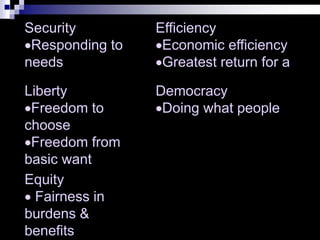
Security
Responding to
needs
Efficiency
Economic efficiency
Greatest return for a
Liberty
Freedom to
choose
Freedom from
basic want
Democracy
Doing what people
Equity
 Fairness in
burdens &
benefits
By the Best Possible means
 Public policymaking aims not only at
achieving what is in ‘the public interest’ but
at doing so by the best possible means.
 Public policy aims at achieving the maximum
net benefit – public interest achieved less
cost of achievement.
 Benefits and costs take in part the form of
realised values and impaired values and
cannot in most cases be expressed in
commensurable units.
 Therefore quantitative techniques cannot
often be used.
 Qualitative significance of ‘maximising net
benefit’ as an aim nor the necessity to think
about alternative public policies in terms of
benefits and costs is important.
 The interdependence between ends and
means is most important.
 Often ends that is both operational and general
values (though perhaps not final value) change
because of innovation in means. E.g. when it
was recognised that science has the potential it
came to be accepted that it is possible to
eliminate poverty.
 More crucially a less direct but important
relationship between means and ends
depends upon the implications for power of
change in means.
 When means change, power distribution
often changes so that to some degree
different ends are stipulated for policy making
and different values motivate the components
of the policymaking system.
Policy Content
Policies are typically promulgated through
official written documents
 A purpose statement, outlining why the
organization is issuing the policy, and what
its desired effect is.
 A applicability and scope statement,
describing who the policy affects and
which actions are impacted by the policy.
The applicability and scope may expressly
exclude certain people, organizations, or
actions from the policy requirements
 An effective date which indicates when the
policy comes into force. Retroactive policies
are rare, but can be found.
 A responsibilities section, indicating which
parties and organizations are responsible for
carrying out individual policy statements.
These responsibilities may include
identification of oversight and/or governance
structures.
 Policy statements indicating the specific
regulations, requirements, or modifications
to organizational behavior that the policy is
creating
Some policies may contain additional sections,
including
 Background indicating the reasons and
history that led to the creation of the policy,
which may be listed as motivating factors
 Definitions, providing clear and unambiguous
definitions for terms and concepts found in the
policy document.
Some Terminology
Policy Demand
 Demands or claims made upon public officials by
other actors, private or official, in the political
system for action or inaction on some perceived
problem.
 These demands can range from a general
insistence that government ought to do something
to a proposal for specific action on the matter.
 Demands that help give rise to public policy and
which it is designed to satisfy are important items
for consideration in the study of public policy.
Policy Decisions.
 Decisions made by public officials that
authorise or give directions and content to
public policy actions.
 Included are decisions to enact statutes, issue
executive orders or edicts, promulgate
administrative rules, or make important judicial
interpretations of law.
 Such decisions may be contrasted with the
large numbers of relatively routine decisions.
Policy Statement
 Formal expressions or articulations of public
policy.
 Included are legislative statutes, executive
orders and decrees, administrative rules and
regulations, and court opinions as well as
statements and speeches by public officials
indicating the intentions and goals of
government and what will be done to realise
them.
 Policy statements are sometimes ambiguous.
 Seen from the conflicts that arise over the
meaning of statutory provisions or judicial
holdings or the time and effort expended
analysing and trying to divine the meaning of
policy statements made by national leaders.
 At another level different levels, branches or
units of government may issue conflicting
policy statements.
Policy Outputs
 Tangible manifestations of public policies the
things actually done in pursuance of policy
decisions and statement.
 Policy outputs are what a government does, as
distinguished from what it says it is going to do.
 An examination of policy outputs may indicate
that policy in actuality is somewhat or greatly
different from what policy statements indicate it
should be.
 Many laws go entirely unenforced.
Policy Outcome
 The consequences for society, intended or
unintended, that flows from action or inaction by
government.
 It is fairly easy to measure welfare policy
output – amount of benefits paid, average level
of benefits, number of people aided, and the
like.
 But what are the outcomes of these actions.
 Do they increase personal security and
contentment?
 Do they reduce individual initiative?
 In the case of aid to families with dependent
children do they have the effect of
encouraging promiscuity and illegitimacy?
 Policies accomplish what they are intended to
accomplish.
Policy Analysis and Policy Advocacy
Explaining the causes and consequences of
various policies is not equivalent to
prescribing what policies governments ought
to follow.
Policy advocacy requires skills of rhetoric,
persuasion, organisation and activism.
Policy analysis encourages scholars and
students to examine critical policy issues with
the tools of systematic inquiry.
Policy analysis involves:
 A primary concern with explanation rather
than explanation.
 A rigorous search for the causes and
consequences of public polices.
 An effort to develop and test general
proposition about the causes and
consequences of public policy and to
accumulate reliable research findings of
general relevance.
Typology of Public
Policy
 Policy addresses the intent of the organization,
whether government, business, professional, or
voluntary. Policy is intended to affect the ‘real’
world, by guiding the decisions that are made.
Whether they are formally written or not, most
organizations have identified policies.
 Policies may be classified in many different
ways. The following is a sample of several
different types of policies broken down by their
effect on members of the organization.
Distributive policies
 Distributive policies extend
goods and services to
members of an organization, as
well as distributing the costs of
the goods/services amongst the
members of the organization.
 Examples include government
policies that impact spending
for welfare, public education,
highways, and public safety, or
a professional organization's
policy on membership training.
Regulatory policies
 Regulatory policies, or
mandates, limit the
discretion of individuals and
agencies, or otherwise
compel certain types of
behavior.
 These policies are generally
thought to be best applied in
situations where good
behavior can be easily
defined and bad behavior
can be easily regulated and
punished through fines or
sanctions.
 An example of a fairly
successful public regulatory
policy is that of a speed
limit.
No Smoking.
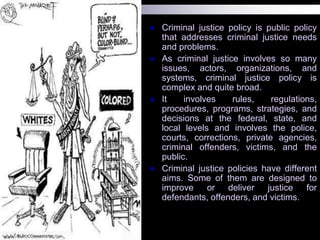
 Criminal justice policy is public policy
that addresses criminal justice needs
and problems.
 As criminal justice involves so many
issues, actors, organizations, and
systems, criminal justice policy is
complex and quite broad.
 It involves rules, regulations,
procedures, programs, strategies, and
decisions at the federal, state, and
local levels and involves the police,
courts, corrections, private agencies,
criminal offenders, victims, and the
public.
 Criminal justice policies have different
aims. Some of them are designed to
improve or deliver justice for
defendants, offenders, and victims.
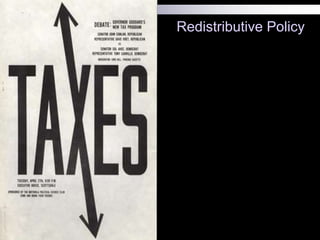
Redistributive Policy
MODELS OF PUBLIC POLICY

12758751.ppt

  • 1.
  • 2.
     Policy Scienceis a comparatively recent discipline.  It primarily emerged in North America and Europe in the post-World War II era.  It is a outcome of the search for new understandings of the relationship between governments and citizens.
  • 3.
     Prior tothat studies of political life tended to focus on the normative or moral dimensions of government or on the minutiae of the operation of the operation of specific political institutions.  Recognition of the increasing gap between prescriptive political theory and the political practice of modern state led many to search for another method of examining politics.
  • 4.
     Similarly, scholarsinterested in the institutions of government had been conducting empirical examination of legislature, courts and bureaucracies while generally ignoring the normative aspects of these institutions. – failed to the basis for evaluation  In the post world war era due to decolonization, the reconstruction of war-torn states and eth establishment of new institutions of international governance – students of politics sought new approach
  • 5.
    The desire wasfor a new approach that would blend their studies with question of  justice,  Equity  Pursuit of social, economic and political development
  • 6.
     Harold Lasswelland others expected Policy Sciences to replace traditional political studies, integrating the study of political theory and political practices without falling into the sterility of formal legal studies.  Lasswell proposed that the policy science had three distinct characteristics :  Multi-disciplinary  Problem Solving  Explicitly Normative – not cloaked in the guise of scientific objectivity
  • 7.
     However, thepassage of time has led to some changes in the three specific components of the policy orientation  First - While emphasis on multi-disciplinary approach remains, policy science is much more a discipline by itself with a unique set of concepts, concerns, and a vocabulary and terminology all of its own.
  • 8.
     Second thevirtually exclusive concern of many policy makers with concrete problem solving has waned as government often proved intractable and resistant to expert advice.  The call for policy sciences to remain explicitly normative also changed over time. Yet, most policy scholars have refused to exclude values from their analysis and have insisted upon evaluating both the goals and the means of policy. More emphasis of late on efficiency or effectiveness in achieving stated goals.
  • 9.
     Question ofassociating policy sciences with an era of unrealised hopes and expectations for social engineering and government planning.  This criticism is to some extent justified and should serve as a warning against premature or ill founded prescriptions or excessive conceptual sophistry.  However, this should not be taken as a rejection of the need to undertake systematic study of government actions.
  • 10.
  • 11.
    Thomas Dye definespublic policy as “Anything a Government chooses to do or not to do”.  This formulation is perhaps too simple and fails to provide the means for conceptualising public policy.  It would include as public policy every aspect of governmental behaviour from purchasing or failing to purchase paper clips to waging or failing to wage nuclear war.  Further there might be a divergence between what governments decide to do and what they actually do.
  • 12.
    Contributions of Dye’sdefinition  First, Dye specifies clearly that the agent of public policy making is a government.  Second, Dye highlights the that public policies involve a fundamental choice on the part of governments to do something or to do nothing. This includes ‘non-decision’.
  • 13.
     Carl Friedrichdefines public policy as “ … a proposed course of action of a person, group, or government within a given environment providing obstacles and opportunities which the policy was proposed to utilize and overcome in an effort to reach a goal or realise an objective or a purpose.”  Friedrich adds the requirement that policy is directed toward the accomplishment of some purpose or goal. Goal and purpose may not always be easy to discern.
  • 14.
     William Jenkinsdefines public policy as “ a set of interrelated decisions taken by a political actor or group of actors concerning the selection of goals and the means of achieving them within a specified situation where those decisions should, in principle, be within the power of those actors to achieve.”  Jenkins views public policy as a process unlike Dye who defines it as a choice (which presumes the existence of an underlying process but does not state that explicitly.
  • 15.
     Jenkins alsoexplicitly acknowledges that public policy is a ‘set of interrelated decisions”.  Jenkins also improves upon Dye by suggesting that the question of a government’s capacity to implement its decisions is also significant. Internal and external constraints on government make public policy difficult.
  • 16.
     Jenkins alsointroduced the idea of public policy making as goal-oriented behaviour on the part of the Government, an idea which provides a standard by which to evaluate public policies.  This says nothing about the nature of the goals or the means to achieve it provides several avenues for evaluating policies which are missing from Dye’s definition.  These include the relevance of the goal, the congruence of the goals and means and the degree to which means succeed in reaching the goals.
  • 17.
     James Andersondefines public policy as “a purposive course of action followed by an actor or a set of actors in dealing with a problem or matter of concern”.  Two important additions namely :  it notes that policy decisions are often taken by sets of actors rather than a sole set or actor within a government. Policies are often the result of not only multiple decisions but of multiple decisions taken by multiple decision makers
  • 18.
     Anderson’s definitionhighlights the link between government action and the perception, real or otherwise, of the existence of a problem or concern requiring action.
  • 19.
     All illustratethat studying public policy is a complex task because  Mere description is not sufficient.  Dependence on government record does not provide information about potential choices or choices not made.  Records of decisions do not reflect the unencumbered will of government decision makers.
  • 20.
     It wouldbe well to spell out some of the implications of our concept of public policy.  These are purposive and goal oriented rather than random or chance behaviour.  Policy consists of courses or pattern of action by governmental officials rather than their separate discrete decisions.  Policy is what governments actually do in regulating trade, controlling inflation, or promoting public housing not what they intend to do or say they are going to do.
  • 21.
     Public Policymay be either positive or negative.  Positive may involve some form of overt government action to affect a particular problem,  Negatively, it involves a decision by government officials not to take action or to do nothing.  Public policy, at least in its positive form, is based on law and is authoritative. Members accept it as legitimate.
  • 22.
     The specialcharacteristics of public policies stem from the fact that they are formulated by what David Easton has called the ‘authorities’ in a political system namely elders,  paramount chiefs,  executives,  legislators,  judges,  administrators,  councillors,  monarchs and the like.
  • 23.
  • 24.
    Very Complex  policymaking involves many components which are interconnected by communication and feedback loops and which interact in different ways.  Some parts of the process are explicit and directly observable, but many others proceed by hidden channels and even actors themselves are often partly aware of.  Series of single decisions that result in a policy without any one of the decision makers being aware of that process.
  • 25.
    Dynamic Process Policy makingis a process, that is, a continuous activity taking place within a structure. To be sustained it requires a continuing input of resources and motivation. It is a dynamic process, which change with time. The sequence of its sub processes and phases vary internally and with respect to each other.
  • 26.
    Various Component  Nearlyall public policymaking involves a great variety of substructures.  The identity of these substructures, and degree of their involvement in policymaking vary among different issues, times and societies. E.g.. the role of President, Legislature, role of Military elite.  The substructure most involved in policy making constitute the ‘political institutions’ or ‘political system’ of a society.
  • 27.
     Make DifferentContributions  Every substructure makes a different and sometimes unique contribution to public policy.  What sort of contribution substructures make depends in part on their formal and informal characteristics which vary from society to society. For instance –
  • 28.
    Representative Parliament : sensitive topublic opinion and pressure groups is low or medium on ‘expertness’, takes short or medium range points of view and shows low or medium Merit- Selected Civil Service : Moderately insensitive to public opinion and pressure groups, has a high level of expertness, takes a medium range and sometimes longer points of view and shows medium or high consistency in its decisions.
  • 29.
    Courts : Highlyinsensitive to public opinion and pressure groups, have a high level of limited legal expertness, take short- or medium range point of view, and show high or very high consistency in their decisions.
  • 30.
    Decides  Policymaking isa species of decision making.  Lets us use decision making models for dealing with policy making.  Yet important to remember that public policy making is an aggregative form of decision making and differs in important respects from the discrete decisions that most decision- theory literature deals with.
  • 31.
    Major guidelines  Publicpolicy, in most cases, lays down general directives rather than detailed instructions, on the main lines of action to be followed.  It is thus not identical with the game-theory definition of strategy as a detailed set of decisions covering all possible situations.  After main lines of action have been decided on detailed sub-policies that translate the general policy into concrete terms are usually needed.
  • 32.
    General policy isbuilt up by a complex, interacting set of secondary policies and decisions In many cases these two flows of decision making from top down and from the bottom up, proceed simultaneously and even partly overlap; Policy is partly formed and partly executed by the same sub-decisions.
  • 33.
     E.g., ifa developing country has declared a policy “to encourage all private investment”  Day-to-day decision making provides incentives mainly to private investment in heavy industry.  This results in an actual policy of “encourage private investment mainly in heavy industry”.  This results from high level decisions interacting with middle-level operational decisions.
  • 34.
     How specificor general a public policy seems to be depends on differing conditions.  The same process can often be viewed from higher level as execution of a policy by sub-decisions, and from a lower level as policy- making.  This ambiguity makes it impossible to draw clear lines between ‘policymaking’, ‘policy execution’ and ‘administration’.
  • 35.
    For Action  Decisionmaking can result in external action, in changes in the decision maker himself, or in both or neither.  The policies of most socially significant decision making, such as most public policymaking, are intended to result in action.  Also policies directed at the policymaking apparatus itself, such as efficiency drives in government, are action-oriented.
  • 36.
     A specialcase is policies whose intent is to have someone other than the policymaker take action.  E.g., aggressive declaration against an unpopular neighbour may be intended to make an internal population render support to the policymakers.  Another special case is policies directed to prevent action by an adversary (deter aggression), mislead opponent, reassure partner, trial balloon the will test reaction or feel good.
  • 37.
    Directed at thefuture  Policy making is directed at the future. This is one of the most important characteristics since it introduces the ever-present elements of uncertainty and doubtful prediction that establish the basic tone of nearly all policy making.  Policy makers tend to formulate policies in vague and elastic terms; to be continuous, to seek defensibility (often incremental) and not to make any policy about many issues.
  • 38.
    Mainly by GovernmentOrgans  One of the main difference between making private policy and making public policy is that the latter mainly concerns actions to be taken by governmental organs.  Of course, this is a matter of degree – public policy can also be directed in part at private persons and non-governmental structures, as when it calls for prohibiting a certain type of behaviour or appeals to citizens to save.
  • 39.
    Formally aims atachieving  One characteristic of all contemporary political systems is that their formal aim is to achieve what is in public interest. What is in the public Interest  Always difficult to define- nevertheless convey the idea of general as against sectoral  Held in good faith by policy makers.
  • 40.
    Security Responding to needs Efficiency Economic efficiency Greatestreturn for a Liberty Freedom to choose Freedom from basic want Democracy Doing what people Equity  Fairness in burdens & benefits
  • 41.
    By the BestPossible means  Public policymaking aims not only at achieving what is in ‘the public interest’ but at doing so by the best possible means.  Public policy aims at achieving the maximum net benefit – public interest achieved less cost of achievement.
  • 42.
     Benefits andcosts take in part the form of realised values and impaired values and cannot in most cases be expressed in commensurable units.  Therefore quantitative techniques cannot often be used.  Qualitative significance of ‘maximising net benefit’ as an aim nor the necessity to think about alternative public policies in terms of benefits and costs is important.
  • 43.
     The interdependencebetween ends and means is most important.  Often ends that is both operational and general values (though perhaps not final value) change because of innovation in means. E.g. when it was recognised that science has the potential it came to be accepted that it is possible to eliminate poverty.
  • 44.
     More cruciallya less direct but important relationship between means and ends depends upon the implications for power of change in means.  When means change, power distribution often changes so that to some degree different ends are stipulated for policy making and different values motivate the components of the policymaking system.
  • 45.
  • 46.
    Policies are typicallypromulgated through official written documents  A purpose statement, outlining why the organization is issuing the policy, and what its desired effect is.  A applicability and scope statement, describing who the policy affects and which actions are impacted by the policy. The applicability and scope may expressly exclude certain people, organizations, or actions from the policy requirements
  • 47.
     An effectivedate which indicates when the policy comes into force. Retroactive policies are rare, but can be found.  A responsibilities section, indicating which parties and organizations are responsible for carrying out individual policy statements. These responsibilities may include identification of oversight and/or governance structures.  Policy statements indicating the specific regulations, requirements, or modifications to organizational behavior that the policy is creating
  • 48.
    Some policies maycontain additional sections, including  Background indicating the reasons and history that led to the creation of the policy, which may be listed as motivating factors  Definitions, providing clear and unambiguous definitions for terms and concepts found in the policy document.
  • 49.
  • 50.
    Policy Demand  Demandsor claims made upon public officials by other actors, private or official, in the political system for action or inaction on some perceived problem.  These demands can range from a general insistence that government ought to do something to a proposal for specific action on the matter.  Demands that help give rise to public policy and which it is designed to satisfy are important items for consideration in the study of public policy.
  • 51.
    Policy Decisions.  Decisionsmade by public officials that authorise or give directions and content to public policy actions.  Included are decisions to enact statutes, issue executive orders or edicts, promulgate administrative rules, or make important judicial interpretations of law.  Such decisions may be contrasted with the large numbers of relatively routine decisions.
  • 52.
    Policy Statement  Formalexpressions or articulations of public policy.  Included are legislative statutes, executive orders and decrees, administrative rules and regulations, and court opinions as well as statements and speeches by public officials indicating the intentions and goals of government and what will be done to realise them.
  • 53.
     Policy statementsare sometimes ambiguous.  Seen from the conflicts that arise over the meaning of statutory provisions or judicial holdings or the time and effort expended analysing and trying to divine the meaning of policy statements made by national leaders.  At another level different levels, branches or units of government may issue conflicting policy statements.
  • 54.
    Policy Outputs  Tangiblemanifestations of public policies the things actually done in pursuance of policy decisions and statement.  Policy outputs are what a government does, as distinguished from what it says it is going to do.  An examination of policy outputs may indicate that policy in actuality is somewhat or greatly different from what policy statements indicate it should be.  Many laws go entirely unenforced.
  • 55.
    Policy Outcome  Theconsequences for society, intended or unintended, that flows from action or inaction by government.  It is fairly easy to measure welfare policy output – amount of benefits paid, average level of benefits, number of people aided, and the like.  But what are the outcomes of these actions.
  • 56.
     Do theyincrease personal security and contentment?  Do they reduce individual initiative?  In the case of aid to families with dependent children do they have the effect of encouraging promiscuity and illegitimacy?  Policies accomplish what they are intended to accomplish.
  • 57.
    Policy Analysis andPolicy Advocacy Explaining the causes and consequences of various policies is not equivalent to prescribing what policies governments ought to follow. Policy advocacy requires skills of rhetoric, persuasion, organisation and activism. Policy analysis encourages scholars and students to examine critical policy issues with the tools of systematic inquiry.
  • 58.
    Policy analysis involves: A primary concern with explanation rather than explanation.  A rigorous search for the causes and consequences of public polices.  An effort to develop and test general proposition about the causes and consequences of public policy and to accumulate reliable research findings of general relevance.
  • 59.
  • 60.
     Policy addressesthe intent of the organization, whether government, business, professional, or voluntary. Policy is intended to affect the ‘real’ world, by guiding the decisions that are made. Whether they are formally written or not, most organizations have identified policies.  Policies may be classified in many different ways. The following is a sample of several different types of policies broken down by their effect on members of the organization.
  • 61.
    Distributive policies  Distributivepolicies extend goods and services to members of an organization, as well as distributing the costs of the goods/services amongst the members of the organization.  Examples include government policies that impact spending for welfare, public education, highways, and public safety, or a professional organization's policy on membership training.
  • 62.
    Regulatory policies  Regulatorypolicies, or mandates, limit the discretion of individuals and agencies, or otherwise compel certain types of behavior.  These policies are generally thought to be best applied in situations where good behavior can be easily defined and bad behavior can be easily regulated and punished through fines or sanctions.  An example of a fairly successful public regulatory policy is that of a speed limit.
  • 63.
  • 66.
     Criminal justicepolicy is public policy that addresses criminal justice needs and problems.  As criminal justice involves so many issues, actors, organizations, and systems, criminal justice policy is complex and quite broad.  It involves rules, regulations, procedures, programs, strategies, and decisions at the federal, state, and local levels and involves the police, courts, corrections, private agencies, criminal offenders, victims, and the public.  Criminal justice policies have different aims. Some of them are designed to improve or deliver justice for defendants, offenders, and victims.
  • 67.
  • 68.