What is Poka-Yoke?
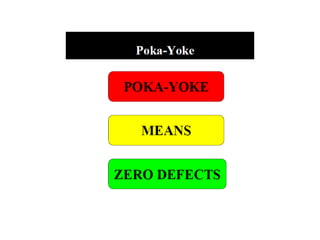
• This is known as ‘MISTAKE-PROOFING’
• From Japanese:
• Yokeru (avoid)
• Poka (inadvertent errors)
What Does Poka-Yoke Do?
• Eliminates the cause of an error at the
source;
• Detects an error as it is being made;
• Detects an error soon after it has been
made but before it reaches the next
operation.
Are Errors Unavoidable?
• There are two approaches to dealing with
errors:
• 1. ERRORS ARE INEVITABLE!
• 2. ERRORS CAN BE ELIMINATED!
1. Errors Are Inevitable
• People always make mistakes.
• While we accept the mistakes as natural, we
blame the people who make them.
• With this attitude, we are likely to overlook
defects as they occur in production.
• They may be detected at final inspection, or
worse still, by the customer.
2. Errors Can Be Eliminated
• Any kind of mistake people make can be
reduced or even eliminated.
• People make fewer mistakes if they are
supported by proper training and by a
production system based on the principle
that errors can be avoided.
Inspection
• One method of detecting errors is
inspection.
• There are two major types of inspection.
• 1. SAMPLING INSPECTION.
• 2. 100% INSPECTION.
1.Sampling Inspection
• In some factories, the attitude is:
“It may take all day to inspect all product”.
• “There may be a few defects, but sampling is the most
practical way to check”.
Sampling Inspection - Reflection
• Think about sampling.
• With sampling, there is a chance that an error may go
undetected.
• Even if 1 part in 1000 is defective, the customer who
buys that part has a 100% defective product!
Sampling Inspection - Reflection
• Think about sampling.
• With sampling, there is a chance that an error may go
undetected.
• Even if 1 part in 1000 is defective, the customer who
buys that part has a 100% defective product!
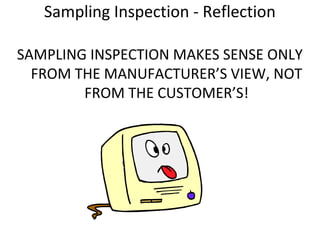
SAMPLING INSPECTION MAKES SENSE ONLY
FROM THE MANUFACTURER’S VIEW, NOT
FROM THE CUSTOMER’S!
Sampling Inspection - Reflection
2. 100% Inspection
• In the best factories, the attitude is:
• “We won’t tolerate a single defect!”
• “We will organize production so that 100%
of the product can be easily inspected”.
• “That makes the most sense”.
The User is Best Inspector
Two Strategies for Zero Defects
1. DON’T MAKE IT!
1. Don’t Make It!
 Don’t make product you don’t need.
 The more you make, the greater the opportunity for defects.
 Follow ‘just-in-time’ principles by only making what is
needed, when it is needed in the amount needed.
Two Strategies for Zero Defects
2. Build Safeguards
The user is an expert in finding defects.
Therefore build safeguards into the production
process.
Quality can be built into products by implementation
of Poka-Yoke.
Poka-Yoke Devices
Human errors are usually inadvertent.
Poka-yoke devices help us avoid
defects, even when inadvertent errors are
made.
Poka-yoke helps build quality into
processes.
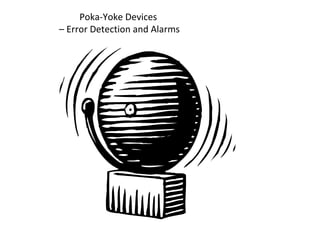
Poka-Yoke Devices
– Error Detection and Alarms
Poka-Yoke Devices
– Checklists
Poka-Yoke Example
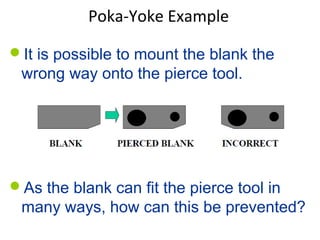
It is possible to mount the blank the
wrong way onto the pierce tool.
As the blank can fit the pierce tool in
many ways, how can this be prevented?
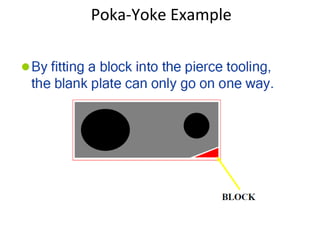
Poka-Yoke Example
Poka yoka

Poka yoka

  • 2.
    What is Poka-Yoke? •This is known as ‘MISTAKE-PROOFING’ • From Japanese: • Yokeru (avoid) • Poka (inadvertent errors)
  • 3.
    What Does Poka-YokeDo? • Eliminates the cause of an error at the source; • Detects an error as it is being made; • Detects an error soon after it has been made but before it reaches the next operation.
  • 4.
    Are Errors Unavoidable? •There are two approaches to dealing with errors: • 1. ERRORS ARE INEVITABLE! • 2. ERRORS CAN BE ELIMINATED!
  • 5.
    1. Errors AreInevitable • People always make mistakes. • While we accept the mistakes as natural, we blame the people who make them. • With this attitude, we are likely to overlook defects as they occur in production. • They may be detected at final inspection, or worse still, by the customer.
  • 6.
    2. Errors CanBe Eliminated • Any kind of mistake people make can be reduced or even eliminated. • People make fewer mistakes if they are supported by proper training and by a production system based on the principle that errors can be avoided.
  • 7.
    Inspection • One methodof detecting errors is inspection. • There are two major types of inspection. • 1. SAMPLING INSPECTION. • 2. 100% INSPECTION.
  • 8.
    1.Sampling Inspection • Insome factories, the attitude is: “It may take all day to inspect all product”. • “There may be a few defects, but sampling is the most practical way to check”. Sampling Inspection - Reflection • Think about sampling. • With sampling, there is a chance that an error may go undetected. • Even if 1 part in 1000 is defective, the customer who buys that part has a 100% defective product!
  • 9.
    Sampling Inspection -Reflection • Think about sampling. • With sampling, there is a chance that an error may go undetected. • Even if 1 part in 1000 is defective, the customer who buys that part has a 100% defective product!
  • 10.
    SAMPLING INSPECTION MAKESSENSE ONLY FROM THE MANUFACTURER’S VIEW, NOT FROM THE CUSTOMER’S! Sampling Inspection - Reflection
  • 11.
    2. 100% Inspection •In the best factories, the attitude is: • “We won’t tolerate a single defect!” • “We will organize production so that 100% of the product can be easily inspected”. • “That makes the most sense”.
  • 14.
    The User isBest Inspector
  • 16.
    Two Strategies forZero Defects 1. DON’T MAKE IT! 1. Don’t Make It!  Don’t make product you don’t need.  The more you make, the greater the opportunity for defects.  Follow ‘just-in-time’ principles by only making what is needed, when it is needed in the amount needed.
  • 17.
    Two Strategies forZero Defects 2. Build Safeguards The user is an expert in finding defects. Therefore build safeguards into the production process. Quality can be built into products by implementation of Poka-Yoke.
  • 18.
    Poka-Yoke Devices Human errorsare usually inadvertent. Poka-yoke devices help us avoid defects, even when inadvertent errors are made. Poka-yoke helps build quality into processes.
  • 19.
    Poka-Yoke Devices – ErrorDetection and Alarms
  • 20.
  • 21.
    Poka-Yoke Example It ispossible to mount the blank the wrong way onto the pierce tool. As the blank can fit the pierce tool in many ways, how can this be prevented?
  • 22.